After eight months of saving and planning, I drove fourteen hours to claim the Montana
Part 2: Her fake title hides a history inside my property’s records
I called my real estate attorney as soon as I reached the highway. I asked him to investigate Deborah Caldwell and an organization called the Clearwater Conservation Committee. Then I stopped at a motel, spread a county map across the bed, and began reading everything I could find. I had not bought Forest Ridge because I was wealthy or looking for a new business empire. I had spent years saving for a place I could renovate, rent on weekends, and eventually call home.
The lodge sat in a quiet stretch of forest, far from the public road, and had been vacant for three years. My plan was to make the cabin safe and comfortable, repair what time had worn down, and let the forest remain what it was. Deborah’s online profile claimed she had spent seven years protecting the surrounding land. The dates did not match the history of the lodge, and the mismatch bothered me. I wrote the claim down beside the date she had changed my locks.
Two days later, a post about me began spreading through a local online group called Protect Clearwater Nature. Deborah had published a photograph of me standing in front of the lodge, darkening the sky and shooting from a low angle that made me look like an intruder. The caption called me an out-of-state speculator trying to seize sacred forest for a commercial resort. Thousands of members saw the accusation; people who had never spoken with me filled the comments with demands that I be removed. I read every comment and answered none of them.
Instead, I searched the Montana business registry. The Clearwater Conservation Committee, the Clearwater Residence Council, and the alliance named on Deborah’s letterhead did not appear as recognized organizations. But another result did: Clearwater Natural Heritage Alliance LLC, registered in 2019, with Deborah Anne Caldwell listed as its agent. The registered address was Forest Ridge Lodge. My house had been serving as the official headquarters for her organization for five years without my knowledge or the previous owner’s. Deborah had not simply taken the lock; she had been living inside my property records long before I arrived.
Part 3: A hidden road reveals what the conservation campaign concealed
I rented a plain gray pickup with no Denver plates and approached my property from a forestry access road to the north. I parked two miles away and walked in with a telephoto camera, a handheld GPS unit, and sample bags I had bought in Missoula. Satellite images showed a patch of forest where the canopy had thinned in a pattern that looked nothing like a natural die-off. After forty minutes, I found a road beneath the trees, four meters wide and packed with gravel and crushed stone. Its carefully built drainage and compacted surface told me it was designed for heavy vehicles, not hikers.
I photographed the route and marked its coordinates. At three locations, I collected soil samples, then noticed a sharp chemical smell under the pine needles and damp earth. I could not identify it in the field, so I flagged the area and gathered more samples. On my way back, I stopped at a local hardware store and asked the cashier, Marcus, about recent bulk orders. He said a conservation group had been buying gravel, structural aggregate, and drainage pipe for months.
Marcus printed three months of receipts. I sat in the parking lot and studied the invoices, realizing that materials purchased with conservation funds might have been used to build a private haul road through protected federal forest. The outline was becoming difficult to dismiss. That night, I found the front tire of my rental truck slashed cleanly across the sidewall. Someone had folded in the driver-side mirror, and two hours later an unknown number texted: You should go back to Denver. This forest doesn’t treat outsiders well.
I saved the message, drove two hours to buy cameras with solar batteries and cloud storage, and returned after dark. I positioned four cameras near the entrance, northwest corner, driveway, and front parking area. I placed a GPS tracker beneath Deborah’s moss-green SUV while it sat unattended. Then I waited. On the third night, at a.m., a commercial timber truck arrived without a visible front plate and with its headlights dimmed.
Deborah came out of the lodge within two minutes, as if she had been waiting for the truck. Two figures emerged from the trees and met her near the tailgate. The exchange lasted about twenty-five minutes before the truck reversed toward the hidden road. My perimeter recorder caught fragments of a call afterward: “Next shipment before Friday” and “The Alliance account is ready.” I watched the footage six times, not because I doubted what I had seen, but because I wanted to be certain before I told anyone.
Part 4: Soil tests and grant records turn suspicion into federal evidence
The independent laboratory in Missoula identified elevated concentrations of imazapyr, a broad-spectrum herbicide used in commercial forestry. It can suppress competing vegetation after a harvest, but its use was prohibited in the federally designated conservation zone around the lodge. Whoever had been cutting the trees had also been trying to keep the forest from growing back. I searched the federal grant database for Deborah’s alliance and found three awards: $110,000 from the Department of the Interior in 2020, $90,000 from the EPA in 2021, and another $140,000 from Interior in 2023. The total was $340,000 for conservation work.
I called the Interior Department’s Inspector General hotline and was transferred twice before reaching Special Agent Rachel Huang at the FBI’s Helena field office. She specialized in environmental fraud and federal grant abuse. I gave her the dates, the dollar amounts, the coordinates, the satellite comparisons, the lab report, the hardware receipts, and the camera footage. She listened without interrupting. Then came four seconds of silence before she said, “Mr. Collins, preserve everything exactly as it is and discuss this with no one.”
I understood what she meant without needing her to explain. Sergeant Puit’s name was already written on my legal pad, circled twice. For the next three weeks I said almost nothing in public, gave no interviews, and attended no community hearings. To Deborah, I probably looked exhausted, stalled, and uncertain whether the lodge was worth the fight. That was the impression I wanted her to have. While I kept still, Agent Huang’s team began a forensic audit of the alliance’s accounts.
Investigators traced $210,000 of the grant money through seven invoices labeled “environmental consulting.” The recipient companies were LLCs with no real addresses, employees, or work histories. Each one led back to accounts Deborah controlled. Forest Service agents independently confirmed that 340 mature ponderosa pines and western larches had been harvested from federal land without a permit. At current timber prices, the trees were worth about $180,000. Before the environmental damage was fully calculated, the financial exposure already exceeded half a million dollars.
Then Deborah made a mistake that expanded the case. As her cash flow tightened, she created an emergency conservation management agreement bearing what appeared to be the seal and signature of the Bureau of Land Management’s Clearwater Field Office. She took it to a regional bank and applied for an $80,000 commercial loan. The bank’s compliance officer noticed that the seal did not match federal standards and contacted the FBI within an hour. The loan was never approved. Instead, the document became a new exhibit in the federal investigation.
Part 5: Deborah turns a community forum into her own public trap
The invitation arrived through the community email list on a Tuesday morning. Deborah had scheduled an emergency public forum for Saturday evening at Ridgefield Community Hall. The agenda said I would present my development plans for open community review, although I had never announced any development plans. It was a trap disguised as a chance for me to explain myself. I accepted within twenty minutes and called Agent Huang that afternoon. She said her team had been anticipating a public event and would be positioned accordingly.
I arrived alone, carrying a thin manila folder. I sat in the third row and spoke to no one. At , Deborah took the stage in a green alliance jacket, her silver hair arranged with precision. She thanked the crowd for coming to defend what belonged to everyone. The applause came quickly. She opened a professionally bound binder of forty-seven pages and began describing years of environmental work, showing photographs, letters, and images she presented as proof of her dedication.
The third section was supposed to establish her legal authority over Forest Ridge Lodge. On page twenty-three, she projected a contract for a timber harvest along the northeast corridor of Clearwater Forest. It was signed by Deborah on behalf of the alliance and dated spring 2022. The agreement with Pacific Northwest Timber Partners LLC was valued at $220,000. The room fell quiet. A man in the third row raised his hand and pointed out that the contract on the screen was for selling timber, not protecting it.
A retired Forest Service worker stood next. He recognized the timber company and said it had no valid extraction permit in Clearwater County. The murmurs changed from agreement to alarm. I rose and waited until Deborah met my eyes. “Page thirty-one,” I said evenly. “Show them page thirty-one.” Her hand paused above the laptop. Perhaps she did not understand what I meant, or perhaps she simply could not process the possibility that I knew what she had placed in the binder.
She advanced the slide. A bank transfer appeared on the screen: $47,000 from the alliance’s operating account to a personal account registered in Deborah’s name. The memo line read “management consulting fee.” The room made a sound that was part gasp, part question. Deborah opened her mouth, but for the first time since I had met her, she had no prepared sentence ready. Then the back doors opened, and I heard several people moving together with the measured purpose of a coordinated team.
Part 6: Federal agents arrive while Deborah’s own binder stays on screen
Agent Huang entered first, badge displayed at chest level, followed by three other federal agents and two IRS Criminal Investigation officers in civilian clothes. Nearly two hundred people turned to look as they walked down the center aisle. Huang stopped beside the stage and introduced herself as an FBI special agent from the Helena field office. She told Deborah to remain where she was. Then she began reading the federal charges connected to the evidence in the room.
The allegations included federal grant fraud involving $340,000, unauthorized harvesting of federal forest resources, falsification of federal documents, bank fraud, and money laundering. The potential penalties were substantial, and financial penalties could reach $1.75 million. Deborah turned toward the audience she had spent years cultivating. “I have given seven years to protecting this land,” she said, still reaching for the authority she had used to control every meeting. “Everything I did was for this community.”
Huang waited for Deborah to finish. Then she pointed out that the binder she had presented contained a central evidentiary exhibit in the case. It had been displayed in a public room, before witnesses, by the person whose signature appeared on its documents. The handcuffs closed behind Deborah’s wrists at p.m. She was escorted through the back door past residents who had arrived expecting to watch me answer for my supposed crimes. Instead, they watched the woman they trusted face the consequences of what she had done in their name.
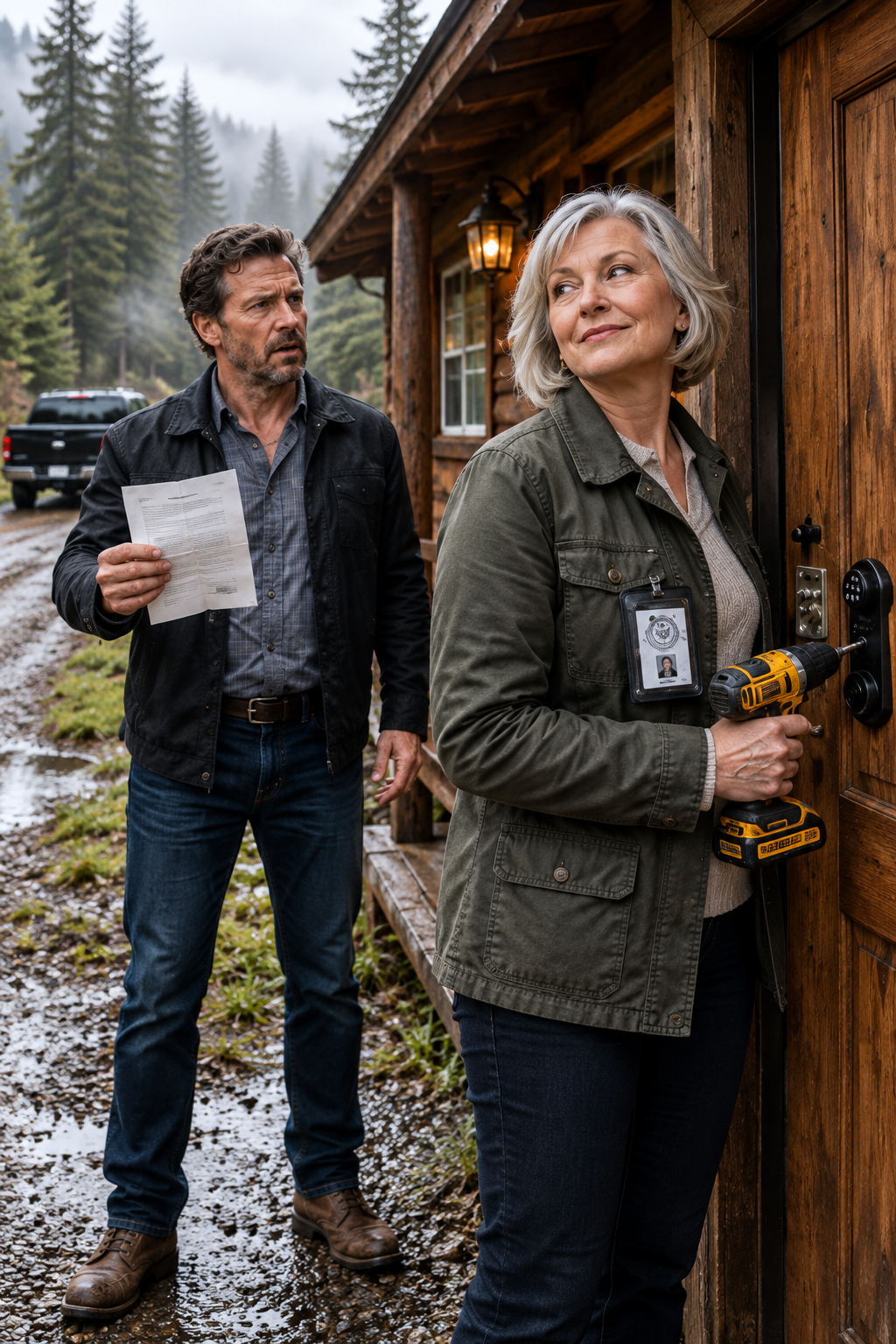
The following morning, I drove to the lodge alone. There was no moss-green SUV across the entrance and no drill cutting through the fog. I parked in front of my own door, took out the key my locksmith had installed, and turned it. The door opened into a space that smelled of old wood, cold air, and the particular silence of a building that had waited a long time for its rightful owner. Through an east-facing window, I could see a federal ecological restoration crew moving among the stumps with seedlings.
The forest had been harvested, but the work of returning it had begun. I stepped inside and let the door close behind me. For months, every hour had produced another fact to record or another record to verify. Now, for the first time, I had nothing left to document at the lodge. It was not a perfect ending; trees do not grow back overnight, and an investigation takes longer than a public arrest. But the first thing I had come for was finally true: I was home.
Part 7: The forest begins to recover as the investigation continues
The weeks after Deborah’s arrest did not unfold like a neat conclusion. Federal agents still needed the original files, and the lab had to verify how each soil sample had been collected. The hardware receipts required confirmation from the store, and the timber records had to be compared against federal land boundaries. The alliance’s books did not become simple just because a suspect had been arrested. Every account led to another invoice, another company name, or another person who had signed off on a payment.
Agent Huang’s team told me little about the case, and I did not ask for details they could not share. My task was to preserve the copies I had, answer questions accurately, and avoid turning suspicion into certainty before investigators finished their work. My attorney helped me document the change of locks and the days I had been denied entry. I did not try to confront Sergeant Puit in public. I gave the FBI the facts I had observed and let them determine whether his conduct belonged in the larger case.
The county moved to secure the lodge records and investigate how Deborah’s company had used the address. My name had never been on the alliance’s filings, but the business address attached to the property could still create confusion for lenders, vendors, and government agencies. My attorney contacted the relevant offices and supplied the deed and closing documents. The county confirmed that I owned the lodge and had not authorized the alliance to use it. Each correction was small, but it helped separate my home from the organization Deborah had built around it.
The restoration crew worked along the northeast corridor where the harvest had been most severe. They set out native seedlings in the openings and tested soil near the areas treated with herbicide. The first time I watched them from the edge of the property, I felt anger return with unexpected force. I thought of the mature trees that had taken generations to grow and the truck leaving under dim headlights. Then one of the crew members stopped to protect a fragile seedling from a boot print. It was a small act, but it reminded me that restoration began with care, not spectacle.
I began repairing the lodge one room at a time. The front door needed a stronger frame, and the lock had to be replaced again after the earlier damage. I cleaned the old kitchen, checked the plumbing, and made a list of repairs before purchasing anything unnecessary. The plans I had made in Denver returned slowly: a comfortable weekend rental first, then a permanent home when I was ready to leave the city. I did not know when that would be. For now, every improvement was something I chose for myself.
Part 8: A false authority loses its grip while a real home takes shape
I never learned every detail of what happened behind the alliance’s accounts. Investigators handled the financial records, the grant reimbursements, and the timber sales. I only knew that the evidence had grown beyond what I had first found beneath the trees. The herbicide, the timber contract, the false BLM document, the consulting invoices, and the transfer to Deborah’s personal account had all come from separate sources. Together, they created a pattern that could not be dismissed as a misunderstanding over land or a disagreement about conservation.
In the community, people began reconsidering what they had believed. Some apologized for sharing Deborah’s post; others admitted they had accepted her title without asking which government agency employed her. A few had thought the lodge belonged to the alliance because its address had appeared on official-looking materials. I did not demand apologies from anyone. I understood that confident authority could influence people, especially when it wore a badge and spoke in the language of public good. But I also hoped they would remember to ask for evidence next time.
The lodge became a weekend rental the following year, though I continued spending more time there than I had planned. Guests came for the quiet, the trees, and the long trail that led toward the ridge. I left a small notebook on the entry table with practical information about the property, not a dramatic account of the investigation. The people who stayed there did not need to inherit the conflict. They needed to know where the trail was safe, where the forest was being restored, and how to leave the land as they found it.
The federal restoration crew returned through the seasons. Seedlings that had looked almost too small to survive began putting out new growth. Areas where the soil had been disturbed remained bare longer, and the team monitored them for signs of recovery. I learned that restoration was not a single operation but a commitment to return and check what had changed. That lesson applied to more than trees. The public’s trust had been damaged too, and no one could repair it with one speech or one arrest.
A year after the forum, I stood at the same door Deborah had once changed the locks on and watched morning fog lift from the forest. My key turned cleanly. The deed was still in the safe, the official address records had been corrected, and the cameras now captured deer crossing the clearing instead of trucks arriving in the dark. I thought about how quickly an official-sounding title had nearly kept me from entering a home I had paid for. Then I heard a bird call from the new growth and went inside to make coffee.
I had driven fourteen hours expecting to begin a renovation. Instead, I had uncovered a scheme hidden behind the language of conservation and community protection. Deborah had tried to control the story by deciding who could enter, what the public believed, and which records people were allowed to question. Her own binder, her own signature, and her own presentation had helped expose the truth. I had not needed to shout over her. I had needed to keep looking, preserve what I found, and bring it to the people whose job was to investigate. The forest was recovering, the lodge was mine, and the door opened when I used my key.
✓ Lynn R. Adams
Part 2: Her fake title hides a history inside my property’s records I called my real estate attorney as soon as I reached the highway. I asked him to investigate Deborah Caldwell and an organization …