After AI erased most of my design work and I bought a forgotten Montana cabin for a $91 auction bid, I thought I had finally found a roof I could call my own, until a tin box fell from the loft insulation and I discovered an old family photograph beside a note naming a woman I had never met…
I climbed down from the loft with the tin in my hands, but I couldn’t make myself stop searching. Beneath a runner in the narrow hallway, one floorboard sat slightly higher than the others. I pried it up with my car key and found a shallow compartment.
There was a yellowed 1961 plat map of the valley, a land-transfer contract dated January 1962, and a small leather notebook. The contract showed Cornelius Kinley selling twelve acres and the cabin to Ellis Thornberry for $600; Cornelius’s signature looked shaky, as though someone might have guided his hand. I wasn’t qualified to call it fraud, but I knew I shouldn’t ignore it.
The notebook belonged to Esteban Vollmer. From 2013 until shortly before his death in late 2024, he had recorded questions, names, county references, and dates in the manner of a reporter following a story. On its last page, one sentence stopped halfway through, and I had the unsettling feeling that I’d stumbled into work he hadn’t been able to finish.
I spent the next three days at the Silver Fork library comparing the old map with modern parcel records. The boundaries had changed over time, and the name Kinley appeared again and again. I didn’t go to the sheriff, make accusations online, or tell myself the papers proved something they didn’t.
I asked the gas-station clerk whether anyone named Sabra lived nearby. He didn’t know, but the waitress at the Antler Diner did: Sabra Kinley was a nurse at the community clinic. I put the photograph inside my denim jacket and walked across the street, so nervous I stood outside for a full minute before going in.
Sabra was in her late forties, with her hair neatly tied back and tired eyes that looked painfully familiar from the photograph. She listened as I told her I’d bought Esteban’s cabin and found something she might recognize. When I held out the picture, she stared at it without taking it.
“Where did you get that?” she asked. I explained the tin box, the hidden note, and the name on the paper. Her face tightened instead of softening, and I realized my surprise was not necessarily a gift to the person receiving it.
Her father, she said, had talked about Kinley land until he died. People around Silver Fork had laughed at his stories, and she’d worked hard to build a quiet life for herself and her nine-year-old son. She wasn’t prepared to have a stranger reopen that wound in the clinic lobby.
“Please leave,” she said. I told her I would, but first I asked whether she had known Esteban Vollmer. She had: he’d come for routine checkups and asked gentle questions about her family, and she’d thought he was simply lonely. When I told her he’d written her name, she closed her eyes.
She still asked me to go. I did, carrying the photograph with me. As I left, I remembered the little boy with a baseball glove I’d seen coming out of the clinic and the small scar near his left eyebrow, so like the man’s in the picture that I had stopped in my tracks.
Back at the cabin, I opened Esteban’s notebook again. His earliest entries asked why an original land record listed three Kinley heirs while a later transfer carried only one signature. I found that he’d bought this crumbling house from an estate for $16,000, not because it was comfortable, but because it was the last surviving building on the family’s former homestead.
I didn’t sleep much. Before sunrise, I put a legal pad beside the notebook and made three columns: what Esteban had established, what he suspected, and what was missing. I was frightened of being wrong, especially after seeing what the subject had already cost Sabra’s family.
I drove to the recorder’s office in Lewistown. A clerk named Delphine showed me the old chain-of-title files and reminded me to use pencils, not pens. Copies cost ten cents each, and I spent $11 that day, which felt like a lot when there was so little money left in my account.
The records were confusing, so I worked the way I used to work for clients. I scanned the plat maps, traced their outlines in Illustrator, and used Figma to build a timeline that separated recorded facts from questions. When I ran out of money for gas, I pitched emergency $40 logo jobs to everyone I’d ever designed for.
The map showed the original Kinley claim had covered seventy-two acres. Twelve contained the cabin, and another sixty had been transferred through separate paperwork that pointed toward Thornberry Holdings, a company formed around the same period. The later sales to neighboring ranch families were documented, but the original Kinley signatures were not.
Esteban had also marked three other parcels in Fergus and Judith Basin counties. Their records showed Black homesteading families, unusually low transfer prices, and the same broker, Ellis Thornberry Sr., appearing between 1961 and 1965. I labeled the other families Trent, Richardson, and Washburn in separate colors and resisted calling every suspicious mark proof.
Part 3 A successor company, Thornberry Capital, was still operating in Billings under Ellis Thornberry II. By then I understood why Esteban’s notebook was so thick. This wasn’t just a question of one cabin, and it would take more than my graphics software to establish what had actually happened.
For three weeks I didn’t bother Sabra. Then one afternoon, while I was stapling plastic over the broken window, a car came up the two-track and someone knocked firmly on the door. When I opened it, Sabra stood there in a dark green jacket, holding a canvas tote bag.
“Not at the clinic,” she said. “Can we talk here?” She looked around the cold room, saw the old photograph beside my maps, and sat at the kitchen table as if doing so required an effort. Then she told me why she’d spent so many years refusing to hear the story.
When Sabra was fifteen, her father, Marcus Kinley, had pointed toward a cabin in the valley and told her it was their family’s land. But Marcus had been ill, and some of his other stories were unreliable, so she’d stopped believing him. He died of a heart attack in 2003, and she’d spent the years since trying to let the argument rest.
She’d also survived an abusive marriage and moved to Silver Fork to raise her son where she could work at the clinic and feel secure. She didn’t want her neighbors debating whether her father had been a fool. “But I can’t stand not knowing now,” she said, and lifted a brown leather journal from her bag.
It was Marcus’s, written in from 1971 until his death. Sabra hadn’t opened it in twenty-two years. She slid it toward me, then answered my question about why she was trusting a woman she’d met once: “I don’t trust you yet, honey. I trust the man in that photograph.”
We put water on the cookstove and started reading. The room got colder after midnight, but neither of us reached for our coats. On one page, Marcus had written that Cornelius hadn’t wanted to sell and hadn’t understood what he was signing.
Other passages described Ellis Thornberry Sr. bringing whiskey to the courthouse. They said Ruth Ann Kinley could write her own name clearly, and that Elijah Kinley, another heir, had moved to Chicago before the disputed signatures would have been needed in Montana. These were family accounts that still needed independent corroboration, but they gave Ingrid’s eventual investigation places to look.
By four in the morning, Sabra stopped on a page and laid her palm across the journal. “I’m not doing this for money,” she said. “People laughed at my father for twenty-two years, and he doesn’t get to come back and defend himself. I have to.” I understood that the case was about something more personal than acreage.
Before leaving, she asked me to finish organizing the evidence. She knew a property-rights lawyer in Missoula named Ingrid Paladino, and she could arrange a meeting if I had the material ready by Saturday. When Sabra drove off, I sat at the table with Marcus’s journal and realized I finally had a job I couldn’t bear to leave unfinished.
For three days I assembled a forty-two-page Kinley dossier. It contained a family tree, copies of the deeds, mapped discrepancies, a dated ownership history, Esteban’s questions, Marcus’s recollections, and separate pages showing what could and couldn’t yet be verified. I put Sabra’s name on the cover, not mine.
Sabra read it Saturday without interrupting me. When she closed it, she said her father would have cried, then laughed, then told her he’d been right all along. She reached across the table, rested her hand on mine, and said, “Thank you.”
We left for Missoula before dawn Monday, with my dossier on my lap and a thermos Sabra handed me without a word. Ingrid Paladino was forty-two, with blunt dark hair, black-framed glasses, and an office above a converted brick building near the river. She read for hours, making notes and circling questions instead of offering comfort.
At last she told us the records warranted legal investigation and petitions challenging the disputed transfers. They raised questions about missing heirs’ signatures, the broker’s conduct, and a pattern of possible discriminatory dispossession. She could represent the family, but she warned that records, title rights, heirs, and later purchasers all had to be addressed properly.
Then Ingrid turned my own maps toward me. The original homestead footprint didn’t stop at the sixty acres I’d spent weeks studying. It included the twelve acres and the cabin I’d bought at auction, too.
“Marlowe,” she said, “the house you’re living in was part of what the Kinleys lost.” I stared at the table. Finding out why a family had lost their home was one thing; realizing my first home sat inside the same disputed history was another.
Part 4 Ingrid made the choice plain. My county purchase was valid unless lawfully changed, and I wasn’t obliged to sacrifice my only shelter to help Sabra. But I could voluntarily transfer my twelve acres into the family’s restoration plan, making it possible to reunite all seventy-two if the other claims could be resolved.
She wouldn’t let me answer in her office. “Sleep on it. You have to know what you’re giving up,” she said, and told Sabra not to pressure me. On the long drive home, Sabra changed the subject to her son’s birthday and a cornbread recipe, giving me the space Ingrid had insisted I needed.
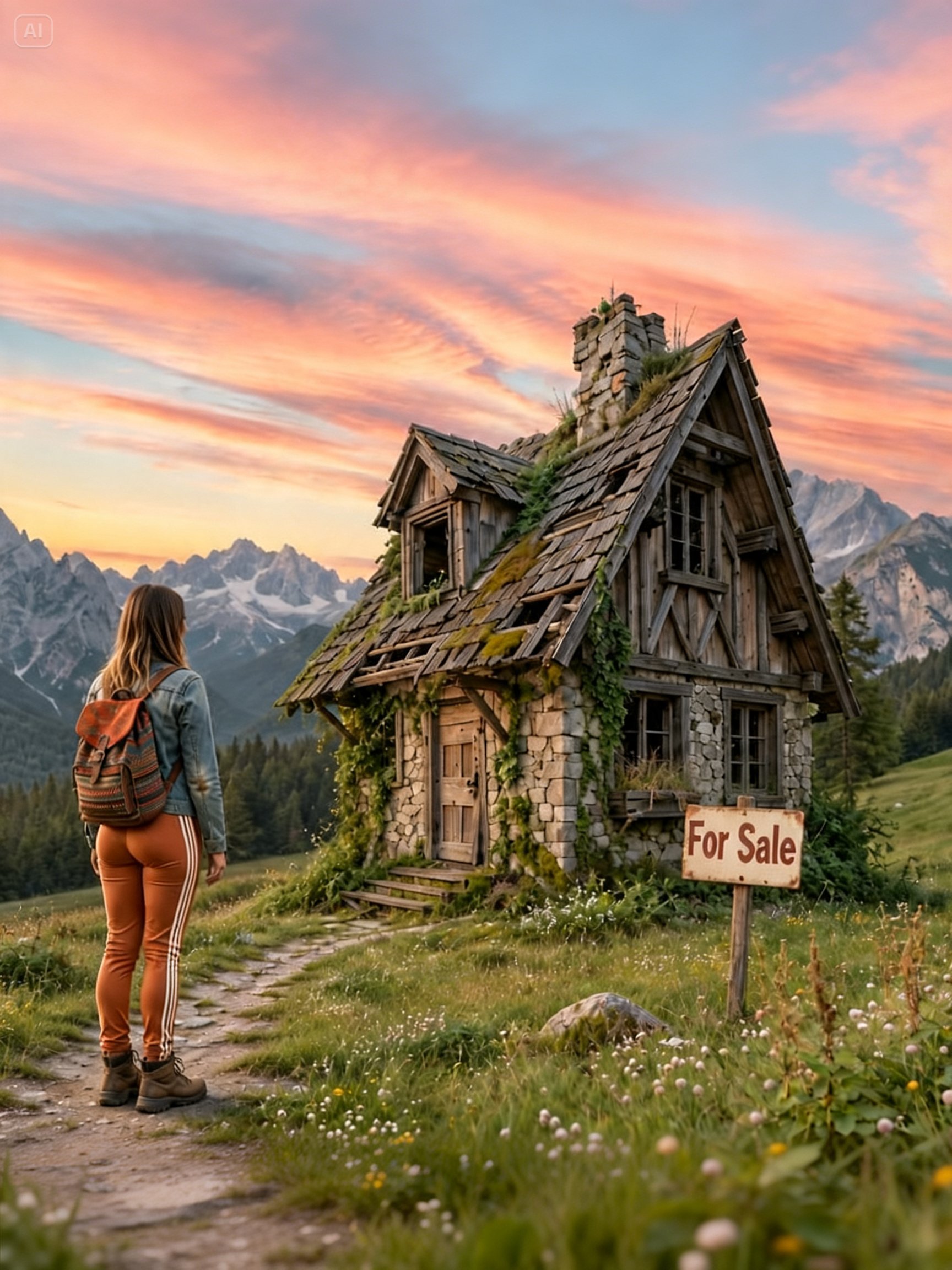
At the cabin I touched the crooked doorframe, the ivy, the broken pane I’d patched with plastic. It was miserable by almost anyone’s standards, but it was the first roof I’d ever owned. I slept poorly for three nights, and on the third I cried at the kitchen table over a memory of my mother telling me that people sometimes discover what they’re meant to do by accident.
The fourth morning, I wrote my decision on a scrap of paper so I’d be forced to look at it. Then I walked to the one spot on the two-track with a cell signal and called Sabra. “I want to talk,” I said, and she promised to come that evening.
I’d decided to give up the cabin and all twelve acres. I didn’t want the money I’d put into it, and I wasn’t expecting anyone to reward me. I was simply unable to enjoy the title knowing what had been taken from this family decades before.
Sabra arrived at with Jude, her nine-year-old son, in a jacket too big for him and his baseball glove in one hand. I made him hot chocolate and handed him my sketchbook and colored pencils at the far end of the kitchen table. He settled into drawing while his mother and I sat opposite each other.
“I’m going to transfer it,” I told her. “The cabin, the land, all of it. If there’s a way for your family to get it back, I won’t stand in the way.” I was shaking, and Sabra watched me quietly until I’d finished.
Then she said, “No.” I thought I had misunderstood. She leaned closer and told me her great-grandfather had lost his land because someone made him sign an unfair agreement, and she was not about to let me sign another one that left me with nowhere to live.
She had talked to Ingrid about another option. On the paper she’d brought were terms for a life estate: title could return to the Kinley heirs, while I would have the legally protected right to live in the cabin and use the five acres around it for the rest of my life. I couldn’t sell or mortgage that land, and when I died the possessory interest would end.
The other fifty-five acres could be returned for the family’s use as the wider title questions were settled. Sabra explained it carefully, not promising any agreement would be effective until a lawyer completed and recorded the proper deeds. But for the first time I saw a way of returning the land without recreating its cruelty.
She reached into her tote and put an envelope on the table. Inside were ninety-one dollars: four twenties, one ten, and one single. “You paid ninety-one dollars for our cabin,” she said. “I want you to have ninety-one dollars and a home you can live in.”
I didn’t take the cash right away. I put my hand over hers and sat there while Jude kept drawing, as though a nine-year-old with a box of pencils were the most ordinary thing in the world. Finally, I told her yes.
Three days later we drove to Missoula with Jude in the back seat. Ingrid went through the drafted transfer and life-estate provisions clause by clause, explaining responsibilities, limits, and the recording steps. I asked her to repeat two sections before I signed because I wanted no confusion about what I was giving away.
Sabra used a fountain pen her father had given her when she qualified as a nurse. I signed with Ingrid’s ballpoint, and Jude drew a small picture of the cabin in his sketchbook. The filings and the broader claim still needed work, but we had made our agreement together, with everyone knowing what it meant.
We stopped for burgers and a strawberry shake on the way home. Sabra told me a story about a clinic visitor who’d brought a goat along, and I laughed so hard my eyes watered. That night I slept under the same leaky roof, no longer confusing owning it with having a home.
Winter arrived two weeks later in earnest. Soren drove down with insulation for the loft, and I sealed the broken pane, split firewood, and bought a used propane heater. I still had no electric lights, so I worked by battery and kerosene and charged my laptop whenever I could in town.
Part 5 The Silver Fork Weekly hired me to tidy its pages for $150 a month. Dr. Genaro at Sabra’s clinic commissioned an $800 website, the Antler Diner paid $200 for menus, and a rancher hired me to design labels for small-batch jerky. By late January I was earning roughly $900 a month and finally able to buy groceries without counting every cracker.
The editor, Ruth Ann Oglesby, was sixty-one and ran the four-page Weekly from a storefront beside the diner. She treated my work like work, not like charity. I hadn’t felt so useful in years, although the cabin still had plenty of holes to patch.
Then in February a heavy letter arrived at my post-office box. It came from a Billings law firm on behalf of Thornberry Capital, now run by Ellis Thornberry II. They claimed Esteban Vollmer had signed a right-of-first-refusal agreement in 2019, giving them priority if my parcel changed hands.
The letter said Thornberry intended to exercise that right at a claimed fair-market price of $340,000 and threatened a lawsuit if I didn’t comply. I sat in my Civic outside the post office rereading it until I could trust my hands on the steering wheel. Then I drove straight to Sabra’s clinic.
Ingrid told us the signature and the circumstances were suspicious, but suspicion wouldn’t defeat a contract. She wanted the agreement compared against verified examples of Esteban’s handwriting by Lenore Byrd, a forensic document examiner in Denver. The expedited analysis cost $1,800, and Ingrid’s nonprofit could cover half.
Nine hundred dollars was almost everything I expected from outstanding design work. I could have asked Soren or Sabra to help, but I told Ingrid I’d pay my share and scraped it together from the clinic website, the diner work, and the rancher’s labels. I understood she might think I was being proud; she didn’t say it.
Lenore compared the disputed signature with authenticated documents and reported marks consistent with a traced signature. Her opinion was that the right-of-first-refusal signature was a forgery, and she expressed 94 percent confidence. It wasn’t a court judgment, but it gave Ingrid something concrete with which to challenge the threat.
I opened the report at the Weekly office after dark. Ruth Ann read over my shoulder, set down her pencil, and asked whether the land, the Kinleys, the old deeds, and the lawyer’s letter were all part of one story. When I said yes, she asked if I’d let her publish it.
She promised it would be a careful account, not a cheap scandal. She wanted the original records, the unresolved questions, and the Kinleys’ words, with allegations described as allegations until proved. I told her I had to ask Sabra first, and Ruth Ann nodded as though that was exactly the answer she hoped for.
Sabra agreed. So did her eighty-nine-year-old grandmother, Mamie Kinley, when she called from Chicago. They knew people might say ugly things, but they also knew what keeping quiet had cost Marcus.
On the last Thursday in February, the Silver Fork Weekly devoted four pages to the story. There were photographs of the cabin and the old Kinley family, scans of the plats, and excerpts from Marcus’s journal. At Sabra’s invitation, I added a short explanation of why I’d transferred my interest even though my auction purchase had been lawful.
The article traveled far beyond our little town. Odessa Wright, whose American Ground podcast reached hundreds of thousands of listeners, asked to tell the story in a three-part series. Sabra and Mamie consented, and the first episode appeared in March.
Listeners began writing in about their own families’ land records. By the end of March, fourteen families across Montana, South Dakota, and Alabama had identified irregularities that deserved examination. They hadn’t suddenly won court cases, but they’d found reason to look at records their relatives had been told not to question.
By early April, Thornberry Capital had hired new counsel. On April 2, its lawyers withdrew the right-of-first-refusal claim against me and parcel 1247-B without an apology or an admission. The withdrawal didn’t resolve every question about the historic deeds, but it removed the immediate threat hanging over the agreement with the Kinleys.
The property and estate work cost money, and the nonprofit could cover only part of it. My share reached $4,200. I sold the Civic for $3,400, and Soren lent me $1,200 without interest or a deadline; he wouldn’t let me turn a practical loan into a speech about what I owed him.
I eventually ended up with a battered 2008 Toyota Tacoma whose mirror was held on with electrical tape. Its heater and four-wheel drive worked, and I was grateful for both. When the last legal payment cleared, I had forty-one dollars in checking, but the paperwork was moving toward the restoration we’d promised.
Final One muddy April afternoon, I received an email from the Land Trust Project, a Georgia nonprofit that documented heirs’ property problems. They’d read the article and heard the podcast. They offered me a remote, part-time research contract for $2,800 a month, starting with a visual documentation system for fourteen potential cases.
It came with a three-month review, no insurance, no retirement plan, and no guarantee that the work would last. After everything that had happened, I appreciated that the letter didn’t pretend otherwise. They needed someone who understood design and the slow work of sorting a pile of records into something people could examine.
I sat on the stone step outside the cabin and wrote back, “Thank you. I accept. I can start Monday.” Then I put the kettle on. It was the first time since Austin that work had felt connected to something I believed in, even if I still had to be careful with every dollar.
By the last Saturday in May, the Kinley family’s restoration had reached the point where they could walk the returned fifty-five acres as their own. Sabra organized a gathering and said her grandmother was flying in from Chicago. Mamie had never stood on that ground, although her family had carried its memory for decades.
I washed my hair in the dry sink, braided it down my back, and put on my denim jacket and mended terracotta pants. Around my neck was the thin silver chain my mother had given me at twenty-one, something I’d considered selling during the worst months and had somehow kept. I waited on the porch until Sabra’s car appeared on the two-track.
Mamie stepped out in a navy hat with a yellow silk flower tucked into the band. She was small and moved carefully, but she looked directly at me when I came to meet her. She took both my hands and quietly asked, “Will you walk me to it?”
Sabra and I walked beside her across the meadow. Jude ran ahead carrying his baseball glove, then slowed when he saw us reach a rise beside a cottonwood. Mamie knelt in the grass, waved off our offered help, and placed both palms on the soil.
I looked away toward the mountains because I didn’t want to intrude on that moment. When I looked back, Jude had sat beside his great-grandmother with one hand on her shoulder, and Mamie had covered it with her own. Sabra stood next to me, crying quietly, while her grandmother stayed there as long as she wanted.
Later Mamie rose, brushed the dirt from her knees, and told me the land had a long memory and that I was one of the people who would remember. She walked with Jude toward three rows of sweet corn he’d planted at the edge of the returned acreage. Neither of them seemed in any hurry.
That evening, twelve Kinleys gathered at the cabin, along with Soren, Ruth Ann, Dr. Genaro, and Ingrid, who drove in briefly from Missoula. There was cornbread, collard greens, pulled pork, and a pie Mamie had carried on the plane. People laughed on the porch as though they’d always eaten there together.
After dessert, Jude handed me a drawing of the cabin and meadow. He’d drawn me on the porch in my denim jacket, with him and his mother in the foreground. Beneath it, in his careful handwriting, were the words “Marlowe’s cabin. Our land.”
I carried the drawing inside and placed it on the mantel beneath a smooth river stone. When I stepped out again, Sabra raised her coffee cup in a small greeting, and I sat on the top step beside Jude. He pointed to a hawk circling over the valley, and for a while we watched without talking.
I thought of the truck driver who’d given me coffee at four in the morning, of Soren’s futon and Esteban’s unfinished notes, and of Marcus writing memories nobody wanted to read. I thought of my mother at the kitchen counter, telling me I might find my purpose by accident. She’d been right, though she couldn’t possibly have known how.
Mamie began singing an old hymn, and Sabra joined her. I didn’t know the words, so I listened with Jude leaning against my side. I had no deed to the cabin anymore, no promise of lifelong wealth, and no guarantee that the new job would be easy, but I had work worth doing and a place where I belonged.
The land was the Kinleys’, and I could live in that little house for the rest of my life. The record of what had happened would continue to matter to other families, too. Nothing about my old life had prepared me for that, except perhaps the habit of taking scattered things and making their meaning visible. I was twenty-seven, and I hadn’t run out of time to become the person I wanted to be.
THE END. I’ve shared the complete story, and I truly hope it touched your heart. If this story moved you, please , like, and share the post. Thank you for reading! ❤️
✓ Lynn R. Adams
I climbed down from the loft with the tin in my hands, but I couldn’t make myself stop searching. Beneath a runner in the narrow hallway, one floorboard sat slightly higher than the others. I pried it…