A struggling single father walked into a police station with his seven-year-old daughter,
Part 2: A widowed father’s painful sacrifices conceal his remarkable past
Three years before that humiliating afternoon, Daniel Carter had stood beside a hospital bed holding his wife’s hand while a heart monitor delivered the most devastating sound he had ever heard. Emily had been thirty-two, a kindergarten teacher with a contagious laugh and an extraordinary ability to make ordinary days feel like celebrations. A sudden, aggressive illness had stolen her strength in a matter of weeks, leaving Daniel struggling to understand how the woman who had danced with him in their kitchen could disappear so quickly. Before she died, she had asked him to promise that Lily would never grow up believing love disappeared when life became difficult. Daniel had promised through tears, never imagining how much that single sentence would shape every decision he made afterward.
The medical bills consumed their savings, and the small house they had purchased together eventually slipped beyond his ability to keep. Daniel sold his truck, gave up most of their furniture, and moved with Lily into a cramped apartment above a grocery store on the older side of town. During the day, he repaired furnaces, leaking pipes, and damaged electrical systems for a maintenance company, earning just enough to cover rent and groceries. Several evenings each week, he delivered food until nearly midnight, returning home with aching shoulders and hands roughened by years of manual labor. Yet every morning, he still woke early enough to prepare Lily’s breakfast, braid her hair with questionable skill, and walk her to school whenever his schedule allowed.
Their apartment wasn’t much to look at, but Daniel had transformed one corner of the living room into a magical kingdom of paper stars and handmade drawings. Lily called it the Moon Room because her father had painted a glowing silver moon on the wall after she complained that their new home didn’t have a backyard. On difficult nights, they sat beneath that moon and imagined all the places they would visit when money was no longer a constant worry. Daniel never told her how often he skipped lunch to afford her school supplies, or how many times he had repaired his own shoes rather than purchase another pair. He wanted his daughter to remember laughter, not the sacrifices that made it possible.
Before Emily’s death, Daniel had worked as a technical rescue specialist attached to a regional emergency-response team. He had helped evacuate families during floods, entered unstable buildings after storms, and trained alongside firefighters who trusted his judgment when every second mattered. But after losing his wife, he stepped away from emergency work because unpredictable deployments made it impossible to raise Lily alone. The decision had cost him a career he loved, yet he never regretted choosing the little girl who needed him more than any rescue unit did. A few former colleagues still called him when complicated mechanical problems arose, and he quietly volunteered whenever the community faced a crisis.
One bitter January night, a winter storm knocked out power across several neighborhoods, leaving an elderly couple trapped inside a freezing house. Daniel heard about their situation through a local dispatcher and drove through dangerous roads with a borrowed generator, extra blankets, and his battered toolbox. He repaired their heating system, stayed until their home was warm, and refused the money they offered because he knew they survived on a fixed income. The couple’s granddaughter later nominated him for a community service award, but Daniel missed the ceremony because Lily had developed a fever that required an emergency hospital visit. He never knew that his name had been read aloud before dozens of grateful residents, including Police Chief Marcus Reynolds and veteran dispatcher Evelyn Hart.
Evelyn remembered Daniel clearly, partly because her own mother had been one of the elderly people helped during that storm. She remembered how he had refused recognition, insisting that anyone with the right tools would have done the same thing. Watching two officers mock him in front of his daughter made her stomach turn, but what disturbed her most was the way Briggs reacted when Daniel mentioned the SUV’s license plate. She had seen the officer’s face change, as though he recognized something he wished he hadn’t heard. And when Daniel finally disappeared through the station doors, Evelyn understood that what she had witnessed might be more than ordinary arrogance.
Part 3: A terrifying roadside incident reveals a wealthy family’s secrets
The trouble began on Tuesday evening, when rain hammered the sidewalks of Millbrook and turned the neighborhood streets into ribbons of reflected headlights. Daniel had picked Lily up from an after-school program and stopped at a grocery store to purchase milk, pasta, and the strawberries she loved. Their budget was tight enough that he had returned a package of cookies to the shelf, promising they could bake something together over the weekend. Lily had accepted the compromise with the seriousness of a child who understood more about money than her father wished she did. They were three blocks from home when the sound of an accelerating engine shattered the ordinary rhythm of their walk.
A black SUV came racing toward the intersection, moving far too quickly for the narrow residential street. An elderly woman carrying a shopping bag had already stepped into the crosswalk, apparently unaware that the driver was ignoring the red light. Daniel saw the danger before anyone else reacted, pulled Lily behind a concrete planter, and shouted for the woman to move. The SUV swerved violently, missing her by inches before slamming into a parked sedan with enough force to scatter broken glass across the wet pavement. For one suspended moment, Daniel expected the driver to stop, but the engine roared again and the vehicle disappeared around the corner.
Lily was crying when Daniel rushed toward the elderly woman, who had collapsed onto the sidewalk in shock. Her name was Margaret Ellis, and she was seventy-four years old, a retired librarian who had lived in Millbrook for nearly five decades. She had struck her wrist while falling and was struggling to breathe through the panic, so Daniel covered her with his jacket and spoke gently until emergency responders arrived. He gave the dispatcher a description of the SUV, including a damaged rear taillight and the license plate he had memorized. Years of reading equipment serial numbers had trained him to retain details that most people forgot almost immediately.
The responding officer recorded a brief statement, but Daniel noticed something strange when he repeated the license plate. The officer stopped writing, looked at his partner, and asked whether Daniel was absolutely certain about the numbers. When Daniel confirmed them, the officer closed his notebook and said investigators would handle everything from there. The exchange bothered Daniel, though he initially dismissed it as an ordinary part of police work. By the next morning, however, he learned from a neighbor that a black SUV matching his description was regularly driven by Nathan Whitmore, the twenty-four-year-old son of prominent developer Richard Whitmore.
Richard Whitmore owned commercial buildings, sponsored local political campaigns, and appeared in photographs beside influential officials at charity galas. His son Nathan had developed a reputation for expensive cars, reckless parties, and the belief that consequences were problems meant for other people. Several residents had whispered about accidents involving Whitmore vehicles, but those conversations always ended with the same warning: confronting that family would only bring trouble. Daniel didn’t know whether Nathan had been driving that night, and he refused to accuse anyone without proof. What he knew was that an elderly woman had almost died, a parked vehicle had been destroyed, and someone had fled without offering help.
When Daniel called the police station to follow up, he was told that no formal report could be located under the incident number he had been given. The receptionist suggested that he come in personally if he wanted to provide additional information, but her voice became noticeably guarded when he mentioned the Whitmore name. Daniel printed a detailed account during his lunch break, including the location, time, plate number, and contact information for another witness. He asked his supervisor to let him leave early, knowing the lost wages would make the following week’s bills more difficult. Because he couldn’t arrange affordable child care on such short notice, he brought Lily with him, believing the station would be the safest place to resolve the matter.
Part 4: A destroyed police report exposes something far more dangerous
The Millbrook Police Department occupied an aging brick building between the courthouse and the municipal parking garage. Its lobby displayed framed photographs of decorated officers, community outreach posters, and a large bronze plaque promising integrity, service, and accountability. Daniel noticed the plaque as he entered with Lily, who was holding a stuffed rabbit named Mr. Buttons and staring curiously at the uniforms behind the counter. He had taught her that police officers were supposed to help people, and she had once announced that she wanted to become one when she grew up. He hoped their visit would reinforce that belief, not destroy it.
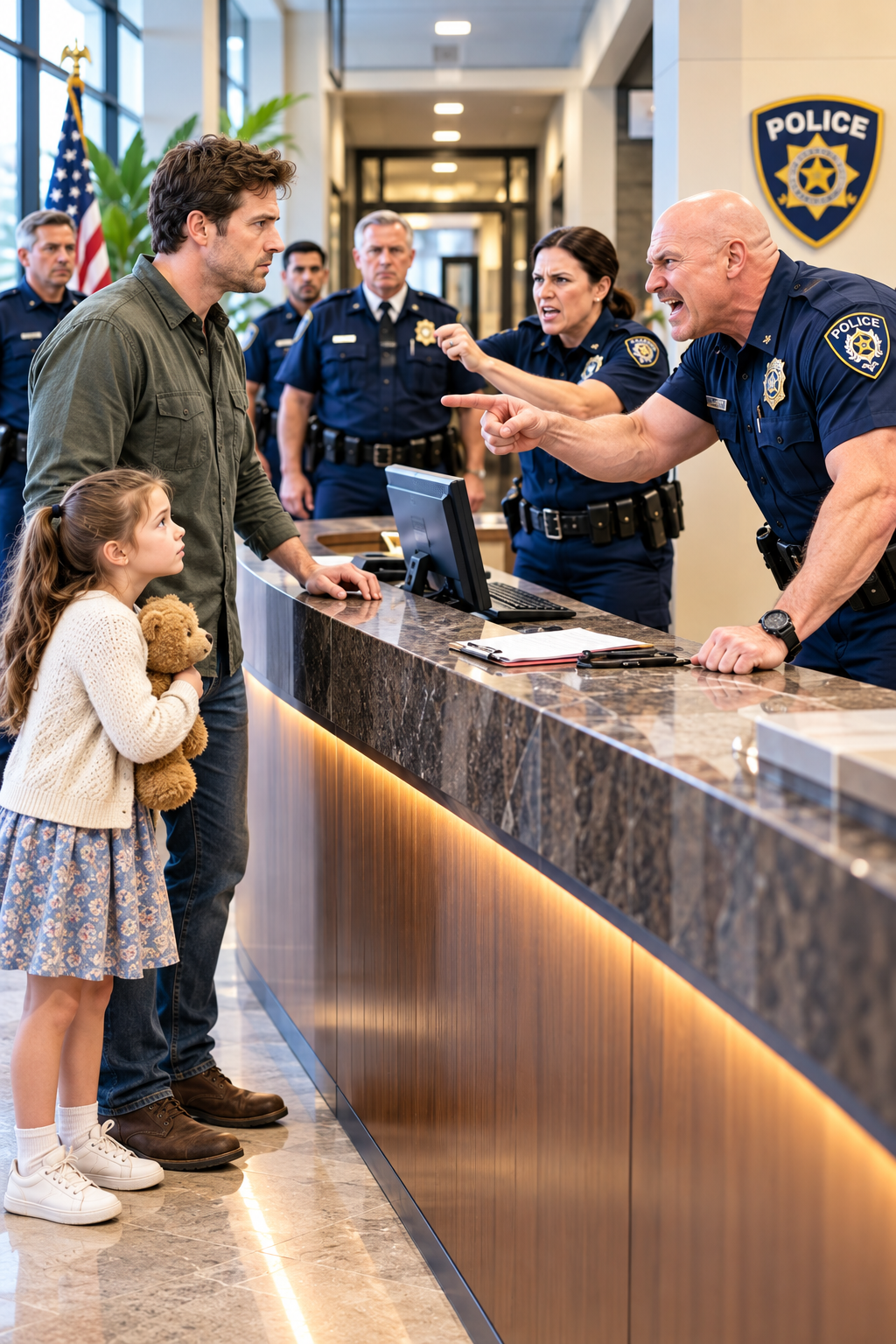
Officer Mason Briggs barely looked up when Daniel approached the desk and explained why he had come. Briggs was forty-one, broad-shouldered, and accustomed to speaking with the kind of impatience that discouraged further questions. His partner, Travis Cole, was younger and more openly dismissive, wearing a smirk that made Lily move closer to her father. Daniel handed over the printed complaint and carefully explained that the original incident appeared to be missing from the system. The moment he mentioned the black SUV and its license plate, Briggs stopped scanning the page and exchanged a sharp glance with Cole.
“Where exactly did you get this information?” Briggs asked, his voice suddenly colder. Daniel explained that he had witnessed the crash personally and had already provided the plate number to responding officers. Cole interrupted to ask whether Daniel had been drinking, then laughed when Daniel said he had been walking home with his daughter. Briggs examined Daniel’s worn clothing and asked whether he understood the seriousness of making accusations against respected community members. Daniel calmly replied that he wasn’t accusing anyone of a crime without evidence; he was requesting an investigation into an incident he had witnessed.
The discussion should have ended there, with the officers accepting his statement and forwarding it to investigators. Instead, Briggs told Daniel that the department had more important things to handle than complaints from people looking for attention. Daniel felt Lily’s fingers tighten around his hand as Cole suggested that he might be trying to pressure a wealthy family into paying him money. The accusation was so absurd that Daniel initially thought he had misunderstood. When he asked for the officer’s name and badge number so he could document the interaction, Briggs’s expression hardened into open hostility.
“You’re not going to threaten me in my own station,” Briggs snapped, grabbing the complaint from the counter. He tore the document in half, holding Daniel’s gaze as the paper split between his hands. Cole took the pieces, ripped them again, and threw several into the trash, laughing as though he had witnessed an entertaining performance. A receptionist looked away, and a young officer standing near the hallway froze without intervening. Lily began to cry silently, not because she fully understood the dispute, but because she had never seen her father treated with such deliberate contempt.
Daniel wanted to shout, to demand a supervisor, and to ask whether either officer would tolerate someone speaking that way to their own children. But Lily was watching him, and he remembered Emily’s belief that courage was measured not by the volume of someone’s anger but by the choices they made while carrying it. He collected the surviving pieces, placed them in his pocket, and quietly told the officers that he hoped they would reconsider their decision. Outside, Lily asked whether poor people were allowed to ask the police for help, and Daniel felt something inside him break. He told her that every person deserved protection under the law, even when the people entrusted with enforcing it forgot their responsibility.
Part 5: A veteran dispatcher uncovers the evidence powerful men buried
Evelyn Hart had spent twenty-three years working inside the Millbrook Police Department, long enough to recognize when a routine disagreement concealed something far more troubling. From her position behind the dispatch-room window, she had watched Briggs tear Daniel’s report and seen Cole throw the pieces away. She had also noticed the uncomfortable silence of the younger officer who witnessed the incident but did nothing to stop it. Evelyn knew Daniel’s reputation, and she knew he was not someone who invented stories for attention. What frightened her was how aggressively Briggs had reacted to information that should have been treated as a routine witness statement.
She retrieved the discarded fragments after the officers left the counter and carefully arranged them across her desk. The license plate remained legible, along with the time and location of the crash, and she entered the details into an authorized records search. Within minutes, she found references to three earlier incidents involving a vehicle with matching identifying information. One concerned a pedestrian struck near a shopping center, another involved damage to a parked delivery van, and the third described a late-night collision that had left a teenage cyclist hospitalized. Yet the reports had been marked incomplete, withdrawn, or administratively closed without explanations that satisfied her.
Evelyn contacted Chief Marcus Reynolds, who was attending a regional public safety conference forty minutes away. Reynolds had served in law enforcement for nearly three decades and had spent much of his career trying to rebuild trust between officers and communities that felt ignored. When Evelyn described what had happened to Daniel and Lily, he initially assumed he was dealing with a serious professionalism complaint. But as she explained the matching vehicle information and the irregularities in earlier reports, his concern deepened. He instructed her to preserve the fragments, secure the lobby surveillance footage, and avoid discussing the matter with anyone who might be involved.
While Reynolds drove back to Millbrook, Evelyn reviewed records that were accessible through her position and documented the inconsistencies she found. Several witness statements had been modified after their initial submission, and one supplemental report had been entered under Briggs’s credentials shortly before the case was closed. Another file referenced an outside request for information that had never been properly recorded. Evelyn didn’t have enough evidence to determine who had altered the records or why, but the pattern was troubling. She prepared a written summary for the chief and flagged the material for preservation rather than attempting to conduct her own unauthorized investigation.
Reynolds arrived shortly after four o’clock, entering through a side door and heading directly to his office. He reviewed the video, examined the complaint fragments, and compared the plate information with the available incident records. The footage showed Briggs and Cole behaving exactly as Evelyn had described, including the moment Lily began crying. Reynolds watched the recording twice, then sat silently for several seconds before calling the department’s internal affairs investigator. He ordered a formal review of the officers’ conduct and directed that the underlying traffic investigation be transferred to personnel outside their chain of involvement.
The chief then summoned Briggs and Cole separately, giving each an opportunity to explain the encounter before revealing what he had seen. Briggs claimed that Daniel had become confrontational and refused to provide credible evidence, while Cole insisted that the complaint had been discarded because it was improperly completed. Reynolds placed the recovered paper fragments on his desk and asked whether destroying a citizen’s statement was standard departmental procedure. Neither officer answered. When he informed them that the lobby cameras had recorded the entire encounter, Briggs’s confident expression collapsed, and Cole suddenly seemed unable to meet his supervisor’s eyes.
Part 6: The police chief delivers justice before an astonished station
Chief Reynolds had spent years teaching young officers that a badge was a public trust rather than a personal privilege. Yet watching two members of his own department humiliate a father in front of a frightened child made him realize that words printed in training manuals meant nothing without accountability. He informed Briggs and Cole that they were being placed on administrative leave pending an internal investigation and ordered them to surrender their department-issued credentials and equipment according to procedure. He also directed investigators to examine whether either officer had improperly interfered with the earlier traffic complaints. Both men protested, but Reynolds made it clear that their explanations would be evaluated through evidence, not personal connections.
Briggs attempted to defend himself by claiming that Daniel had been disrespectful and had tried to embarrass the department. Reynolds turned his computer monitor toward him and replayed the surveillance footage, allowing the room to fill with the unmistakable sound of tearing paper. Daniel’s voice remained calm throughout the recording, while Lily’s frightened expression revealed the emotional damage the officers had inflicted. “That man came here because he believed we would protect his community,” Reynolds said quietly. “You treated his trust like something you could throw in the garbage.”
Meanwhile, Daniel had returned to his apartment, where he was trying to convince Lily to eat a bowl of soup. She had barely spoken since they left the station, and the silence troubled him more than her earlier tears. When his phone rang and the caller identified himself as Chief Reynolds, Daniel felt his stomach tighten. He wondered whether the officers had filed some accusation against him or whether his attempt to help Margaret had created a problem he couldn’t afford to solve. Reynolds apologized for the encounter, explained that the complaint would be properly documented, and asked whether Daniel and Lily would be willing to return for a personal meeting.
Daniel hesitated because he had no desire to expose his daughter to another painful experience. But Reynolds assured him that the officers involved had been removed from public-facing duties and that the department wanted to address the situation openly. Lily listened from the kitchen doorway as her father ended the call, then asked whether they were in trouble. Daniel knelt beside her and explained that sometimes adults made mistakes and needed to correct them. She considered his answer for a moment before retrieving Mr. Buttons and announcing that she wanted to go with him.
When they arrived, the atmosphere inside the station had changed completely. Several officers stood near the hallway, and Evelyn Hart approached Lily with a gentle smile, offering her a cup of hot chocolate from the break room. Reynolds introduced himself to Daniel, shook his hand, and apologized without attempting to minimize what had happened. He explained that Daniel’s information appeared important to an ongoing investigation and that independent investigators would review the related incidents. Then he asked Daniel to accompany him into the central workspace, where officers and civilian employees had gathered after being informed that the chief wished to address them.
Reynolds stood before the room and spoke about the department’s obligation to serve every resident with dignity, regardless of income, occupation, or social standing. He described Daniel’s willingness to help a stranger, his decision to report a dangerous incident, and the restraint he had shown when treated unfairly. Then the chief turned toward Daniel and raised his right hand in a formal salute, an unusual personal gesture of respect rather than an official departmental honor. One by one, the officers present stood and followed his example, while Daniel remained motionless with tears gathering in his eyes. Lily wrapped both arms around her father’s waist, looked up at the people who had finally recognized his courage, and whispered, “Daddy, they’re standing up for you.”
Part 7: A powerful family’s influence collapses under mounting evidence
The salute became a defining memory for Lily, but for Chief Reynolds, it marked the beginning of a difficult investigation rather than the end of the story. Within days, internal affairs investigators began examining the missing traffic reports, while county authorities reviewed whether the suspected record alterations involved criminal misconduct. Daniel provided a detailed witness statement and identified the vehicle from photographs presented through proper investigative procedures. Margaret Ellis also agreed to cooperate after learning that her frightening encounter might be connected to other unresolved incidents. Her testimony helped establish the timeline, though investigators still needed independent evidence to identify the driver.
A nearby pharmacy had retained security footage showing the black SUV moments before the collision, and another camera captured its damaged rear corner as it left the neighborhood. Investigators obtained relevant records through legal process and traced the vehicle to a company associated with the Whitmore family. They discovered that Nathan Whitmore had access to the SUV on the evening of the crash, though his attorneys initially argued that several employees could have been driving it. Additional evidence, including location records and witness accounts, gradually narrowed the possibilities. The investigation also uncovered suspicious communications between people connected to the Whitmore business and individuals who had handled earlier complaints.
Richard Whitmore responded with outrage when reporters began asking questions about his family’s possible involvement. Through his attorney, he accused investigators of pursuing a politically motivated campaign and insisted that his son was being unfairly targeted because of their family’s wealth. Nathan avoided public appearances, while the company’s representatives declined to answer questions about the damaged vehicle. For years, the Whitmores had relied on reputation and influence to control the narrative surrounding their affairs. This time, however, the evidence was being reviewed by authorities beyond the reach of the local relationships that had previously protected them.
As the inquiry expanded, several residents came forward with stories they had been afraid to tell. A delivery driver described being pressured to withdraw a property-damage complaint, while the mother of the injured cyclist revealed that an unidentified caller had warned her against pursuing further action. Investigators documented the accounts and compared them with available records, carefully separating allegations from facts they could substantiate. Some claims could not be verified, but others were supported by communications, financial records, and inconsistencies in official paperwork. The case began to reveal a troubling pattern in which ordinary people had been discouraged from seeking accountability.
Briggs and Cole faced administrative hearings concerning their treatment of Daniel, and investigators separately examined whether they had participated in improper handling of the Whitmore-related cases. Cole eventually acknowledged that he had followed Briggs’s lead at the counter and had failed to challenge behavior he knew was wrong. Briggs maintained that his actions had been justified, even as the video and testimony contradicted important parts of his account. The department ultimately terminated both officers for serious violations of professional standards, while prosecutors continued evaluating evidence related to the records investigation. Reynolds publicly emphasized that disciplinary findings and criminal allegations required different standards of proof.
For Daniel, the growing attention was uncomfortable and exhausting. Reporters called his workplace, strangers recognized him at the grocery store, and several people offered money he politely declined. He worried that Lily might begin believing kindness was valuable only when it brought public recognition. One evening, she asked whether the officers would have apologized if the chief hadn’t discovered what happened. Daniel considered the question carefully before admitting that he didn’t know, then explained that doing the right thing mattered even when no one applauded. Lily looked toward the little silver moon painted on their wall and replied that she was glad someone had finally listened.
Part 8: A little girl’s courage transforms her father’s greatest heartbreak
By the time autumn arrived, the case involving Nathan Whitmore had progressed through the courts, and several charges connected to the traffic incidents had been formally filed. Nathan eventually entered a negotiated guilty plea to offenses supported by the evidence, including leaving the scene of the collision involving Margaret Ellis. The court imposed penalties that included restitution, driving restrictions, and a period of incarceration, while related allegations of improper influence continued through separate proceedings. Margaret attended the sentencing with her granddaughter, determined to hear the outcome for herself. When she saw Daniel outside the courtroom, she embraced him and thanked him for refusing to let her frightening experience disappear into forgotten paperwork.
Daniel told her that he had simply done what he hoped someone would do for Lily if she ever needed help. Margaret smiled through tears and replied that ordinary decency was becoming rare enough to feel extraordinary. She had recovered from her wrist injury, though she still felt nervous crossing busy streets and had begun attending counseling to manage the fear. Daniel listened without interrupting, understanding that justice could not erase every consequence of what had happened. But he was relieved that she no longer had to wonder whether the person responsible would ever be held accountable.
The Millbrook Police Department also began changing its procedures in response to the investigation. Reynolds introduced stronger documentation requirements for citizen complaints, expanded supervisory reviews of closed traffic cases, and established clearer channels for reporting suspected misconduct. Evelyn Hart received recognition for preserving evidence and raising concerns through appropriate channels, though she insisted that she had merely fulfilled her responsibility. The department held public meetings where residents described experiences of being dismissed or intimidated, and some of those conversations were uncomfortable for officers accustomed to hearing praise. Reynolds believed that discomfort was necessary if the institution hoped to regain the confidence it had damaged.
Daniel was invited to speak at one of those meetings, but he initially refused because he disliked standing before crowds. Evelyn eventually persuaded him by explaining that his experience could encourage other residents who felt powerless to speak up. On the evening of the event, he wore a clean blue shirt Lily had helped him choose and carried a folded sheet of handwritten notes. His hands trembled when he approached the microphone, and he briefly considered returning to his seat. Then he saw Lily in the front row beside Margaret, holding Mr. Buttons and smiling with complete confidence in him.
Daniel told the audience about the night Emily died and the promise he had made to protect their daughter. He spoke about financial hardship, the loneliness of raising a child alone, and the painful realization that being respectful did not guarantee receiving respect in return. He explained that his greatest fear inside the police station had not been losing an argument with two officers, but watching Lily learn that powerful people could humiliate others without consequences. Then he looked directly at her and said that courage was not the absence of fear or anger. Sometimes courage meant refusing to abandon your principles when abandoning them would be easier.
When he finished, the audience rose in a standing ovation, but Daniel noticed something more important than the applause. Lily had placed her stuffed rabbit on her chair and was clapping with both hands, her face shining with pride. Afterward, she asked whether her mother would have been proud of him, and Daniel felt the familiar ache of grief rise in his chest. He told her that Emily would have been proud of both of them, especially of Lily for remaining kind after seeing something cruel. That night, Lily placed the surviving fragments of the original complaint inside a small wooden box beside a photograph of her mother.
Part 9: Years later, one final tribute reveals what courage truly means
Life did not suddenly become easy for Daniel Carter after the investigation ended. His bills still arrived every month, his truck still needed repairs, and he still woke before sunrise to keep the furnaces of Millbrook running through bitter Pennsylvania winters. He continued taking occasional grocery deliveries, though a promotion at the maintenance company eventually allowed him to spend more evenings at home. The publicity surrounding the case faded, replaced by newer scandals and stories that captured the town’s attention. Daniel welcomed the return to ordinary life because he had never wanted fame, only the chance to raise his daughter in a community where fairness meant something.
But the experience left permanent changes in the people who had witnessed it. Evelyn continued working at the station for several more years before retiring, and she often told new dispatchers that their responsibility was not merely to answer calls but to recognize the human beings behind them. Reynolds remained committed to rebuilding public trust, understanding that one public apology could never substitute for years of consistent accountability. Margaret became an advocate for pedestrian safety, speaking at council meetings about dangerous intersections and the importance of reporting reckless driving. Even residents who had never met Daniel began discussing whether they had stayed silent when someone else needed their support.
As Lily grew older, she developed a fierce interest in justice, though Daniel was careful not to encourage bitterness toward people in uniform. He taught her that individuals should be judged by their actions, not by the clothing they wore or the institutions they represented. When she was twelve, she wrote a school essay about the afternoon her father had been humiliated at the police station. Her teacher called Daniel after reading it, explaining that Lily had described courage in a way that moved the entire classroom. Daniel asked to see the essay, but Lily insisted that he wait until she was ready to share it.
By sixteen, Lily was volunteering with a community organization that helped elderly residents obtain transportation, home repairs, and assistance with complicated paperwork. She often accompanied Daniel on weekends when he repaired heating systems for families who couldn’t afford professional service. They worked together in drafty basements and cluttered utility rooms, sharing jokes while she handed him tools and learned how to diagnose problems. Daniel sometimes caught glimpses of Emily in Lily’s smile, and the resemblance could still bring tears to his eyes. But the grief had gradually changed from an unbearable wound into a quiet reminder of the love that had shaped their family.
On Lily’s eighteenth birthday, she surprised Daniel with a framed copy of the essay she had written six years earlier. Its title was “The Strongest Man in the Room,” and beneath it she had described the moment two officers tore up her father’s complaint while she stood beside him. She wrote about the fear she felt, the shame she mistakenly believed belonged to them, and the confusion of watching adults abuse authority. But the heart of her essay concerned what happened afterward, when Daniel chose dignity over revenge and showed her that refusing to become cruel was itself an act of strength. The final paragraph explained that the police chief’s salute had been unforgettable, but her father’s quiet decision to protect her faith in kindness had mattered even more.
Daniel read the essay three times before he could speak, and Lily laughed softly when she saw him searching for a tissue. She told him she had been accepted into a university program where she planned to study law and public service, hoping to help people who felt intimidated by complicated systems. Daniel embraced her, remembering the frightened little girl who once asked whether poor people were allowed to seek help from the police. Now she was preparing to dedicate her future to making sure that question never needed to be asked. For the first time in years, he felt that the promise he had made to Emily was becoming something larger than survival.
On the morning Lily left for college, Daniel found the wooden box containing the torn complaint sitting on the kitchen table. Inside was a note explaining that she wanted him to keep the fragments because they belonged to the day he taught her the meaning of courage. Daniel carried the box to the living room and placed it beneath the silver moon he had painted years earlier, when their apartment had felt too small to hold their grief. He stood there for a long time, thinking about the lives that had changed because one exhausted father refused to look away from a stranger in danger. Then he smiled, picked up his toolbox, and headed out to work, knowing that the greatest honor he had ever received was not the salute of an entire police station, but the love and respect of the daughter who had watched him earn it.
✓ Lynn R. Adams
Part 2: A widowed father’s painful sacrifices conceal his remarkable past Three years before that humiliating afternoon, Daniel Carter had stood beside a hospital bed holding his wife’s hand while a …