A SEAL called me a “desk clerk”
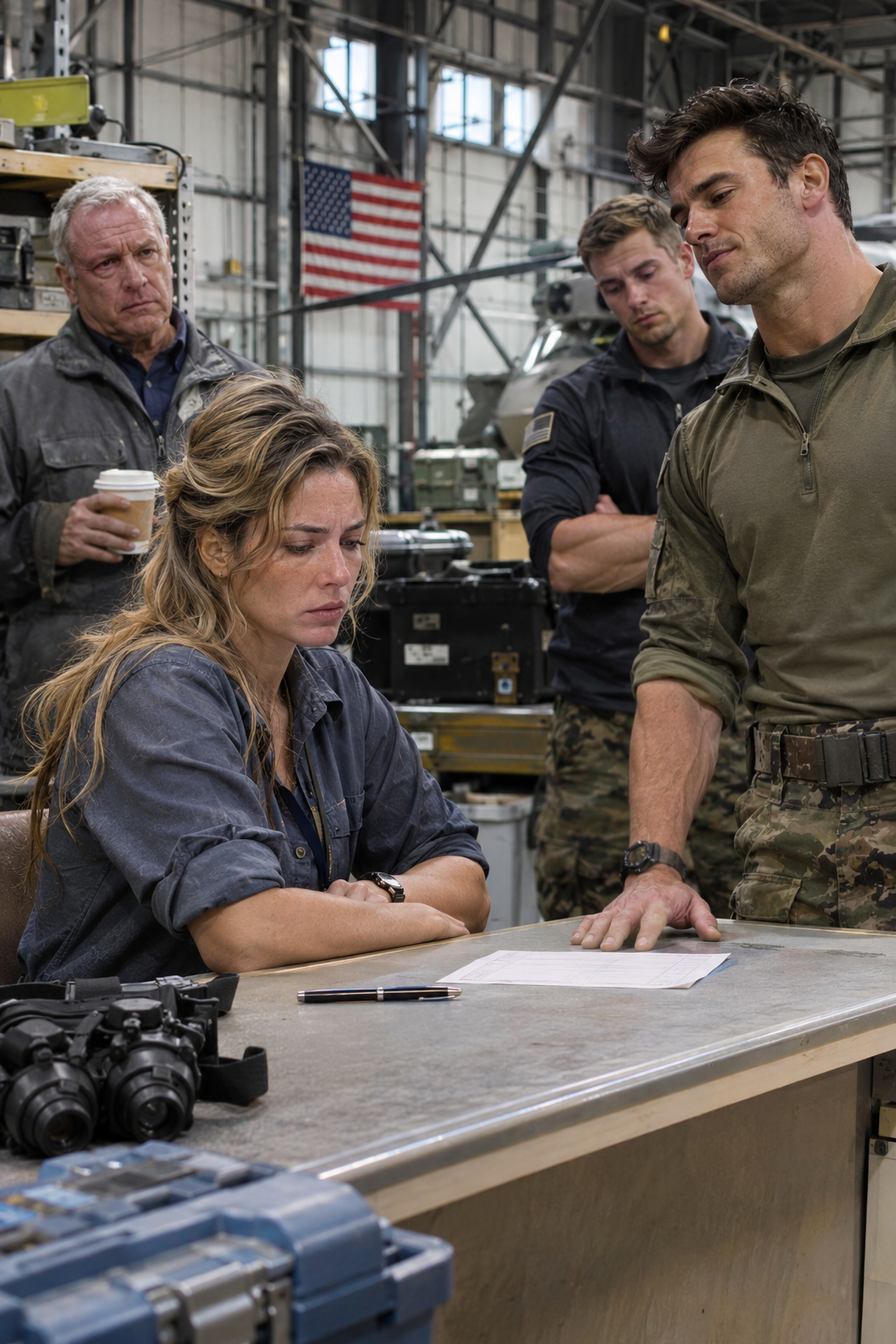
A SEAL called me a “desk clerk” and laughed while his teammates watched, but when a storm swallowed a helicopter over the ridge, I walked toward an old radio nobody believed I knew how to use….
The form hit my counter hard enough to knock my pen onto the concrete. I knew who had thrown it before I looked up. Petty Officer Cole Maddox had spent three days finding new ways to remind me that, to him, I was nothing more than the woman who counted equipment at Harbor Point Naval Air Base.
“Hey, desk clerk,” he said. “I asked for the night gear list an hour ago. Is stamping papers really that hard?” Behind him stood the other members of his SEAL team, twelve men altogether, some smiling and some simply waiting for me to answer.
I retrieved my pen and laid it beside the paperwork. “Your list is ready, Petty Officer Maddox. Crate fourteen, shelf three. The night-vision gear is charged, and the spare radio batteries are in the blue case.”
Cole looked toward the shelves. “You didn’t even check.” I told him I had checked at four o’clock. He gave his teammates a grin and said somebody had to count the staplers, and a few of them laughed.
I kept my face still. I had learned that being accurate and being respected were two different things, and accuracy was the part I could control. When those men went into the field, a missing battery or the wrong piece of equipment would matter more than anything said at my desk.
Above us, a helicopter passed over the hangar roof. Its blades made a deep, steady thudding sound, and my left hand closed around the underside of the counter before I could stop it. I held my breath until the noise faded, hoping nobody would notice.
Chief Walter Doyle noticed. He’d worked on that base for thirty years and had a way of seeing the things other people walked past. He knew I sat where I could see the door, and he knew I could name the pilots without consulting the duty board. He didn’t ask about any of that.
Instead, he brought me coffee and set it beside my pen. “You don’t have to take that from him,” he said, keeping his voice low. I wrapped both hands around the paper cup and told him I’d lived through harder nights than a few rude words.
He waited, as if I might explain what I meant. I didn’t. There were reasons I’d asked for a quiet supply assignment, and I wasn’t ready to explain them to anyone, even a kind man like Chief Doyle.
The SEALs were on a three-day exercise, and every shift brought a new request. I’d found a missing radio component near midnight, corrected boot sizes, and kept their batteries charged. Most of the men barely looked at me. Their commander, Ryan Mercer, never joined in Cole’s jokes, but he was so often away supervising the field training that I doubted he knew what was happening.
Just before nine that evening, rain began ticking against the metal roof. The team gathered by the hangar doors to wait for a weather update, and someone asked Commander Mercer to tell a story. Cole called out, “Tell them about the ghost on the radio.”
I looked down at my work. I had no reason to believe the story concerned me, yet I knew from Mercer’s hesitation that it wasn’t an ordinary campfire tale. When he began, his voice carried across the hangar clearly enough for me to hear every word.
Seven years earlier, he said, his old team had been trapped on a mountain in a whiteout. They couldn’t see their boots, their maps had become useless, and an injured teammate was slowing them down. The route behind them had vanished in the snow, and their radios were failing.
Then one set crackled to life. A woman speaking with a calm voice gave her call sign as Halo. She guided the men around the dangerous ground, ridge by ridge, for six hours until all of them reached the bottom of the mountain alive.
One of the younger SEALs asked who the woman had been. “I don’t know,” Mercer answered. “I looked for her for years. The records were sealed, and the relay station was shut down. I’d give anything to thank her.”
My pen slipped out of my hand. I stared at the counter, hearing that old call sign in a room where I had thought I’d never hear it again. Then I got up and walked through the side door into the rain before anyone could see how badly I was shaking.
Outside, the wind pushed cold water against my face. For seven years, I’d tried to make my life small enough that no one would need anything extraordinary from me. I wanted lists I could double-check, shelves I could straighten, and problems that could be fixed with a fresh set of batteries.
I stayed outside until the storm grew violent. Thunder rolled over Harbor Point, and the wind shook the hangar doors. When I returned, I expected to go straight back to my desk, but everyone was crowded around the radio table.
Captain Leah Morgan, the base commander, was questioning the tower operator. Helicopter forty-one, flown by Lieutenant Nate Brooks, had left the training range carrying two injured trainees. One had twisted his knee badly; the other had a deep cut in his arm and needed medical attention.
They’d taken off just before the storm closed in. Now Brooks was somewhere above the Gray Ridge hills with a failed navigation link, almost no visibility, and radio traffic breaking into scraps of static. The tower could sometimes hear him, but he couldn’t hear their instructions.
One officer wanted to send another aircraft. Another said flying into the storm would put more people in danger. Mercer tried channel after channel and got nothing but hissing noise. Then Captain Morgan asked how much fuel Brooks had left.
“About twenty minutes, ma’am,” the operator said. The room went still, and for the first time since the SEALs had arrived, Cole Maddox had no joke ready. I looked from the useless radio to the far wall of the hangar.
Behind a dusty glass panel sat an old emergency radio station, equipment most people had forgotten was there. I knew its switches. I knew what its signal could do when the newer systems failed, and I knew exactly how it felt to be the only voice someone could hear.
I crossed the floor, opened the glass, and reached for the headset. “Desk clerk, what are you doing?” Cole called. He started toward me, but Chief Doyle stepped between us and said, “Let her.”
Captain Morgan looked at the clock. Eighteen minutes remained. She asked whether I knew how to operate the station, and when I said yes, she told me to do it. I flipped three switches, heard the old equipment begin to hum, and placed the headset over my ears.
My hands, which had trembled at the sound of every passing helicopter for years, became steady on the controls. I pressed the transmit key. “This is Halo,” I said. “Halo to helicopter four-one. Answer on this channel, Nate.” Part 2…..
Final The room behind me went silent. I heard something hit the concrete and break, but I couldn’t turn around to see what it was. I was listening to the static, waiting for one voice.
Then Lieutenant Brooks came through, shaky but unmistakable. “Halo? Is that really Halo? I’ve been calling for ten minutes. I have two passengers and no navigation. I’m blind up here.”
“I have you now,” I told him. “You’re not blind anymore. Listen to me and do exactly what I say.” I asked his altitude, and he answered that he was at eleven hundred feet.
The ridges and valleys around Harbor Point were as clear in my mind as the labels on my supply shelves. I told Brooks to turn left to heading zero-nine-zero and watch for a river bend shaped like a silver hook. “Keep it on your right,” I said.
A moment later he found it. I warned him about the radio tower ahead, a nine-hundred-foot structure with a red warning light at the top. “Climb to fifteen hundred and hold that altitude until you’re past it.” He repeated the instruction and kept moving.
The room’s main lights flickered and went out. The emergency radio stayed alive, and through my headset I heard Brooks say his cabin lights were gone and the fuel warning had come on. His voice was getting thinner.
“I know it’s dark,” I said. “I know that warning is loud. Listen to my voice, not the alarm. You’re four minutes from the field.” Keeping him talking was as important as giving him directions. I could hear him taking breaths between his replies.
I looked toward Mercer. “Commander, get every available vehicle onto the runway. Two straight lines, headlights facing in. Give him something he can see.” Mercer didn’t stop to question me. He turned and shouted for the team to move.
Through the hangar opening I saw men running into the rain. Cole was the first outside, sprinting for a truck. Other trucks and Jeeps followed, along with Chief Doyle’s old pickup, until two lines of headlights shone across the wet concrete.
“I see lights,” Brooks said, his voice breaking. “Halo, I can see them.” I told him that was his runway and asked him to bring the helicopter down slowly. I kept my voice quiet even when all I could hear for several long seconds was wind.
At last the sound of rotor blades rose above the storm. Helicopter forty-one came down through the clouds, wobbled in a gust, and settled onto the landing pad between the lights. I heard cheering in the hangar, but I stayed at the radio until someone confirmed the aircraft was safely on the ground.
Medics ran out with stretchers and brought both trainees to the base clinic. Lieutenant Brooks climbed down into the rain, bent with his hands on his knees, and laughed in the exhausted, disbelieving way people sometimes do when they realize they’re alive.
Only then did I remove the headset. My fingers began to shake again. I rested one hand against the wall and closed my eyes, wishing the sound of those blades didn’t still follow me even after the danger had passed.
When I opened my eyes, Commander Mercer was standing in front of me. His face was wet from the storm, and his voice was rough. “Seven years,” he said. “Halo. It was you.”
I nodded. “I was Lieutenant Hannah Price then. A combat communications officer. That night on the mountain, I was in a cold relay station with a headset and a map. I couldn’t go down the mountain with you, so I talked you through it.”
“You saved my team,” he said. “You saved my life.” I told him that his team had done the walking; I’d only told them where to step. He asked why I’d disappeared, and I finally gave him the answer I’d never given anyone on that base.
After that mountain rescue, every helicopter I heard pulled me back into the relay station. I could hear the men breathing through the static and remember being terrified that one wrong direction might cost someone his life. I didn’t want to be Halo anymore.
So I’d asked for the quietest job I could find. Counting crates and stamping forms weren’t punishments to me. They were ordinary tasks, with ordinary mistakes I could fix, and for years I’d been grateful for that.
The twelve SEALs stood around us, their jackets still wet from the runway. Cole came forward, no grin on his face. “Ma’am, I called you a desk clerk,” he said. “I made jokes about you in front of everybody, every day. I was wrong, and I’m sorry. You did more tonight than I’ve done in my whole career.”
I remembered the way he’d run out first to place those headlights. “You were the first one onto that runway, Petty Officer,” I told him. “That’s what matters.” He looked at me and nodded, as if he understood that I meant it.
Mercer straightened and raised his right hand in a salute. One by one the other men followed. Captain Morgan joined them, and so did Chief Doyle, smiling more broadly than I’d ever seen. I tried to thank them, but my voice barely carried.
Then I straightened my damp uniform and walked back to the supply desk. My pen was waiting where I’d left it. Cole was still nearby, and I said, “Your night gear list is ready, Petty Officer Maddox. Crate fourteen, shelf three.”
Nothing about the shelves had changed, and I still had work to finish. But from that night forward, nobody at Harbor Point called me “desk clerk” again. They called me ma’am. And when they called me Halo, they stood a little straighter.
THE END. I’ve shared the complete story, and I truly hope it touched your heart. If this story moved you, please , like, and share the post. Thank you for reading! ❤️
✓ Lynn R. Adams
A SEAL called me a “desk clerk” and laughed while his teammates watched, but when a storm swallowed a helicopter over the ridge, I walked toward an old radio nobody believed I knew how to use…. The f…