A powerful HOA president demanded $80,000 from a quiet homeowner after her extravagant
Part 2: Years of neighborhood intimidation conceal a dangerous property secret
Karen Whitmore had become president of the Briarwood Estates Homeowners Association seven years before our confrontation, promising cleaner streets, stronger property values, and a more prestigious neighborhood. At first, residents welcomed her enthusiasm because the previous board had neglected repairs, ignored landscaping problems, and allowed the clubhouse to deteriorate. Karen organized volunteer committees, negotiated maintenance contracts, and introduced stricter architectural guidelines that sounded reasonable when presented in glossy newsletters. Within two years, however, those guidelines had become weapons she used against anyone who questioned her decisions. By the time I moved into Briarwood, most homeowners treated receiving a letter from Karen as though they had been summoned before a judge.
My next-door neighbor, Linda Harper, was a retired elementary schoolteacher who had lived in the development for almost twenty years. She once received a $150 fine because a ceramic garden gnome near her roses supposedly violated the community’s aesthetic standards, even though no published rule mentioned garden ornaments. Another couple, newly married and struggling with their mortgage, spent nearly two thousand dollars repainting their porch after Karen repeatedly rejected colors that the architectural committee had already approved. People complained privately but rarely challenged her publicly because the fines multiplied whenever someone demanded an explanation. I learned quickly that Karen didn’t merely want compliance; she wanted everyone to acknowledge that their homes existed under her personal authority.
I had purchased my modest brick house five years earlier after my divorce, wanting a quiet place where I could work, repair old furniture, and enjoy evenings without unnecessary drama. My career required careful documentation, so I kept photographs of every major improvement, copies of every permit, and digital records of my property boundaries. When Karen first inspected my backyard, she commented that my security cameras made the house look like a government facility. I explained that the cameras covered my own property and protected expensive engineering equipment stored in the garage. She smiled tightly and said, “People with nothing to hide usually don’t need that much surveillance.”
The real trouble began when Karen announced her wedding plans at a spring HOA meeting. She intended to marry Richard Whitmore, a successful regional sales executive, and wanted the ceremony held at the renovated clubhouse she frequently described as her greatest achievement. The association had spent substantial money updating the building, installing decorative lighting, improving the outdoor reception area, and upgrading electrical equipment. Karen proposed closing the clubhouse grounds for an entire Saturday, including the pool, playground, and walking paths used by dozens of families. She presented the closure as an administrative decision rather than a request requiring approval from the homeowners who collectively owned the facilities.
I sent a polite email asking whether the governing documents permitted an individual board officer to reserve every common area for a private event without a formal vote. I also requested clarification about rental fees, insurance coverage, and whether association funds would be used for wedding-related expenses. My message contained no insults, threats, or accusations, but Karen apparently interpreted it as a declaration of war. Within fourteen days, I received three violation notices, including one claiming my hedge exceeded the permitted height despite photographs showing it had been trimmed. When I requested the board resolutions authorizing the fines, the management company failed to produce them.
That was when I started keeping a separate file labeled “Briarwood HOA Discrepancies,” although I still believed I was dealing with ordinary administrative bullying. I photographed my lawn, recorded inspection dates, preserved emails, and documented every interaction with Karen or her representatives. Occasionally, I noticed maintenance workers near the rear edge of my property, apparently inspecting utility infrastructure that I assumed belonged to the neighborhood. Once, a contractor stopped working abruptly when he saw me approaching and claimed he had been checking an irrigation connection. I remembered the encounter only because he looked unusually nervous, but months later, that seemingly insignificant moment would become one of the first clues to a secret buried beneath my garage.
Part 3: A midnight recording reveals the bride’s shocking secret intrusion
On Karen’s wedding night, I returned home from a construction inspection at approximately p.m., exhausted after spending ten hours evaluating structural damage at a commercial property. I parked my truck, heated leftover pasta, and settled into my office to review calculations for a client who needed a report the following Monday. Through my kitchen window, I could see distant decorative lights above the clubhouse, and occasionally the evening breeze carried faint music across the neighborhood. Around , the music stopped abruptly, followed by scattered voices and the unmistakable sound of people reacting to an unexpected interruption. I assumed a speaker had failed, closed the window, and continued working.
The following morning, neighborhood social media was overflowing with photographs and complaints about the wedding blackout. According to several guests, the outdoor lighting and sound system had failed during the reception, forcing staff to bring in portable equipment while guests waited in darkness. Some people left early, others continued celebrating inside, and one guest uploaded a video showing Karen angrily demanding to know where I was. That recording disturbed me because she had apparently accused me before anyone investigated the electrical failure. Still, I never imagined she would appear at my home three days later demanding compensation.
After Karen’s visit, I opened my security archive and began reconstructing the evening minute by minute. My driveway camera showed my truck arriving at , while another recorded me carrying my work bag through the front door. The cameras covering the side yard, rear fence, and garage showed no evidence that I had left the property afterward. At , the approximate time of the blackout, I was visible through the garage’s interior camera retrieving a tool from a storage cabinet. Those recordings alone contradicted Karen’s claim that I had traveled to the clubhouse to sabotage its electrical system.
Then I reached footage recorded at 10:12 p.m., and everything changed.
A black SUV stopped outside my front gate, its headlights briefly illuminating the mailbox before the driver switched them off. A woman emerged wearing a white wedding gown, gathering the long skirt in one hand as she hurried toward my property. Even before she lifted her face toward the camera, I recognized Karen by her hairstyle, jewelry, and unmistakable posture. She opened a small clutch purse, removed a key, and unlocked my gate without hesitation. I froze the recording, enlarged the image, and stared at the screen because I had never given Karen permission to enter my yard, much less provided her with a key.
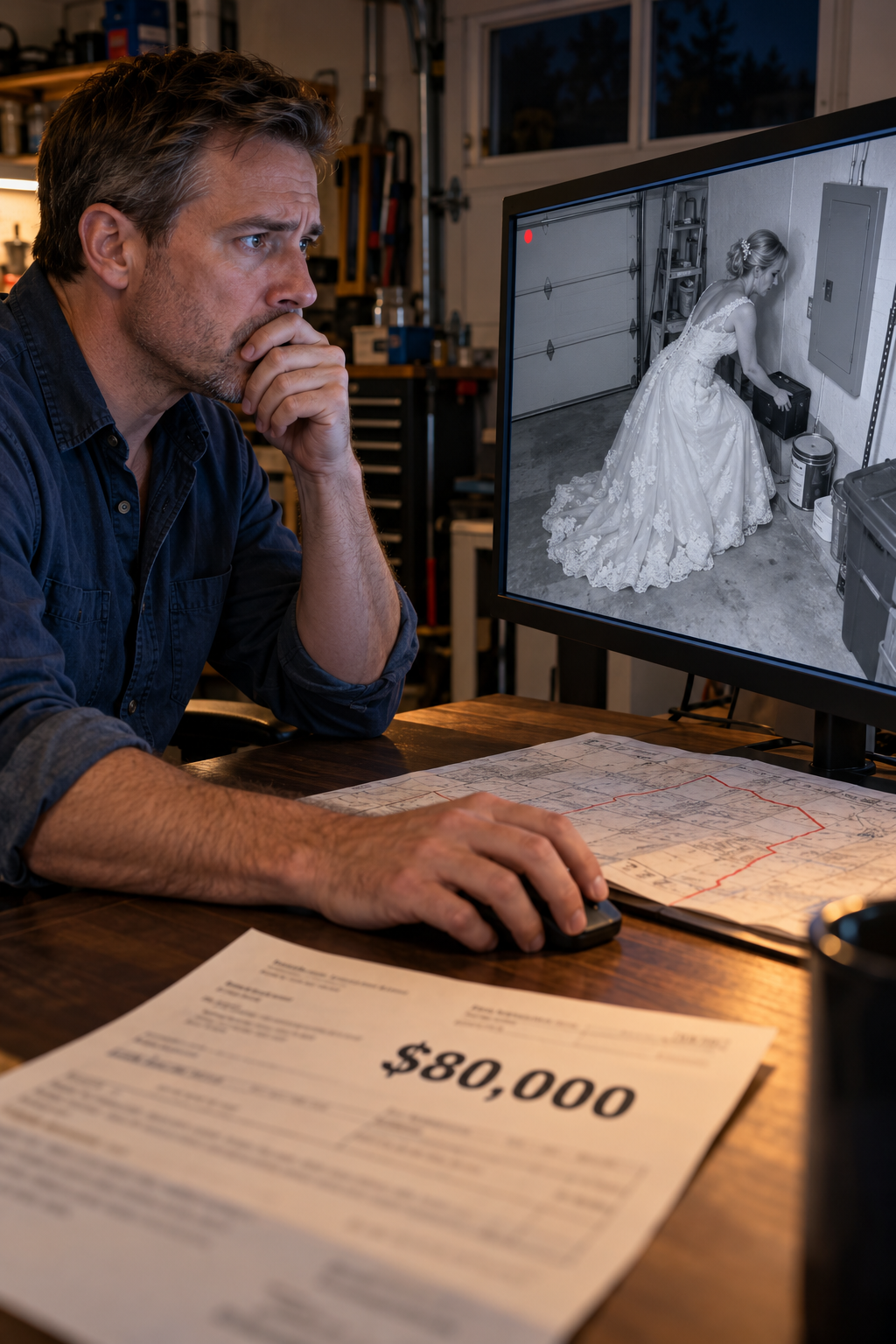
The next camera showed her moving directly toward my garage, where she tried the side door before approaching a narrow window. She pushed the window upward, climbed through the opening, and disappeared into the building while still wearing the gown from her reception. Inside, she searched several drawers, examined a cabinet containing electrical diagrams, and briefly studied a set of documents stored beside my workbench. Then she removed a small black case from her purse and placed an unfamiliar electronic device behind an old paint container near the electrical panel. After approximately six minutes, she climbed back through the window, locked the gate behind her, and drove away.
I replayed the footage repeatedly, struggling to understand why a newly married woman would leave her own reception to break into a neighbor’s garage. I immediately checked the location shown in the video and discovered a compact black device tucked behind the paint container exactly where she had placed it. Rather than touching it, I photographed the area and called my longtime friend Marcus Doyle, a licensed electrician with extensive experience in commercial power systems. After reviewing the images, Marcus warned that the device appeared capable of interfering with certain electrical controls, although its precise function would require professional examination. I contacted an attorney that evening, suddenly realizing that Karen’s accusation was not simply about recovering wedding expenses; someone had entered my home and planted suspicious equipment where investigators might later find it.
Part 4: An abandoned utility map uncovers corruption beneath my own home
My attorney, Daniel Mercer, arrived the next morning with a legal pad, a portable scanner, and the expression of a man who understood that ordinary neighborhood disputes rarely involved covert garage entries. He watched the security footage without interrupting, then asked me to explain the chronology of Karen’s allegations and the clubhouse outage. When I finished, he pointed out a detail I had almost overlooked: the blackout began more than thirty minutes before Karen entered my garage. Whatever the device was intended to accomplish, the footage did not support the idea that she had used it to cause the original outage. That distinction made her actions more mysterious, because she appeared to be constructing evidence after an event she had already decided to blame on me.
Daniel recommended preserving the original recordings, documenting the device without disturbing it, and arranging an independent technical inspection. He also advised me to review the HOA’s governing documents, particularly anything involving utility access and maintenance responsibilities. I spent the afternoon searching through old property records left by the previous owner, a retired contractor named Walter Pierce. Most of the documents concerned drainage, foundation repairs, and minor boundary adjustments, but at the bottom of a dusty filing cabinet I discovered a folded neighborhood utility map. One faded red line crossed several residential lots before terminating near the exact location of my garage.
At first, I assumed the drawing represented an abandoned electrical route, because the map was nearly thirty years old and the neighborhood had undergone multiple renovations. However, when Marcus examined it, he recognized markings associated with a secondary supply line serving the clubhouse’s outdoor facilities. We compared the diagram with current utility information and discovered that a buried electrical connection appeared to cross my property without any obvious recorded easement. Daniel arranged for a licensed surveyor, Diane Reyes, to review county documents and verify the boundary history. Three days later, Diane sat at my kitchen table surrounded by maps that would fundamentally change my understanding of why Karen had targeted me.
“The original utility corridor ran along the eastern boundary,” Diane explained, tracing a straight line across an older survey. She placed a later filing beside it, revealing that the corridor had somehow shifted approximately forty feet into private residential property. The altered route crossed my backyard and approached the garage, yet the recorded documents lacked the property-owner signatures normally required to establish such access rights. Diane couldn’t immediately determine who had initiated the change, but she identified inconsistencies that justified further investigation. The most troubling detail was that the altered filing had been incorporated into later HOA maintenance records as though its legitimacy had never been questioned.
Daniel obtained additional records showing that Karen had been informed of the utility discrepancy almost a year before her wedding. An internal message from the management company warned that the association might lack valid authorization to maintain portions of the buried line crossing privately owned lots. Instead of notifying homeowners or commissioning a proper legal review, Karen had requested that the records be updated administratively to reflect continued access. Another document estimated that rerouting the electrical infrastructure could cost several hundred thousand dollars, potentially requiring a substantial special assessment against every homeowner. Suddenly, her obsession with controlling my property made terrible sense.
If I discovered the unauthorized line, I could demand a lawful resolution, forcing the HOA to confront an expensive problem Karen had concealed during her presidency. Her celebrated clubhouse renovation might be exposed as relying on infrastructure the association had no clear right to operate. The blackout had given her an opportunity to portray me as a dangerous troublemaker while pressuring me into a settlement that might include broad releases affecting my property rights. Daniel looked across my kitchen table and said, “Everett, I don’t think she’s primarily interested in your eighty thousand dollars.” He tapped the old survey and added, “I think she’s terrified of what happens when you realize what belongs to you.”
Part 5: The president retaliates as seventeen cameras dismantle her carefully constructed lies
We responded to Karen’s demand with a formal letter rejecting every accusation and requesting preservation of all wedding-related records, utility maintenance documents, and HOA communications. Daniel included selected evidence establishing that I had remained home during the blackout and that Karen had entered my garage without authorization later that evening. He also demanded an explanation for the suspicious device and the apparent discrepancies involving the buried electrical line. We did not distribute the recordings publicly because Daniel wanted to preserve their evidentiary value and avoid turning the dispute into a social media spectacle. I believed the documents would finally convince Karen to withdraw her allegations, but her reaction was far more aggressive than I expected.
Within forty-eight hours, the HOA issued another series of violations against me, including a vague accusation of conduct detrimental to community harmony. Karen circulated a letter claiming that I had harassed board members and threatened essential neighborhood infrastructure, allegations I considered both false and deliberately inflammatory. Several neighbors stopped greeting me, apparently convinced I had endangered their homes by challenging the association. One evening, someone left an anonymous note on my windshield reading, “Pay what you owe and leave everyone alone.” For the first time since moving to Briarwood, I began wondering whether defending my property would cost me the peaceful life I had worked so hard to build.
Daniel advised me to document every incident and avoid direct confrontation, explaining that retaliatory conduct could become relevant if litigation followed. We filed a police report concerning the unauthorized garage entry and provided copies of the security recordings, while an independent technician examined the device under controlled conditions. The preliminary assessment suggested it could interfere with certain electrical control signals, but there was no evidence it had caused the wedding blackout or had ever been activated. That finding strengthened the conclusion that Karen had planted it for another purpose, although her precise intention remained uncertain. I found the uncertainty almost more unsettling than the accusation itself.
Meanwhile, Diane uncovered additional irregularities in the association’s property records, including two other utility access routes whose supporting documents were incomplete. Daniel’s review of the HOA bylaws also revealed that several fines Karen had issued against me lacked the required authorization or procedural documentation. When we requested a hearing before the full board, Karen responded by scheduling an emergency disciplinary meeting at the clubhouse. The notice accused me of undermining community operations and warned that additional enforcement measures could follow. I accepted the invitation immediately because I had spent months watching Karen use private intimidation to silence homeowners, and I wanted the board to hear facts she could no longer control.
A week before the hearing, Linda Harper knocked on my door carrying a folder filled with old HOA notices. She told me Karen had fined her repeatedly after she questioned a landscaping contract awarded to a company connected with one of Karen’s acquaintances. Linda had never pursued the matter because she feared legal expenses, but seeing what was happening to me convinced her that silence had become part of the problem. Over the next several days, three more residents shared similar experiences involving questionable penalties, denied appeals, and unexplained financial decisions. Their stories didn’t prove every suspicion we had, but they revealed a pattern of governance that deserved independent scrutiny.
On the evening of the hearing, I entered the clubhouse carrying a slim evidence binder while Daniel walked beside me with a laptop and several authenticated recordings. Every chair was occupied, and people stood along the walls beneath the same decorative lights that had illuminated Karen’s wedding. Karen sat at the front beside Preston Cole, wearing a navy suit and an expression of practiced confidence. She smiled when she saw me, apparently expecting an embarrassed homeowner ready to bargain for mercy. What she didn’t understand was that I hadn’t come to negotiate with her; I had come to show everyone exactly what her authority had been hiding.
Part 6: A crowded HOA hearing witnesses the bride’s devastating public exposure
Karen opened the emergency hearing with a lengthy speech about loyalty, responsibility, and the importance of protecting Briarwood Estates from individuals who placed personal grievances above community welfare. She described her wedding as a cherished family occasion deliberately destroyed by a resentful neighbor who had challenged her leadership for months. According to her account, I had interfered with the electrical system, humiliated her before two hundred guests, and then attempted to intimidate the board when asked to accept responsibility. She presented the eighty-thousand-dollar demand as a reasonable effort to recover damages and defend the association’s reputation. Several residents nodded sympathetically, and I could see that Karen still possessed the ability to make accusations sound like established facts.
When she finished, Daniel stood and requested permission to present four brief video recordings before the board considered any disciplinary action. Karen objected, claiming that private surveillance footage was irrelevant to the association’s authority, but other board members insisted on seeing the evidence. The first recording showed me arriving home at p.m. and remaining on my property throughout the period surrounding the blackout. The second showed Karen’s black SUV stopping outside my gate at 10:12, long after the reception had lost power. The third showed her using a key to enter my yard and climbing through the garage window.
A low murmur spread through the room, but the fourth recording brought complete silence. On the screen, Karen moved through my garage, opened storage drawers, and placed the mysterious black device beside my electrical panel before leaving through the window. Someone near the back whispered, “She’s still wearing her wedding dress,” and the observation seemed to make the footage even more extraordinary. Karen stared at the screen, her face draining of color as the recording ended. For several seconds, nobody spoke, and even Preston appeared uncertain how to respond.
Finally, Karen claimed she had been conducting an emergency inspection of HOA infrastructure after the clubhouse power failure. Daniel asked why such an inspection required entering a private garage through a window without contacting the homeowner or obtaining permission. Karen insisted that the association possessed access rights to the electrical equipment, which allowed Daniel to introduce Diane’s survey findings. He displayed the original utility route, the altered filing, and the absence of a valid recorded easement authorizing the line beneath my property. Then he presented correspondence indicating that Karen had known about the discrepancy long before the wedding.
Renata Brooks, a longtime board member who had rarely challenged Karen publicly, leaned forward and asked whether the president had disclosed those concerns to the full board. Karen replied that the issue had been handled administratively and that discussing it earlier would have created unnecessary alarm among residents. Renata asked a second question, quieter than the first: “Did you know the association might be using Everett’s land without permission when you started fining him?” Karen looked toward Preston, but her attorney could not answer a factual question directed at his client. The room began filling with angry voices as homeowners demanded explanations for the concealed records and the financial exposure they might face.
Daniel urged the board not to make immediate findings about criminal intent or the electrical device without a complete investigation, but he emphasized that the video established unauthorized entry requiring a serious response. He also requested that Karen recuse herself from any decision involving my property or the allegations she had made against me. After a tense discussion, the remaining board members voted to postpone the disciplinary action and appoint an independent committee to review the utility records and disputed fines. Karen abruptly gathered her papers and left before the meeting concluded, with Preston following several steps behind. As she passed my chair, she leaned close and whispered, “You think you’ve won, but you have no idea what you’ve started.”
Part 7: A courtroom confrontation destroys the final defenses of Karen’s empire
The emergency hearing changed the atmosphere of Briarwood almost overnight, but it did not end the dispute. Karen refused to withdraw her demand, and her attorney continued arguing that my conduct had contributed to the wedding disaster despite the absence of evidence placing me near the clubhouse. Daniel filed a civil action seeking relief for unauthorized entry, property interference, and the harm caused by the accusations, along with a judicial determination of the association’s utility rights. The HOA’s management company was drawn into the proceedings because its records and communications were central to the easement controversy. What Karen had presented as a straightforward claim for wedding expenses became a complicated legal battle involving property law, association governance, and alleged misconduct.
Discovery revealed documents that Karen had apparently assumed would remain buried in the management company’s archives. One email, sent months before the wedding, instructed a maintenance contractor to avoid discussing the underground electrical line with me while repairs were scheduled near my property. Another showed that Karen had requested revised access records without obtaining written consent from affected homeowners. Financial records indicated that the clubhouse renovation had already exceeded its approved budget, making the potential cost of rerouting utilities particularly dangerous for the association. The evidence suggested that Karen had been trying to contain a growing financial and legal problem long before the reception lights went dark.
The investigation also clarified the original electrical failure, although it did not provide Karen with the answer she wanted. Independent technicians found that aging equipment and an overloaded outdoor distribution circuit were consistent with the blackout experienced during the wedding. The device recovered from my garage showed no signs of activation, and no credible evidence connected me to the outage. Marcus testified about the device’s possible capabilities while carefully distinguishing those possibilities from anything that had actually occurred. His explanation undermined the suggestion that the object proved sabotage, while leaving Karen to explain why she had placed it in my garage.
During her testimony, Karen initially maintained that she had entered my property to protect shared infrastructure during an emergency. Daniel questioned her about the timing, asking why she had waited more than half an hour after the blackout, traveled away from her reception, and entered through a window instead of contacting emergency maintenance personnel. He then asked why she had carried an unfamiliar electronic device and concealed it behind a paint container. Karen repeatedly insisted that her actions had been misunderstood, but her explanations shifted as the questioning continued. When confronted with the earlier correspondence about the buried utility line, she acknowledged that she had been aware of unresolved access questions and had hoped to resolve them without involving homeowners.
The most damaging testimony concerned a proposed settlement document Karen’s representatives had sent after the initial demand. Although it appeared primarily concerned with wedding damages, the agreement included broad language releasing claims related to association property access and existing utility installations. Daniel explained that signing such language could have compromised my ability to challenge the line beneath my garage, even though the settlement amount had supposedly been calculated for wedding expenses. Karen denied intending to deceive me, but she could not explain why a dispute about a ruined reception required concessions involving underground infrastructure. The connection between her financial demand and the concealed easement problem was now visible to everyone.
When the judge issued her decision, she rejected the eighty-thousand-dollar claim because the evidence failed to establish that I had caused or contributed to the wedding outage. The court also found that Karen had entered my property without permission and that her claimed association authority did not justify entering a private garage. Regarding the buried electrical line, the court determined that the HOA had not established a valid legal right to continue using the disputed route without obtaining appropriate authorization. The association was required to resolve the access problem through lawful agreement or alternative infrastructure arrangements, and certain litigation costs were allocated to the responsible parties. Karen left the courthouse without speaking to reporters or residents, while I stood beside Daniel feeling not victorious, but exhausted by how far one woman’s determination to control others had carried us.
Part 8: A fallen president leaves behind consequences nobody can escape
Within two weeks of the ruling, Briarwood’s board convened a special meeting to consider Karen’s continued leadership. Residents who had once avoided HOA gatherings crowded into the clubhouse, carrying folders of disputed fines and questions about years of financial decisions. Renata Brooks presented a motion of no confidence, explaining that the association could not rebuild trust while its president remained unwilling to acknowledge serious failures in judgment. The vote passed overwhelmingly, ending Karen’s seven-year presidency in less than an hour. For a woman who had spent years treating the neighborhood as her personal kingdom, the loss of authority was devastating.
The following afternoon, I stopped by the clubhouse to deliver copies of the updated property survey requested by the new board. Karen was inside the former president’s office, packing binders, framed certificates, and photographs documenting her years of community service. The room looked strangely ordinary without the confident visitors and endless paperwork that had once surrounded her. She noticed me standing near the doorway and stopped packing, her expression shifting from surprise to resentment. “You destroyed everything I spent seven years building,” she said, gripping a cardboard box against her chest.
I considered telling her about the sleepless nights, the legal expenses, the anonymous threats, and the fear that my home might become the center of a financial nightmare. I wanted her to understand what it felt like to be accused publicly of something you hadn’t done, then threatened with losing property you had worked decades to afford. But looking at her standing in that empty office, I realized that another argument would accomplish nothing. “I didn’t destroy your work, Karen,” I answered quietly. “I stopped you from using it to destroy other people’s lives.”
The new board commissioned an independent audit covering financial records, architectural approvals, violation notices, and utility agreements. Investigators found that a significant portion of the fines issued during Karen’s final three years lacked sufficient documentation or proper authorization. Several residents received refunds, including Linda Harper, who cried when a letter arrived acknowledging that some of her penalties should never have been imposed. The association also identified additional utility access problems and began negotiating lawful agreements rather than pretending old paperwork could resolve every dispute. Repairing those problems required money, patience, and difficult conversations, but residents finally had access to the information necessary to make informed decisions.
Karen’s personal life deteriorated as the consequences spread beyond the association. Richard, her husband, had entered the marriage believing he was joining a respected community leader whose accomplishments were admired throughout Briarwood. Instead, he found himself listening to testimony about intimidation, concealed records, and a bizarre midnight visit to another man’s garage on their wedding night. Their relationship became strained, and eventually they separated after months of disagreements about what had happened and why Karen had refused to tell him the truth. She sold her house the following spring and moved away without the elaborate farewell celebration she once would have expected.
I continued working as an engineer, although the experience changed how I approached my own neighborhood. I attended more HOA meetings, reviewed proposed budgets, and encouraged residents to ask questions before approving expensive projects. When several homeowners suggested I run for president, I declined because I had no desire to replace Karen as the person everyone depended upon for decisions. Instead, I supported reforms requiring transparent records, documented votes, reasonable appeal procedures, and independent review of significant contracts. The changes were less dramatic than a courtroom victory, but they offered something far more valuable: a system designed to prevent another person from accumulating unchecked authority.
One evening, almost eighteen months after Karen first appeared on my porch, I stood beside the repaired fence and watched the neighborhood settle into the golden light of sunset. Children rode bicycles along the sidewalk, Linda watered her roses, and the clubhouse lights glowed steadily in the distance. My phone displayed a message announcing that the new governance policies had been approved unanimously, including clearer limits on board authority and stronger protections for homeowners. I looked toward the security camera above my gate and remembered the cream-colored envelope, the seventy-two-hour ultimatum, and the frightening realization that someone had entered my garage while I was working inside my own house. For the first time in a long while, the memories no longer made me angry, because the truth had survived every attempt to bury it.
I had never wanted to become the neighborhood’s hero, and I certainly hadn’t wanted to spend months in court defending myself against a ruined wedding I hadn’t attended. All I had wanted was to live peacefully in the home I had purchased, maintain my property, and be treated with the same respect I offered my neighbors. Karen had mistaken my silence for weakness, my politeness for submission, and my unwillingness to fight for an invitation to take whatever she wanted. She believed eighty thousand dollars would frighten me into surrendering rights I didn’t even realize were threatened, but her demand led directly to the evidence that exposed her. In the end, the greatest damage from Karen Whitmore’s wedding wasn’t caused by the darkness that swallowed her reception; it was caused by the truth that finally came into the light.
✓ Lynn R. Adams
Part 2: Years of neighborhood intimidation conceal a dangerous property secret Karen Whitmore had become president of the Briarwood Estates Homeowners Association seven years before our confrontation…