A perfume built from Clara Holloway’s bridal bouquet arrives at her door, commissioned for her husband’s
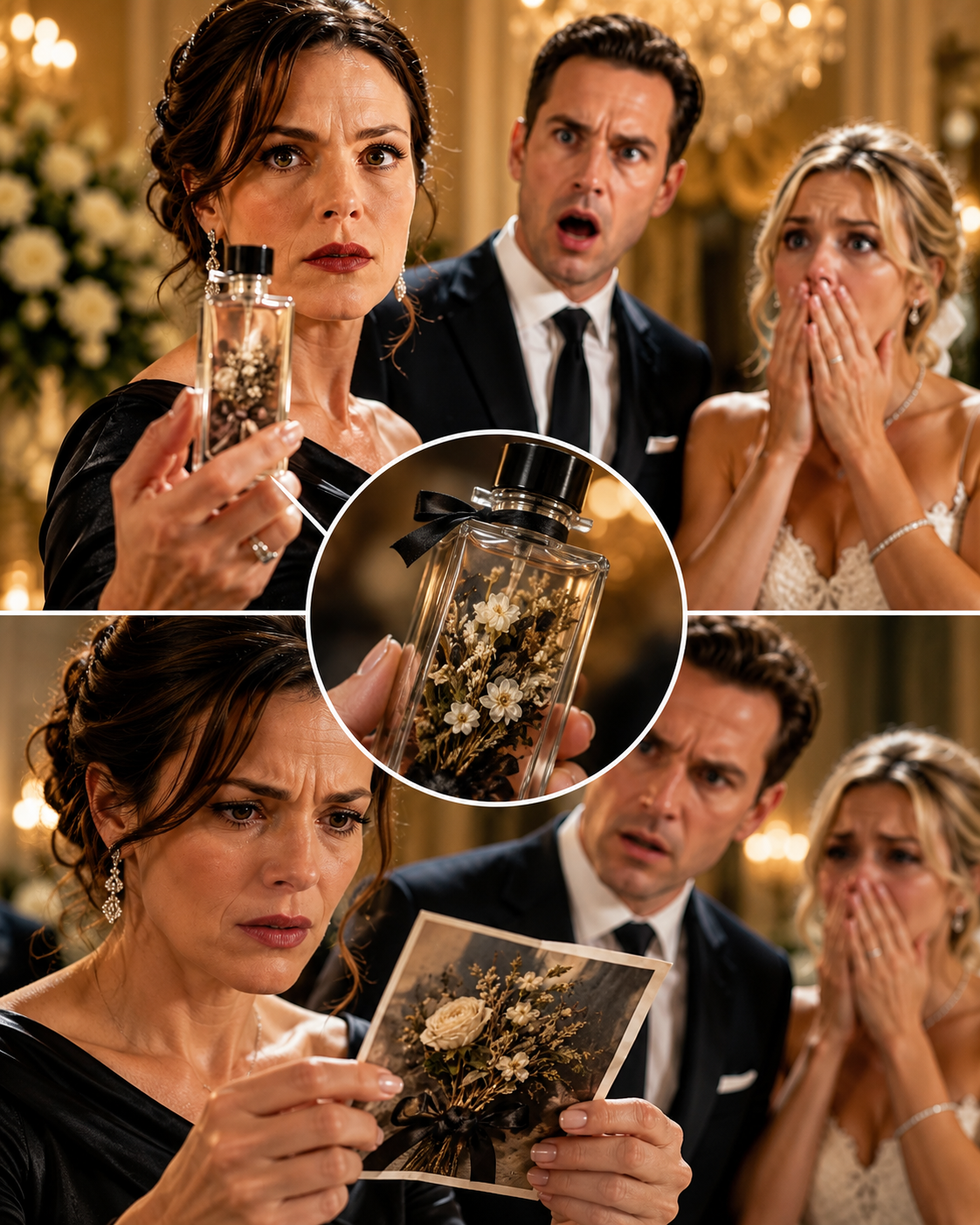
Part 2: The perfumer knew my husband had been making me sick
I went upstairs and opened the drawer where Grant insisted I keep my medication. There were amber bottles for anxiety, sleep, and migraines, all prescribed by Dr. Warren Bell, Grant’s college roommate. I remembered headaches that worsened whenever Grant brought home flowers, the dizziness that began after Sloane sent a scented candle, and the nights Grant watched until I swallowed each pill. I carried the bottles downstairs and locked them in my mother’s writing desk. At 11:17, I left through the service entrance, took a cab instead of the town car, and went to meet the one man Grant had not selected.
Elias was waiting at the darkened atelier, beneath a brass lamp, with one hand resting on the lock. He looked older and sharper than he had at my wedding consultation, but when he saw me, relief crossed his face before he could hide it. He led me into a private laboratory lined with dark cabinets and glass bottles labeled with ingredients. When he asked which sample I had opened, I told him I had opened the first but had not touched the liquid. He said that was good, then explained that the formula contained my original perfume altered by three sets of instructions.
Sloane had approved the floral profile, Grant had requested the base notes, and a third party had supplied an undisclosed “stabilizing compound.” Elias had no idea what it was, which was why he had warned me not to wear the scent. He sent a sample to an independent laboratory while I asked why he had waited five months to tell me about the commission. Grant’s attorney had argued the formula was marital property, but Elias showed me the original contract: I had commissioned and paid for it from my personal account. The formula belonged to me, a small fact that felt unexpectedly intimate because almost everything else in my life seemed to have been taken over.
Elias showed me my original consultation notes, including the flowers from my mother’s garden, the ivy outside my childhood bedroom, and the black tea sewn into my bouquet. On the last page, I had written, “I want to smell like myself, only braver.” Elias remembered the sentence, along with a note he had made to watch my eyes when I disagreed because I smiled before speaking. I asked why he had kept such personal details, and he admitted he had been in love with me before I married Grant. He had not told me then because he believed his feelings did not give him the right to interfere with my life.
His computer showed that Grant had personally requested my old fragrance-sensitivity records. The compound added to Sloane’s perfume was a synthetic jasmine that had once caused me headaches, now concentrated enough to trigger a strong reaction. I thought of the diffusers in our bedroom, the candles, and the flowers Grant had begun placing beside my bed. Elias said the compound might explain the headaches and that we needed to have my prescriptions tested too. Then my phone lit up with messages from Grant demanding to know where I was, followed by a warning not to do anything embarrassing.
Part 3: My illness had been built from pills and perfume
Elias gave me a plain black phone with only his number programmed into it. He had prepared a secure apartment, arranged independent legal counsel, and contacted a physician unconnected to Grant. When I asked how long he had been preparing, he said he had arranged it five months earlier, after learning that Sloane had requested a version of my fragrance. His care felt excessive, even frightening, but he admitted it was an obsession he had to govern rather than a virtue I had to endure. I asked him to take me to the doctor, and he did.
Dr. Naomi Feld examined me for nearly two hours, drawing blood, documenting bruises on my arms, and reviewing every prescription Grant had managed. She said the dosages should never have been combined without close supervision, especially alongside a known migraine trigger. I asked whether they could cause memory loss, confusion, tremors, and emotional flatness, and she answered yes to each question. She ordered further tests and told me not to return home alone. I laughed, because Grant had spent months telling everyone I should never be alone, while quietly making sure I could not trust myself.
The test results arrived two days later and showed that two of my prescription bottles did not contain what their labels claimed. One held a sedative at more than twice the prescribed strength, and another contained a drug used for severe mood disorders, though I had never been diagnosed with one. Combined with sleep medication and repeated exposure to the jasmine trigger, the effects could explain nearly every symptom I had experienced. Dr. Feld documented the findings, and attorney Vivian Shaw filed an emergency challenge to Grant’s attempt to have me declared incapacitated. Vivian told me not to confront him again, because he still believed I was disoriented and did not know how much I had discovered.
Then Vivian found that Grant had filed for divorce three months earlier in Connecticut, claiming I had abandoned our home and could not be located. The record said I had been served at a private treatment facility I had never visited. Grant was manufacturing an alternate version of my life: one in which I was absent, unwell, and unable to challenge him. As Vivian began preparing to expose the forged filing, my new phone rang from a blocked number. Sloane was on the line, asking if we could talk, because she had something I needed to see.
We met in the Mercer Hotel conservatory, where Vivian placed an investigator nearby and Elias stayed within sight. Sloane said Grant had told her I was in treatment after another breakdown, and that he had shown her an order proving our divorce was final. I reminded her I had attended foundation dinners with both of them only weeks earlier. She looked frightened, not merely embarrassed, and admitted she had wanted to believe Grant’s version because it gave her the future she wanted. Then she opened a white leather folder and showed me dozens of photographs of myself, some taken years before she met Grant.
Part 4: The bride had been rehearsing my life for years
The photographs documented my clothes, habits, favorite tea, and the small movements Grant claimed proved I was unstable. Sloane admitted she had taken some of them after Grant asked her to research my “patterns.” She had met him three years earlier, not eighteen months ago, and had been following me before she became a foundation employee. Other photographs showed her in bridal fittings, wearing a silk gown with a neckline like mine, carrying white peonies and ivy, and posing in my mother’s garden. “You weren’t replacing me,” I said. “You were rehearsing me.”
Sloane said Grant had sent the designer photographs from my wedding and insisted that the bouquet reflect a Holloway family tradition. The black tea, however, belonged to my mother, not his family. Sloane had thought the imitation was romantic because Grant told her I had abandoned the marriage and would never return. She had also found copies of my prescriptions and the schedule for the incapacity petition. When I asked why she still intended to marry him, she admitted she had only just understood what the documents meant.
She played a recording she had made of Grant discussing the plan with Dr. Bell. Sloane asked what would happen after the trust transferred, and Grant replied, “We move forward.” When she worried the medication could hurt me, Grant said I had been hurting myself for years and they were merely making sure other people could see it. Another recording captured Dr. Bell warning that the perfume’s concentration was higher than the original trigger. Grant answered that it needed to produce a visible reaction at the tasting dinner, where witnesses could see me collapse.
The hotel doors opened, and Grant entered the conservatory before I could absorb the recordings. He came toward me with the familiar warmth he used in public, saying I had caused enough concern and should come home. When he reached for my arm, Elias caught his wrist before he touched me. Grant accused Elias of wanting me for years, and Elias answered yes, but said that wanting me never made me his. I told Grant I was already home, and reminded him that the townhouse, the Hudson estate, and the foundation were mine.
Then I told him to keep the date, the flowers, and every guest on the wedding list. I would attend the rehearsal dinner and let the truth speak in front of the people he had invited to witness my humiliation. For the next twenty-six days, I disappeared exactly as Grant expected, while Vivian challenged the incapacity petition and filed sealed motions on medical fraud and forged service. I stopped the altered medication and avoided the scented products; within days, the headaches faded, my hands stopped trembling, and my memory sharpened. Sloane agreed to cooperate publicly, then returned to Grant, who believed she had panicked and was now ashamed.
Part 5: I let him finish building the stage for his own ruin
Grant continued planning the wedding at my Hudson estate, restoring the stone fountain and converting my childhood bedroom into a bridal suite for Sloane. He ordered the same white peonies my mother had grown and sent every update through the private wedding portal. I read them all, though Elias warned that watching Grant rebuild my wedding was hurting me. I told him pain was information, and he replied that sometimes pain was only pain. In the laboratory after midnight, he finally told me he wanted me to stop treating endurance as the only proof of strength.
I challenged his own behavior: the apartment prepared five months ahead, my clothing size remembered for eight years, and every note I had written preserved in a file. He admitted it was obsession, but said it was his to govern, not mine to survive. Grant had described control as devotion, choosing my clothes, answering for me, and managing my medication because he claimed I was forgetful. Elias wanted me just as intensely, but he named his desire and respected the boundaries around it. I kissed him because I wanted to, not because I needed a rescuer, then told him I would decide what I wanted after the wedding.
The rehearsal dinner was held beneath the glass atrium, filled with trustees, investors, reporters, and political donors. I arrived in my mother’s black silk dress, while Vivian, investigators, attorneys, and a forensic accountant waited inside. Conversations stopped as I entered, and Grant crossed the room with the public smile of a husband welcoming a fragile wife. Sloane stood beside him in ivory, styled to resemble the bride I had been eight years earlier. I told her she looked beautiful, and she returned the compliment with fear in her eyes.
At dinner, I was seated beside Dr. Bell, who sweated through the first course when I said I had changed doctors. Grant and Sloane then presented a film about their relationship, showing my garden, my fountain, my mother’s library, and the ivy arch where I had married Grant. The title read, “Continuity: A Love That Begins Again.” Grant said some people believed a second chance required destroying the past, while he and Sloane believed the past could be honored as they made room for the future. Then Sloane stopped reading her prepared speech and told the room that the flowers, estate, foundation, and perfume formula all belonged to me.
The wedding film vanished from the screen, replaced by the fraudulent divorce filing, altered prescriptions, incapacity petition, and perfume order bearing Dr. Bell’s supplier code. Vivian stood and called the scheme fraud; two investigators moved to the doors. Dr. Bell tried to deny knowing anything about forged documents, but the recording played his own voice discussing the perfume concentration and Grant’s insistence on a visible reaction. Grant claimed the recording was manipulated, until another captured his line about making people see me as unstable. The room went silent, and I stood to say I was healthier than I had been in months.
Part 6: The rehearsal dinner became the evidence Grant feared
Grant accused me of involving the foundation and said I was not well, using the same word that had trapped me for months. I answered that I was healthier because I had stopped taking the pills he gave me and removed the scented products he had brought into my home. He said he had only wanted to protect what we built, but each justification revealed another theft: he had drugged me, forged documents, and tried to seize my trust. When he said I was nothing before him, I reminded him that everything he stole already had my name on it. Vivian announced the emergency order removing him from foundation operations, and attorneys disclosed unauthorized transfers totaling more than eleven million dollars.
Sloane removed her engagement ring and placed it beside Grant’s champagne glass. He warned she would regret it, but she said regret was still more honest than becoming my replacement. I did not forgive her, and she did not ask me to. The guests gradually moved away from Grant, not because anyone shouted, but because they understood that standing beside him had become dangerous. The next day was still scheduled as the wedding, though by morning half the guests had canceled and the news outlets were publishing excerpts from the recordings. Dr. Bell’s attorney announced that his client would cooperate with investigators.
Grant called me from the terrace outside my mother’s bedroom and said the only thing he wanted was me. I told him he had already had me, and that he had wanted a version of me who would stop changing. He insisted he could fix everything, and I answered no without offering him an argument to twist. He accused me of sleeping with Elias, but I said that was no longer his concern. When he warned that Elias might become bored with me, I told him Elias had spent years remembering me and could survive finally meeting who I was.
At , six black cases of perfume arrived from Reed Atelier, all sealed and paid for by Grant. Elias had refused to produce the fragrance without my authorization, so the bottles held only distilled water. Grant still sent a driver to collect them, then contacted the officiant, caterer, and photographers as though the wedding would proceed. At the next afternoon, he arrived in his tuxedo wearing the cuff links from our wedding and the watch my mother had given him. He entered the house as if he still owned it and asked where Sloane was.
I told him she was not coming, but he insisted she would return because she wanted the life he had offered. Then he looked at the staircase and told me to put on the dress waiting upstairs. He wanted me to stand in Sloane’s place, announce a renewal of vows, and tell the press that she had fabricated the recordings out of jealousy. He believed that if he put every object back where it had been, he could restore the woman who had married him. I reminded him that I had loved him, but that loving him had begun to feel like hating myself.
Part 7: The wedding never happened, but the garden filled with life
Grant lunged at Elias, and both men struck the marble floor. Elias pinned him, his face cold with the desire to hurt the man who had drugged me and tried to erase me. Grant urged him to show me what he really was, and I saw Elias deciding whether revenge could disguise itself as justice. I stepped closer and said his name, then asked him to let Grant go. Elias looked at me, understood what I was asking, and stood back; Grant sneered that Elias obeyed me, and Elias answered, “No. I respect her.”
Investigators entered with uniformed officers and explained that Grant was being detained over financial fraud, unlawful activity, and evidence tampering. He accused me of letting them humiliate him, but I told him I was letting him experience a consequence. As he was led outside, he promised I would come back, but I did not answer. The wedding chairs and flowers were already paid for, and hundreds of meals waited in the kitchen. I could have ordered everything removed, but I was tired of making every decision in reaction to Grant.
Instead, I called the foundation staff and asked them to invite women from local shelters and family housing programs. By evening, buses arrived, the altar was removed, the champagne opened, and children ran between the white chairs while their mothers ate dinner on the lawn. I found Sloane’s bridal bouquet—peonies, gardenias, ivy, and black tea in the ribbon—and carried it outside. A little girl asked whether the flowers were for a bride, and I told her they had been, but the wedding was not right. I gave the children the peonies until only the ribbon remained, then kept that for my mother’s memory.
Elias found me near the ivy arch after dark and told me the laboratory had finished analyzing the perfume. The carrier compound was designed to make the migraine trigger linger on fabric and skin, so that the effect would last through the ceremony. Grant had not intended to kill me; he wanted witnesses to see me collapse, then photographs to prove his story about my instability. Elias destroyed the derivative but kept my original formula archived under my name. I told him I did not want the original destroyed; I wanted to change it, remove the gardenia, and leave the center open.
He understood that I wanted space, not a replacement flower. When he asked if we could build around that space, I said we could, professionally, unless I decided otherwise. Then I gave him permission to kiss me, and this time there was no desperation or anger, only patience. I told him he should stop punishing himself for not rescuing me years earlier, because I had not been ready to leave. He kissed my forehead, and when the musicians began another song, I asked him to dance beneath the arch where I had once married Grant.
Part 8: I chose a fragrance and a future with room to breathe
Grant’s criminal case took more than a year to resolve. He pleaded guilty to financial fraud and evidence tampering after Dr. Bell agreed to testify, and the medical board revoked Bell’s license. The fraudulent divorce petition was vacated; my actual divorce became final fourteen months after the wedding that never happened. Sloane testified, returned foundation documents, and disappeared from New York society. She sent me one letter, which I opened six weeks later: “I thought becoming you would make him love me, but it only taught me how much he hated women he could not control.”
The Bennett Foundation survived and created a legal recovery fund for women facing financial coercion, fraudulent guardianship claims, and medical abuse within relationships. Vivian chaired the advisory board, while Dr. Feld developed a program for patients whose family members controlled their treatment. I sold the Manhattan townhouse and kept the key to the locked drawer in my mother’s library desk, though I no longer needed to hide anything there. Elias and I did not marry immediately; I had fought to escape one man’s timeline and would not become grateful for another’s. He understood that love had to leave me free to choose.
He continued living across the hall for six months, though he spent most nights in my apartment. He never moved an object without asking, read messages over my shoulder, or called fear “protection.” His obsession did not disappear; it evolved into honesty. Sometimes he admitted he feared our happiness would end, or that he wanted to ruin anyone who spoke disrespectfully to me. He also said he was learning not to treat my independence as a threat, and his candor made his darkness survivable.
A year and a half after the canceled wedding, Reed Atelier released a new fragrance called Afterlight. Its opening carried orange blossom and green ivy, with the black tea softened beneath them; there was no gardenia and no replacement at the center. The campaign showed an open door instead of a bride, and its proceeds supported the foundation’s recovery fund. The first production run sold out in forty-eight hours. One reviewer wrote that it smelled like a woman returning to a house after realizing she owned the keys, and I framed the sentence in the atelier.
On the second anniversary of Grant’s removal from the estate, Elias took me to my mother’s garden. He did not kneel; he knew I disliked proposals that placed one person below the other. Instead, he held out my mother’s ring beside a dried ivy leaf I had given him eight years earlier. He said he did not want the woman I had been when we met, or the version Grant had tried to preserve, but every person I might become. “I will love you obsessively,” he said, “but I will never confuse devotion with ownership or make your freedom the price of my peace.”
I looked at the ring and the leaf, then at the man who had preserved a piece of my past without demanding that I live inside it. I said yes, on the condition that we choose new flowers. We married the following spring in Maine beside a gray ocean, with twelve guests, peonies, and a little girl from the canceled wedding scattering ivy leaves along the path. My bouquet held wild roses, sea lavender, and rosemary; the black tea leaves traveled separately in a silver locket, no longer a charm for endurance, but a reminder. I walked toward Elias carrying flowers I had chosen for the woman I was now, while six crystal bottles from my former life remained filled with nothing but water.
✓ Lynn R. Adams
Part 2: The perfumer knew my husband had been making me sick I went upstairs and opened the drawer where Grant insisted I keep my medication. There were amber bottles for anxiety, sleep, and migraine…