A millionaire CEO laughed at my little garage and told my daughter I would never be a real automotive engineer
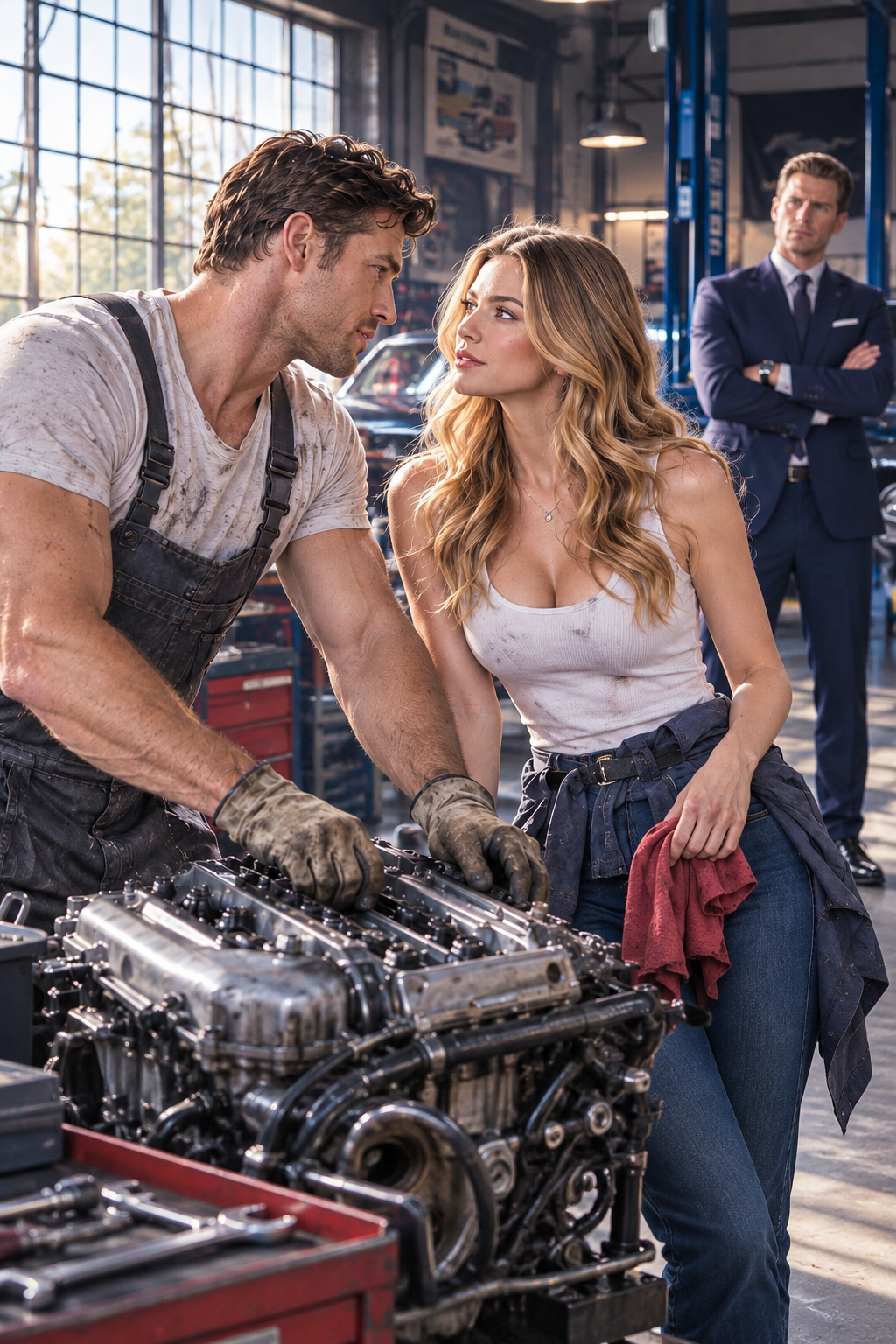
IF FACEBOOK BROUGHT YOU HERE, HERE’S THE CONTINUATION YOU’VE BEEN WAITING FOR. ENJOY! 👇 I stared at the phone after the call ended. Laya stood beside the table, waiting for me to explain, and all I could manage was, “A woman from Ferrari wants to see my drawings.” My daughter grinned, but I felt sick with uncertainty.
Those pages had never been submitted for publication. Apart from Laya, the only outsider who had recently examined them was Victor Hail. I wondered whether he’d copied them, whether Ferrari was calling to accuse me of something, and whether this was another way for him to make me look foolish.
I barely slept. The next day I cleaned the little office, stacked the invoices that had been gathering on my desk, and checked my notebook twice to make sure no pages were missing. At two o’clock a black sedan pulled up outside the garage.
Dr. Isabella Rossi stepped out wearing wire-rimmed glasses, her dark hair pinned neatly back. She was around forty, with the kind of direct gaze that made me feel she could tell whether I understood my own work. She shook my hand and asked if we could speak privately.
In the office, she showed me a tablet displaying my drawings. Every calculation was there, including the mounting bracket I’d sketched long before Victor brought his car to me. I recognized a coffee stain near the corner of one page, and my stomach tightened.
She explained that the images had appeared anonymously on engineering forums three days earlier. Whoever posted them had described their author as a small-town mechanic who didn’t know his place. I thought of Victor leaning over my workbench and felt heat rise into my face.
“I’m sorry they were shared without your permission,” Isabella said. “But the engineers who saw them didn’t laugh.” She told me the designs had been circulating through professional networks because people recognized their technical promise.
Her team had reviewed my hybrid braking proposal and estimated that, if validated, it could improve regenerative efficiency by thirty-seven percent and reduce stopping distances by about fifteen feet. They were also interested in my suspension architecture. I kept asking whether she’d checked the calculations because I couldn’t quite believe what she was saying.
Then she showed me the resonance bracket. Ferrari’s prototype team had spent eight months and roughly two million dollars investigating a similar problem, she said. My proposed solution appeared inexpensive enough to cost under fifty dollars per vehicle if it passed development testing.
She asked where I’d studied. I told her about MIT and the doctorate I’d abandoned after Sarah’s death, when raising Laya became my whole life. My dissertation had concerned harmonic resonance in high-performance automotive systems, which explained why the problem had occupied so much of my thinking.
Isabella asked whether I had any employment or intellectual-property agreements that would prevent me from consulting. When I said I ran the garage independently, she opened a folder and offered me a consulting role with Ferrari North America. The proposed pay exceeded what I normally earned in a year, and the arrangement would let me keep the garage open.
She also described a part-time educational program Ferrari was developing with universities. They wanted someone who could teach students to connect advanced theory with the problems mechanics encountered every day. Teaching had once been as important to me as designing cars, and I found myself looking through the office window at Laya working on her model.
Before leaving, Isabella invited me to present at the International Automotive Innovation Summit in Detroit the following week. Around fifteen hundred people would be there. I told her I needed time to think, and she handed me her card without pressing for an immediate answer.
After she left, Laya threw her arms around my neck. She asked why I looked worried when someone had finally noticed what I could do. I admitted I was afraid of hoping for a future I might not be able to give her, and she reminded me that Sarah had always told us not to let fear make our decisions.
That night I called Isabella and asked why she wanted me, not the polished corporate explanation. She told me about starting her career in Italy, when people had dismissed her ideas because she was a woman in automotive engineering. A professor named Alessandro Marchetti had encouraged her to keep going, and she wanted to offer another engineer the chance someone had once given her.
I accepted the consulting position and agreed to speak in Detroit. When I hung up, I sat quietly at the kitchen table, looking at Sarah’s photograph beside Laya’s school picture. The garage hadn’t changed, and I was still scared, but I’d made a decision I could live with.
Part 3 Two days later, Victor Hail read the news of Ferrari’s partnership with me in his executive office. I learned afterward that the announcement unsettled his board, which wanted to know why a promising engineer had ended up working with a competitor. I didn’t know what he told them, and I had no desire to ask.
My own concerns were closer to home. I had to arrange care for Laya, prepare a presentation, and find a suit that didn’t make me feel like a stranger. She sat on the workbench watching me adjust my tie and told me that being nervous meant the work mattered.
Isabella called the evening before the summit to check on me. She said the audience would include manufacturers, engineers, journalists, and university researchers, and that my work deserved a serious hearing. I told her I was afraid they’d see only the mechanic from Riverside; she answered that being a mechanic was part of why my ideas mattered.
The Detroit auditorium was enormous. During the morning walkthrough, I stood at the podium looking at fifteen hundred empty seats and wondered whether I could get through a single sentence. Isabella introduced me to Professor Alessandro Marchetti, an elderly Italian engineer whose papers I’d studied at MIT.
He’d reviewed my designs and said he admired how I’d developed his earlier work on vibration into practical solutions. When he asked what drove me, I told him about Sarah’s airbag failure. I said I wanted cars designed with the people inside them in mind, not only performance figures and sales targets.
Shortly before my talk, Isabella told me Victor Hail was attending as a sponsor. I saw him in the front row and felt the humiliation of that Saturday morning return. For a minute I told Isabella I couldn’t go out there.
She reminded me that I hadn’t answered his cruelty by hurting him or giving up. I’d kept working, and now other people had a chance to evaluate that work. I thought about Laya at school and went onto the stage.
I began with Sarah. I explained that a drunk driver had caused the collision, but that a failed safety system had contributed to her death. The room became very quiet, and I told the audience that every engineering decision could eventually matter to a family they would never meet.
Then I showed them the designs. I explained the braking system, the harmonic dampening approach, and the mounting improvements, including the limits of what had been tested and what still needed to be proved. As I spoke, the formulas became familiar again, and I stopped worrying about the suit.
During the questions, an engineer asked about production costs. I said my preliminary estimate for the basic safety package was around twelve dollars per vehicle, though large-scale validation would determine the real figure. Another attendee asked whether the vibration principles could be applied to aircraft, and I said the underlying mechanics were relevant beyond cars.
Victor finally stood. He asked what experience I had bringing an innovation into mass production, his tone making it clear he thought the answer would embarrass me. I told him I didn’t have that experience yet, which was exactly why collaboration with manufacturers and researchers mattered.
Then I thanked him for sharing my drawings with the engineering community, even though I hadn’t authorized it. A few people laughed softly at the irony, and the room applauded. Victor sat down, and I moved on to the next question instead of turning the presentation into a quarrel.
Afterward, engineers and executives came over to discuss testing, partnerships, and possible applications. Professor Marchetti embraced me and said the work gave him hope. Isabella stood beside us, smiling, while I tried to remember everyone’s name.
I saw Victor heading toward the exit and followed him into the hallway. He asked whether I’d come to gloat. I told him I wanted him to know that his attempt to embarrass me had unexpectedly brought my work to people who could understand it.
He admitted he’d wanted me to fail. I said I knew, but that I hoped we’d both learned something from the experience. We shook hands without pretending we were friends, and he congratulated me before leaving.
Later Laya texted that her class had watched the presentation. She said I had done well and that her mother would have been proud. I read the message several times before driving back toward Riverside.
Part 4 Laya met me at the door before I’d turned off the car. She told me what her teacher and classmates had said, then curled up beside me on the couch and grew serious. She said she was proud not just because I’d spoken to important people, but because I’d looked like myself again.
That night I sorted through offers that had arrived after the summit. BMW had expressed interest in sustainable technology work, Tesla in electric vehicle development, and Stanford in a research role involving teaching. I could hardly reconcile those possibilities with the man who’d worried about school expenses a few months earlier.
Professor Marchetti had also given me a handwritten note proposing a graduate program that would combine research and practical engineering. It would be based in Michigan, near enough to keep Laya’s life stable. I read it twice because teaching students who cared about safety felt closer to my old dream than a grand job title.
The following morning Isabella returned with Maria Santos, Ferrari’s head of global partnerships. They laid architectural plans across my office desk and explained a proposal larger than the consulting position. Ferrari wanted to fund an automotive innovation center in Riverside, adjoining my garage, with me directing the research.
The plan included laboratories, visiting engineers, and an educational program developed with Professor Marchetti. My garage would remain, connected to the new facility instead of being replaced. I asked why they would build it in a small town, and Maria said the practical environment was part of what made my approach useful.
I didn’t accept on the spot. I took the plans home and spread them on the kitchen table beside two mugs of hot chocolate. Laya studied the drawings and asked whether I’d still be able to work on ordinary cars and spend time with her.
I said yes, if we managed it properly. She asked whether students could come to learn how to make cars safer, the way Sarah had once hoped to teach children. When I told her that was the idea, she said we ought to do it for that reason, not for the size of the building.
I accepted Ferrari’s proposal after discussing the details with Isabella and Maria. Over the following months, construction crews began work on the vacant lot beside the shop. I split my time between the garage, research teams, and planning the educational program.
I traveled to Italy twice, Germany once, and California several times, always returning to Riverside. Professor Marchetti visited regularly to help shape the teaching program. Laya began spending afternoons asking engineers questions, just as she’d once asked me about her science fair engine.
She told me she wanted to study biomedical engineering and design medical devices using the same principles that protected people in cars. I told her she could choose her own field, and she said that was exactly what she was doing. I could hear Sarah’s stubborn kindness in her answer.
A year after Victor’s visit, the Daniel Carter Automotive Innovation Center opened beside the original garage. Young engineers worked alongside local mechanics, and students arrived to learn from both. I gave the first lecture with Laya sitting in the front row, her notebook open.
Victor sent a short message congratulating me on the facility. I thanked him and left it there. I was glad he seemed to be reconsidering his old assumptions, but my work no longer depended on what he thought of me.
Final Three years later, the center had researchers from six countries and graduate students connected with twelve universities. Dr. Yuki Tanaka was working on electric-vehicle battery protection, while Maria Gonzalez had adapted aspects of our mounting research for aerospace applications and earned a position at NASA. I was proud of those achievements because the ideas had moved beyond my own notebook.
Laya was fifteen and had become serious about biomedical engineering. She worked with visiting researchers on a prototype medical device that combined sensor technology with ideas drawn from automotive safety systems. I watched her explain her work to visitors from Johns Hopkins and wondered when she’d become so comfortable speaking to people twice her age.
Isabella had become a steady presence at the center and in our lives. Our professional friendship had grown slowly into love, with both of us careful about Laya’s feelings and Sarah’s place in our family. Six months earlier, Laya had caught us holding hands and told us she wanted us to be happy.
One morning, an intern named Marcus Williams brought us an email from Dr. Jennifer Walsh at the National Highway Traffic Safety Administration. It announced a mandate for the Carter safety protocols on new vehicles sold in the United States beginning with the 2028 model year. I read it twice before I could speak.
The agency estimated that full implementation could prevent about three thousand deaths and fifteen thousand serious injuries each year. Those were projections, not lives we could already count as saved, and I knew the work would still require careful implementation. Even so, I thought of Sarah and the families who might avoid the kind of loss we’d known.
Laya came over and asked why I looked upset. I showed her the announcement and told her our team had reached a milestone we’d been working toward for years. She hugged me, and I told her that her questions had helped shape my thinking from the beginning.
That evening I stopped at the memorial wall near the entrance, where Sarah’s photograph stood among those of people lost in preventable automotive tragedies. Isabella joined me there. I told her I was grateful for the life Sarah and I had shared and that loving someone new didn’t mean forgetting her.
“I love you,” Isabella said quietly. I told her I loved her too, and we stood together until we heard applause coming from the laboratory. Laya and several students had just completed a successful test, and she was explaining how biological structures could inspire better mechanical protection.
Later, over our usual simple dinner in my original office, Laya announced she’d been accepted into an accelerated MIT program. She said she’d earned exceptional test results and strong recommendations from her research work. The arrangement would allow her to stay in Riverside for much of her coursework while traveling to campus for laboratory sessions.
I was proud and frightened by how quickly her world was opening. Professor Marchetti had agreed to serve as a local academic adviser, and Isabella reminded me that Laya had a whole team looking out for her. I asked my daughter whether she was sure she wanted this, and she took my hand and said she did.
Then she showed us an announcement from Hail Automotive. Victor’s company was adopting the Carter safety protocols ahead of the federal requirement and supporting a scholarship program at our center. He’d also sent Laya a personal apology for how he’d treated me years earlier, along with an offer to fund her education.
I sat with that message for a while. Victor hadn’t erased what he said in front of my child, but he had begun to act differently. Laya said she hoped he meant it, and I told her that changed behavior mattered more than an impressive apology.
After dinner I walked through the research rooms and ended up back in my garage. The old pegboard was still on the wall, and my notebooks were still on the workbench, though now they sat beside equipment I couldn’t have imagined affording. Isabella found me there, turning the pages of the first book I’d filled after Sarah died.
I told her I wanted a future in which we kept teaching, researching, and coming home to the people we loved. She smiled and said those were dreams worth sharing. I took her hands and asked her to marry me.
She said yes. We stood in the same garage where Victor had laughed at me, and for once I wasn’t thinking about proving him wrong. I was thinking about telling Laya, about Sarah’s memory, and about the ordinary mornings still ahead of us.
The next day I opened the shop as usual. A customer needed help with an aging car, and Laya wanted to show me a new design before school. I put on my old coveralls, reached for a wrench, and felt no need to be anyone other than the man I’d become.
THE END. I’ve shared the complete story, and I truly hope it touched your heart. If this story moved you, please , like, and share the post. Thank you for reading! ❤️
✓ Lynn R. Adams
IF FACEBOOK BROUGHT YOU HERE, HERE’S THE CONTINUATION YOU’VE BEEN WAITING FOR. ENJOY! 👇 I stared at the phone after the call ended. Laya stood beside the table, waiting for me to explain, and all I c…