A Marine came to my mother’s lake house carrying my brother’s retired dog and a photograph I had given Danny before his last deployment; when I asked why he had finally come after two silent years, he looked at me and said,
A Marine came to my mother’s lake house carrying my brother’s retired dog and a photograph I had given Danny before his last deployment; when I asked why he had finally come after two silent years, he looked at me and said, “Because I’m the reason your brother never came home,” and I told him to leave…
The photograph was lying on my father’s old dock, faceup, its corners softened from being handled. I knew the girl in it immediately. It was me at seventeen, laughing into the summer sun, with two words in my own handwriting on the back: Come home. I had pressed it into my brother Danny’s hand the last time I saw him, at the bus station, before he left for deployment.
The man standing at the foot of our porch steps had the photograph in his hand. He was a Marine, tall and tired-looking, with a gray-muzzled German Shepherd beside him. I had never met him, but the dog seemed familiar in a way I couldn’t place. Our home, the Hayes Lake House in Cedar Hollow, Tennessee, has always held on to things: the porch light, the smell of coffee, and the dock my father built with his own hands. Even after he died, we kept the porch light on over the water. It was the last two weeks of summer, when the heat still clung to the gravel and the evenings came slowly. The town was already preparing for lantern night.
My father had been gone for eight years. I was nineteen when he died, home from college for his funeral, and I never went back. I had meant to become a teacher. Instead, I stayed and helped my mother, Grace, run the inn. The dock had started to come apart, board by board, but every summer Danny promised he would fix it when he came home for good.
Danny was a Marine, too, a dog handler. He had a way of making every place feel less lonely. He talked about our lake, the lanterns the town floated every summer, and the old dock. He said that when he came home for good, he would repair every loose board himself. He called me M, a nickname nobody else was allowed to use. The last time I saw him, I gave him that photograph and told him to bring himself home. He didn’t.
Two years earlier, a Marine officer and a chaplain had driven down our gravel road. They told us Danny had died overseas while saving a wounded Marine. They never gave us the name of the man he saved. We buried my brother with more questions than answers, and I learned how to keep going without making plans that depended on somebody else staying.
A month before the stranger arrived, the phone rang with news that Danny’s Bronze Star had been upgraded to the Silver Star. His old Gunny would bring it to the house on Danny’s birthday. Nobody explained why the award had changed, and my mother didn’t press them. She only wanted the ceremony to be small, with the lake and the people who had known her son. Every summer, our neighbors set paper lanterns afloat there, one for each person they missed.
I didn’t know that the stranger had arrived the night before. Later, Mama told me an old green pickup had stopped at the top of the drive, its engine running, with the same German Shepherd sitting in the passenger seat. The man finally came down to the house after dark. He stood at the door as if he wasn’t sure he was welcome, and introduced himself as Staff Sergeant Cole Brennan.
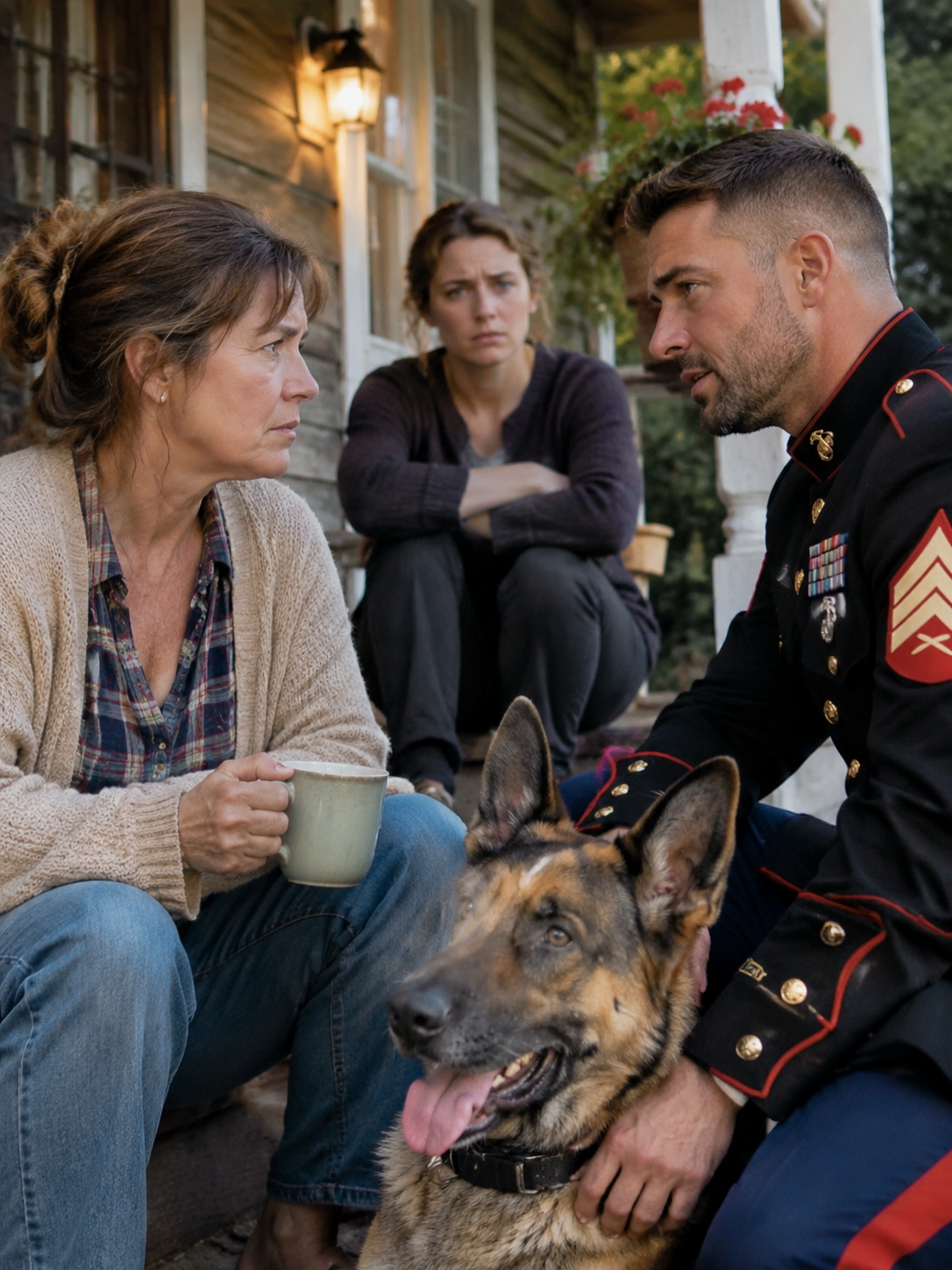
Mama recognized the dog from the pictures Danny had sent home. She didn’t ask questions at the door. She poured two cups of coffee and sat with Cole on the porch steps until the porch light was the only light left on the lake. He told her things she kept to herself. I was upstairs asleep, unaware that a stranger had brought a piece of my brother home, or that my mother had already decided to give him a place to stay.
Before the sun cleared the ridge the next morning, Cole put on his uniform and drove up to the town cemetery. He stood for a long time at Danny’s white headstone. Then he came back to the lake and walked out along the dock, studying the boards one by one. He was measuring what needed to be replaced, though nobody had asked him to.
Somewhere on the dock, his wallet slipped from his pocket. That was how my photograph ended up in my hands. I turned it over and saw my handwriting. When I looked up, Cole was standing nearby, and I asked if the picture was his. He said yes, ma’am. It was the one thing he couldn’t lose.
I asked why he had my picture. He didn’t look away. He told me my brother had given it to him, and that Danny had sworn he would marry me to him one day. I almost laughed at the absurdity of hearing Danny’s old teasing words from a man I had never seen before. Then Cole said they had served together on two deployments.
“He was the only family I had,” Cole told me. There was no performance in his voice, no attempt to make me feel sorry for him. He spoke as if he were still standing beside Danny somewhere far from Tennessee. I looked at the photograph again, then at the dog. The name came back to me all at once: Ranger.
I had seen Ranger in Danny’s pictures, sitting beside him in uniform or looking straight into the camera with those steady ears. Cole said the dog had retired a year earlier, and Danny had made him promise to bring Ranger home to us. I couldn’t understand why he had waited so long. Two years had passed. Two birthdays had come and gone.
“You never came,” I said. “Not a call, not a letter. So why are you here now?” Cole’s face tightened, but he didn’t argue. He stood on the steps with the photograph in his hand, Ranger close to his leg, while the lake moved quietly behind him. My mother was just inside the doorway, watching without interrupting.
“Because I’m the reason he never came home,” Cole said. I asked him to tell me what happened to my brother. He said their patrol had been hit, that he went down, and Danny ran back for him. I heard the words, but all I could see was the empty place at our table and the two years in which this man had stayed away.
“So you came home and Danny didn’t,” I said. Cole answered, “Yes, ma’am.” I could not bear to hear another word. “Get off my porch,” I said. Part 2…..
IF FACEBOOK BROUGHT YOU HERE, HERE’S THE CONTINUATION YOU’VE BEEN WAITING FOR. ENJOY! 👇 Cole gave a small nod and turned toward the dog. “Ranger, let’s go,” he said, but the old shepherd stayed where he was. I looked at his gray muzzle and steady ears, and suddenly recognized him from Danny’s pictures. “Ranger? Is that you? You’re Danny’s dog. You came home.”
“A year ago, and you waited?” I asked. I told him to leave Ranger with us and go. Before Cole could answer, Mama stepped forward. “Emily, honey, he’s our guest. He’s booked for two weeks, and he’s going to fix your daddy’s dock the way Danny always said he would.” I told her the dock wasn’t his to fix. She said Danny had sent him to us, and that made it his. Two weeks, she said. Then he would be gone.
Cole only nodded. “Yes, ma’am. Two weeks.” He added that he never stayed anywhere long. At the time, I thought it was another excuse from a man who had already stayed away for two years. I didn’t know how literally he meant it, or how little experience he had of being asked to stay.
Over the next few days, I learned pieces of his life. He had grown up in foster homes in an Ohio mill town, seven houses before he turned eighteen. At nineteen, he walked into a Marine recruiting office and found the first place that gave him rules, brothers, and a reason to get up in the morning. By twenty-eight, he was a staff sergeant and a platoon sergeant, the man younger Marines looked to when things went wrong.
Danny and Ranger had joined his platoon as a dog team. Danny talked constantly about Tennessee, the lake, the dock, and me. On their second deployment, he carried my photograph everywhere. Under the glow of a camp lamp, he would pull it from his helmet and tell Cole, “That’s my sister. You’re going to marry her one day. I swear it.” Cole laughed it off, but he always looked at the picture longer than he meant to.
Danny had also taught Cole how to read a working dog: the ears, the smallest change in posture, the way trust could keep a person alive. The night before their last patrol, Danny sat on Cole’s cot, handed him the photograph and a sealed envelope, and told him what to do if he didn’t make it. Cole could give me the picture so I would know Danny had kept it. The letter was different.
“Only if you stay,” Danny told him. “Swear it.” Cole promised. The next day came back to him in fragments: heat, a dusty village, the first shot, the ground rushing up, and Danny’s hand in his inside a helicopter, going still. Cole had been badly hurt and spent a year learning to walk again. The left leg would never be right.
When Ranger retired, Cole signed the papers and took him in. The Corps was retiring Cole, too, and he had one last month of leave. He had a job waiting at a ranch in Montana that trained service dogs for veterans. The sealed envelope stayed folded in his back pocket wherever he went. He believed he had no right to give it to me unless he could keep the promise Danny had asked of him.
Mama began sending food down to the dock because Cole worked from first light until the sun went red behind the ridge. One afternoon I brought it myself. He thanked me and called me ma’am. I told him to stop; my mother was ma’am, and I was Emily. He looked almost surprised, then said Danny had predicted I would say exactly that.
I asked what else Danny had told him. Cole said I hated cold water but ended up in the lake every summer because Danny had thrown me in every year since I was six. He said Danny sang to Ranger before lights out, always off key, and Ranger howled along loudly enough to wake the whole base. I asked whether Danny really kept my picture all that time. Cole said it had been in his helmet, and that Danny had asked him to make sure I knew he had kept it.
“And you?” I asked. “Did you ever look at it?” Cole was quiet for a moment. “Every night, Emily. Longer than I had any right to.” After that, the days began to run together. He worked on the dock from morning until evening, replacing the boards and rebuilding it from a drawing Danny had made overseas on the torn flap of a cardboard box.
The drawing showed a long, straight dock with a bench at the very end. Cole kept it folded in his toolbox and never explained why the bench mattered. I started by carrying down a box of nails, then a hammer the next morning. Before the week was over, I was holding boards steady while he drove them into place. Neither of us remembered deciding to work together.
He repaired the porch swing my father had hung, the one that had dangled from a single chain for eight years. That evening Mama sat in it and rocked without saying a word. Ranger began sleeping on the floor outside my bedroom door, as if he had been assigned to keep watch there. The house was changing in small ways, and I was letting it happen.
One afternoon, sitting on a stack of lumber, I told Cole about the winter morning my father died. I had been nineteen, home from college for the funeral, and I never returned. I had stopped making plans that required somebody else to stay. Cole didn’t try to fix that or tell me I was wrong. He listened, which was something I hadn’t realized I needed.
Part 3 In the evenings, we swam from the end of the half-built dock. I hated cold water, but I went in anyway, one shivering step at a time. Once, my foot slipped on a wet board. Cole caught my hand before I fell, and for a moment neither of us let go. Around the lake, people began to talk about the Hayes girl and the Marine.
There were things I kept to myself. Every year on Danny’s birthday, I climbed the hill to his grave and wished him a happy birthday. There were things Cole kept to himself, too. Every few days he took a phone call down by the water, his back to the house. Once I heard him say, “Yes, sir. I’ll be there Monday.” I didn’t know the Montana ranch was holding a job for him.
By the tenth evening, the new boards reached almost to the end of the dock. The frame of Danny’s bench stood there, waiting for its seat. Lantern night was four days away, and it would fall on Danny’s birthday. Cole had six days before he was due in Montana. The envelope was still in his pocket.
That evening I told him the dock looked just as Danny had described it. Cole said Danny had drawn it for me overseas, and that the bench was for me. Then he told me about the letter. Danny had given it to him the night before he died, but Cole had sworn he would give it to me only if he was staying.
I asked whether he was staying. He said his Montana job began the Monday after lantern night. I told him to keep the letter; I wouldn’t open my brother’s words behind his back. I reminded him that I had agreed to two weeks, not a future. “Go, Cole,” I said. “Everybody I love leaves.”
He heard those words all the way up the lawn. He packed his duffel and left before the house woke. On the porch table, he left a sack of dog food and a short note in careful block letters: Ranger sleeps better near you. He left his toolbox at the end of the unfinished dock, too, so the work could be finished with him or without him.
But Cole hadn’t left Cedar Hollow. He had taken a room at the old motor court by the highway, with faded green doors, a gravel lot, and a sign that no longer lit up. Danny’s old Gunny knew where he was. Cole planned to visit Danny’s grave on his birthday, then drive west. He would not be at the small ceremony when the Marines brought Danny’s Silver Star to the house.
The first day after Cole left, I was angry. By the second, I was mostly empty. I scrubbed a porch that didn’t need it and walked down to the dock and back. Ranger lay beside the side door from morning until dark, watching the drive. On the third evening, I sat in the gravel beside him and began humming the old song Danny used to sing, always off key. Ranger lifted his head and howled, and I laughed for the first time in three days before I buried my face in his fur and cried.
Later, in the last light, I opened Cole’s toolbox. Danny’s drawing was inside, folded just as Cole had kept it. On the bench at the end of the dock, Danny had drawn two people sitting close together, with a dog lying at their feet. He had drawn it two years before I ever met Cole.
Mama found me there. I told her Danny had written Cole a letter and that Cole had never said a word. She admitted she had known from the first night. Cole had told her everything on the porch step and asked to tell me himself. She had given him her word, just as he had given Danny his. She also knew Danny had made him promise to bring Ranger home.
I asked why she hadn’t told me. Mama said that ever since my father died, I had waited for people to leave, so I pushed them first. Then she told me to ask Danny’s Gunny two things the next morning: who had carried my brother to the helicopter, and who had asked for the medal to be upgraded.
Saturday morning was Danny’s birthday. The Marines came down the drive as the mist lifted off the lake. A colonel in dress blues and Danny’s broad-shouldered, gray-haired Gunny stood with us on the lawn. Mama had asked for no band and no speeches, just the water and the people closest to her son. The colonel read the citation in a quiet, steady voice and placed the Silver Star in Mama’s hands. She held it to her heart and waited until the Marines stepped back before she cried.
Afterward, I brought the Gunny a glass of iced tea and asked Mama’s two questions. He looked out at the lake before answering. On patrol, he said, Cole had seen a nineteen-year-old lance corporal pinned down behind a cart in the open. Cole put himself between the young Marine and the gunfire. A round shattered Cole’s left leg, and he went down.
Danny ran back across the open ground with Ranger beside him. He reached Cole and threw himself over him. That was when Danny was hit. The squad returned fire, and Cole, on a broken leg, dragged Danny out of the open. He carried him the last stretch to the helicopter himself, with Ranger right beside them. He would not let the corpsman touch Danny until his friend was aboard.
Final The Gunny said the first citation had been written while Cole was still in the hospital. But Cole spent a year learning to walk and another year making people listen to what Danny had done. He had pushed for the Silver Star upgrade while asking that his own name be left out. “Nobody asked the one man who saw it all,” the Gunny said. “He asked me to keep his name out of it. But you asked me straight, and I won’t lie to a Gold Star family.”
Then he told me Cole had called from the motor court the night before. He was driving west that afternoon. I was on my feet before the Gunny finished speaking. Mama only nodded and told me to go. She knew Cole wouldn’t leave town without saying goodbye to Danny.
I barely remembered the drive up the hill. Ranger ran beside me through the cemetery gate. Cole’s old green pickup was parked beside Danny’s grave, loaded with everything he owned. Cole was kneeling at the white headstone. A single quarter sat on top of it. Veterans know what that means: a penny says you visited; a quarter says you were there the day he died.
Ranger saw Cole first and ran to him. Cole looked at the headstone and said, “Happy birthday, Danny.” I told him the Gunny had told us everything. Cole said he had asked him not to. I told him he had carried Danny all that way on a broken leg. “Not far enough,” he said. “He was gone before we landed.”
I told Cole Danny had gone back because that was who he was. Cole said he would trade places with him every single day. I believed him. But I also told him Danny wouldn’t have wanted that, and neither did I. Cole looked at the lake below us and said the life should have been Danny’s, not his to take.
“You’re not taking it, Cole,” I said. “He gave it to you.” I reminded him that I had told him to go, but I hadn’t meant a word of it. Lanterns would be going onto the water at sundown, and Danny’s dock still wasn’t finished. Cole looked at the road west, then back at me. “Then Montana can wait. I’ve got one more promise to keep.”
We drove back down the hill with Cole’s pickup following mine. Ranger rode with him. That afternoon we finished the end of Danny’s dock side by side. Cole cut the last boards, I held them steady, and Ranger lay in the shade supervising every nail. We built the bench last, exactly as Danny had drawn it. When Cole drove in the final nail, I sat down first and patted the place beside me.
At sundown, the town came down to the water. Neighbors, fishermen, church folks, and people who had known Danny since he was a skinny boy jumping off that dock carried paper lanterns to the shore. They set them afloat one by one, each for someone they missed, just as they had every summer since my father started the tradition. The lights drifted across the lake so the people we loved could find their way home.
When the shore had emptied, it was just Cole, Ranger, and me on the new bench. Cole reached into his back pocket and placed the soft, folded envelope in my hands. I didn’t open it right away. I knew he was staying. Then I broke the seal and saw Danny’s big, crooked handwriting.
“M. If you’re holding this, then Cole stayed. I made him swear he wouldn’t give it to you unless he did. You’ve had enough people leave. He’s the best man I know, and he doesn’t believe it. He never had a home, so I’m giving him mine. I swore to him that one day he’d marry you. I’ve never lost a bet to that man. M, light a lantern for me. Love you, sis.”
At the bottom were a few smaller lines meant for Cole. Danny had written that if anything happened to him, it was on him, not Cole. He told his friend to quit carrying it and go home. I looked at Cole. “Two years you’ve carried it. Set it down.” He said he had almost not come. He had sat at the end of our road half the night, but I had come out, and I had stayed.
“Your brother swore I’d marry you one day,” Cole said. I told him not to make Danny a liar. “No, ma’am,” he answered, and for the first time the word made me smile. We didn’t need to decide the rest of our lives on that bench. We only needed to let the promise have a chance.
A year later, lantern night came around again. Behind the Hayes Lake House there was a kennel Cole had built himself, where he trained service dogs for veterans coming home with more than they could say out loud. Ranger was grayer and slower now, and most afternoons he slept on the bench at the end of the dock. It was his bench. He had earned it.
There was a ring on my hand. That summer, nobody had to throw me into the lake. I ran the length of the dock and jumped in all on my own. In the front hall of the inn, we hung Danny’s Silver Star beside the creased photograph of me laughing on the dock. Before it went into the frame, Cole turned it over one last time. The words were still there: Come home. He had tonight. On lantern night, Cole sang Danny’s old song, badly, and Ranger howled right along with him.
THE END. I’ve shared the complete story, and I truly hope it touched your heart. If this story moved you, please , like, and share the post. Thank you for reading! ❤️
✓ Lynn R. Adams
A Marine came to my mother’s lake house carrying my brother’s retired dog and a photograph I had given Danny before his last deployment; when I asked why he had finally come after two silent years, he…