A bruised nine-year-old walked…
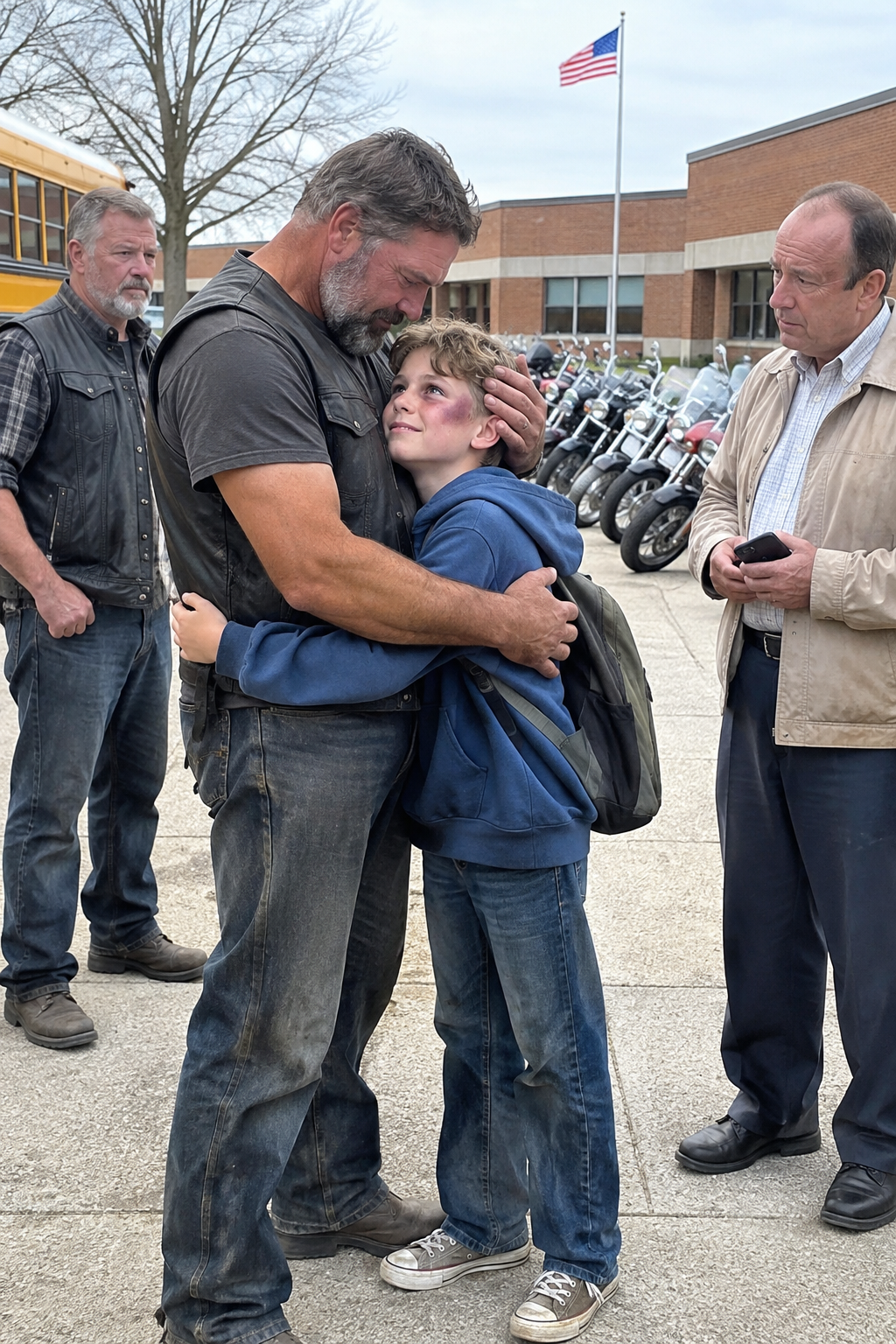
For the first time, the boys who had made Tommy dread school saw that he wasn’t invisible. Kyle Morrison started toward him in the hallway that morning, noticed me through a window, and turned away. Marcus Webb kept his distance. I didn’t mistake their sudden caution for a solution, but Tommy could walk to class without bracing for the next shove.
Principal Hartwell thought our presence was a threat. Parents called the police, and Officer Daniels came to see what was happening. We had stayed on the public street and hadn’t threatened anyone, so he told the principal there was no reason to remove us. Then he asked Hartwell a question I wished every adult at that school had asked sooner: why had it taken a line of motorcycles to get people to look at Tommy?
Some teachers complained that bikers were disrupting the day. Others finally admitted they knew Tommy had been getting hurt. One teacher said they had received reports for six months and had done little. I was grateful for that honesty, though I wondered how different Tommy’s life might have been if someone had spoken up before we arrived.
At two o’clock, Hartwell reluctantly invited me inside. School-board members and child-protection staff had been contacted, and he was desperate to calm things down. He called our demonstration inappropriate. I asked how appropriate it was for a nine-year-old to come to school knowing somebody would corner him in a bathroom.
My brother Ghost had put together a folder overnight. It contained records of eighteen incidents at school, three nurse visits documenting visible bruises, and two complaints from Tommy that had gone nowhere. I put it on Hartwell’s desk and watched him turn the pages. This wasn’t a misunderstanding about playground roughhousing; his own school’s records showed a pattern.
I asked for actual intervention, consequences for Kyle and Marcus, and procedures that would protect Tommy and any other child in his position. The principal said I couldn’t dictate policy. I agreed. The school board and administrators would have to do their jobs, and I would keep showing up to ask whether they had.
Before I left, I told him the school injuries were only part of the problem. Rick was hurting Tommy at home, and Tommy’s mother wasn’t stopping it. Hartwell said he hadn’t known. “Then start looking,” I said. That evening, the school made a report, and Child Protective Services came to Tommy’s house with a police officer.
I wasn’t inside for the visit. I learned later that Rick opened the door with a beer and insisted Tommy was simply accident-prone. The workers documented disturbing conditions, including a lock on the outside of Tommy’s bedroom door, damaged furniture, and a belt with a metal buckle. The physical injuries required a medical examination and a serious investigation.
They spoke to Tommy’s mother, Linda, who finally admitted she knew Rick was hitting him. She also clarified that Rick wasn’t her husband, as Tommy and most of us had believed, but her boyfriend. Linda said he had threatened to kill them both if she intervened. She needed help escaping him, but the workers had to put Tommy’s immediate safety first.
Tommy was told he couldn’t stay in that house while the investigation continued. I can only imagine what the word foster care sounded like to him after a lifetime of being passed over. He later told me he thought it meant another stranger deciding he was too much trouble. I sent him a message that night: “Don’t worry, kid. Working on it. H.”
Three days after the school visit, I went to an emergency custody hearing. Tommy sat small and stiff among adults talking about placements, evaluations, and the best interests of a child. The judge asked him a question he could understand: was there anyone he trusted, anywhere he felt safe?
He pointed to me at the back of the courtroom. “Him. Hank. He’s my friend,” he said. “He said he couldn’t be my dad, but he’s the only person who tried to help me.” I had ridden into plenty of tense situations, but walking toward that judge felt harder than any of them.
She asked about my involvement with the Hells Angels and how I knew Tommy. I told her the truth, including the part about Matthew. I didn’t pretend to have a spotless past or claim that caring about a child made me qualified to raise one. I said only that Tommy mattered to me, and I wanted to help him safely and properly.
The judge explained that nobody could place a child with me just because he asked. There would have to be background checks and a home study. But she authorized regular visits, supervised at first, while Tommy stayed in an approved foster home, and asked for an expedited assessment of whether a longer placement with me might be possible. When I looked at Tommy, there was hope on his face again.
Part 3 Tommy’s temporary foster parents were the Hendersons, an older couple who knew how to care for children carrying heavy experiences. Their house had a spare bedroom and a gentle dog. They didn’t demand that he tell his story every evening. They gave him food, ordinary routines, and enough quiet to start sleeping.
I visited as often as his care plan allowed, eventually every day. Sometimes we did homework at the kitchen table. Sometimes we watched television without saying much. I had spent years dreading the ordinary moments I used to share with Matthew; now I was learning that ordinary moments could help a frightened boy breathe.
Tommy turned out to be sharp as a tack, especially when nobody was yelling at him. One afternoon he solved a homework problem so quickly I asked how he’d learned it. He shrugged and said he just liked figuring things out. I told him he could become a doctor, an engineer, or whatever else he chose. He stared at me and said nobody had ever told him that before.
For six weeks, social workers examined whether my home could truly be a safe place for him. They asked about my finances, criminal record, daily habits, and ties to the motorcycle club. They interviewed me and people who knew me. They inspected the clubhouse, which my brothers cleaned and made safer for a child, and asked difficult questions I knew they had every right to ask.
They found the things I expected them to find. I’d been in trouble before, though my record didn’t include violent offenses, and the club’s reputation raised understandable concerns. I wasn’t going to hide any of that. Tommy had spent enough of his life around adults who lied when lying was convenient.
They also found things that didn’t fit the picture strangers had of me. Since Matthew died, I’d volunteered at homeless shelters. Our club had raised hundreds of thousands of dollars for children’s charities. The men I called brothers were rough around the edges, but many were ready to help Tommy with school supplies, meals, and a safe place to turn.
None of those facts erased the need for careful supervision. The social worker said my connection with Tommy was strong, but affection alone wasn’t the whole test. In the end, she recommended a six-month trial placement rather than an immediate permanent arrangement. I accepted the conditions because getting this right mattered more than getting it quickly.
Tommy came to live with me on a Saturday in October. Upstairs at the clubhouse, we had prepared a bedroom with the things he’d chosen himself: a desk, shelves, and books my brothers kept bringing by. He stood in the doorway for a long time, touching the edge of the desk as though somebody might take it back.
“Is this really mine?” he asked. I said it was. Then came the harder question: “Do you actually want me to stay?” I sat beside him and told him about the years after Matthew died, when I had stopped imagining a future for myself. Tommy listened without interrupting.
I told him meeting him hadn’t replaced Matthew and never would. A person doesn’t replace a child they’ve lost. But Tommy had reminded me that I could still care for someone, keep my promises, and build a life with another person in it. I told him he wasn’t a duty I was putting up with. He was someone I wanted to know, every day.
“I love you,” he said, almost apologetically, as if he were afraid the words had come too soon. I held him close. “I love you, too,” I told him. “And I’ll keep showing you.” From then on, love had to mean breakfasts, school mornings, listening when he was scared, and doing what the people in charge of his care asked of me.
The trial period wasn’t a fairy tale. There were days Tommy needed reassurance, and there were times I had to learn how to respond without letting my own grief do the talking. The Hendersons and the social workers remained part of the support around him. As we kept building routines, he began to act more like a child who expected tomorrow to be safe.
Final Over time, the school had to face the complaints it had overlooked. Our arrival had made people pay attention, but I learned that a real change meant adults following through after the motorcycles left. Tommy needed teachers willing to protect him, not just a row of men waiting outside. I kept asking questions and showing up as his guardian while his placement was reviewed.
Linda was no longer living with Rick. I didn’t try to tell Tommy what he should feel about his mother. He could miss her, be angry with her, and love her all at once. What mattered was that decisions about contact and care were made with his safety at the center, instead of asking him to protect the adults around him.
Two years after Tommy first walked into Thunder Road, the adoption was finalized on his eleventh birthday. We had gone through the necessary reviews, and this time the judge’s signature meant I was legally his father. I still remember my hands shaking when I saw the papers. I hadn’t been sure I’d ever be anyone’s dad again.
Seventy-nine bikers came to the courthouse to celebrate. They filled the hallways and the steps outside, trying to look respectable and failing spectacularly at being inconspicuous. When we came out, Tommy held up his adoption certificate and shouted, “I have a dad! I have a real dad!” My brothers cheered until people on the sidewalk stopped to see what was happening.
I lifted him into my arms, though at eleven he was getting harder to pick up. “You always had people who should have cared for you,” I told him. “Now you have a father who gets to prove it.” He laughed, and I heard Matthew’s memory in my heart without feeling that I was betraying it. There was room for both boys there.
That night, the club threw a party. Tommy stood on a chair with a glass of root beer and looked around at the men who had first seen him as a frightened little visitor. He told them he used to think nobody wanted him. He said they’d shown up when he needed help and had become his uncles, his brothers, and his family.
“To the Hells Angels,” he said, raising his glass. “The best family a kid could ask for.” Seventy-nine voices answered, “To family!” I didn’t bother hiding my wet eyes. Those men had seen me grieving for three years; they could stand to see me happy for once.
After the noise settled, Tommy came over and hugged me. “Thanks, Dad,” he said. I asked what for, and he reminded me of the first day, when he’d asked a stranger to be his father. “You could’ve sent me away,” he said. “But you didn’t.”
I told him I hadn’t known how to say yes that afternoon. I only knew I couldn’t let him leave believing he didn’t matter. Tommy grinned and said he’d known from the moment he saw me with Matthew’s picture. “You looked at me like I mattered,” he said. “I figured you needed a kid, and I needed a dad.”
There was no clever answer to that. I just put my arm around my son and stayed beside him while the party went on. Three years after I lost Matthew, a boy had walked through our door looking for safety. Two years after that, I stood with Tommy and understood that my job wasn’t to rescue him once. It was to keep choosing him, every ordinary day.
THE END. I’ve shared the complete story, and I truly hope it touched your heart. If this story moved you, please , like, and share the post. Thank you for reading! ❤️
✓ Lynn R. Adams
For the first time, the boys who had made Tommy dread school saw that he wasn’t invisible. Kyle Morrison started toward him in the hallway that morning, noticed me through a window, and turned away. M…