A 23-year-year-old mechanic took a chance on a biker whose 1953 Panhead had defeated three repair shops,
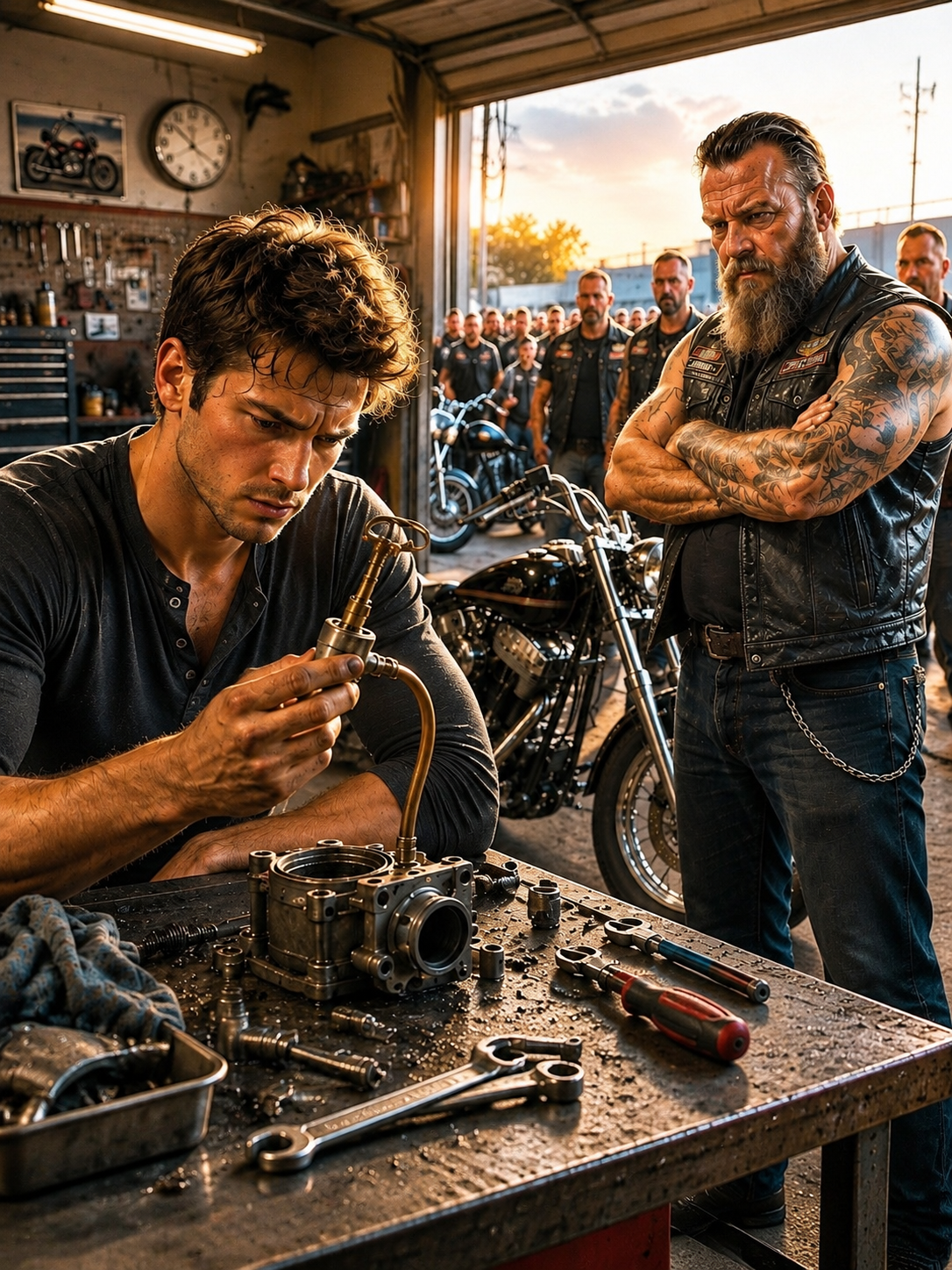
IF FACEBOOK BROUGHT YOU HERE, HERE’S THE CONTINUATION YOU’VE BEEN WAITING FOR. ENJOY! 👇 Ridge arrived at , alone. He walked to the clean cloth where I had laid out the carburetor parts and the fuel line. He studied them without flinching.
“Walk me through it,” he said.
I started with the carburetor, explaining the float setting and how it affected performance over distance. I didn’t accuse anyone. I let the parts speak in the order I had found them. Then I picked up the fuel line and pointed to the crimp.
The shop went quiet.
“How long would it take?” Ridge asked.
“At highway speed, it depends on the road and the load. If the power dropped at the wrong time…” I stopped. “You might have three seconds to react.”
Ridge kept his eyes on the line. “The three shops,” he said. It wasn’t a question.
“I can’t speak to what they saw. Someone had to be looking for this specifically. Otherwise, you’d pass it. I almost passed it. I went back twice.”
He nodded, took out his phone, and stepped to the far side of the bay. He spoke quietly and briefly, then returned.
“Fix it,” he said. “Everything you found. Fix it right.”
“And don’t mention this to anyone until I tell you otherwise.”
I met his eyes. “Understood.”
For the next thirty-six hours, I rebuilt what needed rebuilding. I found a period-correct float through a Toronto parts dealer who specialized in vintage American motorcycles, replaced the fuel line entirely, and checked the work twice. When I finished, I road-tested the Panhead on the back road behind the garage until it ran the way it was supposed to.
Ridge returned the next morning. He started the bike himself, let it idle, and listened. He revved it gently twice, then shut it off.
“What do I owe you?”
I gave him a fair price for the labour and parts. He put more money on the workbench than I had asked for.
“Keep the change,” he said.
“You knew what you were holding when you found that line?” he asked.
“And you called anyway?”
“Because not calling would’ve meant deciding it wasn’t my problem. I couldn’t make that decision.”
Something shifted in his expression. Not quite a smile, but something that stayed with me. He left, and I went back to the ordinary work of keeping a small garage alive.
Three days passed, then four. I didn’t know what Ridge had done with what I told him. It wasn’t my world. I had done the part I understood: find the problem, explain it honestly, and repair the machine properly.
On the fifth day, I heard a low rumble before I saw anything. It seemed to rise through the concrete and into my chest. I was working on an engine when I stopped, wiped my hands, and stepped out into the lot.
Motorcycles were coming down the road in a long, orderly column. They weren’t racing or making a show of themselves. They turned into the lot slowly, filled the spaces in front of the garage, then continued into the gravel beside the building. More kept arriving.
I counted without meaning to. I reached 140 and stopped. There were more than two hundred riders. Some wore Northern Shield patches. Others had come from clubs in Sault Ste. Marie, Thunder Bay, Timmins, North Bay, and Espanola. There were independent riders without patches, older men on old machines, and younger riders who had clearly come because someone had asked them to.
Nobody spoke. They sat on their motorcycles in front of my uncle’s little garage, silent and present.
Ridge walked out of the column with another man beside him. The second man was Clifton Arseneau, president of Northern Shield, a member for thirty-one years and its president for nine. He stopped in front of me and looked at me for a moment.
“We know what you found,” he said, “and we know what you did with it.”
He paused. “A lot of people have seen that bike over the years. You’re the first one who looked at it like something worth protecting.”
I didn’t know what to say.
“We also know you’re carrying a note with a bank that’s not being patient anymore,” Clifton continued.
“That’s my business to sort out,” I said.
“It is,” he answered. “And we’re not here to take that from you.”
He placed an envelope on the workbench beside my hand. Inside was an offer of work, not a handout. Eleven motorcycles needed attention before winter: clutches, brake lines, oil changes, and a carburetor rebuild. They wanted fair invoices, no discount, and the work done properly.
Ridge stood just behind him. “The guy who touched my bike,” he said quietly, “the guy who set the float and found the crimp in the line and told me what those three shops missed. We found him. He’s not your problem anymore.”
The lot remained silent. More than two hundred riders had come a long way, and they were not asking me to say anything or making a show of what they thought I deserved. Their presence said enough.
I picked up the envelope. “Tell me when you want to bring the first one in.”
Clifton almost smiled. “Monday.”
They left the same way they had arrived, slowly and in formation. One by one, the motorcycles pulled onto the road until the column disappeared down the highway. I stood in the empty lot for a while, looking at the tire tracks pressed into the gravel.
I thought about the Panhead under the shop lights, the small crimp someone had put in the fuel line, and the three shops that had called it an engine problem and sent it back onto the road. I thought about Uncle Fernand, who had built the garage around one simple principle: do the work right, or don’t do it.
The difference between a good mechanic and a great one wasn’t just talent. It was what you were willing to be honest about when honesty cost you something. The gravel still held more than two hundred sets of tire marks, already beginning to fade.
I went back inside. I had work to do.
Final THE END. I’ve shared the complete story, and I truly hope it touched your heart. If this story moved you, please , like, and share the post. Thank you for reading! ❤️
✓ Lynn R. Adams
IF FACEBOOK BROUGHT YOU HERE, HERE’S THE CONTINUATION YOU’VE BEEN WAITING FOR. ENJOY! 👇 Ridge arrived at , alone. He walked to the clean cloth where I had laid out the carburetor parts and the fuel l…