When I came home with a flatbed of steel plate, four of my sealed containers were already gone.
Part 2: A private road gate became a weapon against my livelihood
In February, sixteen months before the containers disappeared, I thought I had a manageable disagreement with the homeowners’ association. The Big Chino is mud, blowing cinder, and a forty-degree swing between noon and dark. Snow sits on Bill Williams Mountain, where you can admire it without having to shovel it. My father set up our shop here in 1989, and five years later Granite Rim Ranches was platted around us.
The county gave me a zoning verification letter describing the yard as a lawful pre-existing contractor’s site. I kept it on the office wall and had read it aloud more times than I could count. My business bought retired containers off the rail in Phoenix, then converted them for customers who needed off-grid cabins, well houses, pump shelters, or fire-district cash boxes.
I had eight employees, two flatbeds, a side lifter, a telehandler, a two-hundred-amp welder, and a water truck to control dust. Twelve to eighteen containers sat on the pad at any given time. In Arizona, a steel box can be a cabin, a pump house, or a workshop. A container is already a box, and one of them is already built.
Deanna had been president of Granite Rim Ranches for five terms. She also owned Puit Land Company, which sold five- and ten-acre parcels with “dark skies, big views, and shared well included.” She had nine listings and a twenty-acre property of her own that had been sitting for two years. Her sales pitch depended on the view and the water, and she also ran the volunteer water co-op.
The first letter arrived in February. It cited a 2019 rule against outdoor storage of commercial materials and gave me forty-five days to remove every container, followed by fines of $150 a day. There were thirty-eight lots in the subdivision, and mine was the only one that could ever receive that notice. I sent back a polite response with the county letter and a copy of the 1994 covenants, which specifically permitted contractor and equipment structures customary to the area.
I also asked for the adoption minutes and vote count behind the 2019 rule. They never came. A week later, Deanna walked my fence line in her windbreaker, photographing the yard with her phone. My wife, Jod, didn’t laugh when I told her about it over dinner. “She runs the well,” she said. “I know what she runs,” I replied. But knowing what someone controls and understanding how they might use it are different things.
The next move was a gate at the entrance where Granite Rim Road met U.S. 89. The board funded it with a $650 special assessment per lot and added a twelve-thousand-pound weight limit, residential codes only, and a $200 road-impact fee for commercial deliveries. My side lifter weighed more than that empty.
I received a gate code, and for nine days it worked. On the tenth, a steel delivery driver called from the highway: my code was dead. He couldn’t take his loaded truck down the road, so I cross-loaded eleven thousand pounds of tube and plate on a windy shoulder, two trips in a thirty-mile-per-hour crosswind. On the second load, my young employee Reuben pinched two fingers between the steel and a trailer stake pocket.
Part 3: County inspectors cleared me while my business lost work anyway
Reuben’s fingers turned purple, and he couldn’t run a grinder for a week. He said the accident was partly his fault, and he was right. It also would not have happened in my yard with a forklift under the load. That was when I stopped treating the gate as a paperwork nuisance.
I didn’t cut the lock, even though several people offered to do it for me. Instead, I spent $2,800 on a surveyor and two hours with Renata Fiori, a lawyer in Prescott. The surveyor pulled the recorded documents, walked the property line, and found an easement I had half-known about without ever reading carefully: my deed carried sixty feet of ingress and egress, recorded in 1989, five years before the subdivision was platted.
There was no vehicle-class restriction, no weight limit, and nothing about commercial use. Fiori read the document and said, “They can maintain that road. They can’t lock an easement that predates their subdivision.” She wrote the association’s lawyer a concise letter. Eight days later, my gate code worked again.
Later, discovery revealed how quickly Deanna had been told the gate could not be used to exclude me. The association’s lawyer had written the board in plain English, recommending they restore my code. They did. Deanna followed the advice, but she did not forget that a letter had stopped her.
Then she aimed her complaints at the shop. A county truck arrived on a Tuesday with an inspector and a measuring wheel. Someone had reported an illegal salvage yard and open-flame cutting during Stage One fire restrictions, with fourteen acres of dry grass around my property. It was the kind of complaint that sounded reasonable. If a stranger heard that a man was running a torch in a drought, that stranger would want someone to check.
The complaint included twenty-two dated photographs, a hand-drawn map, and a log of the hours my torch had been running. The inspector spent six hours in ninety-six-degree heat measuring my fire buffer, checking the scrap bins, and reading my spark-watch log. I had a spiral notebook where each worker signed after sitting with an extinguisher for thirty minutes following hot work. The insurer had made me start it in 2021.
I had also cut a sixty-foot mowed and scraped buffer around the cutting bay. The county inspector said it exceeded code. My logs were better than those of many fire departments, and he closed the file with no findings. I had shut down the torch voluntarily before he arrived, and I kept it cold five more days while waiting for the written result.
The inspection still cost me nine working days and $4,400 in legal and consulting fees. Camp Verde’s fire chief had a $61,000 order for four cash shelters that he needed in August. I couldn’t give him a firm delivery date, so he awarded the work to a shop in Cottonwood. He was right to do it. I sat in my truck afterward, looking at the clean county file and the lost contract: nine days, $4,400, and $61,000 in work gone.
Part 4: The board blamed water shortages, then targeted my containers again
Deanna’s county complaint was a public record. Wendell Cypes, a seventy-four-year-old retired phone-company worker who actually read the agenda packet, requested it and saw the inspector’s conclusion. At the next board meeting, he asked why Deanna had told the board the county was investigating my operation when the county had inspected it and found no violation.
I wasn’t there, but I heard about it at the feed store. Wendell’s question was the first time anyone had made Deanna explain herself in public. Three weeks later, a different issue arrived with a legitimate cause. The shared well was dropping. Its static water level had fallen eleven feet over two dry seasons, measured by the same volunteer who had been recording it for eleven years.
Deanna’s water presentation at the annual meeting was excellent. She had charts, rainfall records, and a clear explanation of why one well serving the whole hill was under pressure. People were worried, and her work on the co-op had earned their gratitude. She had driven out at night when pipes froze and kept the meter records at her kitchen table for more than a decade.
Then she proposed a new commercial-user rate: six times the residential rate, a nine-hundred-gallon monthly cap, and a lockable enclosure over my meter. There was exactly one commercial water user on the hill: me. In the same ballot, she proposed banning “outdoor accumulation of unsecured combustible materials and debris” near the shared road during fire season, and giving the board authority to remove such hazards at the owner’s expense during a county pre-evacuation notice.
I spoke for four minutes. I told the room the well problem was real and that my shop was the largest single draw on the system. I offered to disconnect entirely, install my own ten-thousand-gallon tank, and haul water from Chino Valley at my own expense. Wendell asked Deanna whether a sealed steel box was combustible. “It’s clutter,” she said. “Clutter burns.”
I disconnected anyway. The tank and pad cost $6,200, and the water deliveries ran about $3,000 a week at nine cents a gallon. My employees called the tank “Big Bertha” for a week, then got used to it. I gave the secretary my written offer before the meeting began, because Fiori had advised me to put every offer in writing and give it to somebody besides Deanna.
The co-op approved my disconnection. The problem with the well was real, and I didn’t want anyone to think I was trying to take more than my share. My dust control got worse because I watched every gallon. At the following meeting, Deanna raised the dust as a new concern. She had created the cost and then complained about its consequence, while sincerely believing both sides of her own argument.
The board recorded meetings on a member’s phone, and that night’s audio survived in a shared Google Drive folder. Wendell’s question and Deanna’s answer were both there: “Sealed steel box?” “It’s clutter. Clutter burns.” Sixteen months later, a judge in Prescott listened to that exchange twice.
Part 5: Deanna used a real fire to justify a false emergency
The following April, Deanna cut the price on her twenty-acre listing for the second time. Her broker had used the phrase “industrial adjacency” in an email, and she forwarded the message to the board. Then she made four moves against me in five weeks.
First came a $37,400 lien, stacking old container fines, road-impact fees, and the commercial-water differential. The lien flagged my side-lifter loan, and the bank asked for an explanation. A recorded lien does not care whether it is fair. It is a line on a form, and the form has no box for context.
Second, Deanna wrote to the prime contractor’s small-business office. She said my property violated covenants and fire-abatement rules, then asked whether the government knew where its equipment was stored. She called the sealed containers “its equipment.” The prime’s liaison forwarded me the letter with a short note: “You should see this.”
Third, she called the Camp Verde fire chief and mentioned the county investigation while leaving out the part where it had closed without findings. Fourth, she told two neighbors I was under federal review. One repeated the claim at the feed store to a supplier I had known for nine years.
Then the pressure touched my daughter, Marissa. At seventeen, she cleaned turnovers for one of Deanna’s rental properties on weekends, earning forty dollars per unit. The calls stopped in May, with no explanation. That afternoon, I got angry with Marissa over a spray gun whose pressure was wrong. I yelled too long and watched her face close while I was still speaking.
She set the gun down and walked to her car. After the crew left, I sat in the cutting bay listening to the wind thump the roll-up door every eight seconds. Then I knocked on Marissa’s bedroom door and apologized. “Dad, I don’t care about the job,” she said. “I care that you yelled at me.” That landed harder than the lien.
I did one thing right: I contacted Nadia Kesler, the prime’s security officer, before her compliance team had to call me. I attached the county file, the zoning letter, and a summary of the HOA dispute, then offered a site visit. Nadia came down the next Thursday, walked my fence line, tested the alarm, checked camera retention, and asked me to open the cloud account.
She photographed all five bolt seals with a timestamped app. It took fifty minutes, and she re-certified the site on the spot. Those five photographs, made five weeks before anyone cut two seals, became the most important evidence in the case. At the time, Nadia was doing routine paperwork, and neither of us knew what it would mean.
A lightning storm passed through the following Sunday without much rain. That was the bad kind of monsoon: a bright show in the sky and no relief on the ground. Three days later, smoke rose from juniper nine miles west. By Tuesday afternoon, a dirty orange-brown column stood over the Sullivan Buttes, and ash began collecting on windshields.
Yavapai County issued a pre-evacuation notice on Wednesday. That meant residents should gather essentials, prepare trailers, and know where their animals were. It was not an evacuation order, and everyone on the hill knew the difference. Half the neighborhood backed horse trailers toward their fences. Deanna spent the evening on the phone.
Part 6: The stolen cargo triggered federal reports and rapid recovery operations
I learned the timeline much later in discovery. Two days before the lightning storm, Deanna had emailed a heavy-haul company in Chino Valley for a quote to move five containers to a storage lot in Ash Fork. She paid a $1,500 deposit on Friday, when there was no smoke, no fire, and not a cloud in the sky.
On Wednesday night at , she called a board vote by group text. Three members voted yes. Wendell voted no and sent a separate message insisting his objection be included in the minutes. The fifth board member was fishing at Lake Powell and never saw the message. The motion authorized fire-season abatement of hazardous accumulation and off-site storage at the owner’s expense.
On Thursday morning, Deanna signed the hauler’s customer form. Above the signature line, she warranted that she had authority to direct removal and agreed to indemnify the carrier. At , two tilt beds and a side lifter came down my road. They cut the chain on my yard entrance. I still have that chain in a bag with the incident number on it.
I was in Prescott picking up plate. My crew was working on a pump shelter in Chino Valley, while the other employees were building a cabin at the far end of the pad. By , four containers were gone. I was already driving north on U.S. 89 when the calls came in.
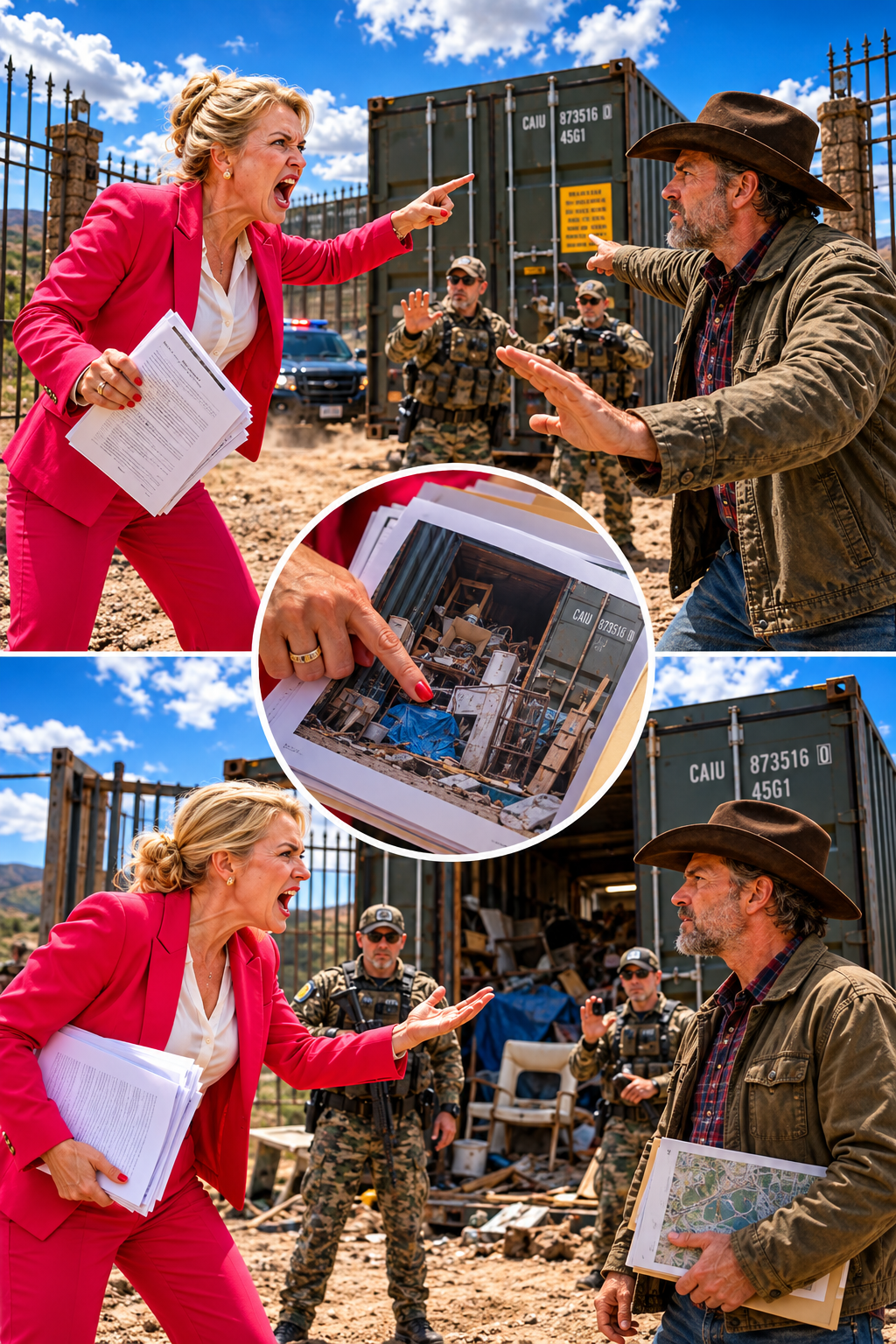
When I arrived, I placed an empty forty-foot container across my front gate. Before I did, the hauler’s foreman had walked to the last container and read its placard. He came to me, not Deanna. “Is that a DoD placard? That’s not my insurance.” Deanna said it was a storage box. The foreman had already done the arithmetic on his company’s liability.
I told him, “Quiet. Give me the work order. You’re going to want me to have it.” He fetched the packet and handed me the delivery address, the customer form, and Deanna’s signed warranty of authority. Then he shut off the truck and refused to touch another thing. I have hired him twice a month ever since.
Deanna walked the loaded truck out my back gate. She was not cackling or celebrating. She stood in the yard holding a laminated board resolution and sincerely believed three yes votes made it a legal order. But the fire notice did not give her the right to take my property. A covenant could allow fines, liens, or an application for an injunction. It could not turn a board vote into a badge.
The hauler’s foreman pointed out that two bolt seals had been cut. My crew had bagged them in the cinder, and I wrote down their numbers. At , I called Nadia. She answered on the second ring. I read her both seal numbers from the bag, and she had me repeat them. Then she said, “Stay by the phone,” and hung up.
Part 7: Discovery proved her paperwork contradicted everything she claimed
My subcontract and my site-security plan both required written notice within twenty-four hours of loss, theft, damage, or possible compromise of government-furnished property. One of the five containers held controlled property on a hand receipt bearing my signature. The deadline was not a formality. I spent an hour reporting the seal numbers, scanning the work order, and uploading camera footage.
Jod sat across from me eating crackers from a sleeve because neither of us had made dinner. I called the sheriff’s office, got a report number, and waited. By Friday morning, four calls came before eight: corporate security, a counterintelligence office, a DCIS agent out of Phoenix, and the property-book officer from the guard unit.
That unit had to report its package non-mission-capable during Arizona fire season. That was why nobody on those calls treated the case as an HOA dispute. The movement was frozen pending inventory, and four organizations spent Friday morning on a container theft in Yavapai County because I had filed the twenty-four-hour notice the night before.
The DCIS agent made me repeat who had taken the containers. “My homeowners’ association president,” I said. There was a long pause. I called the sheriff back at with a federal case number. A deputy was in Ash Fork within the hour.
On Friday at , we stood in a gravel lot beside my five containers. The operator had no idea what was inside; he had rented five spaces to a woman who paid a deposit. The teams checked each seal number against Nadia’s May photographs. Three were intact. Two had been cut by the hauler’s foreman, who had already explained why and documented it before anyone asked.
The inventory was conducted item by item under a shade tent because it was 101 degrees. Every item was present. Nothing was missing or damaged, and nothing had been tampered with beyond the two seals cut during the move. That should have been a relief. Instead, I felt sick, standing beside federal agents in a gravel lot and realizing how differently the count could have ended.
The fire was contained by Saturday. Four hundred acres burned, no structures were lost, and the pre-evacuation notice was lifted Sunday morning. I told Fiori the fire was real and the notice was real, and that those facts cut against my case. “Good,” she said. “Say that to me, and never to anyone else.” Then she lifted two banker’s boxes off my tailgate.
She made me repeat three legal points until I could say them without looking down. The amendment banned combustible materials and debris; a sealed steel container was neither. Even if the covenant covered the containers, it allowed fines and court injunctions, not self-help removal. And the hauler’s deposit predated the lightning and fire by two days.
Two weeks later, we obtained a temporary restraining order and then a preliminary injunction. The association and Deanna could not enter my property, remove anything, interfere with the easement, or disable the gate code. Six weeks in, Fiori filed claims for conversion, trespass, tortious interference, wrongful lien, and breach of covenants.
Part 8: A judge separated legitimate concerns from unlawful actions at trial
Discovery lasted from month four through month thirteen. The association produced the meeting audio, the keypad vendor’s access log, the county complaint file, and the lawyer’s email about my easement. The keypad record showed my code had been activated, deactivated nine days later by an administrator, then restored eight days after Fiori’s letter.
The county complaint included Deanna’s twenty-two photographs. Four showed the yellow placard clearly; two showed the container numbers beneath it. At the hearing, she had called the government-marked box “a storage container.” Her own pictures proved she had been close enough to read the placard.
The association’s lawyer had told the board in writing that it could not use the gate to exclude a deed-easement holder. The new board waived privilege as to that advice. Deanna’s lawyer was good and had a real defense: the fire-season amendment passed by more than a two-thirds vote, the county issued a genuine pre-evacuation notice, the containers were moved to storage rather than sold, and every item was returned intact.
The defense also argued that Deanna relied in good faith on a board vote and a licensed hauler. Nothing was lost, nothing was damaged, and no contents were compromised. “So what exactly are we paying for?” her attorney asked. It was a fair question. I lay awake over it more than once.
The answer came gradually. The amendment covered combustible materials and debris, not sealed steel containers. Deanna’s lawyer conceded the wording was not ambiguous. The pre-evacuation notice was real, but the hauling quote and deposit were dated two days before the lightning storm. Then Nadia testified that the May photographs showed five intact seals, while the evidence bags contained two seals cut during the removal.
She described what a possible compromise report triggered: notifications, inventory, re-certification, and the time a package was unavailable during fire season. The prime’s standby and re-certification charges were documented down to invoice numbers. She never used a dramatic adjective. She just gave the judge the figures.
Fiori also presented my written offer to disconnect from the shared well, the tank receipts, the meeting audio, and the lawyer’s email. The evidence showed the well issue was real, but I had voluntarily removed my operation from it. Wendell asked whether Deanna could still move the boxes. “You can agree with me and still move the boxes,” she had replied.
The bench trial lasted three days in December. The courthouse smelled of floor polish and wet wool, and the radiators knocked twice before hissing. Fiori began by projecting the amendment beside Deanna’s own photograph of a sealed container. She asked the association secretary to read the rule aloud: “Outdoor accumulation of unsecured combustible materials and debris.” Then she asked her to read it again.
Deanna’s attorney argued substantial compliance and a reasonable reading of the rule. He argued that nothing was stolen and that the fire threat justified action. The judge listened. On cross-examination, he asked why I had spent so much time and money on a case where the property came back intact. I answered that the worst part was calling Nadia and using a relationship I had spent four years building to report that my own association had cut government seals.
Part 9: I rebuilt the yard, the business, and my trust again
The written ruling arrived by mail sixteen days later. The fire-season abatement provision did not apply to sealed steel containers; they were not combustible materials or debris. The road-impact fee and gate restriction could not override a 1989 easement recorded before the subdivision existed. The judge upheld the co-op’s authority to set a commercial water rate, however. I lost that part, and I want to say so plainly.
The court found the lien wrongful and ordered it released. It entered judgment against the association and Deanna for conversion and trespass to chattels, and against Deanna personally for tortious interference. The award was $264,900, including prime standby and re-certification charges, the delayed Camp Verde contract, container repair and resealing, three weeks of side-lifter downtime, consultant fees, hauled water, and attorney fees under the covenants’ prevailing-party clause.
The county attorney handled the criminal case separately. Fourteen months later, it ended with a negotiated plea to one theft count: probation, restitution, and 200 hours of community service. There was no jail, no handcuffs, and no courtroom applause. Afterward, Jod asked if we could get green-chile burgers. We went. The burgers were fine.
The association recalled Deanna before the ruling arrived. The vote was twenty-nine to six at a special meeting in the fire-station bay. She stayed for the whole meeting. Her twenty-acre parcel was sold to a hay grower from Chino Valley who cared about water rights, not the view, and installed a pivot on part of it. She kept her house and her real-estate license, though the board issued a reprimand and required continuing education.
The association’s insurance covered most of its share of the judgment, minus a $50,000 retention. That became a $1,300 assessment per lot. The community had spent two years trying to protect residents from exactly the financial hit the judgment ultimately delivered. I never celebrated that part. The water co-op hired a licensed operator, published the meter schedule, and posted static-level readings online.
The well is still dropping. That problem was real when Deanna raised it, and it remains real now. I stayed off the co-op and kept using Big Bertha, my ten-thousand-gallon tank. I still pay about nine cents a gallon for hauled water. The case did not fix the drought or create more groundwater. It only stopped one person from using a legitimate problem to take property she did not own.
The hauler settled, changed its customer packet to require proof of ownership or a court order, and now works for me twice a month. The prime kept my company, then added a second refurbishment package. Nadia told me the audit trail I created during the incident was the cleanest her security office had seen all year. I got more work because someone took my containers and I did the paperwork properly.
The gate code works again. The bank released its lien hold, and the truck loan was reclassified within a week. Marissa graduated and took a paint job at a body shop in Prescott Valley. She reminds me regularly that she makes more than I ever paid her, and she has strong opinions about clear coat that I no longer argue with.
The empty container I set across the front gate never moved. It sat sideways for three weeks while I dealt with everything else. Eventually, I cut two windows into it, framed a door, ran power from the pole barn, and installed a mini-split. It became the yard office. Jod’s desk is inside, along with a coffee maker better than the one at the fire station.
The gouges remain in the left gatepost. I see them every morning when I open up. I could fill them, sand them, and repaint the wood, but I haven’t. Last April, five government containers went out the front gate on schedule. The foreman waved from the cab as dust rose behind the truck.
The most dangerous thing on that hill was never a steel box. It was a motion, a second, three yes votes, and a woman who believed those things added up to a badge. The water shortage was real. My shop did use too much of the shared well. I agreed with Deanna about that, disconnected, and paid to haul my own water.
What she could not do was turn disagreement into ownership. I still live on the Big Chino, and Deanna still lives about a mile and a half up the road. We pass each other twice a week and lift two fingers from the steering wheel. That is not forgiveness or war. It is simply how you keep going when you have to share a road.
✓ Lynn R. Adams
Part 2: A private road gate became a weapon against my livelihood In February, sixteen months before the containers disappeared, I thought I had a manageable disagreement with the homeowners’ associa…