The woman who stole my family’s lake thought she had everything under control: 139 luxury cabins,
Part 2: My father’s forgotten documents expose a multimillion-dollar land deception
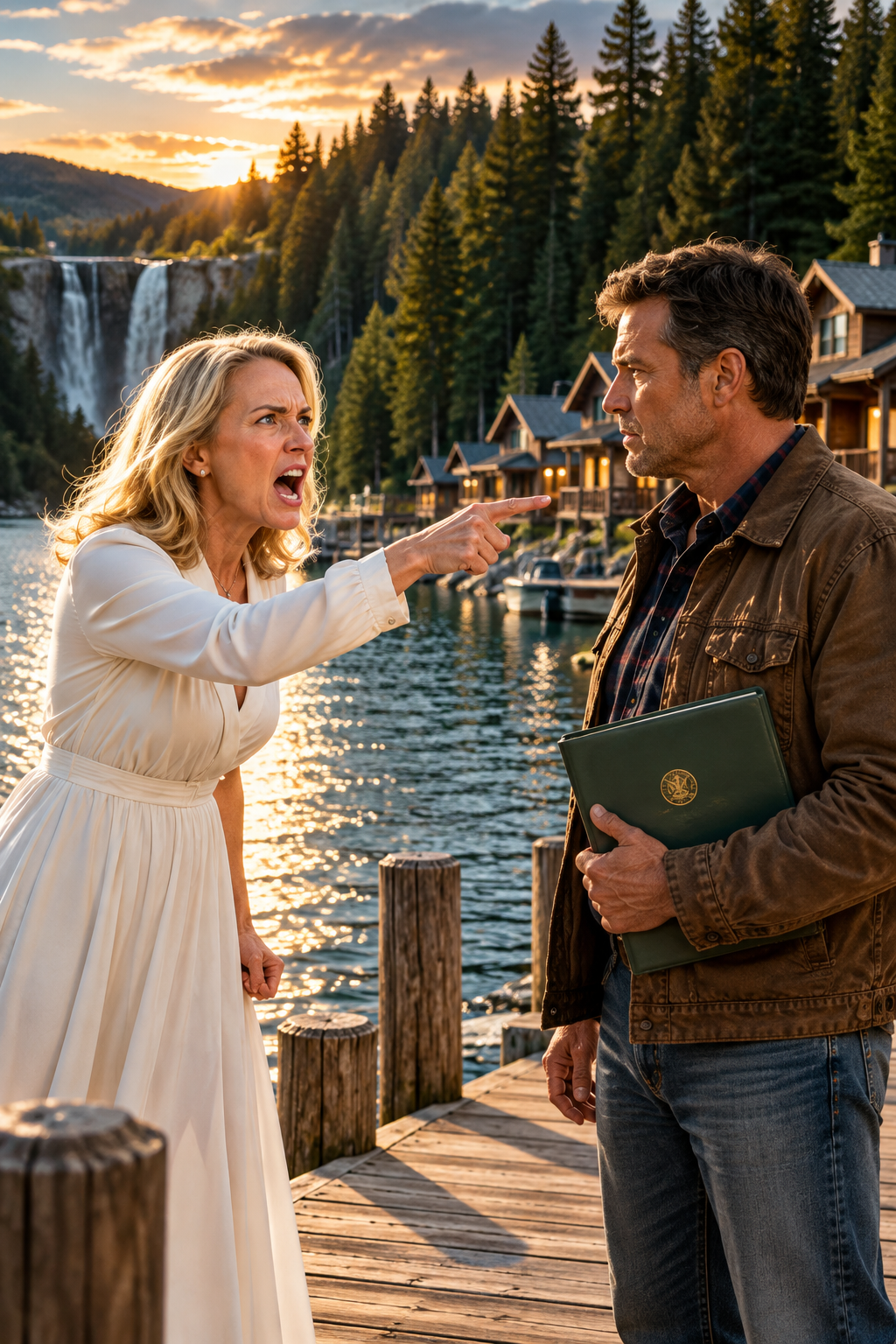
Victoria Hale arrived in a black pickup, followed by a silver sedan carrying a lawyer with an expensive briefcase and the expression of someone expecting an easy victory. She stepped onto my porch wearing a tailored white jacket, the same confident smile she had displayed during the grand-opening ceremony, and an attitude that suggested my home was merely another obstacle awaiting removal. The lawyer introduced himself as Connor Reed, counsel for the Silver Ridge Homeowners Association, and asked whether we could discuss the ownership dispute professionally. I invited them into the kitchen, poured coffee, and waited while Connor arranged his documents beside the old wooden table my grandfather had built. Victoria looked around the room with thinly concealed contempt, apparently unimpressed that the man challenging her expensive development lived in a house without granite countertops or designer furniture.
Connor explained that Silver Ridge had acquired recreational access rights through an easement connected to the original development purchase. He produced a notarized amendment bearing a county recording number and claimed it granted the association broad authority over the lake and its surrounding infrastructure. According to him, the HOA was prepared to formalize those rights through a permanent agreement that would place Cedar Ridge Dam under association oversight. If I refused, he warned, Silver Ridge would pursue a fifty-thousand-dollar damages claim for interfering with amenities promised to its homeowners. Victoria folded her arms and watched me with the satisfaction of someone who believed a carefully delivered legal threat would finally end an inconvenient disagreement.
I picked up the amendment, examined the recording number, and asked Connor whether he had personally retrieved the underlying county records. He admitted that the association had provided the document and that his review had relied on the materials supplied by his client. Without answering further, I opened the green folder and placed my grandfather’s 1941 deed beside the 1963 expansion deed. Next came the state water-rights certificate, the federal easement registration, the Army Corps correspondence, and several engineering surveys identifying the protected shoreline. Connor’s expression changed as he compared the documents, particularly when he noticed that the recording number on Victoria’s amendment did not match the chain of title for Blackstone Lake.
Victoria interrupted before he could speak, announcing that her investment group was willing to purchase my land for what she called a generous market price. The figure she named was less than one-quarter of an offer I had rejected from a timber company eight years earlier. I told her the property wasn’t for sale, just as my father had refused to sell it and my grandfather had refused before him. She accused me of selfishness, arguing that 139 families had built their futures around the development and deserved access to the lake. I reminded her that those families deserved something more important than access: honest information about whether their homes had been constructed on safe ground.
For the first time, Connor asked to examine the flood-zone documents more closely, and I watched his confidence begin to unravel. The county engineer’s report identified a three-hundred-foot protected area associated with the dam’s spillway and documented the risks posed by construction in the lower eastern basin. I showed him the fifteen certified warning letters, including the signed delivery receipts demonstrating that Victoria’s office had received them. Victoria dismissed the correspondence as exaggerated and insisted that her own advisers had found no credible danger. Connor said nothing, but the way he stared at the documents suggested he was beginning to wonder what else his client had concealed.
My father had taught me that a man’s word mattered, but that important agreements needed to survive long after the people making them were gone. He had built Cedar Ridge Dam after severe seasonal flooding damaged downstream farms, and he had insisted on recording every legal and engineering detail properly. I remembered watching him at the kitchen table, checking survey lines with a pencil while explaining that water respected gravity rather than property boundaries. He had never imagined that someone would build an entire subdivision along the protected shore and then claim the lake belonged to them. Yet he had preserved enough evidence to answer precisely that challenge, and I felt his presence beside me as Connor quietly closed his briefcase.
Victoria stood, declared that the matter was far from over, and warned that she had the financial resources to fight me in court for years. I answered that she was free to seek whatever lawful remedy she believed available, provided she stopped misrepresenting the ownership and safety of the property. Connor gathered his papers more slowly than he had arranged them, avoiding eye contact with his client as they left. After their vehicles disappeared, I returned to the kitchen and found one of my father’s handwritten notes tucked behind the oldest survey. Beneath a diagram of the spillway, he had written a sentence I would remember throughout the coming disaster: Never mistake calm water for harmless water.
Part 3: A retired teacher discovers her dream home hides terrifying danger
The next visitor arrived after sunset, when the eastern cabins glowed like a necklace of golden lights around the darkening lake. She introduced herself as Claire Bennett, a recently retired school administrator who had purchased Cabin 42 for two hundred eighty thousand dollars. Claire wore a faded blue jacket and carried a folder of closing documents that she held so tightly her knuckles had turned pale. She explained that she had overheard part of Victoria’s conversation with the HOA board and had recognized the careful language people use when they’re trying to conceal something important. Then she asked a question that immediately separated her from everyone else who had approached me about the development: “Mr Mercer, is my home actually safe?”
I invited her inside and asked her to tell me what she had been promised before purchasing the cabin. Claire explained that she had spent eleven years saving for a quiet retirement near the water after working more than two decades in public education. Her cabin represented nearly everything she owned, and she had no other property waiting to protect her if the investment failed. The sales materials described Silver Ridge as a secure waterfront community with private lake access, professionally managed infrastructure, and carefully reviewed construction standards. Nobody had explained that the lake was privately owned by someone outside the development or that a federally registered flood-control easement affected much of the shoreline.
I spread the engineering maps across the kitchen table and located Cabin 42 near the upper eastern ridge. Claire leaned forward as I showed her that her own property stood above the identified flood boundary and was not among the structures expected to sustain damage during the scheduled release. Relief crossed her face, but it disappeared when she noticed the shaded area covering dozens of neighboring cabins. She asked whether the families living below her understood what the markings meant, and I told her that Victoria had received the same information repeatedly. When Claire asked me to explain the danger without legal terminology, I described how water could rise rapidly through the lower basin and undermine foundations built on unstable shoreline fill.
For several minutes, Claire stared at the map without speaking, occasionally tracing the outline of a cabin with one finger. Then she asked whether the danger was immediate, and I told her about the mandatory maintenance operation scheduled for Saturday morning. I explained that the work had been publicly noticed and that the relevant authorities had been informed, but I also emphasized that protecting residents required an effective evacuation response. Claire looked toward the window, where the lights of the eastern development reflected peacefully on the lake. “Those people think they’re going to wake up Saturday and make pancakes with their grandchildren,” she whispered, “and nobody has told them what their own president already knows.”
I told her about the fifteen certified letters, the county engineering report, and the unanswered requests to halt construction before anyone moved into the affected area. Claire asked whether she could have copies of the documents, and I gave her the publicly available reports and information about contacting county emergency officials. She said she would begin speaking with her neighbors immediately because she knew several residents who would trust her more readily than a stranger involved in a property dispute. Before leaving, she stopped beside the old family photograph hanging near my front door and asked whether the man standing beside the dam was my father. When I nodded, she said he looked like someone who understood the responsibility of building something that other people depended upon.
After Claire left, I walked onto the back porch and listened to the frogs calling from the reed beds. I thought about her eleven years of savings, the hundreds of retirement plans represented by those cabins, and the enormous difference between purchasing a home and purchasing a promise. Victoria had sold the promise beautifully, surrounding it with brochures, champagne, professional photographs, and reassuring legal language. Yet the ground beneath those carefully arranged houses remained the same low floodplain my father had surveyed decades earlier. No amount of marketing could change its elevation, and no HOA vote could alter what would happen when the water reached it.
The following morning, Claire began visiting cabins with printed maps and a list of county offices residents could contact for independent information. Some homeowners listened carefully, while others accused her of spreading rumors on behalf of a bitter landowner trying to destroy their property values. She continued anyway, knocking on doors and explaining the engineering findings without exaggerating what she knew. By evening, several families had contacted emergency management officials, and others were demanding answers from the HOA board. Victoria responded by calling Claire a troublemaker, but the retired teacher had already begun doing what the association’s leadership should have done months earlier: telling people the truth.
Part 4: A midnight break-in exposes the president’s desperate secret operation
Two mornings after Claire’s visit, I opened the security footage from the camera overlooking Cedar Ridge Dam and noticed an unfamiliar vehicle approaching the service entrance. The recording showed a silver sedan arriving shortly before midnight, followed by three people carrying flashlights and tools. One person cut the padlock securing the outer gate, while another approached the control-room door and forced the second lock. The third held a phone horizontally, apparently recording the entire operation as though trespassing on critical infrastructure were an entertaining adventure. When the camera captured the woman in the white coat turning toward the light, I recognized Victoria immediately.
I watched the footage twice, hoping there might be some innocent explanation for what I was seeing. Victoria and her companions remained inside the control room for twenty-two minutes before emerging and attaching a printed sign to the door. The sign announced that Cedar Ridge Dam was now restricted to personnel authorized by the Silver Ridge Homeowners Association. I drove to the dam, photographed the broken locks, and inspected the equipment without touching anything that might compromise the evidence. Although the controls showed no obvious damage, I contacted the appropriate officials and requested a professional inspection before any scheduled operation proceeded.
At the courthouse, I submitted the footage and photographs with a criminal trespass complaint and contacted my attorney, Daniel Foster. Daniel had handled our family’s property matters for years, but even he sounded stunned when I described Victoria’s attempt to claim physical control of the dam. He advised preserving the original video files, avoiding further direct confrontation, and seeking an expedited judicial determination concerning the unauthorized entry. I followed his instructions and arranged for additional security while county personnel examined the condition of the facility. The prospect of someone tampering with flood-control equipment frightened me far more than Victoria’s legal threats ever had.
Two days later, Silver Ridge filed an emergency motion seeking operational control of Cedar Ridge Dam. The petition described the dam as essential infrastructure serving the new community and relied heavily on the questionable easement amendment Connor had shown me. Victoria’s attorneys argued that the association needed authority to prevent interference with residents’ enjoyment of the lake and to preserve the development’s value. The filing also portrayed my maintenance plans as unnecessary and potentially harmful, despite the longstanding engineering and regulatory requirements governing the structure. Reading those accusations, I realized Victoria had moved beyond ignoring warnings and was now attempting to use the courts to legitimize her control.
The hearing was scheduled quickly, and word spread through the development before the date arrived. Claire called to say several homeowners planned to attend because they wanted answers about the flood maps and the conflicting statements they had received. She sounded exhausted after days of knocking on doors, but she refused to stop explaining the risks to anyone willing to listen. I asked whether she was getting enough rest, and she laughed sadly before telling me that retirement wasn’t supposed to involve emergency planning for an entire neighborhood. Then she admitted that every time she closed her eyes, she pictured someone else’s grandchildren sleeping in one of the lowest cabins.
The night before the hearing, I sat at the kitchen table reviewing the original documents while rain tapped softly against the windows. Daniel had organized the deeds, surveys, federal registrations, engineering reports, and certified receipts into a sequence that could be understood without knowing my family’s history. I appreciated his thoroughness, but I kept returning to the photograph of my father standing beside the newly completed dam in 1963. He had been thirty-eight years old, his work clothes stained with concrete dust, and his face carried the weary pride of someone who had finished an important job. I wondered what he would say if he knew the infrastructure he had built to protect people had become the center of a dispute threatening dozens of families.
Before going to bed, I walked outside and looked across the water toward the cabins. Most were dark, but several porch lights remained on, casting narrow reflections across the surface. Somewhere beyond the trees, Victoria was undoubtedly preparing her courtroom arguments and reassuring herself that money, confidence, and political influence would overcome the documents in my father’s folder. I had no desire to embarrass her publicly, but I knew the judge needed to understand that the issue was not simply a disagreement over recreational access. It was a question of whether a private association could disregard recorded property rights and engineering warnings while placing innocent people in danger.
Part 5: One courtroom document destroys the powerful developer’s entire defense
The county water court was crowded when Daniel and I arrived, with homeowners filling the benches and a local newspaper reporter sitting near the back. Victoria entered wearing a dark tailored suit, followed by Connor Reed and three HOA board members who appeared confident that the hearing would confirm their authority. Claire sat beside Samuel Briggs, the county drainage engineer whose report had identified the construction risks long before the cabins were completed. At the front of the room, Judge Patricia Holt reviewed the filings with the quiet concentration of someone more interested in evidence than courtroom performances. I placed my father’s green folder on the table and reminded myself that everything important was already written inside it.
Connor began by describing Silver Ridge as a legitimate residential investment supported by 139 families who had relied on professional advice and recorded documents. He argued that the association possessed established access rights and that allowing an outside landowner to control the dam threatened the community’s stability. His presentation was polished, confident, and carefully structured to make Victoria’s position appear reasonable. Then Judge Holt interrupted and asked the clerk to retrieve the official county record corresponding to the number printed on the association’s easement amendment. Connor confirmed the number without hesitation, apparently unaware that his entire argument was about to collapse.
The clerk returned with a record dated 1987 concerning an agricultural property located twelve miles northeast of Blackstone Lake. It documented the sale of a grain storage facility and surrounding acreage from the Donovan family to a rural cooperative. The document contained no reference to Blackstone Lake, Cedar Ridge Dam, recreational access, flood-control easements, or any land within the Silver Ridge development. Judge Holt read the identifying details aloud and asked Connor to explain why his client’s amendment cited an unrelated agricultural transaction. The silence that followed was so complete that I could hear someone shifting papers three rows behind me.
Connor examined the official record, then turned toward Victoria with an expression that revealed how completely his confidence had vanished. Victoria whispered something to him, but the judge asked that any explanation be made openly for the record. Daniel then submitted my grandfather’s original deed, my father’s expansion deed, the federal easement registration, and the state water-rights certificate. Each document corresponded to identifiable property records and established a consistent chain of ownership covering the lake, shoreline, dam, and relevant easement areas. Unlike Victoria’s amendment, the evidence did not depend on an unsupported assertion or a recording number belonging to somebody else’s land.
Samuel Briggs testified next, explaining that he had personally inspected the development and identified eighty-seven cabins within the protected flood-release zone. He described the likely consequences of a standard maintenance release, including rising water, foundation instability, and potentially severe structural damage to improperly elevated buildings. He confirmed that his report had been submitted to county officials and communicated to the association during construction. When Judge Holt asked whether the project had stopped after those warnings, Samuel answered that work had continued without meaningful interruption. Several homeowners exchanged frightened looks, and I saw Claire lower her eyes as the reality of their situation became impossible to dismiss.
Daniel presented the fifteen certified letters I had sent over fourteen months, along with the delivery receipts showing that Victoria’s office had accepted them. Judge Holt asked Connor whether he had personally reviewed those warnings before filing the association’s motion. He admitted that he had not examined the complete correspondence and had relied on information provided by his client. The judge then asked whether he knew about the county engineering findings before seeking operational control of the dam. Connor hesitated before acknowledging that his understanding of the matter had been incomplete.
Victoria attempted to speak, insisting that the community had invested millions and that stopping the development’s plans would destroy innocent families financially. Judge Holt reminded her that the court could not manufacture ownership rights merely because a development had been completed or because buyers had relied on inaccurate representations. The judge denied the HOA’s emergency motion and declined to transfer control of the dam, while leaving separate questions about trespass and document authenticity for further proceedings. She also emphasized that any maintenance release had to comply with applicable safety requirements and emergency-management procedures. Victoria sat rigidly beside her attorney, her face drained of the confidence she had displayed only an hour earlier.
Outside the courthouse, reporters surrounded Victoria and asked whether she intended to warn residents about the documented flood danger. She declared that the ruling was not the end of the dispute and promised to pursue every available legal remedy. Then she made a statement that would later become central to the litigation against her, telling the cameras that no water release would occur and that residents could continue their weekend plans without concern. I watched from the courthouse steps as Connor attempted to interrupt her, but she continued speaking over him. For the first time, I understood that Victoria might prefer risking everything to admitting she had been wrong.
Part 6: Ignored evacuation warnings leave eighty-seven luxury cabins facing disaster
After the hearing, the county emergency management office issued updated public warnings and coordinated with local responders concerning the scheduled dam maintenance. The operation could not safely proceed without confirming that the equipment was functioning correctly and that residents in the affected area had received clear information about the danger. I worked with Samuel Briggs and the authorized personnel responsible for reviewing the release plan, providing access to the facility and the historical engineering records. The maintenance remained necessary to manage sediment accumulation and preserve the dam’s long-term operation, but protecting human life took priority over every scheduling concern. Nobody involved wanted to discover that an avoidable communication failure had placed someone inside a flooding cabin.
Claire spent Friday traveling along the eastern road, knocking on doors with printed maps and copies of the county’s advisory. Some residents thanked her and began packing immediately, while others insisted that Victoria’s public assurances were more trustworthy than the warnings. At Cabin 17, an older couple listened carefully and decided to stay with relatives until officials confirmed the area was safe. At Cabin 53, a man accused Claire of helping me manufacture a crisis so I could force the development off my property. She walked away without arguing, knowing that another family still needed to hear the same information before darkness fell.
One of her most difficult visits was to Ruth, an elderly widow who had purchased Cabin 7 for the retirement she and her late husband had planned together. Ruth moved slowly, relied on several medications, and had difficulty lifting the heavy storage boxes containing her most important possessions. Claire helped her gather prescriptions, financial documents, photographs, winter clothing, and a frightened orange cat that refused to enter its carrier. Ruth’s son drove three hours to collect her, arriving shortly after sunset with tears in his eyes when he saw how much his mother had tried to carry alone. As their car disappeared toward the highway, Claire stood beside the road and wondered how many other people were still waiting for someone to tell them what to do.
Meanwhile, Victoria sent a community-wide message asserting that the legal situation had been resolved favorably and that weekend activities could proceed normally. The statement contradicted the actual court ruling, but many homeowners received it before seeing the official documents. The rental management company also promoted discounted weekend stays, attracting visitors who knew nothing about the ownership dispute or the flood-release warnings. Families arrived with kayaks, fishing rods, coolers, and children excited about spending time beside the water. Claire watched their vehicles enter the development and felt sick knowing that some guests had never been given the information necessary to make an informed decision.
Philip Osgood, the HOA treasurer, had remained unusually quiet throughout the dispute, but Victoria’s latest message finally pushed him into action. For two years, he had recorded board meetings, maintained financial records, and listened while Victoria dismissed concerns about the lake’s ownership and the engineering reports. He knew the association had received my letters because the board had discussed them repeatedly, and he knew the majority had voted to continue construction despite the warnings. Now he watched Victoria assure residents that no danger existed, even after the court had rejected the legal foundation of her position. Philip opened his laptop, copied twenty-six months of meeting minutes, and began preparing a complete account of what the board had known and when it had known it.
On Friday evening, I met with Samuel and the emergency management coordinator to review the final safety arrangements. We confirmed the status of the dam inspection, communication procedures, evacuation notices, and the conditions under which the operation would have to be delayed or stopped. The coordinator assured me that responders would remain available and that no one should treat the release as a spectacle or an opportunity to settle a property dispute. I agreed completely, explaining that my family had maintained the dam for decades precisely because uncontrolled water could destroy lives and livelihoods. Whatever happened to Victoria’s development, I wanted every person on the eastern shore to survive without injury.
That night, I sat on the back porch listening to the water move gently against the old dock. The lake looked peaceful, reflecting the stars between dark silhouettes of pine trees, and I understood why people had fallen in love with the place. I thought about the retired teachers, widows, young parents, and working families who had trusted a developer promising security and happiness. Their homes were not simply buildings on a map; they contained photographs, wedding rings, favorite chairs, children’s drawings, and the savings of entire lifetimes. I hoped they would all leave before morning, because even a carefully controlled maintenance operation could not make improperly constructed homes safe.
Part 7: The rising water exposes every lie behind her empire
Saturday arrived cold and clear, with pale sunlight spreading across the eastern hills as emergency vehicles positioned themselves near the access road. Samuel and the authorized dam personnel completed their inspections, reviewed the gauges, and confirmed the equipment was ready for the scheduled operation. Officials had continued urging people in the affected cabins to leave, and responders checked the lower shoreline before clearance was given. I stood beside the control building thinking about the countless mornings my father had spent in the same place, maintaining a structure most people never noticed until something went wrong. At nine o’clock, the authorized team began the controlled release under the approved operating procedure.
The first visible changes appeared along the low eastern shoreline, where water began advancing over ground that had looked solid only minutes earlier. Gravel shifted beneath several cabin foundations as the rising basin reached the unstable fill placed along the natural berm. From the upper road, residents watched the water spread across lawns, surround porch steps, and climb toward the lowest structures. Emergency personnel directed anyone still near the affected area toward safer ground, while homeowners who had evacuated stared helplessly at the places where they had expected to spend their retirement. I watched the gauges rather than the cabins, knowing that the release had to remain controlled and that the safety of people downstream depended on disciplined operation.
At , one of the lowest cabins began settling unevenly as the saturated ground beneath its rear foundation gave way. Its porch tilted, the exterior siding separated near a corner, and the building shifted enough to make everyone watching understand that the damage was no longer theoretical. A second cabin soon showed similar movement, followed by others as water spread across the vulnerable shoreline. The scene was heartbreaking, not because expensive property was being damaged, but because every building represented someone who had trusted that the ground beneath it was safe. I remembered Claire describing the retirement dreams of her neighbors and felt no satisfaction watching those dreams collapse.
Victoria’s son had positioned himself on the upper clubhouse deck with a phone, apparently intending to record proof that his mother’s predictions were correct. Instead, his video captured the first cabin shifting, the advancing water, and residents crying as their belongings floated from damaged structures. The footage spread rapidly, drawing attention from local reporters and neighboring communities who had never heard of Silver Ridge Retreat. Victoria arrived near the parking area and demanded that a deputy arrest me for destroying private property, insisting that the release was an illegal attack against her development. The deputy continued documenting the situation and referred her to the court records and officials overseeing the operation.
By late morning, the full extent of the damage had become painfully clear. Eighty-seven cabins had sustained damage, fourteen had been displaced from their foundations, and twenty-three were considered structurally compromised and uninhabitable pending assessment. The fifty-two cabins located above the affected flood boundary remained untouched, their intact porches and dry lawns forming a stark contrast with the damaged lower development. Emergency responders confirmed that the evacuation and safety arrangements had prevented reported casualties during the operation. That fact mattered more to me than every legal argument, every financial loss, and every angry accusation that followed.
Claire stood beside Ruth’s son near the upper road, watching rescue crews assess the damaged properties. Her own cabin had remained safe, but she could not celebrate while so many neighbors faced enormous losses. She moved from family to family, offering water, helping locate temporary accommodations, and directing people toward the officials collecting damage information. Some homeowners were furious with Victoria, while others were angry with me because they associated my dam with the destruction of their homes. Claire listened to both groups and reminded them that understanding the full history would be essential before anyone could decide who bore responsibility.
At two that afternoon, Philip Osgood sent Daniel the complete HOA meeting minutes and supporting records. The documents showed that Victoria and the board had discussed my warnings repeatedly, received the county engineer’s findings, and voted three to two to continue construction despite the identified risks. They also recorded Connor’s earlier assessment that my ownership claims were probably unreliable because the county’s digital mapping system did not display the relevant historical information. That system had not been properly updated for years, a fact that independent examination of the underlying records could have revealed. Philip’s records transformed the dispute from a confusing argument about property boundaries into a documented history of decisions made with knowledge of serious potential consequences.
That evening, I returned home exhausted and sat at the kitchen table without turning on the lights. Across the lake, emergency crews continued working beneath portable floodlights, and the eastern shore looked like a place recovering from a storm. I thought about the fifteen letters I had written, the warnings Samuel had issued, and the opportunities Victoria had been given to prevent the disaster before construction was completed. I also thought about the people who had ignored the evacuation notices because they believed the reassuring statements of someone they trusted. When Daniel called to say the first lawsuits had already been filed, I closed my eyes and wished the story could have ended with nothing more dramatic than an honest conversation over coffee.
Part 8: Her fortune collapses while the lake returns to its rightful legacy
The lawsuits multiplied during the first week after the release, as homeowners began examining the documents they had signed when purchasing their cabins. Several discovered that the easement disclosures described ordinary access arrangements without clearly explaining the flood-control restrictions affecting their properties. Others learned that the county recording number cited in the association’s ownership documents referred to an unrelated agricultural transaction. Eleven owners initially brought personal claims against Victoria, while a larger group pursued action against the association and other potentially responsible parties. What had once been advertised as a secure investment community was now at the center of a legal and financial disaster involving millions of dollars.
The development’s insurance carrier reviewed the engineering reports, flood-zone maps, certified warnings, and HOA meeting minutes before determining that important claims fell within a known-risk exclusion. That decision created enormous financial pressure on the association and the individuals responsible for the development’s representations. Connor Reed voluntarily disclosed his reliance on unverified client-provided records to the state bar, which opened an inquiry into his handling of the matter. Victoria’s personal assets became subject to court restrictions during the civil proceedings, and a second development project she had financed was suspended. Her new attorney warned that the combined claims could exceed twelve million dollars, with the ultimate exposure depending on findings that had not yet been resolved.
Claire organized the affected homeowners into a group that could share information, obtain legal advice, and communicate more effectively with investigators. She held the first meeting in the undamaged clubhouse, where forty-eight residents gathered around tables covered with maps, contracts, photographs, and copies of the board minutes. Rather than deliver an angry speech, Claire carefully explained the timeline, beginning with the earliest construction warnings and ending with the court ruling and maintenance release. She showed homeowners how to distinguish the genuine county records from the amendment that had relied on a false recording number. By the end of the meeting, people who had previously blamed one another were beginning to understand how they had all been drawn into the same dangerous deception.
Six weeks after the release, the Silver Ridge homeowners voted to dissolve the association under the applicable legal procedures. All 139 owners were given the opportunity to participate, and the proposal passed by an overwhelming margin. The organization that had claimed ownership of my family’s lake, threatened me with financial penalties, and attempted to seize control of Cedar Ridge Dam was being dismantled. The remaining legal claims continued, and the dissolution did not erase the responsibilities of those involved. Yet it ended the association’s claim to an authority it had never lawfully possessed.
I did not attend the vote, because I had no desire to watch Victoria experience another public defeat. By then, I had learned that winning a property dispute and watching innocent people suffer could happen at the same time, and the combination offered little pleasure. My attention remained on restoring the shoreline, supporting appropriate environmental assessments, and ensuring that future development respected the flood-control boundaries. Daniel handled the legal proceedings while Samuel continued monitoring the dam and the affected basin. I returned to the daily work of maintaining land that had survived generations of storms, disputes, and changing ownership claims.
In late October, I drove to the dam carrying tools, fresh padlocks, and a small piece of cedar I had carved the previous evening. The autumn air smelled of wet leaves and cold pine, and Blackstone Lake had returned to its familiar dark green color. I removed the association’s unauthorized sign from the control-room door, inspected the restored security hardware, and walked the spillway with the maintenance checklist my father had written decades earlier. Every gauge and mechanism received the same careful attention he had taught me to give them. When I finished, I drove down to the old dock where the entire conflict had begun.
The grand-opening banner was long gone, but the brass nail remained embedded in the timber above my father’s carved initials. I removed it carefully, cleaned the surrounding wood, and discovered that the letters beneath the former sign were still clearly visible. My father had carved them when he was a young man, using a pocketknife that now rested in a drawer beside my bed. I worked linseed oil into the exposed grain and fitted the new cedar piece beneath his initials. On it, I had carved two smaller letters, E M, not as a claim of superiority but as a promise that another generation would continue caring for the place he had entrusted to me.
Claire arrived along the shoreline carrying two cups of coffee and stood quietly while I finished securing the cedar. Her cabin had escaped the flood damage, but the months since the release had changed her retirement in ways she never could have imagined. She had helped displaced families locate temporary housing, organized documents for attorneys, and worked with county officials to ensure that the genuine flood-zone records remained accessible. When I asked whether she regretted purchasing a home at Silver Ridge, she considered the question for a long time before answering. She said she regretted trusting the wrong people, but she would never regret discovering how much courage ordinary neighbors could find when they stopped facing their problems alone.
We sat on the dock watching ducks cross the water beneath a pale autumn sky. The lake was peaceful again, although the damaged eastern shoreline remained a reminder of how expensive arrogance could become when combined with ignorance. Claire asked whether I thought Victoria would ever admit what she had done, and I told her that some people would rather lose everything than acknowledge a mistake. She nodded, then turned toward the distant cabins where a few families were beginning the difficult process of rebuilding. Neither of us spoke for several minutes, because there were losses no courtroom victory could make disappear.
Over the following year, the community changed in ways neither Victoria nor her investors could have predicted. Several damaged properties were cleared rather than rebuilt, while surviving homeowners pursued safer arrangements that respected the recorded flood restrictions. Claire helped establish an independent residents’ committee focused on accurate disclosures, emergency preparedness, and cooperation with county officials. I worked with engineers and conservation specialists to restore damaged shoreline vegetation and preserve the natural buffer areas my father had always insisted were essential. Slowly, Blackstone Lake began becoming a place where people could enjoy the water without pretending its risks did not exist.
On the anniversary of the release, Claire invited me to a small gathering at the clubhouse, where residents shared photographs of repaired homes and remembered the families still working through their losses. Ruth attended with her son and the orange cat that had caused so much trouble during the evacuation, and she thanked Claire for refusing to leave her behind. Samuel spoke briefly about the importance of respecting engineering evidence, while several homeowners discussed new procedures for communicating emergencies. Nobody celebrated the destruction of the cabins or treated Victoria’s financial collapse as entertainment. Instead, they honored the people who had warned others, helped their neighbors evacuate, and worked to rebuild a community founded on truth rather than promises.
That evening, I returned to my family’s house and found the green folder waiting on the kitchen table where I had left it. I added copies of the final court records, the updated shoreline surveys, and the documents confirming the association’s dissolution. Then I placed everything back inside the fireproof safe, knowing that someone decades from now might need to understand why the boundaries mattered. My father had preserved those papers because he understood that property ownership was not determined by confidence, popularity, or the number of people willing to repeat a convenient story. It was determined by facts that remained true whether anyone liked them or not.
Before going to bed, I walked down to the dock one final time and touched the initials carved into the wood. The original letters belonged to my father, and the newer ones belonged to me, but the responsibility represented by both had begun long before either of us was born. Across the water, a few porch lights shone from the surviving cabins, reflecting in gentle golden lines that moved with the evening breeze. I thought about Victoria standing on that same shoreline with champagne raised, convinced that 139 families and a polished legal document could turn someone else’s property into her personal empire. She had believed that enough money could purchase authority, that enough signatures could manufacture ownership, and that enough confidence could silence the warnings of people who knew the land better than she ever would.
But water had never cared about her reputation, and the shoreline had never recognized her title. The lake followed the physical laws that had shaped it for centuries, just as the recorded deeds preserved the legal boundaries my family had worked so carefully to establish. Victoria’s empire had collapsed because she treated both realities as obstacles she could negotiate away, and the people who trusted her had paid a terrible price. I could not undo their suffering, but I could continue protecting the land, telling the truth, and ensuring that the next generation understood what had happened here. As the last light disappeared behind the pines, I looked at my father’s initials and finally understood the lesson he had been teaching me all those years: a legacy is not something you own simply because your name appears on a deed, but something you protect through honesty, responsibility, and the courage to stand firm when everyone else insists that the truth should belong to the highest bidder.
✓ Lynn R. Adams
Part 2: My father’s forgotten documents expose a multimillion-dollar land deception Victoria Hale arrived in a black pickup, followed by a silver sedan carrying a lawyer with an expensive briefcase a…