The president of the subdivision next to my strawberry farm announced that forty strangers could pick my entire crop for free, even though my land wasn’t part of her HOA and the berries were already sold. I went outside expecting to straighten out a misunderstanding, but found my gate chain unhooked, families carrying buckets, and her waving them toward my daughter’s college money…
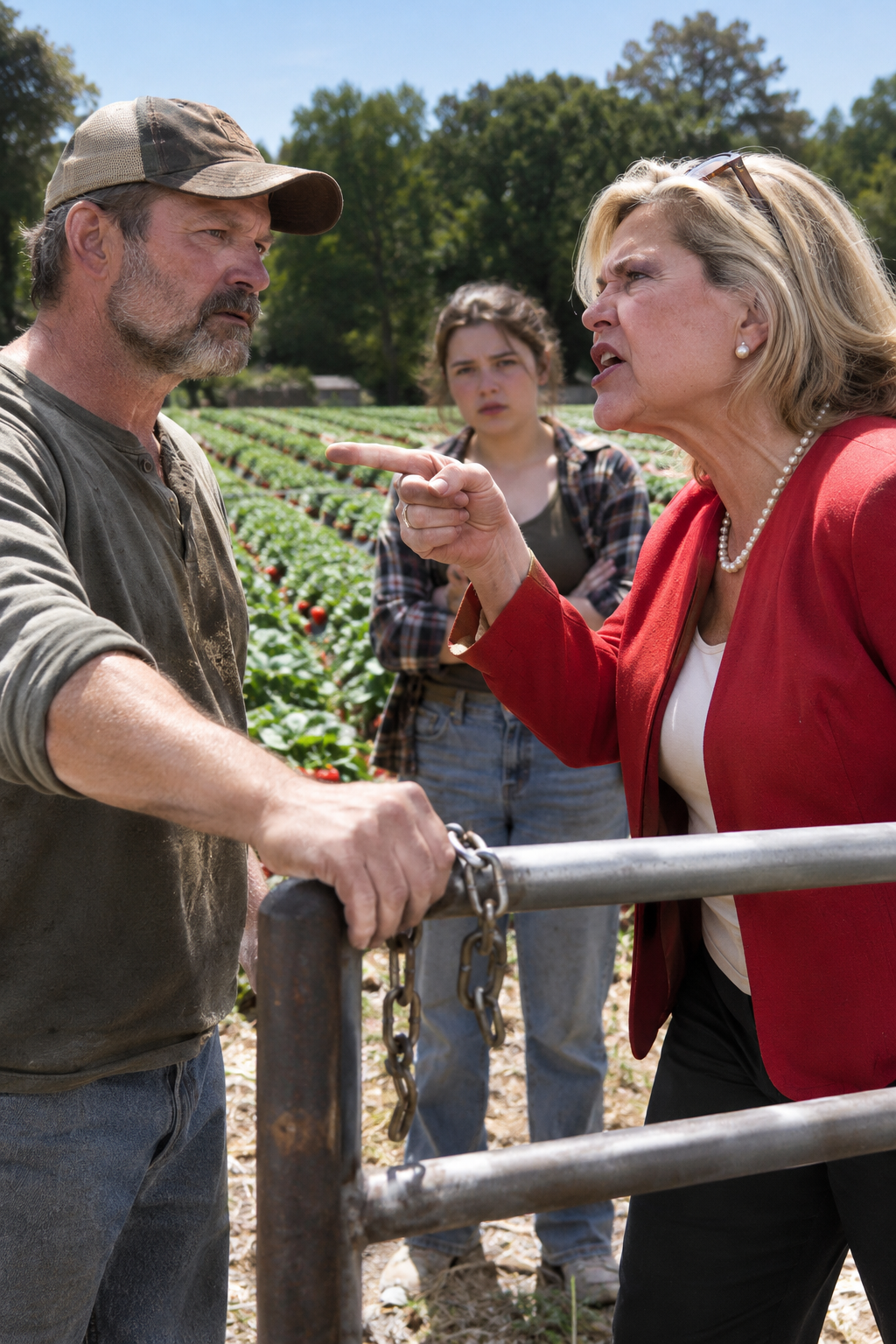
The president of the subdivision next to my strawberry farm announced that forty strangers could pick my entire crop for free, even though my land wasn’t part of her HOA and the berries were already sold. I went outside expecting to straighten out a misunderstanding, but found my gate chain unhooked, families carrying buckets, and her waving them toward my daughter’s college money…
I’m Kirk Sutton, fifty-two, divorced, and a plumber by trade. For twenty years I made my living under sinks and houses in Harnett County, North Carolina, and I bought 3.4 acres outside Brier Creek Estates for $41,000 because the land was zoned for agriculture. My daughter, Ellery, was sixteen, and she lived with me beside the field. We didn’t have much extra, but we had that land.
Four years earlier, I’d gone to the county Cooperative Extension office and asked what could grow in our stubborn red clay. They suggested strawberries, so I learned about frost covers, drip lines, fertilizer, and all the ways a man can ruin a perfectly good row of plants. After two seasons of mistakes, I finally had something worth calling Sutton Family Farm. I supplied two farmers markets and a farm-to-table restaurant, and the standing crop had $22,000 in advance commitments.
That money had a name in my head: Ellery’s college fund. She talked about North Carolina State whenever we drove past a campus sweatshirt in a store window, and I’d told her I’d do everything I could to keep her from starting adulthood with a mountain of debt. Every morning at five, I took my coffee outside to hear the irrigation click on. I could smell wet dirt, strawberries, and the fish emulsion fertilizer my neighbors hated.
One neighbor in particular hated it more than anyone. Diane Holloway was fifty-eight, married to a retired dentist named Lester, and had spent almost three years running the Brier Creek Estates homeowners association. From the pool parking lot, homeowners could see my plain farm sign and the neat red-clay rows beyond it. Diane said my field lowered their property values, though she never showed me a single figure to back that up.
The part she refused to accept was simple: my property wasn’t in her subdivision. My deed described agricultural land, and I’d never joined her HOA or agreed to its rules. That didn’t stop an official-looking letter arriving in my mailbox, telling me my farm violated neighborhood aesthetic standards and giving me thirty days to fix the view. I put it on the refrigerator beside an old drawing Ellery had made and went back to work.
Two weeks later, a county code inspector appeared after someone complained about a hazardous fertilizer smell. He walked among my rows, smelled what I was using, and wrote that he’d found no violation. Three weeks after that, the North Carolina Department of Agriculture called about an anonymous accusation that I was using restricted pesticides without a license. I showed the inspector my fish emulsion and compost tea, but she still collected soil and plant samples.
While the lab worked, I was told to suspend harvesting and sales for at least fourteen days. Strawberries don’t wait because someone has filed a complaint. One market moved its order, the restaurant was patient, but Cedar Mills Saturday Market gave my stall to another vendor, costing me about $3,000 in seasonal business. The samples came back clean, yet the slot was gone for good.
My neighbor Glenn Tilman, a sixty-four-year-old retired accountant who bought berries from me at five dollars a quart, came by with a folded note. He’d heard Diane at the community pool bragging to Brenda Cole that one phone call could shut my little farm down without her leaving her kitchen. He’d written down the date and what he heard. It wasn’t proof of who made the anonymous complaint, but I tucked it in my toolbox.
That evening, I bought four $35 trail cameras on clearance and fixed them to fence posts around the patch. Ellery watched me drill the brackets and asked what they were for. “Insurance,” I said. She reminded me that the last time I’d used that word, I’d repaired a sump pump with duct tape and a soda bottle. She laughed, but I left the cameras pointing at the gate and the rows.
A few weeks later I found twelve orange survey flags lined up fifteen feet inside my eastern fence. The tags named a boundary reassessment for Brier Creek Estates by Dawkins Land Services. By Thursday, two workers were digging postholes along that line. They said Diane had hired them to fence off what she claimed was HOA common ground, including two rows of my strawberry plants and their irrigation lines.
Diane told me on the phone that Travis Dawkins had confirmed I’d been encroaching for years. I told her my deed said otherwise; she answered that deeds change and hung up. I paid $14 for the recorded plat at the Register of Deeds, then $600 for a licensed surveyor from Fayetteville. His measurements placed Diane’s flags fourteen to sixteen feet onto my land. Dawkins had relied on the subdivision landscaping plan, not the recorded boundary.
I sent a certified demand with the survey and property records, and the unauthorized posts came out five days later. By then, the digging had crushed around thirty plants, damaged two rows worth about $800, and torn through drip lines. I took pictures and filed a police report even after the responding officer called it a civil matter. Glenn said a dated report mattered when someone kept crossing the same line.
The worst part wasn’t fixing the irrigation; it was Ellery coming home from school and saying another kid had repeated a rumor that the HOA was going to shut me down. She told me she’d said nothing back. I wanted to explain everything at once, but she just pushed food around her plate. After she went to bed, I stood outside listening to the repaired water lines tick through the dark.
By the third week of May, the remaining crop was turning bright red. I still had $22,000 worth of strawberries promised to buyers, and three part-time pickers lined up for Monday and Tuesday. On Friday night, without telling me, Diane posted in the subdivision’s Facebook group and on Nextdoor that there would be free strawberry picking at my address the next morning.
She called it an HOA-sponsored community event, said to bring baskets and bags, and printed sixty flyers with her name and the association’s logo. She put them around the neighborhood while I went to bed thinking about the deliveries ahead. Later I learned the Facebook post had gone up at p.m. It said the event would run Saturday from eight in the morning until two in the afternoon.
I woke before sunrise to car doors closing along the gravel access road. When I pulled on my boots and went outside, I saw strangers carrying buckets toward my field. The chain on my gate was hanging loose, a handmade free-picking sign was on the post, and Diane stood across the road in a white cardigan waving people through. I asked her what on earth she’d done.
“I organized a community event,” she told me, as though she were describing a bake sale. I said the berries were sold and that she had no right to open my gate. She looked toward the families arriving and asked whether I really wanted to start a fight in front of children. I could hardly get my words out, because every minute another car was stopping.
I called 911 at a.m. The deputy arrived at , by which time twenty-five or thirty people were in the rows. Diane handed him a glossy HOA flyer and described the gathering as authorized; he initially treated it as a dispute between a homeowner and his association. I told him, again, that I wasn’t in that HOA at all, but the picking kept going.
By noon, there were around forty people, and some had brought trash bags and storage bins. I watched adults pull berries from plants I’d nursed through frost, and children tread on the irrigation tubing while their parents filled containers. Diane drove away before lunch. They stayed until about two, leaving ripped row covers, broken lines, uprooted plants, and crushed fruit in the mud.
At three, Ellery stood beside me staring at the empty rows. I knew we’d lost the $22,000 crop and maybe the buyers who had trusted us, and she knew what that money had been meant for. I put my hand on her shoulder, then looked toward the fence posts. All four trail cameras were still there, facing the field where it had happened. Part 2…..
That evening, Glenn Tilman arrived at my kitchen table with a laptop, a yellow legal pad, and a six-pack of Cheerwine. He didn’t ask whether I was all right. He asked for the flyer, and I slid it across to him beside my coffee cup.
He looked at the association’s logo, Diane’s name, and my address, then opened Brier Creek’s recorded bylaws. One provision said officers couldn’t authorize events on property outside the HOA or commit association resources without a two-thirds board vote. Glenn couldn’t find any record of such a vote, and I knew nobody had ever asked my permission. “She’s used their name to give away something they don’t own,” he said.
Glenn also compared an earlier fence-demand letter with the list of board members. Two signatures belonged to Doris Raburn and Phil Canfield, who, according to Glenn, had resigned months before the letter was dated. That raised questions about how Diane had obtained their signatures and whether the remaining members had enough people to conduct business. We didn’t know the answers yet, so Glenn made copies instead of announcing a crime.
Then he told me something else he’d learned. At Windham Trace, a subdivision in Cumberland County where Diane used to live, she had reportedly been removed from an HOA board after authorizing the demolition of someone’s shed without a vote. The homeowner had sued, and the association had settled for $11,000. Glenn warned me it was secondhand information, but it sounded uncomfortably familiar.
He wrote a name on his pad: Rhonda Pierce. She was a property lawyer in Lillington and a cousin of Glenn’s wife. I called the next morning, while she was watching her child’s soccer game, and she told me to send every camera recording, photograph, flyer, post, contract, letter, and police report. “Don’t call Diane,” she added. “And don’t give her a fight online.”
On Monday, I carried everything to Rhonda’s office above a sandwich shop. She was forty-six, straightforward, and kept sorting the material into piles while she asked me precise questions. The cameras showed Diane at the gate and strangers entering. The posts showed the event was planned the evening before, and the contracts showed exactly what I had promised to sell.
Rhonda said she would examine claims involving trespass and conversion, the legal term she used for someone wrongfully taking control of another person’s goods. She also warned that recovering money would be more complicated than simply multiplying a number. Whether Diane was personally responsible, whether the association bore any responsibility, and what insurance covered would have to be determined from documents and the law. I was glad someone was willing to say what she didn’t yet know.
She helped me notify my crop insurer and prepare a civil claim focused on Diane’s own actions. Glenn began talking to Brier Creek homeowners about a recall petition; the bylaws required signatures from fifty-one percent of the eighty-five households to force a meeting. I could repair irrigation, but I had no desire to campaign among people who didn’t even live on my side of the fence. Glenn told me to leave the doorbells to him.
That weekend, I mounted two continuous-recording security cameras on the shed, covering the gate and access road. Ellery helped me put eight no-trespassing signs around the property. I checked the applicable posting guidance before making them, because I didn’t want another argument about where my rights began. She held each sign steady while I drilled; neither of us talked much about the empty field.
News about Rhonda traveled through Brier Creek faster than a plumbing truck at a busted-water-heater call. Diane posted to the association’s Facebook group that I was suing the community and expecting homeowners to pay $22,000 for a harmless family event. That wasn’t the claim Rhonda was preparing, but the post made people furious. Rhonda saved a copy and told me not to respond.
Someone egged my pickup twice, and a page calling me greedy appeared under my windshield wiper at the grocery store. Ellery deleted her Instagram after a student left insulting comments on her pictures. I didn’t know who was responsible for any of it, and I refused to guess. I could see how badly the argument had spread beyond the fence.
Two Saturdays later, Diane came to my porch with Janet Walsh, a retired principal on the HOA landscaping committee. Diane said Janet was there as a neutral witness and offered me $5,000 as a goodwill payment if I’d drop the case. I reminded her that the crop alone was worth $22,000. Janet looked uncomfortable but stayed beside her.
Then Diane told me I’d be sorry if I refused, because she knew people on farmers-market vendor committees and could make sure nobody in the county worked with me again. My hand tightened around the phone in my pocket, where I had started a recording when I saw her car arrive. I didn’t argue about what she’d said. I told her I’d think about the offer and watched them leave.
North Carolina generally allows a participant to record a conversation without the other person’s consent, and I was part of that conversation. I gave Rhonda the file and the time it had been recorded, asking her to decide how it could be used. Janet had come expecting to settle a disagreement; I wondered whether she understood the threat she’d just heard. I didn’t know then that she’d eventually speak about it herself.
Part 3 Three days after Diane’s porch visit, I started replanting. I’d spent $1,500 on Chandler strawberry crowns, and Ellery and I had rebuilt the drip lines so the next season wouldn’t be lost, too. The work was slower than I’d hoped because every time I bent to the soil, I could still picture people hauling our berries away. I kept working because there wasn’t another choice.
On Wednesday morning, I walked outside at five and caught a chemical smell nothing like fish emulsion. The new leaves had curled and browned, and there was an oily-looking residue on the ground. I kept my hands away from it and went straight to the shed to check the new cameras. One view showed a dark green golf cart coming down the access road at a.m.
The headlights were off. A man in a ball cap got out with a pump sprayer and walked between the new rows, sweeping it from side to side, before driving back toward the subdivision. The cart wore a Brier Creek Estates bumper sticker. When he turned toward the camera, I recognized Lester Holloway, Diane’s husband.
I called Rhonda, and she contacted the sheriff’s office. A deputy came out, reviewed the video on my laptop, and took a report about damage to the plants. Investigators would have to establish what had been sprayed, but I could show precisely when the man had entered and what he’d done. When a deputy later spoke to Lester, he asked for an attorney and didn’t give an explanation.
Diane called me that afternoon, furious that police had visited her home over plants. I answered before remembering Rhonda’s advice, then ended the call. I left subsequent messages alone. I’d already spent too many afternoons trying to convince her that a living crop was somebody’s livelihood.
Glenn, meanwhile, had reached thirty-eight signatures for the recall and stalled. A few homeowners feared making an enemy of Diane, and a few believed she was protecting their investments. Then Margot Bates, a Brier Creek resident, shared the publicly available incident report about the overnight damage in the association’s Facebook group. Glenn didn’t circulate my camera footage, but the report itself made people ask questions.
Within two days, eight more homeowners signed. Forty-six signatures cleared the required fifty-one-percent threshold of eighty-five households, so Glenn submitted the petition to Brenda Cole, the other remaining board member. Brenda told Diane the bylaws required a special meeting. From what Glenn heard, Diane wanted to refuse, but Brenda scheduled it for the first Thursday of the month at seven in the evening.
Diane hired an attorney of her own. He reviewed the records, advised her to consider settling, and later withdrew from representing her. I wasn’t in those conversations and only learned about the withdrawal afterward. Rhonda reminded me that having a lawyer leave didn’t mean we’d won anything; we still had to prove what happened and what it cost.
The night of the meeting, Brier Creek’s clubhouse was packed. I counted roughly sixty people in a room that smelled of pool chlorine, and someone had brought a lawn chair because the folding seats were gone. I wore a clean flannel shirt. Rhonda brought her laptop bag, Glenn brought his pad, and Diane sat at the head table in a white blazer while Brenda stared at her notes.
I noticed a man in the back writing in a spiral notebook, but didn’t recognize him. Later I learned he was Wes Callahan from the Harnett County Herald, a reporter who routinely read local incident reports. Diane opened with business about repainting the pool fence. Glenn stood and asked that the recall petition be addressed first.
Diane tried to keep moving through her agenda. Brenda leaned toward the portable microphone and confirmed that a sufficient petition had been received, so discussion of the recall would go forward. It was the first time I’d heard Brenda contradict Diane in public. Glenn sat back down without smiling.
When I was invited to speak, Rhonda told me quietly to stay with the things I could prove. I connected the laptop to the projector and showed the flyer with my address, Diane’s name, and the HOA logo. Then came the dated Facebook announcement, followed by the gate-camera footage of Diane unhooking the chain and putting up the sign. The room grew quiet enough that I could hear the projector fan.
I played the time-lapse of people carrying buckets down my rows until almost nothing remained. I told the neighbors that two markets and a restaurant had been waiting for berries already contracted at $22,000. Then I showed the separate overnight recording of Lester with the sprayer and the earlier survey confirming the false boundary line. Last, I displayed the HOA letters bearing signatures from the former board members.
I didn’t call anyone a thief or a liar. I answered a few questions, said I’d made copies available to the appropriate people, and stepped away from the screen. The faces in front of me weren’t all friendly, but several people who’d been angry at me on Facebook were looking down at their hands now. They were seeing the same events from my side of the gate for the first time.
Part 4 Diane rose from her chair and said the videos misrepresented her. Wes Callahan raised his hand and explained that he’d checked the public posts and incident reports, then asked whether she wanted to comment for the paper. She looked straight at me as though I’d summoned him. I shook my head; I hadn’t even known his name when I entered.
What she said next was louder than anything I’d played. She told the room she’d done the neighborhood a favor because my muddy field and the fertilizer smell were damaging everybody’s property values. She said nobody else had been willing to do what needed doing. Then she said she’d do it again.
Brenda reached for the microphone and called for the recall vote. Glenn counted fifty-two votes for removing Diane as president, six against, and two abstentions. Brenda announced that the presidency was vacant, effective immediately, under the vote. Diane stood without moving for a moment, then walked out as Lester followed her.
People clapped, but I stayed sitting with my laptop on my knees. Glenn asked if I was all right, and I told him I’d forgotten to set my irrigation timer before leaving. It sounded ridiculous even to me, but the plants at home still needed water. Glenn laughed, then pulled his keys from his pocket and offered to help me check the lines.
The meeting didn’t settle my civil case, and it didn’t undo what had happened to the crop. Rhonda continued assembling the contracts, invoices, photographs, camera files, insurance records, and witness statements. Janet Walsh agreed to describe the porch visit and the offer Diane had made in her presence. She’d believed she was accompanying a neighbor to make peace, and the threat to my market relationships had troubled her.
I learned more about the earlier HOA letters as records were reviewed, but I left the disputed signatures to the people qualified to investigate them. I also left the criminal case involving Lester to the sheriff’s office and the court. Having evidence wasn’t the same as being entitled to announce the outcome. Rhonda kept telling me to let each process take its own course.
Three months after the clubhouse meeting, I stood in a courtroom in Lillington while a judge read the decision in my case against Diane. The court entered an $89,100 judgment against her personally, finding her conduct willful and premeditated and awarding enhanced damages for what she had done to my farm. The hearing addressed the $22,000 crop, $3,200 in irrigation damage, and substantial replanting and related losses that had been put before the court. I remember the total because I’d spent months wondering whether we’d recover anything at all.
The pleadings also discussed a $45,500 figure for replanting-related costs and losses, although the award wasn’t a simple sum of all the numbers we’d argued about. Rhonda explained the final judgment and the role of the court’s findings, rather than promising me that every dollar claimed would automatically be paid. I was relieved, but I understood that winning a judgment and collecting it could be two different things. I asked her to help me keep the accounting straight.
Lester’s separate criminal case ended with a no-contest plea over the damage to the replanted rows and a sentence that included 200 hours of community service. Diane sold her Lexus within a month of the civil judgment. The Herald covered the crop case, and the article traveled far beyond Harnett County. I didn’t share pictures of anybody serving a sentence, and I didn’t want Ellery measuring our recovery by someone else’s embarrassment.
My crop insurer paid $18,500 after its deductible. Between that payment and money recovered on the judgment, I was eventually able to set aside $40,000 in a 529 college savings account for Ellery, while still paying for repairs and new plants. I showed her the statement at our kitchen table. She looked at the number twice, then hugged me hard enough to make my back complain.
“That’s NC State money,” she said into my shoulder. “Don’t spend it on T-shirts.” I promised her I wouldn’t. Later I stood in front of the refrigerator, where the old HOA demand and the agriculture clearance letter were still held by magnets beside her childhood drawings. For the first time in months, I took them down and filed them with the other records.
Final The next season, I expanded the farm by an acre and a half and planted blueberries along the northern boundary. The bushes made a useful privacy hedge, but they also gave me something new to learn, which was better than thinking about Diane every time I walked outside. I still set the irrigation for five in the morning. The click of the valves sounded the same as it always had.
Brier Creek elected a new board, and Glenn became treasurer. They repealed fourteen of the rules Diane had pushed, including the one about trash cans being visible from the street and the requirement for approval before planting anything taller than a boxwood. They also adopted a resolution acknowledging that Sutton Family Farm was outside the HOA’s authority. My deed had said that all along, but I was glad to see the neighbors acknowledge it in writing.
Eight families from the subdivision started buying strawberries directly from me. I charged them four dollars a quart, a dollar less than Glenn had paid for years, but Glenn insisted on giving me the full five. “I’m treasurer now,” he said. “I’ve got to set an example.” It was hard to argue with an accountant holding exact change.
That fall, Glenn and I started the Brier Creek Youth Garden Program on a strip beside my fence. Children came with parents to learn how to plant, weed, water, and pick without yanking the roots out of the soil. Ellery set up its Instagram account and took pictures of the things they grew. After watching her leave social media because of strangers’ cruelty, I loved hearing her laugh at the photographs she was choosing to share.
Fourteen families had joined by the following summer. I watched children carry little containers of berries they’d helped grow, and I remembered the Saturday when forty strangers took fruit without anybody asking me. This time, every family knew whose land it was, what the work involved, and why we waited until each row was ready. The difference wasn’t the fruit; it was the respect.
Three months after the judgment, a woman who farmed across the highway called me late at night, upset that her own HOA had voted to condemn her greenhouse. I listened while she explained what she knew. I couldn’t solve her problem over the telephone, and I wasn’t going to pretend my case supplied an answer to hers. But I told her to keep her records and speak with a qualified local lawyer before anything else happened.
One morning in late May, Ellery came outside carrying a second mug of coffee. The blueberry blossoms were opening along the north side, and the Chandler strawberries were coloring up under the leaves. She stopped beside me, pointed to a row, and said, “Dad, the Chandlers are turning red.” I looked at the plants and told her they had a habit of doing that every year if people let them.
She gave me a sideways look and handed me the coffee. We stood there while the irrigation clicked and the day warmed up, neither of us rushing to fill the quiet. The field was ours, the next crop was growing, and the money I’d saved for her education finally had a chance to do what I’d intended. That was enough.
THE END. I’ve shared the complete story, and I truly hope it touched your heart. If this story moved you, please , like, and share the post. Thank you for reading! ❤️
✓ Lynn R. Adams
The president of the subdivision next to my strawberry farm announced that forty strangers could pick my entire crop for free, even though my land wasn’t part of her HOA and the berries were already s…