The HOA Spent $100,000 Building a Luxury Pool on My Ranch — Then My Cattle Found Their New Watering Hole
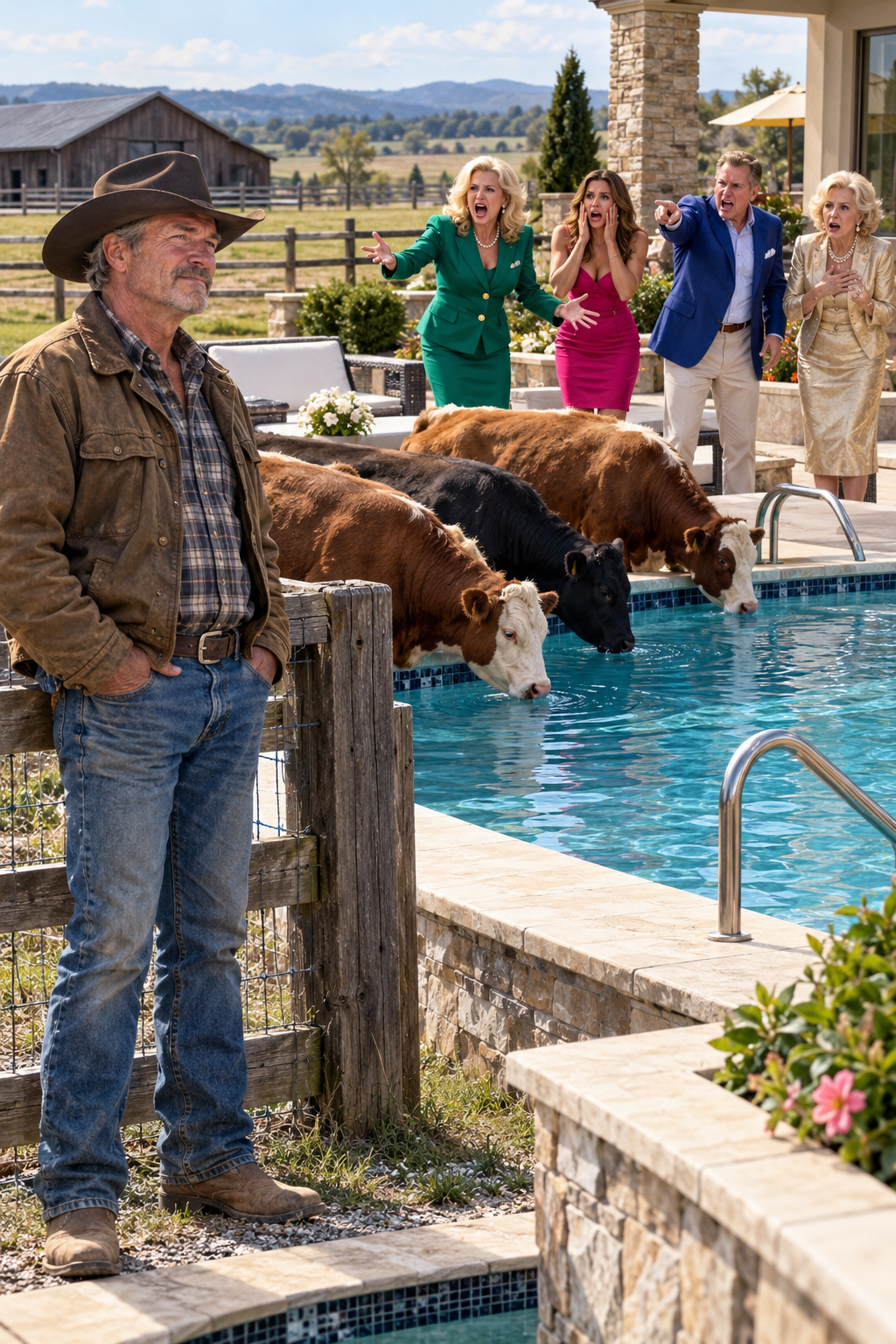
The HOA Spent $100,000 Building a Luxury Pool on My Ranch — Then My Cattle Found Their New Watering Hole
The first time I saw a woman in a white sunhat floating in a hundred-thousand-dollar swimming pool on my ranch, she lifted her sunglasses and told me I was trespassing.
I was standing beside a fence post my father had driven into that ground thirty-two years earlier.
And behind her, bolted to a limestone wall, was a polished brass sign that read PRIVATE RESIDENTS ONLY.
I didn’t yell.
I didn’t call the sheriff.
I didn’t throw her towel into the water, although I’ll admit the thought crossed my mind.
I just looked at the pool.
Then I looked at the survey marker sticking out of the dirt six feet from my boot.
Then I smiled.
Because the Cedar Grove Homeowners Association had made one very expensive mistake.
They had built their luxury pool seventy-three feet inside my property line.
My name is Jack Mercer.
I’m fifty-two years old, and I own 214 acres outside Red Creek, Texas, where the flat pasture starts folding into cedar hills.
My grandfather bought the first eighty acres in 1959.
My father added another ninety-seven.
I bought the remaining tract when the old Dalton place went up for sale after the drought of 2011.
We raise Angus cattle.
Nothing glamorous.
No wine tastings.
No wedding barn.
No Instagram sunflower field.
And invoices that somehow always arrive before the rain does.
My house sits near the southern end of the ranch, shaded by two pecan trees and an oak old enough to have survived three owners, two tornadoes, and one lightning strike.
The northern forty acres were mostly grazing pasture.
Or they had been.
Then Cedar Grove arrived.
Cedar Grove Estates was one of those developments that appeared almost overnight after the highway expansion.
Forty-two homes.
Stone entrances.
Artificial ponds.
Perfect lawns.
Street names like Whispering Elm Court and Heritage View Lane even though there were no elms, no views, and nothing in the neighborhood was old enough to qualify as heritage.
The houses were expensive.
The people weren’t the problem.
Most of them were perfectly normal.
A retired airline mechanic.
A couple who owned a bakery in town.
Families with kids who rode bikes in circles until the streetlights came on.
The problem was the homeowners association.
More specifically, the problem was its president.
Her name was Vanessa Whitfield.
Vanessa was forty-six, blond, polished, and permanently dressed as though a television crew might arrive at any moment.
She drove a pearl-white Range Rover.
She wore oversized sunglasses.
She spoke slowly when she wanted you to feel stupid.
And she had the unsettling habit of using the word community when she really meant Vanessa.
Our community has decided.
Our community expects.
Our community requires.
The community, apparently, always wanted exactly what Vanessa wanted.
For three years, I had managed to avoid her.
That was intentional.
Cedar Grove’s eastern fence bordered roughly seven hundred feet of my north pasture.
Our relationship was simple.
They stayed on their side.
My cattle stayed on mine.
Occasionally, a kid’s soccer ball came over the fence.
I threw it back.
Once a Labrador squeezed under the wire and spent twenty minutes trying to herd a bull before discovering that optimism is not a substitute for experience.
I returned the dog.
Then, one Tuesday morning in April, I heard excavators.
Not nearby.
On my land.
I was replacing a hydraulic hose on my tractor when the first low mechanical growl rolled across the pasture.
I shut the engine off.
There it was again.
The reverse alarm from heavy equipment.
I walked to the porch and looked north.
Yellow machinery was moving behind the cedar break.
At first, I assumed Cedar Grove was doing work along their fence.
Then one excavator swung its boom high enough for me to see it.
Wrong side.
I grabbed my truck keys.
The drive took less than three minutes.
I came around the hill and found six workers, an excavator, two skid steers, a dump truck, and about twenty orange stakes spread across my pasture.
They had already stripped away nearly half an acre of grass.
A man in a hard hat was painting a blue line across the dirt.
He waved politely.
“Can I help you?”
“I hope so,” I said. “Why are you digging up my pasture?”
His smile vanished.
“Your pasture?”
“That’s usually what I call it.”
He looked toward the development.
Then back at me.
“This is Cedar Grove property.”
He frowned.
I pointed at a steel survey pin beside an old cedar post.
“Property line is there.”
He looked down.
The blue paint crossed past it.
Far past it.
His name was Miguel Alvarez.
He was the site supervisor.
And unlike Vanessa, Miguel didn’t pretend reality changed just because it was inconvenient.
He pulled a folded site plan from his truck.
I pulled the parcel map from the plastic sleeve I kept behind my seat.
We laid both across his hood.
His plan showed the Cedar Grove boundary extending into my ranch.
Mine did not.
He tapped his page.
“This is what they gave us.”
“HOA project manager.”
“Vanessa Whitfield?”
“I don’t know. Lady named Whitfield signed authorization.”
That got my attention.
“What are you building?”
Miguel hesitated.
Then he pointed.
A large rectangle.
An equipment room.
A shaded pavilion.
A stone deck.
“Community pool.”
I laughed once.
Not because it was funny.
Because sometimes your brain needs to release pressure before it explodes.
“How much?”
“How much is this thing costing?”
“I don’t discuss client contracts.”
“Ballpark.”
Miguel folded the plan.
“More than a hundred grand.”
Then I took pictures.
Every stake.
Every machine.
Every disturbed patch of soil.
The survey pin.
The site plan.
Miguel’s company logo.
I sent myself copies before leaving the pasture.
That detail mattered later.
Within twenty minutes, Vanessa arrived.
White Range Rover.
Cream slacks.
Royal-blue blouse.
Perfect hair.
She stepped out holding a leather folder.
“Mr. Mercer.”
“Mrs. Whitfield.”
She glanced at the machines.
Then at Miguel.
“You stopped my crew?”
“They’re on my land.”
Her lips barely moved.
“No, they aren’t.”
I pointed at the survey pin.
“They’re standing seventy feet past my boundary.”
Vanessa didn’t even look.
“We had the area professionally evaluated.”
“So did the State of Texas when the deed was recorded.”
Her eyes hardened behind her sunglasses.
“You ranchers have a habit of treating every open piece of ground like it belongs to you.”
That was the moment I understood what kind of conversation we were having.
Not a mistaken map.
Not confusion.
Not two neighbors working through a boundary disagreement.
She wanted me embarrassed enough to back down.
I didn’t give her the pleasure.
“Have your surveyor call mine.”
“There is nothing to discuss.”
“Then stop construction.”
Miguel shifted his weight.
Vanessa turned to him.
“You have authorization. Continue.”
Miguel looked at me instead.
I said nothing.
He looked down at the survey pin.
Then he removed his hard hat.
“I’m calling my office.”
Vanessa’s jaw tightened.
“He works for us.”
“No,” I said. “His company works for you. Big difference.”
She faced me.
“You need to understand something, Mr. Mercer. Cedar Grove has invested heavily in improving this area. Property values have risen because of us.”
“My cows will be thrilled.”
“Your attitude doesn’t help.”
“My attitude isn’t moving the property line.”
She opened her folder.
Inside were renderings.
A beautiful pool.
Blue water.
Stone decking.
Landscaping.
A little pergola.
There were even digitally added families smiling beside the water.
Vanessa tapped the image.
“This amenity was approved by eighty-seven percent of our voting homeowners.”
“That’s impressive.”
“I’m glad you understand.”
“I do. Did the other thirteen percent vote to build it on your land?”
For the first time, Miguel laughed.
He disguised it as a cough.
Vanessa ignored him.
“We have legal authority.”
She held up a document.
Not close enough for me to read.
“Recorded development rights.”
“You can request it through counsel.”
“Then you don’t have it.”
That finally irritated her.
“You think because your family has kept cows out here for sixty years, nothing around you can change.”
I looked at the excavated dirt behind her.
“Change whatever you want on your side.”
“This is our side.”
“It will be.”
Four words.
Quietly spoken.
Almost casual.
But I heard them.
So did Miguel.
Vanessa realized it a second too late.
Her expression changed.
Only slightly.
She closed the folder.
“We’re done here.”
“No,” I said. “You are.”
I told Miguel I was not consenting to any further entry.
Vanessa told him to restart excavation.
He refused until his office reviewed the boundary issue.
By sunset, the machines were gone.
I thought that might end it.
That night I pulled everything.
County plats.
The old title policy from when I bought the Dalton tract.
The boundary was clear.
Painfully clear.
Cedar Grove’s filed plat ended at the old Benton fence line.
My parcel began there.
The pool site sat between sixty-eight and seventy-seven feet inside my ranch depending on where you measured.
No easement.
No shared tract.
No recreational right.
No gray area.
The next morning, I hired a licensed surveyor named Claire Donnelly.
Claire was sixty-one, had cropped gray hair, drove a mud-covered Tacoma, and regarded property disputes with the same enthusiasm some people reserve for murder mysteries.
She spent five hours locating pins.
By lunch she had marked the line in bright pink ribbon.
By three, she had coordinates.
By five, she emailed me her preliminary conclusion.
The proposed construction area was entirely mine.
I called an attorney.
David Collins had handled two agricultural easement cases for neighboring ranchers.
He listened without interrupting.
Then he asked, “Are they still building?”
“Not today.”
“Good. We’ll send notice.”
Certified letter.
Vanessa personally received the notice Thursday at 10:14 in the morning.
I know because the courier recorded the signature.
At Friday morning, the excavator came back.
Not Miguel’s crew.
Different company.
Different machines.
Different supervisor.
They had already dug four feet deep by the time I reached them.
That was when this stopped being a boundary dispute.
That was when it became deliberate.
I didn’t scream.
I didn’t threaten.
I didn’t block the machines with my truck.
I documented.
I photographed.
I measured.
I recorded.
I called David.
Then I stood behind my own fence and watched a contractor dig a swimming pool on land his client had been formally warned did not belong to her.
There are moments when anger feels powerful.
This wasn’t one of them.
Anger would have helped Vanessa.
Anger would have turned me into the unstable rancher interfering with a neighborhood improvement.
Anger would have given her a story.
So I gave her paperwork instead.
I kept the deed.
I kept the photographs.
I kept the delivery receipt.
I kept the survey.
I kept the invoices.
I kept waiting.
That was the most expensive mistake Vanessa Whitfield ever made.
Construction continued.
Almost desperately fast.
Within two weeks, the shell was poured.
Within three, plumbing was installed.
Then came sandstone decking.
Metal fencing.
Landscaping.
A filtration building.
Outdoor showers.
Chaise lounges.
Someone even planted six young live oaks around the deck.
I watched every truck enter.
Every delivery.
Every worker.
Every load of concrete.
I wrote down license plates.
I saved drone photographs from directly above my ranch.
I never interfered.
That drove Vanessa insane.
She came to my gate twice.
The first time, she demanded I remove my survey ribbons because residents found them “visually aggressive.”
I told her no.
The second time, she brought two HOA board members.
One was Thomas Keller, a retired orthopedic surgeon.
The other was Linda Meyers, an accountant.
Neither looked comfortable.
Vanessa did all the talking.
“You’ve made your objection clear.”
“And the board has reviewed it.”
“Wonderful.”
“We disagree with your interpretation.”
“Land doesn’t care about interpretations.”
Thomas looked down.
Linda stared at the pink survey ribbon flapping beside her.
Vanessa continued.
“Our counsel believes Cedar Grove possesses a legitimate claim.”
“Then your counsel should respond to mine.”
“They will.”
“They haven’t.”
“We don’t conduct HOA business through intimidation.”
I almost admired that sentence.
She was standing on my ranch, beside construction she had refused to stop, accusing me of intimidation because my lawyer had mailed her a letter.
“Are you asking permission to continue?” I said.
“Then why are you here?”
Thomas suddenly spoke.
She ignored him.
“The board would prefer resolving this without escalating costs.”
“My preference was not having a swimming pool built in my pasture.”
“It’s too late for that.”
There it was again.
The assumption that once enough concrete had been poured, ownership would somehow become irrelevant.
I studied her for a second.
Then I asked the question I’d been saving.
“How much have you spent?”
Linda’s eyes shifted toward Vanessa.
Vanessa answered immediately.
“That’s confidential.”
“Homeowner money?”
“Association finances are none of your concern.”
“They become my concern when you convert them into improvements on my property.”
Thomas rubbed the bridge of his nose.
Linda looked genuinely sick.
Vanessa stepped closer.
“Here’s what’s going to happen, Jack.”
First-name basis now.
Never a good sign.
“The pool will open Memorial Day weekend.”
“You will stop harassing contractors.”
“Documenting trespass isn’t harassment.”
“You will remove those ribbons.”
“And our lawyers will settle the technical boundary issue.”
“Technical?”
“It’s seventy feet.”
“Seventy-three at the center point.”
Her nostrils flared.
Then she smiled.
“There’s always a number.”
I tilted my head.
“For land. There’s always a number.”
Now we were getting somewhere.
“You want to buy it?”
“We could discuss compensation.”
“For the pool parcel?”
“For enough acreage to correct the inconvenience.”
“Inconvenience.”
She knew immediately I wasn’t interested.
Her smile vanished.
“You really want to force forty-two families to lose an amenity over a strip of dirt your cattle barely use?”
“My cattle use the whole pasture.”
“That area was weeds and dust.”
“It was grass.”
“Whatever it was, it’s improved now.”
Behind her, workers were laying pale limestone around a pool I had never authorized.
That word stayed with me.
Because people like Vanessa often confuse expensive with legitimate.
They think if something costs enough, it deserves to exist.
If enough people want it, it becomes fair.
If the landscaping looks nice, the bulldozer tracks underneath stop mattering.
I looked past her.
“Make me an offer.”
Thomas looked surprised.
Linda looked relieved.
Vanessa smiled.
“I knew we could be reasonable.”
“I didn’t say I’d accept.”
Her smile weakened.
“But send it.”
Three days later, Cedar Grove offered me $18,000.
For 1.6 acres.
The same acreage that would cut a permanent bite out of my north pasture and move their boundary around the pool.
I emailed back one sentence.
No, thank you.
Their second offer was $31,500.
Their third was $45,000.
Then Vanessa stopped offering.
The pool opened on May 27.
They threw a party.
I could hear music from my hay barn.
By noon, there were at least sixty people around the water.
Kids splashing.
Adults drinking canned cocktails under umbrellas.
A food truck parked beside the clubhouse path.
Blue-and-white balloons tied to the fence.
And there was Vanessa, standing at the entrance in a white dress, greeting families as though she had personally delivered them the Mediterranean Sea.
Claire, my surveyor, was with me.
We watched from the hill.
“You planning to shut them down?” she asked.
She raised one eyebrow.
“Your lawyer must be a calmer man than mine.”
“David knows.”
“That’s reassuring.”
I handed her binoculars.
She looked.
“They built another fence.”
“Inside your boundary.”
“They planted shrubs.”
“And is that a permanent grill station?”
“Looks like it.”
Claire lowered the binoculars.
“What are you doing?”
“For what?”
“For them to finish.”
She stared at me for three seconds.
Then she started laughing.
Not politely.
Full-body laughing.
She had to lean against the truck.
“You’re terrible.”
“I haven’t done anything.”
“That’s the terrible part.”
By June, construction was completely finished.
Final cost according to the HOA’s own financial report: $107,486.
That report was supposed to be accessible only to residents.
A Cedar Grove homeowner named Mark Ellis gave me a copy.
Mark lived two houses from the pool.
He was a high school history teacher with two daughters and a hatred of waste.
He contacted me after the HOA announced an emergency $2,400 special assessment.
Residents had originally been told reserve funds would cover the project.
They did not.
Vanessa blamed “unexpected site preparation.”
Mark attended the board meeting where she said it.
“Unexpected?” he told me over coffee. “She moved contractors after the first one quit. She changed engineering drawings. She paid rush fees. Then she tells us it was unexpected.”
“Did anyone ask about the property dispute?”
“What did she say?”
He pulled out his phone.
He had recorded the meeting.
Vanessa’s voice filled my kitchen.
“There is no ownership dispute affecting the association’s use of the pool parcel. Claims made by adjacent landowners are without merit.”
Adjacent landowners.
As though ranchers were swarming Cedar Grove from all directions.
Mark stopped the recording.
“You’re the only adjacent landowner near the pool.”
“I noticed.”
“Is it actually yours?”
I slid Claire’s stamped survey across the table.
Mark read it.
Then read it again.
His face changed.
“You’re kidding.”
“She knew?”
I showed him the certified notice.
He whispered something I won’t repeat.
Then he stared toward the north window.
“My wife and I paid the assessment.”
“I’m sorry.”
“Everybody did.”
“She told us your claim was fake.”
He looked at me.
“What are you going to do?”
That question was becoming popular.
I gave him the same answer.
“Nothing yet.”
But that wasn’t entirely true.
I had been doing quite a lot.
I inspected the old ranch records.
Not merely the deed.
Everything.
My grandfather kept documents the way some people keep ammunition.
Original purchase contracts.
Water district notices.
Fencing agreements.
Pipeline maps.
Mineral correspondence.
Tax receipts.
Old aerial photos.
Inside a steel cabinet in the ranch office, I found a yellow folder labeled NORTH STOCK WATER.
I had seen it before.
Never paid attention.
Inside was a 1978 agricultural water permit for a buried six-inch line running from the old stock well toward the north pasture.
The line had once supplied a concrete watering basin for cattle.
The basin was removed sometime before I finished high school.
But the line?
Still there.
I called a plumber who specialized in agricultural systems.
We located it.
Pressure-tested it.
Functional.
It ran within forty feet of the new pool.
That by itself meant nothing.
Then Claire found something better.
When Cedar Grove installed the pool plumbing, their contractor had crossed the old agricultural line.
Instead of rerouting, they had exposed it.
And capped it.
Without asking me.
The cap was visible inside a utility access area behind their pump building.
My water infrastructure.
On my land.
Altered by their contractor.
David looked at the photographs.
Then he looked at me.
“What are you thinking?”
“I want my line restored.”
He leaned back.
“That’s reasonable.”
“And I want access to my land.”
“Also reasonable.”
“They fenced me out.”
“I need a gate.”
“And I’m still allowed to water cattle on my ranch.”
David narrowed his eyes.
“You’ve had this expression for about five minutes.”
“What expression?”
“The one that tells me I should charge more.”
“Tell me what I can legally do.”
Very carefully.
No destruction.
No self-help likely to cause a breach of peace.
No interference with swimmers.
No disabling safety systems.
No contaminating water.
No dramatic cowboy nonsense that would look excellent on Facebook and terrible in front of a judge.
Instead, we filed.
Boundary action.
Trespass claim.
Demand for restoration of agricultural infrastructure.
Request for declaratory judgment.
And because Cedar Grove had now permanently fenced a portion of my property, we requested immediate access.
The hearing happened on a Thursday morning.
Vanessa arrived with two attorneys.
I arrived with David.
Claire brought the survey.
Miguel Alvarez, the supervisor from the first contractor, brought his original site plan.
That was the first time Vanessa looked worried.
Not scared.
But worried.
Her attorney argued the boundary was contested.
Claire explained that it wasn’t.
He argued Cedar Grove had relied in good faith on project documents.
Miguel testified that I identified the boundary before excavation was complete.
He testified Vanessa ordered work to continue.
He testified his company stopped because its insurer refused to proceed after seeing conflicting surveys.
Then David produced the certified notice.
Received personally by Vanessa Whitfield.
The judge looked at her signature.
Then at Vanessa.
Then back at the document.
Her attorney stopped using the phrase good faith after that.
The judge didn’t settle the full case that day.
But he did something more useful.
He ordered Cedar Grove not to obstruct my access to my property.
He prohibited additional permanent changes.
And he ordered the HOA to allow restoration of my agricultural water line pending final resolution.
Vanessa cornered me outside the courthouse.
“You think you won.”
I adjusted my hat.
“I think the judge can read.”
“You’re going to destroy that pool just to prove a point?”
“I’m not destroying anything.”
“Don’t play games.”
“You built it.”
Her face was flushed now.
No sunglasses.
No polished smile.
“You let us.”
That surprised me.
“Excuse me?”
“You watched.”
“If you really believed it was yours, you would have stopped construction.”
“I told you to stop.”
“You didn’t get an injunction.”
“You waited until the project was complete.”
Her expression changed.
She finally understood.
Not everything.
But enough.
“You did this intentionally.”
“No, Vanessa.”
I looked toward the courthouse doors.
Three days later, a contractor installed a twelve-foot livestock gate in the fence beside the pool.
The HOA’s fence.
On my land.
The order required access.
Vanessa called the sheriff.
Deputies arrived.
David arrived.
The contractor showed them the court order.
The deputies left.
The gate stayed.
The following Tuesday morning, I restored the old stock line.
Perfectly legal.
Perfectly documented.
Professionally done.
Then I brought twenty-three Angus cows into the north pasture.
Not into the pool enclosure.
I let them graze.
That alone caused panic.
Cedar Grove residents started posting pictures.
COWS NEXT TO POOL!!!
IS THIS SAFE???
WHO APPROVED LIVESTOCK???
Someone apparently had to remind them that they had purchased homes beside an active cattle ranch.
Vanessa sent me an email.
She demanded I keep livestock at least two hundred feet from Cedar Grove recreational facilities.
David replied asking her to identify the deed restriction governing my ranch.
She did not respond.
Then came the first real payoff.
The pool developed a water-loss problem.
Nothing catastrophic.
A plumbing fitting leaked.
Maintenance drained roughly eight inches of water to perform repairs.
The HOA refilled it.
Then the county entered Stage Two drought restrictions.
Outdoor recreational water use became limited.
The pool could remain open, but constant refilling was discouraged and certain municipal hookups were restricted.
My agricultural well was exempt for livestock watering under the applicable usage rules.
That distinction mattered.
One hot Saturday morning in July, I was inspecting cattle near the pool when I noticed the old concrete footing of the original stock basin.
The pool stood almost exactly where my grandfather’s watering area had been.
I could still see the scar in the soil.
My father used to bring cattle there.
I remembered being eleven years old, sitting on the fence while he checked calves.
There was something so absurd about it I actually laughed.
Vanessa heard me.
She was standing behind the pool fence.
“What’s funny?”
I pointed at the ground.
“You put it back.”
“My cattle tank.”
She stared at me.
“This is a swimming pool.”
“Currently.”
Her expression tightened.
“You stay away from our facility.”
“Your facility is on my land.”
“The case isn’t finished.”
“So until it is, stop acting like you own it.”
I looked around slowly.
At my pasture.
My cedar trees.
My survey stakes.
Then back at her.
That night, David called.
“I’ve got something.”
“HOA’s attorney finally produced the survey they relied on.”
“No. Better than good.”
“The survey is dated three weeks after construction started.”
“The document they’ve been claiming authorized the project didn’t exist when they broke ground.”
That was twist number one.
And it got worse.
Their survey wasn’t a boundary survey.
It was a conceptual development exhibit.
Across the bottom, in tiny capital letters, were the words:
NOT FOR CONSTRUCTION OR PROPERTY CONVEYANCE.
Someone had removed that disclaimer from the copy handed to the contractor.
David compared both versions.
Same drawing.
Same dimensions.
But the contractor’s version had been cropped.
Not accidentally.
The page border had been changed.
The disclaimer was gone.
And in the upper corner, someone had added a label:
CEDAR GROVE RECREATION PARCEL.
There was no Cedar Grove recreation parcel.
Never had been.
“What does Vanessa say?” I asked.
“She says the project manager prepared the contractor package.”
“Who’s the project manager?”
“According to the agreement?”
“Vanessa Whitfield.”
I leaned back in my chair.
Outside, cicadas buzzed in the dark.
One of the cattle bumped the metal feeder.
David continued.
“This changes things.”
“How much?”
“Possibly. I’m not making accusations until we trace who altered the document.”
“But someone took a map that explicitly said it could not establish property boundaries and converted it into something that appeared to establish property boundaries.”
“Could an assistant have done it?”
“Contractor?”
“Possible.”
“Also possible.”
“Jack, don’t do anything stupid.”
“I’ve been boring for three months.”
“Stay boring.”
For six more days.
Then Cedar Grove sent workers onto my land again.
Not contractors.
HOA maintenance employees.
They planted eight shrubs along the pool fence.
Despite the court order prohibiting permanent changes.
I photographed them.
David filed notice.
The judge scheduled another hearing.
And Vanessa apparently decided subtlety was overrated.
She came to my house at that evening.
No board members.
She stood on my porch while the sun dropped over the hay field.
“I want to make a deal.”
I opened the screen door but didn’t invite her inside.
“What changed?”
“Then why are you here?”
“The board is tired of legal expenses.”
“Understandable.”
“We’ll offer eighty thousand dollars.”
“Two acres.”
“One hundred.”
“One twenty.”
Her eyes narrowed.
“You didn’t even think about it.”
“You cannot possibly believe that dirt is worth more than $120,000.”
“The dirt isn’t.”
She waited.
I said nothing.
Her voice lowered.
“What do you want?”
“My property.”
“Be realistic.”
“You’re going to spend years in court.”
“You’ll spend tens of thousands.”
“Probably.”
That question was sincere.
For the first time since this started, Vanessa truly did not understand me.
So I answered.
“Because you knew.”
She blinked.
“You knew before the shell was poured.”
“That’s ridiculous.”
“You got my notice.”
“I believed your claim was invalid.”
“Your first contractor stopped.”
“He was overly cautious.”
“You hired another.”
“We had deadlines.”
“You altered the plan.”
Her face went still.
I watched it happen.
Tiny movement.
Almost nothing.
But she heard exactly what I meant.
“I don’t know what you’re talking about.”
She turned toward the steps.
Then stopped.
“Take the money, Jack.”
“One hundred fifty thousand.”
I didn’t answer.
She looked back.
And there it was.
That was when I realized the pool itself wasn’t what scared her.
Something else was underneath this.
Something larger.
I just didn’t know what.
The next morning, I called Mark Ellis.
“Has the HOA announced anything about expansion?”
“Expansion?”
“More amenities. Trails. Clubhouse. Anything north of the pool.”
“Any land purchases?”
“Not that I know of.”
“Any big votes coming?”
He hesitated.
“Actually, yes.”
“They’re holding a special meeting next month.”
“Vanessa says it’s about long-term community development.”
“Send me whatever they gave you.”
Twenty minutes later, I had a PDF.
Most of it was vague.
Reserve funding.
Beautification.
Traffic improvements.
Future recreational planning.
Nothing obvious.
But one phrase appeared three times.
Northern amenity corridor.
I forwarded it to Claire.
She called me ten minutes later.
“Where did you get this?”
“Homeowner.”
“You need to see something.”
She came to the ranch with a county planning map.
Cedar Grove had only one realistic direction to expand.
The swimming pool wasn’t near the center of their neighborhood.
It was jammed against their northern boundary.
Or rather, against what their documents pretended was their northern boundary.
Claire traced a line with her finger.
“If they eventually acquired this strip here…”
She moved north.
“…they could run an access road.”
My stomach tightened.
“Depends who owns the parcel beyond you.”
A developer.
Kensington Residential.
They had purchased 380 acres north of my ranch the previous year.
No direct highway access.
Claire looked at me.
“The pool isn’t an amenity.”
I pulled the county map closer.
“It’s an anchor.”
She stared at the lines.
Then understood.
If Cedar Grove established a recreation parcel deep enough into my northern pasture…
If they later claimed an access corridor tied to it…
If they persuaded homeowners that the boundary had always been farther north…
Then the pool wasn’t just a pool.
It was the first permanent structure supporting a much larger claim.
I called David.
He searched county filings.
Then LLC records.
Then planning applications.
At that afternoon, he called me back.
His voice had changed.
“You sitting down?”
“What did you find?”
“Kensington submitted a preliminary concept eighteen months ago.”
“For what?”
“One hundred twenty-six homes.”
My kitchen went very quiet.
“Rejected.”
“No compliant public-road connection.”
“They resubmitted.”
“Six weeks ago.”
That was after Cedar Grove began the pool.
My hand tightened around the phone.
“Where’s the road?”
“Conceptual connection runs south.”
“Through Cedar Grove?”
“Eventually.”
“Through me?”
He took a breath.
The proposed road ran straight through my north pasture.
Within yards of the new pool.
Suddenly Vanessa’s words from April came back.
This is our side.
It will be.
Not arrogance.
The pool wasn’t supposed to remain a lonely amenity at the edge of Cedar Grove.
It was supposed to make the land beyond it look already absorbed.
Already developed.
Already part of the neighborhood.
The permanent structure came first.
The boundary story came second.
Then negotiations.
Then pressure.
Then maybe a lawsuit over reliance.
Maybe adverse claims.
Maybe condemnation arguments once roads and utilities entered the conversation.
I didn’t know exactly how far they planned to take it.
But now I knew why Vanessa kept offering more money.
She didn’t need two acres.
She needed the first two acres.
The dominoes behind them were worth millions.
David said, “Jack, this is no longer just about trespass.”
“We need discovery.”
“And you need to stop talking to Vanessa without me.”
“I’m serious.”
The special HOA meeting was scheduled for August 18.
Before then, something happened that changed the tone of the whole neighborhood.
Cedar Grove’s pool pump failed.
Not because of me.
I need to make that clear.
A bearing seized.
The HOA shut the pool down for four days during the hottest week of summer.
Families were furious.
The special assessment still hurt.
Now the expensive new pool was locked behind temporary fencing.
Vanessa blamed “unexpected equipment defects.”
Mark sent me screenshots from the community message board.
People were starting to ask questions.
Why had the pool cost over $100,000?
Why was there an active property lawsuit?
Why had residents been told there wasn’t one?
Why had the first contractor quit?
Why did the northern fence now contain a livestock gate?
And my personal favorite:
WHY ARE THERE COWS STARING AT US WHILE WE SWIM?
That one was fair.
Cattle are nosy.
Two days later, my attorney obtained permission for me to inspect and maintain the section of ranch occupied by the pool complex, provided we did not interfere with safe public use.
Vanessa closed the pool voluntarily.
She said it was temporary.
I walked through the gate with Claire and a photographer.
The place was immaculate.
Expensive stone.
Stainless fixtures.
New furniture.
The pool water glittered under the Texas sun.
Claire checked coordinates.
Every inch was mine.
The pump building.
The landscaping.
At least physically.
Legal ownership of improvements built by a trespasser can get complicated, which was why David kept using words like pending determination.
I stood at the edge.
The water was so clear I could see individual grout lines eight feet down.
Claire smiled.
“Fancy stock tank.”
Then I remembered the old water line.
I walked behind the pump house.
There it was.
Functional.
The agricultural line fed a frost-free livestock hydrant installed under the court-approved work.
About thirty feet beyond it was a portable galvanized cattle trough I had placed in the pasture.
For a week, the cattle used it.
Then Vanessa made another mistake.
Her HOA maintenance crew removed it.
They claimed it was a hazard near the recreational area.
From my ranch.
After a court order guaranteeing agricultural access.
They dragged it onto Cedar Grove common property.
David called their lawyer.
Their lawyer sounded horrified.
The trough was returned within two hours.
That afternoon, I decided I was finished making livestock walk thirty feet farther than necessary.
I called David.
I asked one question.
He was silent for a long time.
Then he said, “You’re enjoying this.”
“A little.”
“If you do exactly what I tell you…”
“…and if no local health or safety ordinance prohibits it…”
“…and if the pool remains closed to swimmers…”
“…then I see no court order preventing ordinary agricultural access to the disputed parcel.”
I looked out the window.
Twenty-three black cattle stood under a mesquite tree.
“Ordinary agricultural access.”
“That phrase will haunt me.”
The next morning, before sunrise, I opened the twelve-foot gate.
I removed nothing.
Broke nothing.
Cut nothing.
The pool fence already had service gates large enough for maintenance equipment.
Under the access order, one remained unlocked for me.
I opened it.
Then I opened the pasture gate.
Cattle are suspicious animals.
People imagine they stampede toward every opportunity.
They don’t.
They study things.
The first cow walked forward.
A six-year-old Angus with a torn left ear.
She sniffed the stone.
Looked at me.
Walked farther.
Three others followed.
Their hooves clicked against the limestone deck.
It sounded ridiculous.
Like horses entering a hotel lobby.
Number 18 reached the pool edge.
She lowered her head.
Then drank.
One long pull.
Then another.
Within five minutes, eleven cattle stood around a $107,486 swimming pool drinking chlorinated water that had been tested and allowed to return to livestock-safe residual levels under professional guidance before access.
I took one photograph.
Not for social media.
For the case file.
But I didn’t need to post it.
A Cedar Grove resident did.
At a.m., my phone exploded.
By , half the neighborhood seemed to know.
By , Vanessa’s Range Rover came flying down Heritage View Lane.
She stopped so hard gravel kicked sideways.
She got out.
Saw the cattle.
One cow lifted her head from the pool.
Water streamed from her mouth.
I wish I could tell you I had planned that moment.
But God has timing.
Vanessa marched toward the gate.
“GET THEM OUT!”
I leaned on the fence.
“Get those animals out of our pool!”
“What do you mean, can’t?”
“They’re drinking.”
“I can see that!”
“Then we’re making progress.”
Her face turned bright red.
“You did this deliberately.”
That was the first time I gave her the answer she wanted.
Residents gathered along the sidewalk.
Phones appeared.
Mark stood near his driveway trying unsuccessfully not to smile.
Vanessa pointed at the pool.
“This is a recreational facility!”
“Currently closed.”
“You cannot put livestock in a residential swimming pool!”
“Then move your swimming pool off my livestock property.”
People murmured.
She heard them.
That made everything worse.
“I’m calling the sheriff.”
“I’m calling animal control.”
“I’m calling the health department.”
“Probably smart.”
“You think this is funny?”
I looked at the cattle.
Number 18 took another drink.
“Efficient.”
The sheriff’s deputy arrived first.
Same deputy who had seen the court order before.
He read it again.
Called someone.
Walked around the property.
Talked to David by phone.
Then told Vanessa it was a civil dispute.
The county health inspector arrived later.
Because the pool was closed to human swimmers, no immediate public recreational violation applied.
He did, however, tell the HOA they would need a full cleaning, water replacement, and inspection before reopening.
Vanessa nearly combusted.
That part cost them another $4,800.
The cattle used the pool for six days.
Not constantly.
They had other water sources.
But often enough that every resident walking past understood the situation without needing legal vocabulary.
You didn’t need to know what declaratory judgment meant.
You didn’t need to understand boundary law.
You didn’t need to read survey coordinates.
You just had to look through the fence.
There was a luxury pool.
There were cattle drinking from it.
And there was only one question.
How did the HOA screw up badly enough for this to happen?
Vanessa lost control of the story.
That mattered more than anything.
At the August 18 special meeting, more than one hundred residents packed into the Cedar Grove clubhouse.
Spouses came.
Adult children came.
People stood along the walls.
Vanessa sat at the front table with four board members.
Mark invited me.
Vanessa objected.
Residents voted to let me stay.
First defeat of the night.
She opened with twenty minutes about community unity.
Nobody cared.
Then she introduced the northern amenity corridor.
A slideshow appeared.
Landscaped path.
Expanded recreation lawn.
Possible tennis courts.
Possible future vehicle connection labeled for emergency use.
Claire, sitting beside me, whispered, “There.”
The emergency connection crossed my ranch.
A resident raised his hand.
“Do we own that land?”
Vanessa answered, “There are unresolved technical boundary questions.”
People laughed.
Not kindly.
Another resident shouted, “Does Jack Mercer know we’re building a road through his cows?”
More laughter.
Vanessa tapped the microphone.
Mark stood.
“How much money has Cedar Grove paid attorneys over the pool dispute?”
The treasurer looked down.
Vanessa said, “Legal expenditures are disclosed in association reports.”
“Then say it.”
The treasurer finally leaned toward her microphone.
“Twenty-six thousand, four hundred dollars.”
The room erupted.
That was on top of the pool.
On top of maintenance.
On top of assessment collection.
On top of repair costs.
Mark asked, “Did the board know Mr. Mercer sent a survey before construction was completed?”
Vanessa said, “Our counsel advised—”
“Yes or no?”
Another board member, Thomas Keller, suddenly spoke.
“I did not.”
Vanessa turned toward him.
Thomas continued.
“I learned about the certified notice after concrete had already been poured.”
The room changed.
Linda Meyers spoke next.
“So did I.”
Vanessa’s head snapped toward her.
Linda’s hands were shaking, but her voice wasn’t.
“I was told Jack’s complaint came after the project was substantially complete.”
I felt David beside me straighten.
That was new.
Vanessa leaned away from the microphone.
“Linda, this is not appropriate.”
“I asked to see the file.”
“We discussed this in executive session.”
“You wouldn’t show me.”
Residents started shouting questions.
Vanessa banged the gavel.
The gavel made everything worse.
Thomas pushed his chair back.
“Did you receive Mr. Mercer’s notice on April thirteenth?”
Vanessa’s face went blank.
“Counsel needs to answer—”
“You signed for it.”
Thomas had a copy.
He held it up.
That was the moment Cedar Grove turned on Vanessa Whitfield.
Not violently.
Not theatrically.
Something worse.
They stopped trusting her.
You could feel it.
People looked at each other.
Neighbors whispered.
Board members stopped defending her.
The woman who had spent three years speaking for the community suddenly discovered the community could speak for itself.
Then Linda asked a question I hadn’t expected.
“What is Kensington Residential paying us?”
I looked at David.
He looked at me.
Vanessa went completely still.
The room quieted.
Linda turned toward the residents.
“I found a draft agreement.”
Vanessa stood.
“This meeting is adjourned.”
“No,” Thomas said.
The crowd started yelling.
Linda opened a folder.
“Kensington Residential offered Cedar Grove a development participation payment if a through-access connection could be secured.”
My pulse kicked.
David whispered, “Don’t say anything.”
Linda continued.
“Initial payment: $600,000.”
The room exploded.
Vanessa grabbed her bag.
Thomas blocked the aisle.
Not physically.
He just stood there.
“You told us the northern project was for amenities.”
“For six hundred thousand dollars?”
“We were negotiating infrastructure benefits.”
“Using land we don’t own?”
“Nothing was finalized.”
Mark shouted from the back.
“Was the pool built to support the Kensington road?”
Vanessa didn’t answer.
That silence answered enough.
Linda read from the draft.
Cedar Grove would facilitate a northern corridor.
Kensington would fund road improvements, landscaping, drainage, and a cash contribution to the association.
The planned connection required land through my ranch.
The pool parcel sat directly beside the proposed route.
It created the illusion that Cedar Grove’s developed footprint already extended into the area.
But leverage.
Lots of leverage.
Vanessa had gambled.
She thought the pool would become too expensive to move.
She thought I’d accept money.
She thought homeowners would pressure me.
She thought permanent construction would turn a questionable claim into practical reality.
She had underestimated one thing.
Cows don’t care about practical reality.
If the gate is open and the water is there, they drink.
The board voted that night to suspend Vanessa’s authority pending an independent investigation.
She resigned forty-eight hours later.
The HOA offered to settle.
They would remove the pool and restore my pasture at their expense.
Or I could retain the improvements and receive compensation for damage, legal fees, and restoration work.
I chose the second option.
Not because I wanted a swimming pool.
But demolition would cost everyone more.
And despite everything, most Cedar Grove residents hadn’t caused this.
They had trusted the wrong person.
So we negotiated.
The HOA relinquished every claim to the disputed land.
Permanent boundary markers were installed.
The proposed northern corridor was formally rejected.
Cedar Grove paid a portion of my legal costs.
And the pool?
Legally mine.
The fence came down on the ranch side.
The umbrellas disappeared.
The fancy outdoor furniture was sold.
The stone deck remained because tearing it out would have been pointless.
I removed the diving markers.
Converted the pump system.
Installed agricultural filtration appropriate for stock use.
The following spring, I added a solar-powered circulation system and connected overflow to a smaller trough.
My grandfather would have thought I’d lost my mind.
A hundred-thousand-dollar cattle tank.
But the cows loved it.
Especially Number 18.
Vanessa disappeared from Cedar Grove.
Sold her house.
Moved to Dallas, according to Mark.
Kensington’s expansion proposal stalled without southern access.
The northern pasture went back to being quiet.
For a while.
And that should have been the end.
It almost was.
Eleven months after the first excavator entered my ranch, I was clearing old documents from the office when a brown envelope arrived by certified mail.
No return name.
Only a law firm address in Austin.
Inside was a cover letter from an attorney representing a former Kensington Residential employee.
The employee had been reviewing records connected to a separate lawsuit.
He found my name.
He found Cedar Grove.
And he found something he believed I needed to see.
There were seven pages.
The first six were emails.
A Kensington vice president.
A civil engineering consultant.
Dates stretching back nearly two years before construction began.
They were bad.
But the seventh page was worse.
It was a map.
Not the fake pool map.
A much larger development map.
My entire 214-acre ranch was shaded pale yellow.
Across the center ran a four-lane access road.
Where my house stood, the plan showed a traffic circle.
Where my barn stood, there were twelve lots.
Where my father was buried beneath the old oak, there was a retention pond.
At the top of the page were four words.
MERCER TRACT — PHASE TWO.
My hands went cold.
I checked the date.
The plan had been created eighteen months before Vanessa first broke ground on the pool.
Then I saw the handwritten note in the lower corner.
Three lines.
Acquire north parcel after recreational footprint established.
Owner resistant. Pressure strategy required.
County contact confirms condemnation path available after utility dedication.
I read it twice.
Then three times.
The pool had never been the real target.
The two acres had never been the real target.
They had planned to take the whole ranch.
And according to the final email in the envelope, Vanessa Whitfield wasn’t the person who started it.
She was just the person they sent first.
I called David.
I called again.
Still nothing.
Then headlights swept across my kitchen wall.
Three vehicles turned off the county road.
Not HOA cars.
White utility trucks.
Each had an amber light bar on top.
They stopped beside my north gate.
Men stepped out wearing reflective vests.
One unlocked the trailer behind the first truck.
Inside sat survey equipment.
Orange stakes.
And a stack of roadwork signs.
My phone finally rang.
I answered.
He didn’t say hello.
“Jack, do not let anybody onto the ranch.”
I looked through the window.
The men at the gate were already cutting the chain.
“Little late for that.”
David went silent.
Then he said five words that changed everything.
“The county filed condemnation papers today.”
✓ Lynn R. Adams
The HOA Spent $100,000 Building a Luxury Pool on My Ranch — Then My Cattle Found Their New Watering Hole The first time I saw a woman in a white sunhat floating in a hundred-thousand-dollar swimming …