The HOA president had a smart meter bolted onto my father’s private well and told me I would start paying the association for my own water, but the technician noticed something on his tablet she hadn’t counted on…
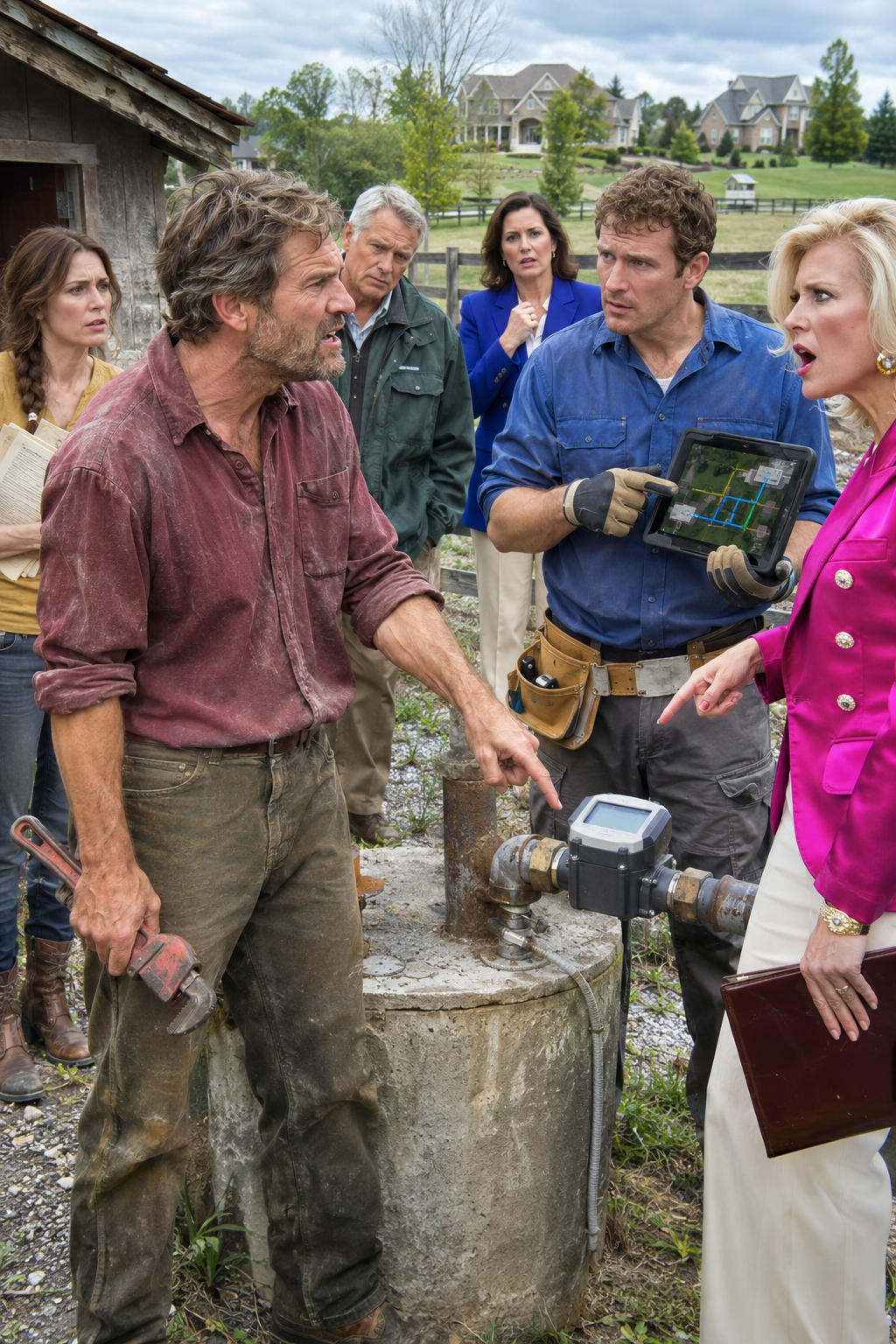
The HOA president had a smart meter bolted onto my father’s private well and told me I would start paying the association for my own water, but the technician noticed something on his tablet she hadn’t counted on…
Rachel Voss was standing beside my wellhouse when I drove up the gravel lane. Her black SUV was parked near the orchard gate, and a man in a utility jacket was crouched beside the pipe that carried water from my well. Rachel wore a red blazer and held a billing notice as neatly as if she had come to collect a library fine.
“The HOA will collect water fees from this property effective immediately,” she said. For a moment, I thought I had misunderstood her. I was standing on land my family had farmed for decades, looking at a well my father had paid to drill nineteen years earlier.
“My water?” I asked. Rachel glanced at the man working on the pipe, then back at me. “The association is bringing community water usage into one billing system.”
I walked past her to see what he had installed. A shiny digital meter, complete with a wireless transmitter, was fastened to the line outside our little concrete wellhouse. Six feet away sat the old pressure gauge I checked every morning, looking suddenly ancient beside the new equipment.
I was fifty-six then, and I knew every bend in that line. My father and I had built the wellhouse ourselves after the drilling crew finished, and I had replaced enough fittings over the years to recognize when something was different. Nobody had called me about changing it, much less asked permission.
“Who authorized this?” I asked. Rachel lifted her red folder. “The board did. Your well is listed in the developer’s community utility records.”
“That doesn’t make it the community’s well.” I pointed toward the orchard, where the irrigation line ran behind a row of older trees. “This water goes to my farm, my livestock tanks, and my house. The subdivision has municipal water.”
Rachel’s expression barely changed. “It’s a recognized community source, Mr. Barrett. We have records showing the association’s authority.” She had that clipped, practiced tone people use when they expect the conversation to end as soon as they mention paperwork.
The technician stood up and wiped his hands on a rag. He introduced himself as Aaron Pike and said he had a work order to install and test the meter. His job, he explained, was separate from the decision about who could be billed through it.
I asked whether the new unit was active. “Not for billing yet,” Aaron said. Rachel turned toward him so quickly the folder brushed her sleeve. “It was supposed to be activated today.”
Aaron kept his voice even. “I can finish the physical installation under the work order. Activation still requires the account to clear verification.” I could see he was trying to explain a procedure, not choose sides in an argument.
Rachel pushed the notice toward me. The words on it were plain enough: the association intended to charge this property for water use. I pictured the sprinkler line running through the orchard in August, and the tanks my cattle drank from every day. Those weren’t ornamental faucets someone could put on a neighborhood fee schedule without a conversation.
Nineteen years earlier, the farm had nearly dried out. The pond had fallen so low that cracked mud showed along the banks, and Dad had spent breakfast after breakfast trying to work out how long the tanks would last. I was thirty-seven, old enough to understand that a drilling crew was expensive and that doing nothing might cost us more.
When the well finally produced steady water, Dad hung its brass key on a nail beside the mudroom door. He liked to say, “Water you control is land you can keep.” I thought of that key now, while a stranger’s transmitter sat on a pipe Dad had been so proud to install.
“Before anyone switches anything on,” I said, “I want to know whose account you’re using.” Aaron raised his tablet. He asked for my name, then my driver’s license, and compared both with the service record on his screen.
“Owen Barrett,” I told him. Aaron read the license, tapped through several fields, and looked at it again. Rachel moved nearer, watching his face instead of the screen.
Something in his manner changed. He wasn’t alarmed, exactly, but he stopped moving through the steps as if they were routine. “Sir,” he said, “this well account has been in your name for nineteen years.”
Rachel reached for the tablet. Aaron moved it back, gently but firmly. “I still need to verify the source account,” he said, and Rachel’s hand hung there for a second before she lowered it.
“That database is outdated,” she told him. “I’ve already given your office the HOA authorization.” Aaron opened the document she had supplied, read it carefully, and said it authorized a meter installation request. It did not, by itself, show that the well account had been transferred to the HOA.
Rachel replied that the association had inherited the developer’s utility rights. I asked to see the agreement she was relying on. She touched the red folder but didn’t take anything out, and the silence that followed bothered me more than another argument would have.
Aaron turned the tablet enough for me to see my name beside the source record and the same property address printed on my license. The history extended back nineteen years, with my ownership reflected in later records. He then showed Rachel the missing item on the activation checklist: current sourceholder authorization, or substitute documentation the administrator would accept.
“You’re saying he has to approve this?” Rachel asked. “I’m saying the work order and the source account don’t agree,” Aaron answered. “I cannot activate HOA billing until they do.”
That distinction mattered. The meter was already mounted on my line, and Aaron wasn’t claiming to be a judge of old property agreements. But he was the one holding the tablet, and he would not turn a disputed account into a bill just because Rachel said the board expected it.
He set the meter’s billing function to inactive and flagged the source account for review. Rachel watched him finish, her billing notice still in her hand. Then she closed the folder and said, “This will be resolved quickly.”
Aaron handed me his card and told me not to alter the equipment while the review was open. I stood beside the pipe after both of them stepped away, looking at the unfamiliar meter and remembering Dad’s brass key. The immediate charge had been stopped, but Rachel clearly believed she had paperwork giving the HOA a right over my well, and I needed to find out what that paperwork really said. Part 2…..
IF FACEBOOK BROUGHT YOU HERE, HERE’S THE CONTINUATION YOU’VE BEEN WAITING FOR. ENJOY! 👇 The next morning, a small green light blinked beneath the meter’s wireless transmitter. I called Aaron to ask whether that meant Rachel had found a way to activate it. He explained that the transmitter could still connect to the network while billing was on hold, and that the hold remained in place.
He could not promise the HOA would refrain from sending a charge through its own office, though. That distinction sent me into Dad’s old farm records faster than any flashing light could have. If Rachel had something in writing, I wanted the complete version, not a sentence she selected from a folder.
Dad kept deeds in one cabinet and utility papers in a green metal file box. Inside were the drilling invoice, pump receipts, the original well registration in his name, and renewals showing how the records followed the farm when I became the owner. I laid them across the kitchen table, smoothing the folds where his hands had once creased them.
Under the pump records was a manila folder from the years the subdivision was built east of our fence. I remembered those years mostly for dump trucks, road dust, and the mud construction crews tracked near our gate. Dad had let the developer draw limited water from our well while the municipal water main was being completed.
A temporary meter had stood near our fence, and Dad complained whenever a truck driver left the gate open. The water was for dust control, construction cleanup, and getting the first landscaping established, not for supplying neighborhood homes forever. When city water began serving the subdivision, the temporary meter disappeared and the construction traffic stopped.
The folder contained a cover sheet marked temporary construction water access. A short memo said the arrangement would continue only until the subdivision’s municipal main was accepted and placed into service. It referred to a separate signed agreement, but that agreement was not in Dad’s file.
I checked every tab twice, even the ones for electric service and tractor maintenance. I found nothing more than Dad’s handwritten note beside the well reference: “Temp only city water.” It wasn’t a legal document, but I could almost hear him saying it while he wrote.
By Wednesday afternoon, Rachel had sent an email with the subject “Community water control final notice.” She said the HOA had succeeded to the developer’s utility rights and quoted a provision allowing the developer to meter and monitor withdrawals from the designated source. She did not include the rest of the paragraph or the signed agreement.
Then came her deadline. Unless I submitted a written objection supported by controlling documentation by five o’clock Friday, she said, my property would be enrolled in the HOA’s standard residential water billing schedule. I reread that sentence and pictured someone at the association office adding a charge to an account I had never agreed to open.
I called my older cousin, who had worked with Dad during subdivision construction. He remembered the temporary meter and the developer waiting for city water. When I asked whether Dad had ever turned over the well, he laughed and said, “Not a chance.”
His memory supported mine, but I knew it would not settle a dispute over a signed agreement. At , I replied to Rachel that I disputed the proposed enrollment and requested the entire agreement, plus any document showing a current HOA right to control or bill water from my well. Nine minutes later she answered that Friday’s deadline remained unchanged.
No agreement was attached. That evening I unlocked the wellhouse with Dad’s brass key and checked the pump controls, the pressure gauge, and the pipe. Everything worked normally, yet the blinking transmitter made me feel as if somebody had left a stranger’s equipment in my yard and was daring me to touch it.
Three days after his first visit, Aaron returned with his supervisor, Denise Mercer. She was in her early fifties, with gray in her short hair and the manner of somebody who wanted accurate readings, not a neighborhood argument. She said they were there to reconcile the source record before any activation.
I brought out the well registration and renewal papers. Before Denise could finish checking them, Rachel’s black SUV rolled up, and she got out carrying the same red folder. “I assume you’re here to finish the activation,” she told Denise.
“We’re here to verify the account,” Denise answered. Rachel pulled out a developer turnover utility sheet, a table of old valves, irrigation zones, pump references, and source identifiers. One highlighted line read “W17 — community backup source.”
Rachel tapped it with her fingernail. “There. The developer transferred utility operations to the association.” Aaron leaned in and said W17 matched the old source number attached to my well. Then he added that identifying a source was not the same as proving what rights anyone had over it.
Denise compared the turnover sheet with the administrator’s database and my paperwork. The screen identified W17, listed me as sourceholder, and showed the original registration from nineteen years earlier and the later ownership update. It showed no subsequent transfer to the HOA.
Rachel argued that private well registration did not necessarily capture inherited HOA operational rights. Denise agreed that the account record alone could not settle every contract question. But it did control whether this particular billing platform could be activated, and she needed documentation that supported the change.
Rachel produced the familiar excerpt about metering and monitoring. “Where is the complete agreement?” Denise asked. “The relevant provision is highlighted,” Rachel replied. Denise kept her voice level. “That wasn’t my question.”
Aaron connected his handheld reader to the new meter. Its flow sensor and transmitter were paired, but billing status still showed inactive. Rachel reminded them that the association had already paid the installation contractor; Denise said payment did not eliminate account validation requirements.
They checked the pipe and pressure, then Aaron put the unit in monitoring-only mode. It could measure flow for local testing but could not send billable usage into an HOA account. When Rachel objected that I was blocking her project, Denise answered, “He isn’t blocking it. We are.”
For the first time, Rachel had to stand there and accept a decision she could not dismiss as a farmer refusing to cooperate. Denise was careful with me, too. If the HOA produced a valid current agreement, she said, the administrator would have to review it, regardless of my name appearing in the system.
Aaron printed a status sheet from his truck. It showed W17, my name, and a billing activation hold. Rachel folded her copy into the folder, promised the matter would be corrected, and drove away without producing the missing agreement.
As Aaron packed his equipment, he looked at the old turnover sheet and said that records could be very good at preserving names while forgetting why the names appeared. I thought about W17 all the way back to the house. Rachel saw that number as control; the service administrator saw an old reference attached to my account.
The following morning I called attorney Laura Bennett, a forty-nine-year-old lawyer who had handled land and contract matters in the area for years. I didn’t need someone to thunder about my rights; I needed someone to find out exactly what Dad had agreed to and when it had stopped. Laura told me to bring every scrap of paper, including Rachel’s emails.
Part 3 Laura didn’t start with the new meter. She started with the word “temporary” on the cover sheet I had brought from Dad’s file. She made three piles on her desk: what we could prove, what somebody claimed, and what still needed to be found.
The registration records went into the first pile, along with Aaron’s W17 status sheet. Rachel’s assertion that the HOA had inherited control went into the second. The missing signed construction agreement went into the third, and Laura kept coming back to it as she reviewed the paperwork.
She requested records from the developer’s successor company, the HOA’s management office, the service administrator, and the city’s infrastructure archives. By then it was clear that arguing about who had drilled the well was not enough. What mattered was the permission Dad had given the developer and whether anything carried it forward.
The HOA supplied an old utility map, a turnover sheet bearing the W17 label, a later operations spreadsheet, and Rachel’s meter authorization. There was no source transfer document and no complete original agreement. Laura wrote the date of each item on a legal pad without making any accusations.
The developer’s successor sent a thicker construction file. Inside it was the signed eleven-page temporary construction water access agreement, bearing Dad’s signature and the developer’s. The permitted uses were specific: dust suppression, construction cleanup, and initial landscaping, with limits on withdrawals and provisions about metering and damage.
Rachel’s favorite sentence was there, exactly as she had quoted it. The developer did have the right to meter and monitor withdrawals from the designated source. But there was also a duration clause, and Laura asked me to read it aloud instead of telling me what to think.
The temporary access would remain effective until municipal water service for the subdivision was accepted and placed into operation. I read it a second time. It matched Dad’s little handwritten note, but Laura said we still needed proof of the event that ended the arrangement.
“I remember when the subdivision switched to city water,” I told her. She nodded. “I believe you, Owen. I don’t intend to ask the board to rely on your memory.” That was how she worked, separating what seemed likely from what a document could actually establish.
The developer file contained no acceptance certificate. Neither did the HOA’s records or the service administrator’s files. An archivist at the city initially found nothing under the subdivision name, then too many records under the developer’s company name.
Laura spotted a small project number on an old construction drawing: PW4-117. When she read it to the archivist, he recognized it as a public works infrastructure job rather than an ordinary water customer account. The documents had been stored under a capital project closeout code and were not appearing in the utility searches.
After checking the older scanned records, the archivist sent four pages: final inspection, pressure testing, punch-list completion, and a certificate of service acceptance. The certificate established that the subdivision’s municipal water system had been accepted and placed into service nearly seventeen years earlier. Laura laid it beside Dad’s agreement and lined up the dates.
The clause on one page described when temporary access ended. The certificate on the other page showed that the event had happened. My hands stayed on the edge of her desk while I read them, because I suddenly understood how something that should have ended seventeen years ago could still be troubling us.
Laura followed W17 through the remaining files. It began as a source reference during the temporary construction arrangement, then appeared in a developer turnover inventory as “community backup source.” Years later, an operations spreadsheet repeated that designation without explaining whether any water-use right still existed.
The words had survived, but the file contained no intervening agreement extending the temporary permission. Laura wouldn’t say the inventory sheet was fake; it wasn’t. She said the question was what the sheet proved, and that a label could be historically accurate without establishing current authority.
The more recent HOA minutes showed why someone had revisited the old entry. Municipal irrigation expenses had risen over two summers, and residents had complained about landscape restrictions around the clubhouse. A consultant suggested a “water source normalization program” to investigate older utility references that might reduce peak-season irrigation costs.
W17 appeared in the consultant’s report as a potential backup source, expressly subject to confirmation of access rights and operational status. In later board minutes Rachel described it more confidently as a source already associated with community operations. A director asked whether current withdrawal rights had been confirmed, and Rachel pointed to the developer turnover records.
The treasurer had questioned whether counsel had verified those rights. The minutes recorded Rachel’s answer that existing documentation was sufficient for preliminary activation. I looked at Laura and said, “So they were trying to save on irrigation.”
“The projected savings explain why the project mattered,” she replied. “They don’t tell us that anyone had permission to use your water.” She separated the consultant’s cost projections from the agreement as deliberately as she had separated the folders on her desk.
Then we found the meter contractor’s proposal. It required sourceholder information and supporting control documents before billing configuration. Rachel had signed a certification stating that the association possessed sufficient rights to authorize installation and billing, but the original temporary agreement and the municipal acceptance certificate were not included.
An email from the HOA property manager asked whether installation should be delayed until the original water agreement could be located. Rachel replied that the legacy designation had been carried forward since turnover, called installation an administrative matter, and said documentation gaps could be reconciled afterward. Laura printed that email and added it to the timeline.
I wanted her to send everything to Rachel immediately. Laura shook her head. She wanted to protect me from Friday’s deadline first, then let Rachel explain at a board meeting what current agreement she believed had survived the arrival of municipal water.
Laura sent the service administrator a formal dispute of any W17 billing destination or sourceholder change. She told the meter contractor I had not authorized HOA billing and asked it not to proceed while the account remained under review. Aaron confirmed that the billing hold still stood and the unit was only in monitoring mode.
She also wrote to Charles Merritt, the HOA’s attorney. The letter disputed the association’s current authority, identified the original water arrangement as temporary, and requested that billing be suspended and relevant records preserved. It did not accuse Rachel of fraud or suggest that the old inventory sheet had been fabricated.
At Friday, I was staring at the kitchen clock when Laura told me the notices were out. At , Charles emailed her that the HOA would not issue water charges while the dispute was under review. Rachel’s five-o’clock deadline had lost its force twenty-two minutes before it arrived.
I thought the hard part might be over, but Laura arranged a special board review for Tuesday evening. She placed the temporary agreement, the W17 turnover sheet, and the municipal acceptance certificate on her desk, then slid the certificate into a separate folder. “Now we need to hear what Rachel says that number actually gave the association,” she told me.
Part 4 Over the weekend, I expected Laura to prepare a thick presentation. Instead she made a one-page timeline and asked me to practice saying almost nothing. She knew I could spend an hour talking about Dad, the drought, and the money the well had cost, but none of that would answer the question the board had to face.
“Rachel’s position depends on the developer having a right it could pass on,” Laura said. “Let her tell the board what she believes that right was.” She wrote one question across her legal pad: What document kept the right alive after municipal service began?
I stared at the question and then at the acceptance certificate in her folder. “Why not just show them this as soon as we walk in?” I asked. “Because I want the board to hear the claim clearly before we compare it with the documents,” she said.
Laura wasn’t trying to make Rachel look foolish. She wanted to distinguish a source identifier from a current permission without burying the directors in old maps and speeches. She reminded me that the developer’s right to meter temporary withdrawals had been real, even if Rachel had drawn the wrong conclusion about how long it lasted.
On Tuesday evening, I drove to the special meeting with Dad’s brass key still on my everyday key ring. The new meter sat quiet on the pipe when I left; its green light was blinking, but its billing function was still inactive. It felt strange to be leaving the farm to discuss water nobody from the subdivision had drawn from it in years.
Rachel sat at the center of the meeting table in a crimson blazer with the W17 turnover sheet in front of her. Charles Merritt was two seats away, while Laura and I sat across from them. Aaron joined by video with Denise beside him at the service administrator’s office.
Rachel opened by saying the well source had been transferred into community operations during developer turnover. She pointed to the line calling W17 a community backup source and noted that the description had been carried for seventeen years. Her voice was steady, as if she were presenting a completed transaction.
Charles studied the sheet. “Transferred as what?” he asked. Rachel replied that it was a community utility source, but Charles said that described the entry, not the actual right transferred. He asked which document established continuing access or control.
Rachel explained that the association had inherited the developer’s position. Charles opened the signed temporary agreement and said the first question was what position the developer had held in the first place. He reviewed the limited construction purposes and the clause allowing metering during the arrangement.
Then he read the duration language aloud. Temporary water access lasted until municipal service for the subdivision was accepted and placed into operation. I watched Rachel press the edge of her red folder flat with one hand while Charles looked up from the paper.
Laura slid the city’s certificate of service acceptance across the table. Charles checked the project number and read the effective date. The system had been accepted nearly seventeen years earlier, the event Dad’s agreement specifically named as the end of temporary access.
The treasurer looked at Rachel. “So this construction agreement ended seventeen years ago?” Rachel answered that the construction use ended, but W17 had continued as a backup source. Charles asked what later agreement gave the association a new or continuing right to use it.
Rachel pointed back to the turnover inventory. “The source continued,” she said. It was the first time Laura spoke since the documents were opened. “The well continued,” she said, “but that is different from the right to withdraw water from it.”
There was no raised voice after that, just the sound of pages moving across the table. Charles asked Aaron to describe what the service system showed. Aaron confirmed W17 remained registered to me and that no later account transfer appeared in the administrator’s records.
Rachel insisted those records might not capture inherited operational rights. Denise agreed they might not, then explained that the activation file still lacked any current agreement acceptable in place of my authorization. She wasn’t declaring the HOA had no rights under any possible document; she was explaining why this meter could not be activated on the record before her.
The treasurer picked up the contractor’s work order and asked why a meter had been installed before the documentation was resolved. Rachel said the board had authorized preliminary activation using the turnover records. Charles then showed her the certification she had signed stating that the association had sufficient rights for installation and billing configuration.
“I relied on the records available at the time,” Rachel said. “The legacy designation had been there continuously.” Charles nodded and placed the municipal certificate beside the turnover sheet. The same file history that preserved a source label also contained a date that the board had not considered when it approved the work.
A director asked what would have happened if Aaron had not checked the name on the source account. Nobody offered a confident answer. Rachel said no bill had actually been issued because activation was stopped, which was true, but it did not answer why the board had come so close to charging me.
Charles recommended withdrawing the billing notice, keeping W17 on hold, removing the HOA-installed smart meter unless I separately authorized its presence, and suspending the water source normalization program. He also recommended reviewing legacy utility entries and requiring legal review before future work involving sources outside confirmed HOA control.
Rachel objected that the association had relied on historical records rather than inventing them. Charles acknowledged the records were real but said the available documents did not support continuing this project. He did not accuse her of stealing water or announce that a single paper resolved every possible property issue.
The treasurer made a motion to follow his recommendations. It passed four to one, with Rachel voting against it. Aaron confirmed the billing hold would remain in place, and Denise explained that the HOA would need to send a corrected work authorization before the meter could be removed and the pipe restored.
Charles then recommended suspending Rachel’s unilateral authority to approve private-property utility projects pending a governance review. That motion passed as well. Rachel remained seated, her red folder closed, while the secretary recorded the decisions in the minutes.
I felt relief, but I didn’t feel like cheering. I remembered standing beside that pipe while Aaron asked for my license and Rachel tried to take his tablet. The same source number she had used to justify a bill now sat in the meeting minutes as a historical entry needing verification.
Outside, Laura asked whether I was satisfied. “I’ll be satisfied when the meter is gone and the old pipe is back,” I told her. She nodded, because the board’s vote had stopped the plan, but somebody still had to carry out what the board had decided.
Final Two days after the meeting, the association formally withdrew its billing notice. No water charge appeared on my account then or later, and I never paid for the meter Rachel had ordered. The HOA agreed to cover removal and restore the well line to its previous condition.
Aaron returned with a new work order. This time he waited beside the wellhouse until I arrived, then held the paper out where I could read it. “Removal and restoration only,” he said, and I took a moment to check the wording before nodding.
That small exchange stayed with me. When I first met Aaron, a meter was already attached to my pipe and I was being told I would pay for my own water. Now the work could not begin until I had seen what was authorized and agreed to it.
Aaron shut down the line, removed the transmitter and digital unit, and restored the original pipe configuration. He checked the connections, tested the pressure twice, and opened the supply again. The old gauge rose and settled at the same steady mark I had watched for years.
“Looks good,” he told me. I stood there a little longer after he packed up, staring at a section of pipe that no longer carried a stranger’s wireless transmitter. The water itself had never stopped running, but the difference felt larger than a piece of hardware.
The board followed through on the rest of its vote. Charles oversaw a review of the inherited utility inventory, and the W17 entry was retained as a historical reference, not treated as a presently active community supply. The corrected description identified it as an inactive construction-water source reference.
The association also adopted a policy requiring legal review before it could authorize equipment changes or billing configurations affecting property outside confirmed HOA control. For future private-property utility work, two board signatures were required, and counsel had to check the authority file before a contractor was sent out.
Rachel stayed on the board, but she no longer had unilateral authority over utility projects. The governance record noted that her certification for the W17 meter had been signed before the original temporary agreement and its termination evidence were fully reviewed. There was no resignation speech, criminal charge, or courtroom showdown.
I was grateful for the lack of drama. The dispute had already taken hours away from the farm, spread paper across my kitchen table, and made me worry about a bill I had no reason to expect. I didn’t need to watch Rachel humiliated; I needed the association to stop touching what it could not show it had authority to control.
The water source normalization program remained suspended while the other legacy entries were audited. Some of them turned out to be old construction references that still had useful historical information but no present operational purpose. The board learned that an accurate old inventory is not necessarily an accurate statement of current rights.
A week after the meter was removed, I went to the wellhouse by myself. There was no black SUV, no service truck, and no red folder under anyone’s arm. The orchard was quiet, and the repaired section of pipe looked nearly the way it had before Rachel arrived.
I unlocked the door with Dad’s brass key and listened to the pump controls hum. The pressure gauge held steady as I opened the test faucet. Water ran clear and cold into the gravel, and I let it flow a moment before closing the valve.
Dad’s voice came back to me as plainly as if he were standing in the doorway: “Water you control is land you can keep.” When I was thirty-seven, I thought he was talking only about drought, cattle, orchards, and the cost of drilling. Nineteen years later, I understood he was talking about the responsibility that comes with owning and protecting something useful.
It also meant knowing who had permission to enter, who could place equipment on a line, and who had to ask before making somebody else responsible for a bill. Dad had given a developer temporary access to help build a subdivision. He had not given away the well simply because an old spreadsheet kept repeating its number.
I walked back to the house and hung the brass key on the mudroom nail where Dad had always kept it. The pipe was mine to maintain, the water was still serving the farm, and the old records finally told the truth about why W17 had been there. Sometimes the most important difference in a file is between what was once allowed and what is still allowed now.
THE END. I’ve shared the complete story, and I truly hope it touched your heart. If this story moved you, please , like, and share the post. Thank you for reading! ❤️
✓ Lynn R. Adams
The HOA president had a smart meter bolted onto my father’s private well and told me I would start paying the association for my own water, but the technician noticed something on his tablet she hadn’…