The HOA president called deputies because she claimed I had ignored repeated warnings to stop using “their private lake.”
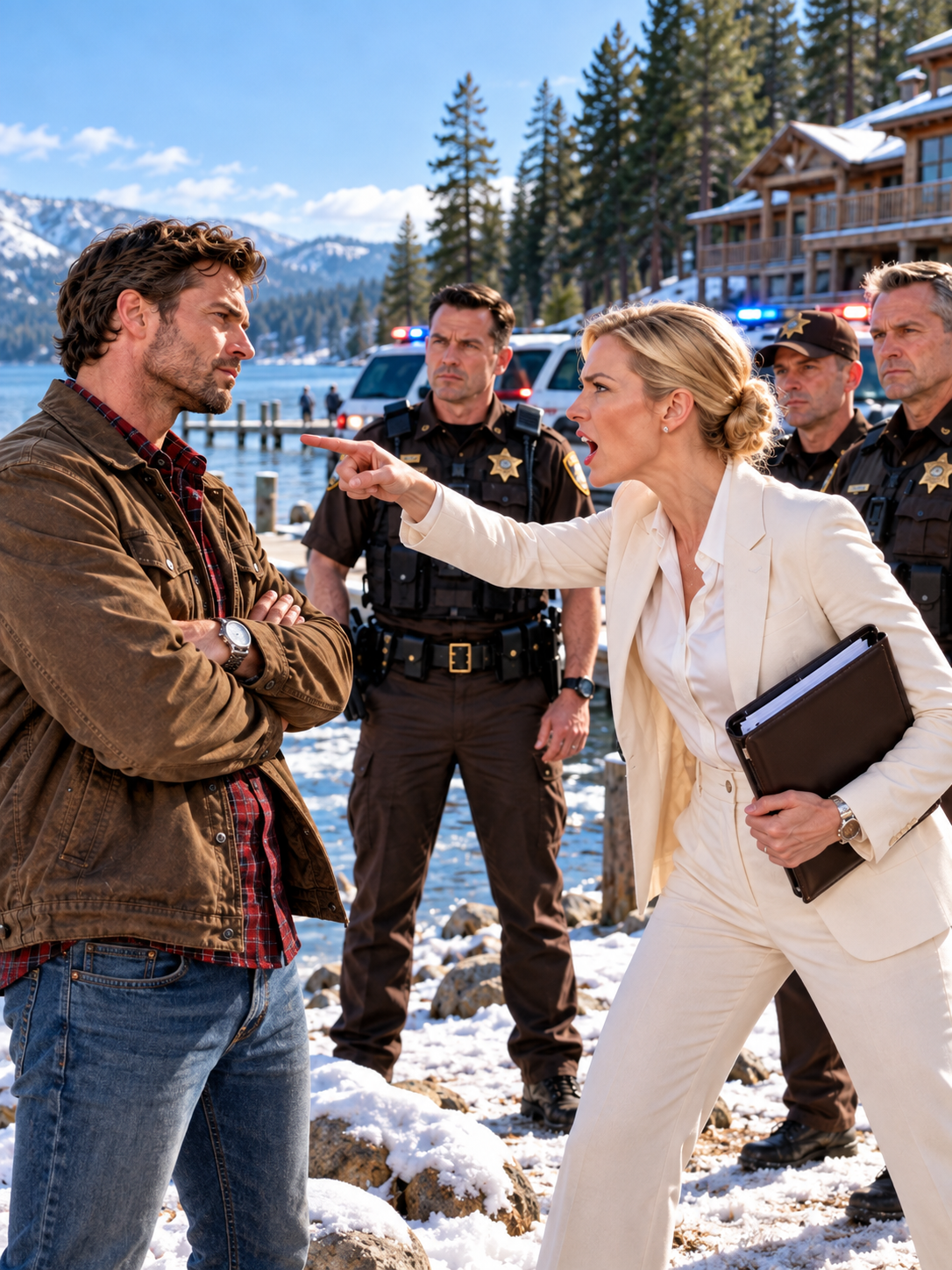
The HOA president called deputies because she claimed I had ignored repeated warnings to stop using “their private lake.” She stood on the community dock with three board members, a laminated rules sheet, and the satisfied smile of someone certain law enforcement would finally remove me from the water. I did not argue when the deputies arrived, and I did not raise my voice when she demanded that my boat be impounded. I simply handed one deputy a 1968 deed, an updated survey, and the lake-access agreement the HOA had apparently never bothered to read. Ten minutes later, nobody was asking why I was on the lake anymore—they were asking why Willow Creek HOA had built docks, stairs, landscaping, and part of a clubhouse on shoreline it had never owned.
Part 1: Deputies arrive to remove me, but the deed reverses everything.
The first deputy stepped onto my dock at on a Saturday morning while I was tightening a loose cleat on my fishing boat. Behind him came a second deputy, Willow Creek HOA president Karen Whitfield, two board members, and enough curious neighbors to make the whole thing feel less like a property question and more like a public performance. Karen pointed at me before the deputies even finished introducing themselves and said, “That’s him. He has repeatedly refused to leave our private lake.” I set the wrench down, wiped my hands on a shop towel, and asked the deputy one question. “Did she tell you I own this dock?”
Karen laughed so sharply that a woman standing near the path actually flinched. “You do not own anything beyond your lot line,” she said. “The shoreline, lake, common docks, and all access rights belong to Willow Creek.” Deputy Aaron Collins looked from her to me, then toward the water, then back to the thick binder under Karen’s arm. “Sir, can I see identification and anything showing your property interest?” he asked. I nodded, walked twenty feet to the small boathouse, and returned with the folder I had already prepared because Karen had threatened this exact stunt in writing three days earlier.
My name is Daniel Mercer, and my family has owned 214 acres outside Cedar Ridge, Tennessee, since my grandfather bought the property in 1968. The lake was not there then. Back then, Willow Creek was exactly what the name suggested: a shallow creek cutting through pasture, hardwood timber, and one narrow limestone basin my grandfather used for cattle. In 1976, he signed a reservoir agreement with the county and a private development company that allowed a dam to be built downstream, flooding roughly forty-eight acres of his land in exchange for compensation and very specific retained shoreline rights. The water covered his valley, but ownership of most of the underlying land and nearly the entire western shoreline stayed with the Mercer family.
That distinction had not mattered much for decades. My grandfather allowed neighboring families to fish. My father allowed the later Willow Creek subdivision to install three pedestrian access points. In 2004, he even signed a revocable recreational license letting residents use a narrow lakeside trail and two small docks so long as the HOA handled maintenance, insurance, and cleanup. The agreement did not transfer ownership, did not create a permanent easement, and specifically prohibited expansion without written Mercer approval.
I inherited the property after my father died four years ago. At first, Willow Creek and I got along fine. Families walked the trail. Kids fished from the old dock. I let residents launch kayaks from a gravel opening near my barn because nobody abused it. Then Karen Whitfield became HOA president.
Karen did not believe in informal arrangements. She believed in laminated rules, enforcement notices, fines, committee approvals, and the mysterious power of letterhead. Within six months of taking office, she sent me a “shoreline compliance notice” ordering me to remove my private fishing boat from what she called HOA-controlled waters. I responded with the 2004 license and the original reservoir agreement. She replied that the documents were “outdated.”
That should have been funny. Instead, it became expensive. The HOA installed new signs reading WILLOW CREEK RESIDENTS ONLY, expanded one dock by almost forty feet, poured concrete steps down the bank, installed lighting, and landscaped a strip of shoreline beside the clubhouse. None of it had my permission. I sent three letters through attorney Melissa Grant telling them to stop construction until ownership was verified.
Karen’s answer arrived by certified mail. It said my continued use of the lake constituted trespassing on association property and that future violations would be “referred to county authorities.” I read it twice, called Melissa, and asked whether Karen understood what she was threatening. Melissa said, “Either she doesn’t, or she thinks uniforms will make the deed disappear.” Three days later, the uniforms arrived.
Deputy Collins opened my folder. First came my deed. Then my father’s deed. Then the 1976 reservoir agreement. Then the 2004 recreational license.
Karen interrupted before he finished the first page. “Those are historical documents. The HOA owns the shoreline now.” Aaron looked up. “Do you have a deed?” Karen opened her binder and handed him a county tax map.
Aaron stared at it. “This is not a deed.” Karen’s expression tightened. “It shows Willow Creek Lake inside the development boundary.” I said nothing.
Aaron radioed dispatch and asked for the county property database. The second deputy, Maria Lopez, walked to the water’s edge and compared the parcel numbers on my deed with the digital map on her tablet. She looked at me. Then at Karen.
“Mr. Mercer,” she said, “your parcel appears to run under a significant portion of this lake.” Karen snapped, “That’s impossible.” Maria kept scrolling. “And according to this layer, the HOA clubhouse parcel stops about twenty-six feet before the current waterline.”
That was the moment Karen stopped smiling.
Aaron turned toward her. “Ma’am, based on what I’m seeing, this is a civil property dispute, and we’re not removing Mr. Mercer from land or water he appears to have a documented ownership interest in.” Karen’s voice rose. “He is violating association rules.” Aaron asked, “Is he a member of your association?” Karen hesitated.
“Then your rules don’t apply to him unless there’s some separate recorded agreement.”
Just not the one Karen wanted.
I handed Aaron the 2004 license.
He read the revocation clause.
Either party may terminate recreational access upon sixty days written notice if terms are violated or use expands beyond the licensed footprint.
Aaron looked toward the huge new dock.
Then the concrete stairs.
Then the clubhouse terrace.
“Mr. Mercer,” he said carefully, “did you approve any of those improvements?”
Karen answered for me.
“The HOA maintained this shoreline for twenty years.”
Aaron looked at her.
“That wasn’t the question.”
The crowd went quiet.
For the first time that morning, the situation became obvious to everyone.
Karen had called deputies to remove me from a lake where her HOA’s own legal right to be on much of the shoreline depended on my family’s permission.
And she had just brought law enforcement directly to the evidence that the association had expanded far beyond what that permission allowed.
Part 2: The survey shows the HOA built far beyond its licensed shoreline.
The deputies left without arresting anyone, impounding anything, or validating a single HOA rule. Karen tried to frame that as a technical delay, telling residents the county simply lacked authority to resolve “complex community ownership.” I did not correct her on the dock. I waited until she walked back toward the clubhouse, then called Melissa and said, “Order the full survey.” She answered, “Already did.”
The surveyor was Owen McCall, a sixty-three-year-old man who had spent four decades arguing with fences, monuments, deeds, and people who thought Google Maps could replace recorded boundaries. Owen arrived Monday with two technicians and enough GPS equipment to make Willow Creek residents nervous. He started with the 1968 monuments, then tied them to the reservoir map and the modern county coordinate system. By Wednesday afternoon, he had found four original iron pins, one buried axle marker, and a stone corner my grandfather described in his field notes. Every one landed where the old deed said it should.
The result was worse for the HOA than even Melissa expected. I owned roughly seventy-eight percent of the lake’s shoreline. The county retained the dam structure and one narrow maintenance strip. Willow Creek HOA directly owned only a small northeastern cove and the parcel beneath its clubhouse. Their walking trail, three docks, landscaped point, kayak launch, and part of the retaining wall all crossed Mercer property.
Karen’s new forty-foot dock was entirely mine.
The concrete stairs were mostly mine.
Even twelve feet of the clubhouse’s new lakeside patio extended over the boundary.
That last item changed the tone.
Willow Creek had spent $640,000 renovating the clubhouse the previous year.
The patio alone cost nearly $90,000.
Karen had publicly bragged that she personally negotiated the expansion.
She had also signed the construction authorization.
Melissa sent the preliminary survey to the HOA’s attorney, Robert Ellis.
His response came within three hours.
PLEASE SUSPEND ALL SHORELINE ACTIVITY PENDING TITLE REVIEW.
Reasonable.
Then Karen emailed residents anyway.
The message accused me of “weaponizing obsolete land records to seize community amenities.”
Melissa read it and laughed.
“Obsolete land records is a creative way to say deed.”
I asked, “Can she actually claim the shoreline by adverse possession?”
“Possibly try.”
“Would it work?”
I hated that answer.
She explained. Long use can create claims under certain conditions, but permissive use is different. My father’s license explicitly granted permission for docks and trail access, which undermined any argument that the HOA used the property hostilely or without permission. Even better, old board records repeatedly referenced “Mercer permission.”
We found them in the HOA’s own archives.
2008 newsletter:
Thanks to the Mercer family for continuing to allow residents shoreline access.
2012 board minutes:
Annual insurance certificate to be delivered to John Mercer pursuant to recreational-use agreement.
2017 maintenance memo:
No dock expansion without Mercer written approval.
Then a 2021 email signed by Karen herself.
Please confirm whether Mr. Mercer will approve replacement of Dock Two.
Not every detail.
But she knew enough to understand the HOA did not own the western shore.
That mattered.
Then Melissa found something more serious.
The clubhouse-renovation permit application included a property-owner certification.
Karen Whitfield, Willow Creek HOA President.
It stated the association had “full ownership or permanent easement rights” over the improvement area.
The survey said otherwise.
The 2004 agreement said otherwise.
And Karen’s own earlier email showed she knew Mercer approval had historically been required.
I stared at the permit copy.
“She certified ownership?”
“Could she claim she relied on someone else?”
“She can claim anything. We’ll see what the records show.”
The HOA attorney scheduled a meeting.
Karen attended.
So did vice president Susan Hale, treasurer Robert Dean, Melissa, Owen, and me.
Robert Ellis opened calmly.
“We need to separate three questions. Ownership. Licensed access. Unauthorized improvements.”
No theatrics.
Karen interrupted.
“We have maintained this land for two decades.”
Ellis looked at her.
“Karen, please let me finish.”
She folded her arms.
He continued.
“The preliminary survey strongly supports Mercer ownership along the western shoreline.”
Karen said, “Preliminary.”
Owen slid four photographs across the table.
“Original monuments agree within three inches.”
Ellis continued.
“The recreational license appears revocable if use expands beyond permitted areas.”
Another silence.
“And the clubhouse addition may physically encroach.”
Susan looked at Karen.
“You told us the patio was within HOA boundaries.”
Karen replied, “That’s what the site plan showed.”
“Whose site plan?”
“Architect.”
Owen said, “Architect used a conceptual subdivision map, not a boundary survey.”
Robert Dean stared.
“You approved a $640,000 renovation without a survey?”
Karen snapped, “We had no reason to believe there was a problem.”
I slid her 2021 email across the table.
She stopped.
Susan read it.
Her face changed.
“You asked Daniel’s approval to replace Dock Two.”
“That was courtesy.”
“No. You literally wrote that the association was required to receive Mercer approval under the shoreline agreement.”
Karen looked at me.
Then Melissa.
Then her attorney.
For the first time, the board members understood this was not a surprise title defect.
Their president had known the HOA’s shoreline rights were limited.
Maybe she believed long use had expanded them.
Maybe she believed nobody would challenge her.
But she knew ownership was not simple.
The meeting ended with no resolution.
Outside, Susan caught me in the parking lot.
“I’m sorry.”
“For what?”
“For the deputies.”
“You didn’t call them.”
“I’m on the board.”
“That doesn’t make every decision yours.”
She looked relieved.
Then ashamed.
“We need those docks.”
“Families use that trail every day.”
“Are you going to shut everything down?”
I looked toward the lake.
“I haven’t decided.”
That was true.
I did not want revenge.
But I also did not intend to reward an HOA for treating my permission like surrender.
That evening, Melissa sent me one more document.
A confidential development proposal discovered in county planning files.
Willow Creek had been negotiating to build twelve luxury lakefront cottages along the western shoreline.
On my land.
Projected sales:
$8.4 million.
Karen had not merely expanded existing community amenities.
She had been preparing to commercialize shoreline the HOA did not own.
And suddenly her decision to call deputies made perfect sense.
If she could establish publicly that I had no right to use “their” lake, then the next phase became much easier to sell.
If Karen had nearly succeeded in turning Daniel’s own shoreline into an $8.4 million HOA development, should he revoke every access right immediately—or wait until the board discovered how much of their future Karen had already promised without owning a single foot of the land?
Part 3: Karen’s secret cottage project explains why she needed me gone.
The county planning file contained a concept plan called Willow Point Residences. Twelve luxury cottages. Private docks. Landscaped shoreline. Gated pedestrian path. Shared clubhouse access.
Every cottage sat west of Willow Creek’s actual boundary.
All twelve sat on Mercer property.
I called Melissa.
“How far had this gone?”
“Concept review.”
“Money exchanged?”
“Developer?”
“Briarstone Residential.”
That name had a reputation.
Aggressive.
They built lake communities across Tennessee and North Carolina.
Melissa requested documents.
Two days later, Briarstone contacted us first.
Their regional attorney, Rebecca Sloan, sounded alarmed rather than hostile.
“We were informed Willow Creek controlled the development tract.”
“The association.”
“President Whitfield.”
“Did you verify title?”
“We requested a title package from the HOA.”
“It included subdivision maps and a board legal memorandum.”
“Recorded deed?”
“That didn’t bother you?”
“We were not yet under final contract.”
Early concept work sometimes begins before title is complete.
“How much did you pay?”
“Twenty-five thousand dollars in preliminary exclusivity fees.”
“To the HOA?”
“What happens now?”
“We suspend planning.”
Reasonable.
Then Rebecca asked:
“Would you consider development?”
She paused.
“May I ask why?”
“I like the shoreline.”
“That simple?”
“Fair enough.”
Briarstone withdrew within the week.
No secret villain.
Their contract with the HOA required clear title before any major payment.
They walked away and demanded return of the $25,000 fee.
The HOA had already spent it.
Treasurer Robert Dean discovered that during emergency financial review.
Karen authorized the money toward clubhouse furniture.
Small compared with everything else.
But symbolic.
She was operating as though the cottage project was inevitable.
Then came the board minutes.
Karen had presented Willow Point as future “association-owned development revenue” that could eliminate dues increases for years.
Projected HOA proceeds:
$2.2 million.
Residents had not been told because Karen wanted to announce it after preliminary county approval.
Her motive became clearer.
Willow Creek faced expensive problems.
Aging roads.
Dam assessments.
Clubhouse debt.
Insurance increases.
The cottages could solve all of it.
If she controlled the shoreline.
Which she did not.
Susan Hale asked me to attend another board meeting.
This time thirty homeowners came too.
Karen looked exhausted.
Still defensive.
Susan opened.
“Karen, did you sign an exclusivity agreement with Briarstone?”
“Did the board authorize it?”
“Executive committee.”
“What executive committee?”
“The development committee.”
Robert Dean said, “We don’t have one.”
Karen snapped, “We discussed creating one.”
“Discussing is not voting.”
She looked around the room.
“You all wanted lower dues.”
A man in the front row said, “Not with somebody else’s land.”
Karen pointed at me.
“He benefited for years from our maintenance.”
I stood only when Susan asked me to respond.
“Your association maintained areas it was permitted to use.”
“You let us believe they were ours.”
I handed Susan copies of newsletters thanking my family for access.
Then board minutes.
Then Karen’s email asking permission.
The room became uncomfortable.
Karen said, “Nobody reads old documents like contracts every time they walk a trail.”
“But you did before signing with Briarstone?”
That question mattered.
She should have.
She had authority to negotiate.
She had lawyers.
She had access to archives.
She simply decided old limits should not control new ambitions.
Susan asked, “Why did you call deputies on Daniel?”
Karen’s answer surprised me.
“Because he refused to move his boat from the proposed cottage area.”
There it was.
Not completely calculated.
But enough.
The boat complicated site photography.
My dock made ownership visible.
Karen wanted it gone.
She had sent three notices.
I ignored them because they were legally meaningless.
Then she escalated.
“I thought if county officers told him to remove it, we could resolve the boundary afterward.”
Robert stared.
“You were trying to create a fact before proving ownership.”
Karen looked away.
That was exactly what she had done.
Part 4: The board removes Karen before she can put the HOA at greater risk.
The vote happened that night. Five board members. Four voted to suspend Karen as president pending legal review. Karen voted against.
Susan became interim president.
Her first action was boring.
Perfectly boring.
She ordered all construction, dock expansion, shoreline landscaping, commercial planning, and enforcement actions involving Mercer property suspended.
Her second action:
Independent title review.
Full insurance notification.
Apology to me.
Just governance.
Melissa appreciated Susan immediately.
“She’s dangerous.”
“She apologized.”
“Exactly. Competent people are dangerous because they solve things.”
The title report arrived three weeks later.
It confirmed Owen’s survey.
Mercer ownership.
County dam strip.
Small HOA cove.
No permanent HOA easement across my western shoreline.
Only the revocable recreational license.
The clubhouse patio encroached by 11.8 feet at its widest point.
The new Dock Four encroached entirely.
Trail expansion crossed outside the licensed footprint by up to thirty-two feet.
Now I had leverage.
The obvious response was revocation.
Close trail.
Remove docks.
Demand patio demolition.
Technically possible.
Emotionally satisfying for about five minutes.
Children lose fishing access.
Older residents lose their walking path.
Homeowners pay for Karen’s mistakes.
I did not want that.
So Melissa and I drafted a proposal.
Willow Creek could keep the trail.
Keep two docks.
Keep most landscaping.
Keep the patio encroachment under a long-term license.
In exchange:
They remove the oversized new dock.
No commercial development.
No additional structures without written consent.
Annual liability insurance.
Clear boundary signs.
No HOA enforcement against Mercer property.
Maintenance standards.
Public acknowledgment that access exists by agreement, not ownership.
And one unusual provision.
Residents could continue using the shoreline without paying me rent.
Susan stared at the draft.
“No annual fee?”
“My father wanted people to enjoy the lake.”
She looked relieved.
Then Melissa said:
“But the clubhouse encroachment is different.”
Permanent structure.
Commercial association asset.
We proposed a twenty-five-year ground license for the patio area.
$18,000 per year.
Adjusted modestly for inflation.
Willow Creek negotiated.
We settled at $14,500.
Reasonable.
The HOA could afford it.
I got compensation.
No demolition.
Everyone moved on.
Almost everyone.
Karen hired her own lawyer.
She claimed the board had scapegoated her for actions taken to benefit homeowners.
She argued Willow Creek’s decades of maintenance created equitable rights.
She threatened litigation.
Then her lawyer saw the 2004 agreement.
And her emails.
And the cottage proposal.
The tone changed.
A month later, Karen resigned from the board entirely.
No spectacular defeat.
Just consequences.
But one issue remained.
The deputies.
Karen had knowingly reported me as a trespasser.
Was that illegal?
Not necessarily.
People can be wrong about property.
Even confidently wrong.
No arrest had occurred.
No false affidavit had been filed.
The sheriff’s department closed the incident as a civil dispute.
That was appropriate.
I did not need handcuffs in the story.
The truth had already done enough.
Part 5: Willow Creek learns the lake was never as private as residents believed.
The shoreline dispute revealed another surprise. Willow Creek residents had been paying nearly $72,000 a year in “lake preservation assessments.” That money funded landscaping, dock maintenance, shoreline patrols, water testing, and insurance.
Reasonable expenses.
But Karen’s administration marketed them as costs of owning the lake.
They did not own most of it.
Residents were furious.
Not because the money was necessarily wasted.
Because the story was false.
Susan asked me to speak at an open meeting.
I brought three maps.
Modern survey.
I explained the reservoir.
My grandfather’s agreement.
My father’s license.
No legal jargon beyond what mattered.
One resident, Patricia Lowe, raised her hand.
“I’ve lived here eighteen years. I was told my HOA dues included private lake ownership.”
“I believe you.”
“Was that ever true?”
“Not for the western shore.”
“Can we still use it?”
“If we finalize the new agreement, yes.”
“What about fishing?”
“Swimming?”
“At designated areas.”
She looked confused.
“So practically nothing changes?”
“Practically, very little.”
Another homeowner asked:
“Then what was all this for?”
Good question.
I answered:
“Ownership matters even when use looks the same.”
People nodded.
I continued.
“If someone lets you walk across their field for twenty years, that generosity should not turn into a belief that the field became yours.”
That line spread through Willow Creek.
Some residents still disliked me.
One man said I should donate the shoreline to the HOA because “the community built value around it.”
I asked whether he would donate part of his backyard because neighbors enjoyed looking at it.
He stopped speaking.
Another mini-payoff.
Boundaries became understandable when applied personally.
The HOA approved the new agreement by a huge margin.
Seventy-two households voted yes.
Three abstained.
The trail reopened officially after new signs went up.
MERCER SHORELINE — COMMUNITY ACCESS BY AGREEMENT.
Karen hated the sign.
I learned later she complained it made Willow Creek look “subordinate.”
That was the problem in one word.
She had treated cooperation like hierarchy.
Someone had to be above.
Someone below.
Trespasser.
I did not care about any of that.
I wanted clear rules and quiet mornings.
Part 6: A storm proves why cooperation matters more than ownership pride.
The following spring, Tennessee received three days of relentless rain. Willow Creek rose nearly four feet. Debris jammed against the county dam. One shoreline tree fell across the main pedestrian path.
At a.m., Susan called.
“Daniel, county emergency management needs access through your north gate.”
“No paperwork?”
“Not at two in the morning.”
She laughed nervously.
Within thirty minutes, county trucks crossed Mercer land to reach the dam.
My tractor helped move debris.
Willow Creek volunteers brought sandbags.
HOA maintenance workers helped protect my boathouse.
Nobody asked whose shoreline they were standing on.
Because real emergencies simplify things.
By dawn, water stabilized.
No homes flooded.
The dam held.
My lower dock took damage.
Willow Creek residents helped rebuild it.
Without charge.
I provided lumber for their trail repairs.
No invoice.
No board vote.
Just neighbors.
A week later Susan came by with coffee.
“Karen would hate this.”
“Everyone cooperating without a committee.”
Then she became serious.
“Do you regret not closing everything?”
“Even after what they did?”
“Karen did it.”
“She represented us.”
“For a while.”
Susan nodded.
That distinction mattered.
Holding an entire community permanently responsible for one leader’s choices would have repeated Karen’s mistake in another direction.
She had treated me as “the outsider.”
I could have treated them as “the HOA.”
Both flatten people into categories.
Reality is messier.
And usually better.
Part 7: Karen returns with one final claim about the original reservoir agreement.
Nine months after resigning, Karen appeared at my gate.
No SUV blocking anything.
Just a folder.
I opened the gate but stayed outside.
“What do you need?”
She handed me a photocopy.
“I found this in my father’s papers.”
Her father had been one of the original developers involved with Willow Creek in the 1970s.
That explained more than I expected.
The document was a draft reservoir amendment.
It appeared to give the development company an option to purchase shoreline after twenty-five years.
My stomach tightened.
If valid and exercised correctly, ownership history might be more complicated.
“Where did you get this?”
“My father’s files.”
“Because everyone thinks I invented everything.”
I studied the document.
No recording stamp.
No signatures from my grandfather.
Draft language.
Still, I called Melissa.
Facts first.
We spent two weeks researching.
County archives.
Old attorney files.
Development records.
The amendment had indeed been proposed in 1978.
But my grandfather refused.
We found the rejection letter.
Handwritten note:
NO SALE OF WEST SHORE.
Then a final signed agreement explicitly stating all ungranted shoreline interests remained Mercer property.
Karen read the documents in Melissa’s office.
She sat quietly.
“So my father lied to me.”
Maybe he simply told the story his way.
“He always said the developer would eventually own the whole lake.”
Melissa replied, “That was the plan. Not the final contract.”
Karen looked at me.
“I grew up believing your family was holding land that belonged to the community.”
Her motive went deeper than dues and cottages.
Family mythology.
Inherited certainty.
She genuinely believed the Mercer shoreline was a technical obstacle to something promised decades earlier.
Then she made every later fact fit that belief.
“Why didn’t you ask?” I said.
She looked tired.
“Because I thought I already knew.”
That may have been the truest thing Karen ever said.
She apologized.
Not dramatically.
“I’m sorry about the deputies.”
“Thank you.”
“And the cottage project.”
“Thank you.”
“I still think the community should own more shoreline.”
“And I still disagree.”
She almost smiled too.
That was enough.
Part 8: Years later, the lake finally belongs to facts instead of assumptions.
Five years after the deputies walked onto my dock, Willow Creek Lake looked almost exactly the same. The trees were taller. The new trail surface drained better. The HOA had replaced one aging dock under the written approval process.
My boat still sat where Karen once demanded I remove it.
The clubhouse patio remained.
Now legally licensed.
The cottage project never returned.
Briarstone developed another parcel closer to the highway.
Willow Creek raised dues modestly to fund roads and insurance.
Residents complained for three months.
Then adapted.
Ordinary life.
Susan remained president for two terms.
After that, she refused reelection.
“Normal people should not enjoy HOA meetings this much,” she told me.
The shoreline agreement became routine.
New homeowners received a copy during closing.
No more claims of ownership.
No more mysterious community authority.
They knew exactly what rights came with their homes.
Kayak access.
No commercial activity.
No new structures without permission.
One summer morning, I found Deputy Aaron Collins fishing from the community dock.
He looked embarrassed.
“I’m technically off duty.”
“Good. Otherwise I’d report you.”
He laughed.
Then pointed toward my boat.
“Still trespassing?”
“Every day.”
We both laughed.
He told me that incident became an informal training example at the sheriff’s office.
Not because officers did anything wrong.
Because property calls are deceptive.
Uniforms do not decide title.
Maps can be misleading.
Calm people with paper sometimes know more than angry people with authority.
I liked that.
My father would have liked it too.
I eventually restored his old boathouse.
Inside, I framed a copy of the 1976 reservoir agreement.
The 2004 recreational license.
Then the modern Willow Creek agreement.
Three generations of paper.
Each one showing the same principle.
Ownership and access are different things.
You can own something and share it.
You can use something without owning it.
You can maintain something without acquiring it.
And generosity survives longer when boundaries stay clear.
A few years later, my niece asked why the lake was called Willow Creek Lake if our family owned most of the shoreline.
“Because names are easier than deeds.”
She frowned.
“What does that mean?”
“It means people remember stories better than documents.”
“Which one is true?”
“Both sometimes.”
She hated that answer.
Kids prefer certainty.
Adults should know better.
Then she pointed toward the HOA dock.
“Can they really fish there because Grandpa let them?”
“Could you stop them?”
“Legally, under some conditions.”
“Would you?”
I looked across the lake.
Families walked the trail.
A teenager helped his little brother untangle fishing line.
Two retirees sat beneath the pavilion.
Nothing about the scene threatened me.
“Because owning something doesn’t mean you have to keep everyone else away.”
She thought about that.
“Then why did Karen try to keep you away?”
Good question.
“Because she confused control with ownership.”
My niece nodded as if that made perfect sense.
Maybe children understand adults better than we think.
I still kept the folder from that first morning.
Karen’s violation notices.
Deputy incident report.
The cottage concept plan.
Not because I wanted to relive the fight.
Because paper has memory when people don’t.
Every time someone says, “Everybody knows this belongs to us,” somebody should ask:
Where does it say that?
Not to be difficult.
To prevent difficult things later.
Karen did not lose because I shouted louder.
I barely shouted at all.
She lost because the deed existed before her certainty.
The survey monuments existed before her rules.
The reservoir agreement existed before Willow Creek had a clubhouse, pool, president, newsletter, or laminated enforcement sheet.
Facts were already waiting.
All I had to do was bring them.
That Saturday morning, Karen called deputies because she wanted me publicly removed from “her” lake.
By lunchtime, she had accidentally created the first official record forcing everyone to examine who actually owned what.
Sometimes arrogance destroys itself that way.
Not explosively.
Document by document.
Signature by signature.
Boundary by boundary.
And when the dust settles, the truth usually looks much less dramatic than the argument.
A line on a survey.
An old iron pin.
A paragraph in a deed.
A simple sentence:
Access granted does not convey ownership.
That was all my grandfather had protected.
A sentence.
Forty-eight years later, that sentence kept an entire shoreline from being quietly converted into somebody else’s property.
My boat is still there.
So is the trail.
So are the families.
Nobody had to lose the lake.
We simply had to learn who owned the shore.
✓ Lynn R. Adams
The HOA president called deputies because she claimed I had ignored repeated warnings to stop using “their private lake.” She stood on the community dock with three board members, a laminated rules sh…