The HOA Covered My Land With 60 Solar Panels—Then the Utility Asked One Question That Changed Everything
The HOA Covered My Land With 60 Solar Panels—Then the Utility Asked One Question That Changed Everything
“Your field belongs to the community now, Mom. You need to stop embarrassing us and accept it.”
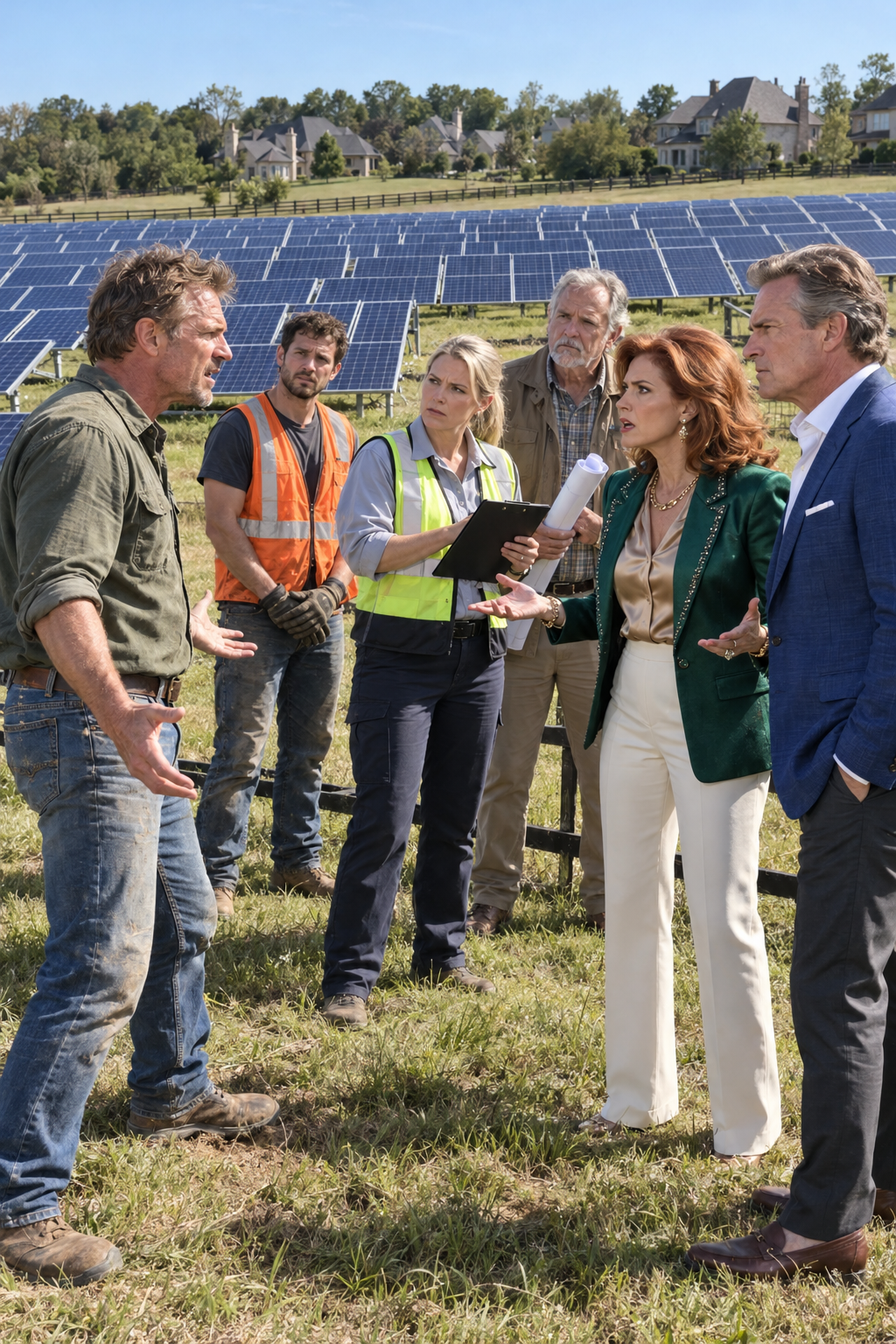
My son said those words while sixty black solar panels glittered across the pasture my husband and I had spent thirty-two years paying for.
Then his wife smiled, slid a cardboard box of my belongings toward me with the toe of her designer boot, and added, “You have until Sunday to leave the farmhouse.”
I looked at my son.
He would not look back.
Behind him stood three members of the Cedar Glen Homeowners Association board, a contractor in a reflective vest, and a county deputy who had clearly been told this was some harmless family property dispute.
Every one of them expected me to cry.
I bent down, picked up the box, and asked one question.
“Did you connect them yet?”
My daughter-in-law, Vanessa, laughed.
She had the kind of laugh that always sounded as if someone else had just made a mistake.
“Tomorrow morning,” she said. “Why?”
I nodded once.
“No reason.”
That was the first moment she should have been afraid.
My name is Margaret Hale.
I was sixty-eight years old when my only son helped a homeowners association cover eleven acres of my land with solar panels and then tried to convince me I had become a trespasser on the property where I had buried my husband.
For most of my life, people confused silence with surrender.
My husband, Walter, never did.
He used to say, “Maggie, the dangerous person in a room isn’t always the one shouting. Sometimes it’s the one who already knows where the documents are.”
Walter had been dead for eleven months when the trucks arrived.
The first one came at on a Tuesday morning.
I remember the time because I was standing at the kitchen sink rinsing my coffee mug when I heard the grinding sound of diesel engines climbing the gravel road.
Our farm sat outside the town of Bellweather, Virginia, just beyond the newest edge of Cedar Glen Estates.
When Walter and I bought the property in 1991, there had been no Cedar Glen.
There had been cornfields, a feed store, a Baptist church with a crooked white steeple, and seventy acres of tired red soil nobody with good sense wanted.
Walter wanted it.
He was thirty-eight years old, permanently sunburned, stubborn enough to repair a tractor with baling wire, and convinced that land was the only thing a working family could buy that would remember their effort after they were gone.
We started with seventy acres.
Over the years, we sold seventeen along the northern road frontage.
We used the money to pay off the mortgage, put our son Daniel through college, and help him with the down payment on his first house.
The remaining fifty-three acres stayed ours.
Even after Walter died, I still thought of the land that way.
The oak grove was ours.
The pond was ours.
The south pasture was ours.
The little cemetery under the sycamore trees, where Walter had asked to be buried beside his parents, was ours.
And the lower eleven-acre meadow, where those trucks were headed, was ours too.
I stepped onto the porch wearing flannel pajama pants and Walter’s old denim shirt.
Six trucks rolled through my open gate.
Then came two flatbeds carrying steel framing.
Then an excavator.
Then a white SUV with CEDAR GLEN COMMUNITY ENERGY PROJECT printed across the doors.
I walked down the porch steps.
A man in a hard hat raised one hand.
“Ma’am, you’ll need to stay clear of the construction zone.”
I looked over my shoulder at my house.
Then back at him.
“What construction zone?”
He glanced at a clipboard.
“Parcel 18-B.”
“That’s my pasture.”
He smiled the cautious smile people use when they think an elderly woman has become confused.
“This area has been approved for the Cedar Glen solar installation.”
“Approved by whom?”
He checked the paper.
“Property authorization is through the association.”
“My property is not in Cedar Glen.”
That got his attention.
Only slightly.
He took off his sunglasses.
“Ma’am, I’m with Blue Ridge Renewable Construction. I’m not involved in ownership questions. We received permits and site authorization.”
“Then you should stop unloading.”
His jaw tightened.
“We’re under contract.”
“With who?”
“The Commonwealth of Virginia.”
That was technically true, though not in the way he probably assumed.
He stared at me.
Finally he said, “I’ll call the project manager.”
“You should.”
Twenty minutes later, Vanessa arrived.
Of course she did.
She stepped out of a pearl-white Range Rover wearing cream trousers, a fitted emerald blazer, oversized sunglasses, and the look of a woman arriving to inspect something she believed she already owned.
Vanessa had married Daniel nine years earlier.
At first, I liked her.
That is a painful sentence to write, even now.
I liked her confidence.
I liked that she had built a real-estate marketing business from nothing.
I liked that she challenged Daniel when he became lazy.
Walter liked her too, though less.
“She measures every room before she decides how to behave in it,” he once told me.
I thought he was being unfair.
I learned later that Walter had simply been paying attention.
Vanessa walked directly toward me.
“Margaret, what are you doing out here?”
I nearly smiled.
“My laundry.”
She removed her sunglasses.
“Daniel said he explained everything.”
“Daniel hasn’t called me in six days.”
“He said he sent you the paperwork.”
“He emailed me a twelve-page HOA proposal that described my field as underutilized common acreage.”
Her mouth tightened.
“That’s a planning designation.”
“It’s a lie.”
The contractor looked between us.
Vanessa lowered her voice.
“This is exactly what I was afraid of.”
“What were you afraid of?”
“That you’d make this emotional.”
I glanced toward the excavator.
A steel bucket was already hanging over the pasture where Walter used to cut hay.
Then I looked back at her.
“You brought an excavator onto my land at sunrise.”
“It’s not just your land anymore.”
There it was.
Not yet the full betrayal.
Just the blade entering.
“What does that mean?”
Vanessa exhaled dramatically.
“The board approved the sustainability easement.”
“I am not on your board.”
“You signed the preliminary access agreement.”
“No, I didn’t.”
“You did three years ago.”
“I signed permission for Cedar Glen residents to use the eastern walking trail from sunrise to sunset.”
She gave me a patronizing smile.
“Margaret, this has all been reviewed by counsel.”
I looked at the contractor.
He looked away.
That was when I knew this was bigger than Vanessa.
People who are lying badly look at you.
People who know they have been handed a dangerous lie look anywhere else.
I told the crew to leave.
They didn’t.
I called the sheriff’s department.
A deputy came, read the paperwork Vanessa handed him, and told me the matter appeared civil.
Then Daniel arrived.
My son parked beside Vanessa’s SUV.
He got out wearing navy slacks and a pale blue dress shirt, though it was barely seven-thirty in the morning.
Daniel was forty-one.
Tall like Walter.
Same brown eyes.
Same habit of rubbing the side of his thumb when nervous.
He was doing it as he walked toward me.
I had the strangest memory then.
Daniel at six years old, standing beside a broken bedroom lamp.
Daniel at sixteen, after he backed Walter’s truck into the barn.
Daniel at twenty-seven, when he confessed he had lost ten thousand dollars in a bad investment and was terrified to tell his father.
That thumb always gave him away.
I looked at it.
Then at him.
“Tell them to stop.”
His eyes dropped.
“Tell them.”
“You need to hear us out.”
“Please don’t make this harder.”
I felt something cold settle inside me.
Recognition.
There are moments when betrayal is still technically happening, but your body understands it before your mind does.
The contractor shouted to his crew.
A hydraulic arm moved.
Metal clanged against metal.
Daniel stepped closer.
“The project is worth almost two million dollars over fifteen years.”
“To the community.”
“What community?”
“Cedar Glen.”
“I don’t live in Cedar Glen.”
“You practically do.”
“No. Cedar Glen was built next to us.”
“Mom, property lines are not the point.”
I stared at him.
Walter had been dead eleven months.
Eleven months.
Daniel had stood beside me at the funeral with one arm around my shoulders.
He had cried when the military honor guard folded the flag.
He had promised me, “You will never have to worry about this place.”
Now he stood in Walter’s pasture explaining that property lines were not the point.
I said nothing.
That bothered him.
He kept talking.
“The association needs a stable energy source. Utility rates are increasing. The south meadow has full exposure and road access. It’s perfect.”
“For solar panels.”
“On my land.”
He rubbed his thumb.
“The easement transfers operational control.”
“To Cedar Glen.”
“Signed by me.”
He swallowed.
“Authorized through the trust.”
That was the first real crack in the wall.
Vanessa felt it too.
She stepped between us.
“Margaret, none of this has to become ugly.”
I looked past her at my son.
“What trust?”
Nobody answered for two full seconds.
Then Vanessa said, “The Hale Family Property Trust.”
I almost admired the confidence.
Walter and I did have a trust.
Vanessa knew that.
Daniel knew that.
They also knew most of the farm had been transferred into it years ago.
But what they apparently did not know was that Walter had amended it four months before his death.
They did not know because Walter had made me promise not to tell Daniel unless something happened.
At the time, I hated that promise.
I thought it was unfair.
Now, standing in the pasture with six trucks and an excavator, I finally understood why my husband had insisted.
I heard Walter’s voice as clearly as if he were beside me.
If Danny ever starts asking about controlling the land instead of caring for it, open the green envelope.
The green envelope.
It was hidden inside an old metal deed box beneath the false bottom of Walter’s walnut desk.
I had not touched it since his funeral.
Not because I had forgotten.
Because I had not needed to.
Until that morning.
Vanessa mistook my silence for confusion.
“The trust allowed Daniel, as successor beneficiary, to act in the property’s financial interest.”
“You’ve read it?”
“Our attorney has.”
“What attorney?”
“Martin Coyle.”
I knew the name.
Martin Coyle was Cedar Glen’s HOA attorney.
He had also represented the developer who built Cedar Glen.
And, if memory served, he had handled Daniel and Vanessa’s purchase of their house.
Not one person.
That mattered.
“Then I suppose you have everything covered.”
Daniel looked relieved.
That hurt more than Vanessa’s arrogance.
His shoulders actually dropped.
He thought I had surrendered.
“Thank you,” he said.
I looked at him for a long time.
“You’re welcome.”
Then I walked back to the farmhouse.
They began digging before breakfast.
By noon, there were forty-three steel posts in my meadow.
By sunset, there were eighty.
I did not call a lawyer.
I did not call the newspaper.
I did not stand in front of the machines.
I went upstairs.
I closed the bedroom door.
I knelt beside Walter’s desk.
And I opened the false bottom.
The green envelope was exactly where he had left it.
My name was written across the front in his handwriting.
Maggie — ONLY IF THEY FORCE YOUR HAND.
I sat on the carpet for several minutes before opening it.
Inside were four things.
A handwritten letter.
A notarized trust amendment.
A survey map.
And a small brass key with a red paper tag.
On the tag, Walter had written:
BOX 317 — FIRST COMMONWEALTH.
My hands shook then.
I unfolded the letter.
If you’re reading this, I was right about something I desperately wanted to be wrong about.
Do not confront Daniel until you understand the amendment.
Do not give anyone the original.
Do not let Cedar Glen’s lawyer “review” it alone.
Most important: the south meadow is not simply farm acreage.
I never told Danny because he talked about value before responsibility.
You understood responsibility.
The state agreement survives me.
So does the restriction.
If anyone builds there without authorization, let them finish enough to prove intent.
Then ask who authorized the interconnection.
I read that last sentence three times.
Then I looked at the survey.
The lower eleven acres were outlined in red.
Along the bottom, in Walter’s precise block handwriting, were four words.
CONSERVATION ENERGY RESERVE PARCEL.
I knew Walter had participated in a state land program years earlier.
I remembered environmental inspectors.
Soil testing.
Meetings at the kitchen table.
He told me it involved storm runoff and preserving agricultural land near new development.
I had signed several papers.
Then life moved on.
My mother got sick.
Daniel got married.
Walter’s heart problems began.
I never understood the full structure.
Walter had.
And apparently, he had expected somebody might one day try exactly what Cedar Glen had just done.
I opened the trust amendment.
The first paragraph changed everything.
Upon the death of Walter James Hale, control of the Conservation Energy Reserve Parcel, consisting of 11.42 acres identified as Parcel 18-B, shall vest solely in Margaret Elaine Hale for her lifetime and shall not pass to successor beneficiaries, trustees, assigns, associations, developers, creditors, or related entities without separate written consent from the Commonwealth program administrator.
Daniel had no authority over that field.
But there was more.
The amendment stated that any unauthorized commercial use could trigger automatic reversion rights.
Not to Daniel.
Not to the HOA.
To a nonprofit land foundation Walter had helped establish with three neighboring farmers.
The Bellweather Agricultural Preservation Trust.
I sat very still.
That was the moral center of Walter’s secret.
This was not about me keeping expensive land.
It was about preventing the very thing Cedar Glen had tried to do.
Walter had known development was coming.
He had known landowners would eventually be pressured.
He had protected the south meadow because runoff from Cedar Glen drained toward a creek feeding three family farms downstream.
The state restriction required any energy project built there to go through environmental review, agricultural review, and utility approval before construction.
The HOA had done none of that.
They had not stolen a lawn.
They had walked into a legal minefield with an excavator.
I put everything back except Walter’s letter.
That stayed in my pocket.
For the next three days, I watched.
I watched them tear grass from soil Walter had seeded by hand.
I watched trucks carry in aluminum rails.
I watched Cedar Glen board members pose for photographs beside a banner announcing “OUR CLEAN ENERGY FUTURE.”
I watched my son stand in front of sixty solar panels while Vanessa took pictures for the HOA website.
And I said nothing.
I said nothing when they parked on my gravel drive.
I said nothing when they installed a chain across the pasture entrance.
I said nothing when Vanessa moved a portable security camera onto my fence post.
I said nothing when a board member told a neighbor the field had been “donated by the Hale family.”
I said nothing when Daniel stopped coming inside my house and began conducting conversations from the driveway like I was a difficult tenant.
Silence is strange.
People reveal themselves inside it.
On Thursday afternoon, Vanessa came to the porch with a folder.
She sat without being invited.
“You’re handling this better than I expected.”
I kept shelling peas.
“That disappoints you?”
“No. Actually, I’m relieved.”
A pea rolled across the table.
I picked it up.
“What’s in the folder?”
“Transition documents.”
“Transition to what?”
She smiled.
“The farmhouse.”
I stopped shelling.
There are injuries so sharp they make the world quiet.
Vanessa opened the folder.
“Daniel thinks it would be better if you moved temporarily.”
“We found a very nice senior community near Charlottesville.”
I looked at her.
She continued.
“It has independent living. Gardens. Transportation. Activities.”
“I have gardens.”
“Margaret.”
“I have transportation.”
“That’s not the point.”
“What is the point?”
She folded her hands.
“The farm is becoming complicated.”
“No. You are making it complicated.”
Her face hardened slightly.
“This house sits on the only practical service route to the solar field.”
I almost laughed.
There it was.
They needed my driveway.
The county access lane on the west side washed out every spring.
The northern route crossed a creek too narrow for utility maintenance trucks.
My driveway was not sentimental to them.
It was infrastructure.
Vanessa leaned closer.
“Cedar Glen will pay you a relocation stipend.”
“How generous.”
“Thirty thousand dollars.”
“For my house.”
“For temporary relocation.”
“How temporary?”
“We can discuss that later.”
I resumed shelling peas.
She watched me.
“You’re not understanding the opportunity.”
“No. I understand it.”
“The property has become too much for you.”
“My property?”
Her mouth tightened.
“Daniel has responsibilities as future trustee.”
“He is your son.”
“That wasn’t my question.”
“You know, this is why Daniel gets so frustrated.”
I looked up.
“Because I understand words?”
“Because you turn everything into a fight.”
I set down the bowl.
“Vanessa, you arrived at my home with construction crews, built a commercial energy site on land I never gave you, and now you are offering me thirty thousand dollars to leave so your trucks can use my driveway.”
“You’re oversimplifying.”
“No. I’m finally simplifying.”
She stared at me.
Then her voice changed.
“Daniel is ashamed.”
I said nothing.
“He doesn’t say it because he loves you. But he’s ashamed of how difficult you’ve become since Walter died.”
That one landed.
She saw it.
People like Vanessa are experts at spotting the exact second a knife finds bone.
She continued.
“He’s trying to build something. He’s on the HOA finance committee. He’s finally respected in Cedar Glen. And every time you challenge this project, you make him look like a man who can’t manage his own family.”
Manage his own family.
I thought of Walter working double shifts at the county maintenance yard to pay Daniel’s college tuition.
I thought of selling seventeen acres so Daniel could graduate without debt.
I thought of the check we wrote when Daniel and Vanessa’s first business failed.
I thought of Walter driving two hours during chemotherapy because Daniel’s basement had flooded and he needed help.
Vanessa mistook my silence again.
“You should let him have this.”
She was six inches taller in her heels.
It didn’t help her.
“What exactly have I not let my son have?”
Her expression changed.
I continued.
“His education?”
“His first house?”
“His business loan?”
Her jaw tightened.
“The forty-two thousand dollars we paid when the bank threatened foreclosure?”
“Margaret—”
“The eighteen months he and you lived here rent-free?”
“That has nothing to do with—”
“The funeral expenses I paid alone because he said his cash flow was tight?”
Her face flushed.
I leaned slightly closer.
“I let my son have everything I could give without cutting pieces off myself.”
She stepped back.
I picked up the folder and handed it to her.
“You don’t get the pieces.”
That night Daniel called.
He did not ask what Vanessa had said.
He started angry.
“You humiliated my wife.”
“She came there trying to help you.”
“She came here trying to evict me.”
“That’s not fair.”
“You should read the papers she brought.”
“I wrote the proposal with her.”
That sentence hurt in a different way.
Completely.
“You wrote it.”
“So this was your idea.”
“Mom, listen—”
“How long?”
“How long have you planned to move me out?”
My son’s silence was not like mine.
Mine made other people nervous.
His made me tired.
Finally he said, “Since Dad’s health started declining.”
I closed my eyes.
That meant before Walter died.
While I was feeding his father ice chips.
While I was sleeping in a chair beside the hospice bed.
While Daniel was sitting at our kitchen table telling me, “Don’t worry about the farm.”
He had already been planning what to do with it.
I whispered, “Your father knew.”
“Mom, this is exactly what I mean. You say things like that.”
I looked toward the dark window.
Outside, the solar panels reflected a pale strip of moonlight.
“Come tomorrow,” I said.
His voice softened.
“Bring Vanessa.”
“I’m ready to discuss leaving.”
That traveled through the phone like electricity.
His whole tone changed.
He tried to sound concerned.
“Well… okay. That’s probably for the best.”
“For everyone?”
I looked at Walter’s letter on the table.
Then I asked the question that sounded weak.
The question Walter had practically written for me.
“Before I go, can you show me who authorized the utility connection?”
He laughed softly.
“Mom, you don’t need to worry about that.”
I stared at the panels.
Friday morning, I drove forty miles to First Commonwealth Bank.
Box 317 required two keys.
And the bank’s.
The manager, a gray-haired woman named Elaine Foster, led me into a private room.
“I’m sorry about Walter,” she said.
“Thank you.”
“He came in several times last year.”
“I didn’t know.”
“He asked us not to contact you unless you came with the key.”
That sounded exactly like Walter.
The box was longer than I expected.
Inside were three binders, a sealed flash drive, and a red folder stamped COMMONWEALTH OF VIRGINIA — AGRICULTURAL ENERGY RESERVE.
There was also a photograph.
Walter and me, 1998.
Standing in the south meadow.
Daniel was thirteen.
He stood between us holding a fishing pole.
On the back, Walter had written:
Land means nothing if you don’t protect what it protects.
I had to sit down.
Not because I was weak.
Because grief sometimes arrives disguised as handwriting.
The first binder contained the state agreement.
The second contained environmental surveys.
The third contained correspondence between Walter and Cedar Glen’s original developer.
That was the first twist.
Cedar Glen had known.
Not Vanessa.
Not Daniel.
The association itself.
Twenty-two years earlier, when Cedar Glen’s first phase was being planned, the developer had tried to buy part of our farm.
Walter refused.
Then stormwater engineers discovered the south meadow formed a natural drainage buffer.
Construction upstream would increase runoff.
The county required Cedar Glen’s developer to contribute to preservation measures.
Instead of selling, Walter negotiated.
He entered the meadow into the state reserve program.
Cedar Glen received development approvals.
In exchange, the south meadow could never be controlled by Cedar Glen or used for commercial infrastructure without independent state approval.
There were signatures.
County signatures.
State signatures.
Developer signatures.
And one signature made my skin go cold.
Martin Coyle.
The same attorney now representing the HOA.
He had been a junior lawyer on the original development project.
He knew exactly what Parcel 18-B was.
The solar project was not a mistake.
It was a gamble.
I opened the red folder.
Inside was a letter dated five months before Walter died.
This letter confirms our conversation regarding your concern that Cedar Glen Estates may attempt to acquire operational control of the reserve parcel through a successor beneficiary.
Please be advised that no private trust designation supersedes the recorded conservation restriction.
Any representation to a utility, lender, contractor, or government body asserting unrestricted site control would be materially false.
I read that sentence twice.
Then a third time.
At the bottom was the name of the state program administrator.
Dr. Rebecca Sloan.
There was a phone number.
I called it from the bank parking lot.
She answered on the second ring.
“Office of Agricultural Resilience, Sloan speaking.”
“My name is Margaret Hale.”
“Walter Hale’s wife?”
Her voice changed immediately.
“Mrs. Hale, is everything all right?”
I looked out through the windshield.
A delivery truck crossed the parking lot.
“Cedar Glen covered the south meadow with solar panels.”
Another silence.
“How many?”
“Are they operational?”
“Do not sign anything.”
“I haven’t.”
“Do not authorize interconnection.”
“I haven’t.”
“Do not allow them to represent you.”
“They already did.”
Her voice sharpened.
“What do you mean?”
“They say my son authorized the project through our family trust.”
“He cannot.”
“I know that now.”
“What utility?”
“Shenandoah Electric Cooperative.”
“Who is the contractor?”
“Blue Ridge Renewable.”
I heard typing.
Then Dr. Sloan said something that changed the next week of my life.
“Mrs. Hale, I need you to listen carefully. Do not stop the interconnection inspection.”
I gripped the phone.
“Because if they submitted the documents I think they submitted, the inspection will establish who made the representation.”
Walter’s letter came back to me.
Let them finish enough to prove intent.
Then ask who authorized the interconnection.
I whispered, “My husband knew.”
“I believe he suspected.”
“Suspected what?”
“That Cedar Glen would try to convert access rights into control after his death.”
I looked at the photograph on the passenger seat.
“Why didn’t he tell me?”
Dr. Sloan’s answer was gentle.
“Maybe he wanted you to live with him instead of spending his last months fighting people who could wait.”
I cried then.
For less than a minute.
Then I wiped my face and asked what she needed.
By Friday afternoon, everything looked normal.
That was the beauty of it.
Vanessa and Daniel came at two.
Martin Coyle came at two-ten.
HOA president Patricia Weller came at two-fifteen.
They sat at my dining table like bankers preparing to close a deal.
I served coffee.
That confused them.
Vanessa had brought the relocation agreement.
Daniel had brought a pen.
Martin brought a leather briefcase.
Patricia brought satisfaction.
“We want this to be dignified,” Patricia said.
She was sixty-three, perfectly groomed, silver-blonde, and so accustomed to running Cedar Glen meetings that she spoke to everyone as if seconds were being recorded.
“I appreciate that,” I said.
Daniel smiled.
They thought they had won.
That mattered.
Predators reveal the most when they stop hunting.
Martin opened the documents.
“The association will provide Margaret with a thirty-thousand-dollar relocation payment, moving expenses up to five thousand, and twelve months of supplemental housing support.”
“Generous,” I said.
Vanessa smiled.
Martin continued.
“In exchange, Margaret acknowledges Daniel Hale’s administrative authority under the family trust and grants Cedar Glen perpetual maintenance access across the eastern drive.”
There it was.
Not temporary.
I looked at Daniel.
“You read this?”
“And you agree?”
“Mom, it protects everyone.”
Vanessa exhaled.
“Please don’t start.”
I looked at her.
“I’m not starting anything.”
I turned another page.
“Who receives revenue from the solar project?”
Patricia answered.
“The association.”
“All of it?”
“After financing costs.”
“How much?”
Martin interrupted.
“That’s not relevant to this agreement.”
“Then it should be easy to answer.”
Patricia shifted.
“Projected gross savings and credits are approximately one hundred and seventy thousand dollars annually.”
I did the math.
Fifteen years.
Over two and a half million dollars.
On land they claimed I was too old to manage.
I turned another page.
“And Daniel?”
My son stiffened.
“What about me?”
“Do you receive anything?”
Vanessa answered too quickly.
“Of course not.”
I looked at her.
Then Daniel.
Then Patricia.
Martin closed the folder.
“This meeting is becoming unproductive.”
“Then let’s make it productive.”
I stood, walked to the sideboard, and returned with one sheet of paper.
Not the trust amendment.
Not the state agreement.
Just a printed email.
I placed it in front of Martin.
His eyes moved across the page.
His face changed.
Only slightly.
But I saw it.
“What is this?” Vanessa asked.
I kept watching Martin.
“It’s an email Walter received six months before he died.”
Martin put it down.
“This is irrelevant correspondence.”
“What does it say?” Daniel asked.
Martin didn’t answer.
“It says Cedar Glen cannot obtain site control over Parcel 18-B through any beneficiary of our trust.”
Patricia’s head turned toward Martin.
“Is that true?”
He recovered quickly.
“Recorded restrictions can be modified.”
“Was this one modified?”
He stared at me.
“That is a legal question.”
“You’re a lawyer.”
Vanessa stood.
“This is ridiculous.”
I looked at her.
“Sit down.”
I had never spoken to her that way.
Neither had anyone else in that room, probably.
I turned to Daniel.
“Your father warned me about this.”
His face lost color.
“About what?”
“About you.”
He flinched.
I hated that I had to say it.
I hated more that it was true.
“He changed the trust.”
Daniel stared at me.
“Four months before he died.”
“That’s impossible.”
“I was successor trustee.”
“Not for the south meadow.”
Martin stood.
“We should adjourn.”
Patricia looked at him.
He began gathering papers.
“I need to review the recorded instruments.”
I almost admired him.
He understood danger faster than the others.
Vanessa didn’t.
“What instruments?”
Martin ignored her.
I said, “The conservation restriction.”
Her expression went blank.
Daniel whispered, “What conservation restriction?”
I looked at him.
“The one your father apparently didn’t trust you to know about.”
Daniel stood so quickly his chair scraped the floor.
“That’s not fair.”
My voice stayed calm.
“It isn’t.”
He stared at me as if I had slapped him.
I continued.
“What wasn’t fair was planning to remove me from my home while your father was dying.”
Vanessa jumped in.
“That is not what happened.”
I turned to Daniel.
“Tell her she’s wrong.”
He couldn’t.
The room became very quiet.
Then Patricia said, “Regardless of family issues, the panels are installed.”
I looked at her.
“They represent substantial association property.”
Her eyes narrowed.
“We have contracts.”
“With whom?”
“Blue Ridge.”
“Who authorized the site?”
Martin said sharply, “Patricia.”
She answered.
I looked at my son.
His mouth opened.
Vanessa said, “Through the trust.”
Martin snapped his briefcase shut.
“We’re done.”
I let them leave.
At the door, Daniel stopped.
His eyes were wet.
For one terrible second I almost saw the little boy with the broken lamp.
Then he said, “You’re going to destroy everything.”
Not I’m sorry.
Not I didn’t know.
Not what did Dad protect?
You’re going to destroy everything.
I answered softly.
“No, Danny.”
I looked toward the meadow.
“You already built it.”
Saturday morning, the utility inspection began at nine.
Two Shenandoah Electric trucks arrived.
Then a white state vehicle.
Then another.
Vanessa was there before eight-thirty.
Patricia came with two board members.
Martin arrived at eight-forty-five.
Daniel did not come.
At nine-six, the lead utility engineer walked to the service cabinet.
His name was Aaron Price.
He wore a yellow vest, safety glasses, and the exhausted expression of a man who expected an ordinary inspection.
For twenty minutes, he checked equipment.
Then he opened a binder supplied by the contractor.
He read the first page.
Then the second.
Then he stopped.
“Who is Margaret Hale?”
I raised my hand.
He walked toward me.
“Are you the property owner?”
“Did you sign the site-control authorization?”
Every sound in that field seemed to disappear.
Aaron looked down at the binder.
Then back at me.
“Did you authorize Daniel Hale to sign on your behalf?”
Vanessa stepped forward.
“He has authority through the family trust.”
Aaron turned.
“Are you counsel?”
“No, I’m his wife.”
Martin approached.
“I am counsel.”
Aaron held up the paper.
“Then maybe you can explain this.”
Martin looked at it.
I watched his jaw tighten.
Aaron pointed to the bottom.
“This document states that Cedar Glen Community Association has uncontested operational control over Parcel 18-B.”
Patricia said, “We do.”
I said, “You don’t.”
Aaron frowned.
Martin spoke smoothly.
“There is a trust instrument granting successor authority.”
The state vehicle door opened.
Dr. Rebecca Sloan stepped out.
Martin stopped talking.
He recognized her.
That was the second twist.
And it was glorious.
Dr. Sloan walked across the grass carrying a red folder.
“Mr. Coyle.”
Martin’s face became expressionless.
“Dr. Sloan.”
Vanessa looked between them.
“You know each other?”
Dr. Sloan did not answer her.
She looked at the solar panels.
Then at the disturbed soil.
Then at the trench running nearly three hundred feet along the edge of the meadow.
“How deep is that conduit?”
The contractor superintendent checked his notes.
“Thirty-six inches.”
“Across the drainage buffer?”
He hesitated.
“We followed the civil plans.”
“Which civil plans?”
He held out a set.
Dr. Sloan took them.
She flipped through three pages.
“These were not approved by our office.”
Martin stepped closer.
“This is a private distributed-generation installation.”
“Not on this parcel.”
Aaron looked at her.
“What parcel restriction?”
She handed him a copy.
He read the first page.
Then looked at Martin.
Then at Patricia.
Then at Vanessa.
Finally he asked the sentence Walter had predicted.
“Who authorized this?”
Nobody answered.
Aaron repeated it.
“Who authorized this interconnection request?”
Patricia pointed at Daniel’s signature.
I almost felt sorry for her.
Aaron shook his head.
“I’m asking who authorized Cedar Glen to represent that it controls this land.”
Martin said, “We need to pause.”
Dr. Sloan answered, “The project was supposed to pause before construction.”
The contractor superintendent went pale.
“What exactly is the restriction?”
Dr. Sloan looked at him.
“This parcel is a protected agricultural stormwater reserve subject to a recorded noncommercial land-control covenant.”
He stared toward the sixty panels.
“So… these can’t be here?”
“Not without review.”
He looked at Patricia.
“You told us permits were complete.”
Patricia turned to Martin.
Martin turned to nobody.
That was the moment the system started eating itself.
The contractor called his office.
Aaron called utility counsel.
One HOA board member walked fifty feet away and began whispering furiously into his phone.
Vanessa stood beside her Range Rover, arms folded tightly.
Dr. Sloan photographed the trench.
Two state environmental officers arrived thirty minutes later.
Then a county engineer.
Then, unexpectedly, a representative from First Commonwealth Bank.
That confused me.
I walked toward him.
He introduced himself as Paul Avery from commercial lending.
“We financed part of the installation,” he said quietly.
My stomach tightened.
“Using what collateral?”
He looked uncomfortable.
“The energy credits and association reserve assets.”
“Not my land?”
“Not directly.”
I heard that word.
“What does directly mean?”
He hesitated.
“Mrs. Hale, I probably shouldn’t discuss borrower documents without authorization.”
Dr. Sloan approached.
“Mr. Avery, you may want to call your legal department before leaving.”
He looked at her.
“Because the site-control certification appears defective.”
His face drained.
By noon, construction tape surrounded the electrical cabinet.
The utility refused interconnection.
The state issued a stop-work order.
Blue Ridge suspended the project.
And Cedar Glen residents began arriving.
People had heard.
They stood along the road asking questions.
“How much did this cost?”
“Why isn’t it connected?”
“Who signed the land agreement?”
Patricia tried to take control.
She climbed onto the bed of a pickup truck.
“This is a temporary administrative issue.”
Someone shouted, “You spent nine hundred thousand dollars!”
Another voice yelled, “On land we don’t own?”
Patricia raised both hands.
“The association acted on legal advice.”
Every face turned toward Martin.
He looked like he wanted the ground to open.
Vanessa found me near the fence.
“This is what you wanted.”
“Yes, it is.”
I looked at the sixty panels.
“What I wanted was Tuesday morning.”
She stared at me.
“I wanted your trucks never to come through my gate.”
Her mouth trembled with anger.
“You could have stopped this.”
There it was.
The favorite accusation of people who build a disaster and discover someone else knew where the brakes were.
I answered quietly.
“You let us keep building.”
“I told you to leave.”
“You knew there was a restriction.”
“Not until after you started.”
“But you knew before the panels were finished.”
Her face hardened.
“That makes you responsible too.”
“You deliberately let costs increase.”
“I deliberately let you prove what you were willing to do after being told no.”
She leaned closer.
“You think that makes you clever?”
I looked at my farmhouse.
“It makes me tired.”
Then Daniel arrived.
He parked near the road and walked toward us.
People noticed him immediately.
Voices changed.
One man shouted, “There’s the land guy.”
Daniel flinched.
Vanessa rushed to him.
“You need to say something.”
He ignored her.
He came to me.
“Can we talk inside?”
We walked to the farmhouse together.
It felt like escorting a stranger through a museum of his own childhood.
The pencil marks on the kitchen doorframe were still there.
Daniel age 5.
Daniel age 8.
Daniel age 12.
Walter had written each date.
Daniel saw them.
His face changed.
He sat at the table.
I remained standing.
He said, “I didn’t know about the restriction.”
“I believe you.”
His eyes lifted.
That surprised him.
“I swear, Mom.”
“I believe you.”
“Then you understand.”
He looked down.
Finally he said, “Martin told us the trust gave me authority to negotiate.”
“Did you read the trust?”
“Because Martin said—”
I pulled out a chair and sat across from him.
He stared at the table.
“Because Dad always handled that stuff.”
“Dad was dead.”
He closed his eyes.
“Why didn’t you ask me?”
“I thought you’d say no.”
The cleanest truth I had heard all week.
“You would have.”
“Because you hate Cedar Glen.”
“Your father hated being pressured.”
“It’s eleven acres.”
I looked at him.
He heard himself.
His shoulders sagged.
“I didn’t mean it that way.”
“Yes, you did.”
He rubbed his thumb.
“You weren’t using it.”
I felt something inside me finally break.
Not loudly.
A thread snapping.
“I wasn’t using it.”
“I mean commercially.”
“Your father was buried fifty yards from that field.”
“That’s not what I meant.”
“We grew hay there for twenty-four years.”
“We used that hay to keep livestock through winter.”
“The meadow slows runoff before it reaches Miller Creek.”
He looked at me.
“That is why your father protected it.”
Daniel frowned.
“What are you talking about?”
I told him.
About the development agreement.
About the drainage buffer.
About the conservation program.
About the trust amendment.
About the land foundation.
About Walter’s warning.
Daniel sat motionless.
When I finished, he whispered, “He didn’t trust me.”
I wanted to comfort him.
God help me, I still wanted to.
But truth deserved one clean moment.
He looked as if I had struck him.
I continued.
“He loved you.”
“That’s not the same thing.”
My voice softened.
“It isn’t.”
Daniel’s eyes filled.
“Did he say that?”
“He said you talked about value before responsibility.”
Daniel looked toward the window.
Outside, residents were still gathering.
“He thought I was greedy.”
“He thought you were vulnerable to people who knew how to flatter your ambition.”
Daniel laughed once.
“That sounds like Dad.”
He wiped his face.
“Is Vanessa part of this?”
I studied him.
“You tell me.”
He shook his head.
“I don’t know anymore.”
That mattered.
“What did she tell you?”
“That Cedar Glen would save hundreds of thousands in energy costs.”
“That the project would raise home values.”
“That I could prove myself to the board.”
He looked at me.
“The reason.”
His face tightened.
“It wasn’t just that.”
“No. But it was enough.”
“I need air.”
At the door, I stopped him.
“Did you sign anything besides the site-control certification?”
His face changed.
But I saw it.
“Did you sign anything else?”
I said nothing.
He looked away.
I did not follow him.
That evening Cedar Glen held an emergency meeting.
I did not attend.
People expected me to.
Vanessa texted twice.
Patricia left a voicemail asking whether I would “participate constructively.”
I turned off my phone.
At seven, I heated tomato soup.
At seven-thirty, I sat on the back porch.
At eight, I walked to Walter’s grave.
The sunset reflected red across the solar panels.
They looked almost beautiful.
That was the worst part.
The panels themselves were not evil.
The idea was not evil.
Clean energy was not the enemy.
Entitlement was.
A good purpose does not purify theft.
Walter understood that better than anyone.
I sat beside his grave.
“You could have just told me,” I whispered.
Wind moved through the sycamores.
I almost heard him answer.
You would have tried to save Danny from the lesson.
He was probably right.
Sunday morning, I was officially supposed to leave my house.
The cardboard box Vanessa had pushed toward me was still sitting by the front door.
I filled it.
Not with clothes.
With copies.
The relocation agreement.
The trust amendment.
The state restriction.
The original developer correspondence.
And one page from the bank binder.
At nine, I drove to the Cedar Glen clubhouse.
Two hundred people were inside.
They went quiet when I entered.
Patricia sat at the front table.
Martin Coyle was beside her.
Vanessa sat in the first row.
Daniel was not there.
I carried the box down the center aisle.
Patricia forced a smile.
“Margaret, thank you for coming.”
I placed the box on the table.
“I’m here because today is the day I was supposed to leave my house.”
Murmurs spread through the room.
Patricia looked sharply at Vanessa.
Apparently that detail had not been widely shared.
A man in the back called, “What does she mean, leave?”
I opened the box.
Vanessa stood.
“This is a family matter.”
I looked at the room.
Then I pulled out the relocation agreement.
“This document gives Cedar Glen perpetual access across my driveway in exchange for moving me into senior housing.”
The room erupted.
Patricia grabbed the microphone.
“Everyone, please.”
Someone shouted, “Did we approve that?”
Another person yelled, “Why would the HOA need her house?”
The noise grew.
Then I held up one hand.
Strangely, people quieted.
Maybe because I wasn’t shouting.
I said, “I’m not here to take your homes. I’m not here to bankrupt your association. I’m not here because I hate solar power.”
Patricia’s expression changed.
That was clearly the defense she had planned.
I continued.
“I’m here because people representing this association decided that an older widow could be treated as an obstacle instead of an owner.”
“They believed my son’s future inheritance mattered more than my present rights.”
Vanessa stared at the floor.
“They believed paperwork could become permission if enough professionals signed it.”
Martin’s face was stone.
“They believed that because my husband was dead, nobody would remember what he protected.”
I reached into the box.
I held up Walter’s letter.
“But he remembered.”
My voice nearly broke.
I did not let it.
“He remembered that land carries water beyond property lines. He remembered that one development’s convenience can become another farmer’s flood. He remembered that promises are easiest to break after the people who made them are buried.”
Someone in the second row whispered, “Jesus.”
I put the letter down.
Then came the anaphora Walter deserved.
“They thought I was alone because my husband was dead.
They thought I was alone because my son stood with them.
They thought I was alone because their lawyer had the papers.
They thought I was alone because trucks had already crossed my gate.
They thought I was alone because silence looks like weakness from far away.”
Nobody moved.
I looked directly at Martin.
“But I was never alone.”
I held up the recorded state covenant.
“The law was still here.”
Then the trust amendment.
“Walter’s warning was still here.”
Then the drainage map.
“The creek was still here.”
Then I touched my chest.
“And I was still here.”
The room exploded.
Not with applause.
Something better.
“How much money was borrowed?”
“Who reviewed the title?”
“Why didn’t counsel disclose the restriction?”
“Was Daniel paid?”
That last question changed the room.
Vanessa’s head snapped up.
Patricia looked at Martin.
Martin looked at me.
I had not asked it.
A man named George Benton had.
He was a retired accountant.
He stood holding several pages.
“I asked the management company for project disbursements this morning.”
Patricia said, “George, sit down.”
He did not.
“There’s a seventy-five-thousand-dollar consulting payment to Hale Strategic Development.”
Every head turned toward Vanessa.
My blood went cold.
I knew that company.
It belonged to Vanessa.
Daniel had told me he received nothing.
Vanessa stood.
“That was legitimate project coordination.”
George lifted the paper.
“Why wasn’t it disclosed?”
“In executive session.”
Someone shouted, “That’s our money!”
Another voice yelled, “Seventy-five grand?”
Patricia grabbed the microphone.
But there was no order left.
Martin leaned toward Vanessa and whispered something.
She snapped back, “You said it was protected.”
I heard it.
So did George.
So did three people near them.
Martin’s face changed.
The system was eating itself again.
Then the clubhouse doors opened.
Daniel walked in.
He looked terrible.
Wrinkled shirt.
He walked down the aisle carrying a blue folder.
Vanessa turned.
“Where have you been?”
He ignored her.
He came to the front.
Then he looked at me.
“I lied yesterday.”
The room went silent.
My stomach tightened.
“About what?”
He opened the folder.
“I signed something else.”
Vanessa rushed toward him.
“Daniel, don’t.”
He stepped away from her.
That told me more than any confession.
Martin stood.
“You should not speak without counsel.”
Daniel laughed bitterly.
“You’re the reason I need counsel.”
He pulled out a document.
“I signed a beneficial-use agreement.”
George asked, “What does that mean?”
Daniel looked at the room.
“It gave a project entity the right to claim tax incentives tied to the solar installation.”
Patricia went pale.
“What project entity?”
Daniel turned toward Vanessa.
“Hale-Coyle Energy Holdings.”
No one breathed.
I stared at Martin.
Then Vanessa.
Daniel’s family name.
Martin’s family name.
Vanessa whispered, “You idiot.”
Daniel looked at her.
“You told me it was just a shell company.”
Martin moved toward the door.
Two men blocked the aisle.
Not threatening him.
Just standing there.
He stopped.
George said, “Who owns it?”
Daniel looked sick.
“Forty percent Vanessa.”
The room erupted.
He raised his voice.
“Forty percent Martin Coyle’s investment company.”
Martin shouted, “That is not accurate.”
Daniel kept going.
“Twenty percent was assigned to me.”
My knees almost weakened.
Not because of the money.
Because my son had signed.
Not blindly.
Not entirely.
He had accepted a piece.
Daniel looked at me.
“I was supposed to receive distributions once the project connected.”
I whispered, “How much?”
“Maybe twenty-five thousand a year.”
For a moment I could not hear the room.
Twenty-five thousand dollars.
That was the price he had put on being able to look me in the eye while forcing me from my house.
He stepped closer.
“Mom, I told myself it was compensation for managing the property.”
I said nothing.
“I told myself Dad would have wanted me to make the farm productive.”
Still nothing.
“I told myself you’d be better somewhere smaller.”
That one cut deepest.
Not because he believed it.
Because he had needed to believe it.
Daniel’s voice broke.
“I told myself a lot of things.”
I looked at my son.
My only child.
The boy Walter taught to fish.
The man we saved from every early mistake until he finally found one big enough to become his character.
“Why are you telling us now?”
He swallowed.
“Because there’s more.”
Martin said, “Daniel.”
My son turned on him.
It was the first strong thing I had heard him say all week.
He reached into the folder.
“There’s a loan.”
George frowned.
“What loan?”
Daniel handed him a page.
George read it.
His face changed.
“How much?”
Daniel answered.
“Three point four million dollars.”
The room erupted again.
Patricia looked as if she might faint.
“That’s impossible.”
“It was approved through a development facility.”
“We didn’t authorize three million dollars!”
Daniel shook his head.
“The HOA didn’t.”
Everyone looked at him.
He continued.
“Hale-Coyle Energy Holdings did.”
George said, “Then why does Cedar Glen matter?”
Daniel stared at the floor.
“Because the collateral includes projected HOA energy payments.”
It took the room a few seconds to understand.
Then someone shouted, “They used us as customers?”
Daniel nodded.
“And there’s a default clause.”
Martin headed for the side door.
This time a county deputy stepped inside.
Not the deputy from Tuesday.
A different one.
Behind him stood Dr. Sloan.
And behind her was a woman I had never seen.
Federal badge clipped at her waist.
The room went dead silent.
She introduced herself.
“Special Agent Laura Mercer, Department of Agriculture Office of Inspector General.”
Martin sat down.
Vanessa didn’t.
She looked at Daniel.
“You called them?”
He shook his head.
I looked at Dr. Sloan.
She looked at me.
“No,” she said.
“Walter did.”
My breath stopped.
Dr. Sloan walked toward the front.
“Not recently, obviously.”
No one laughed.
She opened a red file.
“Mr. Hale submitted a protected disclosure seven months before his death.”
I gripped the table.
“About what?”
Dr. Sloan glanced toward Agent Mercer.
Mercer answered.
“About suspected attempts to manipulate protected agricultural parcels for private energy financing.”
The words seemed to tilt the room.
I looked at Martin.
Then Vanessa.
Then Daniel.
“This happened before the solar project.”
Mercer nodded.
“Then what was Walter investigating?”
She hesitated.
“Mrs. Hale, that discussion should happen privately.”
My heart started beating harder.
“Because Parcel 18-B was not the only property.”
“How many?”
Mercer looked at me for a long moment.
“Seventeen.”
A murmur swept through the clubhouse.
Dr. Sloan laid a map on the table.
Red circles covered land around Bellweather.
Creek buffers.
Old family parcels.
Some were owned by elderly residents.
Some were owned by estates.
Some belonged to people I knew.
The Miller farm.
The Atkins orchard.
The old Jensen place.
“What is this?”
Mercer answered.
“Potential target parcels.”
“For solar projects?”
“Not exactly.”
Martin closed his eyes.
That frightened me more than anything else that morning.
Mercer continued.
“The energy project may only be the financing mechanism.”
“For what?”
She looked toward the crowd.
“I’d prefer not to discuss an active investigation publicly.”
Patricia whispered, “My God.”
Vanessa grabbed her purse.
Mercer said, “Mrs. Hale-Carter, please remain in the room.”
Vanessa froze.
Daniel stared at his wife.
I stared at Martin.
Then I remembered the bank representative’s strange wording.
Not my land.
Not directly.
I asked, “Was the real goal the land?”
Mercer did not answer.
She didn’t have to.
Walter’s warning suddenly felt much larger.
Value before responsibility.
Operational control.
Successor beneficiary.
Target parcels.
Daniel came beside me.
I turned away from him.
I was not ready.
Maybe someday.
Agent Mercer asked several board members to remain.
The meeting dissolved into whispers, phone calls, and frightened clusters.
I collected Walter’s papers.
People approached me.
Some apologized.
Some thanked me.
Some asked what would happen to their association dues.
I answered honestly.
“I don’t know.”
That mattered to me.
Justice should not require pretending innocent people will never feel consequences.
By Monday, Shenandoah Electric had formally rejected the interconnection.
By Tuesday, Blue Ridge Renewable filed a lien dispute against the project entity.
By Wednesday, First Commonwealth froze the remaining construction line.
By Thursday, Patricia resigned as HOA president.
Martin Coyle stopped answering calls.
Vanessa moved out of the Cedar Glen house she shared with Daniel.
And Daniel came to my farmhouse alone.
He stood on the porch.
I did not invite him inside.
“I’m cooperating,” he said.
“They said I may still be charged.”
He looked toward the meadow.
“They’re taking the panels down.”
“I’ll pay back whatever I can.”
His eyes filled.
“Do you hate me?”
There are questions mothers spend their lives fearing.
That was not the hardest one.
The hardest one was the honest answer.
His face broke.
I continued.
“But I don’t trust you.”
“I understand.”
“No, Danny.”
I looked at him.
“You’re going to have to learn what that actually means.”
He wiped his eyes.
“I want to.”
“That’s a beginning.”
He looked toward Walter’s grave.
“Did Dad hate me?”
“Are you sure?”
I thought of Walter’s letter.
His careful amendment.
The secret bank box.
The legal protection.
The warning built not to punish Daniel but to prevent Daniel’s weakness from destroying something larger than himself.
“Because he protected you from becoming worse than you became.”
Daniel covered his face.
I let him cry.
I did not comfort him.
Sometimes love is standing close enough that someone is not abandoned, but far enough that they must carry what they have done.
Two weeks later, the final solar panel came down.
Blue Ridge restored the trench as part of a settlement with the state.
The meadow looked scarred.
But scars are not ownership papers.
Grass would return.
Rain would come.
Roots would hold.
The Bellweather Agricultural Preservation Trust voted to strengthen the reserve covenant.
Three neighboring families joined.
Cedar Glen elected a new board.
They apologized formally.
I accepted the apology.
I did not grant them access.
Daniel sold his interest in a small rental property and transferred the proceeds into an escrow account for restitution.
Vanessa hired a criminal-defense attorney.
Martin Coyle disappeared for six days before federal agents served a search warrant at his office.
That should have been the end.
For a while, I thought it was.
Then, on the first cold morning of October, I received a package.
No return address.
Inside was a flash drive.
And a note written on yellow paper.
Walter was right about the land.
But he was wrong about why they wanted it.
Do not trust the state map.
Look under the solar survey.
There was no signature.
I locked the kitchen door.
Closed the blinds.
Then I retrieved the sealed flash drive from Box 317.
The one I had never opened.
I placed both drives on the table.
One anonymous.
One from my dead husband.
For ten minutes, I simply stared at them.
Then I opened Walter’s drive.
There were forty-three files.
Most were maps.
One was labeled:
CEDAR GLEN — ORIGINAL ACQUISITION PLAN — DO NOT DISTRIBUTE.
I opened it.
A satellite map appeared.
My farm sat at the center.
Cedar Glen surrounded it on three sides.
Seventeen protected properties were circled in red.
But beneath them, running in a straight line for almost twelve miles, was a thick blue corridor.
I zoomed in.
It crossed every targeted parcel.
Including mine.
The legend identified it with four words.
PROPOSED REGIONAL TRANSMISSION CORRIDOR.
I stopped breathing.
The solar panels had never been the prize.
They were a way to establish control.
Control created easements.
Easements created corridors.
Corridors made land cheap to acquire.
And somebody had been planning this for years.
Then I saw a file dated three weeks before Walter died.
PRIVATE — M.H.
I opened it.
A scanned letter filled the screen.
Walter had written it.
If this file is open, then they finally moved.
The HOA is only the front door.
Follow the transmission corridor.
Do not assume Daniel is the highest person involved.
Do not assume Coyle is either.
And if someone claims the state approved the route, ask them one question:
Who owned the land before Cedar Glen existed?
My hands went cold.
I pulled the old survey from the green envelope.
For the first time, I turned it over.
There was writing on the back.
Walter’s handwriting.
Three parcel numbers.
And one sentence underlined twice.
THEY NEVER BOUGHT THE GROUND BENEATH THE ROAD.
I stared toward the window.
Beyond the pasture, Cedar Glen’s main entrance road curved through manicured stone pillars and rows of expensive houses.
Nearly three hundred families used that road every day.
School buses.
Delivery trucks.
Emergency vehicles.
Utility crews.
I looked back at Walter’s note.
Then at the brass key from Box 317.
And suddenly I understood why my husband had spent his final months protecting eleven acres nobody thought mattered.
The solar panels had been removed.
The HOA had fallen.
The money trail had been exposed.
But Walter had not built his trap around the meadow.
He had built it around the road.
And if the old deed in front of me meant what I thought it meant, Cedar Glen had just spent twenty-two years driving across land it had never legally owned.
My phone rang.
Unknown number.
I answered.
A man’s voice said, “Mrs. Hale?”
“You opened Walter’s file.”
I stood slowly.
“Who is this?”
Then he said, “Someone who tried to warn your husband.”
My eyes went to the road outside.
“What do you want?”
His next words turned my blood to ice.
“Before you show anyone that deed, Mrs. Hale, ask yourself why Walter hid the original instead of recording it.”
The line went dead.
I stared at the phone.
Then at the three parcel numbers.
Then at the road carrying hundreds of Cedar Glen residents across the edge of my farm.
For the first time since the trucks arrived, I felt afraid.
Not because they had tried to take my land.
Because I was beginning to understand something far worse.
Maybe they had built an entire community on it.
And maybe Walter had known exactly who would come looking if I ever proved it.
✓ Lynn R. Adams
The HOA Covered My Land With 60 Solar Panels—Then the Utility Asked One Question That Changed Everything “Your field belongs to the community now, Mom. You need to stop embarrassing us and accept it….