The HOA Bulldozed My Family Cemetery for a Luxury Golf Course—Then One Broken Grave Uncovered Their $30 Million Lie
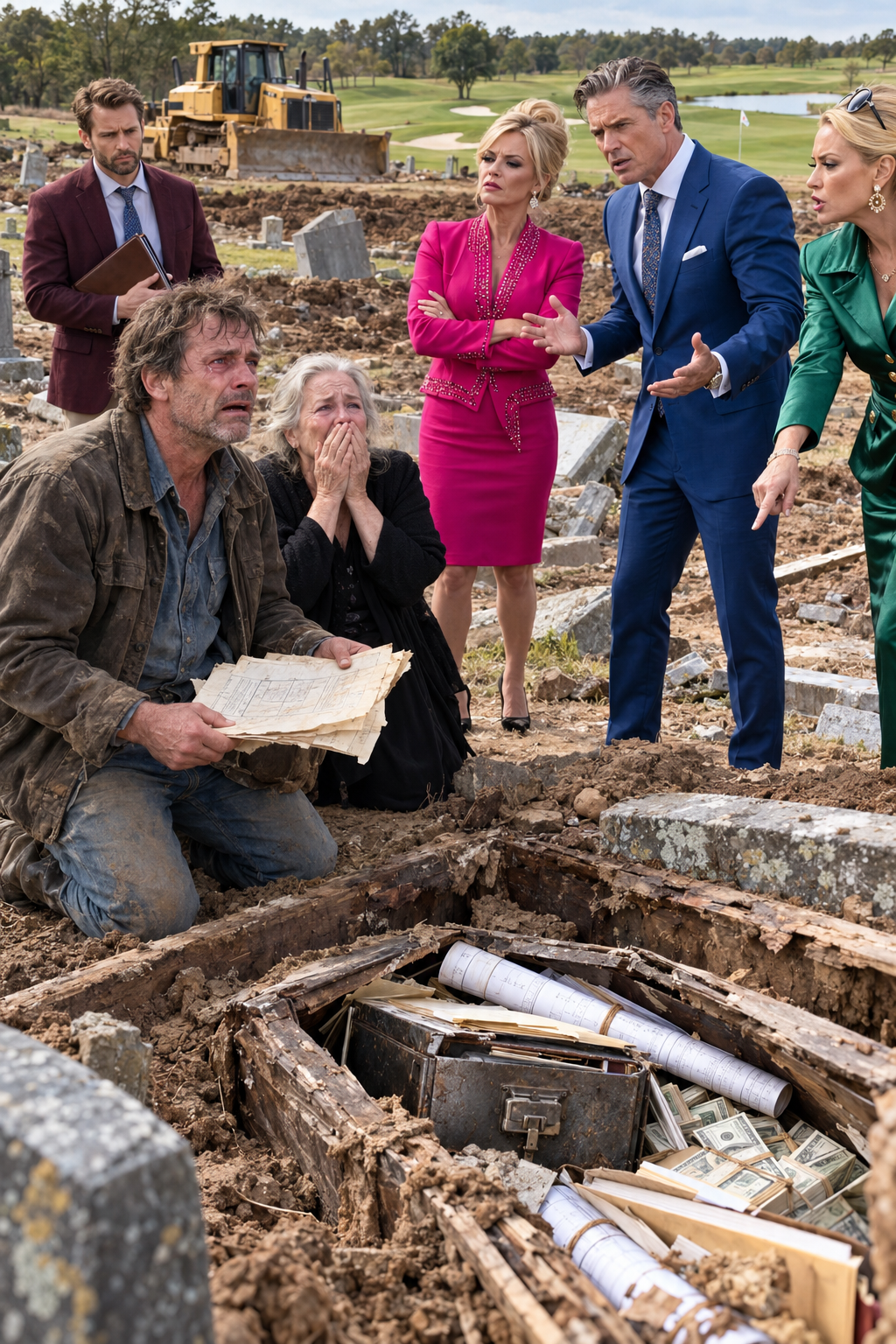
The HOA Bulldozed My Family Cemetery for a Luxury Golf Course—Then One Broken Grave Uncovered Their $30 Million Lie
The first thing I saw was my grandmother’s headstone upside down in the mud.
The second was a bulldozer parked where my little sister had been buried for twenty-seven years.
The third was Karen Whitfield standing beside it in a white golf visor, telling me I was trespassing.
I didn’t yell.
That seemed to disappoint her.
I stopped my truck at the edge of the torn field, killed the engine, and sat there for three seconds with both hands on the steering wheel.
Three seconds was all I allowed myself.
Then I reached for my phone.
Not to call the police.
I opened the camera.
The Mercer Family Cemetery had occupied the same rise of land outside Cedar Ridge, Missouri, since 1879.
It wasn’t large.
Maybe half an acre enclosed by an old black iron fence, shaded by two bur oaks and a crooked hickory tree my grandfather used to complain about every fall.
Twenty-three people were buried there.
A railroad mechanic.
Two babies who had lived less than a week.
And my sister Emily, who died when she was fourteen.
The cemetery sat on the southern edge of my 196-acre cattle property, separated from Cedar Ridge Estates by a narrow creek.
At least, it used to.
Now the iron fence had been crushed into the dirt.
The hickory tree was gone.
Half the hill had been scraped flat.
Orange construction stakes stretched toward the subdivision.
And where generations of my family had rested, men in fluorescent vests were measuring distances for what a polished sign near the road called:
Cedar Ridge Championship Golf Club.
The sign showed a computer rendering of a limestone clubhouse, emerald fairways, and a fountain shaped like a fan.
Underneath it were three words.
COMING SPRING 2027.
I zoomed in on the bulldozer.
Then the overturned stones.
Then the workers.
Then Karen.
She crossed the mud toward me in spotless white sneakers that already had brown spots around the soles.
Karen Whitfield was sixty-one, president of the Cedar Ridge Homeowners Association, and one of those people who dressed for every conversation as if a photographer might appear.
White visor.
Champagne-colored quilted vest.
Cream pants.
Gold watch.
Perfect silver-blonde bob.
Behind her stood HOA attorney Mitchell Crane in a navy suit, holding a leather portfolio against his chest.
Two sheriff’s deputies waited beside a black SUV near the construction trailer.
That interested me.
Prepared people interested me.
Karen stopped ten feet from my truck.
“You need to leave, Daniel.”
My name is Daniel Mercer.
I’m forty-five years old.
I manage agricultural properties, conduct boundary research for rural acquisitions, and spent eleven years working as a civil engineer before returning home when my father got sick.
If Karen had bulldozed almost anyone else’s family cemetery, she might have expected grief first and questions second.
She had made a serious mistake with me.
I stepped out.
My boots sank an inch into freshly churned Missouri clay.
“You moved the cemetery,” I said.
Karen folded her arms.
“The graves were legally relocated.”
“Last week.”
“A licensed contractor.”
“Which contractor?”
Her mouth tightened.
“Daniel, I’m not standing in a mud field arguing administrative details with you.”
I kept recording.
“Where are the remains?”
Mitchell stepped forward.
“Mr. Mercer, I recommend you stop filming and direct all questions through counsel.”
I looked at him.
“Where are the remains?”
“You have been served notice.”
“No, I was sent a certified letter stating the HOA intended to survey land adjacent to my southern boundary.”
Karen gave a small laugh.
“You refused delivery twice.”
“I was in Wyoming inspecting irrigation equipment.”
“That’s not our responsibility.”
I glanced past her toward the hillside.
“My family is.”
One of the excavators rotated slowly.
Its bucket was full of dark earth.
Something pale rolled inside it.
Every muscle in my body tightened.
I walked forward.
Karen moved in front of me.
“You cannot enter an active construction zone.”
“You are trespassing on HOA property.”
That sentence almost made me smile.
Instead, I looked straight into her phone, which she had apparently started recording too.
“Please say that again.”
She hesitated.
“Tell the camera I’m trespassing.”
“This property belongs to Cedar Ridge.”
“All of it?”
“The cemetery too?”
“Thank you.”
Mitchell turned sharply toward her.
Karen noticed.
For the first time, confidence slipped out of her face.
Just for a second.
Then she recovered.
“We acquired the parcel legally.”
I raised my phone toward the construction site.
“Then you won’t mind showing me the deed.”
“We don’t carry deeds around construction sites.”
I reached into my truck and pulled out a plastic map tube.
Karen actually rolled her eyes.
That reaction told me more than any answer could have.
I opened the tube and removed a laminated copy of the Mercer property survey.
Not the county GIS map.
Not the subdivision marketing plat.
The boundary survey recorded in 1988 when my grandfather transferred the farm into the Mercer Family Trust.
I unfolded it across my hood.
Karen refused to look.
Mitchell did.
That was the second useful thing that happened that morning.
His eyes landed on the southern boundary.
Then the cemetery reserve.
Then the surveyor’s seal.
His expression changed.
Only slightly.
But I saw it.
“You know what that is?” I asked.
He said nothing.
Karen leaned closer.
“It’s outdated.”
“The HOA has newer documents.”
“Then show them.”
“You’ll receive them through the appropriate legal process.”
I tapped the map.
“The cemetery is Parcel C. Zero point six three acres. Permanently reserved from conveyance. Separate legal description.”
Karen shrugged.
“That reservation was extinguished.”
“The trust.”
“You’re not the only trustee.”
“I’m the sole surviving trustee.”
Her silence lasted half a beat too long.
I looked at Mitchell.
Then at Karen.
Then at the bulldozer.
Something was wrong.
Not emotionally wrong.
Document wrong.
Procedure wrong.
Timeline wrong.
They had destroyed the fence before contacting me.
They had moved the stones before getting my signature.
They had brought deputies before I ever threatened anyone.
They had scheduled excavation before producing a deed.
They had started pouring money into a golf course before making sure they owned the ground beneath it.
They had done everything except the one thing people with good title do first.
They had refused to show me the paperwork.
That was when I stopped thinking like a grandson.
And started thinking like an engineer.
I folded the map.
Karen mistook the movement for surrender.
“I’m glad we can handle this rationally.”
“I need the name of the cemetery relocation company.”
Mitchell answered this time.
“That information will be provided.”
“The county permit number.”
“Provided.”
“State authorization.”
“Provided.”
“Archaeological review.”
He blinked.
Karen said, “This isn’t an archaeological site.”
I turned toward her.
“A cemetery established in 1879 containing burials more than a century old?”
“It’s a private family plot.”
I put the map back in its tube.
“Where did you move them?”
Karen inhaled through her nose.
“Memorial Rest.”
I knew Memorial Rest.
Everyone in Cedar Ridge did.
It was a commercial cemetery eleven miles east of town.
I called them while standing in front of her.
A receptionist answered.
“Memorial Rest Cemetery, this is Alicia.”
“Hi, Alicia. My name is Daniel Mercer. I’m trying to locate a group burial relocation from the Mercer Family Cemetery.”
Keyboard sounds.
“One moment.”
Karen stared at me.
Mitchell looked toward the deputies.
Alicia came back.
“I’m sorry, sir. I don’t show anything under Mercer.”
“Try Cedar Ridge HOA.”
More typing.
“Whitfield.”
“Crane Development.”
Karen stepped closer.
“End the call.”
I held up one finger.
Alicia spoke again.
“Sir, are you looking for a funeral service?”
“No. Twenty-three graves were supposedly transferred to your cemetery last week.”
The line went quiet.
Then Alicia said something that changed the temperature of the morning.
“We haven’t accepted any transferred remains this month.”
I looked at Karen.
“Thank you.”
I ended the call.
Karen’s face had gone still.
Mitchell spoke quickly.
“There are several Memorial facilities in the state.”
“You said Memorial Rest.”
“Perhaps Mrs. Whitfield misspoke.”
Karen turned on him.
“I did not.”
Interesting.
I walked toward the deputies.
The older one put out a hand.
“Mr. Mercer, hold up.”
His nameplate said DANIELS.
“Deputy, I’m reporting possible desecration of a cemetery.”
Karen called from behind me.
“This is a civil dispute.”
Deputy Daniels didn’t look at her.
“Do you have documentation showing this cemetery belongs to your family?”
I handed him the laminated survey.
He studied it.
The younger deputy came over.
“What are we looking at?”
“Separate reserved tract,” Daniels said.
He traced the boundary with one finger.
I said, “They claim the bodies were moved to Memorial Rest. Memorial Rest says they received no transferred remains this month.”
The younger deputy stopped chewing gum.
Daniels raised his eyes toward the excavation.
“Mrs. Whitfield?”
Karen started walking toward us.
“This matter has been reviewed by our attorneys.”
“That wasn’t my question.”
Mitchell stepped between them.
“Deputy, the HOA holds recorded title.”
“Do you have the deed?”
“Not physically.”
Daniels stared at him.
“You brought me out here to keep him off property, but nobody brought the deed?”
Nobody answered.
I almost admired the silence.
People reveal themselves fastest when the easy lie suddenly becomes inconvenient.
Daniels handed my survey back.
“Stop excavation.”
Karen’s head snapped around.
“Excuse me?”
“Until we figure out whether there are remains still here.”
“You don’t have authority to shut down a permitted construction project.”
“I have authority to preserve a possible scene involving human remains.”
“This is absurd.”
Then someone shouted.
Not from our group.
From the hill.
Every head turned.
A laborer in a yellow vest was waving both arms beside the excavator.
The machine operator had climbed out of the cab.
For several seconds, nobody moved.
Then the laborer yelled again.
Deputy Daniels started running.
I went after him.
Karen shouted my name.
I ignored her.
We crossed churned ground toward what had once been the western row of the cemetery.
That row held the oldest graves.
Isaac Mercer.
Louisa Mercer.
Thomas Mercer.
Beatrice Mercer.
And Abigail Mercer, who died in 1908.
The excavator bucket had opened a trench six feet deep.
At the bottom was a broken concrete burial vault.
One side had cracked away.
Inside, through wet soil and fragments of old wood, I could see bone.
The younger deputy swore.
Daniels ordered everyone back.
I stopped at the edge of the trench.
My heartbeat sounded strangely calm in my ears.
Karen arrived behind us, breathing hard.
“This is exactly why civilians shouldn’t be wandering through construction zones.”
Daniels turned.
“Everyone stops work. Now.”
“It’s an old grave. We knew there were graves.”
“You told us they were relocated.”
Karen opened her mouth.
Nothing came out.
The worker who had shouted pointed toward the broken vault.
“There’s something else.”
Daniels looked down.
“Metal box.”
For the first time that morning, I forgot to breathe.
Half embedded beneath the collapsed side of the vault was a narrow copper-colored container.
Not a coffin fitting.
Not construction debris.
About eighteen inches long.
Sealed at both ends.
I knew exactly what it was.
My grandfather used one just like it.
He called them survey cans.
Before digital records, surveyors sometimes sealed field notes, monument references, or copies of plats inside weatherproof metal containers.
Most were buried near section corners or major boundary monuments.
This one had been hidden beneath a grave.
Daniels climbed down carefully.
He put on gloves.
The construction workers backed away.
Karen did not.
She stepped closer.
“Whatever that is belongs to Cedar Ridge if it was found on Cedar Ridge property.”
I turned toward her.
“You really want that sentence on my recording too?”
She looked at my phone.
Her eyes sharpened.
“Turn that off.”
Mitchell finally lost some of his professional calm.
“Daniel, filming human remains may violate—”
“I’m filming you.”
He stopped.
Daniels lifted the metal tube from the earth.
Mud covered most of it.
But one line had been scratched into the copper by hand.
E.M. — 1988.
My grandfather.
Edward Mercer.
I stepped closer.
“That belonged to him.”
“How do you know?”
“Initials. And he was the one who commissioned the 1988 survey.”
Karen shook her head.
“This proves nothing.”
I looked at her.
“I haven’t opened it.”
Her jaw tightened.
Neither of us said anything.
But that moment stayed with me.
Because innocent people are usually curious about sealed boxes found under hundred-year-old graves.
Karen looked afraid of it.
Daniels placed the tube inside an evidence bag.
Then he called his supervisor.
The construction site remained frozen for the rest of the morning.
By noon, three sheriff’s vehicles were parked near the hill.
At 12:40, the county medical examiner arrived.
At , a representative from the Missouri State Historic Preservation Office called the sheriff.
At , the county prosecutor’s office sent an investigator.
At , Cedar Ridge’s contractor locked the excavator and told its crews to go home.
Karen stood near the construction trailer making phone call after phone call.
I sat on the tailgate of my truck.
I never approached her.
I didn’t need to.
At , she approached me.
“You’ve made your point.”
“What do you want?”
“My family put back.”
She looked toward the hill.
“That’s impossible.”
“Then we’re going to have a difficult conversation.”
“You’re not getting the golf project canceled.”
“I never said anything about the golf project.”
Her eyes narrowed.
There it was.
Not over the cemetery.
Over the project.
Cedar Ridge Championship Golf Club had been Karen’s obsession for three years.
The subdivision had been built in phases beginning in the late 1990s.
Nice homes.
Artificial lakes.
Stone entrance pillars.
About three hundred properties now.
But Cedar Ridge had one problem.
It was aging.
New developments twelve miles north had pools, pickleball courts, walking trails, clubhouses, restaurants.
Cedar Ridge had a thirty-year-old community center and two tennis courts nobody used.
Home values had flattened.
Then Karen became HOA president.
She promised transformation.
A private eighteen-hole golf course.
Luxury clubhouse.
Restaurant.
Wedding venue.
Fitness center.
The marketing package claimed it would add sixty to ninety thousand dollars to the value of each home.
At first, I thought it was ridiculous.
Then land started changing hands.
The HOA bought three adjoining parcels.
A development company acquired another.
Trees disappeared.
Survey crews arrived.
Last winter, Karen announced that construction financing had been secured.
Thirty million dollars.
That number had been repeated everywhere.
HOA newsletters.
County meetings.
Local newspaper.
Business association luncheon.
Thirty million dollars in private financing and community improvement bonds.
I hadn’t cared.
The project was supposed to stop at the creek.
My cemetery sat west of it.
Or so I believed.
Karen crossed her arms.
“The golf course employs people.”
“It doesn’t exist.”
“You think you can destroy three years of work because of an obsolete family burial plot?”
That was the first genuinely cruel thing she said.
But cruelty is useful when recorded clearly.
I held up my phone.
“Obsolete?”
Her face changed.
She had forgotten I was still filming.
“Don’t twist my words.”
“I didn’t say them.”
She walked away.
I sent the video to my attorney before leaving the property.
Her name was Sarah Bell.
Forty-eight years old.
Former county prosecutor.
Current civil litigator.
No patience for drama.
Exactly the kind of lawyer I wanted.
She called me nine minutes later.
“Tell me you didn’t touch the tube.”
“I didn’t.”
“Tell me nobody opened it.”
“Not while I was there.”
“What do you know?”
“Nothing yet.”
“You sound like you know something.”
“I know people don’t hide survey containers under graves because they’re bored.”
That evening, Sarah met me at my farmhouse.
She brought pizza, two yellow legal pads, and a portable scanner.
We spread every property record I owned across my dining table.
The original Mercer tract was much larger than my current farm.
My great-great-grandfather Isaac had accumulated nearly seven hundred acres.
Over generations, parcels were divided.
Some inherited.
Some lost during the Depression.
By 1988, my grandfather Edward owned 196 acres plus the cemetery reserve.
When Cedar Ridge was developed, the eastern adjoining acreage came from the Crawford family.
At least, according to every public map.
Sarah pulled up county records on her laptop.
She rotated the screen.
A deed recorded fourteen months earlier showed something I had never seen.
Grantor: Mercer Family Trust.
Grantee: Cedar Ridge Community Holdings LLC.
Parcel size: 18.7 acres.
Consideration: $480,000.
The legal description crossed the creek.
It included the cemetery.
I stared at the screen.
“That deed is fake.”
Sarah didn’t react.
“I didn’t sign it.”
“You’re not the signatory.”
She enlarged the document.
The signature line read:
MARGARET E. MERCER, TRUSTEE.
I stopped moving.
Sarah looked at me.
“Who is Margaret Mercer?”
“My mother.”
“Another trustee?”
“Could she ever have been?”
“My mother died in 2016.”
The deed was notarized in 2025.
Sarah leaned back.
For the first time since she arrived, she looked genuinely surprised.
I stared at my dead mother’s signature.
It wasn’t even a good forgery.
My mother wrote capital Ms with deep center strokes and always looped the final r in Mercer.
This signature looked like someone had practiced from a birthday card.
Sarah took a screenshot.
“Who notarized it?”
We scrolled.
Linda Carver.
Notary public.
Commission number listed.
Sarah searched the state database.
Her face hardened.
“No active commission.”
She turned the computer toward me.
Linda Carver had been a notary.
Her commission expired in 2019.
She died in 2021.
My dead mother had sold eighteen acres to the HOA four years after a dead notary verified her signature.
Neither Sarah nor I spoke for a moment.
Then she whispered:
“Daniel, this isn’t a boundary dispute.”
“This is fraud.”
I stared at the deed again.
“Bad fraud.”
She nodded.
“Which scares me more.”
“Because people forging property transfers normally try harder.”
That was exactly what bothered me too.
This wasn’t some amateur slipping a fake deed into a filing cabinet.
The document had been accepted by the recorder.
Referenced by a title company.
Used in planning applications.
Used to obtain construction permits.
Apparently used in financing.
Too many professionals had touched it.
A forged signature that obvious survived because nobody expected anyone to challenge it.
Or because someone made sure no one would.
Sarah opened another record.
Mortgage filing.
Then another.
Development agreement.
Then a financing statement.
By 11:30 that night, we had a whiteboard full of company names.
Cedar Ridge HOA.
Cedar Ridge Community Holdings LLC.
Crane Development Partners.
Whitfield Community Management.
Heartland Recreation Finance.
And a special improvement district approved by the county.
Thirty million dollars didn’t come from one lender.
Twelve million came from a regional bank construction facility.
Another eight million came from private investors.
Ten million came through tax-exempt community improvement bonds.
All secured, directly or indirectly, by land rights associated with the golf development.
Including my land.
I pointed at the screen.
“If their deed collapses…”
Sarah finished the sentence.
“The collateral package may collapse with it.”
“And the permits.”
“Potentially.”
“And the bonds?”
“Depends on what representations were made.”
I looked toward the dark window over my sink.
“So the cemetery wasn’t bulldozed because Karen hated my family.”
“Probably not.”
“They needed possession.”
Sarah nodded slowly.
“They may have needed a clean site before anyone looked closely at why your cemetery was sitting inside their supposedly acquired property.”
That was our first real theory.
And it explained the speed.
They weren’t relocating graves.
They were erasing evidence that the parcel had never been conveyed.
Sarah left after midnight.
At the next morning, my phone rang.
Deputy Daniels.
“We opened the tube.”
“What was inside?”
“Documents.”
“What kind?”
“Survey notes. A recorded plat copy. Couple photographs.”
He exhaled.
“There’s a letter addressed to you.”
My feet touched the floor.
“Daniel Mercer. By name.”
My grandfather died in 2004.
I had been twenty-three then.
“What does it say?”
“I haven’t read it.”
“When can I?”
“Sheriff wants you here at eight.”
I arrived at .
Sarah was already in the parking lot.
Of course she was.
Inside the sheriff’s office, Daniels led us to a conference room.
Sheriff Robert Hale sat at the table with county prosecutor Elaine Foster and a man I didn’t recognize.
The man introduced himself as Martin Reyes, fraud investigator for the state auditor’s office.
That got my attention.
On the table were clear evidence sleeves.
The copper tube.
A folded survey.
Three Polaroid photographs.
A sealed envelope.
My name was written across it in my grandfather’s blocky handwriting.
My throat tightened.
Sarah noticed.
She touched my elbow once.
That was all.
Sheriff Hale said, “The contents were dry.”
“Can I open it?”
Prosecutor Foster slid the evidence sleeve forward.
“We photographed everything.”
I removed the envelope.
For twenty-two years, I had forgotten what my grandfather’s handwriting did to me.
He wrote like he built fences.
Inside were two pages.
The first began:
If you are reading this, someone has disturbed Abigail’s grave or the boundary around it.
Sheriff Hale watched me carefully.
I kept reading.
My grandfather explained that in 1988, he had discovered repeated discrepancies between old Mercer deeds and county parcel maps.
At first, he blamed sloppy surveying.
Then he found something stranger.
Several acres along the eastern line had been described differently in newer records than in the deeds dating back to 1912.
Not dramatically.
Thirty feet here.
Seventy feet there.
Small errors.
But always in one direction.
Always away from Mercer land.
He hired an independent surveyor from Kansas City.
That surveyor found original iron monuments still in place.
One monument sat beneath Abigail Mercer’s grave enclosure.
My grandfather had apparently known it existed.
The cemetery had been established around an older boundary marker.
That marker fixed the original section line.
And according to my grandfather’s letter, the line was not where Cedar Ridge claimed it was.
It was 412 feet farther east.
Sarah leaned over my shoulder.
Her lips parted.
Four hundred twelve feet.
Across nearly a mile of boundary.
That wasn’t eighteen acres.
That was more than fifty.
I continued.
My grandfather had confronted a county planning consultant in 1989.
The consultant told him the map discrepancy would be corrected.
It never was.
Then my grandfather wrote the sentence that made everyone at the table go quiet.
The consultant’s name was Harold Whitfield.
Karen’s father.
I lowered the page.
Nobody spoke.
Martin Reyes finally asked, “Was that name familiar to you?”
“Relation to Mrs. Karen Whitfield?”
“Her father.”
Sarah whispered, “Jesus.”
I finished the letter.
My grandfather hadn’t accused Harold of stealing land.
Not directly.
He wrote that Harold became hostile when challenged.
Then offered to buy the entire eastern strip.
My grandfather refused.
Months later, survey monuments began disappearing.
So he placed certified copies of the old plat and independent survey beneath Abigail’s grave, where he believed nobody would disturb them.
The last paragraph was underlined.
Daniel, land can be stolen on paper long before anyone puts a fence on it. Never trust a map because a government office printed it. Find the monuments.
I read that line twice.
Then I looked at the evidence photographs.
One showed my grandfather standing beside Abigail’s stone in 1988.
Another showed a rusted iron pin beside a measuring rod.
The third showed a concrete monument marked with survey coordinates.
Reyes reached for the certified plat.
“We verified the surveyor’s seal this morning. Firm still exists.”
Sarah looked at him.
“You did that before Daniel arrived?”
“We’ve been looking at Cedar Ridge for another reason.”
The room changed.
There it was.
A door opening behind the door we had already opened.
“What reason?” I asked.
Reyes glanced at Prosecutor Foster.
She nodded.
He opened a file.
“Financial irregularities involving the golf development.”
“How long?”
“About six weeks.”
“Does Karen know?”
“We don’t believe so.”
Sarah leaned forward.
“What irregularities?”
Reyes chose his words carefully.
“The project budget is thirty million dollars.”
“We have been unable to account for approximately eleven point eight million in projected expenditures.”
“Projected?”
“Contract invoices.”
“Multiple vendors.”
“Real vendors?”
His expression answered before he did.
“Some appear questionable.”
Sarah sat back.
“So they may have borrowed thirty million against land they didn’t own, then routed part of the construction money through fake vendors.”
Reyes held up a hand.
“That is not yet an official conclusion.”
“It’s a pretty good sentence though.”
He didn’t disagree.
For the next two hours, the cemetery became a crime scene.
Not formally at first.
But effectively.
The county issued an emergency stop-work order.
The state ordered preservation of every burial location.
The sheriff secured the hill.
By noon, a forensic archaeology team was requested.
By afternoon, local media showed up.
Karen gave an interview from the sidewalk outside the HOA office.
She wore emerald green.
Of course she did.
I watched it on Sarah’s phone.
“This appears to be an unfortunate paperwork misunderstanding being exploited by one disgruntled neighboring landowner.”
Sarah paused the video.
“Disgruntled.”
“She likes adjectives.”
“She just accused you of exploiting your dead family on camera.”
“You’re very calm.”
“I’m saving angry for when it becomes useful.”
She looked at me for a second.
Then smiled.
“Your grandfather would probably like you.”
That evening, Cedar Ridge residents began calling me.
At first, they wanted information.
Then they wanted reassurance.
Then they wanted someone to blame.
One man named Peter Caldwell told me he had paid a $14,000 special assessment toward the golf project.
A widow named Marlene Keene had paid $9,800.
A retired teacher had taken money from her IRA.
Several owners told me Karen had warned that people who refused the assessments could face liens.
That changed my view of the project.
This wasn’t just developers and lenders risking money.
Ordinary homeowners were trapped inside it.
The next morning, an envelope appeared beneath my front gate.
No return address.
Inside was a photocopy of a spreadsheet.
At the top:
CEDAR RIDGE GOLF — LAND ACQUISITION.
Most entries were boring.
Parcel numbers.
Closing dates.
Then I found mine.
MERCER EAST TRACT.
Acquisition cost: $480,000.
Actual owner payment: $0.
Consulting allocation: $480,000.
Recipient code: WCM-3.
Sarah came over twenty minutes later.
She read the page twice.
“Where did this come from?”
“Anybody see who delivered it?”
“My gate camera.”
We checked.
At a.m., a hooded person parked beyond camera range, walked to the gate, dropped the envelope, and left.
Sarah pointed at the recipient code.
“Whitfield Community Management.”
“That’s what I’m thinking.”
“So the project’s own ledger says they spent $480,000 buying my property.”
“You received nothing.”
“And the deed says your dead mother sold it.”
Sarah sat very still.
“They didn’t forge the deed just to get your land.”
“They may have used the fake purchase to move $480,000.”
My land wasn’t merely stolen.
It may have been used as an invoice.
By Friday, the story was everywhere locally.
HOA BULLDOZES HISTORIC FAMILY CEMETERY.
GOLF COURSE DEVELOPMENT HALTED.
FORGED DEED QUESTIONED.
Karen stopped giving interviews.
Mitchell Crane stopped answering calls.
Then the HOA board scheduled an emergency meeting.
Cedar Ridge residents packed the community center.
Sarah advised me not to attend.
So naturally, I attended.
I stood in the back.
Four hundred folding chairs had been crammed into a room designed for two hundred fifty people.
Residents lined the walls.
Some shouted before the meeting even started.
Karen sat behind a long table with the six other board members.
Mitchell was beside her.
She struck the gavel three times.
Nobody stopped talking.
She hit it again.
“I said order.”
A man near the front shouted, “Where’s our money?”
Applause erupted.
Karen waited.
Her eyes found me at the back.
For just one second, the entire room seemed to disappear.
Then she looked away.
“We are aware of the allegations being circulated by Mr. Mercer.”
“Your bulldozer found his dead relatives!” someone yelled.
More shouting.
Karen raised her voice.
“The board relied on licensed professionals and recorded title documentation.”
Sarah whispered beside me, “There’s the defense.”
“Blame counsel, title, engineers, everyone except herself.”
Mitchell leaned into his microphone.
“No determination of fraud has been made.”
I raised my hand.
Karen ignored me.
I kept it raised.
People noticed.
The room quieted almost by accident.
Karen’s face tightened.
Finally she said, “Mr. Mercer is not an association member.”
A woman near the front shouted, “He owns the cemetery you bulldozed!”
Someone laughed.
Karen gripped the gavel.
I spoke without raising my voice.
“Who authorized the acquisition payment for my property?”
Karen stared at me.
“What payment?”
“Four hundred eighty thousand dollars.”
Mitchell moved toward his microphone.
I continued.
“Your accounting records show Cedar Ridge paid $480,000 to acquire eighteen point seven acres from the Mercer Family Trust.”
The room became completely quiet.
Karen’s eyes flicked toward Mitchell.
He looked back at her.
Board member Thomas Reed leaned over.
“What accounting records?”
That was useful.
He didn’t know either.
I held up the photocopy.
“Who received the money?”
Karen said, “I have no idea what document you’re holding.”
“So you didn’t approve $480,000?”
“Not personally.”
“Did the board?”
Board members started looking at one another.
Sarah whispered, “Keep going.”
I didn’t need encouragement.
“The deed says my mother received the money.”
Nobody moved.
“My mother died nine years before the deed was signed.”
A gasp moved through the room.
“The notary who supposedly witnessed her signature died four years before she did.”
People started shouting again.
Karen stood.
“This meeting is adjourned.”
The crowd exploded.
She hit the gavel.
Sarah grabbed my arm.
“Don’t move.”
Two men in plain clothes had entered through the side door.
They walked directly toward the board table.
One showed identification to Mitchell.
His face drained.
The second man spoke quietly to Karen.
I couldn’t hear him.
But I watched her expression.
First irritation.
Then confusion.
They weren’t arresting anyone.
They were serving something.
Karen looked down at the papers.
The room slowly noticed.
A woman near me whispered, “What is that?”
Sarah already knew.
“Subpoena.”
She was right.
The state auditor and attorney general’s financial crimes section had subpoenaed the golf project’s accounting records.
The meeting ended in chaos.
Karen left through a side door.
Mitchell followed.
I went home.
At 11:06 p.m., my security alarm went off.
Not the house.
I grabbed my phone and opened the cameras.
A man in dark clothing was inside.
He wasn’t stealing tools.
He walked directly past my tractor.
Past the welder.
Past two cabinets full of equipment.
Straight toward the locked file room where I stored my grandfather’s property records.
I called the sheriff.
Then I turned on every exterior light remotely.
The man froze.
His head snapped toward the camera.
For less than a second, I saw his face.
Then he ran.
He reached a black pickup parked beyond the barn.
By the time deputies arrived, he was gone.
But he had made one mistake.
He left the file-room door half-open.
The lock had been drilled.
Nothing obvious was missing.
The next morning, Daniels reviewed the footage.
“Recognize him?”
She stared at the paused frame.
“I think that’s Evan Crane.”
“Mitchell’s son?”
“His nephew.”
Evan Crane worked for Crane Development Partners.
The golf course contractor.
Daniels looked at me.
“You sure?”
Sarah said, “I’ve seen him at planning hearings.”
We zoomed in.
Clear enough for suspicion.
Not clear enough for certainty.
Then I noticed something in his hand.
A folded paper.
“He took something.”
Daniels searched the file room with me.
Nothing jumped out.
I kept old surveys, trust papers, tax receipts, engineering drawings, and boxes of family records.
It took three hours before I realized what was missing.
A red folder.
My grandfather’s 1991 correspondence with Cedar Ridge’s original developer.
I hadn’t opened it in years.
I couldn’t even remember what was inside.
That scared me more than if they had stolen money.
Because whoever entered my barn knew exactly what he wanted.
That afternoon, Sarah filed an emergency civil action.
Fraudulent conveyance.
Destruction of cemetery property.
Quiet title.
Injunction.
Preservation of financial records.
We asked the court to freeze transfers involving the disputed tract.
The hearing was scheduled for Monday morning.
Karen arrived with three lawyers.
I arrived with Sarah.
Judge Ellen Caldwell entered at nine.
By , she had seen the fake deed.
At , she saw my mother’s death certificate.
At , she saw the supposed notary’s obituary.
At , Karen’s lawyers stopped arguing that the deed was valid.
They shifted.
They claimed Cedar Ridge Community Holdings had relied on a third-party title package and acted in good faith.
Judge Caldwell looked over her glasses.
“Counsel, your client demolished a cemetery located on property conveyed by a woman who had been dead nine years.”
Mitchell’s outside attorney cleared his throat.
“We acknowledge serious defects in the chain of title.”
“That is an interesting phrase for dead people signing real estate contracts.”
Nobody laughed.
The judge issued the injunction.
No construction.
No transfer.
No new borrowing secured by the disputed parcel.
All cemetery work would be supervised by the state.
Then Sarah stood.
“One additional matter, Your Honor.”
She handed over my grandfather’s 1988 survey.
“If the original monument can be located, we believe the disputed acreage may be substantially larger.”
Karen turned toward Mitchell.
The judge studied the map.
“How much larger?”
Sarah looked at me.
I answered.
“Potentially fifty-one acres.”
The courtroom murmured.
Judge Caldwell ordered a court-supervised boundary survey.
Karen left without looking at me.
Three days later, surveyors found the iron pin.
Exactly where my grandfather said it would be.
Beneath Abigail Mercer’s grave enclosure.
After 138 years underground, the iron was rusted almost black.
But it was there.
Coordinates matched.
Witness ties matched.
Historic field notes matched.
The county’s modern parcel line was wrong.
Four hundred twelve feet wrong.
The result cut directly through the planned golf course.
Through two fairways.
The clubhouse parking area.
The maintenance facility.
And part of the artificial lake they had already excavated.
Sarah stood beside me while the survey crew drove temporary stakes along the corrected line.
Orange flags marched across the torn landscape.
One after another.
Each little strip of plastic felt like a verdict.
A golf-course superintendent watched from a utility cart.
Finally he muttered, “You own all that?”
“Looks that way.”
He shook his head.
“They’ve already spent millions.”
“You gonna make them tear it all out?”
“I haven’t decided.”
He looked at me strangely.
“You’re calmer than I’d be.”
That was because anger had stopped being useful.
Information was more valuable now.
And information kept arriving.
The state archaeologists recovered all twenty-three burial locations.
Some had been disturbed.
Most had not actually been relocated at all.
The contractors had removed headstones, dismantled fencing, and begun excavation while the remains stayed in place.
Their “relocation plan” existed mainly on paper.
Another lie.
Then investigators traced the $480,000 acquisition payment.
It had never gone to my mother.
The money moved from the golf development account into a consulting company.
That company sent $310,000 to Whitfield Community Management.
The remaining $170,000 moved through another vendor connected to Crane Development.
Karen’s attorney claimed she knew nothing about the transactions.
Mitchell Crane resigned as HOA counsel.
Then he disappeared from public view.
Homeowners demanded a recall vote.
Karen fought it.
For four days.
Then eighty-eight owners signed a petition.
By the end of the week, enough signatures existed to remove the entire board.
I thought that might be the end of Karen.
On Thursday evening, she came to my farm.
No immaculate SUV.
She drove an older gray Lexus and parked outside my gate.
I watched her through the camera for a minute before walking down.
She looked ten years older.
“We need to talk.”
“My attorney prefers written communication.”
“This can’t be written.”
“Then it probably shouldn’t be said.”
She stared at me through the gate.
“You think I did this.”
“I think my mother signed a deed nine years after she died.”
“That wasn’t me.”
“I think $310,000 from the supposed purchase of my property went to your company.”
“That’s not what you think it is.”
“Then explain.”
She looked back toward the road.
“Can I come inside?”
Her mouth twisted bitterly.
“You think I’m going to hurt you?”
“I think you bulldozed my family cemetery.”
She flinched.
Some sentences deserve weight.
Karen lowered her voice.
“The cemetery was supposed to be empty.”
I didn’t move.
Her eyes filled with instant regret.
She had said too much.
I stepped closer to the gate.
“Empty how?”
“I was told relocation was complete.”
She shook her head.
“You don’t understand what’s happening.”
“Then help me.”
Her fingers tightened around the leather strap of her purse.
“The golf course wasn’t my project.”
I almost laughed.
“You’ve spent three years telling everyone it was.”
“I was the face of it.”
“Because I believed it would save Cedar Ridge.”
“That’s not an answer.”
“It’s the only answer I can give.”
She looked behind her again.
This time I followed her eyes.
Empty road.
“Who forged the deed?”
“I don’t know.”
“Who authorized the fake acquisition payment?”
“I don’t know.”
“Who ordered the cemetery destroyed?”
Her eyes met mine.
“That order didn’t come from the HOA board.”
That got my attention.
“Then who?”
She stepped closer.
“Your grandfather wasn’t the first person who found the boundary problem.”
I said nothing.
“My father found it too.”
“That’s in the letter.”
Her face changed.
“You found Edward’s letter?”
For several seconds, she looked almost sick.
“What else was in the container?”
“What else?”
“Survey records.”
“Anything from 1991?”
There it was.
The year from the stolen red folder.
I watched her carefully.
“What happened in 1991?”
She whispered something.
I couldn’t hear.
“My father tried to stop them.”
I stared at her.
That did not fit the story in my head.
Harold Whitfield was supposed to be the beginning of the fraud.
Karen’s father.
County consultant.
The man my grandfather suspected.
Karen reached into her purse.
She pulled out a photograph.
She slid it through the bars.
Three men stood beside a survey truck.
One was Harold Whitfield.
One was my grandfather.
The third man I didn’t recognize.
On the back, written in pencil:
Edward, Harold, Charles — March 1991.
“They were working together?” I asked.
“For a while.”
“Against whom?”
Karen’s eyes moved toward the house.
Then toward the road.
“Harold discovered land transfers going back decades. Parcels moved through estates that didn’t own them. Boundary adjustments. fake easements. Quiet-title judgments mailed to dead addresses.”
“Cedar Ridge?”
“Before Cedar Ridge existed.”
“Who was Charles?”
She swallowed.
“Charles Crane.”
Mitchell’s father.
The pieces shifted.
Not enough to form a picture.
Enough to make the old picture impossible.
“Why did your father keep working with him?”
“He didn’t.”
“Then why did he tell my grandfather the map would be corrected?”
“I don’t know everything.”
“You seem to know more than you told anyone.”
Her eyes hardened.
“You think people stay quiet for thirty years because they’re greedy?”
“Sometimes.”
“Sometimes they stay quiet because they watched what happened to the person who talked.”
A pickup appeared at the far end of the road.
Karen stepped back immediately.
Too quickly.
The truck continued past without slowing.
She exhaled.
“Who are you afraid of?”
She looked at me.
“Find the red folder.”
My stomach tightened.
“What red folder?”
Her expression told me my answer had failed.
“You had it.”
“How do you know?”
“Because Edward gave my father a copy.”
“The copy was stolen from my barn.”
Karen closed her eyes.
“Last week.”
“Then they know.”
“Know what?”
She grabbed the gate with both hands.
“Daniel, listen to me. The cemetery wasn’t destroyed because it was blocking a golf hole.”
“No. You don’t.”
Her voice shook for the first time.
“It was destroyed because someone knew Edward had buried evidence there.”
I stared at her.
The copper tube.
The sudden construction.
The fake relocation.
The rush to scrape the ground flat.
“I can’t tell you.”
“You came here.”
“I came here because I saw the survey stakes this morning.”
“You found the original line.”
“And once that line becomes legally accepted, somebody can reopen every transfer connected to it.”
“How many?”
She didn’t answer.
“How many, Karen?”
“Hundreds.”
The word barely left her mouth.
Cedar Ridge had roughly three hundred homes.
I looked toward the subdivision beyond my pasture.
Roof after roof.
Street after street.
People who thought they owned their land.
My voice came out quieter.
“Are you telling me Cedar Ridge itself is built on stolen property?”
Karen’s face went pale.
“I’m telling you the golf course is thirty million dollars.”
She stepped backward.
“But the land scheme underneath Cedar Ridge is worth much more.”
“How much?”
“I don’t know.”
“Fifty million?”
She shook her head.
“One hundred?”
She said nothing.
That was answer enough.
Then she looked at the photograph still in my hand.
“Find out what happened to Charles Crane in 1992.”
She turned toward her car.
She stopped.
“What happened in 1992?”
Without looking back, she said:
“He disappeared.”
Then she drove away.
Sarah searched from my kitchen table that night.
Charles Crane had indeed disappeared in November 1992.
Forty-six years old.
Real estate attorney.
Last seen leaving his office in Cedar Ridge.
His car was found two days later near Lake Stockton.
No resolution.
Mitchell Crane would have been twenty-one.
His son wasn’t the man in my barn.
His nephew Evan had been born years later.
But the Crane family had remained deeply involved in local development.
I stared at Charles Crane’s newspaper photograph.
Same eyes as Mitchell.
Same narrow mouth.
Sarah leaned toward her laptop.
“I found something.”
She had searched court records tied to Charles.
One lawsuit appeared repeatedly in archived indexes.
Mercer v. Crane Land Services.
Filed April 1992.
Plaintiff: Edward Mercer.
My grandfather.
The case had been dismissed.
But no scanned complaint existed online.
“Can we get it?”
“Courthouse archive.”
“Tomorrow.”
At the next morning, we were in the county records basement.
A clerk brought us three boxes.
Old cases smelled like dust, glue, and damp cardboard.
It took forty minutes to find the file.
Inside was my grandfather’s complaint.
He alleged fraudulent alteration of boundary records.
Unlawful conveyance.
Civil conspiracy.
Defendant: Crane Land Services.
Then I turned the page.
Additional defendant:
Heartland Land & Trust.
That name stopped Sarah.
She took out her phone.
Heartland Land & Trust no longer existed.
But a successor company did.
Heartland Recreation Finance.
One of the principal lenders behind the golf course.
The same institution helping finance the modern project.
Sarah stared at me.
“This didn’t start with Karen.”
“It didn’t start with Mitchell.”
“And they used the same financial network thirty-four years later.”
The clerk brought another folder.
A motion to dismiss.
Then correspondence.
Then a photocopied deposition notice.
The last document in the file was dated November 6, 1992.
Four days before Charles Crane disappeared.
My grandfather had scheduled him for deposition.
Subject matter:
Unauthorized land transfers, concealed beneficial ownership, and off-book payment accounts.
Sarah slowly sat down.
“Your grandfather was about to question him.”
I flipped to the next page.
The case was voluntarily dismissed six weeks later.
Signed by Edward Mercer.
Except the signature wasn’t my grandfather’s.
I knew his handwriting.
I had just read his letter.
Sarah compared them.
“Another forgery.”
A chill moved up my back.
My grandfather hadn’t dropped the case.
Somebody had made it disappear.
Just like the deed.
Just like my mother’s signature.
Just like the cemetery.
We scanned everything.
At 10:17, Sarah’s phone rang.
She answered.
Her expression changed.
Another pause.
“We’re coming.”
She ended the call.
“What happened?”
“Survey crew found another container.”
My pulse jumped.
“Another tube?”
She looked directly at me.
We drove back to the cemetery.
State archaeologists had opened a section near the old eastern fence where ground-penetrating radar showed an anomaly beneath a collapsed stone foundation.
The object was a small steel document safe.
Probably forty years old.
Buried nearly four feet down.
Nobody opened it at the site.
Sheriff Hale took custody.
Karen was nowhere around.
Neither was Mitchell.
At the sheriff’s office, the lock was cut under camera.
Inside were four plastic-wrapped ledger books.
A stack of deeds.
Microcassette tapes.
And a black notebook.
The first ledger began in 1978.
Parcel numbers.
County offices.
Some names were dead.
Some retired.
Some I recognized immediately.
One name appeared again and again.
Martin Reyes arrived less than thirty minutes later.
He flipped through the ledger wearing gloves.
His face lost all color.
“What?” I asked.
He didn’t answer.
He pointed to a column.
Ten thousand.
Twenty-five thousand.
Forty thousand.
Beside them were county parcel numbers.
Sarah leaned closer.
“What are these?”
Reyes turned several pages.
“Payoffs, maybe.”
“Or purchase adjustments,” Sheriff Hale said.
Reyes looked at him.
“These codes appear in a current investigation.”
Nobody moved.
“Current how?”
He looked at me.
“The golf project.”
He flipped toward the final pages.
The old ledger stopped in 1993.
But tucked inside it was a loose sheet.
Photocopied.
Much newer.
Dated only eight months earlier.
At the top:
CRG PHASE IV — CONSOLIDATION.
Below it were account transfers totaling $30,000,000.
The golf course financing.
I expected that.
Then Reyes unfolded the page.
There was another column.
Collateral reserve.
$118,400,000.
Sarah whispered, “What the hell is that?”
Reyes didn’t answer.
He kept reading.
Then his eyes stopped.
I moved beside him.
A list of parcel groups filled the lower half of the page.
Cedar Ridge Estates.
Pine Hollow.
Meadow Creek.
Westlake Commons.
Three commercial centers.
And one name that made no sense.
MERCER LEGACY HOLDINGS.
4,806 acres.
I laughed once.
Not because it was funny.
Because sometimes your brain rejects a number before it understands it.
“I own 196 acres.”
Reyes said nothing.
“Why does that say forty-eight hundred?”
Sarah took the page.
Her face tightened.
“There’s a reference number.”
“Trust instrument.”
I looked at Sheriff Hale.
“Can we search it?”
Reyes was already typing.
Thirty seconds passed.
Then sixty.
His eyes narrowed.
“I don’t have access.”
“It isn’t in the county system.”
Sarah leaned over.
He tried another database.
Then another.
Finally he froze.
Reyes looked slowly around the table.
“That trust number belongs to a sealed federal case.”
Nobody spoke.
My phone vibrated.
Unknown number.
I almost ignored it.
Then a text appeared.
DANIEL MERCER?
WHO IS THIS?
The reply came instantly.
YOU FOUND EDWARD’S SAFE.
My skin went cold.
Sarah saw my face.
I showed her.
Another message arrived.
DON’T GIVE THE BLACK NOTEBOOK TO REYES.
Everyone at the table went still.
Reyes stared at my phone.
“How would anyone know I’m here?”
Then my phone buzzed again.
This time there was a photograph.
Taken through glass.
My grandfather stood beside Harold Whitfield.
Charles Crane was with them.
And a fourth man.
I zoomed in.
Sheriff Hale swore softly.
Reyes leaned closer.
Sarah looked from the photograph to the sheriff.
“Who is he?”
Nobody answered.
I recognized him from television.
White hair.
Same narrow eyes.
A man who had spent twenty-six years in Missouri politics.
Former state senator.
Former lieutenant governor.
Current chairman of Heartland Recreation Finance.
Samuel Voss.
The institution financing the golf course.
The same financial network named in my grandfather’s 1992 lawsuit.
The same organization now tied to a $118 million collateral reserve.
Another text arrived.
YOUR GRANDFATHER DID NOT BURY THE SAFE.
I stared at the screen.
CHARLES CRANE DID.
THE NIGHT BEFORE HE DISAPPEARED.
Sarah whispered, “Ask what they want.”
WHAT DO YOU WANT?
Three dots appeared.
Appeared again.
Then a final message came through.
A photograph.
Taken that morning.
My farmhouse.
Zoomed in from the tree line.
My kitchen window was visible.
So was my truck.
Under the image were seven words.
YOU’RE LOOKING UNDER THE WRONG GRAVE.
I felt every person in the room stop breathing.
Then one more message appeared.
ABIGAIL’S GRAVE HELD THE SURVEY.
YOUR FATHER’S GRAVE HOLDS THE NAMES.
✓ Lynn R. Adams
The HOA Bulldozed My Family Cemetery for a Luxury Golf Course—Then One Broken Grave Uncovered Their $30 Million Lie The first thing I saw was my grandmother’s headstone upside down in the mud. The s…