The HOA Built a $22 Million Shopping Center on My Land—Then My Lawyer Found the Deed They Buried
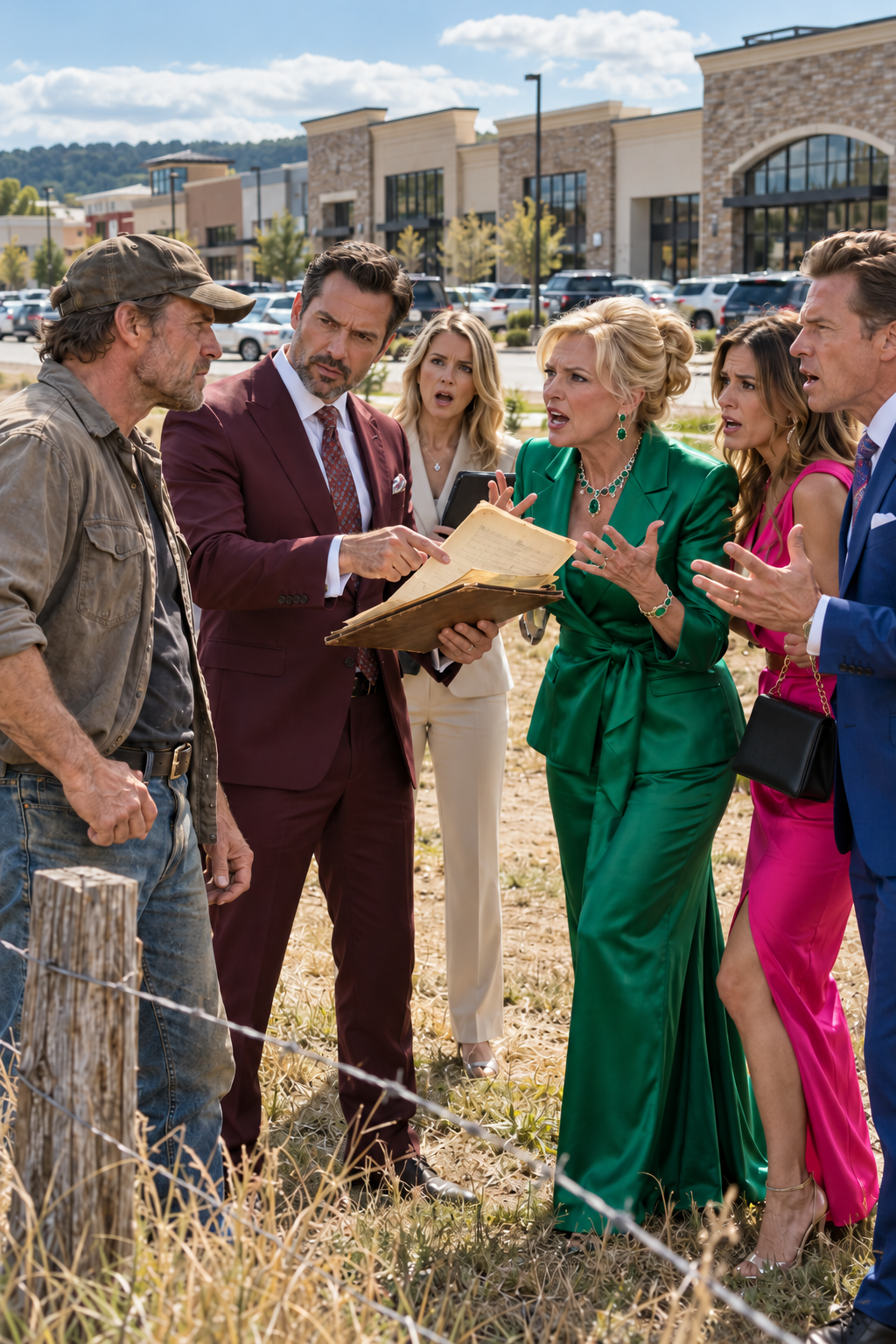
The HOA Built a $22 Million Shopping Center on My Land—Then My Lawyer Found the Deed They Buried
The first time I saw the shopping center, there were already six hundred people celebrating on land my father had told me never to sell.
The second surprise came when the HOA president raised a champagne glass from a stage built twenty feet inside my property line and thanked me—by name—for “supporting the future of Cedar Ridge.”
The third came when a security guard grabbed my elbow and told me I was trespassing.
I looked at his hand.
Then at him.
“You should let go.”
Not because I shouted.
Not because I threatened him.
He let go because something in my face told him I wasn’t confused.
Everyone else was.
Behind him, a brass band played beneath white tents.
Children carried shopping bags from stores that had apparently opened that morning.
A fountain sprayed silver arcs into the October sunlight.
A three-story brick-and-glass building stood where my father’s cattle barn had once been.
A gourmet market occupied the south wing.
There was a steakhouse with patio seating.
A boutique hotel entrance faced the new roundabout.
Someone had planted thirty maple trees along a boulevard I had never authorized.
Above the central archway, polished steel letters read:
CEDAR RIDGE COMMONS.
Estimated project cost, according to the banner beside the stage:
$22 MILLION.
I had been gone eleven months.
Apparently, that was all it took to lose forty-eight acres.
My name is Jack Mercer.
I was forty-four years old when an HOA tried to steal enough land from me to build a shopping center.
Not metaphorically steal.
Not annoy me with landscaping rules.
Not mail me a stupid fine because my mailbox was the wrong shade of brown.
They poured concrete.
They ran utilities.
They signed leases.
They collected rent.
They borrowed millions.
And somewhere along the way, someone decided the easiest solution to a small problem called ownership was pretending I didn’t exist.
The crowd erupted in applause.
On the stage, Pamela Whitmore smiled like a woman unveiling a hospital wing.
She was sixty-one, silver-blonde, perfectly dressed in an emerald-green suit that probably cost more than my first truck.
I knew her by reputation.
Everyone around Cedar Ridge did.
Pamela had been president of the Cedar Ridge Property Owners Association for nine years.
Technically, my ranch wasn’t part of Cedar Ridge.
That detail would become important.
Very important.
She stood beside Mayor Thomas Bell, three developers, two bankers, and County Commissioner Harold Pryce.
Behind them was an artist’s rendering of the development.
Except it wasn’t a rendering anymore.
It was real.
And it was sitting on my dirt.
Pamela lifted the microphone.
“Today represents what happens when neighbors stop thinking about individual interests and begin thinking about community legacy.”
People applauded.
I almost laughed.
Instead, I took out my phone and started recording.
“Five years ago,” Pamela continued, “this area was neglected pasture. Today, because of courage, cooperation, and vision, it has become the economic heart of our community.”
Neglected pasture.
My father would have enjoyed that.
He had rotated cattle through those fields for thirty-seven years.
He had restored the creek bank himself.
He had planted the windbreak.
He had paid taxes on every acre until the day he died.
Then I had.
Pamela pointed toward a row of storefronts.
“Cedar Ridge Commons will create an estimated two hundred and eighty permanent jobs.”
More applause.
“More than six million dollars in annual economic activity.”
More applause.
“And a future our children can be proud of.”
That time I did laugh.
A woman beside me turned.
“You okay?”
“Fantastic.”
“You know someone involved?”
She smiled uncertainly.
Before she could ask what I meant, Pamela continued.
“We especially acknowledge the families whose generosity helped make this possible.”
There it was.
I watched closely.
Pamela’s smile changed.
Just slightly.
Anyone else would have missed it.
She was scanning the crowd.
Looking for someone.
“Some people understand,” she said, “that property carries responsibilities beyond ownership.”
That line was for me.
I knew it before she finished saying it.
I hadn’t spoken to Pamela Whitmore in almost two years.
But eleven months earlier, just before leaving Colorado to help my sister through a difficult medical situation in Oregon, I had rejected an offer from a development company connected to the HOA.
They wanted forty-eight acres.
I wanted to keep them.
Or so I had thought.
Their first offer was $1.4 million.
Their second was $1.8 million.
Their third came through Pamela herself.
She had driven up to my ranch in a pearl-white Mercedes and stood on my porch holding a leather folder.
“Two point three million,” she said.
“You haven’t looked at the proposal.”
“I looked at the number.”
“It’s nearly twice market value.”
“Then buy someone else’s land.”
“It has to be yours.”
“Then you have a problem.”
Pamela studied me for several seconds.
Most people hate silence.
People like Pamela use it.
I use it better.
She finally said, “Development is coming whether you participate or not.”
“Then it can come around me.”
“You’re holding up an entire corridor.”
“I own the corridor.”
I remembered those two words as I stood in the grand opening crowd eleven months later.
I remembered her smile.
I remembered the folder.
I remembered my father’s warning about people who confuse patience with surrender.
And I remembered something else.
Pamela Whitmore had never made threats accidentally.
She finished her speech.
The crowd cheered.
Cameras flashed.
Someone released gold-and-white balloons.
I lowered my phone.
A man in a navy suit stepped beside Pamela and whispered something.
She looked directly at me.
That was the moment.
The smile didn’t disappear.
Only for half a second.
Then Pamela recovered.
She leaned toward the mayor, said something, handed off the microphone, and walked down the stage steps.
Straight toward me.
People moved aside for her.
She stopped six feet away.
“I heard you were still in Oregon.”
“I came home.”
“So I see.”
Her eyes moved over me like she was checking for weapons.
I had jeans, boots, a gray work jacket, my phone, and the kind of calm that makes dishonest people nervous.
Pamela glanced toward the security guard.
“Is there a problem?”
“No problem,” I said.
She smiled.
“I’d hate for your first day back to become unpleasant.”
I turned slowly and looked at the buildings.
“My first day back is interesting.”
Her smile tightened.
“You received the notices.”
“They were sent.”
“To where?”
“Your address.”
“Which address?”
“Your legal address.”
“That would be my ranch.”
Pamela didn’t answer.
I looked at her.
“My ranch is three hundred yards that way. Same mailbox for seventeen years. Nothing was forwarded to Oregon because I never changed residency.”
Her expression didn’t move.
“The association followed statutory procedure.”
“I’m not in your association.”
“We’ve been through this.”
“No, you’ve been through this. I’ve mostly said no.”
A couple nearby had begun listening.
Pamela noticed.
She lowered her voice.
“This isn’t the place.”
“Come to my office Monday.”
“So I can explain the situation.”
“I understand the situation.”
Her left eyebrow rose.
“Yes. You built a shopping center on my ranch.”
Pamela exhaled.
Not dramatically.
Almost sympathetically.
That annoyed me more than anger would have.
“Jack, that parcel hasn’t legally belonged to you for months.”
There it was.
I stared at her.
She stared back.
“Say that again.”
“The disputed acreage was transferred after the county’s administrative process concluded.”
“What administrative process?”
“You failed to respond.”
“Multiple notices.”
“I received none.”
“That doesn’t invalidate service.”
“Service for what?”
Pamela hesitated.
Tiny mistake.
But I saw it.
“For the assessment lien.”
Not because anything was funny.
Because now she had given me something concrete.
“What assessment?”
“Road access, drainage improvements, utility extension, and common-area infrastructure.”
“My property isn’t in the HOA.”
“The parcel benefited from association improvements.”
“That doesn’t create membership.”
“It created an enforceable obligation.”
“How much?”
Pamela’s eyes flicked briefly toward the crowd.
“Originally?”
“Thirty-one thousand eight hundred dollars.”
“And somehow $31,800 became forty-eight acres worth several million?”
“You ignored penalties, legal costs, accrued interest, and statutory notices.”
“Ignored notices I never received.”
“That will be a matter for attorneys.”
She almost smiled again.
“I prefer paperwork to speeches.”
For the first time, Pamela’s face changed.
Just slightly.
I continued.
“Who owns the shopping center?”
“Cedar Ridge Development Partners.”
“Who owns them?”
“I don’t manage their corporate structure.”
“But you negotiated the deal.”
“I represented the association’s interests.”
“Did the HOA acquire my land?”
“Through lawful process.”
“And then sell it?”
“For how much?”
She stopped.
“That’s what I thought.”
A photographer walked past us.
Pamela waited until he was out of earshot.
“Take my advice.”
“I didn’t the last time.”
“You should now.”
“Go ahead.”
“Walk away.”
The words were soft.
Almost kind.
“You’re upset. Understandably. But fighting this will destroy you financially, and nothing will change. The buildings are complete. Tenants have possession. Financing has closed. Infrastructure is dedicated. The county has approved everything.”
She glanced toward the shopping center.
“This isn’t a fence you can move.”
I followed her gaze.
Then I looked back at her.
“It’s collateral.”
That landed.
Pamela’s eyes narrowed.
I continued.
“Which means somebody gave a lender a title policy.”
She didn’t respond.
“And somebody certified ownership.”
Still nothing.
“And somebody signed warranties.”
The color left her face so gradually most people wouldn’t have noticed.
“Monday,” she said.
“I’ll be busy.”
“With what?”
“Finding my lawyer.”
I walked away.
I did not enter the stores.
I did not confront the developers.
I did not yell at the mayor.
I did not call the police.
When you discover somebody has spent $22 million building on land you believe is yours, anger feels useful.
Evidence is useful.
So I drove home.
The ranch house stood exactly where I’d left it.
White siding.
Green roof.
Wraparound porch.
Cottonwoods along the driveway.
But the southern view was gone.
Where my pasture had once rolled gently toward County Road 18, I could see rooftops, signs, parking-lot lights, and the top floor of the hotel.
My gate had also been moved.
That made me stop.
The original cattle gate had stood beside a granite marker my father set in 1998.
Now the gate was eighty feet north.
A black decorative fence ran along what someone apparently wanted me to believe was the boundary.
Walked to the old marker.
It was still there.
Half buried behind ornamental grass.
I crouched and brushed dirt from the stone.
MERCER SOUTH LINE.
My father carved those words himself.
I touched the letters.
Then I noticed something bright beneath the grass.
Orange plastic.
Survey ribbon.
Very recent.
Someone had surveyed the original line after landscaping was complete.
I took pictures.
Every angle.
Then I walked the boundary.
The shopping center parking lot crossed approximately five acres of what I remembered as our north pasture.
The buildings occupied another eleven or twelve.
Drainage ponds covered four.
A service road cut toward the creek.
The rest appeared designated for future expansion.
I found survey stakes.
Some marked with blue caps.
Some yellow.
Then, near the creek, I found two wooden stakes lying flat on the ground.
One still had a label.
MERCER TRACT BOUNDARY.
I photographed that too.
Back at the house, I opened my father’s old fireproof cabinet.
Lease agreements.
Water rights.
Conservation papers.
I found the most recent deed from 2006, when Dad transferred the ranch jointly to himself and me after Mom died.
Seven hundred and twelve acres.
Including the forty-eight-acre southern tract.
Nothing looked unusual.
But legal descriptions aren’t written for normal humans.
They read like someone turned geometry into punishment.
I scanned everything.
At p.m., I called the one attorney I trusted.
Her name was Rachel Sloan.
We had gone to high school together.
She was now a property and commercial litigation attorney in Denver.
Rachel answered on the third ring.
“Jack Mercer. Either someone died or you need a lawyer.”
“Can it be both?”
“Please tell me you didn’t kill anyone.”
“That pause worries me.”
“Can I send you something?”
“Romantic.”
“And pictures of a $22 million shopping center.”
“Because I think the second one is sitting on the first one.”
Another silence.
“Send everything.”
Twenty minutes later, she called back.
“Don’t speak to anyone.”
“I spoke to Pamela Whitmore.”
“Of course you did.”
“She says they took it through an assessment lien.”
“Are you in the HOA?”
“Were you ever?”
“Any annexation agreement?”
“Utility covenant?”
“Not that I know of.”
“Special district?”
“Road maintenance agreement?”
“There’s an old easement.”
“What kind?”
“That’s why I called.”
Rachel exhaled.
“I need county records. All of them.”
“I can go Monday.”
“No. Digital first. I’ll pull what I can tonight.”
“You working Saturday?”
“I am now.”
“I don’t know yet.”
“I don’t guess with titles.”
That was Rachel.
I liked that.
“Do you still have the original deed from before your father transferred the property?”
“Because the 2006 deed references a prior instrument, but the exhibit attached to your scan looks incomplete.”
I looked down at the pages.
“Incomplete how?”
“Page three describes Tract A. Then it jumps to signatures.”
“There’s no Tract B?”
“Not in what you sent.”
I felt something cold settle in my stomach.
“The forty-eight acres are Tract B.”
“Then how do I own them?”
“You probably do. The county tax map says you do—or at least did until recently.”
“Until recently?”
“I found a transfer.”
My grip tightened on the phone.
“Cedar Ridge Holdings LLC.”
“Seven months ago.”
“Signed by me?”
“Dad’s dead.”
“Then who transferred it?”
“It wasn’t a voluntary deed. Treasurer’s deed following a lien foreclosure.”
“HOA lien?”
“That’s what it says.”
“Can they do that?”
“Not if they had no lawful assessment authority.”
“Pamela claims they did.”
“Pamela claims many things.”
“What happens now?”
“I’m going to find out how they manufactured jurisdiction over that parcel.”
That phrase stayed with me.
Manufactured jurisdiction.
Not mistake.
Not confusion.
Manufactured.
Rachel called again at 11:47 that night.
I was sitting at my father’s kitchen table with papers spread across the wood.
“Are you awake?”
“I own cattle.”
“What did you find?”
“Enough to ruin my weekend.”
“Good ruin or bad ruin?”
“Interesting ruin.”
“The foreclosure file is wrong.”
“Several ways.”
I sat straighter.
“Start with the biggest.”
“The HOA claims your Tract B was annexed into Cedar Ridge in 2013.”
“It wasn’t.”
“Because the annexation declaration requires the owner’s notarized consent.”
“The county file contains one.”
My stomach dropped.
“With whose signature?”
“Your father’s.”
I stared at the dark window over the sink.
Dad died in 2010.
“When was it signed?”
“According to the document, September 14, 2013.”
I said nothing.
Rachel said nothing.
We stayed like that for maybe five seconds.
Then I asked, “You sure?”
“My father had been dead three years.”
“So somebody forged his signature.”
“Possibly.”
“Possibly?”
“I’m a lawyer. Let me keep my cautious words until we see the original.”
“What else?”
“The notarization was performed by Elaine Porter.”
“Who’s that?”
“Don’t know yet.”
“Is she real?”
“Yes. Or was. Colorado notary commission from 2012 through 2016.”
“What about the assessment notices?”
“Sent to an address in Aurora.”
“I’ve never lived in Aurora.”
“What address?”
She gave it to me.
I wrote it down.
“Who lives there?”
“I don’t know yet.”
“And they foreclosed because I didn’t answer letters they sent to somebody else?”
“Essentially.”
“And the court?”
“Default judgment.”
“No one checked the address?”
“Apparently not successfully.”
“No one checked Dad was dead?”
“Apparently not.”
“How does a $31,800 lien become loss of land worth millions?”
“Attorney fees. Penalties. Interest. Collection charges. Special assessments.”
“How much total?”
“By the foreclosure filing, $286,441.”
I laughed once.
No humor in it.
“For drainage?”
“And infrastructure.”
“I didn’t ask for infrastructure.”
“What did they sell the land for?”
Rachel went quiet.
That bothered me.
“I found two transactions.”
“The HOA foreclosure entity took title first through a shell called CR Community Recovery LLC.”
“Sounds friendly.”
“Three weeks later, that company transferred the forty-eight acres to Cedar Ridge Holdings LLC.”
“Four hundred and ten thousand dollars.”
“Four hundred ten—”
“Five months later, Cedar Ridge Holdings entered a development joint venture.”
“With who?”
“Northstar Commercial.”
“For how much?”
“Land contribution valued at $6.8 million.”
I looked through the kitchen window toward the glow over the southern fields.
They had taken it for an alleged $286,000 debt.
Moved it through a shell.
Then valued it at $6.8 million.
Rachel continued.
“Northstar obtained construction financing based partly on the land.”
“How much?”
“$16 million credit facility.”
“And the project cost?”
“Approximately twenty-two.”
I sat back down.
“What’s Pamela’s connection?”
“Still tracing it.”
“Board president.”
“More than that, probably.”
“Because CR Community Recovery was formed by a registered agent whose office is also used by Whitmore Management Group.”
I knew the name.
“Her husband’s company.”
“Was. He died four years ago. Pamela now controls it.”
There was our first real break.
“How quickly can we stop this?”
“Slow down.”
“They stole land.”
“I agree it looks terrible.”
“Jack, we need admissible evidence, not outrage.”
“I’m not outraged.”
“You should probably be a little outraged.”
“I’m busy.”
That made her laugh.
Then her tone changed.
“I need the original 1991 deed.”
“Why that one?”
“Because your father bought the southern tract separately before consolidating the ranch. The 2006 instrument references Book 1842, Page 611. That’s probably it.”
“I’ll search the cabinet.”
“Also check safe-deposit records. Lawyers. Old closing files. Anything.”
“You think there’s something special in the original?”
“I think someone wanted the county to treat Tract B as ordinary fee-simple land subject to annexation.”
“And it isn’t?”
“I don’t know.”
She paused.
“But your father was meticulous. The omission of the full legal exhibit from the copy bothers me.”
At in the morning, I found a key taped beneath the bottom drawer of Dad’s desk.
A tiny brass key.
Attached was a faded paper tag.
FIRST NATIONAL—BOX 311.
The bank had merged twice since Dad died.
But Box 311 still existed.
Monday morning, Rachel met me outside Mountain State Bank in Fort Collins.
She wore a burgundy coat and carried a leather briefcase.
“You look tired,” she said.
“You look expensive.”
“I bill by the insult.”
Inside the safe-deposit room, a bank officer brought Box 311.
It was longer than I expected.
Dad had stored almost nothing sentimental inside.
No jewelry.
No letters.
That was him.
There were mineral-rights records.
Water decrees.
A conservation survey.
Three original deeds.
And one sealed envelope with my name on it.
I stared at that envelope for several seconds.
Rachel noticed.
Inside was a single handwritten note.
If anything ever happens to the south parcel, do not rely on the county map. Use the Harlan deed. The east boundary is governed by the 1957 reservation, not the later subdivision plat.
Rachel held out her hand.
“Harlan deed.”
We found it beneath the conservation documents.
The paper was yellowed.
Stamped 1991.
Rachel unfolded the attached exhibit.
Her eyes moved quickly.
Then slower.
Then stopped.
She didn’t answer.
“Give me a second.”
She read the page again.
Then turned to another attachment.
“What is it?”
Rachel looked at me.
“This land was never annexable.”
I felt the air change.
“Your father didn’t buy unrestricted property.”
She tapped the document.
“In 1957, the Harlan family placed a private restrictive reservation over the tract when they sold surrounding acreage.”
“What kind?”
“A reversionary limitation tied to residential association control.”
“In English.”
“No HOA, subdivision association, or common-interest community can acquire governance rights over this tract without unanimous written consent from the dominant estate owners.”
“Who are they?”
“Originally the Harlans. Later transferred to whoever owns the Mercer north ranch.”
I stared at her.
“That’s me.”
“So I would have needed to approve annexation twice? As owner of Tract B and holder of the restriction?”
“I approved neither.”
“And Dad’s fake signature couldn’t fix that?”
“Not by itself.”
Rachel kept reading.
Then she made a sound I had never heard from her before.
A tiny, stunned laugh.
“What now?”
She turned the page toward me.
“Your father added another layer in 1991.”
“When he bought Tract B, the deed incorporated the Harlan restriction and added a prohibition against commercial development within three hundred feet of Mercer Creek without written consent from the owner of the adjoining ranch.”
“Which is—”
I looked through the bank’s little frosted window.
“So even if they owned the land—”
“They may not have had the right to build this project as designed.”
“How bad is that?”
“For them?”
Rachel smiled.
“Potentially catastrophic.”
That was the first time I felt we weren’t defending ourselves anymore.
We were advancing.
By noon, Rachel had filed emergency motions in district court seeking a temporary restraining order against further transfer, construction, leasing changes, or financing related to the disputed acreage.
We didn’t ask the judge to shut the stores.
That mattered.
Rachel’s reasoning was simple.
“If we walk in demanding that two hundred employees lose their jobs tomorrow, we look reckless. We freeze the chessboard first.”
Pamela’s attorneys responded within three hours.
Not one attorney.
The HOA hired a regional firm.
Northstar Commercial brought its own counsel.
Mountain Prairie Bank intervened because of its construction loan.
Two title insurance companies appeared.
The mayor publicly called it “an unfortunate historical boundary disagreement.”
Boundary disagreement.
That phrase made local television by dinner.
The shopping center was sitting more than a quarter mile inside my deed line.
But apparently that was a boundary disagreement.
Tuesday morning, Pamela finally called.
“You’ve made your point.”
“I haven’t started.”
“Your attorney filed a lis pendens against the entire development parcel.”
“You understand what that does?”
“I imagine the bank explained it.”
Her silence confirmed that.
A lis pendens meant anyone dealing with the property was now on notice that ownership was disputed.
Refinancing became difficult.
Sales became dangerous.
New leases became risky.
Title companies started sweating.
Pamela’s voice hardened.
“You’re hurting innocent businesses.”
“I didn’t build their businesses on disputed land.”
“You can resolve this.”
She waited.
Finally she asked, “What do you want?”
“My property.”
“That is not realistic.”
“It was realistic eleven months ago.”
“The land has been fundamentally transformed.”
“By people without my permission.”
“Jack, if this becomes litigation, it will take years.”
“I own boots.”
“I’m comfortable waiting.”
She hung up.
Wednesday brought our first mini-payoff.
A district judge granted the temporary restraining order.
No refinancing.
No new construction.
No additional encumbrances.
No alteration of disputed records.
The shopping center could operate temporarily, but everyone involved was ordered to preserve documents.
Rachel called it “putting the crime scene in glass.”
Pamela called an emergency HOA meeting.
I attended.
Cedar Ridge’s clubhouse parking lot was full before I arrived.
Homeowners crowded inside.
Some angry at me.
Some angry at Pamela.
Most confused.
A man at the entrance tried to tell me the meeting was residents only.
Rachel stepped beside me.
“My client is a named party in the agenda.”
The man moved.
Pamela sat at the front behind a long table with four board members and two attorneys.
She looked composed.
That was impressive.
Behind her, residents whispered.
The HOA attorney began.
“We want to reassure members that recent claims involving Cedar Ridge Commons are unfounded and will be vigorously defended.”
A woman shouted, “Did we steal his land?”
People laughed nervously.
The attorney frowned.
“No property was stolen.”
I raised my hand.
Pamela ignored me.
A man in the third row stood.
“My dues paid legal fees for this?”
Pamela leaned toward the microphone.
“The commercial development generated substantial revenue that stabilized association finances.”
“How much revenue?”
“We’ll address finances later.”
“We have an agenda.”
Another voice:
“Why is his dead father’s signature on something from 2013?”
The room changed instantly.
Pamela looked toward me.
I hadn’t released that information publicly.
Rachel hadn’t either.
Interesting.
Someone else knew.
Pamela’s attorney whispered to her.
She said, “There has been substantial misinformation.”
The same homeowner shouted, “Is the signature fake?”
“We cannot discuss ongoing litigation.”
That answer destroyed her.
Not legally.
Politically.
Everyone heard what she hadn’t said.
She hadn’t said no.
A board member named Greg Sanders leaned toward Pamela.
“Were we told the owner consented?”
She whispered something.
Greg pulled away.
“No. I’m asking publicly.”
Pamela’s smile vanished.
“We will not litigate privileged board discussions in open session.”
Greg stared at her.
Then pushed his chair back.
“I resign.”
The room exploded.
Phones rose.
People shouted questions.
Pamela’s attorney demanded order.
Greg walked straight past us.
Rachel caught his eye.
“Mr. Sanders.”
He stopped.
She handed him a card.
“If you have records relevant to the dispute, preserve them.”
Greg looked at the card.
Then at Pamela.
“I preserved everything.”
That sentence was worth more than the entire meeting.
Pamela adjourned seven minutes later.
Outside, Rachel and I walked toward my truck.
“You planned that?” I asked.
“Why good?”
“Means they’re cracking on their own.”
Rachel smiled.
“Now you’re learning litigation.”
Greg Sanders called us the next morning.
He had emails.
A lot of emails.
He had joined the HOA board fourteen months earlier, after most of the land acquisition was complete.
But he had inherited access to an archive.
Pamela’s attorneys immediately threatened privilege.
Rachel didn’t touch anything until the court established what could legally be reviewed.
The judge ordered a neutral discovery process.
Two days later, we were allowed access to non-privileged board communications.
That’s where we found the phrase.
LEGACY OWNERSHIP PROBLEM.
It appeared in an email from Pamela to the project manager sixteen months before construction.
Not “title issue.”
Not “boundary uncertainty.”
Legacy ownership problem.
The attached message said:
We cannot allow the Mercer position to delay financing again. Counsel believes the association status can be established through historical documentation. Proceed with survey revisions once administrative title is secured.
Rachel read it twice.
“Historical documentation.”
“Dad’s forged annexation?”
“Probably.”
Another email mentioned “alternate service address confirmed.”
The fake notice address.
Then we found the address owner.
Elaine Porter.
The notary.
She had lived at the Aurora property until 2019.
Now things stopped looking sloppy.
They started looking engineered.
Rachel hired a licensed investigator.
Three days later, we knew Elaine Porter had worked as a bookkeeper for Whitmore Management Group from 2011 to 2017.
Pamela’s company.
The same notary who supposedly watched my dead father sign the HOA annexation in 2013.
The same woman whose old address later received my foreclosure notices.
That was twist number one.
And it was enough.
We didn’t need five conspiracies.
We needed one chain.
False address.
Development.
The court scheduled an evidentiary hearing.
By then, the case had become statewide news.
LOCAL RANCHER CHALLENGES $22M DEVELOPMENT.
HOA TITLE DISPUTE THREATENS CEDAR RIDGE COMMONS.
DEAD MAN’S SIGNATURE AT CENTER OF PROPERTY FIGHT.
Pamela kept appearing on television.
I declined every interview.
That drove reporters crazy.
One caught me outside court.
“Mr. Mercer, do you want the shopping center demolished?”
That surprised him.
“What do you want?”
“But the center is on the land.”
“That’s not a question for me.”
“Would you accept money?”
“Everyone keeps asking the wrong question.”
“What’s the right question?”
“Who decided ownership was optional?”
Then I walked inside.
The hearing lasted two days.
Elaine Porter arrived under subpoena.
She was seventy-two now.
Gray-haired.
Pamela sat fifteen feet away.
Elaine wouldn’t look at her.
Rachel handled the examination.
“Ms. Porter, were you a commissioned notary in September 2013?”
“Did you work for Whitmore Management Group?”
“Do you recognize this annexation consent?”
Elaine looked.
“Is that your notary stamp?”
“It appears to be.”
“Your signature?”
A long pause.
“Did you personally witness Robert Mercer sign this document?”
Elaine swallowed.
The courtroom went silent.
Rachel waited.
That was her gift.
She never rushed into silence.
“Because I never met Robert Mercer.”
Pamela stared straight ahead.
Rachel continued.
“Were you aware Robert Mercer died in 2010?”
“Not then.”
“When did you learn?”
“How did his signature appear on a document you notarized?”
Elaine’s lawyer stood.
“Fifth Amendment.”
Rachel nodded.
The judge allowed the invocation.
Who gave you the document?
Who instructed you to notarize it?
Did Pamela Whitmore provide it?
Were you paid?
Did you allow your former address to be used for notices directed to Jack Mercer?
By the sixth invocation, no one needed a confession.
The shape of the case was visible.
But Pamela’s lawyers had one defense left.
They argued that even if annexation was defective, later foreclosure proceedings and third-party reliance protected the current owners.
Northstar had spent millions.
The bank had lent millions.
Retail tenants had signed in good faith.
Title insurers had issued policies.
Equity, they argued, should prevent me from reclaiming improved land.
Rachel stood.
“Equity does not reward a chain of title originating in fraud.”
Their attorney replied.
“My client did not commit the alleged fraud.”
“Then your client has claims against the people who sold it defective title.”
That sentence made three attorneys look at Pamela.
So did the judge.
The judge ordered expedited title discovery.
That’s when everything got dangerous.
Not physically.
Financially.
Northstar froze payments to Cedar Ridge Holdings.
The bank suspended an undrawn portion of its credit line.
Two anchor tenants invoked title-dispute clauses.
The hotel lender delayed permanent financing.
And Cedar Ridge homeowners discovered something Pamela had never told them.
The HOA had guaranteed part of the development infrastructure debt.
Not all $22 million.
But $4.7 million.
Backed by association assessment revenue.
Homeowners lost their minds.
The next HOA meeting had sheriff’s deputies outside.
Pamela lasted twelve minutes before someone shouted:
“You put our homes behind your shopping center?”
She banged the gavel.
“No individual home is collateral.”
A man yelled back.
“Our dues are!”
Another homeowner held up documents.
“You guaranteed road bonds!”
“They were revenue-backed obligations.”
“With our assessments as backup!”
Pamela looked toward her attorney.
He looked down.
That was all the room needed.
People started chanting.
Pamela didn’t.
Of course she didn’t.
People like her don’t leave when the door opens.
They leave when the building burns.
The board scheduled a recall vote.
Meanwhile, Rachel and I had a different problem.
The original Harlan deed.
Our strongest weapon.
And possibly our weakest.
Northstar hired historians and title experts.
They claimed the 1957 restriction had expired.
Their argument wasn’t ridiculous.
Old covenants can become unenforceable.
Changes in land use matter.
Ambiguous language matters.
Statutes matter.
They said even if the forged HOA annexation was void, the commercial-development restriction might no longer bind the land.
Rachel didn’t panic.
She did something more irritating.
She disappeared into archives.
County records.
State records.
Old ranch files.
Probate documents.
Water district maps.
For six days, I heard almost nothing.
Then she arrived at my ranch one evening carrying a banker’s box.
“You have coffee?”
“You have whiskey?”
“Also always.”
“We may need both.”
She spread documents across the kitchen table.
“Your father didn’t merely inherit the Harlan restriction.”
“No. You don’t understand.”
She pointed to a 1991 closing statement.
“When Robert Mercer bought Tract B, the seller wanted the restriction released.”
“To maximize future development value.”
“Dad refused?”
“Your father negotiated the opposite.”
She pulled out another document.
A private covenant agreement.
Barely indexed because of a clerical spelling error in the grantor’s name.
“What did he do?”
“He renewed the commercial limitation for ninety-nine years.”
“Until 2090?”
“And tied enforcement to the north ranch?”
“Which I own.”
I leaned back.
“Why wasn’t this in the title search?”
“That is going to be a very expensive question for the title insurer.”
Rachel didn’t.
“There’s more.”
“Of course.”
“The agreement includes a remedy.”
“What remedy?”
“If commercial improvements are constructed without consent, the dominant-estate owner may elect between injunctive removal…”
She paused.
“…or a use charge based on gross commercial revenue.”
“How much?”
Rachel slid the page toward me.
“Eight percent.”
“Eight percent of what?”
“Gross revenue generated from unauthorized commercial use.”
“From when?”
“Commencement of use.”
“Every store?”
“Potentially.”
“Restaurants?”
“If revenue-generating.”
I looked toward the glow on the horizon.
“How much are they doing?”
“Projected annual gross sales across the center?”
“Between forty-eight and sixty million dollars once stabilized.”
I did the math.
Rachel watched me do it.
“Four million a year.”
“Potentially more.”
“For using my land.”
“If enforceable.”
“And they thought the covenant expired.”
“They hoped nobody found it.”
That sentence bothered me.
Rachel looked at me.
“I’m beginning to think they knew.”
“Northstar?”
“I don’t know.”
“Almost certainly.”
“Because someone requested a certified copy of this agreement eighteen months ago.”
“The county archive keeps retrieval logs.”
She turned over a page.
WHITMORE MANAGEMENT GROUP.
I stared at the name.
“That’s before they foreclosed.”
“Four months before.”
So Pamela knew.
Before the fake annexation became useful.
Before the foreclosure.
Before the land transfer.
Before construction.
She knew the land carried a ninety-nine-year commercial restriction.
And she moved anyway.
That was the question.
Greed alone no longer explained it.
Pamela could have developed other land.
More expensive, yes.
Less convenient, yes.
But possible.
Why risk forgery?
Why risk the HOA?
Why risk millions?
Why this specific forty-eight acres?
I asked Rachel.
She stared at the documents.
“I don’t know.”
“Developers wanted road frontage.”
“They had alternate frontage.”
“Utilities?”
“Could be routed.”
“Creek access?”
“Restricted.”
“Visibility?”
“Good, but not unique.”
She leaned back.
“Something about this parcel mattered more than the shopping center.”
That was the first time the bigger mystery entered the room.
But we didn’t chase it yet.
One war at a time.
The recall vote happened Friday.
Eighty-eight percent of Cedar Ridge homeowners participated.
Pamela lost.
Three hundred fourteen votes to fifty-nine.
After nine years, she was removed as HOA president.
People cheered in the clubhouse.
I wasn’t there.
I was in my barn repairing a hydraulic line.
Rachel texted me one sentence.
Pamela removed.
Then kept working.
An hour later, three black SUVs pulled into my driveway.
Northstar executives.
No lawyers.
That was interesting.
Their CEO, Daniel Choate, stepped out wearing jeans and a navy jacket.
Mid-fifties.
He introduced himself.
“I assume you know who I am.”
“I know who signs your filings.”
He smiled faintly.
“Can we talk?”
“Your lawyers know you’re here?”
“Mine doesn’t either.”
We sat on the porch.
Daniel looked south toward the center.
“You know I didn’t steal your land.”
“I know your company built on it.”
“We relied on title.”
No argument.
That earned him ten points.
“We spent $18.6 million so far,” he said.
“Banner said twenty-two.”
“Full project budget.”
“Congratulations.”
He almost smiled.
“I’m not here to fight.”
“Then why are you here?”
“To understand whether there is a solution.”
“Your attorneys offered me $3 million.”
“I said no.”
“Then four.”
“Then six.”
“I approved six.”
“Still no.”
Daniel nodded.
“What would you accept?”
I looked at him.
“The truth.”
His expression changed.
“About what?”
“Why this parcel.”
“Its location.”
“It was part of the master plan.”
“Plans change.”
“Not always.”
“You had other options.”
“Less profitable ones.”
“Not enough to justify forging a dead man’s signature.”
“I had nothing to do with that.”
“I didn’t say you did.”
Daniel looked toward the parking-lot lights.
After several seconds, he said, “Pamela told us there was an uncooperative owner.”
“How early?”
“Before acquisition.”
“What else?”
“She said title could be cleared through association enforcement.”
“You didn’t ask how land outside the HOA suddenly became HOA land?”
“Our counsel received documentation showing annexation.”
“With Dad’s signature.”
“We didn’t know he was dead.”
“You could have Googled him.”
Daniel looked embarrassed.
“What did Pamela tell you about the 1991 covenant?”
He looked at me.
That was my answer.
“She didn’t tell you.”
“Your title insurer missed it.”
“And Whitmore Management requested a copy four months before foreclosure.”
Daniel went still.
“You’re certain?”
“Certified archive log.”
For the first time since he arrived, Daniel looked angry.
“May I see it?”
Then he asked, “What are you going to do?”
“What I find.”
The next Monday, Pamela vanished.
Not dramatically.
Her house was still there.
Furniture inside.
Her attorney said she was “temporarily unavailable for medical reasons.”
No hospital confirmed anything.
The state attorney general’s office announced it was reviewing the forged annexation.
The county district attorney opened a fraud investigation.
Elaine Porter entered negotiations through counsel.
And suddenly Pamela Whitmore, the woman who had spent nine years controlling every mailbox color and fence height in Cedar Ridge, could not be reached.
The court hearing on title continued without her.
Three weeks later, Judge Melissa Grant issued a preliminary ruling.
The HOA annexation was void.
The foreclosure based on HOA assessments was therefore likely void.
The downstream title transfers were clouded.
The 1991 covenant appeared valid pending final adjudication.
Cedar Ridge Holdings had likely never obtained clean title.
Legally, the words were cautious.
Financially, they were dynamite.
Mountain Prairie Bank demanded additional collateral.
Northstar sued Cedar Ridge Holdings.
The title insurer reserved rights.
Retail tenants demanded assurances.
And the new HOA board sued Pamela Whitmore and Whitmore Management Group for breach of fiduciary duty.
Rachel and I received settlement requests from four directions.
We ignored most of them.
Then Elaine Porter asked to talk.
She wanted immunity.
Not from us.
From prosecutors.
But before making her formal statement, she told investigators something that changed the case again.
I learned about it when Rachel showed up at my ranch at one morning.
Just headlights coming up the driveway.
I opened the door.
“You look terrible.”
“Thank you.”
“What happened?”
“Elaine talked.”
I stepped aside.
Rachel entered and placed her bag on the table.
“Pamela gave her the annexation document.”
“Expected.”
“And paid her.”
“Expected.”
“Elaine also forwarded the fake notices.”
“Expected.”
“To her own old Aurora property.”
“Expected.”
Rachel didn’t speak.
I poured coffee.
“You didn’t drive ninety minutes to tell me things we expected.”
“What didn’t we expect?”
“Elaine says Pamela wasn’t acting alone.”
I handed her the mug.
“Northstar?”
“County official?”
“She doesn’t know.”
“Then who?”
“She says a man attended two meetings at Whitmore Management before the foreclosure.”
“She never learned it.”
“Description?”
“Late sixties at the time. Gray hair. Tall. Wore expensive suits. Arrived in a black Lincoln.”
“That describes half the retired bankers in Colorado.”
“She remembers Pamela calling him ‘Judge.’”
“Or nickname.”
“What meetings?”
“About the Mercer tract.”
“What did Elaine hear?”
Rachel opened her notebook.
“She heard the man tell Pamela the foreclosure had to happen before ‘the old records were digitized.’”
I stared at her.
“What old records?”
“She doesn’t know.”
“County deeds?”
“Court files?”
“Why before digitization?”
“Because digitized records are easier to search.”
I leaned against the counter.
“So they weren’t just trying to bury ownership.”
“That’s what I think.”
“They were trying to bury something attached to the land.”
“Something older than 1991.”
“Possibly much older.”
I remembered Dad’s note.
Do not rely on the county map.
Use the Harlan deed.
The east boundary is governed by the 1957 reservation, not the later subdivision plat.
East boundary.
Not ownership.
I looked at Rachel.
“The east line.”
“Dad specifically mentioned the east boundary.”
“The shopping center mainly sits west of it.”
“So why mention it?”
We drove out there.
The old east boundary of Tract B ran through a wooded strip behind the shopping center’s service road.
Nothing special.
Cottonwoods.
Creek grass.
An abandoned irrigation ditch.
Except the 1957 reservation described something called:
Harlan Access Corridor No. 2.
Rachel frowned.
“Access to what?”
We followed the line toward the creek.
The newer development survey treated the corridor as obsolete.
The older deed did not.
It was a sixty-foot strip crossing Tract B, continuing east beyond the current ranch boundary toward county-owned land.
Rachel searched records from her tablet.
“Harlan family had mining claims.”
“Not exactly.”
“What kind?”
“Gravel, mostly.”
That sounded useless.
Then she found a 1962 map.
Not mining.
An abandoned petroleum transfer corridor had once crossed the area.
Still not enough to explain a $22 million scheme.
We kept walking.
Near the creek, I noticed concrete beneath the brush.
Rectangular.
Three feet wide.
A utility marker.
Most of the lettering was worn away.
Rachel brushed dirt from it.
That got our attention.
We photographed it.
Called no one publicly.
Instead, Rachel contacted a land-records specialist.
Two days later, we learned the corridor had been transferred through the Harlan property under a Cold War-era federal easement.
The easement was supposedly abandoned in 1974.
Supposedly.
But the release instrument referenced a map that was missing from the county file.
Another missing document.
Another old record.
Then the settlement pressure changed.
Mountain Prairie Bank offered to help fund a buyout.
Northstar offered $9 million.
The title insurer floated eleven.
The new HOA board offered cooperation if I released homeowners from any claim.
I had never planned to go after homeowners.
Pamela had used them too.
Then an anonymous envelope appeared in my mailbox.
No return address.
Inside was a photocopy of a typed letter dated 1976.
The paper itself wasn’t original.
The signature was hard to read.
But the heading was clear.
DEPARTMENT OF THE INTERIOR.
The letter referenced the Harlan-Mercer corridor and a “subsurface federal reservation.”
Rachel read it three times.
“What does that mean?”
“Federal government may have retained something beneath the land.”
“Minerals?”
“Could be.”
“Then why build a mall?”
“Maybe the mall isn’t the goal.”
She looked at me.
That word sat in the kitchen like smoke.
We sent the letter to federal archives for authentication.
While waiting, the shopping center dispute moved toward settlement.
Northstar couldn’t survive indefinitely with frozen title.
The bank wanted certainty.
The title company wanted its exposure capped.
The HOA wanted out.
I wanted ownership recognized.
After seven weeks of negotiation, we drafted a framework.
I would retain title to the forty-eight acres.
Northstar would receive a sixty-year commercial ground lease rather than ownership.
They would pay back rent from the opening date.
They would pay a percentage of gross revenue under a reduced version of the 1991 covenant.
They would also restore fifteen acres of undeveloped land to ranch use.
The HOA would receive no development revenue.
Homeowners would be released from liability.
Northstar and the insurers would pursue Pamela and Cedar Ridge Holdings separately.
It wasn’t revenge.
It was better.
It made the people who built responsibly enough pay for continued use.
It protected the stores.
Protected jobs.
Protected homeowners.
And most importantly, the land stayed Mercer land.
Rachel reviewed the final draft in my kitchen.
“You realize this could pay you several million annually.”
“I realize.”
“You’re surprisingly calm.”
“I still have cattle.”
“Of course.”
She closed the folder.
“One signature tomorrow.”
“Then done?”
“With the shopping center dispute, mostly.”
She looked at me.
“We still don’t know why Pamela was desperate to control the tract.”
Right then, my phone rang.
Unknown number.
I answered.
“Jack Mercer?”
“This is Special Agent Daniel Reeves with the Office of Inspector General, Department of the Interior.”
Rachel saw my expression and stopped packing.
“What can I do for you?”
“We received an archival authentication request connected to property you own in Larimer County.”
“I need to ask you not to disturb any subsurface structure on the eastern portion of the parcel.”
I looked at Rachel.
“What structure?”
“Mr. Mercer, are you alone?”
“My attorney is here.”
Rachel put the call on speaker.
Reeves continued.
“The 1976 letter you submitted is authentic.”
Rachel wrote something on her pad.
I asked, “What was the federal reservation?”
“We’re still reviewing classified and declassified records.”
“Classified?”
“Mostly declassified now.”
“What’s under my land?”
Another pause.
“In 1958, the government acquired a concealed subsurface easement through the Harlan property as part of a continuity-of-government communications project.”
I stared at the floor.
“What does that mean in normal English?”
“It means there may be a hardened underground facility beneath part of your property.”
Rachel’s pen stopped.
I almost laughed.
“Like a bunker?”
“Possibly a relay station.”
“Possibly?”
“The site was listed as decommissioned.”
“We have conflicting records.”
Rachel leaned closer to the phone.
“Agent Reeves, did Whitmore Management Group ever request access to these records?”
“That’s one reason I’m calling.”
My skin went cold.
“What do you mean?”
“An archival request was submitted eighteen months ago concerning the same corridor.”
Rachel and I looked at each other.
It had to be.
“By Pamela Whitmore?” I asked.
That surprised me.
“I can’t discuss the requester yet.”
“Because that individual used credentials belonging to a retired federal judge.”
Elaine’s mystery man.
Rachel stood.
“Is he alive?”
Agent Reeves didn’t answer immediately.
Then he said, “The retired judge whose credentials were used died in 2009.”
Nobody spoke.
Finally I asked, “So someone used a dead judge’s identity to research the federal corridor?”
“And then Pamela used my dead father’s identity to annex the land.”
“That appears to be the sequence.”
My kitchen suddenly felt very small.
“What does the shopping center have to do with the facility?”
“We don’t know.”
“Then why tell me not to disturb it?”
“Because satellite records show excavation activity near the corridor during construction.”
Rachel went pale.
“What kind of excavation?”
“Not shown on the approved plans.”
I remembered the shopping center construction had supposedly included massive drainage work.
Stormwater.
Foundations.
Plenty of reasons to dig.
Plenty of places to hide digging.
“How deep?” I asked.
“We’re determining that.”
“Was anything removed?”
“We’re determining that too.”
“Agent Reeves.”
“You’re giving me a lot of answers that mean you don’t know.”
“That’s correct.”
I respected that.
“What do you know?”
He took a breath.
“We know somebody discovered the federal reservation before the foreclosure.”
“We know somebody used fraudulent credentials to access records that were not available online.”
“We know the association then acquired your property through documents containing the signature of a deceased man.”
“We know the development plans were changed after the land transfer.”
“What change?”
“The original center had no underground parking.”
I looked at Rachel.
Cedar Ridge Commons had a two-level underground garage beneath the hotel and market.
I had parked there once during mediation.
Massive concrete structure.
“Maybe parking was needed,” I said.
“But you don’t think so.”
“Mr. Mercer, federal engineers reviewed the construction geometry this morning.”
“The lowest garage level overlaps the coordinates of the old government facility.”
My mouth went dry.
“How close?”
“It may actually connect.”
Rachel whispered, “Jesus.”
I walked to the window.
From the kitchen, I could see the hotel roof glowing in the distance.
Hundreds of people there.
Parking cars.
Completely unaware that something built sixty-eight years earlier might be beneath them.
“When can you inspect it?”
“Federal agents are en route now.”
Then headlights appeared at the far end of my driveway.
Not one vehicle.
Black SUVs.
Rachel looked through the window.
“That them?”
“I assume.”
My phone buzzed.
Another incoming call.
Daniel Choate.
Northstar’s CEO.
I answered.
His voice was breathless.
“Jack, don’t sign tomorrow.”
“We found something.”
I looked at Rachel.
“Our construction archive.”
“What about it?”
“The underground garage plans were altered six weeks before excavation.”
“That’s what I’m trying to tell you.”
Outside, the four SUVs stopped near the porch.
Doors opened.
Men and women in jackets stepped out.
Daniel continued.
“The revised excavation drawings didn’t come from our engineering firm.”
“Then where?”
“They were inserted into the project file through Cedar Ridge Holdings.”
“No signature.”
“What change did they make?”
Daniel took a breath.
“They extended the eastern wall thirty-eight feet beyond the structural requirement.”
Rachel heard it through the speaker.
Her eyes widened.
“Into the federal corridor,” she said.
Daniel went quiet.
“How do you know about the corridor?”
Before I could answer, someone knocked on my front door.
Three hard knocks.
Federal agents.
I walked toward it.
“Daniel, stay available.”
“There’s something else.”
I stopped with my hand on the doorknob.
“Our excavation contractor logged a void under the site.”
“An underground chamber.”
Rachel stepped closer.
Daniel answered through the speaker.
“Bigger than the garage.”
My hand tightened around the knob.
“What happened when they found it?”
“They were told to seal the access and continue construction.”
“I’m trying to find out.”
Another knock came.
Then Daniel said the words that made every fight over the deed, every forged notice, every dollar, every lawsuit suddenly feel like the smaller story.
“Jack, the contractor took pictures before they sealed it.”
I didn’t move.
Daniel’s voice dropped.
“There was a steel door inside the chamber.”
Rachel whispered, “What was on it?”
Daniel said:
“Your family name.”
I stared at her.
“MERCER,” he said. “Painted across the door in white military stencil.”
My father had been twelve years old in 1958.
My grandfather had owned no land anywhere near Cedar Ridge.
At least that was what I had always been told.
Outside, one of the federal agents knocked again.
I opened the door.
A tall man held up credentials.
“Jack Mercer?”
“Special Agent Reeves.”
Behind him, technicians were unloading cases from an SUV.
Rachel came to my side.
Reeves looked past us toward the lights of the shopping center.
“We have another problem.”
“What now?”
He handed me a printed photograph.
Black-and-white.
Stamped JUL 1959.
It showed six men standing outside a concrete entrance built into a hillside.
Five were military.
The sixth wore work clothes.
I recognized him immediately.
I had seen his face in family photographs my entire childhood.
My grandfather.
William Mercer.
Beneath the photograph was a typed caption.
PROJECT CINDER — SITE 12 ACCESS TEAM.
And beside my grandfather’s name were three words:
CIVILIAN PROPERTY CUSTODIAN.
I looked up.
“My grandfather worked there?”
Reeves nodded.
“It appears so.”
“Why didn’t my father know?”
“I think he did.”
That hit harder than anything Pamela had done.
I looked again at Dad’s handwritten note in my mind.
Do not rely on the county map.
Use the Harlan deed.
Maybe it had never been about protecting acreage.
Maybe Dad had been pointing me toward something he couldn’t write down.
Reeves pulled another document from his folder.
“This was found in a restricted archival box associated with your grandfather.”
He didn’t hand it to me immediately.
“Why are you hesitating?”
“Because yesterday, we believed the facility had been empty since 1974.”
“And today?”
“Today we found the final closure inventory.”
Rachel asked, “What was stored there?”
Reeves looked at her.
Then at me.
“The inventory page is missing.”
Of course it was.
“But,” he continued, “the page after it contains a handwritten notation.”
He handed me the photocopy.
Three lines.
TRANSFER DENIED.
SITE REMAINS UNDER CUSTODIAN AUTHORITY.
DO NOT OPEN WITHOUT MERCER KEY.
I read the last line twice.
Mercer key.
My mind went to Dad’s safe-deposit box.
The brass bank key.
The envelope.
But there had been something else in that box.
Something I hadn’t taken.
Something I had assumed was junk.
A heavy, old-fashioned steel key.
Just a stamped number.
My heartbeat changed.
Rachel saw my face.
“I know where the key is.”
Reeves went completely still.
“What key?”
I looked toward the shopping center.
Toward the hotel.
Toward the underground garage.
Toward the $22 million project Pamela Whitmore had been willing to forge documents, destroy her HOA, and risk prison to build over my land.
Then I looked back at the federal agent.
“The one to Site 12.”
Before anyone could answer, Reeves’s radio crackled.
A voice came through.
“Agent Reeves, we have movement at Cedar Ridge Commons.”
Reeves grabbed the radio.
“What kind of movement?”
“Security camera on the lower garage. East maintenance corridor.”
“Unknown female. Entered restricted service area three minutes ago.”
Rachel and I exchanged a look.
Reeves asked, “Description?”
Then the reply:
“Approximately sixty. Silver-blonde hair. Green coat.”
Reeves was already moving.
“Lock down the site.”
The radio answered:
“Too late.”
Reeves stopped.
“What does that mean?”
A burst of static.
“She opened the sealed wall.”
My stomach dropped.
“We don’t know.”
Another voice broke in behind the first.
“She had a key.”
I stared at Rachel.
The key marked 12 was still in a bank box forty miles away.
At least mine was.
Reeves turned toward me.
But before he could speak, every light at Cedar Ridge Commons went out.
The stores.
The parking lot.
The streetlamps.
Twenty-two million dollars disappeared into darkness.
Three seconds later, the lights in my ranch house flickered.
Then my father’s old landline rang.
I hadn’t used that phone in years.
Nobody had the number anymore.
Nobody except family.
I stared at it.
Rachel whispered, “Don’t.”
It rang again.
Reeves reached for his radio.
The third ring came.
I picked up.
For several seconds, there was only static.
Then breathing.
A woman’s voice.
Almost relieved.
I gripped the receiver.
“Where are you?”
She ignored the question.
“You found the deed.”
“And William’s file.”
My blood went cold.
“How do you know about my grandfather?”
Another breath.
Then she said:
“Because your grandfather wasn’t protecting that bunker from the government.”
Behind her voice, somewhere deep underground, metal groaned.
“What was he protecting?”
Pamela whispered:
“The government from what was inside.”
Then the line went dead.
✓ Lynn R. Adams
The HOA Built a $22 Million Shopping Center on My Land—Then My Lawyer Found the Deed They Buried The first time I saw the shopping center, there were already six hundred people celebrating on land my…