The HOA Bought the Only Road to Trap Me at Christmas—So I Bought the 4,200-Acre Ranch Around Their Homes
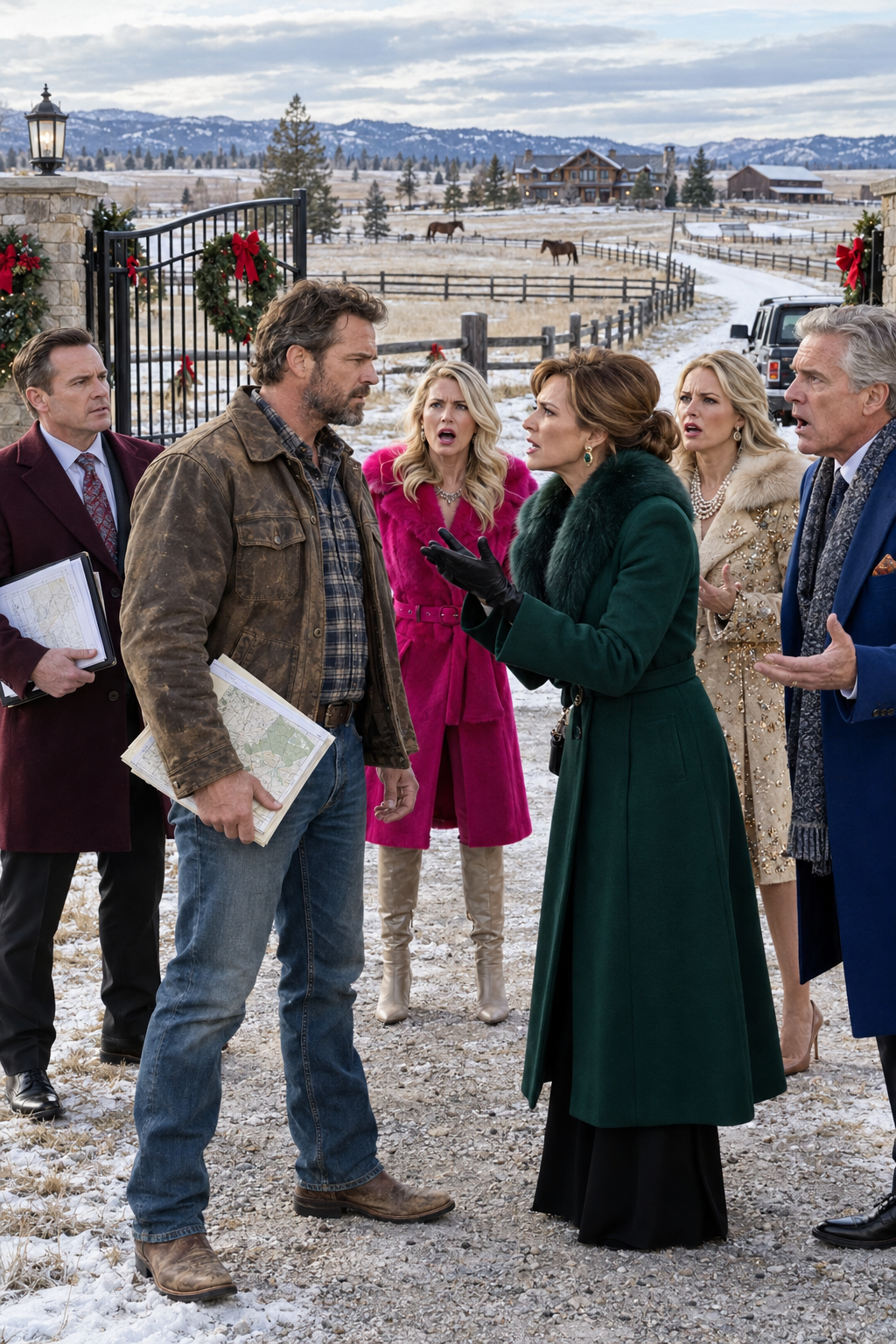
The HOA Bought the Only Road to Trap Me at Christmas—So I Bought the 4,200-Acre Ranch Around Their Homes
The steel gate appeared across my driveway six days before Christmas.
Not beside my property.
Not near my property.
Across the only road connecting my ranch house to the county highway.
And hanging from the center chain, beneath a bright red Christmas bow, was a laminated notice from the Cedar Ridge Homeowners Association.
ACCESS REVOKED.
I stood there in eighteen-degree Wyoming air with a bag of groceries in one hand and my eleven-year-old daughter Lily beside me.
Behind the gate, HOA president Pamela Whitfield smiled from the heated cab of her white Range Rover.
“Merry Christmas, Mr. Bennett,” she called through the cracked window. “You should’ve taken our offer.”
I set the groceries in the snow.
Then I looked at the new padlock.
Then at Pamela.
Then at the security camera someone had bolted onto my neighbor’s old fence post.
And finally at the small brass plaque screwed into the gate.
CEDAR RIDGE COMMUNITY — PRIVATE ROAD.
I almost laughed.
Because Pamela Whitfield thought she had just trapped me on ninety-three acres.
She had no idea that twenty-four hours earlier, I had signed a purchase agreement giving me control of the 4,200-acre ranch surrounding nearly every house in Cedar Ridge.
I didn’t tell her.
That would have ruined Christmas.
My name is Daniel Bennett.
I was forty-three that winter, divorced, raising Lily most of the time, and living on a horse property outside Buffalo, Wyoming, that had belonged to my grandfather.
Granddad bought the original parcel in 1968.
Back then, there was no Cedar Ridge.
No luxury homes.
No stone entrance monuments.
No committee sending angry letters because somebody parked a horse trailer where people could see it.
There was just grassland, cottonwoods, cattle, snow, and the long gravel lane that ran from County Road 18 through the neighboring Harlan property to ours.
The Bennetts had used that road for fifty-five years.
The Harlans had never cared.
Walter Harlan was seventy-eight, stubborn as a fence post and probably the only man I knew who still called every refrigerator an “icebox.”
For decades, all we needed was a handshake.
“You use the road,” Walter used to tell Granddad. “I use your north well when mine freezes. That’s what neighbors are for.”
Then Cedar Ridge happened.
A developer named Sterling Land Company bought eight hundred acres east of Walter’s ranch during the housing boom.
They carved it into oversized lots and advertised “exclusive Western living.”
People arrived from Denver, Seattle, Minneapolis, and California.
Nothing wrong with that.
Most were good people.
The problem was the HOA board.
Especially Pamela Whitfield.
Pamela was fifty-eight, always dressed like she had somewhere more important to be, and possessed an extraordinary ability to turn small amounts of authority into military occupations.
She drove around Cedar Ridge photographing trash cans.
She fined residents for leaving basketball hoops visible from the street.
She once sent a retired firefighter a $400 violation because his American flag was “two inches larger than community standards.”
And three years before the gate appeared, she decided my ranch was damaging Cedar Ridge property values.
My red barn was apparently “visually inconsistent.”
My cattle trailer was an “industrial vehicle.”
The horses were “odor-producing livestock.”
And my ranch house, which had stood there since 1974, did not comply with Cedar Ridge’s approved exterior color palette.
That was the first letter.
I mailed it back with four words.
I am not in Cedar Ridge.
The second letter arrived two weeks later.
It included photographs of my barn and a proposed “compliance schedule.”
I returned that one too.
Not in your HOA.
The third letter threatened a lien.
I called the association’s attorney.
He sounded embarrassed.
“You’re Daniel Bennett?”
“Parcel ending 0417?”
There was silence.
Then keyboard tapping.
Then a sigh.
“Mr. Bennett, disregard the notices.”
Pamela didn’t.
For three years she kept trying little things.
Complaints to the county.
Noise reports.
Anonymous calls about “unlicensed commercial agricultural activity.”
A petition claiming my cattle contaminated Cedar Ridge runoff.
Every accusation disappeared after someone checked the records.
I never fought Pamela emotionally.
That frustrated her more than anger would have.
I documented everything.
Photographs.
Survey pins.
Phone calls.
Because my grandfather taught me something useful when I was sixteen.
“When somebody keeps pushing a fence,” he said, “don’t stand there yelling at them. Find out who owns the ground under their boots.”
I remembered that sentence.
Especially that Christmas.
The trouble started in October when Walter Harlan called me.
His voice sounded weak.
“Danny, I’m selling.”
I lowered the wrench I was holding.
Walter had no children nearby.
His wife had died four years earlier.
His cattle herd was down to thirty head.
I knew the day would come.
Still, hearing it hurt.
“How much land?”
“House parcel and west field. Two hundred eleven acres.”
My stomach tightened.
The gravel road crossed Walter’s property for nearly three-quarters of a mile.
“Who’s buying?”
“Don’t know yet.”
Then he paused.
“Your HOA lady has been around.”
“She’s not my HOA lady.”
Walter laughed.
“Sure acts like she is.”
I drove over that afternoon.
Walter sat on his porch wearing an old Carhartt jacket with a blanket across his knees.
“You have an easement recorded?” he asked.
That question bothered me.
The Bennett family had used the road since before I was born.
But had anyone recorded the access formally?
I had copies of several old deeds.
I remembered references to agricultural access.
Nothing specific enough to trust.
“I’ll check.”
Walter nodded.
“Do it soon.”
Two weeks later he accepted an offer.
The buyer wasn’t Pamela personally.
It was a company called CR Community Holdings LLC.
I searched the Wyoming business registry that night.
Registered agent: a law office in Sheridan.
Mailing address: same suite used by Cedar Ridge HOA counsel.
That got my attention.
I called Walter.
“You sold to the HOA?”
“I sold to an LLC.”
“Funded by them.”
He coughed.
“Could be.”
“They paid cash, Danny.”
I closed my eyes.
I couldn’t blame him.
He needed medical care.
He wanted to move to Arizona and live near his sister.
“How long until closing?”
“December second.”
“Did they say anything about my road?”
Another pause.
“They asked whether you had rights to it.”
I stopped breathing for half a second.
“What did you say?”
“Told them your family had used it forever.”
“They wanted paperwork.”
I looked out my office window toward the dark line of cottonwoods separating our properties.
“What else did they want?”
Walter hesitated.
“That’s when I decided you ought to hear about it.”
Two days later Pamela came to my ranch.
She brought HOA vice president Trevor Collins and a younger man wearing polished boots and carrying a leather folder.
I was repairing fence near the driveway.
Pamela stepped out of her Range Rover and smiled.
She glanced around.
“Beautiful land.”
“That’s new.”
“I’ve always appreciated its potential.”
There it was.
People like Pamela never admired land unless they had plans for it.
Trevor stayed by the vehicle.
The younger man introduced himself as Grant Hollis, a real estate consultant.
Pamela got to the point.
“We understand the Harlan property is being transferred.”
“That creates an interesting access situation.”
“I’ve been using that road since 1983.”
“Historical use and legal rights aren’t always the same thing.”
I wiped my hands on my jeans.
“Is that why you bought Walter’s land?”
Pamela gave me the kind of smile people use when they think admitting nothing makes them clever.
“The HOA has long-term infrastructure goals.”
“Did those goals cost $680,000?”
Grant’s eyebrows moved.
Pamela’s didn’t.
Public records are useful.
She stepped closer.
“Daniel, Cedar Ridge has discussed acquiring your ninety-three acres several times.”
“You haven’t even heard the new offer.”
“Still no.”
“One point one million.”
That was higher than the earlier offers.
Still irrelevant.
“My grandfather’s buried on that hill.”
Her expression barely changed.
“I’m sorry, but sentimentality can become very expensive.”
That sentence stuck with me.
“What happens if I don’t sell?”
She looked toward Walter’s road.
“We’ll all have to operate within our legal rights.”
“So that’s the plan.”
“What plan?”
“You bought the road to pressure me.”
“That’s your interpretation.”
“I like interpretations that survive discovery.”
For the first time, Grant looked uncomfortable.
Pamela’s smile tightened.
“You always make everything adversarial.”
“You came to my ranch after buying my access road.”
“We bought property available on the market.”
“To box me in.”
She straightened her coat.
“I’m offering you a graceful solution.”
“Think about Lily.”
That changed the temperature.
I took one step toward her.
Not quickly.
Not threateningly.
Just enough.
“Do not use my daughter as leverage.”
Pamela’s confidence flickered.
Only for a second.
Then she recovered.
“Nobody is threatening anyone.”
I opened the pasture gate beside me.
“Then we understand each other.”
She didn’t move.
“You could be landlocked by Christmas.”
I looked directly at her.
“Then I guess we’ll see what Santa brings.”
Pamela left thinking she had scared me.
She had actually done me a favor.
She made the threat specific.
I called my attorney before her Range Rover reached the county highway.
His name was Marcus Hale.
Former county prosecutor.
Not flashy.
And incapable of being impressed by HOA letterhead.
I sent him every deed I had.
He started digging.
The first problem surfaced quickly.
The road had been used continuously for decades, but the oldest express easement was poorly worded.
A 1971 deed referenced “shared agricultural ingress,” but the attached survey was missing.
Another agreement from 1986 mentioned access “along the existing western lane” but had never been properly indexed by the county clerk.
We likely had a strong prescriptive easement claim.
But strong did not mean painless.
Pamela was betting that litigation would take months.
Maybe years.
She didn’t need to win permanently.
She only needed to make life miserable long enough for me to sell.
Marcus said exactly that.
“She’s not buying a road,” he told me. “She’s buying pressure.”
“So how do we remove the pressure?”
“Find another road.”
There wasn’t one.
My northern boundary climbed into rough foothills.
West was federal grazing land separated by steep ravines.
South and east were surrounded by private ranch property.
The Harlan road was the practical route.
Marcus studied the parcel map.
“What about the Mercer Ranch?”
I leaned forward.
The Mercer Ranch.
4,200 acres.
It wrapped around Cedar Ridge like a horseshoe.
For generations, the Mercer family had run cattle across the hills north, east, and south of the development.
Cedar Ridge looked enormous from inside its stone gates.
On a county parcel map, it looked like a postage stamp cut from the middle of Mercer land.
“What about it?”
“The south boundary of your ninety-three acres touches Mercer for approximately four hundred feet.”
“Across Miller Creek.”
“That creek runs through a canyon.”
“Only part of it.”
I zoomed in.
Marcus tapped the screen.
“There’s an old service trail here.”
I knew the trail.
Granddad and I had ridden horses through it when I was a teenager.
It climbed from my south pasture, crossed a shallow section of Miller Creek, and connected to an abandoned ranch track.
But that track belonged to Mercer.
“What are you suggesting?”
“Call the owner.”
The Mercer Ranch belonged to Eleanor Mercer, a widow in her seventies.
I hadn’t spoken to her in years.
I called anyway.
A man answered.
“Mercer Ranch office.”
“This is Daniel Bennett. I’m trying to reach Mrs. Mercer.”
There was silence.
Then, “Regarding?”
“A land issue.”
Another pause.
“Mrs. Mercer died in August.”
I sat back.
“I’m sorry. I hadn’t heard.”
“Family kept it private.”
“Who owns the ranch?”
“Estate does, temporarily.”
“Is it being sold?”
This pause was longer.
“Who did you say you were?”
The man was Eleanor’s nephew, Caleb Mercer.
We met two days later at a coffee shop in Buffalo.
Caleb was forty-six, broad-shouldered, tired-looking, wearing a ranch jacket with dried mud across the sleeves.
He had no interest in taking over the property.
Neither did his sister.
Estate taxes, equipment loans, and deferred maintenance had turned 4,200 acres of beautiful Wyoming ground into a problem nobody in the family wanted.
“It’s not listed yet,” he said.
“What would you take for an access easement across the northwestern corner?”
He stirred his coffee.
“Depends where.”
I showed him the map.
He studied it.
“You could build a road there.”
“With grading.”
“And a bridge.”
“Culvert, probably.”
“What happened to your old road?”
“Cedar Ridge bought it.”
Caleb laughed once.
“They bought Harlan just for the road?”
“That appears to be the strategy.”
He sat back.
“You know they’ve been after us too.”
That was news.
“For what?”
“What trails?”
“Walking paths. Bike routes. Creek access.”
Cedar Ridge’s brochure advertised miles of “community nature trails.”
I had assumed those trails were inside the development.
Caleb pulled out his phone.
He showed me photographs.
Wooden bridges.
Directional signs.
All sitting on Mercer land.
“How long has this been here?”
“At least four years.”
“Did your aunt approve it?”
“Why didn’t she stop them?”
“Mom was sick. Aunt Eleanor spent most of her time in Arizona. Ranch manager quit. Nobody paid attention.”
I looked again.
A trail map on one sign clearly carried the Cedar Ridge logo.
Caleb leaned closer.
“They think the south pasture belongs to them.”
“How much land?”
“Roughly three hundred acres they treat like a private park.”
“Three hundred?”
Suddenly Pamela’s “infrastructure goals” looked larger than my driveway.
“Are you selling the ranch?”
Caleb watched me.
“Eventually.”
“How eventually?”
“How much?”
He almost laughed again.
“You asking because you want twenty feet for a road or because you want 4,200 acres?”
“At the moment?”
I looked at the map.
I was not rich enough to casually buy a 4,200-acre ranch.
But I wasn’t broke either.
I owned a regional fencing and excavation company my father and I had built together.
Twenty-two employees.
Four dozers.
Two graders.
Three excavators.
A lot of equipment debt.
And enough equity in the business and my existing ranch to make dangerous ideas possible.
Caleb’s estate wanted $8.9 million.
That number was well beyond my comfort zone.
Then Caleb said something that changed everything.
“There’s a conservation buyer looking at it.”
“Won’t say.”
“Seven point two.”
“Why so low?”
“Cash. Thirty-day close.”
I stared at the map.
4,200 acres.
Creek frontage.
Grazing leases.
Timber rights.
Two employee houses.
A machine shop.
And, most importantly, every private road Cedar Ridge relied upon on its southern and eastern edges crossed small fingers of Mercer property.
Not the main entrance.
But secondary access.
Utility corridors.
Drainage channels.
Two miles of walking trails.
A private fishing pond.
Their Christmas sledding hill.
I called my accountant from the parking lot.
By sunset, I knew purchasing Mercer Ranch would hurt.
By midnight, I knew it was possible.
I did not decide because of revenge.
Revenge is a terrible reason to sign an eight-figure stack of debt.
I studied cattle leases.
Water rights.
Conservation credits.
Timber contracts.
Equipment values.
A cell tower lease nobody in the Mercer family had remembered.
Two hunting outfitters paying below-market rates.
A county gravel agreement.
The ranch could support the debt if managed correctly.
More importantly, it would connect directly to my land.
I made an offer.
$7.55 million.
Forty-five-day close.
Substantial earnest money.
Caleb countered at $7.9 million.
We settled at $7.72 million, subject to environmental and title review.
I signed the purchase agreement on December fifteenth.
Twenty-four hours later, Pamela installed her gate.
She stood behind it believing I had nowhere to go.
I looked at Lily.
She was staring at the sign.
“Can they do that?”
“For today?”
I picked up the groceries.
“Apparently.”
“How do we get home?”
I pointed toward the tree line.
Her eyes widened.
“The creek?”
“The creek.”
We drove half a mile south along the county shoulder, entered Mercer Ranch through a gate Caleb had given me temporary permission to use, and followed the abandoned ranch trail toward our property.
Snow covered most of it.
My truck crawled in four-wheel drive.
Lily loved every second.
When we reached Miller Creek, she looked at the frozen banks.
“This is not a road.”
We crossed slowly through the shallow ford.
Ten minutes later, we entered our south pasture.
Lily turned around in her seat.
“So the HOA didn’t trap us?”
“Not exactly.”
She smiled.
“Do they know?”
Her smile got bigger.
“Can I be there when they find out?”
I looked at her.
She had inherited my mother’s talent for enjoying consequences.
“Absolutely.”
The next morning, Marcus filed for emergency relief regarding the Harlan road.
Meanwhile, I did something Pamela wasn’t expecting.
I didn’t cut the gate.
I didn’t argue with her security guards.
I didn’t post angry videos.
I didn’t threaten lawsuits on Facebook.
I didn’t call local television stations.
I documented.
I photographed.
I recorded every denial of access.
The UPS driver turned away with Lily’s Christmas gifts.
Documented.
The propane delivery truck denied entrance.
Documented.
My farrier told he couldn’t pass.
Documented.
A county ambulance attempted to verify emergency access and was delayed at the gate for nine minutes while a private security employee tried calling Pamela.
Documented.
Pamela wanted emotion.
I gave her evidence.
She wanted panic.
I gave her timestamps.
She wanted me begging at her gate.
I gave her silence.
I kept records when the snow fell.
I kept records when the propane truck turned around.
I kept records when Lily asked why strangers were guarding Grandpa’s road.
I kept records when Pamela sent another purchase offer.
I kept records because some people mistake quiet for weakness right up until quiet becomes Exhibit A.
Three days before Christmas, Pamela emailed me.
SUBJECT: FINAL OPPORTUNITY.
The offer had increased to $1.25 million.
The message said Cedar Ridge “could not guarantee continued accommodation” if I refused.
I forwarded it to Marcus.
He replied with two words.
The next morning I met a road engineer on Mercer Ranch.
By lunchtime we had staked a route.
Seven-tenths of a mile.
A raised gravel section.
One engineered culvert.
Minimal grade work.
My own company could build most of it.
We started immediately.
I had the advantage of owning the machines.
Pamela had the disadvantage of believing I was helpless.
At the following morning, my D6 dozer started clearing the old ranch track.
At , Pamela arrived.
She parked on the Cedar Ridge side of the fence.
Trevor Collins jumped out behind her.
Pamela stared at the machine.
Then at me.
“What are you doing?”
“Building a road.”
“This is Mercer property.”
“You don’t own Mercer property.”
She looked confused.
“You can’t construct a road here.”
“I have written permission.”
“From whom?”
“The seller.”
Her face changed.
Just slightly.
“The seller?”
Trevor walked closer to the fence.
“Mercer Ranch isn’t for sale.”
“It wasn’t publicly listed.”
Pamela looked at Trevor.
He looked back at her.
That little exchange told me something.
They knew more about Mercer than they wanted me to know.
Pamela turned toward me.
“Whatever arrangement you made, Cedar Ridge has recreational-use rights through this corridor.”
“Show me the recorded easement.”
She hesitated.
“We’ve used these trails for years.”
“Interesting argument.”
Her jaw tightened.
“You know exactly what I mean.”
“Actually, I do.”
She had unknowingly repeated the central argument in my access case.
Historical continuous use.
I could almost hear Marcus laughing when I told him later.
Pamela pointed toward my dozer.
“Stop construction until this is resolved.”
“You may be interfering with community assets.”
“On Mercer land.”
“We have rights.”
“Then send documentation.”
“You are being deliberately difficult.”
“No, Pamela. I’m being deliberately specific.”
I climbed back into my pickup.
She stepped closer.
“Did you buy an easement?”
I closed the door.
“Have a nice morning.”
Her confidence had cracked.
I could see it.
For the first time since she bought Walter’s road, Pamela didn’t know what I was doing.
That frightened her.
The temporary road reached my property on December twenty-third.
It was rough.
Muddy beneath the snow.
And absolutely beautiful.
A propane truck became the first commercial vehicle to use it.
Lily filmed the truck rolling toward our house like we were opening the interstate.
That evening, we decorated the tree.
I made chili.
Snow collected on the porch railings.
For the first time in a week, the house felt normal.
Then somebody knocked.
Walter Harlan stood outside.
I hadn’t expected him.
He had moved most of his furniture already.
His Arizona flight was scheduled for the twenty-sixth.
He shook snow from his boots.
Lily hugged him.
Walter handed her a wrapped box.
“Christmas present.”
She disappeared toward the tree.
Walter waited until she was out of earshot.
“Need to tell you something.”
I poured coffee.
He didn’t touch it.
“Pamela came to me in September.”
“No. Earlier than you think.”
I sat down.
“She knew about your road problem before she made the offer.”
“What do you mean?”
Walter pulled a folded document from his coat.
It was a photocopy of an old survey.
My pulse changed.
A dashed line crossed Walter’s property along the exact gravel route we used.
Beside it were the words:
PERPETUAL INGRESS/EGRESS — BENEFIT OF BENNETT PARCEL.
I looked at Walter.
“Where did you get this?”
“My closing file.”
“Pamela’s people saw it?”
Walter nodded.
“The title company flagged it.”
I stared at him.
“If this is valid, they never had the right to block me.”
“Why didn’t you give me this earlier?”
His face tightened.
“Because I didn’t have it earlier. Title company sent the full packet yesterday.”
I looked again.
Recorded instrument number.
Everything.
Pamela didn’t buy the road believing she could legally block me.
She bought it knowing she probably couldn’t.
Which meant the gate wasn’t a legal strategy.
It was intimidation.
Maybe worse.
Walter rubbed his hands together.
“There’s another thing.”
Of course there was.
“She asked me to sign a statement.”
“What statement?”
“Saying your family’s road use had always been permissive.”
I felt my jaw tighten.
“Did she offer money?”
“How much?”
“Twenty thousand.”
I leaned back.
That was the first real twist.
Pamela wasn’t simply aggressive.
She had tried to manufacture evidence.
“Do you have proof?”
Walter reached back into his coat.
Printed email.
There it was.
A message from Pamela.
A draft declaration attached.
And a sentence that made Marcus go completely silent when I sent it to him.
Compensation would be available for Walter’s cooperation.
Christmas Eve arrived clear and bitterly cold.
At 10:30 that morning, a sheriff’s deputy met Marcus and me at the Harlan gate.
We had an emergency court order.
Access restored immediately pending final determination.
Pamela arrived ten minutes later with Grant Hollis and HOA counsel.
She got out of her SUV holding a folder.
“This is unnecessary.”
Marcus handed the order to the deputy.
“Judge disagrees.”
Pamela looked at me.
“You really want to do this on Christmas Eve?”
I almost admired the nerve.
“You put the gate here six days before Christmas.”
“I was protecting HOA property.”
“By ignoring a recorded easement?”
Grant turned toward Pamela.
That was interesting.
She hadn’t told him.
Her attorney took the survey Marcus offered.
He read it.
Then read it again.
She didn’t answer.
He lowered his voice.
“Did the title company provide this before closing?”
She stared at me.
The deputy cleared his throat.
“Ma’am, I need the gate opened.”
Pamela folded her arms.
“The HOA disputes the scope.”
The deputy looked at the court order.
“The judge doesn’t.”
She finally removed a key from her purse.
The padlock clicked.
The chain fell.
I didn’t cheer.
Didn’t smile.
Didn’t say a word.
I just drove through.
That bothered Pamela more than any celebration could have.
Because she was beginning to understand I wasn’t trying to win arguments.
I was building positions.
At noon, my employees shut down for Christmas.
I gave everybody bonuses.
Then Lily and I drove to the Mercer Ranch house.
Caleb was there signing final estate documents.
Our closing was scheduled for December twenty-ninth.
“Still want it?” he asked.
“More than ever.”
He slid a second folder across the kitchen table.
“We finished going through Aunt Eleanor’s office.”
“What’s that?”
“Cedar Ridge.”
Inside were letters going back six years.
Requests for trail access.
Requests for utility easements.
Requests to purchase sixty acres along Miller Creek.
Eleanor had denied all of them.
Then something changed.
Three years earlier, Cedar Ridge began referring to the trails as “established community amenities.”
Without permission.
A year later, HOA maps included the Mercer pond.
Then the sledding hill.
Then almost three hundred acres of open space.
I found a glossy Cedar Ridge real estate brochure.
Across one page was a photograph of Miller Creek.
PRIVATE COMMUNITY CREEK ACCESS — EXCLUSIVELY FOR CEDAR RIDGE RESIDENTS.
I knew that creek.
It was nearly half a mile outside Cedar Ridge.
Squarely inside Mercer Ranch.
“They’ve been marketing land they don’t own,” I said.
Caleb nodded.
“There’s more.”
He showed me a proposed development map.
Phase Four.
Forty-seven luxury homes.
A clubhouse.
Equestrian center.
Private lake.
All drawn across Mercer acreage.
“Where did this come from?”
“Aunt Eleanor’s files.”
“Pamela sent it.”
I looked at the date.
Eighteen months earlier.
At the bottom, handwritten in Eleanor’s sharp script:
ABSOLUTELY NOT.
Then underneath:
Tell P. Whitfield she cannot sell what isn’t hers.
I stared at the note.
Something cold settled in my stomach.
Pamela had wanted my ninety-three acres because my property sat beside the proposed Phase Four entrance.
The Harlan road wasn’t the prize.
My ranch wasn’t the prize.
The 4,200 acres around Cedar Ridge were.
And Pamela had been building toward them for years.
On Christmas morning, Lily woke me at .
She had received a telescope from me.
Riding boots from my sister.
Books from Walter.
And an antique silver horse pendant that had belonged to my mother.
We made pancakes.
Opened gifts.
Called family.
For six hours, I ignored Pamela Whitfield completely.
At noon, Lily and I rode horses along the south pasture.
Fresh snow covered the temporary road.
Sunlight hit the mountains.
For a while, none of the legal mess mattered.
Then we reached the fence overlooking Cedar Ridge.
Kids were sledding on Mercer land.
Families stood around a fire pit.
A Cedar Ridge maintenance crew had erected a temporary Christmas pavilion beside Miller Creek.
Music played from speakers.
Lily frowned.
“Is that part of the ranch you’re buying?”
“Do they know?”
“Probably not.”
“Is Pamela there?”
I spotted the white Range Rover.
Lily adjusted her gloves.
“Are you going to kick everybody out?”
I looked at the families.
Most had no idea.
They had bought homes believing the HOA’s claims.
Punishing them for Pamela’s actions would be easy.
It would also be stupid.
“Because when you’re right, you don’t need to be cruel.”
She considered that.
Granddad would have liked her.
December twenty-ninth came cold and cloudless.
I signed papers for nearly two hours.
Loan documents.
Water rights.
Grazing leases.
Mineral disclosures.
Transfer documents.
By 11:47 a.m., Mercer Ranch belonged to Bennett Land & Cattle LLC.
My company.
My responsibility.
My 4,200 acres.
I drove directly from closing to the ranch overlook.
Cedar Ridge spread below me.
Two hundred thirty-one homes.
A golf course.
Private pond.
Decorative entrance.
From the neighborhood, the HOA probably felt powerful.
From 4,200 acres above it, Cedar Ridge looked very small.
Marcus arrived in his truck.
He handed me a thermos.
“You realize you bought several million dollars of Wyoming because a woman put up a gate.”
“I bought a productive ranch.”
“Because a woman put up a gate.”
“Those facts can coexist.”
He laughed.
Then became serious.
“What now?”
“Nothing dramatic.”
“That disappoints me.”
“We send notices.”
“Everyone.”
January second, every Cedar Ridge homeowner received a letter.
It was polite.
And devastating.
The letter explained that ownership of Mercer Ranch had transferred.
Existing community use of ranch property would be temporarily honored for thirty days while access agreements were reviewed.
Residents were asked not to panic.
No immediate fences would be erected.
No family would be cited for unknowingly using trails.
Then came the important sentence.
Cedar Ridge HOA did not own, lease, or possess recreational rights to the approximately 312 acres it had represented as community-controlled open space.
The HOA board called an emergency meeting that night.
I was invited.
Of course I went.
The clubhouse parking lot was full.
Pamela stood near the front with Trevor and five board members.
More than one hundred residents packed the room.
Some held my letter.
Others held property brochures.
People were angry.
But not at me.
A man in a navy sweater raised his hand.
“My purchase agreement says the creek trail is a permanent amenity.”
Another woman said, “Our realtor specifically told us the pond was HOA property.”
A third homeowner called from the back.
“We paid a premium for lots adjacent to community open space.”
Pamela raised both hands.
“Please. Everyone. There is substantial misinformation circulating.”
I stood against the rear wall.
She saw me.
Her voice tightened.
“The recent purchaser of Mercer Ranch has chosen an aggressive interpretation of historic access arrangements.”
A woman turned.
“Is that him?”
Heads rotated.
Pamela had made a mistake inviting me.
I stepped forward.
“My name is Daniel Bennett.”
The room went quiet.
Pamela interrupted immediately.
“This meeting is not a forum for—”
“Let him speak,” someone shouted.
Then someone else.
“Let him talk.”
I kept it short.
“I’m not here to remove anyone tonight. I’m not here to threaten families. I’m not here to ruin property values.”
Pamela folded her arms.
I continued.
“I purchased Mercer Ranch. During title review, we found no recorded document granting Cedar Ridge HOA ownership or permanent recreational rights over the land identified in my letter.”
A homeowner raised his brochure.
“Then why is it marketed as ours?”
“That’s a question for your board.”
The room turned toward Pamela.
She stepped to the microphone.
“We relied on established usage and representations made during development.”
Marcus, seated near the side aisle, leaned toward me.
“Historical usage,” he whispered.
The irony was almost perfect.
The same woman who claimed fifty-five years of road use gave me no rights now argued a few years of unauthorized hiking gave her community rights over 312 acres.
I didn’t need to point it out.
A resident did it for me.
It was an older man named Frank Delaney.
I knew him vaguely.
Retired engineer.
He looked from Pamela to me.
“Didn’t we just buy the Harlan property because Mr. Bennett supposedly didn’t have legal road access despite using it for decades?”
Nobody spoke.
Frank frowned.
“So his fifty years of use meant nothing, but our five years of use means we own the Mercer trails?”
There are moments when an entire room understands something simultaneously.
That was one of them.
Pamela’s face went pale.
Trevor leaned toward her.
The board attorney stared at his notes.
Frank wasn’t finished.
“How much did we spend on the Harlan parcel?”
Pamela tried to move on.
“That transaction involved several strategic considerations.”
“How much?”
The treasurer finally spoke.
“Seven hundred twelve thousand after closing expenses.”
The room erupted.
Someone shouted, “For a road?”
Another yelled, “Whose idea was this?”
Pamela hit the microphone.
The microphone squealed.
That made things worse.
I didn’t say a word.
Mini-payoff number one.
Pamela had built a trap for me.
Instead, she had spent more than $700,000 of HOA money buying a property subject to my recorded easement.
And now her homeowners knew.
The next question came from a woman named Melissa Grant.
“Did the board know about Bennett’s easement before buying Harlan?”
Pamela went still.
Marcus looked at me.
I had Walter’s email.
I could drop it now.
But timing matters.
“Pamela?” Melissa asked.
The board attorney stood.
“We should not discuss active litigation.”
Wrong answer.
The crowd got louder.
Pamela ended the meeting seventeen minutes later.
Residents stayed another hour.
People came to me privately.
Most were reasonable.
They wanted trail access preserved.
I told them I was open to a licensing agreement.
Frank shook my hand.
“I don’t care who owns the hill. I care whether we were lied to.”
That was the real threat to Pamela.
Once homeowners stopped trusting the board, every old decision became suspicious.
Within forty-eight hours, residents requested financial records.
Board minutes.
Legal invoices.
Real estate communications.
Pamela responded by blaming me.
Her January newsletter described me as an “outside commercial landholder attempting to destabilize Cedar Ridge.”
I had lived there before Cedar Ridge existed.
I printed the newsletter and added it to the file.
Then my road crew discovered something.
We were grading along the eastern boundary when foreman Luis Ortega called.
“You should get out here.”
I drove twenty minutes.
Luis stood beside a buried utility marker.
“This power line is feeding something in the neighborhood.”
“It’s on our side.”
He pointed across the pasture.
“Almost a mile.”
I called the utility company.
They checked records.
There was an easement.
But not where the line had been built.
The recorded corridor ran fifty feet west.
At some point during Cedar Ridge’s expansion, contractors shifted the line onto Mercer land.
But another example of sloppy entitlement.
Then we found a sewer lift station.
Seven feet inside my boundary.
Then a stormwater basin.
Twenty-three feet inside.
Then half of Cedar Ridge’s decorative south entrance landscaping.
Then six hundred feet of golf-cart path.
Nobody had noticed because the old Mercer fence wandered with terrain instead of following the surveyed boundary.
I hired a professional survey crew.
They placed bright orange stakes.
That afternoon Pamela drove out.
She stopped beside one.
“What are these?”
“Boundary markers.”
“This isn’t the boundary.”
“Survey says it is.”
“The HOA has maintained this area for years.”
“There’s that argument again.”
Her mouth tightened.
“You’re enjoying this.”
“Not really.”
“You expect me to believe that?”
“I expect you to believe the survey.”
She stepped closer.
“What do you want, Daniel?”
The question that mattered.
“Nothing from you.”
“Everyone wants something.”
“I want accurate boundaries. Legal agreements. Honest records.”
“That sounds noble.”
“It’s also cheaper than litigation.”
“You bought an entire ranch to prove a point.”
“I bought a ranch because it was a good asset.”
“You’re trying to humiliate me.”
“No, Pamela.”
I glanced toward Cedar Ridge.
“You’re experiencing the difference between authority you actually have and authority you assumed nobody would challenge.”
Her face hardened.
Then she said something strange.
“You have no idea what you bought.”
“What does that mean?”
For half a second, fear appeared in her eyes.
Then it vanished.
“You’ll find out.”
I stood there watching the Range Rover disappear.
That sentence bothered me.
That night I called Caleb.
“Did Mercer Ranch have any major undisclosed issues?”
“Not that I know of.”
“Lawsuits?”
“Environmental?”
“Development agreements?”
“There was something Aunt Eleanor used to complain about.”
“Old option contract.”
I sat upright.
“What option contract?”
“I never saw it.”
“With whom?”
“Sterling Land, maybe.”
The original Cedar Ridge developer.
“Ten, twelve years.”
“Still active?”
“Thought it expired.”
“Daniel, estate lawyers reviewed title.”
“But Pamela just told me I don’t know what I bought.”
Another silence.
“I’ll check Eleanor’s boxes.”
January moved fast.
The emergency hearing over my road became almost anticlimactic.
The recorded 1971 easement was clear.
My access rights remained.
The gate stayed open.
The HOA paid part of my legal fees.
Pamela called it “a procedural setback.”
Residents called it $700,000 wasted.
A recall petition started.
She survived the first vote because the bylaws required sixty percent.
She got fifty-seven.
Three points saved her.
That made her more dangerous.
A week later, Cedar Ridge’s attorney sent me a formal demand.
They claimed adverse possession over portions of Mercer Ranch.
Pond shoreline.
Sledding hill.
Utility land.
Golf-cart path.
I read the letter twice.
Then called Marcus.
“They’re claiming the land?”
“Apparently.”
“After sending me violation letters for using property they didn’t own?”
“Apparently.”
“Can they win?”
“Very unlikely.”
“Why file it?”
“To create leverage.”
There was that word again.
Pamela’s favorite tool.
The problem was she kept creating leverage for me too.
Our survey found something bigger.
The private pond Cedar Ridge advertised?
Eighty-one percent of it lay on Mercer Ranch.
Including the dam.
The HOA owned only a narrow northeastern shore.
Their fishing dock extended into my parcel.
Their kayak storage building sat entirely on my land.
The Christmas pavilion?
The sledding hill?
Two trail bridges?
The overlook where Cedar Ridge held wedding ceremonies?
I could have closed them all.
Instead, I offered a temporary annual recreation license for one dollar.
One dollar.
The agreement required only four things.
Cedar Ridge would acknowledge Bennett Land & Cattle ownership.
Residents could keep using designated trails.
The HOA would carry appropriate insurance.
And the board would stop representing the property as HOA-owned.
That was it.
Pamela rejected it.
One dollar.
She rejected it.
Because signing would publicly admit she never controlled the land.
She would rather risk losing access than surrender the illusion of ownership.
That decision turned homeowners against her faster than anything I could have done.
Frank posted the proposed agreement in the community group.
Comments exploded.
ONE DOLLAR?
WHY DID THE BOARD REFUSE THIS?
WE ARE ABOUT TO LOSE THE TRAILS OVER PRIDE?
Pamela removed the post.
Someone reposted it.
She disabled comments.
Screenshots circulated.
She sent a violation notice to Frank for “improper use of community communications.”
Frank framed it.
By February, the second recall petition had seventy-four percent support.
Pamela tried one last move.
She called me.
Not emailed.
“I’d like to settle.”
“Send terms through Marcus.”
“This should be between us.”
Her voice sounded exhausted.
“I can make the road issue disappear permanently.”
“It already disappeared in court.”
“I can guarantee Cedar Ridge never interferes with your property again.”
“In exchange for?”
“Sell us four hundred acres.”
There it was.
“Which four hundred?”
“You know.”
The southern bench.
Miller Creek.
My new access corridor.
Phase Four.
“You’re still trying to build the expansion.”
“Cedar Ridge needs growth.”
“Because infrastructure costs are rising.”
“So raise dues.”
“You don’t understand the finances.”
“Then explain them.”
She changed direction.
“Four hundred acres. Three point six million.”
“Four point five.”
“That is nearly twice agricultural value.”
“I’m not selling.”
“You don’t even need that land.”
Neither had Walter, according to her.
Neither had Eleanor.
Neither did anyone, apparently, unless Pamela wanted it.
“Good night.”
Something in her voice stopped me.
Not authority.
Desperation.
“If Cedar Ridge doesn’t complete Phase Four, there could be consequences for everyone.”
“What consequences?”
She caught herself.
“I’m talking about long-term property values.”
“No, you aren’t.”
“Good night, Daniel.”
She hung up.
I sat in my office staring at the phone.
Then I opened every document Caleb had given me.
Three hours later, I found a reference.
Not the contract.
A reference to it.
Sterling Land Development Agreement — Phase IV Option.
Dated eleven years earlier.
I called Caleb at 11:30 p.m.
He answered half asleep.
“Please tell me nobody died.”
“Where are Eleanor’s old legal files?”
“Storage building behind the equipment barn.”
“Office drawer.”
I put on my boots.
By midnight, I was opening boxes under fluorescent lights.
Tax records.
Cattle receipts.
Water reports.
Old Christmas cards.
Property maps.
At a.m., I found Sterling Land.
The original agreement was thick.
Most of it had expired.
Phase Three.
Then Exhibit H.
OPTION FOR FUTURE DEVELOPMENT PARCEL.
Four hundred twelve acres.
Exactly the land Pamela wanted.
The option had originally expired seven years earlier.
But a handwritten note directed me to an amendment.
I found Amendment Three.
Expiration extended.
Then Amendment Five.
Extended again.
Then a document signed three years earlier.
It extended the purchase option through December 31 of the current year.
My heart started beating harder.
The option price?
$2.4 million.
Pamela had just offered me $4.5 million for land Cedar Ridge apparently believed Sterling could force me to sell for $2.4 million.
Something didn’t fit.
Then I saw the signature.
Eleanor Mercer.
Except I had seen Eleanor’s signature on dozens of ranch documents during closing.
Her E curved high.
Her M slanted backward.
The signature on the option extension looked different.
Not dramatically.
But enough.
I photographed it.
At the next morning, I sent it to Marcus.
He called immediately.
“Do not contact Pamela.”
“Wasn’t planning to.”
“We need a handwriting expert.”
“Think it’s forged?”
“I think we assume nothing until someone qualified looks.”
Three days later, the preliminary opinion came back.
High probability the signature was not authentic.
That was twist number two.
And it changed the entire story.
If the extension was forged, somebody had tried to create development rights across land they didn’t own.
If Cedar Ridge relied on it, that explained Pamela’s desperation.
If Pamela knew it was forged, the problem was far beyond HOA politics.
Marcus dug deeper.
Sterling Land Company had dissolved five years earlier.
Its remaining contractual assets had been transferred to another LLC.
Western Community Expansion Partners.
Registered manager?
Grant Hollis.
The real estate consultant who had stood beside Pamela the day she threatened to landlock me.
Not Pamela.
Suddenly their relationship made sense.
Grant’s company held the alleged option.
Pamela needed Phase Four.
Grant needed land.
The Harlan purchase boxed me from the north.
Cedar Ridge’s claim over Mercer trails pressured the south.
My ninety-three acres controlled the cleanest entrance to their planned development.
This was never about my barn.
Never about my trailer.
Never about my horses.
I had been sitting on the missing puzzle piece for years.
And they had been trying to make me sell without telling me why.
Marcus wanted patience.
“Let them make the next move.”
February twenty-third.
Western Community Expansion Partners sent me certified notice that it intended to exercise its option to purchase the 412-acre Phase Four parcel for $2.4 million.
I read the letter at my kitchen table.
Lily was doing math homework.
She looked up.
“Interesting.”
“That means bad.”
“Sometimes.”
I handed the notice to Marcus that afternoon.
He smiled without humor.
“They stepped in it.”
“How deep?”
“We’re going to find out.”
We rejected the option as invalid.
Grant’s attorneys sued for specific performance.
Pamela publicly insisted Cedar Ridge was “not a party to the private dispute.”
Then discovery started.
That sentence did not age well.
Emails showed Pamela and Grant had discussed the Mercer property repeatedly.
Infrastructure.
One email from Grant to Pamela read:
Bennett remains obstacle at northwest entrance. Harlan acquisition should improve negotiating position.
Once road control is secured, Bennett likely has 60–90 days before operational pressure becomes unsustainable.
Operational pressure.
That was my propane delivery.
My groceries.
My daughter’s access.
My business trucks.
They had written it down.
Pamela had replied:
That one word ended her presidency.
The third recall vote was held on a snowy Thursday night.
Eighty-eight percent voted her out.
Trevor resigned before votes finished counting.
Frank Delaney became interim board president.
His first act was signing my one-dollar recreation license.
His second was ordering a forensic audit.
Pamela left the clubhouse through the side door.
I saw her in the parking lot.
She looked smaller somehow.
Not defeated.
There’s a difference.
She stopped beside my truck.
“You think this is over.”
“You destroyed this community.”
“They’ll blame you when dues double.”
“Why would dues double?”
She stared at me.
Then laughed softly.
“You still don’t know.”
“What don’t I know?”
She opened her Range Rover.
“You bought the ranch.”
“You bought the debt attached to it.”
“What debt?”
She got inside.
Marcus stepped toward us.
Pamela closed the door.
I knocked on the glass.
She lowered it two inches.
“What debt?”
Her face had changed.
For the first time, she looked almost relieved.
“You should ask why Eleanor Mercer kept extending an option she supposedly hated.”
“She didn’t sign the last extension.”
Pamela’s eyes flickered.
That landed.
But she recovered.
“What debt?”
She rolled the window up.
Then drove away.
I immediately called the title company.
No recorded mortgage beyond the loan I had used to purchase.
No tax lien.
No judgment.
No obvious debt.
Marcus searched state records.
Caleb knew nothing.
For two weeks, Pamela’s warning seemed like another bluff.
Then the forensic audit of Cedar Ridge arrived.
Frank called me at on a Sunday morning.
“You need to see this.”
We met at the clubhouse.
Frank had financial statements spread across a conference table.
HOA reserve account.
Construction accounts.
Developer reimbursements.
Legal expenses.
Then one entry.
A payment from Cedar Ridge HOA to Western Community Expansion Partners.
$1.8 million.
“What is that?”
Frank shook his head.
“We don’t know.”
“Three years ago.”
Same period as the forged Mercer option extension.
Another payment followed.
Then $450,000.
Nearly $2.9 million total.
Paid to Grant’s company.
No homeowner vote.
No clear contract.
No completed development.
Frank looked sick.
“We have less than $400,000 left in reserves.”
“What were the payments labeled?”
“Land development deposits.”
“But the HOA didn’t acquire land.”
I looked at him.
“Where did Pamela get authority?”
“Board minutes.”
The minutes referenced confidential executive sessions and “future amenity acquisition.”
No parcel numbers.
No details.
Marcus arrived twenty minutes later.
He read everything.
Then said, “Call the sheriff.”
The investigation moved out of HOA territory quickly after that.
County detectives interviewed former board members.
The state Division of Criminal Investigation requested records.
Grant stopped answering calls.
His office closed.
Pamela hired a criminal defense attorney.
I focused on the civil case.
Then came March seventh.
A ranch employee found a metal box inside an old desk in Eleanor’s locked tack room.
It contained letters.
One was from Pamela.
One from Grant.
And one from a bank.
The bank letter changed everything again.
It referenced a private loan.
Borrower: Sterling Land Company.
Collateral: proposed Phase Four development rights.
Guarantor: Cedar Ridge HOA.
Secondary collateral: future utility assessment revenues.
I read it three times.
The amount?
$11.6 million.
My mouth went dry.
Sterling Land had borrowed $11.6 million years earlier to fund expansion infrastructure.
The project stalled.
The company collapsed.
But instead of allowing the development plan to die, somebody kept the Phase Four option alive.
Because if the option expired, the collateral package unraveled.
And Cedar Ridge HOA might be exposed to the guarantee.
That was why Pamela needed the land.
Not just profit.
If the bank enforced the old guarantee, homeowners could face massive special assessments.
Potentially tens of thousands per house.
Pamela hadn’t simply been trying to expand Cedar Ridge.
She was trying to hide a financial bomb.
A bomb inherited from the original developer.
A bomb she believed she could solve by quietly acquiring my ranch entrance and the Mercer Phase Four land.
She had gambled millions of HOA dollars trying to keep the plan alive.
Then I bought the ranch.
I called Frank.
He was silent for nearly ten seconds.
“Eleven point six?”
“That’s what the letter says.”
“We don’t have eleven point six.”
“If this is valid, people could lose homes.”
There was no satisfaction in it.
Pamela had hurt me.
She had abused authority.
She had tried to manipulate Walter.
She had tried to trap Lily and me behind a gate.
But the families in Cedar Ridge hadn’t done those things.
They had bought houses.
Raised kids.
Trusted people they elected.
I wasn’t going to celebrate while they were crushed by a secret debt.
Marcus contacted the bank’s successor institution.
Their attorneys responded immediately.
Too immediately.
Yes, they had records.
Yes, the guarantee existed.
No, they would not discuss enforcement outside counsel.
That same day, two black SUVs arrived at Mercer Ranch.
Not police.
One represented the bank.
The other represented an investment company I had never heard of.
Northstar Municipal Assets.
They wanted a meeting.
I agreed for the next morning.
At sharp, four people entered my office.
Two lawyers.
One financial analyst.
And a gray-haired man named Stephen Cross.
Cross placed a folder on my desk.
“Mr. Bennett, our firm recently acquired certain distressed obligations connected to the Cedar Ridge development.”
“You bought the debt.”
“How much?”
“That information is confidential.”
“What do you want?”
He opened the folder.
Phase Four.
“We are prepared to resolve all outstanding obligations if development proceeds.”
“You haven’t heard the proposal.”
“I’ve heard versions of it for years.”
“Mr. Bennett, this is larger than Pamela Whitfield.”
“I’m beginning to understand that.”
He pointed at the map.
“Northstar can release Cedar Ridge HOA from substantial guarantee exposure.”
“In exchange for my land.”
“In exchange for development participation.”
Cross didn’t react.
“Four hundred twelve acres.”
“We would pay market value.”
“Seven million.”
The analyst looked at him.
Cross folded his hands.
Lily’s school bus passed outside.
I watched it for a second.
Cross noticed.
“We all have people we protect.”
I turned slowly.
His attorney immediately said, “He means financially.”
I looked at Cross.
“Be very careful with your next sentence.”
He lifted both hands.
“No threat intended.”
He gathered his documents.
Then he left one page behind.
“Consider what refusal means for your neighbors.”
I waited until they were gone.
Then picked up the page.
Projected special assessment.
Average per Cedar Ridge home:
Some homes higher.
Frank came over that evening.
He looked twenty years older than he had in January.
“How many families can handle fifty grand?”
“Not many.”
“What do we do?”
I walked to the window.
Snow was melting now.
Spring mud had appeared along the road.
The gate Pamela installed months earlier still stood on the Harlan property, permanently open, the chain removed.
I could see it from my office.
Funny thing about traps.
Sometimes the person who builds one spends so much time watching the door that they forget to look behind themselves.
“We audit the debt.”
Frank frowned.
“Bank already confirmed it.”
“Confirmed the guarantee existed.”
“Same thing.”
I turned back.
“We find out whether it’s enforceable.”
Marcus loved the idea.
For the next month, his team reconstructed eleven years of transactions.
Sterling Land.
Cedar Ridge HOA.
Grant Hollis.
Western Community Expansion Partners.
Every amendment.
Every payment.
Every board vote.
Every signature.
The picture that emerged was ugly.
But not hopeless.
The original HOA guarantee had conditions.
Strict ones.
Developer obligations had to be completed by specific dates.
Reserve thresholds had to be maintained.
Material amendments required homeowner approval.
Several requirements appeared not to have been met.
More importantly, the guarantee contained an expiration clause.
Five years.
Unless Cedar Ridge formally reaffirmed it.
Frank found no reaffirmation.
Northstar claimed Pamela had extended the obligation through side agreements.
Marcus asked for copies.
They resisted.
The court ordered production.
That’s when the final piece surfaced.
A document dated four years earlier.
Cedar Ridge Guarantee Reaffirmation.
Signed by Pamela.
And supposedly signed by then-treasurer Howard Pike.
Howard Pike had died eighteen months earlier.
Frank remembered him well.
“Would he have signed this?”
“No chance.”
“How sure?”
“He spent two years warning Pamela about developer debt.”
We compared signatures.
Howard’s looked wrong too.
A forensic examiner agreed.
Likely imitation.
Now we had two suspicious signatures.
Eleanor Mercer.
Howard Pike.
Both documents benefited the same development plan.
Both connected to Grant.
Both kept Phase Four alive.
By April, Grant Hollis was gone.
House empty.
Office empty.
Phone disconnected.
Federal investigators entered the picture because banking documents crossed state lines.
Pamela stopped speaking publicly.
Northstar backed away from its demand that I sell immediately.
Then, one Monday morning, Pamela called me.
I almost didn’t answer.
Her voice sounded different.
No command.
Just exhaustion.
“I need to meet you.”
“Talk to your attorney.”
“Because he’ll tell me not to tell you this.”
I looked at Marcus across my desk.
He shook his head.
I put the phone on speaker.
“You’re on speaker with counsel.”
Pamela laughed weakly.
“Of course I am.”
“What do you want?”
“Do you still have Eleanor’s original files?”
“Find a red ledger.”
“What ledger?”
“She kept one.”
“What’s in it?”
A long silence.
Then Pamela said, “The actual ownership records.”
I looked at Marcus.
“Ownership of what?”
“Phase Four.”
“We own Phase Four.”
“You own the surface.”
Cold moved down my spine.
“What does that mean?”
“Find the ledger.”
“Grant wasn’t after development rights.”
“What was he after?”
Another silence.
“He was after what’s underneath.”
The call disconnected.
Marcus stared at the phone.
“Mineral rights?”
“I don’t know.”
Our closing documents showed partial mineral reservations going back decades.
Common in Wyoming.
We knew we didn’t control everything underground.
But no major producing wells existed on the ranch.
No active drilling permits.
No obvious reason Grant would spend years manipulating an HOA for subsurface rights.
I called Caleb.
“Red ledger.”
He knew it.
“Aunt Eleanor kept an old ranch book in the house safe.”
“Where is it?”
“Safe should still be there.”
“Combination?”
He gave it to me.
Marcus and I drove to the original Mercer ranch house.
The safe sat behind a framed photograph in Eleanor’s study.
Inside were deeds.
Gold coins.
A revolver.
And a dark red leather ledger.
The pages were handwritten.
Livestock numbers at first.
Then water rights.
Then leases.
Then mineral agreements going back to the 1940s.
Near the back, Eleanor had created a separate section.
MILLER CREEK FORMATION.
I had never heard the term.
Marcus photographed every page.
One line was underlined twice.
Do not sell Parcel 7B mineral access. Geological report attached separately.
We searched the safe.
No geological report.
Desk drawers.
File cabinets.
Then I remembered Pamela’s words.
Grant wasn’t after development rights.
He was after what’s underneath.
I called a petroleum geologist I knew through excavation work.
He came out the next day.
We gave him copies.
He studied the old survey coordinates.
Then his expression changed.
“You know what these numbers are?”
“Old exploratory data.”
He pointed at the ledger.
“This notation is gas-bearing shale. But this one…”
He stopped.
“This is strange.”
I laughed because I thought he was joking.
Wyoming has natural helium deposits.
Industrial helium.
Valuable concentrations trapped with natural gas.
The old data suggested a possible field beneath the southern Mercer acreage.
Beneath Phase Four.
No proof of commercial quantity.
But enough to explain attention.
“How valuable?”
“Could be nothing.”
“And if it isn’t nothing?”
He looked at me.
“Then eight million for four hundred acres would be cheap.”
Suddenly every number changed.
The secret option.
The pressure campaign.
The forged signatures.
The HOA money.
Grant’s desperation.
Phase Four wasn’t about luxury homes.
Luxury homes were camouflage.
The land deal was the vehicle.
Someone had spent years trying to secure control without alerting the Mercers to what might lie underground.
I went outside.
Wind moved through dry grass.
Cedar Ridge roofs were visible in the distance.
Lily’s horse grazed near the south fence.
For months, I thought I had bought 4,200 acres to protect ninety-three.
Now I wondered whether I had accidentally bought something people had been secretly fighting over for a decade.
Federal agents executed warrants two weeks later.
Grant Hollis was arrested in Colorado.
Pamela surrendered the following morning.
The criminal cases would take months.
Maybe years.
Cedar Ridge homeowners were furious, but the immediate debt threat weakened when Northstar agreed to suspend enforcement pending litigation over the guarantee.
Frank remained president.
The trails stayed open.
The pond stayed accessible.
My road remained mine to use.
The old Harlan gate was removed completely.
For the first time since Christmas, life began to feel quiet.
One evening in May, Lily and I sat on the porch eating burgers after a long day.
She looked across the pasture.
“Do you regret buying the big ranch?”
I thought about debt payments.
Investigators.
Survey crews.
$7.72 million.
Then I looked at the sunset burning orange over Miller Creek.
“Even if there’s no helium?”
“Especially then.”
She frowned.
“That makes no sense.”
“It will when you’re older.”
A black pickup appeared far down the new ranch road.
Not one of mine.
It stopped at the house.
An elderly man stepped out.
Late seventies.
Maybe eighty.
Western hat.
Brown jacket.
He carried an envelope.
“You Daniel Bennett?”
He glanced at Lily.
“Need to speak privately.”
“Who are you?”
“Name’s Samuel Crane.”
The name meant nothing to me.
He handed me the envelope.
Inside was a photograph.
Black and white.
Probably taken in the late 1970s.
Three men stood beside a drilling rig on what looked like Mercer Ranch.
One was Eleanor’s husband.
One I didn’t recognize.
The third was my grandfather.
I stared at the picture.
Granddad had never told me he had anything to do with drilling on Mercer land.
I turned the photograph over.
Coordinates were written on the back.
And a sentence.
BENNETT KNOWS WHERE THE SECOND CORE WAS BURIED.
My mouth went dry.
“Where did you get this?”
Samuel Crane looked toward the hills.
“Your grandfather gave it to me.”
“Because people were already trying to buy that ground.”
I looked again at the photograph.
“My grandfather died twelve years ago.”
“What second core?”
Crane studied me.
“You really don’t know.”
His face changed.
Not surprise.
“Then Eleanor never told you.”
“Told me what?”
He looked toward Lily again.
Then lowered his voice.
“That ranch wasn’t the first property they tried to control.”
A cold feeling returned.
“What was?”
He pointed past my barn.
Toward my original ninety-three acres.
My grandfather’s land.
The property Pamela had been trying to buy for three years.
I stared at him.
“No exploration happened on my parcel.”
“You sure?”
Crane shook his head.
“Your grandfather drilled there himself.”
“He wasn’t looking for oil.”
The wind rattled the porch chimes.
I suddenly remembered something Granddad used to say whenever developers offered to buy the south pasture.
Never sell the hill.
I had always thought it was sentimental.
Family history.
His favorite view.
His grave was there.
Maybe I had been wrong.
Crane reached into his jacket and removed a folded topographic map.
A red X had been drawn directly beneath the hill where my grandfather was buried.
Beside it were three numbers.
I didn’t understand them.
Marcus would.
The geologist would.
Crane tapped the first number.
“This concentration reading came from Mercer.”
Then the second.
“This one came from seventeen miles south.”
Then the third.
He tapped the red X.
“This came from your grandfather’s test.”
I looked up.
“What is it?”
Crane’s eyes held mine.
“The highest helium concentration any of us had ever seen.”
For several seconds, I heard nothing except wind.
Then headlights appeared on the county road.
Two vehicles.
Moving slowly.
Crane looked toward them.
His expression changed instantly.
“You expecting anyone?”
He folded the map and shoved it into my hands.
“Put that somewhere safe.”
“Who are they?”
“I don’t know.”
The SUVs turned onto the old Harlan road.
Straight toward my ranch.
Crane stepped backward.
“Listen carefully.”
“If Grant Hollis was willing to forge deeds and bankrupt an HOA to get Phase Four, ask yourself one question.”
The first SUV accelerated.
Gravel sprayed behind it.
Crane looked toward the hill where my grandfather was buried.
Then back at me.
“What was somebody willing to do to get the land your grandfather refused to sell?”
The vehicles were less than half a mile away when my phone rang.
Unknown number.
I answered.
Nobody spoke.
Then a man’s voice said four words.
“Daniel, burn the map.”
The line went dead.
And from somewhere beyond my grandfather’s hill, deep beneath land my family had owned for fifty-eight years, I heard the unmistakable metallic crack of someone forcing open the padlock on the old drilling shed I hadn’t entered since I was sixteen.
✓ Lynn R. Adams
The HOA Bought the Only Road to Trap Me at Christmas—So I Bought the 4,200-Acre Ranch Around Their Homes The steel gate appeared across my driveway six days before Christmas. Not beside my property….