The End – The Maid Who Saw Through the Prince’s Test and Changed Rosehaven _064
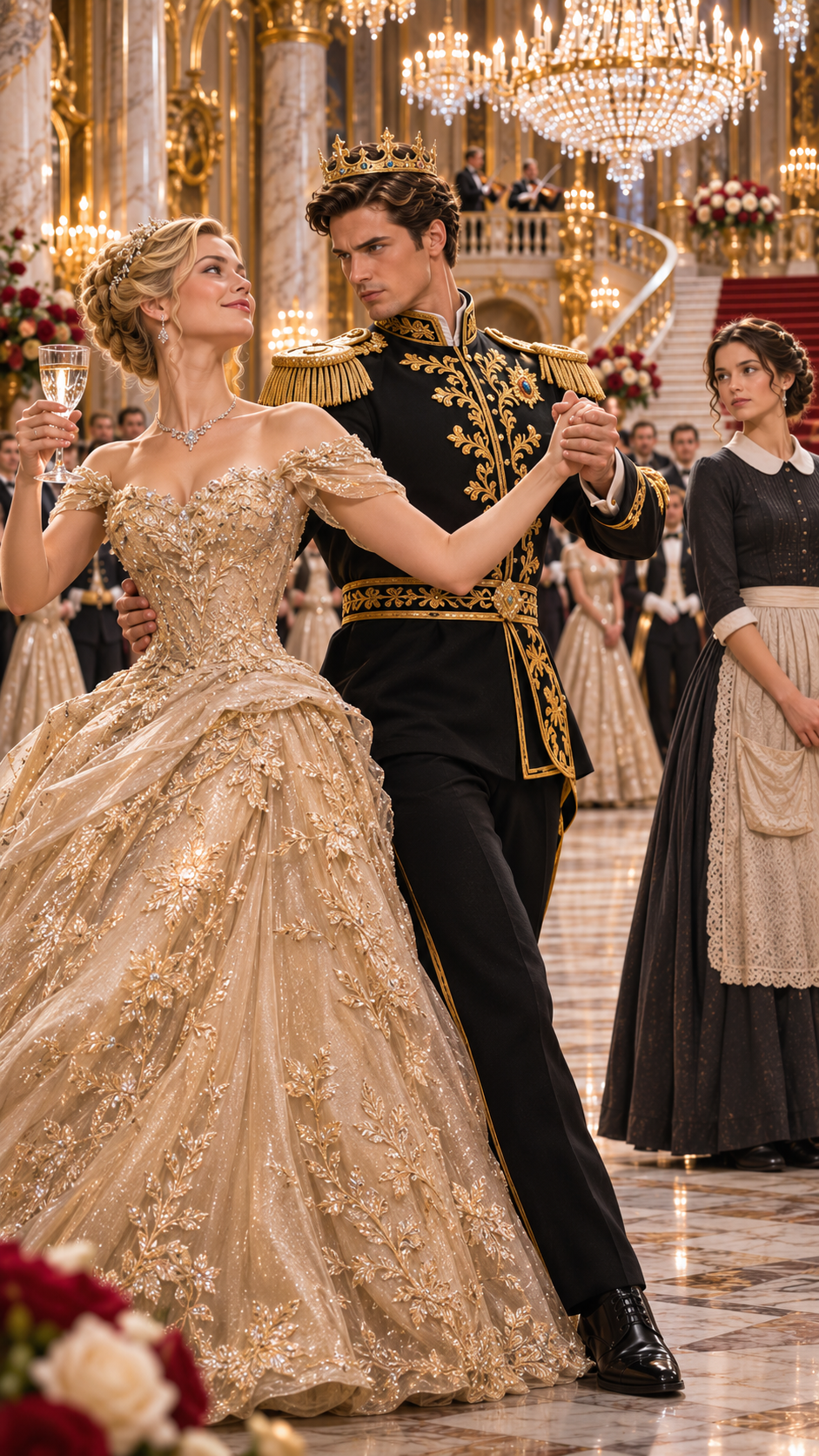
## **Part 6 – The Queen Who Never Forgot the View From Behind the Ballroom Door**
Emily did not become a perfect queen.
That disappointed people who preferred legends.
In her first month, she misread ceremonial precedence and entered a diplomatic supper ahead of an ambassador’s wife.
In her second, she approved a charitable budget containing duplicate allocations because she assumed a clerk had already checked them.
The clerk had assumed she would.
They fixed the process.
In her third month, she publicly answered a reporter too sharply after he called her mother “the queen’s seamstress.”
Sarah Carter laughed when she heard.
“You were a maid.”
“Yes.”
“I sew dresses.”
“Yes.”
“Then what exactly offended you?”
Emily had to admit:
“The way he said it.”
Sarah shrugged.
“Then let him reveal himself.”
Good advice.
Emily apologized for her tone without apologizing for her family.
Alexander enjoyed reminding her that queens could be arrogant too.
She threatened him with the crystal glass.
Their marriage became less dramatic after the wedding.
Better.
Alexander remained impatient.
Emily remained stubborn.
He sometimes brought state problems into private supper when he had promised not to.
She sometimes gave opinions on matters she had not studied enough.
They corrected each other.
Not always gracefully.
The old ballroom test became a private language between them.
Whenever Alexander changed expectations midway through a discussion, Emily raised one eyebrow.
“Water.”
He hated that.
Good.
Whenever Emily became so focused on adapting that she failed to ask whether the goal itself mattered, Alexander said:
“Glass.”
She hated that too.
Fair.
The consultative assembly petition became their first major test as king and queen.
Emily did not decide policy.
Important.
She met municipal delegations as part of her official duties and listened.
Alexander convened ministers.
Victoria’s economic commission provided reports.
Queen Helena, now queen mother, advised caution.
Duke Montgomery opposed broad political change.
No one became villain.
The question was genuinely difficult.
How much representation could Rosehaven incorporate without destabilizing existing institutions?
Alexander’s instinct was to control the process tightly.
Emily noticed.
One evening:
“You’re designing another test.”
He frowned.
“How?”
“You invited municipal representatives but gave them only ten minutes each.”
“We have forty delegations.”
“Then invite fewer at a time.”
“That takes weeks.”
“Yes.”
“Weeks matter.”
“So does whether listening is real.”
Alexander sighed.
“Water.”
Emily smiled.
Exactly.
The process expanded.
Not a full democracy overnight.
That would have been implausible.
Rosehaven created a limited elected civic assembly with authority to review budgets, petitions, infrastructure plans, and local taxation proposals.
The crown retained executive power.
Noble houses retained seats in the upper council.
Imperfect.
Still change.
Victoria became one of the principal architects of the economic committees linking both bodies.
Her father eventually admitted she was better at public finance than he was.
He said it privately.
She forced him to repeat it at dinner.
Progress.
Emily’s scholarship fund grew too.
Within five years, palace servants could take evening courses.
Accounting.
Languages.
Administrative law.
Engineering basics.
Several left service for municipal jobs.
Some royal officials disliked that.
Emily considered it success.
One young footman named **Samuel Green** became a transport clerk.
A kitchen assistant, **Nora Bell**, trained in bookkeeping and later managed a hospital budget.
No one became queen.
That was never the point.
Opportunity mattered even when romance did not appear.
Emily’s mother continued her dressmaking shop until retirement.
She refused to move permanently into the palace.
“I have customers.”
“You are the queen’s mother.”
“They still need hems.”
Alexander adored her.
Mostly because she treated him like a man who occasionally stood in doorways wearing muddy boots.
James Carter’s printing career grew too.
He struggled with the attention.
At first everyone wanted to hire “the queen’s brother.”
He nearly quit.
Emily advised nothing until he asked.
When he finally did, she said:
“Use the attention if you want. Refuse it if you want. Just don’t build your entire identity around resenting it.”
He stared.
“That sounds annoyingly wise.”
“I am queen now.”
“You spill tea.”
“Leave.”
Siblings.
Good.
Emily and Alexander did not have children immediately.
The court noticed.
Of course.
After two years, newspapers speculated.
After three, noble families began discussing succession.
Emily hated it.
Alexander hated it more.
One evening he threw a newspaper into the fire.
Emily stared.
“That was dramatic.”
“They are discussing your body as state property.”
There it was.
A real issue of monarchy.
Not easily solved by personal boundaries.
The kingdom did need succession.
Emily’s reproductive life had political implications.
She resented that.
Still true.
They consulted physicians privately.
No problem identified.
Time passed.
Eventually Emily became pregnant.
The palace celebrated too loudly.
Emily nearly fled.
Alexander reduced public announcements after she asked.
Their daughter, **Princess Helena Rose**, was born healthy.
Three years later came a son, **Prince Frederick James**.
Emily loved them fiercely.
She also refused to let motherhood become proof that she had earned queenship.
That distinction mattered to her.
When Helena was six, she asked why portraits always showed queens wearing jewels.
Emily answered:
“Because painters are expensive and apparently dislike ordinary dresses.”
Alexander laughed from across the room.
The children grew knowing their mother had once carried trays.
Not as a charming legend.
As work.
Emily occasionally took them through the palace service corridors.
They met cooks.
Laundry workers.
Stable hands.
Not staged tours.
Real conversations.
When Frederick was eight, he left muddy boots in a servants’ passage.
A cleaner moved them.
The prince became angry.
Emily asked:
“Where did you leave them?”
“In the hall.”
“Was the hall yours?”
He froze.
Lesson.
No humiliation.
He apologized.
Good.
Alexander changed too.
At forty, he remained king.
Still decisive.
But less addicted to surprise as a tool.
He began giving ministers problems in advance.
Asked for dissent explicitly.
At first, everyone still agreed.
Then he created a rule:
The first council session on major policy required one minister to present the strongest argument against the king’s preferred option.
Not because opposition was always correct.
Because obedience made weak decisions look stronger than they were.
Emily approved.
Mostly.
Then one minister began opposing everything performatively.
Alexander came home irritated.
Emily laughed.
“You created a professional contrarian.”
“I may execute him.”
“You may not.”
“Unfortunate.”
They adjusted the rule.
Governance requires iteration.
So does marriage.
Queen Helena lived long enough to watch her son become a different king than Frederick.
Not entirely different.
Nothing is.
When she became ill, Emily visited often.
One evening Helena said:
“I thought I invited you to teach Alexander something.”
Emily smiled.
“Dangerous assumption.”
“Yes.”
“I learned more than he did.”
Helena laughed.
Then:
“No.”
“What?”
“You both learned.”
Better.
Helena looked toward the palace gardens.
“I used you.”
Emily did not pretend otherwise.
“Yes.”
“And you forgave me.”
“Mostly.”
The queen mother smiled.
“Victoria says the same thing about her father.”
“Wise woman.”
Then Helena said:
“I am glad you did not become queen because the pool turned green.”
Emily frowned.
“What pool?”
Helena laughed until she coughed.
A joke from some old Rosehaven fairy tale.
Good.
Not every royal story needed magic.
Helena died the following winter.
Alexander grieved deeply.
He did not disappear into council work.
At least not entirely.
Emily found him one evening signing documents long after midnight.
She set down the crystal glass from Victoria’s gift.
Alexander stared.
“Cruel.”
“You’re changing the problem.”
“What problem?”
“Grief into paperwork.”
He looked at her.
Then put down the pen.
Progress.
Their children became adolescents.
Helena loved horses and mathematics.
Frederick loved music and hated council meetings.
The court assumed Frederick, as male heir under old succession law, would become king one day.
Emily questioned that.
Not because Helena should automatically inherit.
Because the law had never been examined.
Alexander resisted at first.
“Changing succession creates instability.”
“Maybe.”
“Helena knows this.”
“Yes.”
“Frederick knows it.”
“Yes.”
“Then why reopen it?”
Emily looked at him.
“Because knowing a rule exists is not the same as knowing the rule is good.”
There it was.
The original lesson.
Alexander groaned.
“Glass.”
“No. Entire table.”
They commissioned a legal review.
Public consultations.
Historical research.
No dramatic decree because the queen wanted her daughter crowned.
That would repeat old mistakes.
After three years, Rosehaven changed succession from male preference to equal primogeniture for future generations, while clarifying that Helena, as the eldest current child, would become heir only after parliamentary and council ratification under transitional rules.
The decision passed.
Helena became crown princess.
Frederick was relieved.
He wanted to compose music.
Good.
A future not assigned merely because of birth order and sex.
Still inherited monarchy.
Still imperfect.
Change within structure.
Emily understood that governing a kingdom was often exactly that.
Years passed.
Victoria never married young.
People speculated.
She ignored them.
At thirty-seven, she married **Julian Hart**, a civil engineer who had spent years arguing with her over railway gradients.
Emily found this hilarious.
Victoria did not.
Their marriage remained childless by choice.
The court eventually found other things to gossip about.
Duke Montgomery softened in age.
Not into sainthood.
He and Victoria repaired enough.
That was realistic.
Edmund Vale served his sentence, later worked as an accountant for a small shipping firm under strict oversight.
Emily heard about it once.
She felt no triumph.
His consequences belonged to law.
Not her.
Good.
The ballroom where the story began remained in use.
Every winter, Rosehaven held a state dance there.
For years, people pointed out the spot where Emily defeated the prince’s test.
She disliked the word defeated.
Eventually, during a charity exhibition, Crown Princess Helena asked:
“Mother, will you show me how you held the glass?”
Emily laughed.
Alexander groaned from across the room.
“Do not encourage this.”
Helena filled a crystal glass.
Too high.
Emily adjusted her grip.
“Close to your center.”
“Why?”
“Smaller arc.”
Alexander approached.
“You know the trick.”
Emily looked at him.
“There was never a trick.”
He stared.
She smiled.
“That was the trick.”
Their daughter laughed.
Then she asked:
“Did Father really try to make you spill?”
“Yes.”
“Why?”
Alexander answered himself.
“Because I thought pressure revealed truth.”
Helena frowned.
“Doesn’t it?”
“Sometimes.”
He looked toward Emily.
“Sometimes it only reveals how someone behaves when another person keeps changing the conditions.”
Emily smiled.
Good answer.
Then Helena asked:
“How do you know the difference?”
Emily handed her the glass.
“You ask what you’re actually trying to learn before you design the test.”
That became a family saying too.
Years later, when Crown Princess Helena prepared for her first major diplomatic negotiations, she used it.
What am I actually trying to learn?
Not whether the other side would yield.
Whether they could build terms both sides would keep.
Good.
Emily eventually stepped back from some public duties.
Not because she vanished into motherhood.
Because younger officials were capable.
Her scholarship program became independently governed decades earlier.
She did not need to remain at its center forever.
That mattered.
Institutions should outlive founders without becoming monuments.
Alexander developed gray at his temples.
Emily teased him.
He reminded her she had silver too.
She denied it.
Marriage.
One evening, long after their children were grown, Alexander found the old crystal glass in a cabinet.
Victoria’s engraving still visible:
**THE TEST MAY BE WRONG.**
He carried it to Emily.
“We kept this?”
“You complained every time I tried to display it.”
“Because diplomats ask questions.”
“Good.”
He sat beside her.
“Do you ever think about what would have happened if you spilled?”
Emily smiled.
“I would have gone back to work.”
“That simple?”
“No.”
She thought.
“I would have been embarrassed.”
“Would you have hated me?”
“Possibly for a week.”
He laughed.
Then:
“And us?”
She looked at him.
“There might not have been an us.”
That sobered him.
Entire lives turn on small moments.
But Emily had learned not to worship chance too much.
“If not the glass,” she continued, “something else might have happened.”
“Or nothing.”
“Yes.”
He squeezed her hand.
“Does that bother you?”
“No.”
“Why?”
“Because love is not more valuable because it was inevitable.”
Alexander went still.
Emily continued.
“We chose it after it became possible.”
That was enough.
They sat in comfortable silence.
No need for a lifespan epilogue.
No need to turn their entire marriage into a monument to one ballroom.
The kingdom continued changing.
Their marriage continued requiring adjustment.
Their children continued becoming themselves.
Victoria continued arguing with railway committees.
Sarah Carter continued sending Emily dresses even after retirement because apparently queens could not be trusted to choose sleeve lengths.
James continued printing editorials that occasionally criticized royal policy.
Alexander found this irritating.
Emily found it healthy.
And once each year, at the winter state dance, Emily crossed the ballroom where she had once stood holding a glass of water beneath twenty thousand eyes.
The marble had not changed.
The chandeliers still glittered.
Noble families still competed for influence.
Servants still moved along the walls carrying trays.
Power had not vanished because one maid became queen.
That would have been a fairy tale too easy to believe.
But some things had changed.
Servants could study administration.
Council information followed public release rules.
Municipal representatives could question budgets.
A crown princess could inherit because the law had been examined instead of merely repeated.
Ministers could disagree with the king without treating disagreement as disloyalty.
And a queen who had once stood unnoticed behind ballroom doors could look across the room and remember exactly what the palace looked like from the other side of importance.
That memory did not make Emily wise automatically.
It reminded her to keep asking.
Who is missing from this room?
Who pays the cost of this decision?
Who is afraid to disagree?
What are we actually testing?
And most importantly:
Did the problem change—
or did someone powerful simply change the rules?
One winter evening, Alexander offered Emily his hand beneath the chandeliers.
“Dance?”
She looked at the empty hand.
“No glass?”
“Absolutely not.”
“Coward.”
“Experienced.”
She smiled.
Then placed her hand in his.
The orchestra began.
Alexander led.
Emily followed.
Then, halfway through the waltz, he changed direction unexpectedly.
She stopped.
The king nearly collided with her.
Everyone nearby stared.
Alexander blinked.
“What?”
Emily raised one eyebrow.
He understood immediately.
“You cannot be serious.”
“You changed the problem.”
“It was a turn.”
“Unannounced.”
“We are dancing.”
“Exactly.”
Alexander laughed.
The court relaxed.
Then he bowed.
“My queen, shall we turn?”
Emily smiled.
“Yes.”
He did.
And they continued.
Not because Emily had finally learned to follow perfectly.
Not because Alexander had stopped leading.
Because somewhere between the ballroom test and the life they built afterward, both had learned that partnership did not require guessing what the other person intended.
Sometimes the strongest move was simply to ask.
The maid who once held a crystal glass did become queen.
But that was never the most important thing she achieved.
The important thing was that even after people bowed to her, Emily Carter never forgot what it felt like to stand in a room where everyone assumed her position told them how much she knew.
And Alexander never forgot that the first woman who truly understood his test was also the first one brave enough to tell him—
the test itself might be wrong.
**–THE END– PLEASE
Share your thoughts or feedback to motivate us to create more stories ♥️
✓ Lynn R. Adams
## **Part 6 – The Queen Who Never Forgot the View From Behind the Ballroom Door** Emily did not become a perfect queen. That disappointed people who preferred legends. In her first month, she misre…