THE DIAMOND BRACELET BETRAYAL: MY HUSBAND INTRODUCED HIS
My father, Thomas Whitmore, founded Whitmore & Co. in Savannah, Georgia, with $26,000, a rented warehouse, and a belief that American craftsmanship still deserved a place in the luxury market. He began producing cedar-lined travel trunks and hand-stitched leather cases, personally visiting suppliers and inspecting finished products long after his company became profitable. By the time I was twelve, I could distinguish high-quality leather by touch and identify which craftsmen had stitched a particular pattern simply by studying its details. My summers were spent among worktables, leather samples, and people who took pride in making something beautiful enough to last for generations. My father never called those people his employees without adding that they were the reason he had a business at all.
When I returned from studying design history in London, he gave me responsibility for evaluating new product lines and potential acquisitions. I enjoyed the challenge because I loved finding opportunities that preserved craftsmanship while creating sustainable growth. During a trip to Chicago, I met Grant Caldwell, an ambitious acquisition adviser who represented a struggling leather manufacturer. He was handsome, confident, and unexpectedly funny, particularly after I pointed out that his valuation model contained an assumption no experienced buyer should have accepted. Instead of becoming offended, he invited me to dinner and asked whether I would help him correct it.
For the first five years, Grant and I were genuinely happy. He listened when I discussed design history, admired my father’s work, and seemed delighted by the possibility of building something meaningful together. When we married, he promised he would never ask me to choose between the company and our relationship. He even moved to Savannah temporarily because he wanted to understand the business from the warehouse floor rather than from executive presentations. I believed I had found someone who respected the world my father created.
Our happiness became more complicated as our family faced painful losses. I experienced two pregnancies that ended before we could welcome the children we had hoped for, and the grief sometimes made ordinary life feel impossibly heavy. During the second loss, Grant stayed beside me, brought food when I could not bear to eat, and told me we would face whatever came next together. Those memories remained precious because they were real, even after everything that happened later. Betrayal would have been easier to understand if our marriage had contained nothing worth loving.
Then my father became seriously ill. Grant gradually assumed more responsibilities, building relationships with investors and taking over negotiations that previously passed through my father’s office. When Thomas died, I felt as though the foundation beneath my entire life had disappeared. I wanted to preserve his company, but I could barely sit through a meeting without remembering him across the table. Grant offered to serve as interim chief executive while I recovered, and the board approved the arrangement with my consent.
Six months became two years, and eventually two years became seven. Grant transformed into the public face of Whitmore & Co., appearing in business magazines, attending high-profile conferences, and describing the company’s progress as the result of his leadership. I continued developing products, advising designers, reviewing strategic proposals, and managing the family trust, but I increasingly worked away from cameras. When reporters asked about my role, Grant called me the soul of the brand. At first, I interpreted that as affection rather than a polished way of making my professional contributions disappear.
My mother, Margaret Whitmore, noticed the change long before I acknowledged it. She lived in Charleston after my father’s death, filling her days with gardening, charitable work, and memories she preferred not to discuss directly. During one visit, she asked whether Grant still listened when I disagreed with him. I told her he was under enormous pressure and sometimes became impatient, which she said was not an answer. Then she reminded me that my father had never confused delegation with surrendering ownership.
That conversation prompted me to review our governance records. The Whitmore Family Trust retained sixty-one percent of the company’s controlling voting interests, and Grant’s executive authority existed under agreements requiring appropriate board oversight. His responsibilities were significant, but he could not unilaterally transfer company intellectual property or change protected ownership rights. I understood those provisions well because my father insisted I participate when the structures were established. Still, I had never imagined needing them to defend the company against my own husband.
Avery Blake entered our lives as a consultant specializing in luxury marketing partnerships. Grant praised her enthusiasm, her social connections, and her supposed ability to attract younger customers. I initially welcomed her involvement because our brand needed to evolve without abandoning its heritage. Gradually, however, Grant began arranging meetings without me and treating my strategic opinions as outdated. He repeatedly claimed that the company’s future belonged to people willing to take risks.
I did not realize then that the greatest risk was trusting him.
The first evidence appeared inside the pocket of Grant’s navy cashmere coat. I was preparing it for the cleaners when I discovered a receipt from a Madison Avenue jewelry boutique showing a purchase of $48,700. My birthday was approaching, and for one foolish moment I imagined he had chosen something extravagant to surprise me. I placed the receipt back where I found it, feeling a small rush of happiness that embarrassed me afterward. My birthday came and went without a bracelet.
Two days later, I reviewed a corporate expense statement and noticed a three-night stay at The Lowell Hotel in Manhattan. Grant had classified it as accommodation for visiting investors, but the dates overlapped with a period when he claimed to be attending late meetings near our apartment. The named investors were actually in Dallas, and the supporting documentation did not explain the discrepancy. I asked Martin Shaw to investigate the charge through our finance department’s normal review process. His response was cautious, but I could hear concern beneath the professionalism.
Within a week, several additional expenses surfaced. There were luxury car transfers, resort charges in Miami, expensive dinners, spa treatments, and consulting payments involving Blake Strategic Partnerships. Grant had also used company travel arrangements for a trip that included Avery’s name on the passenger manifest. I wanted to believe there were reasonable explanations, but the details formed a pattern too consistent to ignore. Finally, a message appeared on Grant’s phone while he slept in the library, confirming that their relationship extended well beyond business.
Avery wrote that she enjoyed watching him look at her while I was present. She said it made her feel as though she already possessed something I mistakenly believed belonged to me. I stood beside my sleeping husband for a long time, looking at those words while trying to reconcile them with the man who once drove through a snowstorm to bring me my favorite soup. I did not search the rest of his phone because I understood that evidence needed to be obtained properly. Instead, I photographed the visible message, returned the phone to the table, and contacted our corporate counsel the following morning.
Elliot Harrow had advised Whitmore & Co. for more than a decade. He knew our ownership arrangements, my father’s expectations, and the internal safeguards that protected the family trust. When I described the questionable expenses, he advised engaging an independent forensic accountant and preserving corporate records through authorized procedures. I hired Priya Nair, a former investigator with extensive experience examining financial misconduct. She approached the assignment with such quiet precision that even Martin seemed relieved to have someone capable of following complicated transactions without creating unnecessary alarm.
Priya discovered that Avery’s consulting company had been formed less than a year earlier. Its invoices described strategic research, hospitality development, branding analysis, and partner acquisition, but several payments lacked meaningful documentation of completed work. Some expenses passed through third-party vendors that appeared connected to Lance Deveraux, a real estate developer whose projects Grant had discussed repeatedly. Other payments matched luxury travel and purchases that seemed unrelated to legitimate business activity. Priya warned me that some charges might eventually prove appropriate, but the available records required formal scrutiny.
The most troubling document was a proposed hospitality partnership agreement. Grant and Lance planned to create a separate company that would license Whitmore concepts, trademarks, research, and hospitality designs under terms unfavorable to the family business. Avery’s company was listed as a strategic partner eligible for substantial economic participation. The proposal also contemplated financing and ownership changes that could weaken the Whitmore Family Trust’s control if implemented without proper safeguards. I recognized the structure immediately because it bore the unmistakable signs of someone attempting to move value away from an established company into a newer entity under different leadership.
I sat in my father’s old office reviewing those records, remembering the years he spent protecting the business from decisions driven by vanity. His walnut desk still bore a small burn mark near the corner, left by a cigar he once tried unsuccessfully to hide from my mother. I touched the mark and whispered that I was afraid I had allowed someone to take advantage of everything he built. The room offered no answer. Then my phone rang.
The caller identified herself as Lena Torres from Meridian Corporate Banking’s compliance team. She explained that my name appeared in records identifying controlling interests connected to several Whitmore accounts and that certain unusual transactions required clarification through formal channels. She did not disclose confidential information improperly, but she directed our authorized finance and legal representatives toward the bank’s established review process. The resulting records raised additional questions about payments linked to the proposed hospitality venture. For the first time, I understood that Grant’s secret arrangements might extend beyond extravagant gifts and questionable consulting fees.
Then Priya found a reference to a private fertility clinic in Los Angeles.
The entry appeared among expenses routed through a consulting account, with no obvious connection to our luxury business. Seeing it brought back the hospital rooms where Grant once held my hand after our losses, and I felt a sharp ache that had nothing to do with money. I did not know whether the expense involved Avery or someone else, and Priya reminded me that medical information required special care. We documented the unexplained business charge without attempting to obtain private patient records. Still, I understood that Grant had created secrets in places where our marriage should have been protected by honesty.
The evening before the board meeting, Grant and I attended a benefit at the Metropolitan Museum of Art. He wore a dark tuxedo and the confident smile that had made him popular with investors, while I chose a deep sapphire gown and my mother’s pearls. Avery appeared on Lance Deveraux’s arm, although she spent much of the evening moving between his table and ours. The diamond bracelet glittered against her wrist whenever she lifted her glass. I recognized it from the receipt I had found weeks earlier.
During dinner, Avery leaned toward me and asked whether I felt prepared for the following morning’s expansion discussion. Her voice was sweet, but the question carried the unmistakable suggestion that I no longer understood my own company. She explained that sophisticated hospitality strategies required specialized knowledge and that major changes could overwhelm people attached to established traditions. I thanked her for the concern and asked whether she had ever visited our original Savannah workshop. She admitted she had not.
I told her that every business built on heritage should begin by understanding the people who created it. She smiled politely, clearly deciding that I was discussing sentimental history rather than serious strategy. Grant placed his hand over mine and said we all wanted the company to succeed. I looked at their faces and knew that our definitions of success had become irreconcilable. Then I told him that we would discover whose plans truly served Whitmore & Co. in the morning.
When we returned home, Grant mentioned that Avery would be attending the meeting as his principal strategic adviser. He described her as brilliant, innovative, and unusually capable of understanding the needs of a younger luxury audience. I asked whether he had disclosed their personal relationship to the board before arranging her compensation and proposed partnership. His expression changed, and he accused me of allowing jealousy to interfere with important business decisions. I told him disclosure was a governance requirement, not a judgment about whether he found another woman attractive.
He insisted nothing improper had happened. I asked about the hotel bills, consulting invoices, and the proposed transfer of intellectual property. He answered that complex partnerships required flexibility and that I no longer possessed the operational knowledge necessary to understand every arrangement. Then he repeated a phrase he had begun using whenever I challenged him. “You’re the heart of this company, Evelyn, but you need to let the professionals handle its future.”
I wanted to ask when he decided the daughter of the founder was no longer a professional. I wanted to remind him of the product lines I developed, the deals I negotiated, and the years I spent reviewing financial models he now claimed were beyond my understanding. Instead, I told him I intended to attend the meeting and examine the proposal carefully. He appeared relieved because he interpreted my restraint as surrender. That was his final mistake before the investigation became impossible to conceal.
After midnight, I returned to my father’s office. Priya had completed a detailed summary identifying the disputed transactions and the proposed transfer of valuable company assets. Elliot had prepared the necessary materials for the directors, including an explanation of potential conflicts and the steps available under our governing documents. Martin had agreed to provide the finance department’s records through authorized channels. Everything was ready for a meeting that would be governed by procedure rather than by my anger.
At in the morning, Priya confirmed that the evidence package had been delivered securely. Two minutes later, Elliot informed me that the board chair had authorized an emergency review of the new partnership proposal. Martin sent a message explaining that certain payment approvals had been suspended pending investigation. I read all three communications and sat quietly beneath my father’s portrait. For the first time since discovering the affair, I cried.
I cried because I had loved Grant. I cried because my father trusted me to protect the business and I feared I had been careless with that responsibility. I cried for the children we never welcomed, the years when Grant comforted me, and the man I now struggled to recognize. Then I wiped my face, opened the next financial report, and continued reading until dawn. Grief did not excuse me from the responsibilities I still possessed.
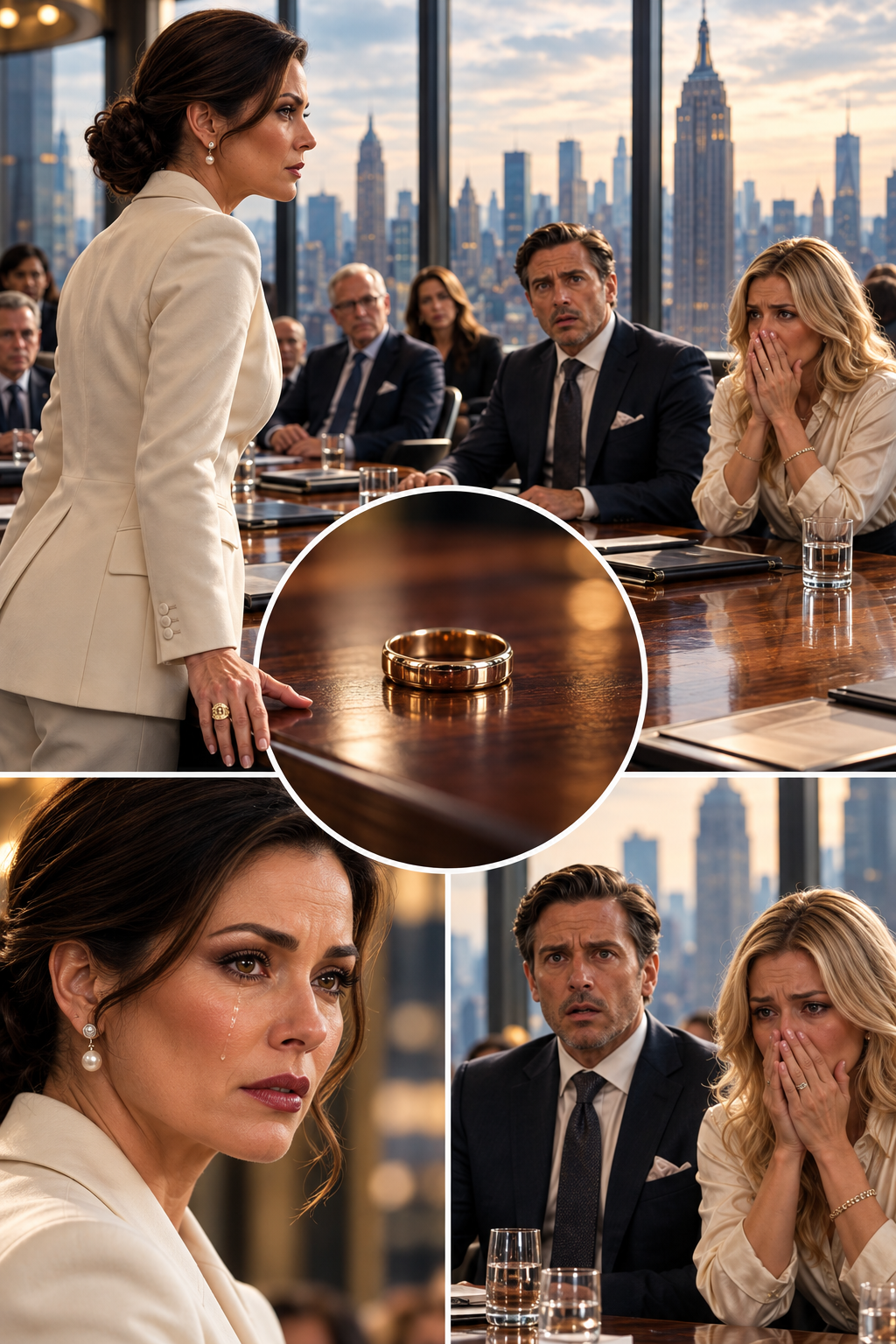
At seven, I dressed in a tailored ivory suit. I fastened my mother’s pearl earrings and placed my father’s signet ring on my right hand. Then I looked into the mirror and reminded myself that I was not attending the meeting as a jealous wife. I was attending as the controlling shareholder of a company whose reputation and future needed protection. When I entered the executive floor, Avery was already arranging her presentation beside Grant.
She greeted me brightly and asked whether I wanted coffee.
I told her I wanted accurate numbers.
She laughed because she thought I was joking.
The board meeting began at nine with routine financial updates and reports from our retail divisions. Martin presented seasonal projections, Denise discussed international distribution, and Elliot confirmed that the directors had received additional materials concerning the proposed hospitality venture. Grant appeared impatient, repeatedly checking his watch while Avery adjusted the presentation equipment. I understood his urgency because he believed approving the partnership would strengthen his position before anyone could challenge the underlying structure. The more quickly the board acted, the harder it might become to reverse the consequences.
When the hospitality proposal finally began, Grant transformed into the persuasive executive who once impressed my father. He described growing demand for luxury travel, the value of established American brands, and opportunities to introduce Whitmore products into exclusive hotel experiences. Avery followed with slides displaying beautifully photographed interiors, branded leather goods, private residences, and projected operating returns. Her presentation was visually impressive, but I recognized entire paragraphs from my earlier concept memo. She had changed the design of the slides while leaving much of the underlying work untouched.
I let them continue for forty minutes. When Avery misstated one projected margin, Grant corrected her and smiled reassuringly, as though their ability to finish each other’s sentences demonstrated strategic competence. Several directors exchanged glances because the relationship between them was becoming impossible to ignore. Then Avery introduced a proposed ownership diagram showing Blake Strategic Partnerships and Deveraux Hospitality Ventures receiving participation in the new entity. The Whitmore Family Trust’s influence appeared materially reduced compared with its position under existing company arrangements.
I raised my hand.
Grant seemed irritated but invited the question. I asked which department would be responsible for the proposed partner development expenses, particularly the hospitality accommodations and luxury purchases appearing in supporting accounts. He described them as ordinary relationship-building costs. Then I asked whether that category included hotel suites occupied by him and Avery, private travel without documented business purposes, and a diamond bracelet purchased with funds linked to the company’s accounts. Avery stopped smiling.
Grant accused me of raising personal allegations. I placed the relevant expense summary before the independent directors and asked Martin to confirm whether the finance department had approved the identified charges through the ordinary process. He explained that several items lacked sufficient support and were already under review. Priya’s forensic report identified payments requiring further investigation, including consulting retainers to Avery’s company and transfers associated with Lance’s development business. The room became increasingly uncomfortable as directors realized the proposal might be connected to spending practices they had never properly examined.
I then presented my original hospitality concept. The document included dates, market research, financial assumptions, design sketches, and internal correspondence confirming that I had developed it eighteen months earlier. Avery’s proposal reproduced significant portions of the work while presenting the strategy as independently created through her consulting firm. Grant claimed the similarities reflected normal collaboration, but one email showed he had instructed Avery not to identify the original source. I told the board that the issue was not simply who deserved creative credit. It was whether the company was being asked to transfer valuable intellectual property into an outside structure on terms that benefited people with undisclosed conflicts.
Elliot explained the governance concerns. Grant’s personal relationship with Avery created a conflict requiring disclosure, while the proposed entity involved additional agreements needing careful review. Certain transactions had been approved without adequate documentation, and the ownership structure might have affected the rights attached to the Whitmore Family Trust. Independent directors needed to establish whether the proposed arrangement served the company or primarily enriched a smaller group of participants. No one could responsibly approve it based on the materials presented that morning.
Grant stood and accused me of manipulating the board because our marriage was experiencing difficulties. He said I had been emotionally distant since my father’s death and lacked the courage to accept that someone else possessed better ideas for the company’s future. I felt the insult deeply because it exploited the period when grief made me most dependent on his support. For a moment, I remembered him comforting me after our second pregnancy loss and wondered when he began seeing vulnerability as something useful to attack. Then I stood and turned toward the directors.
“My father founded this company in Savannah,” I said. “He built it from a rented warehouse into a national luxury brand because he believed quality required honesty, patience, and respect for people whose names rarely appear on magazine covers.” I explained my work in product development, investment strategy, and the hospitality concept they had just reviewed. Then I reminded them that the Whitmore Family Trust retained sixty-one percent of the relevant voting interests, with protections Grant could not alter unilaterally. The company’s public image did not change its legal ownership.
Avery stared at me as though hearing the information for the first time. Grant demanded that I stop humiliating him, but Elliot clarified that the board had received the ownership records and was entitled to consider the implications. I told Grant I had appointed him as chief executive because I trusted his judgment and believed we were protecting my father’s legacy together. That trust had never included permission to use company resources for personal expenses or redirect valuable assets without authorization. His marriage to me did not make him the owner of Whitmore & Co.
The independent directors voted to suspend approval of the proposed hospitality venture and initiate a formal investigation into the identified transactions. They also voted to suspend Grant from executive duties pending review and establish interim leadership under the company’s governance arrangements. Avery’s consulting payments were placed under appropriate controls while her firm’s contracts were examined. The decisions were serious, but they were not criminal convictions or final findings about every disputed expense. I wanted the process to remain accurate even if the truth proved more complicated than anyone expected.
Grant stared at the directors in disbelief. He had entered the meeting imagining that Avery would leave with a new executive role and a valuable interest in the company’s future. Instead, he was being removed from decisions he had expected to control. Avery’s face had lost its polished confidence, and her hand rested protectively over the diamond bracelet. When the meeting ended, Grant looked at me and asked how I could do this to the man I once loved.
I answered that loving him had been my choice.
Protecting the company was my responsibility.
The announcement reached employees before lunchtime. Whitmore & Co. confirmed that Grant had been suspended from executive responsibilities pending an independent governance review and that certain consulting arrangements would be examined. The company issued a short statement emphasizing business continuity, employee stability, and the importance of financial accountability. It did not describe the affair or publish private correspondence. Those details belonged to the appropriate legal processes, not to the public statement of a company employing hundreds of people.
Grant reacted with fury. He accused the board of surrendering to family influence and told his attorneys that the investigation was merely an attempt to remove him from a company he had helped grow. I acknowledged his contributions during the years he served as chief executive, but those contributions did not excuse misconduct. The board retained the authority to evaluate his decisions, and the trust’s ownership rights had existed long before our marriage began to collapse. I refused to turn the investigation into a contest over which spouse felt more betrayed.
Avery’s position became increasingly difficult. She initially claimed she had been unaware of the questionable financial arrangements and believed every expense had received appropriate approval. Investigators examined her contracts, invoices, communications, and the work allegedly performed by Blake Strategic Partnerships. Some activities appeared to have legitimate business purposes, while others required reimbursement or further review because the records were incomplete. I insisted that findings distinguish between Avery’s personal relationship with Grant and any professional misconduct that could actually be established.
Then she contacted me through her attorney.
Avery offered to cooperate with the review and provide records concerning the proposed hospitality entity. She said Grant had promised her significant equity participation once the board approved the deal and repeatedly described me as a woman who had lost interest in the company. He told her that the family trust would eventually accept a reduced role because I preferred charitable events and social recognition to difficult business decisions. I listened to the account without pretending it excused her behavior. She had knowingly participated in an affair, but determining the extent of her financial responsibility required examining the evidence carefully.
The investigation also uncovered deeper problems involving Lance Deveraux. His firm had received payments associated with preliminary development work, yet some services could not be verified against the underlying invoices. Draft agreements suggested the planned venture could have placed Whitmore intellectual property into a structure granting Lance and Grant substantial control. The board referred the relevant findings to appropriate professionals for further action. I felt relieved that the proposal had been stopped before the company committed its most valuable assets.
At home, the atmosphere became unbearable. Grant alternated between apologies and accusations, sometimes describing Avery as an insignificant mistake and sometimes blaming me for forcing him to seek appreciation elsewhere. He insisted I had become obsessed with protecting my father’s company while neglecting our marriage. I admitted that grief and professional obligations had changed me, but I rejected the idea that those difficulties justified his choices. I had been his wife, not an obstacle to be removed whenever another woman offered admiration.
One evening, he found me packing a suitcase and asked whether I intended to end everything over a business disagreement. I looked at him and realized he still considered the affair and financial investigation temporary problems that could be managed through persuasion. I told him the marriage had been damaged by repeated deception, not one mistaken expense or a single night with another woman. He asked whether I had ever loved him enough to forgive him. I answered that forgiveness and remaining married were different questions, and I was no longer willing to confuse them.
Our divorce proceeded through attorneys. Marital property, financial interests, and trust-controlled assets were evaluated according to the relevant agreements and applicable law. Grant initially sought terms that assumed continued influence over Whitmore & Co., but the documents established limits he could not simply negotiate away. Eventually we reached a settlement allowing both of us to move forward while the corporate investigation continued separately. I signed the final papers with a sadness that surprised me.
I remembered the man who once brought soup through a snowstorm. I remembered the notes he left on hotel stationery, the way he held my hand after our losses, and the years when building something together felt like the most natural expression of love. Those memories did not vanish because his later conduct became unacceptable. I had loved him, and some part of our history remained meaningful. But the truth of our past could not excuse the harm he caused in the present.
After the divorce, I moved into my father’s old office at Whitmore Tower. The staff removed Grant’s executive nameplate and installed a temporary sign identifying me as Evelyn Whitmore, Executive Chair. I stood in the doorway looking at my maiden name, remembering how often Grant had encouraged reporters to describe me primarily as his wife. For years, I believed being gracious meant allowing him to receive the attention. Now I understood that public recognition and professional authority were not the same thing.
I was ready to build something that belonged to the future rather than the scandal.
Noah Bennett entered my office carrying three cups of coffee because he had forgotten how I preferred mine and did not want to choose incorrectly. He was head of product design, a quiet man in his early forties who had spent years protecting the quality of Whitmore craftsmanship while newer executives pursued fashionable trends. I laughed when he lined the cups across my desk and announced that his first strategic recommendation was to establish a reliable system for remembering the chairwoman’s preferences. Then he opened a portfolio containing sketches I recognized immediately. They were based on the hospitality concept Grant had dismissed eighteen months earlier.
Noah explained that he discovered my original proposal in the design archives and believed it could become one of the company’s strongest long-term opportunities. Unlike the partnership Avery presented, his plan began with limited investments, carefully chosen properties, transparent contracts, and direct involvement from established Whitmore artisans. The first location would be a restored historic house in Savannah, where guests could experience the company’s leather goods, handcrafted furniture, travel collections, and distinctive approach to hospitality. He had developed preliminary designs but never attempted to present them as his own idea. He wanted to know whether I would consider building the project properly.
I studied the sketches and felt something inside me loosen. For months, the hospitality concept had seemed permanently contaminated by Grant’s deception. I associated it with hotel receipts, secret transfers, and the woman who wore diamonds purchased through questionable accounts. Yet Noah’s drawings reminded me why I developed the idea in the first place. My father’s business had always been about creating objects that carried memory, usefulness, and craftsmanship into everyday life.
I told Noah I wanted to begin in Savannah. He smiled because he understood the importance of returning to the place where my father rented his first warehouse. We reviewed the preliminary budget and agreed that the company would pursue the concept only after independent analysis established a commercially responsible structure. No shell entities, no hidden partners, and no extravagant promises designed to impress investors. The project would proceed only if the numbers justified it and the people responsible could explain every major decision.
The team began work that summer. We selected a historic mansion with white columns, green shutters, and a courtyard that had fallen into disrepair after years of neglect. Preservation specialists studied the building’s original features, while Whitmore designers developed furnishings inspired by our earliest travel collections. Craftsmen in Savannah created cedar trunks, leather-bound journals, luggage accessories, and decorative pieces that connected the property to our company’s history. The work gave experienced employees opportunities to contribute ideas that had been overlooked during Grant’s leadership.
My mother visited the construction site wearing pale-blue linen and carrying a parasol she insisted was necessary in the Southern heat. She walked through the unfinished lobby, inspected a restored staircase, and told the architect exactly what she thought of the proposed lighting. Then she found an original Whitmore trunk waiting to be installed beneath a portrait of my father. She touched the worn leather carefully and began crying. I held her hand because there was nothing useful to say.
We stood together for several minutes, remembering the man who believed good work mattered more than impressive speeches. My mother eventually told me she had worried I would spend the rest of my life trying to punish Grant for betraying us. I admitted there had been moments when I wanted nothing more than to watch everything he valued disappear. Then I explained that building Whitmore House made me realize the company deserved a future larger than the mistakes of one executive. She smiled and told me my father would have approved.
The hotel opened six months later. Its rooms were elegant without being excessive, filled with warm wood, natural fabrics, thoughtful details, and handcrafted products produced by Whitmore employees. Guests received leather travel journals, and each suite contained a small card explaining the history of the craftspeople whose work appeared inside. We partnered with local suppliers, supported hospitality training, and established clear operating standards that treated employees as essential participants in the business. The property became a success because the experience felt genuine rather than manufactured.
Noah attended the opening wearing a dark jacket and an expression of nervous pride. We walked through the lobby together, watching guests admire the original cedar trunk beneath my father’s portrait. He told me that the most remarkable part of the project was how many people had contributed ideas once they were given permission to speak. I agreed because I had spent years allowing Grant to become the voice of a company built by hundreds of quieter people. Whitmore House was proof that leadership could create room instead of occupying every available space.
Our friendship deepened slowly. Noah never treated my divorce as an opportunity to rescue me or used my position as a reason to flatter me. We discussed design disagreements honestly, laughed over small mistakes, and occasionally met for coffee after difficult days. I appreciated his patience because I no longer trusted grand declarations made by people who expected immediate rewards. He seemed comfortable allowing friendship to become whatever time and honesty made possible.
One evening, after the opening celebration ended, I stood alone beneath my father’s portrait. The lobby smelled of cedar, fresh flowers, and polished wood, while distant music drifted through the courtyard. I remembered telling my father, on the night I discovered Grant’s scheme, that I feared I had married someone determined to steal what he built. Now I looked around at the restored house and understood that his legacy had survived. I had not merely protected the company from a dangerous transaction. I had brought one of its forgotten dreams to life.
A year after the boardroom confrontation, Whitmore & Co. was stronger than it had been during the final years of Grant’s leadership. The independent review led to revised financial controls, changes in executive compensation procedures, and greater oversight of consulting agreements involving potential conflicts. Certain disputed payments were recovered or addressed through negotiated remedies, while unresolved matters continued through appropriate legal channels. The hospitality venture Grant and Lance proposed never received approval, and its proposed transfers were abandoned. More importantly, employees understood that the company would no longer treat the chief executive’s personal preferences as substitutes for proper governance.
Grant eventually left New York. I heard that he pursued consulting work elsewhere and continued insisting privately that his downfall resulted from personal hostility rather than his own decisions. Avery also disappeared from our professional circles, later attempting to rebuild her career in luxury marketing. I did not interfere with either person’s future because my responsibility ended where their separate lives began. Whatever legal or financial accountability remained would be handled by the people qualified to address it. I had no interest in making revenge a permanent occupation.
Whitmore House continued attracting guests who appreciated its combination of American craftsmanship and thoughtful hospitality. Noah’s design team introduced new collections inspired by our archives, while regional managers developed relationships with local suppliers. I remained involved in long-term strategy but delegated daily operations to professionals with the relevant experience. That decision allowed me to focus on preserving the company’s identity without becoming trapped by every small problem. My father had built something intended to last beyond one lifetime, and I finally understood that honoring him required preparing others to carry it forward.
My private life changed more slowly. I sold the apartment Grant and I had shared because its rooms felt crowded with memories I was no longer obligated to revisit every day. I purchased a townhouse with tall windows, a small library, and a garden where I could sit without hearing traffic or business conversations. My mother visited frequently, sometimes bringing flowers and sometimes arriving simply because she wanted someone to share dinner. We began talking about my father without immediately becoming overwhelmed by grief. The sadness remained, but it no longer prevented us from enjoying what he had left behind.
I also learned to be alone. For years, I had measured my days through Grant’s expectations, my father’s legacy, and the responsibilities attached to an expensive company. After the divorce, there were evenings when I did not know what to do with the freedom I had fought so hard to protect. Gradually, I began reading novels again, taking long walks, visiting galleries, and traveling without arranging every journey around work. Ordinary pleasure returned in small moments rather than dramatic revelations.
Noah remained part of my life, and our friendship eventually developed into a relationship built on patience and mutual respect. We were careful about professional boundaries and made sure neither our personal feelings nor my position compromised legitimate business decisions. He understood that I wanted affection without losing independence and that I would never again confuse admiration with accountability. We disagreed sometimes, but neither of us treated disagreement as evidence that the relationship was failing. After years of walking carefully around Grant’s pride, that kind of honesty felt extraordinary.
One spring evening, Noah and I visited Savannah after a successful season at Whitmore House. We walked through the garden while guests gathered for dinner beneath strings of warm lights. He asked whether I ever regretted confronting Grant during the board meeting instead of attempting to resolve everything privately. I told him the confrontation itself had not been the important achievement. The real work involved preserving evidence, protecting employees, and using legitimate governance procedures to prevent the company from being damaged.
Then I admitted that part of me still remembered Grant with tenderness. I could recall the kindness he showed during our early marriage and the comfort he offered when we lost the children we hoped to have. Those memories were genuine, even though they could not justify his later choices. Noah listened without jealousy because he understood that loving someone in the past did not prevent me from recognizing what they became. I was grateful he could hold that complicated truth without demanding I make it simpler.
My mother joined us later for dinner. She wore her favorite pearls and complained affectionately that the new hotel was so beautiful she might refuse to return to Charleston. Noah laughed and suggested reserving her a permanent suite, which she pretended to consider before asking whether it came with complimentary breakfast. Watching them banter reminded me that family could become joyful again after years defined by loss. The happiness was not perfect, but it was real.
After dinner, I walked alone through the lobby and stopped before my father’s portrait. The old cedar trunk remained beneath it, polished carefully but still bearing the marks of decades of travel. I remembered the first time I touched leather in his Savannah workshop and learned how much work went into something that appeared simple from the outside. I remembered him telling me that quality was not created by expensive materials alone. It came from patience, integrity, and the willingness to correct mistakes before anyone else noticed.
For years, I believed protecting his legacy meant keeping Whitmore & Co. successful at any cost. I tolerated Grant’s arrogance, minimized my professional contributions, and convinced myself that maintaining our marriage protected the company from instability. Only after discovering the affair did I recognize how easily that thinking allowed one person to gain influence without accountability. My father’s business had never depended on Grant being admired. It depended on people doing their work responsibly, even when the truth was inconvenient.
The diamond bracelet Avery wore eventually became part of the completed financial review. Its purchase and related expenses were documented, and the relevant transactions were addressed through the company’s recovery procedures. I did not ask to keep the jewelry or turn it into a trophy. It had once symbolized the attention Grant gave another woman while dismissing my role in our marriage and business. Now it was simply another expense identified, reviewed, and resolved. Its emotional power had disappeared long before the paperwork ended.
The fertility clinic charge remained one of the most painful details I discovered. I never learned every private circumstance connected to it, and eventually I accepted that not every question deserved an answer obtained at someone else’s expense. What mattered was that Grant had concealed significant aspects of his life while demanding my unquestioning trust. I had enough information to understand why our marriage could not continue. The rest no longer needed to govern my future.
On the second anniversary of the boardroom meeting, Whitmore & Co. announced a program supporting young craftspeople and designers who wanted to preserve American manufacturing traditions. We established apprenticeships, scholarships, and partnerships with small workshops, giving talented people access to training that might otherwise have been unavailable. At the launch event, an elderly leatherworker who had known my father approached me holding a worn photograph from our original warehouse. He said Thomas would have been proud that the company still valued people who made things with their hands. His words brought tears to my eyes.
Later that evening, I stood beside Noah on the porch of Whitmore House. Warm light spilled through the windows, and the garden smelled of magnolias after rain. He asked whether I was happy, and I considered the question carefully. Happiness had once seemed like a grand achievement, something confirmed by a beautiful marriage, expensive celebrations, and a life admired by strangers. Now it felt quieter and more dependable.
I was happy because my father’s company remained strong. I was happy because my mother laughed again, because employees could question leadership without fear, and because the Savannah property had become a place people genuinely wanted to visit. I was happy because I no longer needed Grant’s approval to understand my own value. I was happy because affection had returned to my life without demanding that I become smaller. Most of all, I was happy because the future no longer felt like something someone else would explain to me.
I looked toward the lobby, where my father’s portrait watched over the original cedar trunk. The image reminded me of the man who built an empire from a warehouse lease and a belief in honest craftsmanship. He had left me more than controlling shares, trademarks, and valuable assets. He left a responsibility to protect the people whose lives depended on the business and the judgment to recognize when protection required difficult action. For a long time, I feared I had disappointed him by trusting the wrong man.
Now I understood that trusting Grant had not been my greatest mistake. My mistake was allowing his confidence to silence my questions after the facts no longer supported his promises. I had confused love with unquestioning loyalty and assumed that because we once built a happy marriage, the person beside me would always act in good faith. When the truth emerged, I finally chose to protect the company without sacrificing my dignity to preserve his reputation. That decision changed everything that followed.
Sometimes I still think about Avery sitting in the wrong chair, smiling beside my husband while presenting work she believed she could claim as her own. I remember the diamonds glittering on her wrist and Grant’s confident expression as he waited for the board to applaud their plan. They believed they were introducing a future in which my name would remain useful but my authority would disappear. What they did not understand was that I had inherited more than a business. I had inherited the right and the responsibility to defend it.
Their scheme failed because the documents told a different story from the speeches. The ownership records established my rights, the original research established where the hospitality concept began, and the financial review exposed transactions requiring accountability. But those facts alone did not create the life I wanted afterward. I still had to grieve my marriage, rebuild trust, and decide what kind of leader I intended to become. That work took longer than any board meeting.
One evening, long after the opening celebrations had ended, I walked through Whitmore House alone. The rooms were quiet, filled with the scent of cedar and polished leather, while the garden lights glowed beyond the windows. I stopped beneath my father’s portrait and remembered the night I sat in his old office wondering whether I had allowed everything he built to be stolen. I wished he could see what we created in Savannah. Then I touched the worn corner of the trunk beneath his portrait and smiled.
“We brought it home, Daddy,” I whispered.
The words did not erase the grief or restore the years I lost. They simply acknowledged what remained after betrayal, financial uncertainty, and the end of a marriage I once believed would last forever. The company was thriving, the people who built it were being recognized, and the dreams my father left unfinished were becoming real. I had stopped waiting for permission to lead a business that had always been part of my life. I had also stopped treating love as something that required me to disappear.
Grant once believed his mistress could inherit my future by sitting beside him in a boardroom.
Avery believed wearing expensive diamonds made her the most powerful woman at the table.
They mistook attention for authority, appearance for competence, and access for ownership.
The company survived their plans.
My father’s legacy survived their deception.
And I survived the marriage that almost made me forget who I was.
In the end, the most valuable thing I recovered was not a title, a boardroom chair, or sixty-one percent of a luxury empire.
It was the woman who had always known how to build one.
✓ Lynn R. Adams
My father, Thomas Whitmore, founded Whitmore & Co. in Savannah, Georgia, with $26,000, a rented warehouse, and a belief that American craftsmanship still deserved a place in the luxury market. He bega…