Rich Karen Called 911 While I Fished My Own Lake—Then She Learned My Family Owned the Only Road Out
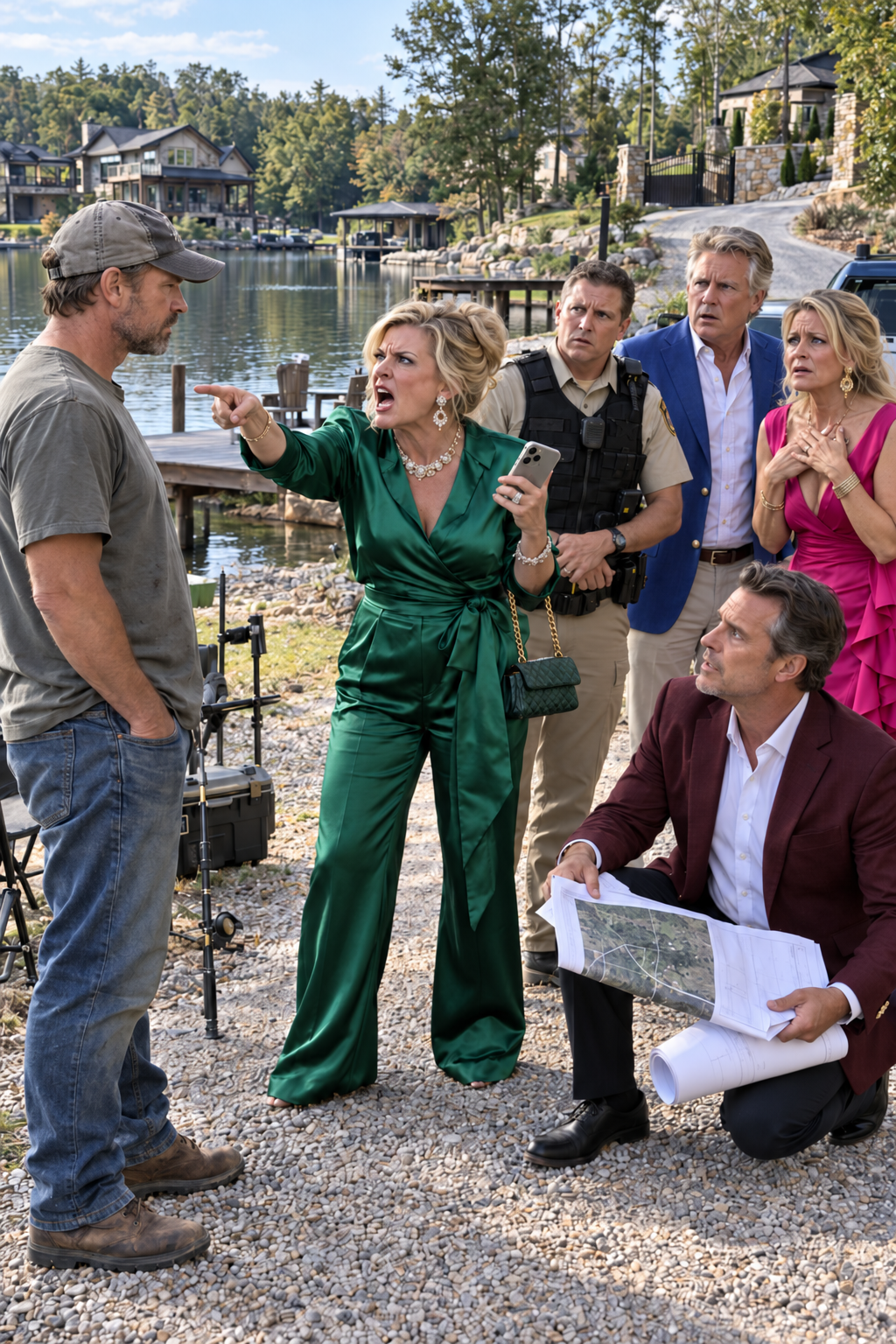
Rich Karen Called 911 While I Fished My Own Lake—Then She Learned My Family Owned the Only Road Out
The woman in the white Range Rover pointed at me like I was something her landscaper had forgotten to remove.
“Get off this lake before I have you arrested.”
I was sixty-one years old, sitting in my late husband’s aluminum fishing boat, holding the same cedar-handled rod he had given me on our twenty-fifth anniversary.
I looked at the water.
Then at her.
Then at the three men standing behind her in matching navy polo shirts with SILVER PINES LAKE ESTATES embroidered over their hearts.
I didn’t move.
That seemed to bother her more than if I had screamed.
The woman planted one expensive riding boot on the dock and lifted her phone.
“I’m serious. This is a private HOA lake.”
Her mouth tightened.
“Then you know you’re trespassing.”
I reeled in another six inches of line.
The morning was cool enough that mist still floated over Blackwater Lake. Pines reflected in the surface like dark green glass. Somewhere across the cove, a woodpecker hammered at a dead trunk.
I could smell wet earth.
Gasoline from the boat motor.
And the faint orange scent of the hand cream my husband, Jack, used to tease me about because I carried it everywhere.
The woman clicked her tongue.
“You people always think rules don’t apply to you.”
One of the men behind her laughed.
Not loudly.
Just enough.
I looked at him.
He stopped.
The woman held out her hand.
“Evelyn Hart.”
She typed it into her phone.
Nothing came up.
That made her smile.
“Exactly what I thought.”
She turned slightly, making sure the men could hear.
“No resident sticker. No guest registration. No access permit.”
“I don’t need one.”
Her smile disappeared.
“Oh, sweetheart.”
Sweetheart.
Spoken the way some people say stray dog.
“You absolutely do.”
I set the fishing rod across my knees.
On the floor of the boat beside my tackle box sat a small brown leather case.
The case was cracked at the corners.
Its brass clasp had gone green with age.
Karen Whitfield noticed it.
Her eyes flicked toward it and back.
“What’s in the bag?”
“Family papers.”
“Not relevant.”
“No,” I said quietly. “Probably not.”
That answer satisfied her.
That was the first mistake she made.
The second was calling 911.
The third was assuming the lake was the thing I owned.
Twenty minutes later, two county sheriff’s cruisers rolled down the gravel road toward the dock.
Karen crossed her arms triumphantly.
She was fifty-five, maybe fifty-six, with smooth blond hair, a pearl necklace and the kind of tan that required planning.
I learned later that her husband had made money in commercial roofing.
A lot of money.
Karen had turned that money into influence.
She chaired the Silver Pines Homeowners Association.
She hosted fundraisers.
She knew judges.
She donated to the county sheriff’s reelection committee.
She owned a six-bedroom house near the north shore, two jet skis, a pontoon boat and a lakefront wine cellar because apparently a normal basement would have been embarrassing.
Most importantly, Karen believed money and ownership were the same thing.
They aren’t.
I learned that before I turned thirty.
My father had owned a plumbing company in western North Carolina.
He worked six days a week and still drove a truck with a cracked dashboard.
When I was nineteen, I asked why he never bought himself anything nice.
He held up both hands.
The knuckles were swollen.
The nails were stained.
He said, “Nice things impress people. Useful things protect people.”
At twenty-three, I married Jack Hart.
Jack believed something similar.
He bought land.
Not flashy land.
Not resort land.
Old cattle roads.
Things rich men laughed at until they needed them.
Over thirty-four years of marriage, Jack and I built a life that looked smaller from the outside than it actually was.
We lived in a farmhouse with a squeaky staircase.
We drove used trucks.
I canned tomatoes.
He fixed fences himself even after we could afford to hire someone.
When his construction company grew, we put most of the money back into property.
Jack used to say the county was filling up with people who understood granite countertops better than drainage maps.
He wasn’t wrong.
Then Silver Pines came.
Two hundred and forty-seven luxury homes.
A clubhouse.
Tennis courts.
Private security.
A sales office with photographs of smiling couples holding wine glasses beneath the words:
YOUR LAKE. YOUR LEGACY.
Except it wasn’t their lake.
Not entirely.
And it certainly wasn’t their road.
But I’m getting ahead of myself.
Sheriff’s Deputy Cole Brennan stepped from the first cruiser.
He was young.
Late twenties.
Careful eyes.
Behind him came Deputy Mark Doyle, who was older and shaped like a refrigerator.
Karen walked toward them before their doors fully shut.
“Thank God.”
Brennan looked past her at me.
“What happened?”
“She’s trespassing.”
“I’m fishing.”
Karen spun around.
“On private property.”
Brennan looked at the lake.
Then at the marina.
Then back at Karen.
“Do you own the lake, ma’am?”
“The association does.”
I almost smiled.
Karen caught it.
“Something funny?”
“Then why are you smiling?”
She looked at Brennan.
“You see what I’m dealing with?”
Brennan walked onto the dock.
“Mrs. Hart?”
“Do you live in Silver Pines?”
“Are you a guest of a resident?”
“Do you have permission to be on the lake?”
Karen laughed.
“From whom?”
I looked directly at her.
“My husband.”
That changed her expression.
Only for a second.
She thought she had found the weakness.
“I’m sorry your husband gave you bad information, but grief doesn’t exempt anyone from property law.”
Jack had been dead eleven days.
Karen knew.
Everyone on that road knew.
The funeral procession had driven past the stone entrance to Silver Pines the previous Tuesday.
Forty-three cars.
Two work trucks.
One old red tractor driven by Jack’s foreman, because Jack had once joked that if anyone brought a limousine to his funeral he would come back and flatten its tires.
Karen knew who I was.
That part mattered later.
At the time, she pretended she didn’t.
Brennan lowered his voice.
“Mrs. Hart, I’m sorry for your loss.”
“Thank you.”
Karen inhaled impatiently.
“Can we handle the trespassing issue?”
Brennan glanced at the boat.
“How did you access the lake?”
“From my dock.”
Karen laughed again.
“Her dock?”
I pointed across the inlet.
Through the trees, barely visible from the HOA marina, stood a narrow wooden dock beside an old boathouse.
Green shutters.
Nothing fancy.
Karen followed my finger.
“That abandoned property?”
“My property.”
“You mean the Hart cabin?”
Her face changed again.
This time, longer.
Karen knew the Hart cabin.
Everyone did.
It sat on eighty-six acres at the southern end of Blackwater Lake, outside the Silver Pines development boundary.
Jack’s grandfather built the original cabin in 1948.
It had electricity now.
Running water.
A rebuilt chimney.
But from the lake, it still looked like something left behind by another century.
Karen recovered quickly.
“The cabin may belong to you. The water does not.”
Deputy Doyle spoke for the first time.
“Mrs. Whitfield, do you have the HOA deed?”
“Excuse me?”
“Documentation establishing ownership of the water body.”
“I don’t carry deeds while walking my dog.”
“You called 911.”
“I called because she refused to leave.”
Doyle nodded.
“And Mrs. Hart says she has permission.”
“From a dead man.”
I heard Jack’s voice in my head.
Don’t argue with someone who’s already writing your affidavit for you.
He had said that more than once.
So I stayed quiet.
Karen stepped closer to the edge.
“You have five minutes to dock that boat.”
“Then we’ll tow it.”
“And we’ll bill you.”
I picked up my rod.
Karen stared.
The bobber drifted near a patch of lily pads.
“You’re unbelievable.”
I cast toward the far reeds.
The lure touched the water with a soft plop.
That was the moment Karen lost control.
“Arrest her.”
Brennan looked at her.
“I can’t arrest someone because you’re annoyed.”
“She’s trespassing.”
“We haven’t established that.”
“I am president of this association.”
“That’s not a criminal designation.”
Deputy Doyle hid a smile.
Karen didn’t miss it.
Her voice went colder.
“My attorney will call Sheriff Mallory.”
There it was.
The first glimpse of the system around her.
Not just money.
Connections.
Karen didn’t threaten people personally.
She referenced people who could threaten them for her.
County commissioners.
Developers.
She had spent years learning that the cleanest knife was the one someone else held.
Brennan asked me whether I had documents.
I looked at the leather case.
“May I see them?”
Karen barked a laugh.
“Of course.”
Brennan frowned.
“Mrs. Hart—”
“I’m not refusing.”
I reeled slowly.
“I’m asking whether I’m being detained.”
“Am I under arrest?”
“Then I’d like to finish fishing.”
Karen looked genuinely stunned.
“You called the police on me while I was fishing on land my husband’s family has used for seventy-eight years. I’m not interrupting my morning because you’re impatient.”
Even Doyle looked at me differently after that.
Brennan nodded once.
Fair enough.
Karen wasn’t finished.
“You have no idea what you’re playing with.”
That line stayed with me.
Because she was right.
Three days after Jack died, my younger brother, Thomas, arrived at my farmhouse.
He brought our sister Lydia.
My nephew Eric.
And Eric’s wife, Mallory.
They carried casseroles.
By the end of the afternoon, they were asking about Jack’s estate.
Thomas tried to make it sound practical.
“Just making sure you’re protected.”
I told him Jack and I had an estate attorney.
He said family should understand family assets.
I told him family didn’t need to.
Lydia cried.
Not because Jack was dead.
Because I had “shut everyone out.”
That was the phrase she used.
Shut everyone out.
For twenty years I had paid our mother’s property taxes.
For seven years I helped Thomas make payroll when his flooring business nearly collapsed.
When Lydia divorced, Jack and I let her live in our rental house for eleven months without charging her a dollar.
When Eric needed $42,000 to finish college after he lost his scholarship, I wrote the check.
I never asked for it back.
I never reminded them.
Maybe that was my mistake.
Some people mistake generosity for surrender.
Four days after the funeral, Thomas came back.
This time without food.
He placed a folder on my kitchen table.
“There’s been a misunderstanding.”
Jack’s estate plan left me almost everything.
That wasn’t the misunderstanding.
The misunderstanding, according to Thomas, involved the lake property.
He believed Jack had promised to sell the Hart cabin and surrounding acreage to a developer years earlier.
The developer was Northstar Communities.
The same company expanding Silver Pines.
Thomas had a copy of a letter of intent.
Meaningless.
But he spoke as if the sale had already happened.
“The family needs liquidity.”
“What family?”
“The property belonged to Jack.”
“And now you’re sitting on everything.”
I remember looking at him then.
Really looking.
Thomas had my father’s nose.
My mother’s green eyes.
Gray hair at the temples.
He looked like somebody I had loved since I was six years old.
That was what made the betrayal hurt.
Not the greed.
The familiarity.
A stranger can only take money.
Family can take the memory of who you believed they were.
Thomas pushed the folder toward me.
“Northstar is offering twelve million for the southern tract.”
“You didn’t even read it.”
Lydia stood near the sink.
“Evelyn, what are you going to do with eighty-six acres?”
“For what?”
I looked at her.
“Because Jack asked me to.”
That quieted the room.
Not for long.
Eric leaned forward.
“Uncle Jack’s dead.”
Mallory touched his arm but didn’t stop him.
“Someone needs to say it.”
Eric continued.
“You’re sixty-one. You don’t have children. What exactly are you preserving all this for?”
There are sentences that age you.
That one did.
I could feel every Thanksgiving I hosted.
Every birthday check.
Every Christmas morning.
Every time Jack and I bought gifts for children we didn’t have because we had convinced ourselves nieces and nephews could fill certain rooms in a heart.
Until they decide your life is inventory.
“I think you should leave.”
Thomas shook his head.
“You’re making emotional decisions.”
“I said leave.”
Lydia’s face hardened.
“You know, maybe Eric’s right.”
I opened the kitchen door.
Two days later, I received a certified letter from Northstar’s attorney alleging that part of the Hart property was subject to development rights connected to Silver Pines.
That was when I opened the leather case.
Jack had given it to me six months before he died.
Cancer had already made his hands thin.
We were sitting on the porch.
Rain was hitting the metal roof.
He handed me the case and said, “Don’t open this unless somebody comes for the lake.”
I thought he was joking.
“Who’s coming for the lake?”
“Eventually? Everybody.”
“If nobody comes, burn it unopened.”
“What’s inside?”
“Insurance.”
“Against what?”
“People who think a widow won’t read the footnotes.”
I should have opened it that night.
Maybe I wanted to believe there would always be time to ask him.
There wasn’t.
Inside the case were seven documents.
Three deeds.
A 1951 county survey.
A road maintenance agreement.
A water-rights declaration.
And a handwritten letter from Jack.
At the bottom lay a small iron key attached to a brass tag stamped with two words.
I read Jack’s letter twice.
Then a third time.
Most of it was ordinary estate language.
Where records were stored.
Which lawyer to call.
Which parcels should never be sold separately.
But near the bottom he had written:
If Silver Pines ever challenges your right to Blackwater Lake, do not argue about the lake first.
Make them identify their legal access.
Then ask Daniel Mercer to pull Instrument 4187-C.
Do not waive anything.
Do not sign anything.
And whatever you do, do not let anyone convince you that Blackwater Road became public through use.
It did not.
The final line was underlined twice.
They built the gates on our land.
I slept three hours that night.
The next morning, I went fishing.
And Karen Whitfield called 911.
I had not planned the confrontation.
But Jack had.
Maybe years before any of us knew it.
Karen stood on the HOA dock while the deputies waited.
She was convinced time favored her.
People like Karen mistake silence for uncertainty because silence is unbearable to them.
They need your reaction.
They need your anger.
They need your fear.
They need you to explain.
They need you to beg.
I gave her none of it.
I didn’t raise my voice.
I didn’t wave a deed.
I didn’t threaten a lawsuit.
I didn’t tell her what the key opened.
I didn’t tell her what Jack had written.
Instead, I caught a bass.
Three pounds, maybe.
Beautiful fish.
Green back.
White belly.
It flashed in the sunlight while I removed the hook.
Deputy Doyle laughed from the dock.
“Nice one.”
“Thank you.”
Karen looked ready to explode.
I released the fish.
She said, “Are we finished?”
I wiped my hands.
Finally, she smiled.
Then I added, “For today.”
Her smile died.
Deputy Brennan asked if I intended to leave the lake.
Karen nodded sharply.
I started the motor.
She called after me.
“And don’t come back without HOA authorization.”
I looked over my shoulder.
She stiffened.
I had not used her first name before.
“Which road did you drive in on?”
She blinked.
“Which road?”
“Blackwater Road.”
“Thank you.”
Then I drove away.
It was the weakest question I could have asked.
That was why she never heard the trap close.
The next morning, Northstar Communities filed for emergency injunctive relief.
They claimed I was interfering with recreational lake access.
Their petition described Blackwater Lake as “an essential amenity serving Silver Pines Lake Estates.”
Interesting word.
Their attorney, Preston Hale, was expensive.
You could tell by the thickness of the paper.
He copied the HOA board.
County planning.
My estate attorney, Daniel Mercer.
And, curiously, Thomas.
My brother.
That hurt more than I expected.
Daniel noticed it too.
We sat in his office overlooking downtown Asheville while he turned the pages.
“Your brother is involved.”
“Did you know?”
Daniel removed his glasses.
He had handled Jack’s business matters for eighteen years.
“Evelyn, I’m going to ask you something unpleasant.”
“All right.”
“Has Thomas ever had access to Jack’s records?”
“My home office occasionally.”
“Bank records?”
“Property files?”
“Possibly.”
“What about the cabin?”
I hesitated.
“Jack gave him a key years ago.”
Daniel leaned back.
“When Thomas was hunting up there.”
“Do you still have the key?”
“I changed the locks after Jack died.”
“Jack told me to.”
Daniel studied me.
“What else did Jack tell you?”
I placed the leather case on his desk.
Daniel’s expression changed.
He recognized it.
“You opened it.”
He closed the office door.
That was the first time I understood the papers were more serious than I thought.
Daniel read Jack’s letter.
Then Instrument 4187-C.
He became very still.
“Do you know what this is?”
“A road agreement.”
He tapped one paragraph.
“This is the road.”
I didn’t understand.
Daniel turned the document toward me.
The original Blackwater Road had been built by Jack’s grandfather and two neighboring farmers in 1952.
The county maintained the first 1.7 miles.
After that, the pavement narrowed and curved through land now associated with Silver Pines.
Everyone assumed that section had become public decades ago.
The land under 4.3 miles of road remained part of a Hart-owned corridor.
Not just an easement.
The ground itself.
A strip varying between forty and eighty feet wide.
Silver Pines had permission to use it under a recorded access license created when phase one of the development was approved.
The license had conditions.
Very specific conditions.
No commercial expansion beyond the original residential plat without written consent from the Hart property owner.
No gate structures.
No transfer of access rights to additional parcels.
No widening.
No heavy construction traffic exceeding certain limits.
No change in lake usage.
Northstar and the HOA had violated every one.
Over years.
One amendment here.
One clubhouse expansion there.
A second gate.
A new marina.
Then thirty-four luxury townhomes.
Then a hotel proposal.
Then a conference center.
They behaved like tenants who remodeled the house until they forgot there had ever been a landlord.
Daniel looked up.
“Do they know you have this?”
“I don’t think so.”
“Does Thomas?”
“I don’t know.”
“Did Jack ever enforce it?”
“Apparently not.”
Daniel read more.
Then he found something else.
If the access license were materially violated and written notice was ignored for thirty days, the Hart owner could suspend non-emergency access until compliance.
I stared at him.
“You mean close the road?”
“Not exactly.”
“What exactly?”
“You can revoke their contractual right to use your land.”
I thought of the stone Silver Pines entrance.
The bronze letters.
The fountain.
The smiling gate attendant.
Two hundred and forty-seven houses beyond it.
Daniel nodded.
“We’re not trapping families in their homes.”
His shoulders relaxed slightly.
“I’m angry at Karen. I’m angry at Northstar. I’m angry at Thomas. But people have kids. Jobs. Medical appointments.”
Daniel gave a faint smile.
“Jack knew you’d say that.”
“Because page eleven contains an emergency residential carve-out.”
I closed my eyes.
Of course it did.
Jack had planned a legal weapon and installed a safety catch.
That was Jack.
Never build something you can’t control.
Daniel leaned forward.
“You can restrict commercial construction vehicles, developer traffic, nonresident recreational access, marketing tours and expansion parcels while preserving homeowner ingress, emergency services, utilities and school transportation.”
I stared at the document.
“How much is Northstar depending on this road?”
“Let’s find out.”
The answer was almost unbelievable.
Northstar wasn’t buying eighty-six acres for twelve million because they wanted my cabin.
They needed my land to complete a $96 million resort expansion.
Event center.
Eighty lake cottages.
A second marina.
And fourteen estate lots on the southern ridge.
Their only feasible access?
Blackwater Road.
Their primary water intake plan?
Blackwater Lake.
Their emergency egress plan?
Also Blackwater Road.
They didn’t want the cabin.
They wanted the choke point beneath it.
The twelve-million-dollar offer had been designed to make me think I was rich.
Because if I thought I was rich, I might never realize they needed me more than I needed them.
That was twist number one.
Twist number two came from my own blood.
Daniel’s investigator found a Northstar consulting agreement.
Signed six months earlier.
The consultant?
T. Cole Property Advisory LLC.
Owner: Thomas Cole.
My brother.
Payment on successful acquisition of the Hart southern tract:
I sat in Daniel’s conference room staring at the signature.
Thomas Cole.
The same handwriting that once signed my birthday cards.
The same hand that held mine when our father died.
The same man who stood in my kitchen and told me “the family needs liquidity.”
He didn’t need liquidity.
He needed a commission.
Daniel didn’t speak.
He let the silence do what it had to do.
Finally I asked, “Does he know about the road corridor?”
“Probably not.”
“How can he not?”
“Because Northstar may not know.”
That surprised me.
“They built the development.”
“Developers change. Lawyers change. Companies merge. Silver Pines began with a small regional partnership thirty years ago. Northstar bought control eleven years ago. The original access instrument is badly indexed.”
“So Jack knew.”
“And waited.”
Daniel looked at the letter.
“Maybe because Jack wasn’t interested in using a knife until somebody forced his hand.”
I understood that.
So we waited too.
The next Friday, Karen held an emergency HOA meeting at the Silver Pines clubhouse.
Someone sent me the livestream link anonymously.
I watched from my kitchen.
Karen stood behind a polished wooden podium.
Residents filled rows of white chairs.
She wore red.
Red jacket.
Gold buttons.
The uniform of someone planning to win in public.
She told them an “outside party” was attempting to disrupt established lake access.
She called me confused.
She called the Hart claim outdated.
She assured everyone that Northstar’s attorneys had reviewed the matter.
Then she made the mistake we needed.
Karen announced the HOA had voted to authorize construction of a new automated security gate on Blackwater Road.
Commercial arms.
License plate cameras.
“The association,” she said, “has controlled access to this road for years, and we intend to formalize that control.”
Daniel paused the video.
“Thank you, Karen.”
The new gate required concrete foundations.
On my land.
Monday morning, contractors arrived.
Tuesday morning, we served notice.
Not a lawsuit.
A Notice of Material Access Violation.
Delivered to the HOA.
County planning.
The gate contractor.
The lender financing the expansion.
The title insurer.
Karen received hers at a.m.
At , she called me.
I didn’t answer.
At , she called again.
At , Northstar’s attorney called Daniel.
At 10:02, Thomas sent me a text.
What the hell are you doing?
Then put my phone facedown.
At noon, three construction trucks tried to enter Blackwater Road carrying steel gate assemblies.
They encountered a temporary barrier placed on the commercial lane.
Residential traffic passed normally through the adjacent lane.
A deputy was present.
So was Daniel.
So was a survey crew.
And so was I.
Karen arrived twelve minutes later.
White Range Rover.
She braked hard on the gravel shoulder and jumped out.
“What is this?”
Daniel walked toward her.
“Mrs. Whitfield, commercial construction access has been suspended pending resolution of the recorded road license violation.”
“You can’t suspend a public road.”
“It isn’t public.”
She laughed.
Not convincingly.
“This road has existed for seventy years.”
“The county maintains it.”
“Only to Mile 1.7.”
“This is absurd.”
Daniel handed her a copy of Instrument 4187-C.
She didn’t take it.
“I don’t need ancient paperwork.”
“You probably do.”
“I have attorneys.”
“They have copies.”
Her eyes found me.
I stood beside the old granite survey marker Jack had uncovered years earlier.
A metal cap on top read HART CORRIDOR B.
Karen walked toward me.
“You’re doing this because I embarrassed you at the lake.”
“Because I called the police.”
“Then what?”
“Because you poured concrete on my property.”
“It’s an access road.”
“My access road.”
“You don’t own roads.”
“People own the ground under roads every day.”
“This is extortion.”
“You’re trying to destroy property values.”
“You’re punishing hundreds of families.”
That stopped her.
Because cars were driving past us.
A school bus.
A UPS truck.
An ambulance.
All permitted.
Only Northstar’s construction convoy sat blocked.
Only commercial expansion traffic.
Only the people who had treated permission like ownership.
Karen finally looked at Daniel’s paperwork.
Then at the survey marker.
For the first time, she wasn’t angry.
She was scared.
Just a little.
But enough.
Thomas arrived an hour later.
He didn’t come to me.
He went straight to Preston Hale.
That confirmed everything without anyone saying a word.
I watched my brother stand beside Karen and Northstar’s lawyer while they examined the survey.
The physical arrangement said more than any confession.
They were on one side.
I was on the other.
Thomas finally walked over.
“You need to stop.”
“Hello, Thomas.”
“This isn’t a game.”
“You’re exposing yourself to enormous liability.”
“Daniel says otherwise.”
“Daniel isn’t family.”
That almost made me laugh.
“You sold access to my property for six hundred and forty thousand dollars.”
His face went white.
There it was.
Just calculation.
“Who told you?”
“Does it matter?”
“That agreement isn’t what you think.”
“It says acquisition bonus.”
“I was helping negotiate.”
“For everyone.”
“Without telling me.”
“You weren’t thinking rationally.”
That phrase again.
Irrational.
Words used against women when our answer is no.
Thomas stepped closer.
“Evelyn, listen to me. Twelve million dollars is more money than you’ll ever spend.”
“This isn’t about twelve million dollars.”
“Then what is it about?”
I looked past him.
Toward the lake.
Toward the road Jack’s grandfather built.
Toward the pine ridge where Jack and I used to walk in October.
“It’s about being asked.”
Thomas stared at me.
I continued.
“Jack’s grandfather let neighbors use this road because their farms had no winter access. Jack’s father kept that agreement. Jack kept it. We never charged families. We never blocked ambulances. We never stopped school buses. We never treated kindness like leverage.”
Thomas said nothing.
“But Northstar added houses without asking.”
I pointed toward the gate.
“Karen poured foundations without asking.”
I looked back at him.
“And you sold something you didn’t own without asking.”
His jaw tightened.
“You always thought you were better than us.”
“Yes, you did.”
“I thought you loved me.”
That landed.
Thomas looked away first.
For a second, I saw my little brother again.
Twelve years old.
Bloody knee.
Following me home from school.
Then Preston Hale called his name.
And Thomas walked back to them.
That was the funeral I cried at.
Not Jack’s.
Jack had loved me until his last breath.
There was grief in losing him.
But no betrayal.
Thomas was different.
You can mourn the dead.
It is harder to mourn the living while they stand ten yards away discussing how to defeat you.
The thirty-day cure period began.
Northstar moved fast.
They offered me fifteen million.
Then eighteen.
Then twenty-two.
Karen organized residents.
Not against Northstar.
Against me.
Flyers appeared.
SAVE OUR HOMES.
STOP THE HART LAND GRAB.
PROTECT BLACKWATER ACCESS.
One local news station ran a segment showing my temporary commercial barrier.
They interviewed Karen beside the lake.
She looked straight into the camera.
“One grieving property owner is threatening an entire community.”
There it was again.
My husband’s death turned into evidence against my judgment.
Daniel advised me not to respond publicly.
So I didn’t.
Instead, I mailed every Silver Pines homeowner a copy of the access notice.
Four pages.
Plain language.
Residential access protected.
Emergency access protected.
School transportation protected.
Utilities protected.
Only unauthorized commercial expansion restricted.
At the bottom I included one sentence.
Ask your board why they told you otherwise.
That changed everything.
Not immediately.
But truth rarely arrives dramatically.
It spreads.
At mailboxes.
At kitchen tables.
In text threads.
One neighbor asks another.
One resident pulls old board minutes.
One retired lawyer reads the attachments.
Within forty-eight hours, people discovered Karen had known about the Hart road claim for at least two years.
The board had received a title exception during the marina refinancing.
Karen had signed the acknowledgment.
Remember when she called 911 and pretended not to know who I was?
That wasn’t arrogance.
It was strategy.
She needed me to appear like the intruder.
Because if I was merely a grieving widow trespassing on an HOA lake, the story was simple.
If I was the owner of the corridor beneath their entrance, the story changed.
Karen had tried to define reality before the paperwork could.
It almost worked.
Then Silver Pines residents found something worse.
Northstar’s proposed resort expansion required HOA support for infrastructure costs.
Three million dollars.
Karen had negotiated the agreement privately.
In exchange, Northstar promised to purchase her husband’s struggling commercial property outside Asheville for nearly twice its appraised value.
That was the corruption.
Not a suitcase of cash.
Not a secret confession.
Something cleaner.
Something that looked legal until you placed the documents beside one another.
Her motive finally made sense.
Karen didn’t need my lake.
She needed Northstar’s deal.
And Northstar needed my road.
The system around her began cracking.
One HOA board member resigned.
Then another.
Residents demanded records.
The treasurer stopped answering Karen’s calls.
The gate contractor removed its equipment voluntarily.
The county planning director suspended review of the resort’s access plan.
Then Northstar’s lender sent a letter requesting clarification of legal ingress.
In real estate, people can survive bad publicity.
They can survive lawsuits.
They can survive protests.
What they cannot survive is a bank asking whether the road to a ninety-six-million-dollar project exists.
Day twenty-seven.
Northstar offered thirty million.
I declined.
Day twenty-eight.
Thomas came alone.
It was raining.
He stood on my porch in a soaked gray jacket.
I almost didn’t open the door.
Then I remembered my father.
Useful things protect people.
Sometimes information is useful.
I let Thomas inside.
He looked older than he had three weeks earlier.
He seemed surprised.
I poured two cups.
We sat at the kitchen table.
The same table where he had first told me to sell.
Thomas wrapped both hands around the mug.
“They’re going to sue you personally.”
“They’ll bury you.”
“You should take the money.”
He rubbed his forehead.
“You don’t understand Northstar.”
“I understand them better now.”
Something in his voice made me look at him.
Thomas leaned closer.
“The road isn’t the whole thing.”
I said nothing.
“They don’t care about the resort.”
“Then why spend ninety-six million dollars?”
“That’s the public project.”
“What’s the private project?”
He looked toward the window.
Rain ran down the glass.
“I don’t know exactly.”
That sounded true.
“They’ve been buying parcels north of the lake for three years. Shell companies. Timber lots. Old farms. Even useless swamp acreage.”
“How do you know?”
“I sourced some of them.”
Of course he did.
“They never told me.”
“How many acres?”
“At least forty-eight hundred.”
That number chilled me.
“What connects them?”
Thomas looked at me.
Blackwater Lake fed two creeks.
One river tributary.
And an underground aquifer Jack had talked about for years.
I remembered something from the leather case.
The water-rights declaration.
Thomas said, “What?”
I went upstairs.
When I returned with the brown case, he stared at it.
“What is that?”
“Something Jack left.”
I removed the water document.
The language was old.
But one phrase jumped out now.
Riparian withdrawal priority.
Jack hadn’t only preserved road rights.
His family had retained senior rights governing significant commercial withdrawal from the southern watershed.
Thomas stared at the paper.
“They’re not building a resort.”
My hand tightened around the document.
“What are they building?”
“I don’t know.”
He paced once.
Then stopped.
“But I heard Preston on the phone months ago. He said if they secured Hart access and the southern water position, phase two became worth ten times phase one.”
I felt cold.
“Ten times ninety-six million?”
Thomas looked at me.
“At least.”
That was the moment I realized Jack’s warning had never been about an HOA.
The HOA was camouflage.
Karen was camouflage.
Even Northstar’s resort might be camouflage.
Someone wanted control of the water beneath thousands of acres.
And my husband had known enough to leave me a key marked MILE 0.
“What does the key open?” Thomas asked.
“I don’t know.”
For once, he believed me.
The thirty-day deadline expired at midnight Friday.
At 12:01 a.m., Silver Pines lost all contractual commercial expansion rights over the Hart corridor.
At a.m., Northstar trucks arrived anyway.
Six of them.
Excavators.
Concrete equipment.
Survey vehicles.
I was waiting.
So were Daniel and two deputies.
This time Karen didn’t come first.
Preston Hale did.
He stepped from a black Mercedes and handed Daniel a court order.
Temporary restraining order.
Signed at that morning by Judge Ernest Bell.
The order prohibited me from interfering with “established access.”
Karen arrived five minutes later.
She smiled from inside her Range Rover.
Thomas had warned me Northstar would move.
He hadn’t known how.
Daniel read the order twice.
His face gave away nothing.
Preston adjusted his cuff.
“You will open the lane.”
Daniel looked at me.
“This order appears valid.”
Karen stepped from her vehicle.
“I tried to tell you.”
The trucks started engines.
Diesel smoke drifted through the pine trees.
For the first time since this began, the other side thought I had lost completely.
Karen walked toward me.
She wanted to enjoy it.
“Thirty million,” she said softly.
“That was their last offer, wasn’t it?”
I didn’t answer.
“I hope your pride keeps you warm.”
She looked toward the leather case in my hand.
“You should’ve taken the money.”
I looked at the court order.
Then at Preston.
“Judge Bell signed this?”
“At six twelve?”
“And it covers the Hart corridor?”
“All of it?”
He sounded irritated.
“That is what established access means.”
Karen narrowed her eyes.
I opened the leather case.
Daniel watched me.
I took out the iron key.
Then I looked at Deputy Brennan.
“Would you mind following me?”
Karen laughed.
“Where are you going?”
“Mile zero.”
There hadn’t been a visible Mile Zero marker in decades.
Jack’s maps showed it near an abandoned maintenance shed half a mile south of the county line.
The shed sat behind blackberry bushes and two fallen pines.
Karen followed.
So did Preston.
The deputies.
Then Thomas.
Rain from the night before made the ground soft.
My boots sank into mud.
We reached the shed.
It was older than I remembered.
Gray boards.
Rusting metal roof.
A padlock hung beneath the door handle.
I inserted the key.
Inside were old tools.
Road signs.
A broken chainsaw.
A metal filing cabinet.
And a steel survey box bolted into the concrete floor.
The same marking.
My hands shook slightly as I unlocked it.
I could almost hear him telling me not to lose the key.
Inside were rolled surveys sealed in plastic.
Photographs.
County correspondence.
And a notarized affidavit.
Daniel took the affidavit first.
Then stopped.
He read again.
Preston stepped closer.
“What is it?”
Daniel handed the paper to me.
The affidavit was signed by three men.
Former County Engineer Samuel Reeves.
Former Highway Superintendent Curtis Lane.
Dated eighteen years earlier.
It documented something none of the current records showed clearly.
Blackwater Road had been relocated during a flood-control project in 2008.
Everyone—including Northstar’s lawyers—had been analyzing the old corridor description.
But the relocated road crossed a second Hart parcel.
A parcel never included in the original Silver Pines access license.
The HOA had no recorded right to use nearly nine hundred feet of the present roadway.
For eighteen years, Jack had allowed it under a revocable neighbor accommodation.
That was why he wrote:
Do not argue about the lake first.
The road they believed they were fighting over wasn’t even the entire road.
Part of their entrance sat on land where they had no easement at all.
Preston’s face changed.
“The court order—”
Daniel looked at him.
“Covers established licensed access under Instrument 4187-C.”
“This section isn’t subject to 4187-C.”
Karen whispered, “That’s impossible.”
Daniel opened the survey.
A red line crossed directly beneath the road.
Preston grabbed his phone.
Karen stared at me.
“You knew.”
“You planned this.”
“Jack did.”
That was the truth.
Jack had been dead less than a month, and somehow he was still protecting me.
Not from poverty.
Not from taxes.
From pressure.
From humiliation.
From the moment powerful people decided my silence meant I could be pushed aside.
I felt grief rise into my throat.
But I swallowed it.
There would be time later.
Now required steadiness.
Preston walked away making calls.
The construction convoy remained parked.
Karen looked toward the line of trucks.
Then back at me.
“You can’t close this road.”
“I’m not closing residential access.”
“The court will force you.”
“You think this makes you powerful?”
“What do you want, Evelyn?”
There it was.
Not What are you doing?
Not How much?
What do you want?
I looked at Silver Pines.
At its rooftops between the trees.
At families who had bought homes believing glossy brochures and title policies.
At people who had never heard the name Hart until Karen turned me into their enemy.
“I want Northstar’s expansion stopped until every title, access agreement and water claim is reviewed.”
Karen shook her head.
“They’ll never agree.”
“I want Silver Pines homeowners protected from the cost of your unauthorized deal.”
“That’s not your concern.”
“It is now.”
“I want the HOA to acknowledge the road license publicly.”
Her jaw hardened.
“I want the gate foundations removed.”
I thought of Jack.
“And I want you to stop calling my kindness your property.”
Karen stared at me for a long time.
Then she said something unexpected.
“You think you’ve won.”
“I think construction isn’t happening today.”
“That’s not winning.”
She stepped closer.
“Northstar will take this land.”
“They have condemnation options.”
“Not for a private resort.”
She smiled.
And that smile bothered me.
Because it wasn’t defensive.
It was almost pitying.
“Who said anything about a resort?”
Then she walked away.
I watched her get into the Range Rover.
Thomas heard it too.
He came beside me.
“That’s what I was trying to tell you.”
My phone rang.
Daniel’s investigator.
I answered.
He didn’t say hello.
“Evelyn, I found the shell company buying the northern parcels.”
“What is it?”
“Blue Meridian Infrastructure.”
“Never heard of it.”
“You wouldn’t have.”
“Who owns it?”
“That’s complicated.”
“How complicated?”
“Northstar owns twenty-two percent.”
“And the rest?”
“A consortium.”
“What kind?”
“Data infrastructure. Energy. Water treatment.”
The words seemed unrelated for half a second.
Then they weren’t.
“What are they building?”
“We’re still pulling records.”
“A hyperscale computing campus.”
I looked at the lake.
Data centers.
Jack and I had read about them.
Huge buildings.
Huge electrical demand.
Huge cooling demand.
Lots of water.
The resort wasn’t the project.
The resort was the road.
Northstar needed recreational expansion approval because it made road improvements politically attractive.
Wider lanes.
Utility corridors.
Water infrastructure.
A secondary substation.
Once everything existed, Blue Meridian could build beyond the ridge.
Forty-eight hundred acres.
Maybe more.
And whoever controlled Blackwater’s water rights could control whether the project lived or died.
Jack hadn’t left me a fortune.
He had left me leverage over a transformation that could alter the entire valley.
That was different.
Money buys comfort.
Leverage can force justice.
By afternoon, word spread.
Northstar halted construction.
The county attorney announced a title review.
Silver Pines scheduled a recall vote.
Karen resigned as HOA president two days before residents could remove her.
She claimed health reasons.
Nobody believed her.
Preston Hale withdrew from representing the HOA but continued representing Northstar.
My brother disappeared from the Northstar consultant directory.
Then Thomas came to my house with three cardboard boxes.
“What’s this?”
“Everything I have.”
Inside were development files.
Purchase agreements.
Internal emails.
Thomas had kept copies.
Insurance, he said.
For himself.
Maybe that made the gesture less noble.
I didn’t care.
Evidence doesn’t need a pure heart.
One document showed Northstar planned to pay twenty-two million for my land.
Another showed an internal valuation of something called SOUTHERN CONTROL POSITION.
Estimated strategic value:
$187 million.
Not because of the cabin.
Not because of the lakefront.
Because of road access and water priority.
Another file listed political consultants.
County relationships.
Utility negotiations.
Land acquisition targets.
And one entry that made my stomach turn.
HART FAMILY ALIGNMENT — T. COLE
My brother had not merely been hired to negotiate.
He had been categorized as a method.
A way into me.
Thomas read it over my shoulder.
His face collapsed.
“They used me.”
I closed the file.
“You let them.”
He flinched.
Forgiveness without truth is just another kind of lying.
“I’m sorry,” he said.
“Can you forgive me?”
“Not today.”
That was the first respectable thing he had done in weeks.
A month later, Silver Pines elected a new board.
Their first vote recognized the Hart road corridor and terminated the unauthorized Northstar infrastructure agreement.
Their second authorized legal action against former officers who had concealed title risks.
Karen sold her house.
She did not lose everything.
Life is rarely that tidy.
She remained wealthy.
Her husband still had businesses.
She still had friends.
Still had lawyers.
Still had a beautiful house waiting somewhere else.
Justice is not always watching the villain become poor.
Sometimes justice is simply making sure they can no longer use your silence as a ladder.
Northstar sued me anyway.
Then the lender froze their expansion financing.
Then county planning suspended the project.
Then Blue Meridian filed its own intervention.
That was when things became larger than Karen.
Much larger.
My name appeared in newspapers.
Not because of fishing.
Because of water.
Reporters called.
Television trucks appeared near my mailbox.
Environmental groups wanted meetings.
Business groups wanted meetings.
County officials wanted meetings.
Everybody wanted coffee.
Everybody wanted cooperation.
Everybody wanted to explain what Jack’s land ought to become.
I listened.
I signed nothing.
That part would have made him proud.
In November, I returned to the lake alone.
The trees were copper and red.
Cold air sat over the water.
I took the aluminum boat from the old dock.
Same tackle box.
Same leather case under the seat.
I caught nothing for two hours.
Didn’t care.
Jack had loved fishing even when the fish refused to participate.
Around noon, I drifted near the center.
No deputies.
No cameras.
Just wind crossing Blackwater.
I finally cried.
Not dramatically.
No screaming.
No collapsing.
Just quiet tears falling onto my jacket while the boat turned slowly in the current.
“I found the road,” I said aloud.
The lake did not answer.
“I found the water papers too.”
Still nothing.
I smiled through the tears.
“You could have explained this better.”
A hawk circled above the ridge.
I wiped my face.
Then I noticed something.
The leather case was open.
I must not have latched it.
One of Jack’s old maps had slipped halfway out.
I pulled it free.
It was the 1951 survey.
I had seen it dozens of times by then.
But sunlight hit the reverse side as I unfolded it.
There was writing.
Faded pencil.
So faint I had never noticed it indoors.
Coordinates.
And three words.
BELOW OLD SPILLWAY.
My pulse changed.
The old spillway had been abandoned before Silver Pines existed.
Jack used to take me there when we were young.
It sat upstream of the lake, buried beneath kudzu and stone.
I started the motor.
Twenty minutes later, I tied the boat near shore and walked.
The spillway was worse than I remembered.
Collapsed concrete.
Saplings growing through cracks.
I followed the coordinates on my phone.
They led twenty-seven yards above the structure.
Then I saw iron.
A ring embedded in a flat stone.
The stone didn’t move.
I cleared dirt around it.
A rectangular lid.
My heart hammered.
I called Daniel.
I called Thomas.
Stopped before pressing dial.
I found an old tire iron in the boat and returned.
The lid lifted two inches.
Cold air came from beneath it.
There was a steel box inside.
Newer than the spillway.
Maybe twenty years.
I dragged it out.
I stared at the lock.
Then at the brass key in the leather case.
It couldn’t be.
The key slid in.
Inside were geological reports.
Well tests.
Water tables.
Mineral surveys.
Photographs.
And a sealed envelope.
My name was on it.
Jack’s handwriting.
I sat on the damp ground.
For several seconds, I couldn’t open it.
Then I did.
If you found this, they learned about the road.
If they learned about the road, they will eventually learn why my grandfather kept the upper watershed separate.
Do not trust the development maps.
Do not trust the county parcel overlays.
The northern boundary was changed in 1989 without our consent.
Find the original federal survey.
Until you do, nobody knows how much land we actually own.
My mouth went dry.
There was one final paragraph.
And do not let anyone drill near the eastern ridge.
There is something under it they have been looking for since before Silver Pines existed.
I read the line again.
Something under it.
The geological report underneath carried a logo I recognized from Thomas’s files.
Blue Meridian.
But the date was impossible.
Blue Meridian supposedly hadn’t existed until 2018.
A sound came from the road above me.
Tires on gravel.
I closed the box.
An SUV stopped beyond the trees.
No plates visible from where I sat.
A man stepped out.
He didn’t walk toward me.
He simply stood beside the vehicle.
Then my phone rang.
Unknown number.
I answered.
No greeting.
A man’s voice said, “Mrs. Hart, you found something that belongs to us.”
I looked at the steel box.
Then almost politely:
“You should ask your late husband why he never told you what happened in 1989.”
The call ended.
The SUV began backing away.
My hands were cold, but my voice was steady.
The vehicle stopped.
The driver’s window lowered halfway.
I couldn’t see the man clearly.
I picked up Jack’s envelope.
Then I asked the quietest question I had asked since Karen stood on that dock and ordered me off my own lake.
“Before you leave—could you tell me which road you used to get here?”
✓ Lynn R. Adams
Rich Karen Called 911 While I Fished My Own Lake—Then She Learned My Family Owned the Only Road Out The woman in the white Range Rover pointed at me like I was something her landscaper had forgotten …