Pregnant and Betrayed at the Maternity
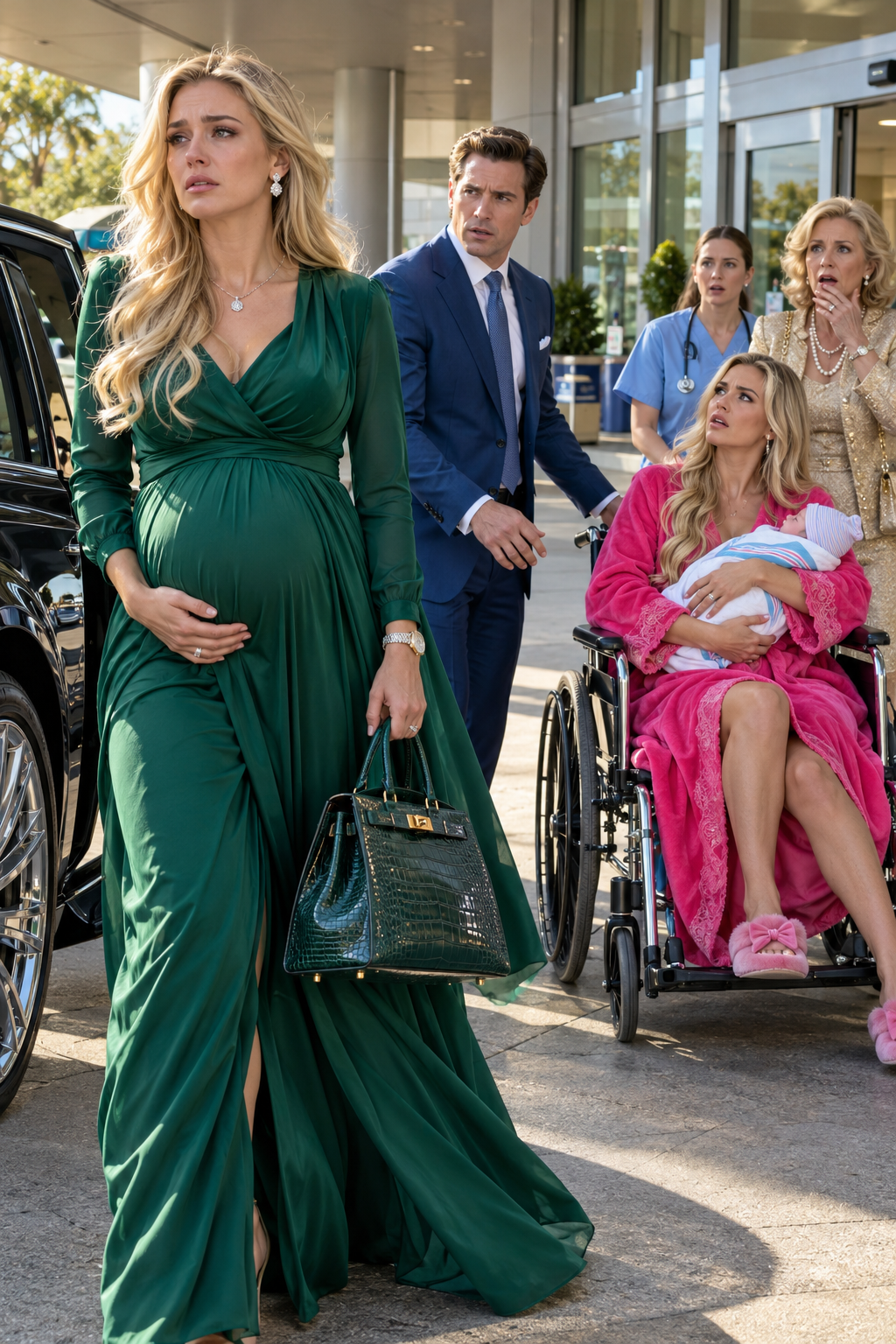
Pregnant and Betrayed at the Maternity Ward, I Walked Away Quietly—Then My Husband Learned I Owned the Empire He Thought Was His
My husband was holding another woman’s newborn son when he saw me standing at the end of the maternity ward.
I was seven months pregnant with his daughter.
And the first thing Grant Whitmore said was, “Claire, don’t embarrass me here.”
For one strange second, the entire hallway seemed to lose its sound.
The rolling carts.
The soft alarms.
The nurses speaking behind the station.
Even the crying baby in Grant’s arms seemed to disappear beneath the pressure building behind my ribs.
Grant stood outside Room 418 wearing the navy suit I had steamed for him that morning.
His tie was gone.
His white shirt was open at the collar.
There was a hospital bracelet around his wrist.
And tucked against his chest was a tiny red-faced infant wrapped in a blue blanket.
Behind him, through the partially open door, I could see Paige Lawson lying against a mountain of white pillows.
Grant’s vice president of marketing.
The woman he had described for two years as “practically family.”
The woman who sent him messages after midnight because campaigns were apparently emergencies now.
The woman who once smiled at me over Thanksgiving dinner and asked whether the baby kicking inside me had made me “more emotional than usual.”
She looked exhausted.
Victorious.
Grant adjusted the blanket beneath the newborn’s chin.
Then he glanced down the hall, as if checking whether anyone important had witnessed my arrival.
Not whether I was all right.
Not whether I might faint.
Not whether the seven-month-pregnant wife he had lied to for nearly a year could breathe.
Whether anyone important had seen.
That was Grant.
Even betrayal needed good lighting.
“What is this?” I asked.
My voice came out so steady that it frightened even me.
Grant’s mother, Diane, appeared in the doorway behind him.
That was when I understood this was worse than an affair.
Diane Whitmore was wearing cream cashmere and pearl earrings.
Her hair was perfect.
Her lipstick had been freshly applied.
She had flowers in her hand.
She had come prepared to celebrate.
She had known.
“Claire,” she said quietly, almost impatiently. “This is not the place.”
I looked from her to Grant.
Then to Paige.
Then to the child.
The baby made a small sound and opened his mouth.
Grant instinctively rocked him.
He had never once attended a childbirth class with me.
He had missed my twenty-week ultrasound because his mother needed him at a board dinner.
He had left me alone in our kitchen at two in the morning when I was bleeding during my first trimester because, as he put it, “If something is wrong, the hospital can handle it.”
But he knew how to rock Paige’s son.
I placed one hand over my stomach.
My daughter kicked hard beneath my palm.
I remember that more clearly than anything.
Not Grant’s face.
Not Paige’s expression.
Not Diane’s pearls.
My daughter kicked.
As if she were reminding me that someone inside my body still believed I was home.
Grant shifted his weight.
“This is my son,” he said.
No apology.
No hesitation.
Three words.
He said them like announcing a quarterly result.
I stared at him.
“How old is he?”
Grant’s jaw tightened.
Diane answered.
“Six hours.”
I had spent those same six hours sitting in an obstetric triage room two floors below because my blood pressure had spiked during a routine appointment.
Grant knew.
I had texted him.
I had called him twice.
He had replied:
In meetings. Keep me posted.
He had been in the same hospital.
Holding his mistress’s hand.
Waiting for his son.
Something inside me became very still.
Grant mistook that stillness for collapse.
People like him often do.
He stepped toward me.
“Claire, listen. I was going to tell you.”
His face changed.
But enough.
“When the timing was better.”
I looked at the newborn again.
“There was a nine-month warning.”
Paige turned her face toward the window.
Grant’s mother exhaled sharply.
“Must you be sarcastic?” Diane asked.
I looked at her.
That almost made me smile.
Grant lowered his voice.
“Paige and I didn’t plan this.”
He kept talking.
Men like Grant always keep talking when silence makes them nervous.
“It happened during a difficult time between us.”
“We weren’t having a difficult time.”
“We were disconnected.”
“I was pregnant.”
The word landed between us.
As if my pregnancy had somehow created a vacancy.
As if nausea, exhaustion, fear, and carrying his child had made me temporarily unqualified to be his wife.
Then Grant said the sentence that ended our marriage.
Not the affair.
Not the baby.
Not the months of lying.
The sentence.
“I need stability right now, Claire. Paige just gave birth. She needs me. The baby needs me. You’re strong. You’ll be fine.”
I stared at him.
Behind the glass wall of the nurses’ station, a nurse slowly stopped typing.
Diane looked away.
Even Paige closed her eyes.
Grant, however, seemed relieved.
He thought he had explained it perfectly.
I did not scream.
I did not throw my wedding ring.
I did not ask whether he loved her.
I did not ask how long it had been happening.
I did not beg him to remember our marriage.
I did not give them the scene they had prepared themselves to survive.
Instead, I reached into my purse.
Grant stiffened.
Diane did too.
I took out a small brass key.
Stamped with the number 317.
My grandmother had given it to me three weeks before she died.
Grant had seen it once.
He had asked what it opened.
I had told him, “Something my grandmother believed I might need one day.”
He had laughed.
“Knowing Eleanor, probably a box of Depression-era silver dollars.”
I closed my fingers around the key now.
Not because I needed to use it.
Because I needed to remember what came with it.
My grandmother’s voice.
Her warning.
Her last clear afternoon in the library of the old Hawthorne house.
She had held my wrist with fingers weakened by cancer and said, “If people love your usefulness more than they love you, Claire, eventually they will confuse your kindness with ownership.”
At the time, I had thought she was talking about my brother.
I had been wrong.
She was talking about everybody.
Grant stared at the key.
“What are you doing?”
“Remembering.”
“Remembering what?”
I slid it back into my purse.
“That I have somewhere to go.”
He almost looked amused.
That hurt more than if he had laughed.
“Claire, our home is your home.”
Diane touched his arm.
He ignored it.
“For now,” he added.
There it was.
The first knife after the betrayal.
Deliberate.
I looked at him.
Grant glanced toward Paige’s room.
“You’re seven months pregnant. Nobody is throwing you into the street tonight. But we need to be realistic. This situation has changed things.”
I nodded slowly.
“Of course.”
That answer confused him.
I could see it.
He had expected tears.
Maybe a demand that he choose.
Instead, I adjusted the strap of my purse.
Then I stepped aside so a nurse pushing a bassinet could pass between us.
Grant lowered his voice again.
“Claire, say something.”
“No. Say what you’re actually thinking.”
I looked directly at him.
“I’m thinking you should hold your son correctly. His neck needs more support.”
Grant’s face went blank.
I turned and walked toward the elevators.
Nobody stopped me.
That was their first mistake.
The second mistake happened four days later.
Grant changed the locks.
I discovered it at on a rainy Tuesday evening.
I had spent the previous three nights at a hotel near my obstetrician’s office because my doctor wanted my blood pressure monitored, and because I had no interest in sleeping beside a man who had gone home each evening to prepare for another woman and child.
Grant had sent polite messages.
We should talk.
Mom is worried about you.
We can solve this maturely.
My lawyer will send something over.
I had not answered.
On Tuesday, I returned to our house in Lake Forest, outside Chicago, because I needed my medical records, laptop, and the cedar box containing my mother’s letters.
My key would not turn.
I tried twice.
Then once more.
The front door opened from inside.
Diane stood there.
Behind her, I could see two suitcases.
“What is this?” I asked.
She folded her arms.
“Grant thought some space would help everyone.”
“By changing the locks?”
“You left voluntarily.”
“For three nights.”
“Technically four.”
Rain slid beneath the collar of my coat.
I looked past her.
The entry table where our wedding photograph had stood was empty.
The photograph was gone.
A framed picture of Grant holding Paige’s newborn son had taken its place.
That was all it had taken them.
Diane followed my eyes.
“Paige and the baby are coming tomorrow.”
I looked at her.
“To my house?”
Diane’s mouth tightened.
“This house belongs to Grant.”
That sentence interested me.
I stepped beneath the porch light.
Her eyes flickered.
If I had been crying, I might have missed it.
But I was not crying.
I was watching.
“My belongings are inside,” I said.
“We packed what you’ll need.”
“What you decided I’ll need?”
“Claire, please don’t make this vulgar.”
I almost laughed.
Instead, I looked at the two suitcases.
One contained maternity clothes.
The other contained shoes, toiletries, three sweaters, and a folder of prenatal paperwork.
No jewelry.
No family photographs.
No computer.
No financial records.
No cedar box.
They had not packed me out.
They had inventoried me.
That distinction mattered.
“Where is Grant?”
“At the hospital.”
“With Paige.”
“And my things?”
“We’ll arrange the rest after you sign the separation agreement.”
So there it was.
Prepared paperwork.
I had spent eleven years thinking Diane Whitmore disliked spontaneity.
Now I realized she simply preferred conspiracies with calendars.
I reached into my purse and took out my phone.
Diane’s expression sharpened.
“I hope you’re not recording me.”
I opened my camera and took a photograph of my luggage sitting on the marble floor behind her.
Then another of the new lock.
Then one of the photograph on the entry table.
I lowered the phone.
“This is a family matter.”
“So was my marriage.”
She stared at me.
The rain thickened behind me.
Finally she said, “Grant doesn’t want a fight.”
“No. Grant wants compliance.”
“You’ve always been dramatic when you’re hurt.”
That made me look at her properly.
For eleven years, I had driven Diane to oncology appointments after her breast cancer diagnosis.
I had cooked Thanksgiving dinner while she recovered from surgery.
I had quietly covered the property taxes on the Whitmore family lake house one year when Grant’s business nearly collapsed.
I had never told her.
Grant had asked me not to embarrass him.
I had been the one who sat with Diane through her first chemotherapy session because Grant had an investor lunch.
I had been the one who washed her hair in the sink when her scalp hurt too badly beneath the shower.
I had been the one she called at a.m. when she found blood on her pillow after surgery.
That was the word she chose.
“You’re right.”
She blinked.
“I should probably become less emotional.”
My phone vibrated.
I did not look at it.
Diane stepped back.
“There’s a car coming to take you to the hotel.”
“I have my own car.”
“Grant canceled your access to the garage.”
That was almost impressive.
He really had thought of everything.
“Did he cancel the car insurance too?”
Diane said nothing.
I smiled faintly.
“Good night, Diane.”
She looked unsettled now.
“Claire, the agreement is generous.”
“I haven’t seen it.”
“You will tomorrow.”
“What does Grant think generous means?”
Her chin lifted.
“The condo downtown for two years. Medical expenses through your pregnancy. A monthly allowance. And, naturally, child support once your daughter is born.”
My daughter.
Not his daughter.
Interesting.
“And in exchange?”
“You waive any claim to Whitmore Holdings.”
There it was.
The land mine.
The sentence my grandmother had taught me to wait for.
I looked at Diane’s perfectly composed face.
“Whitmore Holdings?”
“Grant built that company.”
“No,” I said softly. “He didn’t.”
Her eyes narrowed.
“You know what I mean.”
That was exactly the problem.
Whitmore Holdings had become one of the largest privately held hospital-services and medical-property groups in the Midwest.
Grant liked telling reporters he had built it from “a secondhand desk, one leased office, and raw nerve.”
That story photographed well.
It was also false.
The first office had been financed by my grandmother.
The second acquisition had been guaranteed by my family trust.
The entire company’s early expansion had been possible because I signed a collateral agreement against Hawthorne land when Grant’s own father refused to back him.
Grant always called that “help from family.”
He never specified whose.
But even that was not the real secret.
The real secret lived behind brass key 317.
And Grant had no idea.
I picked up one suitcase.
Diane reached for the other.
I stopped her.
“Leave it.”
“I only need one.”
She looked at me like I was insane.
Maybe because people who have spent years training you to accept crumbs become frightened when you stop carrying the bowl.
I walked into the rain.
I did not cry until I reached the car.
And even then, it lasted less than a minute.
Not because I was strong.
Because my daughter moved beneath my ribs.
I placed both hands over my stomach and said, “You are never going to learn love by watching your mother beg for it.”
Then I started the engine.
The message on my phone was from my younger brother, Evan.
Call me. Urgent.
I stared at his name.
Evan and I had been close as children.
After our parents died in a plane crash when I was nineteen and he was sixteen, I became more sister than sibling.
I postponed graduate school.
I sold my mother’s jewelry to cover his rehab after his first overdose.
I paid for the private college he dropped out of twice.
I helped him open a restaurant that failed.
Then a second one.
Then a consulting business whose only consistent client was me.
Our grandmother Eleanor loved him fiercely, but she did not trust him.
“You keep saving him from consequences,” she once told me.
“He’s my brother.”
“And that has become his favorite form of employment.”
I had hated her for saying it.
Mostly because it was true.
I called Evan from the hotel lobby.
He answered immediately.
“Where are you?”
“Grant called me.”
Of course he had.
“What did he want?”
Evan hesitated.
That hesitation changed the temperature of the room.
“What did he want, Evan?”
“He’s asking questions about Grandma’s estate.”
I walked toward the elevator.
“What questions?”
“Whether you inherited anything significant.”
“And what did you tell him?”
The elevator doors opened.
I did not enter.
“Claire, come on.”
“What did you tell him?”
A longer silence.
“I said there might be a trust.”
My fingers went cold.
Only four people knew the trust existed.
My grandmother.
Her attorney, Martin Hale.
I had told my brother because I still believed blood meant loyalty.
“What else?”
“Nothing important.”
“Define important.”
“He wanted to know whether Grandma owned any companies.”
I closed my eyes.
“I told him I didn’t know.”
“He offered me money for copies of some old documents.”
There are moments when betrayal arrives screaming.
This one whispered.
“How much?”
“Fifty thousand.”
“For what documents?”
“Old tax records. Property filings. Some trust correspondence. Nothing that gives him anything.”
“You took the money?”
“I needed it.”
“You took the money?”
“I have debts.”
“You always have debts.”
“Don’t start.”
I leaned against the elevator wall.
“What did you give him?”
“Copies. That’s all.”
“A letter Grandma sent Martin about the holding company. An appraisal. Some land records.”
I stopped breathing.
“Which letter?”
“I don’t remember.”
“You scanned it.”
“I said I don’t remember.”
“You remember everything that might get you paid.”
“Claire, he’s your husband. I assumed he already knew.”
That sentence was so cowardly that it made me calm.
Completely calm.
“You assumed my husband already knew the thing he was paying you fifty thousand dollars to discover?”
Evan said nothing.
“You know what Grandma said about you?” I asked.
“She said one day you would sell the map and swear you hadn’t sold the destination.”
“Go to hell, Claire.”
“I’ve been there all week.”
I ended the call.
Then I entered the elevator.
My room was on the twentieth floor.
Martin Hale was waiting outside the door.
Seventy-two years old.
Silver hair.
Camel coat.
Umbrella under one arm.
He had been my grandmother’s attorney for thirty-eight years.
He looked at my wet coat, my swollen stomach, and the single suitcase in my hand.
Then he said, “So they finally did it.”
Not What happened?
Not Are you okay?
So they finally did it.
I unlocked the door.
“You knew?”
“I suspected.”
Martin stepped inside.
“Because your grandmother did.”
He reached into his leather briefcase.
And placed a sealed ivory envelope on the desk.
My name was written across the front in Eleanor Hawthorne’s handwriting.
CLAIRE — WHEN THEY ASK YOU TO SIGN.
My knees nearly gave out.
“When did she write this?”
“Two weeks before she died.”
I looked at Martin.
“She knew about Grant?”
“She knew about Grant’s nature.”
“That isn’t the same thing.”
Martin removed his glasses.
“She also knew about the loan.”
“What loan?”
He was silent.
I felt the room tilt.
“Open the envelope first.”
I broke the seal.
Inside was a single page.
My grandmother’s handwriting had grown shaky near the end of her life, but every sentence was readable.
If you are reading this, someone who has benefited from your silence is asking you to sign away your rights.
Do not sign.
Do not argue.
Do not explain.
Let them believe you are smaller than you are.
People reveal the most when they think there is nothing left to steal.
The assets in the Hawthorne Stewardship Trust were designed to protect what your grandfather and I built, but I chose you because you understand what ownership is for.
Not comfort.
Not vanity.
Responsibility.
The Whitmores may believe they own the company beneath their name.
They do not.
And if Grant ever treats your marriage as an acquisition, remind him of one thing:
A man cannot divide property he never owned.
I read it twice.
Then a third time.
My mouth had gone dry.
“What loan?”
He sat in the chair opposite me.
“Grant borrowed ninety-two million dollars eighteen months ago.”
I stared at him.
“From whom?”
“Hawthorne Capital.”
I laughed once.
Not because it was funny.
Because the alternative was breaking something.
“Hawthorne Capital doesn’t lend directly.”
“It does through affiliates.”
“Which affiliate?”
I looked at the brass key inside my open purse.
Martin nodded.
I sat down.
The safe deposit vault at Lakeshore National.
A holding entity I had signed papers for after my grandmother’s death but never personally operated because Martin and an independent fiduciary team had been handling the transition.
“What did Grant borrow ninety-two million for?”
“To acquire Mercy Ridge Medical Properties.”
I knew the deal.
Everybody in Chicago finance knew the deal.
It had doubled the apparent value of Whitmore Holdings almost overnight.
Grant had celebrated by buying a vintage Porsche.
Diane had hosted a dinner for eighty people.
Paige had given a speech about Grant’s “vision.”
I had stood at his side in a green silk dress while he thanked his investors.
He never thanked me.
I had not cared.
“What was the collateral?”
Martin met my eyes.
“Forty-nine percent of Whitmore Holdings.”
My daughter kicked again.
“And has he paid the loan?”
“He made the first two payments.”
“And after that?”
“How far behind?”
“Eleven months.”
I sat very still.
Martin continued.
“Your grandmother structured the facility with a conversion clause. In the event of sustained default, fraud, or material misrepresentation, the trust may convert the debt to equity.”
“How much?”
“Potentially controlling interest.”
I looked toward the dark hotel window.
Rain traced silver lines across Chicago.
Grant believed I was about to sign away my claim to his company.
He had no idea his company might legally belong to me already.
“Why didn’t you tell me?”
“You asked us to keep the trust passive until you were ready.”
“That was before this.”
“And how much is the trust worth?”
Martin did not answer immediately.
I had never asked directly.
That sounds impossible, I know.
But wealth had ruined nearly every relationship in my grandmother’s life.
Her siblings fought over it.
My mother resented it.
My father tried to escape it.
Evan chased it.
And I had spent my entire adulthood proving I could survive without it.
I knew the trust was substantial.
I knew it held property.
Foundation assets.
Investment partnerships.
I did not know the total.
Martin folded his hands.
“As of Monday’s valuation, approximately one point four billion dollars net of committed charitable obligations.”
I looked at him.
The number did not feel real.
The hotel air conditioner clicked on.
Somewhere in the hall, a child laughed.
“One point four billion?”
“And Grant borrowed ninety-two million from it?”
“Indirectly.”
“Without knowing?”
“He knew H-317 was a private investment vehicle. He did not know the beneficial owner.”
I looked at my grandmother’s letter.
Let them believe you are smaller than you are.
A man cannot divide property he never owned.
Martin leaned forward.
“Claire, I need you to understand something. This is not simply a divorce.”
“No. I don’t think you do.”
He opened his briefcase again.
He removed three folders.
He opened the red folder first.
Inside were copies of signatures.
My signatures.
Except I had never written them.
I stared at the top document.
SPOUSAL CONSENT TO ASSET RESTRUCTURING.
The date was six weeks earlier.
“Where did you get this?”
“H-317’s compliance review.”
“I never signed it.”
“Who submitted it?”
Martin looked at me.
“Grant’s office.”
That was the moment the affair became almost irrelevant.
Because betrayal of the heart can destroy a marriage.
Forgery can destroy a life.
“What does the document do?”
“If accepted, it would appear to subordinate any marital claim you might assert while confirming your consent to move specific corporate assets outside the reach of future domestic litigation.”
“So he knew he planned to leave me.”
“Possibly.”
“He forged my signature before Paige gave birth.”
“Possibly.”
“He changed the locks four days after I found them.”
Martin nodded.
“And now his mother wants me to sign a separation agreement waiving claims to Whitmore Holdings.”
I looked down at my wedding ring.
Grant had proposed to me on a freezing dock in Wisconsin with a ring he could barely afford.
Back then, he drove a used Audi that stalled in cold weather.
He worked fourteen-hour days.
He brought grocery-store flowers home and arranged them in coffee mugs because we did not own a vase.
I had loved him.
That was the hardest truth.
Not that he betrayed me.
That once, long ago, he had been worth loving.
Maybe that man had disappeared slowly.
Maybe I had been too loyal to notice the funeral.
“What do you recommend?” I asked.
Martin’s eyes softened.
“My legal recommendation?”
“Sign nothing. Say little. Preserve evidence. Let him continue.”
“Continue?”
“If someone has forged one signature, we need to know what else they’ve done.”
I looked at him.
“And my personal recommendation?”
Martin’s expression hardened.
“Make him underestimate you one last time.”
The separation meeting happened two days later.
Grant chose the Whitmore Holdings executive conference room.
Of course he did.
Thirty-eighth floor.
Walnut table.
Lake Michigan behind glass.
His territory.
His name in brushed steel outside the elevators.
He brought three lawyers.
Diane came.
So did Grant’s uncle Warren, the chief financial officer.
Paige was eight days postpartum and still pale, but she wore a cream sweater dress and sat near Grant with her newborn in a bassinet beside her.
That detail told me everything.
They wanted me displaced visibly.
Not just legally.
Grant wanted me to walk into a room and see my replacement already seated.
My attorney, Melissa Chen, sat beside me.
Martin stayed downstairs.
That had been deliberate.
Nobody on Grant’s side knew Martin represented me personally.
They thought Melissa was a divorce lawyer I had hired that morning.
Grant began with a sigh.
“Claire, I hate that we’re here.”
Melissa glanced at me.
I almost admired the performance.
“I’m sure,” I said.
Grant’s attorney slid a thick document across the table.
“We’ve prepared terms we believe are more than fair.”
I did not touch it.
He continued.
“Mrs. Whitmore would receive temporary use of the company condominium in Streeterville for twenty-four months, full medical coverage through delivery and six months postpartum, and fifteen thousand dollars monthly support pending final dissolution.”
Paige looked at me.
Not cruelly.
That surprised me.
She looked nervous.
Diane looked pleased.
Grant looked generous.
Fifteen thousand dollars a month.
He believed that number would stun me.
I had spent more than that the previous year anonymously funding a legal clinic for women escaping financially abusive marriages.
Nobody at the table knew.
That was why the trust mattered to me.
Not because of the planes.
There were no planes.
Not because of jewels.
I rarely wore them.
My grandmother had spent the last decade of her life building a philanthropic structure that financed neonatal units, rural clinics, addiction treatment, domestic violence shelters, and scholarships for nurses.
I had watched money save lives when ego did not touch it.
I had also watched money become a weapon when men like Grant believed possession was proof of worth.
I wanted the first kind.
He wanted the second.
Grant leaned forward.
“Claire, this means you won’t have to worry.”
I looked at him.
“About what?”
Diane answered for him.
“You haven’t worked full-time in years.”
That was technically true.
I had left corporate law eight years earlier.
What Diane did not know was that I managed foundation grants, sat on two private boards under my maiden name, and had spent hundreds of unpaid hours untangling Hawthorne Trust governance.
To Diane, work counted only if a Whitmore man wrote the paycheck.
“And in return?” I asked.
Grant’s attorney tapped the document.
“Standard releases.”
“You waive any present or future claim against Whitmore Holdings, its subsidiaries, related entities, officers, directors, employees, or property.”
“All property?”
“Corporate property.”
“What about our house?”
Grant answered.
“The house is mine.”
I looked at him.
“You’re certain?”
His mouth tightened.
“My company purchased it.”
“Which company?”
Warren shifted.
That was the second flicker I noticed.
“Whitmore Residential Assets,” Grant said.
Melissa wrote something on her legal pad.
“And you want me to leave permanently?”
“For now, yes.”
“And after our daughter is born?”
Grant rubbed his forehead.
“We’ll figure out custody.”
Diane said, “The baby will need stability.”
I looked at Paige’s bassinet.
“So will that baby.”
Nobody spoke.
Paige’s face changed.
I had not said it bitterly.
That bothered her more.
Grant straightened.
“This isn’t productive.”
“No,” I said. “It isn’t.”
I reached for the agreement.
Six people visibly relaxed.
Grant most of all.
I turned to the signature page.
Then I placed my hand over the blank line.
Grant watched the pen.
I looked up.
“I have one question.”
His lawyer smiled.
“Of course.”
I looked at Grant.
“If I sign this, you believe everything with the Whitmore name stays yours?”
He frowned.
“In essence.”
“And you believe I walk away with nothing except the condo and support?”
“That’s not nothing, Claire.”
“No. It isn’t.”
I picked up the pen.
Then set it down.
“But I’m confused.”
Grant exhaled through his nose.
“About what?”
I folded my hands over my stomach.
“If Whitmore Holdings is worth what you say it is, why did you need ninety-two million dollars from H-317?”
Warren’s pen fell out of his hand.
It hit the table.
A tiny sound.
Sharp as a gunshot.
Grant stared at me.
Diane looked at Warren.
Paige looked at Grant.
His attorney stopped smiling.
I said nothing.
That was the beauty of knowing the right question.
You do not need a speech.
You only need to open the correct door.
Grant recovered first.
“What are you talking about?”
“Mercy Ridge.”
Warren’s face had gone gray.
Grant leaned back.
“Who told you?”
I smiled faintly.
“That isn’t a denial.”
His attorney interrupted.
“Mrs. Whitmore, if you have obtained confidential corporate information improperly—”
Melissa placed one finger on the agreement.
“My client is asking a question.”
Grant looked at me differently now.
For eleven years, I had known every version of his face.
I had never seen this one.
Calculation.
Fast, cold calculation.
“How do you know H-317?” he asked.
I looked at the gold watch on his wrist.
My anniversary gift.
“Shouldn’t you be asking who they are?”
Warren stood.
“We need five minutes.”
“No,” Grant snapped.
His uncle froze.
I looked at Grant.
There was tension between them.
New tension.
Useful tension.
Diane whispered, “Grant?”
He ignored her.
His eyes stayed on me.
“What did Evan tell you?”
My brother.
There it was.
Confirmation.
Grant had not merely purchased documents from Evan.
He had used him actively.
I kept my expression neutral.
“What should Evan have told me?”
Grant realized the mistake.
Paige turned toward him.
“Who’s Evan?”
Nobody answered her.
I looked at the separation agreement.
Then at Grant.
“I’m not signing today.”
His attorney pushed back.
“We can adjust financial terms.”
“I’m sure.”
“Twenty thousand a month.”
Diane looked annoyed.
Grant said nothing.
“Thirty,” the lawyer said.
Melissa almost smiled.
I stood slowly.
My back hurt.
My ankles were swollen.
My husband had fathered another child while I carried his.
My brother had sold information about my inheritance.
My mother-in-law had changed the locks on my home.
And yet, for the first time in years, I felt like I was standing inside my own life instead of borrowing space in someone else’s.
Grant stood too.
I picked up my purse.
“Sit down.”
He looked stunned.
Not because of the words.
Because I had never spoken to him that way.
I leaned one hand on the table.
“You spent years telling people you built this company alone.”
His jaw hardened.
“I built it.”
“No. You expanded it.”
“I built it.”
“With my grandmother’s collateral.”
Diane whispered, “What?”
“With my family’s guarantees.”
Grant’s face darkened.
“That was private.”
“With my unpaid legal work.”
“With my contacts.”
“With my credibility.”
“And apparently,” I said, “with ninety-two million dollars you forgot to repay.”
Paige stared at him.
Grant’s attorney closed the agreement.
Very slowly.
I straightened.
Then Diane asked the question I had been waiting years to hear.
“What exactly did Eleanor leave you?”
I turned toward her.
Her eyes narrowed.
“Enough for what?”
“To stop letting your family tell me what belongs to me.”
Grant laughed then.
Actually laughed.
He shook his head.
“Claire, whatever Grandma Eleanor left you, don’t do this.”
“My grandmother.”
“You always called her Grandma Eleanor when you wanted money.”
His smile disappeared.
“She loved me.”
“She tolerated you.”
“That’s not true.”
“She invested in you because I loved you.”
The words came out more painfully than I expected.
Grant heard it.
For a second, something almost human passed across his face.
Then he ruined it.
“If you’re trying to intimidate me with an inheritance, understand something. I have a four-billion-dollar company.”
Melissa closed her pen.
I looked at Grant.
He frowned.
I slipped the brass key from my purse and placed it on the table.
Warren sat down.
Diane stared at the number.
Grant looked from the key to my face.
I said, “You have a company valued at four billion dollars.”
His mouth tightened.
“That’s what I said.”
“It isn’t the same thing.”
“Do you know what H-317 stands for?”
No one moved.
“Hawthorne 317,” I said. “It’s the lending vehicle that financed Mercy Ridge.”
Grant’s face drained.
I continued.
“It’s owned by the Hawthorne Stewardship Trust.”
Diane grabbed the back of her chair.
Grant whispered, “Your grandmother’s trust?”
“How much?”
I let the silence stretch.
Not for drama.
For memory.
For every morning I had made Grant coffee before investor calls.
For every dinner I had reheated because meetings came first.
For every time Diane introduced me as “Grant’s sweet wife” instead of by my own name.
For every time Paige had sat across from me pretending to be my friend.
For every time Evan asked me to save him.
For every room where I had made myself smaller so men could feel tall.
Then I answered.
“Last valuation? About one point four billion.”
Paige covered her mouth.
Diane sat down.
Grant stared at me.
I could see him doing the math.
Inheritance.
Separate property.
Trust ownership.
Loan default.
Collateral.
Suddenly, fifteen thousand dollars a month looked very different.
Grant’s lips parted.
“You’re a billionaire?”
I held his gaze.
It was the first time I had ever said it aloud.
And I hated the sentence.
Not because it was false.
Because I could see exactly what it did to him.
His betrayal did not matter for that second.
Paige did not matter.
The baby did not matter.
My pregnancy did not matter.
He was looking at me like a lost acquisition.
Like a deal he had failed to close.
“What else do you own?” he asked.
Not Are you okay?
Not Why didn’t you tell me?
What else do you own?
That was when whatever tiny piece of my marriage I had still been grieving finally died.
I picked up the key.
“Goodbye, Grant.”
The next morning, Whitmore Holdings missed another H-317 payment.
At noon, Martin issued a formal notice of default.
By two o’clock, Grant had called me fourteen times.
I answered the fifteenth.
His voice sounded different.
No confidence.
No practiced calm.
“We need to talk.”
“We just did.”
“Not with lawyers.”
“Especially with lawyers.”
“You can’t convert that debt.”
“Yes, I can.”
“That would destroy me.”
“No. Fraud might destroy you. Default might cost you control. Those are different problems.”
“This is revenge.”
I looked out the window of the Hawthorne house library.
I had moved there the night before.
My grandmother’s house stood forty miles north of Chicago on twelve wooded acres beside the lake.
Grant had always called it “the mausoleum.”
He had never understood why I loved it.
The house smelled like cedar, old books, and coffee.
My childhood lived in its walls.
So did my grandmother’s rules.
Do not confuse being needed with being loved.
Never negotiate when you are desperate.
Never humiliate someone who has already lost.
And never use power merely because you have it.
“This is not revenge,” I told Grant.
“Then don’t do it.”
“I’m not making the decision alone.”
“You control the trust.”
“I’m one trustee. The independent fiduciaries vote.”
“Tell them no.”
“Because I’m your husband.”
I almost felt sorry for him.
“You remembered that?”
He breathed hard.
“Paige’s child changes things.”
“I didn’t plan to hurt you.”
“No. You planned not to get caught until the documents were signed.”
That one landed.
“Evan lied to you,” Grant said.
Interesting.
“About what?”
“About everything.”
“Be specific.”
“He came to me. I didn’t go to him.”
I said nothing.
“He said Eleanor left you a trust. He said you were hiding assets from me.”
“So you paid him.”
“He wanted money.”
“And you wanted information.”
“I was protecting myself.”
“By forging my signature?”
The line went silent.
Then Grant said, very carefully, “I don’t know what you’re talking about.”
There it was.
The first real fear.
I sat down at my grandmother’s desk.
“Then you have nothing to worry about.”
“Don’t do anything stupid.”
I looked at the lake.
Gray water.
Bare trees.
October wind pushing leaves across the lawn.
“You changed my locks while I was pregnant and moved your mistress into my home.”
“She hasn’t moved in yet.”
I closed my eyes.
That might have been the most Grant answer possible.
His voice softened.
The old voice.
The one from the used Audi.
The one from grocery-store flowers.
“Claire, I loved you.”
My throat tightened.
Past tense.
Maybe accidentally.
I answered honestly.
That silence hurt both of us.
Then he said, “Can we fix anything?”
I placed my hand over my daughter.
His breath caught.
“You can start telling the truth.”
He hung up.
Two days later, he filed for divorce.
By the end of the week, Paige and the baby had moved into the Lake Forest house.
I knew because photographs appeared online.
Not from Grant.
From Paige.
A lifestyle blogger posted them after Paige shared a picture of the nursery.
The nursery had been my daughter’s room.
I knew the wallpaper.
I had chosen it.
Tiny silver stars against pale green.
Grant and I had spent a Saturday painting the trim.
Now there was a blue crib beneath the window.
My rocking chair had been replaced.
The embroidered blanket my mother made before she died was gone.
That one hurt.
I called Diane.
She answered on the second ring.
“Where is my mother’s blanket?”
“The blanket from the nursery.”
“I don’t know.”
“You packed my things.”
“Where is it?”
“Maybe storage.”
Her tone hardened.
“You don’t get to order me around.”
I stared at the photograph on my phone.
“No. But the court order preserving marital property does.”
Melissa had obtained the order the previous afternoon.
Diane did not know yet.
“You filed something?”
“Grant said you wanted this peaceful.”
“This doesn’t look peaceful.”
“Neither did changing the locks.”
She lowered her voice.
“You’re trying to punish Paige’s baby.”
That made me furious.
There is a difference.
“No child is responsible for any of this.”
“Then why threaten the house?”
“I didn’t.”
“You’re trying to take the company.”
“I’m enforcing a loan.”
“Same thing.”
“No. It isn’t.”
“He has employees, Claire. Thousands of them.”
“And that is exactly why I won’t let Grant burn the company down to protect his pride.”
She did not answer.
That was the moral line I would not cross.
I could have accelerated the default.
I could have forced liquidation.
I could have frozen accounts and watched Whitmore Holdings collapse under debt pressure.
There were 6,400 employees.
Billing staff.
Maintenance workers.
Technicians.
Administrative assistants.
People with mortgages and children and prescriptions.
They had not cheated on me.
They had not forged my signature.
They should not lose their jobs because Grant did.
Instead, the trust proposed a restructuring.
Debt converted to equity.
Existing operations protected.
Independent oversight installed.
Grant removed as sole decision-maker pending investigation.
The board received the proposal on Monday.
By Wednesday, three directors supported it.
By Thursday, Warren called me.
I almost did not answer.
“Claire,” he said.
“What do you need?”
“To talk without Grant.”
“Because he’s lying.”
“About what?”
Warren swallowed.
“The house.”
I leaned back.
“What about it?”
“Whitmore Residential Assets doesn’t own your house.”
“You know?”
Martin had discovered it that morning.
The house had originally belonged to a Hawthorne subsidiary.
Eleven years earlier, when Grant and I were newly married, my grandmother had purchased it through an entity because Grant could not qualify for favorable financing.
Later, Grant claimed his company bought it out.
But the transfer had never properly closed.
Title still sat with Hawthorne Residential Trust.
Grant had been living for a decade in a house my family owned.
The irony was so precise it felt fictional.
But that was not why Warren sounded afraid.
“Grant used the property in a collateral schedule last year,” he said.
“For what?”
“A line of credit.”
“He pledged a house he didn’t own?”
“Did you know?”
Warren’s breathing became louder.
“Why are you telling me?”
“Because there’s more.”
There always is.
People rarely confess because they grow a conscience.
They confess because fear changes teams.
“What more?”
“Grant has been moving assets.”
“How much?”
“I don’t know.”
“That means you know enough to estimate.”
“Maybe sixty million.”
My hand tightened around the phone.
“Shell entities.”
“Who controls them?”
“Anyone else?”
Another pause.
Then Warren said, “Paige.”
That surprised me.
Not because she was innocent.
Because Grant had trusted her with something real.
Warren continued.
“He started moving money before she got pregnant.”
So the baby had not caused the plan.
The affair had not caused the plan.
The plan was older.
“What was he preparing for?”
“I don’t know.”
“Yes, you do.”
“I think he found out Eleanor was sick.”
My stomach turned.
Grant had known my grandmother’s health was failing.
Everyone did.
He knew she distrusted him.
He knew I was likely to inherit something.
He had begun moving assets before she died.
This was not a man scrambling after an affair became public.
This was a man positioning pieces on a board.
“Send everything to Melissa,” I said.
“Will you protect me?”
Warren inhaled sharply.
“I’ll tell the truth about what you give us. That’s all.”
“What if Grant retaliates?”
“Then document it.”
“You really sound like Eleanor.”
“That isn’t an insult.”
He almost laughed.
Then he said, “Claire?”
“I’m sorry.”
I looked at my grandmother’s portrait across the library.
“No, you’re scared.”
Warren did not argue.
Two weeks later, the Whitmore board suspended Grant as CEO.
He learned during an emergency meeting at nine in the morning.
At , my phone rang.
I answered because I wanted to hear his voice once.
Not to enjoy it.
To remember.
“Did you do this?”
“Don’t lie to me.”
“I voted one share class. The board made the decision.”
“You control the board now.”
“You control enough.”
“You forged my signature.”
“You pledged property you did not own.”
“You concealed assets.”
“Those are allegations.”
“And you’re enjoying this.”
That accusation surprised me.
I looked around the nursery at Hawthorne House.
My nursery.
Not the one Paige had occupied.
A new room.
Soft yellow walls.
An antique maple crib.
My mother’s recovered blanket folded over the chair.
Diane had found it in a storage bin.
She sent it without a note.
“I’m not enjoying any of this,” I said.
“You always hated the company.”
“No. I hated what you became inside it.”
“You think you’re better than me because of inherited money?”
“Then what?”
“I think I’m responsible for what I do with power.”
He laughed bitterly.
“Spare me the Eleanor philosophy.”
“You asked.”
“Do you know what people are saying?”
“They’re saying my pregnant wife turned out to be the secret billionaire behind my company and destroyed me after discovering an affair.”
“That’s dramatic.”
“It’s humiliating.”
I almost smiled.
There was the real wound.
Not losing me.
Not losing trust.
Humiliation.
“You told me not to embarrass you at the hospital.”
“So I didn’t.”
He hung up.
My daughter was born five weeks later.
I named her Eleanor Rose Whitmore.
Then, after the divorce judge granted my petition to restore my maiden name, I amended it.
Eleanor Rose Hawthorne.
Grant arrived at the hospital three hours after delivery.
He brought flowers.
White roses.
My least favorite.
He stood outside the room because I had told security he could visit only if he came alone.
No lawyers.
No cameras.
He entered quietly.
For the first time in months, he looked tired instead of polished.
He had lost weight.
His suit hung differently.
When he saw Eleanor in the bassinet, something happened to his face.
His eyes filled.
He did not touch her.
He washed his hands.
Then he lifted his daughter.
Just as I had told him to hold Paige’s son.
The symmetry nearly broke me.
Grant looked down at Eleanor.
“She has your mouth.”
“She has your chin.”
He smiled faintly.
For ten minutes, we were not enemies.
Not litigants.
Not headlines.
We were two people looking at a child who deserved better than both our mistakes.
Then Grant sat.
“I want to be her father.”
“I want you to be her father.”
He looked surprised.
“I thought you’d fight me.”
“I’ll fight for what keeps her safe. I won’t fight to erase you.”
His eyes lowered.
“Thank you.”
“Don’t thank me. Earn it.”
Eleanor made a tiny sound against his chest.
Grant closed his eyes.
Then he whispered, “I ruined everything.”
I did not rescue him from the sentence.
That was another habit I had stopped.
After a moment, he looked at me.
“Paige left.”
That surprised me.
“Last week.”
“She said she couldn’t live inside this.”
I almost laughed.
“Inside what?”
“My family. The lawsuits. Mom watching everything. The press. Me.”
“And your son?”
“He’s with her.”
“You’ll support him?”
“Of course.”
Grant stared at the floor.
“Paige says I used her.”
He looked up.
“I loved her.”
“Then why did she say that?”
His face tightened.
“She saw documents.”
My body went still.
“What documents?”
“Things I had Warren prepare.”
“What things?”
Grant shook his head.
“I shouldn’t be talking about this.”
“You came into my hospital room.”
“To see Eleanor.”
“Then see her.”
He looked down at our daughter.
But something had shifted.
I recognized fear now.
Grant had carried it for weeks.
“What did Paige see?” I asked.
He whispered, “A trust analysis.”
“Whose trust?”
The room felt colder.
“You knew?”
“Not the value.”
“Months before Eleanor died.”
My grandmother.
He had known before she died.
Warren had been right.
Grant did not answer.
My brother.
My useful, broken, endlessly rescued brother.
“Evan found a draft.”
“A draft of what?”
“Your grandmother’s succession plan.”
I felt sick.
“How did Evan get it?”
Grant looked at me.
“He took it from her house.”
I could barely process the words.
“The week before she died.”
“That’s impossible. She was bedridden.”
“That’s why he could.”
For the first time since the maternity ward, I wanted to scream.
Not at Grant.
Every warning.
Every bailout.
Every lie I had forgiven because Evan was family.
Grant continued.
“He photographed pages. He came to me because he thought you were going to control everything and cut him out.”
“He was already provided for.”
“He wanted control.”
I looked at my sleeping daughter.
“What did the draft say?”
“That the trust would go primarily to you.”
“There was another section.”
“What section?”
Grant looked toward the door.
“Claire, you should ask Martin.”
“Ask him what?”
Grant handed Eleanor back to me.
His hands were trembling.
“That’s all I’m saying.”
“Because I think someone knew Eleanor would change the trust before she died.”
I stared at him.
“What does that mean?”
Grant stood.
“I don’t know.”
“You absolutely know something.”
He buttoned his jacket.
His face had gone pale.
“I’m already under investigation. Anything I say can become evidence.”
“You forged my signature.”
“I didn’t forge it.”
That stopped me.
“Then who did?”
He stared at me.
And for the first time, I believed his fear was not for himself.
“I authorized the restructuring,” he said. “I told legal to prepare consent documents. I assumed you would sign. But I never told anyone to forge you.”
“Who submitted it?”
“I thought Warren did.”
“He says your office did.”
“Warren is protecting himself.”
“You’re both blaming each other.”
“Maybe you’re asking the wrong question.”
“What question should I ask?”
Grant opened the door.
Then he looked back at me.
“Ask who benefited if you and I destroyed each other.”
And he left.
I called Martin before the door closed.
He arrived forty minutes later.
I did not tell him everything Grant said.
Not immediately.
I asked one question first.
“Was there an earlier version of Grandma’s trust?”
Martin stopped removing his coat.
My blood went cold.
“You never told me.”
“It was replaced.”
“What was different?”
He looked at Eleanor sleeping beside me.
Then at the hospital door.
“Claire, where did this come from?”
“Answer me.”
Martin sat slowly.
“The first draft split voting control between you and Evan.”
My heart dropped.
“And the final?”
“You hold controlling authority.”
“Why did she change it?”
“Because she became concerned about his debts.”
“That’s all?”
Martin looked away.
“There was an incident.”
“What incident?”
“Evan attempted to borrow against his expected inheritance.”
“About six months before Eleanor died.”
I shook my head.
“He couldn’t. He didn’t own anything.”
“What did he do?”
“He presented a lender with a draft trust schedule he should never have possessed.”
The hospital room blurred.
So Evan had stolen trust documents once before my grandmother died.
And my grandmother knew.
“Why wasn’t he prosecuted?”
“Eleanor refused.”
Of course she had.
Always family.
“She changed the trust instead,” I said.
“And wrote me the warning.”
“Did Grant know about Evan’s attempt?”
Martin’s face changed.
“I don’t know.”
I thought of Grant’s final question.
Who benefited if you and I destroyed each other?
For months, I had believed the system against me was Grant, Diane, Warren, Paige, and eventually Evan.
But systems are not always alliances.
Sometimes they are people using one another in opposite directions.
Grant wanted my inheritance.
Evan wanted Grant’s access.
Warren wanted safety.
Diane wanted the Whitmore dynasty protected.
Paige wanted Grant.
Everyone thought they were holding a different piece of the knife.
Maybe none of them knew who had sharpened it.
“Martin,” I said.
“Open box 317.”
He looked at me carefully.
“The bank box?”
“You have the key.”
“Your grandmother requested that you open it only when you believed someone had tampered with the trust.”
My skin prickled.
“She said that?”
I looked at the bassinet.
“Then I believe someone tampered with the trust.”
We went to Lakeshore National three days after I left the hospital.
Melissa came too.
So did a bank officer.
Box 317 was longer than I expected.
Martin inserted the bank key.
I inserted the brass one.
The lock turned.
Inside were four things.
A flash drive.
A sealed ledger.
A photograph.
And another envelope in my grandmother’s handwriting.
The photograph was old.
Maybe twenty years.
My grandmother stood outside Hawthorne House beside my mother.
A young Martin.
And a man I did not recognize.
I turned the photograph over.
On the back, Eleanor had written:
Daniel Mercer — never trust the accounting twice.
Melissa frowned.
“Who is Daniel Mercer?”
Martin’s face had gone completely white.
“You know him,” I said.
He did not answer.
He sat down.
The bank officer looked uncomfortable.
Finally Martin whispered, “Daniel Mercer was the first chief financial officer of Hawthorne Capital.”
“What happened to him?”
“He disappeared.”
I stared at him.
“What do you mean disappeared?”
“That is not the same word.”
Martin looked at the flash drive.
“He stole money.”
“How much?”
“We believed eighteen million.”
“Twenty-one years ago.”
I looked again at the photograph.
“Why would Grandma leave me his picture?”
Martin did not answer.
I opened the envelope.
Inside was a note.
Money leaves fingerprints.
So does fear.
If you ever reach this box, then someone has already made you question the people closest to you.
Do not begin with Grant.
Do not begin with Evan.
Begin with the year your parents died.
My hands started shaking.
My parents had died when I was nineteen.
Their private plane went down over northern Michigan.
Pilot error.
That was the official finding.
Bad weather.
Mechanical complications.
I read the next line.
The crash was not the beginning.
It was the cleanup.
I stopped breathing.
Melissa leaned closer.
Martin whispered, “Claire…”
I kept reading.
Your mother discovered irregularities connecting Mercer’s theft to accounts that survived his disappearance.
She believed someone inside Hawthorne helped him.
Your father agreed to meet a federal investigator.
He died forty-eight hours before that meeting.
I looked at Martin.
“You knew?”
His voice cracked.
I believed him.
That was almost worse.
The letter continued.
I lacked proof.
For years, I lacked proof.
Then, shortly before my diagnosis, a dormant account moved again.
Someone used a signature authorization that should have died with your mother.
I traced it as far as I could.
If you are holding this letter, open the ledger.
Trust evidence, not blood.
I put the paper down.
My fingers would not work properly.
Melissa opened the ledger.
Rows of account numbers.
Corporate entities.
Millions moved through obscure partnerships.
Then she stopped.
She pointed.
One entity name appeared repeatedly over the final pages.
WHITMORE STRATEGIC SERVICES.
Grant’s company.
Not Whitmore Holdings.
A smaller consulting entity he had formed years earlier.
Before we married.
My lungs tightened.
Melissa turned another page.
Old payments.
Some dated before Grant and I had even met.
“That’s impossible,” I whispered.
Grant had been twenty-four.
His father had still been alive.
His father.
Robert Whitmore.
Suddenly I understood why my grandmother had never liked the Whitmores.
Not Grant specifically.
The family.
“Martin,” I said. “Who was Daniel Mercer connected to?”
Martin looked at me as if the answer physically hurt.
“Robert Whitmore.”
My husband’s father.
The man who died twelve years earlier.
The man whose company Grant inherited and expanded.
The man who had toasted me at my wedding and called me “the daughter I never had.”
I sat back.
The betrayal had just become older than my marriage.
Older than Paige.
Older than Grant’s ambition.
Older than my daughter.
Melissa plugged the flash drive into an offline laptop supplied by the bank.
There was one video file.
Recorded by my grandmother.
Her face appeared on the screen.
“Claire,” she said, “if you are watching this, then I failed to finish what your mother started.”
I covered my mouth.
Eleanor looked directly into the camera.
“I spent twenty years believing Robert Whitmore and Daniel Mercer stole from this family.”
She paused.
“I was wrong.”
Martin leaned forward.
The recording continued.
“They stole through this family.”
A document appeared on screen.
An authorization form.
My mother’s signature.
Then a second signature beneath it.
I leaned closer.
The name was familiar.
Too familiar.
Martin Hale.
I turned slowly toward the man who had represented my grandmother for thirty-eight years.
The man sitting beside me.
The man who had brought me her final letter.
The man I trusted more than almost anyone alive.
Martin did not move.
Melissa stood immediately.
“Step away from the table.”
Martin raised both hands.
“Claire, listen to me.”
I could barely hear him over my heartbeat.
“My grandmother said you betrayed her.”
“Your signature is right there.”
“It’s my signature.”
Melissa reached for her phone.
Martin’s voice sharpened.
“But I did not witness that document.”
Nobody moved.
“What are you saying?” I asked.
He looked at me.
“Your mother came to me three days before the crash.”
My throat closed.
“She said someone had copied internal signatures. Mine. Hers. Eleanor’s. Robert Whitmore’s. She believed the thefts were being disguised as legitimate transfers.”
“She didn’t know.”
“You expect me to believe that?”
His eyes filled with tears.
“I expect you to verify it.”
He pointed toward the screen.
“Play the rest.”
Melissa kept her phone in her hand.
I pressed play.
My grandmother reappeared.
“If Martin is with you, he will believe I suspected him.”
Martin closed his eyes.
Eleanor continued.
“I needed him to believe that.”
I stared at the screen.
“So did the person still watching him.”
Martin opened his eyes.
Nobody breathed.
My grandmother leaned toward the camera.
“The person who betrayed us was never the person signing the papers.”
The video flickered.
“The person who betrayed us was the person deciding which papers each of us would see.”
Another document appeared.
A delivery log.
Twenty-one years old.
A courier receipt.
My father’s name.
My mother’s name.
Robert Whitmore’s name.
Then a fourth.
Margaret Lawson.
Melissa whispered, “Lawson?”
My stomach dropped.
Paige Lawson.
It could be coincidence.
It had to be.
Eleanor continued.
“Margaret Lawson worked as Robert Whitmore’s executive assistant for fourteen years.”
I looked at Melissa.
She looked at me.
The video continued.
“She controlled his mail, private correspondence, travel schedules, copied files, and courier deliveries.”
A photograph appeared.
A younger woman standing behind Robert Whitmore at a company function.
Blond hair.
Same narrow chin.
Same expression.
Paige’s mother.
My husband’s mistress had not entered our lives by accident.
My grandmother’s voice became quieter.
“Margaret disappeared six months after your parents died.”
A final document appeared.
A birth certificate.
PAIGE MARIE LAWSON.
MARGARET ANNE LAWSON.
Attached behind it was a handwritten note.
Ask Robert.
I stared at those two words.
Then I remembered Grant at the hospital.
Paige’s newborn son in his arms.
At least, that was what he believed.
My phone rang.
Nobody spoke.
It rang again.
I answered.
Grant was breathing hard.
“Claire, where are you?”
“Paige disappeared.”
“What do you mean disappeared?”
“She took the baby and left.”
“Last night.”
“Then call her.”
“Call the police.”
“Then why are you calling me?”
Then Grant said, “Because she left something in the house.”
My fingers tightened around the phone.
I looked at the open vault box in front of me.
“What kind of box?”
“Old. Metal. It has your grandmother’s name on it.”
Every hair on my arms lifted.
“What did you do with it?”
“I opened it.”
Of course he had.
“What was inside?”
He went silent.
I could hear traffic behind him.
Then he said, “A photograph of my father with Paige’s mother.”
I looked at the image frozen on my grandmother’s screen.
“And a letter.”
“From whom?”
“I don’t know.”
“What does it say?”
His voice broke.
Not cracked.
“Claire, I think my father knew your parents.”
I closed my eyes.
A long silence.
Then Grant whispered, “There’s something else.”
“The letter says Paige isn’t Margaret Lawson’s only child.”
I stopped breathing.
“What are you talking about?”
“It says Margaret had a son first.”
My hand went cold around the phone.
“I don’t know. The page is torn.”
“Then why does it matter?”
Grant did not answer.
When he finally spoke, his voice was almost inaudible.
“Because there’s a photograph attached.”
My heart pounded.
“Your brother.”
The room disappeared around me.
Grant inhaled.
I could not speak.
Grant continued.
“It’s a picture of me as a newborn.”
A sound escaped Martin behind me.
Grant’s next words were barely a whisper.
“Claire… the woman holding me isn’t my mother.”
I stared at the photograph of Margaret Lawson.
At Paige’s mother.
At the woman my grandmother had spent decades tracing.
Grant said, “It’s her.”
My knees weakened.
“Claire, I think Margaret Lawson gave birth to me.”
Nobody in the bank vault moved.
Not Melissa.
Not Martin.
Not the officer at the door.
The entire architecture of my marriage seemed to crack at once.
Grant’s father.
Paige’s mother.
My parents.
My grandmother.
The stolen money.
The forged signatures.
The affair.
Everything overlapping across twenty-one years.
Then Grant said the sentence that made the billion-dollar trust feel suddenly insignificant.
“There’s one more line on the back of the photograph.”
I closed my eyes.
“What does it say?”
Grant read it.
His voice shook.
“Robert raised the boy. Eleanor raised the girl. Neither child can ever know why.”
I opened my eyes.
Martin had gone white.
Melissa slowly lowered her phone.
I looked at my grandmother’s final letter lying beside box 317.
Trust evidence, not blood.
My voice sounded strange when I finally spoke.
“Grant… what exactly did our parents hide from us?”
✓ Lynn R. Adams
Pregnant and Betrayed at the Maternity Ward, I Walked Away Quietly—Then My Husband Learned I Owned the Empire He Thought Was His My husband was holding another woman’s newborn son when he saw me stan…