PART 6 (THE END): The Woman Who Knew Their First Cry 070
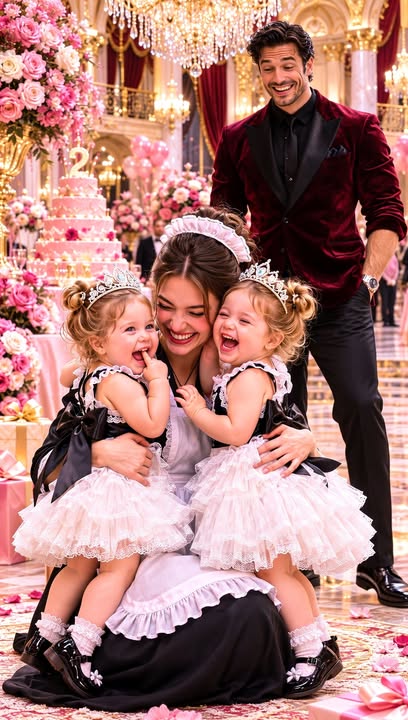
Part 6 – A Family by Choice
Dominic did not pick up the phone.
The message remained on the screen between us, a photograph of Claire’s familiar handwriting and a question that seemed to reopen every careful answer we had found.
Why did you never open the letter she left for you?
Margaret stared at the image.
“I don’t know who sent this,” she said, though her voice held no certainty.
“Neither do I,” Dominic replied. “But we’re going to find out.”
The girls had noticed the change in the adults around them.
Lily set down her chalk, and Rosie moved closer to Nadia.
“Is something wrong?” Lily asked.
Dominic slipped the phone into his pocket and crouched beside them.
“Something unexpected has come up,” he said. “But you’re safe, and we’re going to take care of it.”
“Do we have to go inside?” Rosie asked.
“Only if you want to.”
She looked at Nadia, then at me.
“Can we finish the crown first?”
A smile touched Dominic’s face, faint but real.
“Of course.”
We stayed beneath the arbor while the girls completed their chalk drawing, adding so many flowers that the crown looked more like a garden than anything a queen might wear.
Margaret sat at the far end of the bench, quiet and pale.
When Lily offered her the pink chalk, Margaret accepted it.
Together, they added a small bird above the crown.
Only after the girls had gone inside with Mrs. Collins did Dominic turn back to the message.
He called Mr. Bell and asked him to verify the number, preserve the message, and contact the person who had sent it through a secure channel.
Then he called the woman who had spoken to him.
She answered after several rings.
“This is Dominic Hayes,” he said. “You told me Claire was your sister.”
A pause followed.
“My name is Elena,” the woman replied. “I’m Claire’s younger sister.”
Margaret had gone still beside me.
“Why have we never heard of you?” Dominic asked.
“You have. I sent letters after Claire died, but Margaret returned them.”
Margaret’s hand rose to her throat.
“I never saw any letters.”
“I didn’t say you had.”
Elena’s voice was measured, without anger.
“Claire told me Margaret would know what to do with the envelope. She asked me to keep the other one safe until Nadia came back.”
Dominic glanced at Margaret.
“What did Claire write to you?”
“I don’t know. I never opened it. Claire asked me not to, and I promised.”
“Why contact us now?”
“Because I read the news about the hospital records being reviewed, and I realized Nadia might finally have found the girls.”
There was a rustle at the other end of the line.
“I have no interest in making your family’s history public,” Elena continued. “I just didn’t want Claire’s last request to be forgotten.”
Dominic looked at the photograph on his phone.
“Can we meet you?”
“Yes,” Elena said. “Tomorrow, if that suits you.”
“It does.”
When the call ended, Margaret remained silent.
Dominic did not press her in front of the girls or ask her to defend herself before she understood what had happened.
Instead, he said, “We’ll go together tomorrow.”
Margaret nodded.
For once, no one tried to fill the quiet with explanations.
The next morning, Elena met us in a small café near the park.
She was in her late forties, with Claire’s dark eyes and a thoughtful manner that made me understand how someone could be family and still remain unknown.
She carried a plain envelope in a protective sleeve.
“This is the one Claire left for Margaret,” she said.
Margaret received it with both hands.
“I’m sorry I didn’t know you were trying to reach me,” she said.
Elena’s expression softened.
“I thought the message had been delivered. Claire was very careful about what she asked of people.”
Margaret looked down at the handwriting.
“May I open it now?”
“It was meant for you.”
Margaret slid a finger beneath the flap.
The letter inside was brief.
Claire had written that Margaret should read it only when Nadia and the girls were together, because the truth belonged to all of them.
Margaret’s eyes moved slowly across the page.
Then she passed it to Dominic, who read aloud.
“Margaret, I know you believe you are carrying the family alone.
“You are not.
“Nadia is not a danger to the girls; the people who would use our fear to separate us are.
“If you have to keep her safe, do so with the truth between us, not with a lie placed in her hands.
“Please don’t make a decision for Nadia and call it her choice.
“When she returns, let her speak for herself.
“And if I am not there, tell Dominic what you know.
“He will be angry.
“He will grieve.
“But he will understand that love without trust can become another kind of loneliness.”
Dominic stopped reading.
Margaret lowered her head.
“I was afraid,” she said. “And then I was ashamed that I had been afraid, so I kept telling myself the lie was still protecting everyone.”
Elena sat quietly beside her.
“Claire knew you loved her,” she said. “She also knew fear could make people do things they would never have chosen if they had been able to see beyond it.”
Margaret pressed the letter against her chest.
“I should have opened every door I closed.”
Dominic’s voice was calm, though pain remained in it.
“You cannot undo the years.”
“No.”
“But you can stop deciding what the truth is allowed to reach.”
“I will.”
“Then start by helping Mr. Bell correct the records and identify everyone who was involved.”
“I will.”
The conversation did not make Margaret’s choices harmless.
It did not return the years Nadia had lost, or the childhood moments she had never been able to witness.
But it ended the long chain of people deciding what another person could bear.
Over the weeks that followed, the story emerged piece by piece.
The former physician supplied his records and made a formal statement about the altered documents.
The investigation traced the payments to a company controlled by one of Dominic’s father’s former business associates.
The man who had once questioned the hospital arrangement had died years earlier, but the company had continued making small payments to keep old files hidden.
When authorities examined its accounts, they found no evidence that anyone had recently been pursuing Nadia or the girls.
There had been no current plan to harm them.
There had only been old secrets, quietly maintained, and a series of people who had allowed fear to outlive the danger that created it.
Dominic gave the authorities the documents he had spent years believing he needed to keep within the family.
He turned over the account records, the letters, and the hospital paperwork.
Then he closed the old business arrangements connected to his father’s circle and surrendered what was needed to establish how the payments had been made.
It was not a sudden transformation, and it did not erase the years Dominic had spent around dangerous people.
It was a beginning, made through difficult choices that left him less powerful in some rooms and more honest in every one that mattered.
Mr. Bell found that Nadia’s later attempts to contact the family had been intercepted by the same intermediary who maintained the hidden account.
The warnings she received had been written to sound official, but no one had ever been sent to threaten her.
The deception had relied on her fear, Margaret’s silence, and a record that appeared more certain than it was.
Nadia read the findings without speaking.
When she finished, she folded the papers carefully and set them on the table.
“For years I thought I had failed them,” she said.
“You didn’t,” Dominic replied.
“I know that now.”
Her eyes glistened.
“But knowing it doesn’t make the years come back.”
“No,” he said. “It doesn’t.”
He did not offer an easy reassurance.
Instead, he sat with her in the quiet and let the loss be what it was.
The girls learned the truth in gentle pieces, as they had learned every other part.
They were told that Nadia had carried them before they were born, that Claire had loved them and had been unable to carry them herself, and that the adults had made choices meant to keep everyone safe.
They were also told that some of those choices had been wrong.
“Did Aunt Margaret make a mistake?” Rosie asked one afternoon.
Margaret, who was sitting nearby with a picture book, put the book down.
“Yes,” she said. “I did.”
“Are you sorry?”
“Very.”
Rosie considered that.
“Are you still our aunt?”
Margaret’s eyes filled.
“If you want me to be.”
Lily took the wooden fox from the table and placed it in Margaret’s lap.
“You can be our aunt and still say sorry.”
Margaret covered the fox with her hand.
“That is a very kind thing to say.”
“It’s true,” Lily replied, and returned to her drawing.
Margaret did not ask the girls to forgive her more quickly than they could.
She came to the house when invited, stayed for short visits, and let them choose whether they wanted her at their table or beside them in the garden.
Gradually, the girls began asking her for stories about Claire.
Margaret told them about the way Claire laughed when she tried to bake, about the little blue shoes she had bought before the twins were born, and about the first time Dominic had fallen asleep holding both babies.
When her voice faltered, she let it.
The girls learned that missing someone and loving the people still there could exist together.
Nadia’s visits began with short afternoons and grew into longer ones.
The twins chose a name for her without anyone suggesting it.
They called her Nadia, and sometimes Mommy Nadia when they were talking about their birth story, but never because anyone asked them to.
Their relationship grew through ordinary things: planting herbs in the conservatory, choosing library books, learning which pastries she liked, and discovering that Nadia laughed hardest when Rosie told a joke that did not make sense.
Nadia never demanded to be called anything else.
She never tried to replace Claire, and she never asked Emily to step aside.
One afternoon, as we sat beneath the rose arbor, Nadia watched the girls race along the garden path.
“They’re happy,” she said.
“They are,” I replied.
“I used to imagine I would feel jealous if they loved someone else like a mother.”
“And do you?”
She turned toward me.
“No.”
Her smile was tender.
“I feel grateful.”
I looked toward Lily, who was holding Rosie’s hand as they tried to balance on the low stone border.
“They have enough love around them to be careless with it,” I said.
“Careless?”
“They don’t have to guard every bit. They can give it away and trust there’ll still be more.”
Nadia’s eyes softened.
“That is a beautiful thing you gave them.”
“They gave it to me too.”
She reached for my hand.
For the first time, I took hers without wondering what it meant about my place in the family.
Dominic changed in smaller ways than people might have expected.
He remained careful, but his care no longer took the form of deciding everything before anyone else could speak.
He asked the girls what they wanted.
He asked Nadia what she needed.
He asked me whether I wished to stay before assuming that love meant I would.
And when difficult news came, he brought it to the people it concerned instead of carrying it alone.
His life outside the mansion changed as well.
The old operation his father had built began to come apart, not in a blaze of spectacle, but through the deliberate ending of its legitimate fronts and the transfer of evidence to the authorities.
Dominic distanced himself from the remaining associates and accepted that honest choices would cost him money, influence, and some of the protection he had once taken for granted.
He did not complain about the cost.
When I asked whether he missed the certainty of command, he considered the question.
“I miss knowing what everyone expects of me,” he said.
“And now?”
“Now I have to ask.”
“That sounds harder.”
“It is.”
He looked toward the garden, where Rosie was attempting to teach Nadia a made-up dance.
“It’s also better.”
The diamond ring remained in its velvet box for months.
Dominic did not bring it up again, and neither did I.
There was no need to pretend the proposal had been wrong because it had been paused.
It had simply come before we understood what our family needed.
When the school year began, Lily and Rosie walked through the front doors holding one hand each.
Lily held mine.
Rosie held Nadia’s.
Dominic stood just behind us, carrying their backpacks even though both girls insisted they could carry them themselves.
At the classroom door, Rosie looked up at us.
“Are you all coming to get us?”
“If you want us to,” I said.
“I want all of you.”
Nadia smiled.
“So do I.”
The girls disappeared into the classroom with a wave and a promise to tell us everything afterward.
Dominic walked back to the car beside me.
“They didn’t look back,” he said.
“They knew we’d be there.”
He glanced at me.
“That’s what you gave them first.”
“Mrs. Collins gave them that before I arrived.”
“And you helped it stay.”
His hand found mine between us.
This time, there was no hesitation.
That evening, the family gathered for dinner in the sunroom.
Margaret was there, along with Elena, who had become a regular visitor and had begun telling the girls stories about Claire’s childhood.
Nadia brought a bowl of strawberries.
Rosie made a place card for every person at the table, spelling several names in her own inventive way.
Mine read “Emmy Momee.”
Nadia’s read “Nadeea.”
Dominic’s was simply “Dady,” with a heart in place of the second letter.
No one corrected them.
After dinner, the girls asked Nadia to sing the lullaby.
She began softly, and Dominic joined her on the second verse.
Their voices were different, but the melody was the same one Claire had carried into the hospital and asked Nadia to keep.
The girls leaned against my sides, one on either side, and listened.
As the song ended, Lily lifted her head.
“Can we sing it tomorrow too?”
“Whenever you want,” Nadia said.
Rosie looked at me.
“Can Mommy Emmy sing with us?”
“I can try,” I replied.
“You have to,” Lily said. “You know all the words.”
Dominic smiled across the room.
The house had not become simpler.
It had become honest enough for every person’s place to be visible.
Later, after the girls were asleep and the last dishes had been cleared, Dominic asked me to walk with him to the garden.
The roses had begun to fade at the edges, but the night was mild, and the windows glowed warmly behind us.
“I kept thinking I should wait until everything was settled,” he said.
“Everything won’t ever be settled.”
“I know.”
He stopped beneath the arbor where Lily had once drawn the chalk crown.
Then he took the velvet box from his coat.
My breath caught.
He opened it, but he did not kneel.
“I don’t want to ask because the girls call you Mommy,” he said. “And I don’t want to ask because the house is quieter when you’re here, or because I’m afraid of losing you.”
He looked directly at me.
“I want to ask because you’ve seen the worst of what this family hid, and you still chose to help us build something better.”
I felt my eyes sting.
“Emily, will you marry me?”
I looked at the ring, then at the man holding it.
This time, there was no ballroom full of witnesses, no frightened children between us, and no unfinished truth waiting behind a door.
There was only the garden, the steady light of home, and the choice in front of me.
“Yes,” I said.
Dominic let out a breath that sounded almost like a laugh, and slid the ring onto my finger.
He kissed me softly, with none of the urgency that had once made me wonder whether our future was being decided too quickly.
When he drew back, he rested his forehead against mine.
“Thank you.”
“I’m not saying yes to be grateful.”
“I know.”
“I’m saying yes because I love you.”
“I love you too.”
From the open window behind us came a small, sleepy voice.
“Daddy?”
We turned to find Lily standing there in her pajamas, with Rosie peering over her shoulder.
“Did you ask Emmy again?” Lily whispered.
Dominic looked at me.
“I did.”
“Did she say yes?”
“I did,” I told them.
The twins hurried down the steps and wrapped themselves around us.
Rosie touched the ring carefully.
“Does this mean you’re staying?”
“It means I’m staying because I want to,” I said.
Lily took one of my hands and reached for Nadia’s, who had appeared in the doorway behind them.
“Then we’re all staying.”
Nadia came closer and let Lily draw her into the circle.
Dominic placed one arm around me and the other around the girls, while Nadia stood close enough to join them without being asked.
The family was not made of one name for love, or one version of the past, or one person who had to stand in the center.
It was made of people who had chosen honesty, and who kept choosing one another after learning the truth.
Under the quiet garden lights, the girls began humming Claire’s lullaby.
Nadia sang with them.
Dominic followed.
And I joined in, held between the man I loved and the children who had taught me that a family could grow without anyone being asked to disappear.
**–THE END–PLEASE
Share your thoughts or feedback to motivate us to create more stories ♥️
* * *
[PREVIOUS: PART 5](https://storyly.idolsgift.com/blog/part-5-the-woman-who-knew-their-first-cry-070)
✓ Lynn R. Adams
Part 6 – A Family by Choice Dominic did not pick up the phone. The message remained on the screen between us, a photograph of Claire’s familiar handwriting and a question that seemed to reopen every…