PART 6 (THE END): The Truth in the Brass 058
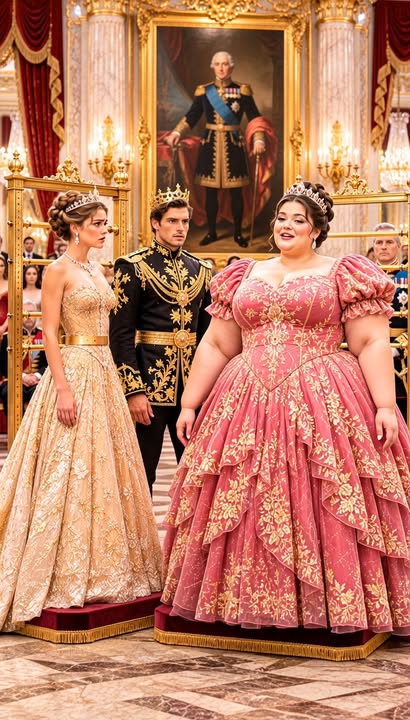
Part 6 – The Measure of a Kingdom
“Why,” Adrian had written beneath his mother’s question, his voice scarcely above a whisper, “does the court’s bloodline begin again with her younger brother—and what happened to the sister history erased?”
No one answered.
The gallery’s lamps cast warm circles across the floor, but the portrait above them seemed to hold its own cold silence.
Amara looked at the old queen’s painted face, then at the letter in Adrian’s hands.
“Your mother left you a question,” she said. “Not an accusation.”
“I know.” He lowered his eyes to the page. “But if she was right, then our history has another missing room.”
The Keeper stood with his hands folded before him.
“I knew she had found a reference to a princess,” he said. “I did not know the name or what became of her.”
“Why did you keep this letter?” Adrian asked.
“Because your mother trusted me with it. I believed that waiting for the right moment was a form of care.”
“And now?”
“Now I understand that waiting can become another way of deciding that other people must live without the truth.”
Adrian looked at him for a long moment.
“Thank you for telling me.”
The Keeper bowed his head, accepting neither absolution nor punishment.
The examiner had brought the inspection ledger from the council chamber, and he opened it carefully beside the queen’s letter.
“There may be a record in the earlier household books,” he said. “If the princess’s name was removed from the family register, there should still be references to her somewhere else.”
“Or someone may have changed those too,” Celeste said.
“Possibly,” the examiner replied. “But it is difficult to erase a life from every account. There are household payments, letters, inventories, and records from the guilds.”
Adrian folded his mother’s note along its original crease.
“Then we search for the person, not just the missing name.”
Amara watched him tuck the note into his coat.
“Do you want me with you?”
“I do,” he said, then paused. “But I’m not asking because I need you to prove anything.”
“I know.”
“I want your judgment.”
“That is different.”
“Yes.”
Celeste stepped closer to the table.
“My aunt can help us search the city archive. She knows the older catalogues, and the guild records sometimes mention the people who commissioned a work, not only the monarchs who paid for it.”
Lady Maren, waiting just beyond the gallery doors, heard her niece and came in.
“I can arrange access,” she said. “But we should begin with the dates. A missing name is harder to find than a name hidden under another description.”
The examiner turned the page in the ledger.
“King Oren’s reign began with the death of Queen Elowen,” he said. “The princess would have been his daughter.”
“His elder daughter,” Adrian said. “If she disappeared from the record after refusing a marriage, the succession may have been changed to favor her brother.”
“Not necessarily,” Amara said. “A family record can be incomplete for many reasons. We need evidence before we decide what happened.”
Adrian nodded.
“Then we will look for evidence.”
The search took four days.
They read through household accounts and marriage negotiations, through lists of servants and gifts, through letters written by ambassadors who had praised the royal family while quietly recording its private arrangements.
At first, they found only fragments.
A payment for a riding horse entered under the words “the elder princess’s mare.”
A tailor’s invoice for a traveling cloak in a color no later royal portrait ever showed.
A letter from an ambassador mentioning that the king’s daughter had “withdrawn from the proposed match and departed for the northern estates.”
Each clue brought another question.
The northern estates had been sold generations ago.
The royal family’s official record said King Oren had only one child before his son, Prince Edric.
The index gave no daughter’s name.
On the third afternoon, Celeste found a reference in a book of household musicians.
She read it twice before calling the others over.
“Listen to this,” she said.
The entry recorded a payment to a singer named Liora Vale for a private performance at the northern residence.
Beside the payment, a clerk had written, “At the request of Her Royal Highness Princess Elianor, who departs for the coast on the first day of spring.”
“Princess Elianor,” Adrian said.
It was the first time they had seen her name.
Amara leaned over the page.
“Does it say why she left?”
“No,” Celeste replied. “Only that the payment included travel expenses for three attendants and a small archive chest.”
“An archive chest?” the examiner asked.
“Perhaps she took books,” Lady Maren said. “Or family papers.”
Adrian’s face had gone very still.
“If she left with records, she may have kept a copy of Queen Elowen’s letter.”
“Or she may have taken something unrelated,” Amara reminded him.
“Yes,” he said. “We should not turn possibility into certainty.”
The city archive’s correspondence catalogue listed a collection of letters donated by a coastal family named Vale.
The collection had been transferred to the archive decades earlier, but its contents had never been fully indexed.
Lady Maren arranged for them to examine it.
The letters were bundled by family and date, their edges soft with age.
Many concerned music, trade, and ordinary matters of household life.
Near the bottom of a box marked “Vale family papers, private correspondence,” Amara found a small packet tied with faded blue ribbon.
The ribbon had been repaired twice.
A note on the outer fold read: For my children, so they will know I was not lost.
Adrian stared at the handwriting.
“Is it hers?” Celeste asked.
“I don’t know,” he said. “But the date matches.”
The archivist brought a support board, and Amara unfolded the packet beneath the careful attention of everyone at the table.
The first letter was addressed to a woman named Maren Vale, who had been a musician at the royal court.
It said Princess Elianor had chosen to leave because she did not wish to marry the man selected for her, nor remain in a household where her body and future were treated as matters of royal arrangement.
She had not been driven out.
She had left by choice, with two attendants who wished to go with her.
She had taken the name Elianor Vale from the family that welcomed her and spent the rest of her life teaching music and helping maintain a small coastal library.
In a later letter, she wrote that she had heard Queen Elowen’s warning read aloud once, when she was a child.
The letter had been kept among her mother’s papers.
Elianor had copied its words and carried them with her when she left the palace.
She had not returned the original to the gallery because she believed the court would bury it again.
Instead, she had written that the portraits could not be allowed to decide who belonged to a family or a kingdom.
Beside her name, she recorded her own measurements in the same plain form as Queen Elowen’s register—not as a judgment, but as a record of the living woman she had been.
Amara felt her throat tighten.
“She made her own record,” she said.
“And left the court’s measure behind,” Celeste replied.
A final letter, written late in Elianor’s life, contained a request.
She asked that her papers be returned to the royal gallery only when the court was prepared to tell the whole truth, including that she had not been cast out or lost.
She had chosen another life.
She had wanted the choice to be remembered as hers.
Adrian set down the page with extraordinary care.
For a while, he could not speak.
The mystery had not ended in a secret prison or a family tragedy hidden behind the palace walls.
It had ended in a woman who had walked away from a life she did not want, built another, and made certain the court could not claim she had never existed.
“She wasn’t erased because she was punished,” Amara said softly. “She was erased because her choice made the old story harder to tell.”
“And because the next king needed the bloodline to appear uninterrupted,” Lady Maren added.
The examiner looked toward Adrian.
“Your father may have discovered this.”
“Or my mother did,” Adrian said. “Perhaps my father learned it from her.”
He touched the edge of the letter, not its writing.
“I wish I had known she was looking for Elianor.”
Amara sat beside him.
“Knowing now does not give you back the years you didn’t know.”
“No.”
“But you can choose what happens with the truth she left you.”
He looked at her, and the grief in his face did not disappear.
It softened into something he could carry.
The council met again the following morning.
This time, the verified records included Queen Elowen’s letter, the original measurement register, the guild entries, and Elianor’s papers.
The conservator confirmed the age and condition of the documents.
The city archivist confirmed the provenance of the Vale family collection.
Lady Maren presented the archive’s findings.
The examiner described the instructions he had received to omit the frames’ original purpose, and admitted that he had obeyed without asking why.
Celeste spoke plainly about altering her measurements and the belief that being chosen would make her safe.
She did not present herself as the harmed party alone, nor ask the room to forget what she had done.
“I cannot undo the choice I made,” she said. “I can refuse to teach it to anyone else.”
Adrian waited until the council had heard every account.
Then he stood.
“We know now that Queen Elowen commissioned the frames to record real lives, not rank them,” he said. “We know King Oren altered the gallery’s meaning to support a uniform royal image. We know his daughter chose a different life, and that the official history left her out rather than acknowledge her choice.”
He looked down the table.
“We know my mother searched for the truth, and that my father continued her effort. We know the court preserved a false standard because it seemed useful.”
No one interrupted him.
“The records will be published in full,” he continued. “The gallery will be restored to its original purpose. The appearance-based marriage rule will end.”
A council member folded her hands over the transcript.
“And the succession?”
“The crown cannot require a woman to meet a prescribed shape in order to be considered a suitable partner,” Adrian said. “Nor will I choose a bride by a test designed to make a private decision look like a public duty.”
The council chair looked at him for a long moment.
“You understand that some members may withdraw their support.”
“I do.”
“And that the court may need to revise its agreements with the provinces?”
“I understand that too.”
“Are you prepared to risk your authority?”
Adrian glanced at the letters before him, then lifted his eyes.
“I am prepared to let the council judge my authority by the choices I make with the truth in front of me.”
The room was silent.
At last, the council chair closed the record.
“Then we will vote on the abolition of the custom and the public release of the documents.”
The vote was close, but it passed.
No one cheered.
There was work to do: the official histories had to be corrected, the archive opened, the gallery restored, and the council’s marriage agreements rewritten.
But when the chair announced the result, the examiner released a breath he had been holding since the first line of Queen Elowen’s letter.
Celeste’s hands rested open on the table.
Lady Maren placed her palm over them.
Adrian looked toward Amara.
She did not smile as if the world had become simple.
She smiled because something hidden had been brought into the light without being made into a weapon.
The following weeks altered the palace in small, visible ways.
The royal archive opened its relevant records to independent scholars.
The letter and register were displayed in a protected case beside the frames, with a clear account of how the gallery’s purpose had changed and why.
Queen Elowen’s portrait remained where it had always hung, but the plaque beneath it now explained that the painter’s narrow silhouette was a convention, not a measure of the queen’s body.
A new plaque honored Princess Elianor Vale, who had chosen a life beyond the palace and asked that her choice be remembered as her own.
The measuring frames were repaired and returned to the gallery.
Their six brass markers slid easily along the rails, outward or inward, with no preferred position.
Visitors were invited to learn how the queens had been recorded, though no one was asked to stand inside a frame or offer their own measurements.
The frames held history.
They did not judge the living.
Adrian kept his promise to Amara.
He did not make her the face of the change.
When the court asked her to speak at the gallery’s reopening, she agreed only after the program described her as one of the people who had helped question the old custom, not as proof that the new one had succeeded.
She spoke briefly.
“An accurate record does not make every person the same,” she said. “It gives each person the dignity of being remembered as herself.”
The applause that followed was warm, but it did not ask her to become anything more.
Afterward, she found Adrian beneath the portrait of Queen Elowen.
He had no speech prepared and no council watching.
Only the late afternoon light rested across the floor between them.
“You changed the gallery,” he said.
“We changed its description,” Amara replied. “The gallery was always more than the story people told about it.”
“I’m glad you make that distinction.”
“You are learning.”
“I hope I keep learning.”
She looked up at the old portrait.
“Do you think your mother would have been satisfied?”
“I think she would have wanted more than a plaque and a vote.”
“Then what?”
“People who ask questions before they inherit the answers.”
Amara turned to him.
“That is a larger thing to give.”
“Yes.”
He glanced toward the repaired frames, then back at her.
“There is something I want to ask you,” he said. “And I want to be clear that the answer will not change anything we have already done.”
“Then ask.”
“Would you consider building a future with me?”
His voice did not carry the authority of a prince addressing the court.
It carried the uncertainty of a man who had learned that wanting something did not give him the right to demand it.
“I don’t mean a title or a place beside the throne,” he continued. “I mean a life in which we can disagree, change our minds, and make decisions together. I will not ask you to save the monarchy, or stand for every woman it failed, or become a symbol of what I chose.”
Amara listened to every word.
“Would you still ask me if I never stood in that frame?” she said.
“Yes.”
“Would you still ask me if the council had voted against you?”
“Yes.”
“Would you still ask me if I told you I wanted a quiet life far from the gallery?”
His answer took a moment.
“I would still want to know what life you wanted,” he said. “And I would not ask you to give it up.”
The care in the answer mattered more than its certainty.
Amara thought of the girl she had been at twelve, standing beneath the painted queens while people offered kindness that always came with an instruction to become smaller.
She thought of the woman who had stood before the frame and refused to disguise her shape.
She thought of Adrian in the antechamber, admitting what he did not know.
She thought of Celeste confessing what she had done without demanding forgiveness, and of the examiner choosing at last to put his name beside the truth.
The future between her and Adrian was not guaranteed to be easy.
It was, at least, being offered without a test.
“I would like to build that future with you,” she said.
Relief crossed his face, followed by a smile so unguarded that it seemed to belong to no portrait and no title.
“Then we’ll begin there,” he said.
They married the following spring, not as the conclusion of a royal selection but as the beginning of a promise made between two people who had seen one another clearly.
The ceremony took place in the palace garden, beneath a canopy of white blossoms.
Celeste stood beside Amara, no longer trying to appear faultless.
She had begun working with young nobles and their families, helping them speak honestly about the pressures that had once governed her own choices.
When Celeste offered her congratulations, she did not call Amara fortunate to have been chosen.
She said, “I’m glad you both chose.”
Adrian’s council stood among the guests, not as judges but as witnesses.
Lady Maren sat beside the examiner, who had become the gallery’s first public keeper of records.
In the weeks afterward, the repaired measuring frames returned to their place beneath the chandeliers.
Queen Elowen’s letter and the register were displayed nearby.
Princess Elianor’s name appeared in the royal history again, beside the account of the life she had chosen for herself.
Visitors often paused before the frames.
Some studied the rails and the maker’s plate.
Others read the names of the queens and the details recorded beside them: a favored flower, a chosen pose, the color of a gown, the breadth each woman had occupied in life.
The gallery no longer asked its visitors to find one perfect shape.
It asked them to remember that the women in the portraits had been real.
Years later, when Amara and Adrian walked through the gallery together, he sometimes stopped beneath the oldest portrait and looked up at Queen Elowen’s face.
He no longer saw an ideal he had to defend.
He saw a woman who had trusted the future enough to leave it the truth.
And beside him, Amara stood exactly as she was, her hand resting in his, her place in the story neither measured nor granted by the court.
The brass markers gleamed beneath the light.
They could slide outward or inward.
They could record the truth without deciding what the truth was worth.
And at last, the kingdom had learned the difference.
**–THE END–PLEASE
Share your thoughts or feedback to motivate us to create more stories ♥️
* * *
[PREVIOUS: PART 5](https://storyly.idolsgift.com/blog/part-5-the-truth-in-the-brass-058)
✓ Lynn R. Adams
Part 6 – The Measure of a Kingdom “Why,” Adrian had written beneath his mother’s question, his voice scarcely above a whisper, “does the court’s bloodline begin again with her younger brother—and wha…