PART 6 (THE END): The Lullaby Hidden in the Crown 055
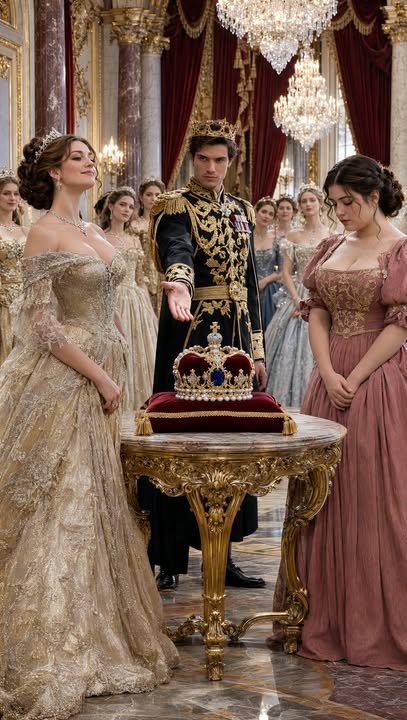
Part 6 – The Song That Pointed Home
The missing page was recovered before dawn from a narrow compartment beneath the display stand.
The conservator found it when the crown was lifted for transfer to the secure workroom, where its lining could be examined without the court watching.
A folded slip of blue silk had been tucked behind a wooden support, wedged so carefully that it could have been missed even by someone searching for it.
The page inside was creased but intact.
William waited until the conservator had placed it beneath a clear protective sheet before leaning close enough to read.
The room had emptied except for Emma, Beatrice, the chamberlain, and two members of the palace’s independent review team.
Lord Ashcombe had remained in the ballroom, where he had agreed to wait for the investigators.
The page held a list of names, dates, and short notes in the queen’s handwriting.
At the bottom, beneath the final entry, was a line that made William’s face change.
“What does it say?” Emma asked.
He swallowed once.
“It says that the copies were made by my mother and your mother, and that the remaining original ledger was taken from the archive by an assistant clerk named Peter Vale.”
Emma’s hand went to her chest.
“Vale was my mother’s family name.”
“Was Peter your uncle?”
“My mother had one younger brother,” Emma said. “I never met him. She told me he left the palace before I was born.”
The page identified Peter as a clerk who had helped preserve the original ledger when the archive transfer was being reorganized.
Beside his name, the queen had written that he had taken it to a trusted bookbinder outside the palace, where it could be kept until the investigation was safe to reopen.
The bookbinder’s name and address were written below.
Beatrice read the final lines over William’s shoulder.
“The page doesn’t say Ashcombe was involved in taking the money,” she said. “It says he approved the transfers and failed to account for them.”
“That distinction matters,” William replied.
It mattered to the inquiry, and it mattered to the lives that would be altered by whatever the inquiry found.
No one in the room had forgotten that suspicion was not the same as proof.
The review team sent a representative to contact the bookbinder, while the chamberlain arranged for the original ledger to be brought to the palace under formal supervision.
By midday, the record had been recovered.
It matched the queen’s copied figures and Lydia Vale’s careful notes.
Together with the palace’s surviving accounts, it showed that Lord Ashcombe had redirected funds through false invoices over several years, concealing the money among ordinary expenses.
The evidence also established that he had not acted alone.
Some of the names belonged to contractors who had received payment for work never completed.
Others were officials who had signed records without checking them.
The investigation continued, but the central mystery was no longer a mystery.
Ashcombe did not try to flee.
When the investigators presented him with the original ledger, he read the entries in silence, then admitted that he had taken funds entrusted to the palace.
He had told himself the accounts could be corrected later, and that his actions were temporary.
Over time, he had used the archive’s confusion to hide what he had done, and when the queen began asking questions, he had helped keep her evidence from reaching anyone who might act on it.
He had not planted the secret in the crown, nor had he put the key there.
But he had known the queen was trying to preserve proof, and he had moved records in the hope that the trail would grow too difficult to follow.
The missing page had frightened him because it named the people who had helped her.
The discovery of it ended his ability to protect the lie.
By the end of the week, Lord Ashcombe had resigned his position and agreed to answer the formal charges against him.
The palace released a statement that described the recovered records and the independent investigation without turning the matter into a spectacle.
The workers dismissed years earlier were contacted privately and then publicly cleared once their names had been confirmed.
The palace restored their lost wages where possible and apologized for having let suspicion fall upon them.
William attended each meeting, not as a prince arranging a graceful ceremony, but as the person responsible for acknowledging what his household had done.
Emma went with him when he asked, and stayed away when he did not.
He had learned to ask rather than assume.
Beatrice gave her testimony in full.
She spoke plainly about seeing Ashcombe with the crown, about her family’s hoped-for alliance, and about the reason she had remained silent.
The arrangement between their families was set aside.
Her brother’s future marriage was left for him to decide freely, without a promise made in exchange for influence at court.
Beatrice’s family lost no title or place in the palace, though they had to answer uncomfortable questions from people who had once praised their discretion.
Beatrice accepted those questions without trying to disguise her part in what had happened.
Several weeks later, she visited Emma in the palace gardens.
Spring had softened the air, and the first pale blossoms had opened along the path beside the eastern wing.
The old wing had been closed for years, but repairs had begun, not as a private restoration for royal use, but as part of a public project to preserve the palace’s historic rooms.
Beatrice wore no diamonds that day, only a simple blue coat and a small gold pin.
“I wanted to thank you,” she said.
Emma looked up from the ledger of names she had been helping the palace archivist organize.
“For what?”
“For not pretending my silence was harmless.”
“I wasn’t sure I was helping.”
“You were honest.” Beatrice paused. “I needed that more than I wanted to hear it.”
Emma closed the ledger.
“I’m glad you came forward.”
“I should have done it sooner.”
“Yes,” Emma said. “You should have.”
Beatrice accepted the answer without flinching.
“I hope one day we can speak without this between us.”
“Perhaps we can,” Emma said. “But it will take more than one conversation.”
“I know.”
They stood together for a while, watching a pair of groundskeepers carry a young tree toward the eastern lawn.
It was not a friendship yet.
It was a beginning built without pretending the past had not happened.
The palace also began to change in quieter ways.
William created a public fund for palace workers, supported by recovered money and a portion of the royal household’s annual budget.
The fund was managed by an independent board that included staff representatives, historians, and community members who had never before been invited into the palace’s decisions.
Its first work was practical rather than grand: repairing staff housing, offering training for apprentices, and helping former employees whose lives had been affected by the old accusations.
William insisted that the fund bear no royal name.
“It should belong to the people it serves,” he told the board.
The recovered ledger and the queen’s notes were placed in a public archive, where visitors could learn how the investigation unfolded and why small acts of attention mattered.
Lydia Vale’s contribution was recorded beside Queen Eleanor’s.
Emma attended the archive opening in a rose-colored dress much like the one she had worn the night the crown opened.
This one had been sewn by a local dressmaker from fabric Emma chose herself.
No one called her a princess.
No one suggested that a hidden birth record had changed her place in the palace.
The birth record remained what it had always been: proof of her mother’s life, preserved because the queen had cared for her.
Emma was honored for her integrity and her work.
She was offered a position as assistant curator of the royal objects collection, with the training and salary that belonged to the responsibility.
She accepted only after speaking with the staff who would work alongside her.
The post did not make her a servant in the same rooms or a noblewoman in the court.
It gave her a chance to care for the things she had spent years noticing, and to make sure their histories were kept with the objects themselves.
On the evening the restored crown returned to its display, William asked Emma to meet him in the west gallery.
The room had been quiet for several days, prepared for a small gathering of staff, archivists, and the families of those whose names had been cleared.
The crown rested beneath a new glass cover on a stand made by palace craftspeople.
Its sapphire faced left.
Toward the painted eastern wing in Queen Eleanor’s portrait.
The conservator had repaired the mechanism without replacing the old music box.
He had cleaned its gears and secured the lining, leaving the crown able to play the tune it had kept safe for so long.
William stood beside the display, hands resting loosely at his sides.
For once, he wore no formal uniform.
His dark jacket was simple, and the open collar made him look younger than he did at ceremonies.
“Does it feel strange?” Emma asked.
“Seeing it here?”
“Seeing it without all the court gathered around it.”
William considered the question.
“I thought the crown made a room feel more important,” he said. “Now I think it was the people who kept treating it that way.”
Emma smiled.
“That sounds like something your mother might have said.”
“She did say something like it once.” He looked up at the portrait. “I remember now.”
“What did she say?”
“She told me that a crown could remind people of a promise, but it could never make the promise for them.”
William’s expression softened.
“I had forgotten that too.”
A small group gathered behind them, speaking quietly.
Among them were the conservator, the library keeper, Beatrice, and several palace workers whose names had been cleared.
At the front stood a woman with a silver ribbon pinned to her coat.
She had worked in the laundry rooms during the years when the false accusations had begun.
Emma recognized her from the archive records.
William turned to the group.
“I’m grateful you came,” he said. “I know that an apology cannot return the years you lost, and a public record cannot undo the uncertainty you lived with.”
The woman looked at him steadily.
“No,” she said. “It can’t.”
William nodded.
“But I hope the record can make it harder for the same mistake to be repeated.”
“It can,” she replied. “If people keep reading it.”
“Then we’ll make sure they do.”
There was no grand speech after that.
The group moved around the display, asking the conservator about the music box and the direction of the sapphire.
The library keeper explained how the key had opened the portrait frame.
Beatrice spoke with one of the workers she had once passed in the corridors without noticing.
Emma stayed beside the crown, answering questions about the lining and the unusual stitch her mother had used.
William did not claim the story as his alone.
He listened.
When the last guest had gone, the gallery grew quiet.
William remained beside the portrait.
“I want to ask you something,” he said.
Emma’s hands rested lightly on the edge of the display table.
“Go ahead.”
“When this began, I thought I needed to find out what my mother had hidden.”
“You did.”
“I did.” He looked at the crown. “But I also thought that if I understood her secret, I could finally know why she had been distant.”
Emma waited.
“I understand more now,” he said. “But I still don’t know everything she felt. I never will.”
“No one can know every part of someone they love.”
“I used to think love meant people would always find a way to make themselves understood.”
“And now?”
“Now I think it means listening when they try, even if the answer comes late.”
The honesty in his voice made Emma’s heart feel both lighter and more cautious.
William turned toward her.
“I also want to be clear about something.”
“All right.”
“I don’t want gratitude to decide anything between us.”
“Good,” Emma said. “It shouldn’t.”
“I don’t want the court to decide it either.”
“Even better.”
A small laugh escaped him, quiet and unguarded.
“I would like to know you outside the crown, the investigation, and the stories people tell about us.”
Emma studied his face.
There was no royal command in the request.
No promise of a place at court in exchange for affection.
Only a young man asking if she might choose to spend time with him, and leaving the answer in her hands.
“I would like that,” she said. “But I want time.”
“Then we’ll take time.”
“And I don’t want you to mistake my honesty for disloyalty.”
“I won’t.”
“Or my work for a reason to keep me close.”
“I won’t.”
“Or your title for an answer to every problem.”
“I suspect I’ll have to work on that one.”
“Everyone has something to work on.”
He smiled.
“So, time.”
“Time,” Emma agreed.
William offered his arm, not because a courtier had instructed him to escort her, but because they were standing together in a quiet gallery and he wanted to walk beside her.
Emma took it.
They stopped in front of Queen Eleanor’s portrait.
The sapphire in the painted crown pointed toward the eastern wing.
The real sapphire beneath the glass faced the same way.
“Do you think she knew we would find the note?” William asked.
“I think she hoped someone would.”
“Do you think she knew it would be you?”
Emma looked at the painting.
“I think she trusted my mother’s stitch, and she trusted that someone who cared about the crown would notice when it didn’t look right.”
“That sounds like trust.”
“It sounds like trust in people who pay attention.”
William followed her gaze to the queen’s painted face.
“I wish I could tell her what happened.”
“Maybe you can.”
“How?”
“By living the promise she left you.”
He stood quietly for a while.
Then he looked at the conservator, who had been waiting near the display.
“Would it be all right to play the music box once?”
“Of course, Your Highness. The mechanism has been tested.”
The conservator showed them the small control beneath the stand.
William hesitated.
“Would you do it?” he asked Emma.
She touched the control gently.
The crown answered with three bright notes.
A pause.
Then two more.
The melody drifted through the gallery, delicate and imperfect, like a voice remembered across a long distance.
William closed his eyes.
Emma heard the lullaby as she had heard it in the queen’s rooms, beneath the soft rustle of a curtain and the quiet rhythm of needle through cloth.
She hummed the tune.
The melody came back to her easily, though its words remained beyond her.
William joined her on the final notes.
He had remembered the tune from his childhood, and now he remembered enough to carry it forward.
The music box fell silent.
For a moment, the gallery held the hush that follows a song shared between people who do not need to fill every pause.
William opened his eyes.
“Thank you,” he said.
Emma looked at the crown, at the portrait, and then at the prince standing beside her.
“You’re welcome.”
Outside the tall windows, the eastern wing caught the first light of morning.
The sapphire pointed home.
And for the first time in many years, the palace did not treat silence as a reason to stop asking questions.
It listened.
**–THE END–PLEASE
Share your thoughts or feedback to motivate us to create more stories ♥️
* * *
[PREVIOUS: PART 5](https://storyly.idolsgift.com/blog/part-5-the-lullaby-hidden-in-the-crown-055)
✓ Lynn R. Adams
Part 6 – The Song That Pointed Home The missing page was recovered before dawn from a narrow compartment beneath the display stand. The conservator found it when the crown was lifted for transfer to…