PART 6 (THE END): The Letter No One Had Opened 035
Part 6 – The Promise That Stayed
Nia read the words again, as though the handwriting might change if she looked away and returned to it.
“Open this only when the children are ready to know what I should have told Lena,” she said.
No one moved around the kitchen table.
The evening light had faded from the windows, leaving the room warmed by the lamp above the stove and the quiet glow of the hallway.
Lena sat very still, one hand resting against the edge of the table.
“What did Patricia say?” she asked.
“She found it in a box with the other papers,” Nia replied. “She hasn’t opened it. She said she thought we should decide what to do.”
Daniel glanced at the closed wooden box on the shelf.
“Maybe we should wait until tomorrow.”
“I don’t want to wait,” Maya said, though her voice was gentle. “Not because I need the answer right now, but because I don’t want another letter sitting unopened while we’re all afraid of what it might say.”
Elise reached for Lena’s hand.
“Mom?”
Lena looked at her children, seeing in their faces not the babies Charles had left, nor the young people who had learned to manage without him, but five adults who had chosen to meet the past together.
“If you’re ready, I am,” she said.
Nia called Patricia and asked whether they could come by the next morning.
Patricia said the envelope would be waiting.
That night, Lena slept fitfully, waking once to find the old promise returning to her in the dark.
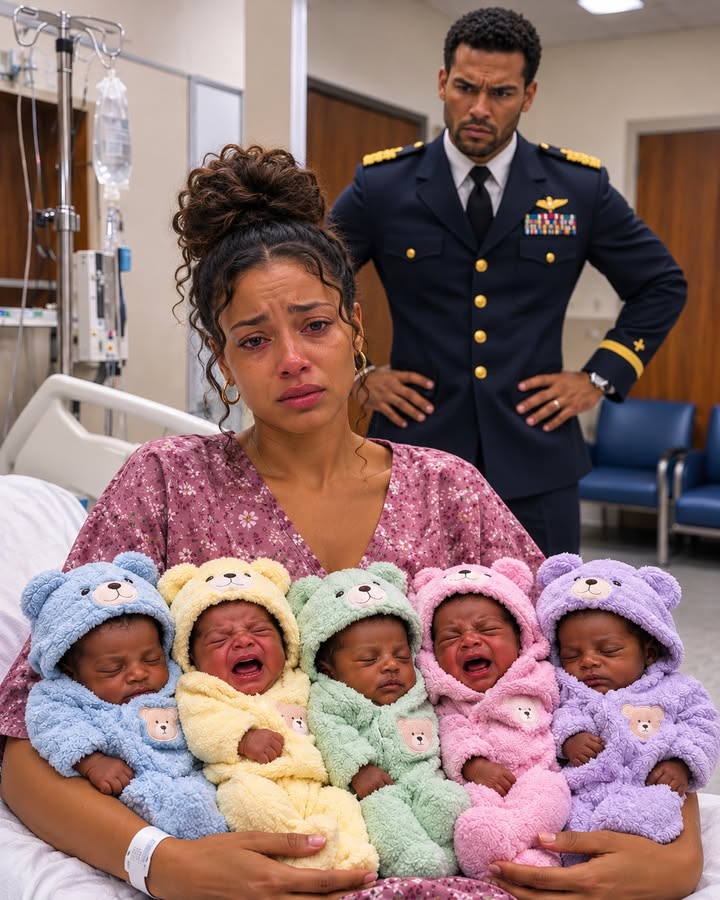
Your daddy may have left, but Mommy never will.
She had said it to five tiny babies in a hospital room where the future seemed impossibly large.
For a long time, she had believed that promise was the only thing she could give them.
Now she understood it had become the beginning of everything else: the work she took, the meals she stretched, the school meetings she attended, the hands she held, and the home they had built from whatever they had.
In the morning, all five children arrived at Lena’s house before she had finished her coffee.
They drove together to Patricia’s home, the five of them talking quietly along the way, as though the familiar sound of one another’s voices could steady whatever waited inside the envelope.
Patricia welcomed them at the door and led them to the dining room.
The envelope lay on the table beside the copies of the hospital report.
It was smaller than the one Lena had kept all these years, and the paper had browned at the edges.
Ruth’s handwriting covered the front.
To Nia, Daniel, Maya, Jonah, and Elise.
Lena’s breath caught.
“They had been named already,” Jonah said softly.
“Yes,” Patricia replied. “Ruth told me she wanted the babies to have names that belonged to them, whether or not Charles ever found his way back.”
Nia looked at the postmark.
Three weeks after the birth.
“Do you know why she wrote to us?” she asked.
“I can tell you what she told me,” Patricia said. “She said she wanted to explain something she should have told Lena before the babies were born. But she was afraid she had already made matters worse.”
Lena watched Patricia’s face.
“What did she mean?”
“I don’t know. I thought the letter might tell you more than I can.”
No one reached for it at first.
Then Elise placed her hand beside the envelope, not touching it, but close enough that the gesture felt like an invitation.
“Let’s read it together,” she said.
Nia carefully opened the flap.
Inside was one sheet of paper, folded twice.
She glanced at Lena, who nodded, and began to read.
“My dear children,” Nia said, then paused.
Her voice had softened around the words.
“I hope one day you will be old enough to understand that you were loved before I ever held you, even though the people who should have protected you failed to act with care.”
Daniel’s eyes lowered to the table.
Nia continued.
“I am Charles’s mother, and I have no right to ask you for affection. I only want you to know what I did and what I failed to do.”
Lena listened, feeling the years gather around her, not as a weight this time, but as a room she could finally see from end to end.
“Before the birth, I heard Charles repeating a rumor that Lena had been unfaithful,” Nia read.
“He did not have proof, and when I asked him what had made him believe it, he could not give me a clear answer.”
Maya drew a slow breath.
The letter continued.
“I told him he should speak with Lena, but I did not insist strongly enough. I thought he would calm down after the babies arrived. I thought that when he saw them, he would understand how much he loved them.”
Nia’s voice faltered at the next sentence.
“That was my mistake. I treated his fear as if it would pass on its own, and I did not protect Lena from the harm it could cause.”
Lena looked at the table.
For years, she had imagined Ruth knowing the truth and choosing to remain safely distant.
The letter showed a different failure, less simple and perhaps more painful: a woman who had seen danger forming and had trusted that time would fix what courage should have confronted.
Nia kept reading.
“When I saw the babies at St. Anne’s, I knew they were beautiful, but I also saw how startled Charles was. He had been told they might be early and very small. He had not been told anything about their coloring because no one could have known exactly how they would look.”
Daniel glanced up at Lena.
The letter continued in Ruth’s hand.
“I understood that his shock was not evidence of Lena’s wrongdoing. It was only shock. But he turned that surprise into an accusation, and I was not strong enough to stop him.”
Maya lowered her eyes.
Nia read on.
“I have asked St. Anne’s to arrange a test because a mother should not be left to defend herself against a story when facts can be found. I do not want the children to grow up with their worth measured by whether a man believes them to be his.”
A quiet ache moved through Lena.
Ruth had understood more than she had been able to say in the returned letter.
She had understood the humiliation of being made to prove what should never have been doubted.
She had understood that children could grow up carrying a question they had not created.
Nia reached the bottom of the page.
“I have sent Charles the report and written to Lena, but I have not managed to reach either of you. The letter to Lena came back to me, and Charles refuses to open what I send him. I should have gone to Lena myself. I should have found a way to tell her what I learned and to apologize in person.”
Her voice grew quieter.
“I am sorry that I did not.”
The letter ended with a final paragraph.
“Whatever you choose to feel about your father, and whatever you choose to feel about me, I hope you never mistake our failures for a measure of your worth. You were wanted by the world from the moment you arrived, even when the adults around you were too frightened or proud to show it.”
Nia lowered the page.
For a long moment, no one spoke.
The last hidden piece had not been a secret about the children.
It had been the truth about the adults who had failed them, each in a different way: Charles, who chose suspicion over listening, and Ruth, who saw the harm but trusted delay and hope when action was needed.
Lena felt grief for the young woman she had been, alone with five newborns and no explanation.
She felt compassion for the older woman who had written the letter, though compassion did not erase what she had failed to do.
Most of all, she felt the relief of no longer having to wonder whether she had missed some crucial piece of evidence or some chance that might have saved her children from abandonment.
She had not been unfaithful.
Her babies had never been in doubt.
The accusation had been a choice, not a fact.
Nia folded the letter along its old creases.
“Mom, do you wish she had come to you?”
“Yes,” Lena said.
The truth came easily now, without the need to protect anyone from it.
“I wish she had come to the hospital. I wish she had stood beside me and told me Charles was wrong. I wish she had found a way to reach us before so many years passed.”
“Do you think you could have forgiven her?” Elise asked.
“I don’t know,” Lena said. “But she could have given me the truth when I needed it. I wish she had.”
Patricia’s eyes glistened.
“I’m sorry,” she said. “I know that is not the same as an apology from her.”
“No,” Lena replied. “But I appreciate you bringing the letter to us.”
Patricia reached across the table and covered Lena’s hand with hers.
“She worried about what she had failed to do until the end,” she said. “I think she would be glad the truth finally reached you.”
Lena looked again at the five names in Ruth’s handwriting.
The words did not make Ruth’s silence acceptable, but they gave it a shape she could understand.
They also released the children from the last shadow of uncertainty.
On the drive home, Daniel sat beside Lena in the back seat while Nia drove.
After a few quiet miles, he said, “I used to think we had to decide whether Dad was a good man or a bad one before we could decide what to do with him.”
Lena turned toward him.
“And now?”
“Now I think he made a terrible choice, and we get to decide what happens next without making that choice the whole story.”
Maya looked back from the front passenger seat.
“That sounds like something Mom would say.”
“I learned from the best,” Daniel replied.
A soft laugh moved through the car, brief but real.
The laugh did not erase the past.
It made room for the present.
A week later, the contribution from Charles cleared into the family support fund.
The siblings had worked with the scholarship committee and a local nonprofit to establish a careful process for assisting parents who needed help with childcare, transportation, school fees, or an emergency bill that threatened to derail a child’s education.
They named it the Promise Fund.
They did not tell Charles the name until the paperwork was complete.
When Nia finally called him, she explained what the fund would do and why they had chosen the name.
There was a long silence on the other end.
“That was the promise you made them?” he asked.
“Yes,” Lena said, taking the phone when Nia offered it.
“I told them their father might leave, but I never would.”
Charles did not speak for a moment.
“I’m glad they had you,” he said.
“So am I.”
“I know I was the one who should have been there.”
“Yes.”
“I don’t expect you to comfort me.”
“Good.”
“I’ll keep the agreement,” he said. “The money is theirs to use, and the name is yours to choose. I won’t ask for anything in return.”
Lena believed him.
Not because one good sentence could settle the matter, but because he had begun to do what he said: he had made the contribution without demanding attention, and he had admitted his abandonment where other people could hear him.
His next work would be quieter.
The first few months, the siblings did not invite him into their home.
They met him only when they chose, usually for brief conversations in public places where each person could leave whenever they wished.
Charles did not ask them to call him Dad.
He did not send presents that might be mistaken for attempts to buy affection.
When birthdays passed, he sent a simple message with no expectation of an answer.
Some of the siblings replied.
Some did not.
Nia agreed to have coffee with him every few weeks, bringing a notebook because she wanted to ask about his life before she decided what to share about hers.
Maya chose to meet him once, then waited several months before agreeing to another conversation.
Jonah and Elise spoke with him together at first, their familiar closeness helping them find their own words.
Daniel kept his distance.
He told Charles plainly that he was not ready for a relationship, and Charles thanked him for telling the truth.
He did not call again unless Daniel invited it.
The boundaries were different, and Charles learned to live with that difference without trying to make the siblings responsible for his loneliness.
Lena watched from the edge of their decisions, resisting the old instinct to smooth discomfort before anyone asked her to.
She did not tell them when they should forgive.
She did not tell them that they should give Charles another chance because he was trying.
She did not ask them to protect him from the consequences of his absence.
When Nia said she had enjoyed a conversation with him, Lena listened.
When Daniel said he still felt nothing but anger, she listened to that, too.
The family had not become whole because Charles returned.
It had been whole in its own way long before he did.
What changed was that the truth no longer had to remain locked inside a story no one could explain.
As the Promise Fund began assisting families, Lena accompanied her children to its first community gathering.
The room was smaller than the scholarship hall, crowded with folding chairs, children’s drawings, and trays of food prepared by volunteers.
A young mother came forward to thank them after receiving help with childcare while she completed a training program.
Her little boy held her hand, and his sleeve had a bright patch sewn over one elbow.
Lena recognized the careful stitching before she recognized the mother’s nervous smile.
“Thank you for making it feel like asking for help doesn’t mean I failed,” the woman said.
Lena squeezed her hand.
“It never meant that.”
Across the room, Nia was speaking with a student who hoped to become a nurse.
Daniel was helping a volunteer carry boxes of supplies.
Maya sat on the floor with two children, patiently showing them how to fold paper cranes.
Jonah and Elise were laughing over a stack of forms that had somehow been filled out in the wrong order.
The room held the kind of ordinary noise Lena had once believed she might never be able to give her children: conversation, laughter, the scrape of chairs, and the certainty that there would be enough people to help when someone needed it.
Charles stood near the doorway, having come only after the siblings invited him.
He did not approach Lena until she finished speaking with the young mother.
“That was a good idea,” he said, looking around the room.
“It was theirs,” Lena replied.
He nodded.
“They built it well.”
“They did.”
He waited, leaving the silence open rather than filling it with an apology or an explanation.
After a moment, Lena asked, “Would you like something to eat?”
His expression changed, not with triumph, but with the careful gratitude of someone offered a small kindness he knew he had not earned.
“If that’s all right.”
She brought him a plate.
They stood together near the wall, looking out at the people in the room.
There was no sudden embrace.
No declaration that everything had been forgiven.
There was only a plate passed between them, a quiet conversation, and the recognition that the future would be made of small choices rather than one grand return.
Years continued to pass.
Some of Lena’s grandchildren grew old enough to ask about the photographs in the wooden box.
She showed them the picture of the five babies at St. Anne’s, each wrapped in a different blanket, their faces scrunched and tiny.
She showed them school portraits, graduation pictures, family vacations taken with borrowed cars and carefully packed lunches.
She told them the truth gently: that their grandfather had been absent for a long time, that he had made choices that hurt the family, and that the people he hurt had been allowed to choose what kind of relationship they wanted with him.
When the children asked whether he was part of their family now, Lena answered, “He is part of our history, and some of us are finding a place for him in our lives.”
She did not promise more than that.
At a later gathering, one of the twins brought Charles a cup of tea without being asked.
He thanked her and held it with both hands, as though the small kindness deserved his full attention.
Nia and Charles continued their cautious meetings.
Maya became comfortable enough to invite him to a family event, though she made clear that she might leave early.
Jonah stayed in touch by phone.
Elise sometimes sent him photographs of the grandchildren.
Daniel remained distant, and Charles never tried to persuade him otherwise.
Lena came to understand that respect for a boundary was also a kind of answer.
The past did not disappear, but it stopped demanding that every new day be organized around it.
On the anniversary of the Promise Fund’s opening, the family gathered in Lena’s backyard.
The grandchildren ran between the garden and the patio, carrying paper cups of lemonade and calling to one another over the low murmur of the adults.
Nia had brought a framed copy of the first scholarship announcement.
Daniel had brought food.
Maya had brought flowers from her garden, and Jonah and Elise had brought a cake decorated with five small stars.
Charles arrived near the end of the afternoon, as agreed, and greeted each person without assuming an embrace.
He stood back while Lena’s children arranged the food and welcomed guests.
No one announced him as a donor.
No one asked him to speak.
He stayed because the siblings had invited him to stay.
When the gathering began to wind down, Lena sat on the porch steps, watching her children move through the yard.
Nia was helping a grandchild tie a ribbon.
Daniel was listening to one of the scholarship recipients explain her plans.
Maya had a little one asleep against her shoulder.
Jonah and Elise were setting aside plates for the neighbors who had volunteered with the fund.
Charles stood several paces away, speaking quietly with a young father who had come to ask about assistance.
For a moment, Lena felt the old hospital room return, but it no longer held only the image of Charles walking out.
It also held the promise she had made after he left.
The promise that had carried her through every night shift, every uncertain bill, every school meeting, and every morning when five children needed breakfast before she could sit down.
Her daughter Nia came to the porch and lowered herself beside her.
“You’re quiet, Mom.”
“I’m watching.”
“What are you thinking?”
Lena looked out at the yard, at the children and grandchildren gathered beneath the late sun, at the family that had endured without pretending it had never been hurt.
“I was thinking that I kept my promise.”
Nia leaned her head against her mother’s shoulder.
“You did more than that.”
The others drifted toward them, drawn by the familiar ease of being close.
Daniel sat on Lena’s other side.
Maya took a step down and rested her hand on Lena’s knee.
The twins settled on the porch rail, smiling at one another.
For a little while, no one spoke.
Then Elise said, “You kept all of us together.”
Lena looked at her children, at the faces she had kissed in a hospital bed and watched grow into people kinder and stronger than the circumstances that shaped them.
“You kept each other together, too,” she said.
“We learned it from you,” Jonah replied.
The words were simple, but they reached the place in Lena that had held the lonely years.
Across the yard, Charles looked over, saw the family gathered on the steps, and did not interrupt.
He understood, at last, that the place Lena had made for him could never be taken by force, money, or even an apology.
It could only be offered, slowly, by the people who had lived without him.
Lena rested her hands over her children’s.
She was no longer waiting for the past to give her a different ending.
The life she had built was here, surrounding her in the voices of her children and grandchildren, in the work they had chosen together, and in the love that had stayed when everything else had gone.
The man who left had found his way back only to the edge of the family.
The woman who never left sat at its center.
**–THE END–PLEASE
Share your thoughts or feedback to motivate us to create more stories ♥️
* * *
[PREVIOUS: PART 5](https://puretales.idolsgift.com/blog/part-5-the-letter-no-one-had-opened-035)
✓ Lynn R. Adams
Part 6 – The Promise That Stayed Nia read the words again, as though the handwriting might change if she looked away and returned to it. “Open this only when the children are ready to know what I sh…