PART 5: The Marker in His Blood 008
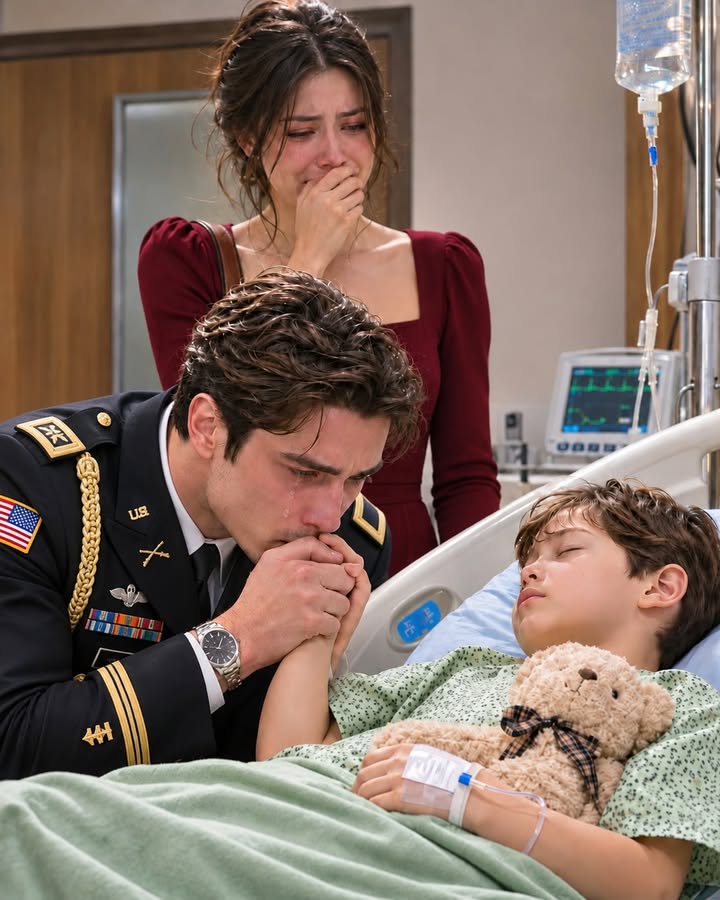
Part 5 – The Choice Between Us
“No,” I told Noah, smoothing his hair back from his forehead. “It isn’t bad. The doctors found information that helps them understand your blood better.”
He studied my face, looking for the part I hadn’t said.
“Does it mean Alexander can help me?”
“It means the doctors have another clue,” I said. “They still need to finish their tests.”
Noah looked toward Alexander, who was waiting quietly by the window.
“Are you still going to stay?”
Alexander came to the bedside.
“Yes,” he said. “I’m still here.”
Noah reached for his hand, and Alexander held it gently between both of his.
I kept my eyes on their joined hands, thinking of the old test result and the letter that had never reached me.
The doctor had been clear that the marker was not an illness, and that I had not caused Noah’s leukemia.
Still, guilt didn’t disappear just because someone explained why it had no place to live.
When Noah’s eyes grew heavy again, I stepped into the hallway with Alexander.
“I keep thinking about that result,” I said. “If I had received the letter, maybe I would have known.”
“You couldn’t respond to a letter you never got.”
“I should have followed up.”
“You went to the clinic. You had a newborn. You moved and did what you could with what you knew.”
I looked at him.
“You don’t have to protect me from feeling bad.”
“I’m not trying to.” His voice was quiet. “I’m trying to keep you from blaming yourself for something you didn’t understand.”
For a moment, neither of us moved.
Then he added, “I did enough blaming for both of us.”
The admission left me with no easy answer.
We returned to Noah’s room, where a nurse was adjusting the line beside his bed.
Alexander waited until she finished before asking whether the transplant team had set a meeting.
“They’ll come by tomorrow morning,” she said. “They want to discuss the options and make sure you both have time to ask questions.”
“Both of us?” I asked.
“Yes,” the nurse said. “You’re Noah’s parents. They’ll explain the plan to both of you.”
The words were ordinary, but I felt them settle heavily between Alexander and me.
Noah’s parents.
For years, I had been the only one answering his questions, signing forms, and staying beside him when he was sick.
Now the title included Alexander, and the hospital was treating it as a fact rather than a possibility.
That evening, Alexander called his office and told his assistant he would be staying close to the hospital.
He spoke without drama, then put the phone away.
“You don’t have to stay here every minute,” I said.
“I know.”
“You can go home and sleep.”
“I can sleep here.”
“In that chair?”
“I’ve slept in worse places.”
“I’m sure you have, but this isn’t a test of how much discomfort you can tolerate.”
A faint smile touched his face.
“I’m not trying to prove anything.”
“Then what are you trying to do?”
“Be where Noah expects me to be.”
He glanced toward the bed.
Noah was asleep, his rabbit tucked beneath his chin and the sailboat blanket folded around his feet.
I understood that Alexander was not asking me to believe in a future.
He was trying to keep a promise made to a little boy who had no reason to trust it yet.
The next morning, the transplant team came to speak with us.
A hematologist, a transplant coordinator, and the specialist who had explained the marker gathered around a small table near Noah’s bed.
They described the next steps in careful, plain language.
Noah’s treatment would continue, and the team would monitor his response.
Because the donor comparison was encouraging, they were preparing for the possibility of a transplant if his doctors decided it offered his best chance.
Alexander’s remaining evaluation would determine whether he could donate.
The unrelated donor search would continue as well.
I listened to every word, forcing myself to ask questions even when my voice threatened to fail.
“What are the risks for Noah?” I asked.
The hematologist explained that transplant could lead to serious complications, including infection, organ problems, or the body reacting against the new cells.
The team would take precautions, but they could not remove the risks entirely.
“What about the chances that it works?” Alexander asked.
“The transplant offers Noah his best chance if his treatment response shows he needs one,” the doctor said. “But we can’t promise a particular outcome.”
Alexander’s hand rested on the table, palm flat against the polished surface.
“And the donor procedure?” he asked.
The coordinator explained that the method would depend on the final medical recommendation.
It could involve collecting cells from the blood after medication prepared the donor’s body, or using a procedure to collect marrow under anesthesia.
Either approach required additional testing, careful monitoring, and time to recover.
Alexander asked about the discomfort, the length of the procedure, and the potential complications.
He did not ask whether the process would interfere with his work.
When the team finished, they gave us a few minutes alone.
Noah had been listening from his bed, his face solemn.
“Would Alexander get sick if he helped me?” he asked.
The coordinator had stayed in the room and answered gently.
“There are risks to any medical procedure, but we would evaluate him carefully and explain every step before he decided.”
Noah looked at Alexander.
“Do you have to say yes?”
“No,” Alexander replied. “The decision is mine.”
“Do you want to?”
Alexander held his gaze.
“If the doctors say I’m a safe match and the procedure could help you, yes.”
Noah glanced at me.
“Is that okay?”
I brushed my thumb across his hand.
“The doctors will make sure everyone understands what would happen. We won’t rush into anything.”
Noah turned back to Alexander.
“You don’t have to do it just because you’re my dad.”
Alexander’s expression shifted.
“I wouldn’t do it just because I feel I have to,” he said. “I’d do it because I want to help you.”
Noah considered this, then looked down at the rabbit in his lap.
“Okay.”
When the team left, I asked the coordinator if I could speak with her privately.
Alexander started to rise, but I stopped him.
“Please stay,” I said. “I want you to hear this too.”
The coordinator sat with us at the small table.
“I need to know that Alexander’s decision is truly his,” I said. “No guilt, no pressure from me, and no feeling that he has to earn a place in Noah’s life.”
“That’s a fair concern,” she said. “We speak with every potential donor separately as well as together. We make sure the decision is voluntary.”
Alexander leaned forward.
“I’ve decided I want to be evaluated,” he said. “I haven’t decided to proceed without understanding the risks, but no one is forcing me.”
“I don’t want you to believe that donating earns forgiveness,” I said.
“I don’t.”
“And it doesn’t buy you a place in my life.”
“I know.”
“Then why are you willing to do it?”
He looked through the open doorway at Noah.
“Because he’s my son,” he said. “Because he needs help. And because being his father can’t begin and end with whatever is easiest for me.”
The coordinator gave us time to sit with that.
I realized I had been waiting for him to say something that would prove he hadn’t changed.
Instead, he was saying he did not get to choose the convenient parts of fatherhood and leave the rest behind.
That did not undo what had happened.
It did make me listen.
After the coordinator left, I went to the window.
The courtyard below was washed with pale morning light, and a volunteer was setting a basket of fresh flowers on a table near the entrance.
Alexander came to stand a few feet away.
“I can’t make the decision for you,” I said.
“You shouldn’t have to.”
“If the doctors say the transplant is Noah’s best chance, and you’re a suitable donor, I’ll have to trust that you understand what you’re agreeing to.”
“I do.”
“You don’t know every risk yet.”
“Then I’ll learn them before I decide.”
“And if they say it’s not safe?”
“Then I won’t do it.”
I turned toward him.
“You’re not going to argue with the doctors?”
“No.”
“You won’t insist they make you a match?”
“No.”
“I know you can’t control the result.”
His gaze stayed steady.
“I’m beginning to understand that.”
The answer was not perfect.
It was more honest than perfect.
That afternoon, Noah’s treatment left him tired and quiet.
Alexander sat beside him and read from the picture book Noah had chosen.
When Noah lost interest, Alexander put the book down and asked whether he wanted to hear about the hotel near the coast.
“Is it really by the ocean?” Noah asked.
“It is.”
“Can I see it someday?”
“If the doctors say it’s safe and you feel up to traveling, we could go.”
“Mommy has to come.”
Alexander looked toward me.
“Of course.”
“And you can’t leave before we get there.”
“I won’t.”
Noah seemed to accept that promise, though I noticed Alexander did not make it grander than it was.
He did not tell Noah they would go next week or that everything would be fine.
He offered a possibility and let the future remain uncertain.
When Noah fell asleep, I sat beside Alexander in the corridor.
“I used to think you only knew how to make promises with money,” I said.
He looked down at his hands.
“I made a lot of things easier by paying for them.”
“You paid for my mother’s surgery.”
“I did.”
“You gave me a home when I had nowhere else.”
“I did that too.”
“And then you put rules around everything.”
“I thought rules would keep us from hurting each other.”
“They did the opposite.”
“I know.”
He said it without trying to turn the admission into a plea.
I folded my hands in my lap.
“I don’t know what would have happened if I’d seen that letter.”
“Neither do I.”
“Maybe I would still have left.”
“Maybe.”
“Maybe I would have stayed.”
“Maybe.”
“Maybe we would have fought and I would have told you about Noah.”
His face tightened, but he did not look away.
“I wish I had the chance to find out.”
“So do I.”
We sat in silence as a cart rolled past at the end of the corridor.
For years, I had imagined the past as a door that could open if I found the right key.
Now I understood that the past was not a door.
It was a room we had both left without saying goodbye, and neither of us could return to it as the person who had first walked in.
All we could do was decide what to do next.
The following morning, the specialist came to Noah’s room with the final donor evaluation schedule.
Alexander’s initial results remained encouraging, but there were additional tests to complete before the team could formally recommend him.
The unrelated donor search had produced potential candidates, though none had yet been confirmed as a better option.
The transplant team would review all possibilities before making a recommendation.
“How soon?” I asked.
“Within a few days, we should have enough information to give you a clearer answer,” she said. “We’ll keep you updated as each result comes in.”
Alexander nodded.
“Tell me where to be.”
After she left, he turned to me.
“I have one request,” he said.
Every muscle in my body tightened.
“What?”
“If the team says I’m suitable, I want you to let Noah make whatever choice he can understand.”
“That’s what we’ve been doing.”
“I know. I mean about whether he wants me there.”
“He’s already asked you to come back.”
“I know. I don’t want him to feel he has to be brave for me.”
I studied his face, trying to find the hidden demand.
There was none.
“I won’t make him choose between us,” I said.
“Thank you.”
“I also won’t let him carry the medical decision. He’s a child.”
“I understand.”
“He can tell us what he wants from you, but the adults have to decide what’s safe.”
“Agreed.”
It was the first time we had made a decision together without reaching back for an old contract, an old argument, or an old fear.
That night, Noah woke after a restless dream.
I was at his side before he had fully opened his eyes.
He clutched my sleeve and whispered, “Don’t go.”
“I’m here.”
He looked beyond me and saw Alexander asleep in the chair, his head tilted against the wall.
“Is he still here?”
“Yes.”
“Did he stay all night?”
“He did.”
Noah’s gaze lingered on Alexander.
“Can he sit by me when they do the big tests?”
I hesitated, then turned to Alexander.
He woke at the sound of our voices and straightened.
“If Noah wants me there, I will,” he said.
Noah nodded and settled back against his pillow.
“Then stay.”
Alexander moved to the bedside.
“I’m here.”
Noah closed his eyes, still holding my sleeve in one hand and Alexander’s fingers in the other.
I stayed beside them until his breathing settled.
The next days were measured in waiting.
Alexander completed the additional tests, met with the donor team, and went through a detailed medical assessment.
The unrelated donor registry returned new information, but the candidates would need further verification.
The doctors continued Noah’s treatment while explaining that the transplant decision could not be made until the final review.
Alexander came to every appointment.
He asked questions when something was unclear and listened when I asked the same question twice.
He learned which foods Noah could manage on difficult days and which nurse could coax him into taking a few more sips of water.
He never made a display of it.
He simply noticed.
One evening, I found him sitting on the floor beside Noah’s bed, repairing the paper sailboat Noah had folded from a napkin.
The boat had torn down one side.
Alexander used a strip of clear tape from the nurse’s supply drawer and pressed it carefully into place.
“You’re good at fixing things,” Noah murmured.
“Not everything,” Alexander said.
Noah glanced at me, then back at him.
“Can you fix my sickness?”
Alexander was quiet for a moment.
“No,” he said. “The doctors are the ones who know how to treat it, and we’ll do what they tell us.”
Noah’s lower lip trembled slightly.
“But you can stay while they do.”
“Yes,” Alexander said. “I can stay.”
Noah held out the repaired boat.
Alexander placed it on the bedside table, where it could sail beside the paper house.
I looked at the two small drawings and felt the walls of my old certainty shift another inch.
The following afternoon, the transplant specialist asked Alexander and me to meet in her office.
She brought the final results from his evaluation and a summary of the unrelated donor search.
“The team has completed its review,” she said. “We have not found a more suitable unrelated donor at this time.”
Alexander’s hands clasped together.
“And my results?” he asked.
“You are a sufficiently close match for Noah, and your evaluation shows you’re medically eligible to donate.”
I held my breath.
The specialist continued, explaining that the transplant team believed transplantation offered Noah his best chance if his treatment response remained appropriate.
The procedure carried real risks.
They would monitor both Noah and Alexander closely.
The decision could not guarantee a cure, and the recovery could be difficult.
“But it is our recommendation,” she said. “We believe this is the best path available.”
Alexander looked at me.
I saw the question in his eyes, though he did not ask me to answer for him.
“I want to proceed,” he said. “After I meet with the donor team and understand the procedure fully.”
The specialist nodded.
“We’ll arrange that. They’ll speak with you privately, and they’ll answer every question.”
“And Noah?” I asked.
“We’ll explain what he can understand in a way that doesn’t place the responsibility on him.”
I looked at the summary in front of me.
This was the choice I had feared from the moment Alexander’s first blood test showed a possible match.
If he proceeded, he would take on a medical risk for a son he had only just met.
If he didn’t, the team would continue looking, but the other donor options were less certain.
I knew the decision was his.
I also knew that letting him make it meant trusting him with more than a blood test.
“I need to speak to him alone,” I told the specialist.
She nodded and left us with the door open.
Alexander waited.
“You don’t need to say anything,” he said.
“I do.”
I looked down at the paper, then back at him.
“If you do this, it cannot be a trade.”
“It won’t be.”
“You don’t get to say you gave part of yourself and therefore deserve my forgiveness.”
“I would never ask for that.”
“You don’t get to decide that we’re a family because the transplant works.”
“I know.”
“And if something changes between you and me, if we argue or if I need space, you still have to show up for Noah.”
“I will.”
“You can’t make that promise based on what you hope I’ll give you.”
“I’m not.”
His voice was rough, but steady.
“I’m making it because he’s my son, whether you and I ever find our way back to each other or not.”
I believed that he meant it.
I did not know whether he could keep it.
That was the hard part of trust: it asked for room before there was proof.
“If the doctors believe this is Noah’s best chance, I will support the choice,” I said. “But you need to make it for yourself, with all the risks in front of you.”
“I will.”
“I can’t choose your body for you.”
“I wouldn’t ask you to.”
“Then go speak to the donor team. Ask every question. Take the time you need.”
He rose.
Before he reached the door, I said, “Alexander.”
He turned.
“If you choose to do this, Noah shouldn’t have to wonder whether you’ll disappear afterward.”
“I understand.”
“I’m not asking you to promise the impossible.”
“I know.”
“What are you promising?”
“That I’ll keep coming back. That I’ll learn how to be his father one ordinary day at a time.”
The words were simple.
They did not erase the five years we had lost.
They did not tell me what would become of us.
But they were the first promise Alexander had made to me without asking me to sign anything in return.
He met with the donor team that afternoon.
They reviewed the procedure in detail, including the risks, the preparation, and the recovery.
The team spoke with him privately and made sure his decision remained voluntary.
I sat with Noah during the meeting, answering the questions he was ready to ask and leaving room for the ones he wasn’t.
When Alexander returned, his face was pale with fatigue, but his expression had settled.
“I’ve decided to proceed,” he said.
I looked at him.
“Are you certain?”
“Yes.”
“Not because you think it will fix the past?”
“No.”
“Not because you think I owe you?”
“No.”
“Because Noah needs you?”
“Because Noah needs help, and I can give it.”
The answer brought tears to my eyes, though I tried to blink them away before he noticed.
He noticed anyway.
He didn’t touch me.
He only stood beside the chair and waited until I could speak.
“Then I’ll stand with you through the process,” I said. “For Noah.”
His shoulders eased.
“For Noah,” he repeated.
The donor team set the next appointments, and the doctors arranged to speak with Noah in the morning.
When we returned to his room, he was awake and waiting.
“Did the doctor say you can help me?” he asked.
Alexander pulled the chair to the bed.
“Yes.”
Noah studied him.
“Does it hurt?”
“There will be some uncomfortable parts,” Alexander said. “The doctors will explain everything. They’ll take care of me too.”
“Are you scared?”
“Yes.”
Noah’s eyes widened.
“Then why are you doing it?”
“Because you need help, and I want to help you.”
Noah looked toward me.
I sat on the edge of his bed.
“You don’t have to decide anything about the medical treatment,” I told him. “The doctors and I will make sure it’s safe. You can tell us what you want while it happens.”
“Can I ask Alexander to stay?”
“Yes,” I said.
Noah reached for Alexander’s hand.
“Then stay with me.”
Alexander lowered his head and pressed his forehead gently against Noah’s knuckles.
“I will.”
Noah’s eyes began to close.
“Promise?”
“I promise.”
I looked away, suddenly afraid that if I watched them too closely, I would ask for more from the moment than it could give.
A knock sounded at the open door.
The transplant coordinator stood in the doorway, holding a phone and a printed message.
“I’m sorry to interrupt,” she said. “The registry has just confirmed a new result.”
The hope in Alexander’s face faltered.
“What result?” I asked.
She glanced down at the page.
“One of the unrelated donor candidates has completed the additional verification,” she said. “The match is closer than expected.”
Alexander’s hand remained in Noah’s, but his eyes moved to the report.
“Closer than mine?” I asked.
“The comparison is still being reviewed,” she said carefully. “The team needs to confirm how this donor’s profile relates to Noah’s inherited marker before making a recommendation.”
“Can they do it in time?” Alexander asked.
“We don’t know yet.”
The coordinator stepped closer and placed the page on the table.
A single line had been highlighted.
The new donor shared the uncommon marker that had first appeared in my prenatal record.
The coordinator looked from the page to me.
“Before we proceed,” she said, “we need to know whether this donor is someone either of you recognizes.”
**–END OF PART 5–CLICK “NEXT” AT THE BOTTOM OF THE PAGE TO CONTINUE READING**
* * *
[PREVIOUS: PART 4](https://puretales.idolsgift.com/blog/part-4-the-marker-in-his-blood-008-1) | [NEXT: PART 6(THE END)](https://puretales.idolsgift.com/blog/part-6-the-end-the-marker-in-his-blood-008)
✓ Lynn R. Adams
Part 5 – The Choice Between Us “No,” I told Noah, smoothing his hair back from his forehead. “It isn’t bad. The doctors found information that helps them understand your blood better.” He studied my…