PART 5: The Lullaby Hidden in the Crown 055
Part 5 – The Truth Before the Court
By morning, the palace had learned that something was wrong, though no one agreed on what.
In the corridors, whispers traveled faster than the servants carrying breakfast trays.
Some said the crown had been damaged.
Others claimed the prince had canceled the marriage challenge.
A few had heard Emma’s name and attached it to the story as if it were another strange ornament discovered inside the royal heirloom.
Emma heard none of the rumors directly.
She spent the first hours of the morning in the conservation room, watching the conservator examine the crown while William stood near the window with his mother’s letter in his hands.
The note from the portrait, the copy of Lydia Vale’s birth record, and the strip bearing Ashcombe’s signature had been placed in separate protective sleeves.
The crown rested beneath the inspection lamp, its inner lining turned back with painstaking care.
“Here,” the conservator said at last.
A narrow panel beneath the music box’s brass casing had been loosened.
Inside was a folded sheet of thin paper, protected from the metal by a square of blue silk.
William drew closer.
“Is it safe to remove?”
“Yes,” the conservator said. “It is not attached to the mechanism.”
He lifted the paper with a small pair of tweezers and placed it on the padded table.
The page held a column of figures, dates, and brief notes in the queen’s hand.
At the bottom, beneath a line of totals, was a name.
Lydia Vale.
Emma’s throat tightened.
“My mother’s handwriting is on the reverse,” she said.
William looked at her.
“Are you certain?”
“She made her capital L that way.” Emma leaned closer without touching the page. “And she always wrote the number seven with a line through it.”
The conservator turned the paper over.
A second set of notes appeared in a smaller hand.
Emma recognized it at once.
The handwriting was careful, slightly slanted, and familiar from the labels her mother used to put inside repaired garments.
She felt the years between them fold briefly together.
“This is hers,” Emma whispered.
William did not ask her to prove it.
He simply stood beside her, allowing the recognition to be hers before it became evidence for anyone else.
The page contained a record of payments to contractors who had never completed the work listed beside their names.
It also referenced several original ledgers, identified by dates and storage numbers.
One line was underlined twice.
“Copies made before transfer,” Emma read. “Originals removed from section seven.”
“Those may be the missing books,” William said.
The conservator studied the marks.
“The paper is consistent with the period, and the ink appears old. I can’t authenticate it fully without a specialist, but it is certainly worth preserving.”
“Can it be traced to my mother?” William asked.
“The handwriting can be compared with her other work records, if any survive.”
Emma stared at the page.
Her mother had not merely helped the queen.
She had preserved a piece of the truth, knowing that she might never be able to explain what she had done.
William’s hand rested on the edge of the table.
“She trusted you with this,” he said.
“She trusted the queen.”
“And the queen trusted you.”
Emma looked at him.
“I’m not sure the distinction matters anymore.”
For a moment, his expression softened.
Then the chamberlain entered, carrying a sealed note.
“Your Highness, Lord Ashcombe is waiting in the council room.”
William took the message but did not break the seal.
“Did he say why?”
“He said he wishes to discuss the evidence before the court gathers.”
“Is the court gathering?”
“The families have been asked to assemble in the ballroom at noon. They were told there would be an announcement regarding the challenge.”
William glanced at the clock.
“Then I will speak with him now.”
Emma began to step back.
William noticed.
“Stay, if you wish.”
“I’m not sure my presence would help.”
“It may help me remember who could be harmed by what I decide.”
The words settled quietly between them.
Emma could have taken them as a courtesy, but she saw the strain in his face.
He was not asking her to lend him certainty.
He was asking her to remain present while he faced the choice.
“I’ll stay,” she said.
The council room had been prepared for a private meeting, with a pot of tea left untouched on the table and the curtains drawn against the morning light.
Lord Ashcombe stood beside the hearth, hands clasped behind his back.
He turned when William entered.
“Your Highness.”
“Lord Ashcombe.”
Ashcombe’s gaze moved to Emma, then to the evidence case in William’s hand.
“I see you have found something.”
“We found a record hidden in the crown.”
“May I see it?”
“No.”
The answer was not sharp, but it was final.
Ashcombe nodded as though he had expected it.
“Then perhaps we should speak plainly.”
William sat at the table.
Emma remained near the door, where she could listen without making the meeting feel like a public examination.
Ashcombe took the chair opposite the prince.
“I will not pretend the records are complete,” he said. “They are not.”
“You authorized the removal of my mother’s letters.”
“I did.”
“And you cannot tell me where they went.”
“Not yet.”
“You also handled the crown before the challenge.”
“I inspected it.”
“Without a recorded inspection.”
Ashcombe folded his hands.
“The crown was about to be displayed before the court. I considered it sensible to ensure the clasp was secure.”
“Did you know there was a hidden mechanism?”
“No.”
“Did you know the queen’s records were inside?”
“I knew she had kept private papers in more than one place.”
The room seemed to still around that admission.
William’s face did not change, but his thumb pressed against the evidence case.
“Why didn’t you tell me?”
“Because I could not be certain what she had left, or whether it was safe to bring into the open.”
“Safe for whom?”
Ashcombe looked down at the table.
“For the palace. For you. For those whose names may appear in the records.”
Emma watched him carefully.
His restraint could have been the practiced manner of a steward protecting his position.
It could also have been the caution of a man who understood that a true record might contain more than one kind of guilt.
William opened the evidence case and withdrew the copy of the queen’s ledger page.
He did not hand it over.
“This document records missing funds,” he said. “It names my mother and Emma’s late mother as the people who found the discrepancies.”
Ashcombe’s gaze settled on the page.
“And it names you,” William continued. “Your signature appears on the note in the portrait.”
“I signed many records.”
“That note stated that original records were moved before my mother died.”
“Yes.”
“Where were they moved?”
“I don’t know.”
“You authorized their transfer.”
“I authorized a transfer of boxes from the archive to private review. I did not personally carry them, and I cannot tell you what was in each box.”
“Who did?”
“I would need the transfer records.”
“We searched the index.”
“Then the records may be elsewhere.”
William sat back.
“Lord Ashcombe, the story you have given me is a series of gaps.”
“I understand how it sounds.”
“Do you?”
Ashcombe met his eyes.
“I was responsible for too much, and I allowed procedures to replace attention. I should have followed the papers to their destination. I should have demanded a full account when the queen’s belongings were moved.”
“That is not the same as answering whether you stole the money.”
“No,” Ashcombe said. “It isn’t.”
The admission was so direct that Emma looked up.
William’s expression remained guarded.
“Did you?”
“I did not take the funds.”
“Did someone acting under your authority?”
“I don’t know.”
“Did you know the workers were blamed?”
“I knew an inquiry had been completed. I was told the accounts had been reconciled.”
“And you accepted that?”
“I did.”
Ashcombe’s voice had lost some of its polish.
“I believed the palace’s officers had resolved the matter. That may have been a failure of judgment. It may have been worse. I cannot give you an answer I do not have.”
William looked at the documents.
“Then the answer has to come from an investigation.”
“It may.”
“Why have you asked me here?”
Ashcombe drew a slow breath.
“Because the court will be waiting for you, and because there is still a way to prevent this from becoming a public scandal.”
Emma felt the room’s temperature change, though no one had moved.
“What way?” William asked.
“You could announce that the crown’s old mechanism was disturbed during the challenge. You could state that Miss Emma handled it without authorization and that the evidence found inside is incomplete and unverified.”
The words were carefully chosen.
Ashcombe did not suggest punishing Emma.
He suggested giving the court a tidy explanation that would leave her name attached to the discovery and its uncertainty.
“The challenge could proceed,” Ashcombe continued. “The crown would be secured, the documents examined privately, and the palace could conduct its own review without inviting speculation across the kingdom.”
“And the missing records?”
“They could be sought without public pressure.”
“The people who were dismissed?”
“If the review finds an error, the palace can correct it.”
Emma looked at William.
She saw the appeal of the offer in the stillness of his face.
A private review would protect the monarchy from immediate embarrassment.
It might protect the families gathered for the challenge from having their hopes turned into public gossip.
It might also keep Emma from becoming the focus of a story she had never sought.
It would leave the truth in the hands of the same institution that had misplaced it.
“Your Highness,” Ashcombe said, “you have a responsibility to the crown beyond your personal grief.”
“My mother’s letters are not a matter of personal grief alone.”
“No. But the timing is unfortunate.”
“The timing is when we found them.”
Ashcombe held his gaze.
“If you expose this before the evidence has been authenticated, you risk accusing people without proof. You risk damaging the court and the families who came here in good faith. You may also expose Miss Emma to attention she did not ask for.”
Emma’s name sounded different in his voice than it had in the ballroom.
It was not mockery.
That made his argument harder to dismiss.
William turned toward her.
“What do you think?”
Ashcombe’s eyes followed him.
Emma was aware of her plain shoes against the polished floor, the modest sleeves of her rose-colored dress, and the invisible line the court had drawn between her and the people who would soon gather beneath the chandelier.
“I think the challenge should end,” she said.
Ashcombe looked surprised.
William remained still.
“Not because of me,” Emma continued. “Because the crown has become evidence, and it should not be used to judge anyone’s worth as a wife.”
“The challenge was meant to be a ceremony,” Ashcombe said. “It can still be preserved as such.”
“It was announced as a test, with a marriage as the prize.”
She spoke without anger, but each word felt clearer once it had left her.
“If you continue it now, every contestant will be competing beside a secret they do not understand. And if I am blamed for opening the crown, then I will be asked to carry a truth that belongs to the palace.”
William’s gaze stayed on her.
Emma turned to him.
“You asked me to be here because you trusted what I remembered. Please don’t turn that trust into a reason to keep me quiet.”
“I wouldn’t.”
“Then don’t protect me by hiding the evidence. Let me decide what I can bear.”
His expression shifted, and she saw that he had been trying to shield her from the court’s attention without asking whether that was what she wanted.
“I’m sorry,” he said.
“For what?”
“For thinking silence might be kindness.”
Emma lowered her eyes for a breath, then looked back at him.
“Silence can be kind when someone needs rest. It is not kind when it asks them to disappear.”
Ashcombe’s hands separated on the table.
“Your Highness, there are consequences to a public accusation.”
“I know.”
“Your position, the court’s confidence, and the future of this challenge may all be affected.”
“I know.”
“If the documents are challenged, the palace may face years of inquiry.”
“Then it will face the inquiry.”
The prince’s voice was quiet, but the decision inside it was unmistakable.
Ashcombe looked at him for a long moment.
“Would your mother have wanted this?”
William glanced toward the letter in the evidence case.
“I think she wanted the truth found. I don’t know exactly what she would have wanted me to do after that.”
“Then you cannot claim her wishes as justification.”
“I’m not.”
William closed the case.
“I’m choosing what I believe the crown should stand for.”
He rose from the table.
“The challenge is canceled. The evidence will be presented to the court, and the records will be examined by people outside this household. The workers named in the old inquiry will be cleared if the evidence supports it.”
Ashcombe remained seated.
“And if it does not?”
“Then we will say that too.”
The steward looked toward Emma.
“Miss Emma, this will bring attention to your family.”
“I know.”
“You may be questioned about your mother’s work.”
“I understand.”
“People may misunderstand why you are involved.”
“People already do.”
Ashcombe had no immediate answer.
Emma felt neither victorious nor brave.
She felt afraid, and she understood that fear would not disappear simply because William had chosen the more difficult path.
The prince offered her no protection that would erase the cost.
He only asked her, with a glance, whether she was willing to stand beside him.
Emma nodded.
William turned to the chamberlain, who had waited outside the council room.
“Please assemble the court in the ballroom. Inform the contestants that the challenge is canceled and that I will make a formal announcement.”
The chamberlain bowed.
“Immediately, Your Highness.”
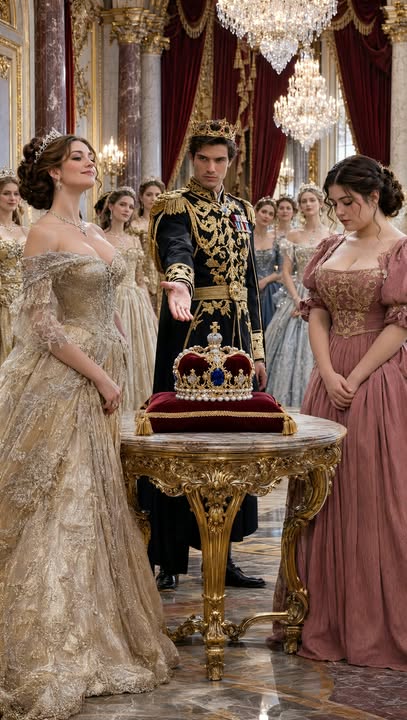
Within the hour, the ballroom had filled again.
The contestants stood together near the front, their gowns less like costumes now than clothes chosen for a future that had abruptly changed.
Lady Beatrice stood among them, her expression troubled but steady.
The courtiers gathered in rows behind the royal seats.
The crown rested on its velvet cushion beneath the clear protective dome, with the sapphire still facing forward.
No one laughed when Emma entered.
Some looked curious.
Others looked uncomfortable, as though they had only just noticed that the palace had turned her into a story without asking her.
William walked to the center of the room.
He did not wear the jeweled crown he had worn the previous night.
His dark formal uniform remained, but without it he looked less like a figure in a ceremony and more like a young man asked to answer for his family.
The chamberlain announced that the marriage challenge had been canceled.
A stir moved through the gathering.
Several families exchanged startled looks, while the princesses stood in silence.
William waited until the room quieted.
“My mother’s crown was never meant to decide who should become my wife,” he said. “I announced the challenge because I believed tradition could make a private choice simpler. I was wrong.”
His eyes moved across the contestants.
“You came here in good faith, and I owe you an apology. None of you should be judged by a ritual created to make a marriage appear inevitable.”
The champagne-gold princess lowered her gaze.
William continued.
“Last night, Miss Emma noticed that the crown’s clasp had been altered. Her care opened a hidden music box and revealed a private note written by my mother.”
The room turned toward Emma.
She felt their attention like light on her face, but she stayed beside William.
“Further examination has uncovered a record concerning missing royal funds,” he said. “The record was preserved by my mother and by Lydia Vale, Emma’s late mother, who served as a palace seamstress.”
A murmur passed through the court.
William lifted one hand.
“I will not accuse anyone on the basis of an unverified page. The evidence will be authenticated, and an independent investigation will examine the missing records and the decisions made during that period.”
Lord Ashcombe stood among the senior officials.
He did not move.
“Some palace workers were blamed for irregularities years ago,” William said. “If the inquiry finds they were wrongfully accused, their names will be cleared publicly.”
The court’s quiet had changed.
It was no longer merely the hush of expectation.
It was the silence of people understanding that the palace’s past might not be as orderly as it had appeared.
“I will also ask the household to preserve every remaining record and provide the investigators with full access,” William said. “No one will be asked to hide evidence for the sake of ceremony, convenience, or my comfort.”
His eyes found Emma’s.
“I will not ask Miss Emma to answer for the crown’s discovery alone. She did what I should have done first: she noticed that something was wrong and refused to pretend otherwise.”
Emma’s throat tightened.
She had not expected him to say her name before the court.
She had not expected him to say it without making her a symbol, a rival to the princesses, or a convenient witness.
William faced the gathering again.
“The challenge is over. The investigation begins now.”
For several seconds, no one spoke.
Then Lady Beatrice stepped forward.
“Your Highness, may I make a statement?”
William gave her permission.
She looked toward the assembled court.
“I saw Lord Ashcombe handle the crown before the ceremony,” she said. “I failed to report it at the time. My family hoped to secure an alliance, and I let that hope outweigh my responsibility.”
Her voice trembled once, then steadied.
“I am prepared to give my account to the investigators.”
The admission was not grand, and it did not erase her earlier silence.
It made the room more honest.
William thanked her.
Ashcombe bowed his head, but did not speak.
The conservator brought the crown to a nearby display stand, still protected beneath its dome.
The evidence page remained sealed in its case, and the queen’s note stayed with the other documents.
William stood beside the crown, with Emma at his right.
He did not take her hand.
Perhaps he understood that the court was watching, or perhaps he knew that she had not yet decided what his trust meant to her.
Instead, he placed his hand beside hers on the edge of the table, close enough to offer support, not close enough to claim it.
Emma looked down at the space between their fingers.
For the first time, the difference between them did not feel smaller.
It felt visible, and therefore something they would have to face honestly rather than pretend away.
The chamberlain approached the conservator.
“Should the crown remain here?”
“For the moment,” the conservator replied. “It is secure, and the documents must be logged before they are transferred.”
The chamberlain nodded.
A moment later, the conservator bent toward the inner lining.
“Your Highness,” he said, his voice low. “There’s a problem.”
William turned.
“What is it?”
“The inventory lists two original pages in the crown’s compartment. We found only one.”
Emma’s eyes went to the evidence case.
The narrow sheet they had removed was still there, sealed and untouched.
“What was written on the missing page?” William asked.
The conservator’s expression was grave.
“I don’t know. But the space where it was kept shows fresh marks.”
The court quieted again.
Ashcombe’s gaze moved to the crown.
William looked from him to the velvet lining, then to the faces gathered around them.
Somewhere within the palace, someone had reached the secret before they had—and the missing page might hold the names of everyone who had helped keep it hidden.
**–END OF PART 5–CLICK “NEXT” AT THE BOTTOM OF THE PAGE TO CONTINUE READING**
* * *
[PREVIOUS: PART 4](https://storyly.idolsgift.com/blog/part-4-the-lullaby-hidden-in-the-crown-055) | [NEXT: PART 6(THE END)](https://storyly.idolsgift.com/blog/part-6-the-end-the-lullaby-hidden-in-the-crown-055)
✓ Lynn R. Adams
Part 5 – The Truth Before the Court By morning, the palace had learned that something was wrong, though no one agreed on what. In the corridors, whispers traveled faster than the servants carrying b…