PART 4: The Secret Behind “Welcome Back” 047
Part 4 – What the Silence Protected
“My office,” Richard repeated.
For a moment, he seemed unable to look away from the line on Emily’s screen.
“Someone was told not to proceed,” Elena said. “We need the complete report before we can determine what happened after that.”
Richard gave a small nod, but the color had not returned to his face.
“I want to know who received it.”
“So do I,” Marcus said.
The answer came without accusation, though the uncertainty between them had sharpened.
Richard glanced at him. “I understand why you might think I’m hiding something.”
“I’m trying to understand what happened,” Marcus replied. “That isn’t the same thing.”
Elena took a photograph of the index page with her phone, then asked Emily to forward the directory entry and whatever report she could access.
“I’ll request the original transition records from our archive team,” she said. “Until we have them, we should avoid treating this index as proof that the warning reached Richard personally.”
Richard’s eyes remained on the screen.
“I don’t remember seeing it,” he said. “But I was responsible for the office it went to.”
“That matters,” Elena said. “So does the distinction between a report routed to an office and a report placed in your hands.”
Richard drew a slow breath.
“Both things can be true.”
Emily lowered her phone.
“I’m sorry. I didn’t mean to put this on you without knowing the whole story.”
“You found the record,” Richard said. “You did what we asked.”
He spoke gently, but his eyes had drifted again to the faded photograph of David and himself.
Marcus could see the effort it took Richard to remain in the archive room.
The past was no longer something sealed inside a picture frame.
It was unfolding in pages and signatures, and each new fact seemed to make the familiar story harder to hold.
Elena gathered the papers and placed them in a folder.
“We need a quieter place to review what we have,” she said. “And we need to contact Nora Patel directly, not rely on a partial index.”
“I’ll call her,” Emily offered.
“Send her a message first,” Elena said. “Let her choose when to speak and what she’s comfortable sharing.”
Emily nodded.
They returned to the showroom.
The Phantom X stood beneath the lights, dark and still, its shape reflected in the polished floor.
The message on its dashboard had faded, leaving only the pale outline of the interior beyond the glass.
Marcus paused beside it.
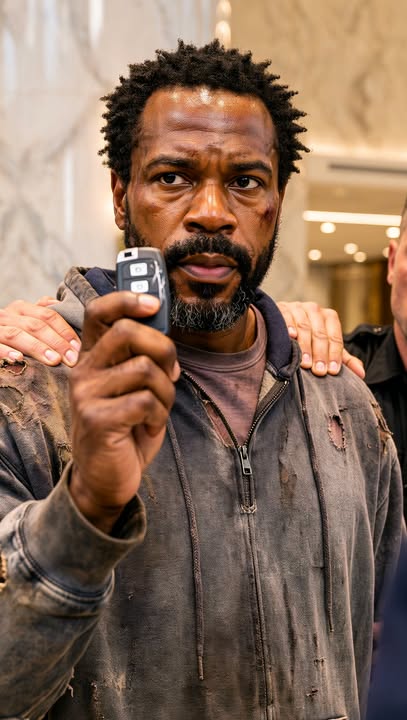
The old fob rested in his hand.
He had expected the car to open a door into his father’s past.
He had not expected it to lead to Richard.
“Elena,” he said, “can we review the development records here?”
“I’ll need to verify what can be shared, but yes.”
“Then I want to see all of it, not just the documents that support one version.”
Richard looked at him.
“You think there’s another version?”
“I think my father kept a lot of things to himself.”
Richard’s face softened with something close to recognition.
“He did.”
The sentence carried more weight than Marcus expected.
He turned toward Richard.
“Tell me what happened between you.”
Richard lowered his gaze.
“I can tell you what I remember. But I don’t want memory to take the place of evidence.”
“Then tell me where memory begins.”
Richard considered that.
“Your father and I met when we were both trying to prove we could build something that the larger companies thought was impossible.”
He glanced toward the car.
“David had the kind of mind that could see a problem from several directions at once. He understood the machine, but he also understood the person who would someday trust it.”
“And you?”
“I understood how to persuade people to give us the time and money to try.”
There was no false modesty in his answer.
He seemed to know that his strengths had once fit beside David’s.
For a while, the partnership had worked.
Elena set her folder on a low table.
“Could the Phantom’s project agreement help us identify the people involved?”
“It might,” Richard said. “The early design files were kept at the old workshop. I don’t know what survived.”
“Could you take us there?”
Richard hesitated.
“It isn’t mine anymore.”
“Who owns it?”
“A technical institute. They took over the property after the company moved.”
Marcus looked at the album Emily still carried.
“Would they have retained the records?”
“Possibly. David kept everything.”
The words drew Marcus back to the home he had grown up in, to the shelves of labeled binders and boxes his father had never let anyone discard.
He remembered David calling it organized chaos.
He also remembered how the house had changed after the accident, how the workshop tools had gradually been packed away, and how conversations about the Phantom had grown shorter whenever Marcus asked.
“What was the accident?” he asked.
Richard looked at Elena before answering.
“An early road test. The car’s security system was supposed to coordinate with the braking controls and prevent unauthorized startup or access. During a high-speed test, the system failed to hand control back correctly.”
“Was anyone hurt?”
“No one died,” Richard said. “But I was injured, and the car was badly damaged.”
Marcus held the fob more tightly.
“You were driving?”
“Yes.”
“Was my father responsible for the system?”
“He designed much of it. I helped integrate it with the vehicle controls.”
Richard let the words settle before continuing.
“The system had passed the bench tests. We had run simulations. We believed the failure had been caused by a defect in David’s authentication logic.”
“Did you believe that then?”
“I did.”
His voice was low.
“I was in pain, the company was running out of money, and everyone wanted an answer immediately. The report said the failure began in the security module. David signed it.”
“Did he tell you he caused it?”
“He said he was responsible.”
“That still isn’t the same thing.”
“No,” Richard said. “It isn’t.”
Elena pulled a chair closer to the table.
“Do you have records of the investigation?”
“I assume the institute may have them. We should also check the company archive.”
“Not the records from the transition,” Marcus said. “The original incident files.”
Richard nodded.
“They may be in the workshop boxes.”
“Then let’s look.”
The group returned to the archive room, where the boxes waited in orderly stacks.
Richard searched the labels until he found one marked DEVELOPMENT—EARLY TESTS.
He set it on the table and lifted the lid.
Inside were notebooks, printed diagrams, and folders softened by age.
Elena put on a pair of disposable gloves from her case.
“Let’s photograph each page before moving it,” she said. “We don’t want to damage anything.”
Marcus watched the care with which she handled the documents.
The work of uncovering the past felt different from the confrontation in the showroom.
There was no crowd, no roaring engine, no moment when a screen announced what everyone should believe.
There was only paper, and the possibility that someone had once written down what really happened.
Richard opened the first folder.
The earliest pages contained test schedules and notes in several hands.
Some were technical; others were brief reminders about parts, suppliers, or meals ordered for the workshop.
David’s handwriting appeared across the margins, precise and slanted.
Richard’s was broader, often written quickly.
Marcus recognized neither style, yet both seemed intimate in their ordinary details.
“Here,” Elena said.
She had found an incident report dated the week of the test accident.
The first two pages listed the vehicle’s condition, test conditions, and injuries.
The final page included an assessment of the security system.
“The original report names David as the engineer responsible for the authentication module,” she said.
Richard leaned over it.
“That was the summary we had at the time.”
“Does it identify a specific failure?”
Elena turned the page.
“Not beyond an apparent failure to release control after the emergency signal.”
Marcus read the line twice.
“Was there a second review?”
Richard sorted through the folder.
“There should have been.”
He found a thin envelope tucked beneath the report.
The flap was sealed with an old strip of clear tape.
“It hasn’t been opened,” he said.
Elena examined the envelope.
“It may have been sealed after the review. Let’s photograph it first.”
Richard set it down.
Marcus watched his face as Elena recorded the envelope from every side.
The older man looked as if he had come upon a locked room inside his own memory.
When Elena had finished, she slid a letter opener beneath the flap.
Inside were several pages and a small folded note.
The report was typed, but the final observations were handwritten by a technician whose name appeared in the document’s header.
Elena read silently, then looked up.
“This review did not conclude that the authentication module caused the failure.”
Richard’s shoulders stiffened.
“What did it conclude?”
“It says the system received a conflicting command from the vehicle’s braking controller. The module prevented unauthorized access correctly, but the integration layer failed to return control after the emergency signal.”
“Who designed that layer?” Marcus asked.
Richard stared at the page.
“I did.”
No one spoke.
He took the report from Elena and read it himself.
His finger stopped at the paragraph identifying the control interface as the likely source of the failure.
“That can’t be right,” he said, though the words sounded more like disbelief than denial.
Elena pointed to the following section.
“The reviewer says the conclusion is preliminary and recommends a full examination of the controller logs.”
“Were those logs preserved?”
“I don’t know.”
Richard set the report down.
He looked at the first incident summary, where David had accepted responsibility for the security system.
“Why would he sign that?”
“Because he believed it was his failure,” Marcus said.
“Or because he knew the company would not survive a public dispute over who had designed which part,” Elena replied.
She spoke carefully, leaving room for evidence they had not yet found.
Richard lowered himself into a chair.
“The company was close to collapsing,” he said. “The test accident frightened our investors. I had brought them in. I had promised them the system was ready.”
“And you were the one injured,” Marcus said.
“I was.”
“Did my father know the controller was your design?”
“Of course.”
“Then why would he let you take the blame?”
Richard did not answer.
He picked up the small folded note from the envelope.
The writing on it was unmistakably David’s.
Elena asked before he opened it.
“Would you like us to document this first?”
Richard nodded.
She photographed both sides, then handed it to him.
He unfolded the note.
His eyes moved slowly across the few lines.
At the bottom was David’s signature.
Richard began to read aloud, then stopped.
Marcus waited.
“He wrote this the night after the accident,” Richard said at last. “It says, ‘The report is mine to sign. You were driving because I asked you to test the system. The company cannot survive two men trying to save themselves. Let me carry the failure this time.’”
Richard read the note again, his voice breaking around the last sentence.
Marcus’s mouth had gone dry.
“So he took responsibility to protect you.”
“To protect the company,” Richard said.
“And you let him.”
Richard closed his eyes briefly.
“I didn’t know he had written this.”
The room seemed to tilt, though nothing had moved.
Marcus tried to fit the new truth into the image he had carried of his father.
David had accepted public responsibility for a failure that was not entirely his, perhaps not even primarily his, because the company—and Richard—might not have survived the truth.
It was the kind of sacrifice that could look like courage from a distance and a wound from inside it.
“Did you ask him to do that?” Marcus said.
“No.”
“Did you know he was taking the blame?”
“I knew the report named him. I believed the failure originated in his system, and I was too consumed by my own injury and the fear of losing the company to question the conclusion.”
“That isn’t the same as asking him.”
“No,” Richard said. “But I still benefited from it.”
He looked down at David’s note.
“I should have kept looking. I should have demanded the controller logs. Instead, I accepted the explanation that let the company continue.”
Elena placed the preliminary review beside the note.
“The written evidence shows there was a second assessment. We don’t yet know whether the controller logs were examined, whether the review reached David, or who made the final decision not to pursue it.”
Richard’s eyes lifted.
“The report must have gone to both of us.”
“Do you remember seeing it?”
“No.”
“Then we’ll need to establish what happened to it.”
He nodded, though his attention had returned to the note.
Marcus sat across from him.
“My father never told me this.”
“He may not have wanted you to carry it,” Richard said.
“Or he may not have wanted me to know how you treated him afterward.”
Richard’s gaze fell.
“That’s possible.”
The honesty did not make the history easier.
If anything, it made Marcus feel the years of silence more deeply.
His father had protected Richard, perhaps the company, perhaps the people whose work depended on it.
But that protection had also left Marcus with an incomplete story and a father whose sacrifice he had never understood.
“How did the partnership end?” Marcus asked.
Richard drew in a breath and let it out slowly.
“After the accident, investors demanded changes. The company needed money quickly, and I wanted to keep developing the car. David wanted the project paused until we understood the failure.”
“Which was the right call,” Elena said.
“Yes,” Richard replied. “It was.”
“Then what happened?”
“I told him the pause would cost us our funding. He told me a deadline was not a reason to put anyone at risk.”
Richard’s gaze settled on the photo album in the corner.
“We argued. He thought I was more worried about the company’s name than the people who would eventually drive the car.”
“Were you?”
“I thought I was protecting everyone’s jobs. I had convinced myself there was no difference.”
His fingers curled around the edge of the table.
“David said he would not continue until we had a full independent review. I said the company could not afford it.”
“And then he left,” Marcus said.
“Yes.”
“After taking the blame for you.”
Richard’s face tightened.
“After we both believed the other had betrayed what we built.”
The words sat heavily between them.
Marcus looked at his father’s note again.
The first sentence had been simple: The report is mine to sign.
The last line was not.
Let me carry the failure this time.
It was not the writing of a man who thought Richard had done nothing wrong.
It was the writing of a man who had chosen, for reasons Marcus could only partly understand, to shield someone he still cared about.
Richard folded the note along its old crease.
“He never told me he had written it,” he said. “I thought he signed the report because he believed it was his error.”
“Maybe he did believe some of it was his,” Marcus said. “He designed the authentication module.”
“Maybe.”
“But the review says the system did what it was supposed to do.”
Richard looked at him.
“I wish I had known that then.”
“You had a chance to find out.”
“Yes.”
There was no defense in the answer, only regret.
Elena made another note.
“We need to locate the original controller logs and the full follow-up review. If they exist, they may tell us whether the failure was an integration problem, a testing problem, or both.”
“Where would they be?” Marcus asked.
“Possibly at the institute,” Richard said. “Possibly in the company’s technical archive. The workshop records were divided when David left.”
“Did he take his own copies?”
“He took his notebooks and personal design materials.”
“Would he have kept the logs?”
“He might have.”
Marcus thought of the boxes at his father’s house, most of which he had not opened since David died.
He had kept them in storage because he could not bring himself to sort through them, and because every labeled binder seemed to belong to a conversation that had ended too soon.
“I may have them,” he said.
Elena looked at him.
“Do you know where?”
“My father’s workshop files are in a storage unit outside the city. I haven’t gone through everything.”
“Then we should arrange access. Carefully.”
“I will.”
Richard stood and walked to the window of the records room.
Beyond the glass, the showroom appeared almost unreal in its immaculate brightness.
The Phantom rested in the center, still and silent.
“I used to think David had chosen to leave me,” he said.
Marcus remained seated.
“He did choose to leave.”
“Yes. But I thought he believed I had caused the accident and refused to admit it.”
“Did you tell him you thought that?”
“I told him I thought he was protecting his design at the expense of the company.”
“That isn’t the same thing.”
“No.”
Richard watched the rainwater slip down the showroom windows.
“I was angry that he wanted to stop the project. I was ashamed that I’d been injured, and frightened that the company was finished. When he signed the report, I thought it proved he had accepted the conclusion.”
“Did you ever ask him?”
“Not properly.”
“Did you apologize?”
“Not then.”
Richard turned away from the window.
“Years later, I called him. I wanted to ask him to meet. He said he wasn’t ready.”
“And after that?”
“I waited too long.”
The quiet that followed did not absolve him.
It did, however, reveal the shape of a regret that had been living in him for years.
Marcus understood now that there had been two silences between the men.
One had begun with David’s decision to protect Richard.
The other had grown from Richard’s belief that David had blamed him for the accident.
Each man had been waiting for the other to speak, and time had carried their partnership beyond the point where either could repair it.
Elena placed the note and report in separate protective sleeves.
“These documents don’t change the fact that the prototype belongs to Marcus,” she said. “They also don’t settle the dealership transfer issue. We have to keep those questions separate.”
“I understand,” Richard said.
“And they don’t excuse what happened in the showroom,” Marcus added.
“No,” Richard replied. “They don’t.”
Emily had been quiet throughout the account.
Now she stepped closer to the table.
“Mr. Bennett, do you think your father wanted you to know this?”
Marcus looked at the note.
“I don’t know.”
“You said he gave you the original key.”
“He did.”
“Did he tell you what to do with it?”
“He told me to keep it safe.”
“Nothing else?”
Marcus remembered the final months of David’s life, when the old key fob had sat in his father’s palm as if it were something fragile enough to break beneath a careless touch.
“He said the car belonged to its history as much as it belonged to him,” Marcus said.
“What does that mean?”
“I never knew.”
Richard looked over.
“Your father believed a machine could tell the truth about the people who made it.”
Marcus felt something tighten in his throat.
“Did he say that to you?”
“Many times.”
Elena closed the folder.
“We should not read more into the key than the records support.”
“You’re right,” Marcus said.
But the words David had spoken so long ago returned to him anyway.
Judge people by what they do after they know the truth.
Marcus had not remembered them until this moment.
He stared at the old fob.
He had been certain the message on the Phantom’s dashboard was a simple recognition: the car knew him, and no one else.
Now he wondered whether his father had left him something more difficult than a key.
Not an answer.
A choice.
Richard moved toward the table and rested one hand on its edge.
“I can’t undo what I did to you today,” he said. “And I can’t undo the years I misunderstood your father.”
“No,” Marcus said.
“I’m sorry.”
Marcus looked at him for a long moment.
“I believe you’re sorry,” he said. “I still need to know what you do next.”
Richard nodded.
“Then I’ll cooperate with the review. I’ll give Elena every record I can find, and I’ll help locate the missing test files.”
“That’s a beginning.”
“It’s the only one I have.”
A soft chime sounded from Emily’s phone.
She glanced down at the screen.
“Nora replied.”
Elena came closer.
“What did she say?”
Emily read the message quietly, then lifted her eyes.
“She remembers the Phantom paperwork. She says she sent the discrepancy to the transition manager and followed up twice.”
Richard’s expression sharpened.
“Did she say who she spoke to?”
Emily scrolled.
“She says Graham Voss told her the matter had been cleared.”
“Cleared by whom?” Elena asked.
Emily’s gaze moved to the next line.
“He told her the owners had agreed to the transfer.”
Marcus looked at the unsigned transfer note in the folder.
“Did Nora believe him?”
“She says she asked to see the signed document. He told her it was being handled by senior management and that she should focus on the rest of the inventory.”
Richard went very still.
“Did she say which senior manager?”
Emily shook her head.
“Not yet. She says she’ll speak with Elena if we send her the records.”
Elena reached for her phone.
“I’ll contact her directly and arrange a time.”
Richard looked once more at the warning note.
“Graham told the staff the transfer had been cleared,” he said. “But he never produced the title.”
“Not yet,” Elena corrected. “We still need the complete record.”
Richard accepted the correction.
The storm outside had weakened to a fine drizzle.
The showroom lights reflected in long pale bands across the floor, reaching all the way to the Phantom’s dark body.
Marcus rose and went back to the car.
The battered key fob rested against his palm.
Through the windshield, the empty dashboard reflected the ceiling lamps.
He touched the fob’s worn edge with his thumb.
His father had carried it through the accident, the partnership’s collapse, and all the years afterward.
Then he had given it to Marcus with almost no explanation.
Perhaps he had wanted his son to find the truth in his own time.
Perhaps he had simply been too tired to tell it.
Behind Marcus, Richard spoke with Elena about the records, answering each question without trying to soften the answers.
Emily stood nearby, waiting for Nora’s next message.
The people in the room had not become friends.
The wrongs had not disappeared.
But the past had changed shape, and the future was no longer a simple matter of deciding who had been right.
Elena came to stand beside Marcus.
“I’ve been sent a note from the archive team,” she said. “They found the original transfer packet.”
“That’s good.”
“They also found a file connected to David’s final instructions.”
Marcus turned toward her.
“What kind of instructions?”
“His attorney’s office has a copy of a letter he wrote shortly before he died.”
The old fob seemed to cool in Marcus’s hand.
Elena glanced toward Richard, who had gone quiet at the sound of David’s name.
“The letter was sealed until the Phantom’s ownership was formally challenged,” she said. “That condition was triggered today.”
Marcus looked from Elena to Richard.
“What does it say?”
“I haven’t seen the full letter yet,” Elena replied. “But the archive note includes one line from the cover sheet.”
She paused, choosing her words with care.
“David asked that the person who caused the test accident be given the chance to tell Marcus the truth before anyone else did.”
**–END OF PART 4–CLICK “NEXT” AT THE BOTTOM OF THE PAGE TO CONTINUE READING**
* * *
[PREVIOUS: PART 3](https://echoesofstories.idolsgift.com/blog/part-3-the-secret-behind-welcome-back-047) | [NEXT: PART 5](https://echoesofstories.idolsgift.com/blog/part-5-the-secret-behind-welcome-back-047)
✓ Lynn R. Adams
Part 4 – What the Silence Protected “My office,” Richard repeated. For a moment, he seemed unable to look away from the line on Emily’s screen. “Someone was told not to proceed,” Elena said. “We ne…