PART 3: The Secret Behind “Welcome Back” 047
Part 3 – The Photograph in the Archive
For several seconds, no one spoke.
Marcus looked from the photograph to Richard, searching the older man’s face for some trace of the easy arrogance he had seen earlier.
It was still there, perhaps, but buried beneath something harder to name.
“You and my father built the first version of the Phantom?” Marcus asked.
Richard glanced at the picture again.
“We built the first version of its security system,” he said. “The car itself was a collaboration between several people. Your father was the engineer who made the system work.”
“You knew him well.”
“Well enough to know what he would have said about the way I treated you today.”
Richard’s voice had gone quiet.
Marcus could not tell whether the remark was meant as an apology or simply an admission.
Elena lifted the photograph from its hook and turned it over again, careful not to disturb the faded ink.
“Do you remember who took this?”
“No,” Richard said. “It might have been someone from the workshop. We were still working out of the old building then.”
He paused, studying David’s younger face.
“He was patient with people. More patient than I deserved.”
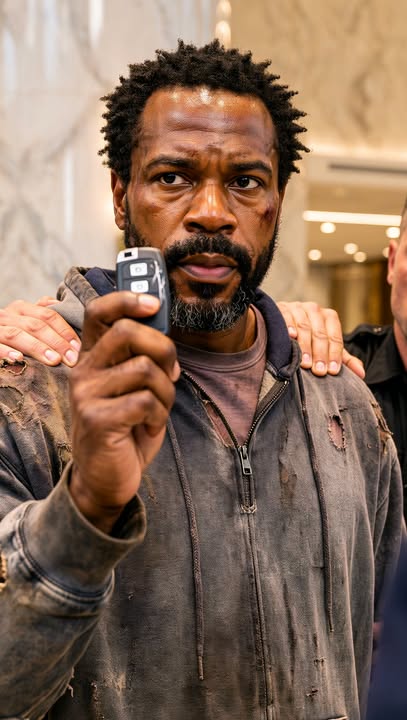
Marcus felt the old key fob press into his palm.
His father had never spoken about a business partner named Richard, not in the years Marcus had been old enough to understand the words.
There had been stories about late nights in the workshop, about a prototype that refused to start, about a friend who could make a room laugh even when the project was months behind.
But names were usually absent.
“Why didn’t he ever mention you?” Marcus asked.
Richard folded his arms, then let them fall again.
“I can’t answer for him.”
“Can you answer for yourself?”
Richard looked toward the front windows, where rainwater traced thin paths down the glass.
“I thought you might ask that.”
Elena gave him a measured look.
“We should separate what we know from what we remember,” she said. “The ownership question is one thing. The history between you and David is another.”
“I agree,” Marcus said.
Richard nodded, seemingly relieved that no one was demanding an explanation he could not yet give.
“Then let’s look at the records,” Elena said. “Perhaps they’ll tell us what the photograph can’t.”
Richard unlocked the door to his office and held it open.
The space was larger than Marcus had expected, though not ostentatious.
A wide desk faced the showroom, and one wall was lined with framed photographs of cars from different decades.
Near the far corner stood a cabinet filled with old folders, service ledgers, and dealership memorabilia.
Richard removed a ring of keys from his desk drawer.
“The archive is in the back room,” he said. “Most of it predates the current ownership.”
“May we see the acquisition file first?” Elena asked.
“Of course.”
He pulled a thick folder from a lower drawer and set it on the desk.
Its label read: STERLING CROWN MOTORS — ASSET TRANSFER, 2023.
Marcus remained standing as Elena opened it.
Richard sat, then seemed to reconsider and rose again, leaning over the desk to see the pages.
The paperwork was arranged by date, with colored tabs marking sections.
Elena moved through the file slowly, checking each page against the inventory list.
Marcus watched the small changes in her expression as she read.
“Here is the bill of sale for the dealership,” she said at last. “It covers the business name, service equipment, furnishings, and listed vehicles.”
Richard pointed to a page near the center.
“That was the inventory schedule I was given.”
Elena ran a finger down the column of vehicles.
“The Phantom is not listed by model or identification number.”
“Could it be included under display assets?” Marcus asked.
“It could be mentioned elsewhere,” she replied. “But that would not establish ownership without a clear transfer.”
Richard leaned closer.
“There’s a section for showroom exhibits.”
Elena turned to it.
The list named two vintage cars, a racing engine, and several pieces of branded equipment.
There was no Phantom X.
Richard studied the page with a troubled frown.
“I remember seeing a reference to the car in the transition materials.”
“Do you remember seeing it in a signed transfer?” Elena asked.
“No.”
The admission came without hesitation.
Richard drew a hand over his forehead.
“I was told the former owner had settled the display arrangements before the sale closed. I assumed that meant the car had been included in the assets.”
“Who told you?” Marcus asked.
“The transition manager. He handled most of the transfer.”
“Name?”
“Graham Voss.”
Elena made a note.
“Was Voss an employee of the previous dealership or the acquiring company?”
“Both, briefly. He worked for the seller, then stayed on during the transition.”
“Do you know where he is now?”
“He left about a year after the sale.”
Richard’s tone suggested the memory had begun to bother him.
“Did he explain why?”
“He said he had another opportunity.”
Elena turned another page.
“Here’s an email summary referring to ‘the Bennett display vehicle’ and temporary custodianship.”
Richard leaned in.
“That’s what I remember.”
“Temporary custodianship is not ownership,” Elena said.
“I understand that now.”
Marcus studied the page.
“Did you know the display agreement was still in effect?”
“I knew the car had been left here for safekeeping,” Richard said. “I didn’t know the agreement placed limits on what the dealership could do.”
“You said earlier you believed it came with the dealership.”
“I believed the dealership had been given responsibility for it as part of the transition. I took that to mean the previous owner had cleared the rights.”
“Without seeing the signed document.”
Richard’s eyes lifted to Marcus.
“Yes.”
The answer was plain.
It did not undo the choice he had made in the showroom, but it gave the mistake a shape more complicated than simple theft.
Marcus had expected one of two things: a lie or a confession.
Instead, Richard seemed to be discovering the missing pieces at the same time they were.
Elena closed the acquisition file and looked toward the glass wall.
“Do you have the old company archive here?”
“Some of it,” Richard said. “The rest went into storage when we renovated.”
“Can we look?”
“I’ll take you.”
He led them through a side door into a narrow corridor that smelled faintly of paper and cedar cleaner.
At the end was a small records room with metal shelving along two walls.
Boxes were stacked neatly, each marked with a year or a department name.
The showroom’s bright polish faded behind them, replaced by the quiet order of a place where forgotten decisions had been kept.
Richard found the archive boxes from the year of the dealership’s sale.
He set one on a table and began lifting out folders.
Emily remained at the doorway.
She had followed them from the showroom but had not stepped fully inside.
“Are you looking for something specific?” she asked.
“Anything related to the display agreement or the acquisition,” Elena replied.
Emily’s gaze moved to the shelves.
“There are old photographs in the lower cabinet. The ones they used to keep in the showroom display.”
Richard looked over.
“You remember that?”
“I helped sort the awards and photographs when the front wall was repainted.”
“Could you check the cabinet?” Marcus asked.
She hesitated, then nodded.
The cabinet held several albums and loose envelopes.
Emily crouched to reach the bottom shelf, where the oldest photographs were stored in a shallow cardboard box.
While she searched, Marcus examined the folders Richard had arranged.
The first contained routine notices and equipment lists.
The second held a series of emails printed from an old company account.
Elena read through them, pausing now and then to mark a page.
“Here is a note from the transition manager,” she said. “It says the Phantom would remain on the premises pending clarification of the display agreement.”
Richard leaned over her shoulder.
“I’ve never seen this.”
“It was sent to the acquisition team and copied to an address that appears to have been inactive by the time you took over.”
“Who was on the team?”
Elena traced the header.
“Graham Voss, the finance director, and an operations coordinator.”
Richard’s expression tightened.
“The finance director was still with us when I bought the dealership.”
“Do you remember receiving a briefing about the Phantom?”
“No.”
“Did anyone tell you the title was disputed?”
“No.”
The answer seemed to surprise him less than it had earlier.
He turned away from the table and walked a few paces toward the shelves.
“I thought I had done my due diligence,” he said. “I checked the business accounts, the liens, the vehicle inventory. I was told the transition was clean.”
“And the car?” Marcus asked.
“I should have asked for the title.”
“That would have answered a lot.”
“Yes.”
Richard looked at him, and for the first time his expression held no attempt to defend himself.
“I should have asked before I called it mine.”
Marcus could not offer absolution merely because Richard had finally named the mistake.
But he recognized the difference between a man insisting he had done nothing wrong and one beginning to understand what he had failed to do.
Elena turned a page.
“There’s a reference here to a discrepancy reported during the transfer review,” she said.
Richard came back to the table.
“What kind of discrepancy?”
“The note says, ‘Vehicle schedule incomplete; Bennett prototype not supported by title record.’”
Richard’s face went still.
“When was that?”
“About six months before the acquisition closed.”
“That would have been before I signed.”
“Do you remember seeing it?”
“No.”
Elena checked the page again.
“The note is attributed to someone named Nora Patel.”
Richard looked toward the office doorway, as if the name might summon a memory.
“She was a junior asset coordinator.”
“Is she still with the company?” Marcus asked.
“No. She left shortly after the transition.”
“Was she dismissed?”
“No,” Richard said. “She resigned. I remember because she was very good with the inventory systems.”
Elena looked at him.
“Did she tell you why she left?”
“She said she wanted to finish her degree.”
“Did she ever raise the discrepancy directly with you?”
Richard shook his head.
“Not that I recall.”
Emily had found an album and was turning its thick pages carefully.
“I found the workshop photographs,” she said.
She brought the album to the table.
The paper sleeves had yellowed at the edges, but the pictures inside were clear enough to show the room where the first Phantom security system had been tested.
In one photograph, David stood beside the unfinished car.
Richard stood at his shoulder, younger and leaner, his sleeves rolled up, one hand resting on a tool cart.
There was no polished showroom around them.
Only concrete floors, hanging work lights, and a cluttered bench crowded with wires and notebooks.
Marcus studied his father’s face.
He looked younger than Marcus remembered, but the eyes were unmistakable.
“Do you remember this day?” he asked Richard.
Richard leaned closer.
“Not the exact day.”
“You look happy.”
“I was.”
The word came out with a softness that made Marcus turn toward him.
Richard lowered his gaze to the photograph.
“David could make even a failed test feel like a reason to try again.”
“Then what happened?”
Richard’s eyes stayed on the image.
“A lot of things happened.”
“That isn’t an answer.”
“No,” Richard said. “It isn’t.”
Elena stepped between the two men with a folder in hand.
“We’ll need time to review the records before anyone reaches conclusions about the transfer.”
Marcus nodded.
Richard looked toward the album.
“May I?”
Emily passed it to him.
He turned a page, then another.
A photograph showed David sitting on the floor beside a car wheel, laughing at something outside the frame.
In the next, Richard was holding up a small black device.
The old key fob.
Marcus’s fingers closed around it.
“You built this together?”
“Your father designed the original authentication logic,” Richard said. “I worked on the vehicle integration and the fallback system.”
“Why did he give it to me?”
“I don’t know.”
Richard studied the fob in Marcus’s hand.
“But if David gave it to you, he wanted you to have it.”
Marcus wished the certainty in that sentence could answer everything.
“Did you ever see him after the partnership ended?”
“Once, briefly. We spoke on the phone a few times, but not after…” Richard stopped.
“After what?”
Richard closed the album gently.
“After the test accident.”
The room seemed to become smaller.
Marcus had heard about the accident from company records and old news articles.
A prototype had failed during a high-speed safety test, and David had accepted responsibility for the failure.
The incident had ended his professional partnership with Richard and left Bennett Automotive struggling to recover.
That was all Marcus had known.
“Was my father responsible?” he asked.
Richard’s face changed.
“I don’t know what you were told.”
“I was told he accepted responsibility.”
“That’s true.”
“It’s not the same thing as being responsible.”
“No,” Richard said. “It isn’t.”
The words were careful, but something in them shifted Marcus’s understanding of the silence that had surrounded his father’s past.
Elena set a hand on the folder.
“We should not reconstruct the accident from memory alone. If there are records, we’ll need to review them.”
“I agree,” Richard said.
He sounded almost grateful for the boundary.
Emily turned another page in the album.
A small note had been written on the back of one photograph.
She read it softly.
“‘To David, for the next one. R.’”
Richard’s eyes moved to the handwriting.
“I wrote that.”
“Why didn’t you keep in touch?” Marcus asked.
Richard did not answer right away.
“Because I thought he had made a choice,” he said at last. “And because I was angry.”
“At him?”
“At myself. At the company. At the fact that the one person who could explain what had happened was the one person I believed had let me down.”
Marcus looked at the photograph again.
It was strange to see his father’s life as something that had existed before Marcus knew him, full of loyalties and arguments and unfinished work.
He had always carried David’s absence as a private grief.
Now the absence had acquired a second shape: a history Richard had never told him, and perhaps had never known how to tell.
Elena returned to the acquisition file.
“We should check whether the original display agreement was attached to this archive.”
Richard moved to the back shelves and searched through a box of contracts.
Emily stayed beside the table, still holding the photo album open.
As she lifted the next page, a folded sheet slipped from between the photographs and landed on the floor.
She picked it up carefully.
“It looks like a memo.”
Richard turned.
The paper bore the old dealership letterhead, faded but legible.
Near the top was a date from months before the sale.
Below it, someone had typed a short note about the Phantom X’s ownership documentation.
At the bottom, in dark blue ink, was a handwritten instruction.
Richard stepped closer.
“Can you read it?” Marcus asked.
Emily held it out.
The note was brief.
Please do not release the Phantom or sign any transfer until title is verified.
It was signed with the initials N.P.
Richard stared at the page.
“Nora,” Elena said.
The memo had been filed with the photographs, not the acquisition documents.
It was the clearest warning they had seen so far, and it had never reached Richard.
He read it twice, his lips pressed together.
“I never saw this.”
“Do you know how it ended up here?” Marcus asked.
“No.”
Elena inspected the paper without touching the handwriting.
“It may have been misplaced during the archive move. Or someone may have put it here intentionally. We can’t tell yet.”
Richard looked at the note as if the ink itself had accused him.
“Even if I had seen it, I should have checked the title before calling the car inventory.”
“Yes,” Marcus said.
Richard accepted that without argument.
Emily kept her hand on the edge of the table.
“I remember Nora,” she said. “She used to double-check every vehicle record. She was careful.”
“Could you contact her?” Elena asked.
“I don’t have her number, but I might find it in the staff directory.”
“Please do.”
Emily nodded and left the archive room.
Richard watched the doorway after she had gone.
“She was good at her job,” he said.
“Then you owe it to her to find out whether her warning was ignored or simply lost,” Marcus replied.
“I know.”
The old key fob felt heavier in Marcus’s hand.
His father had entrusted it to him without explaining why.
Richard had once stood beside David as a partner, and now he stood before Marcus as the owner of a dealership that had treated the Phantom as its own.
Neither fact erased the other.
Elena gathered the documents into a careful stack.
“We have enough to say the sale was not supported by a clear title transfer,” she said. “We do not yet know who failed to correct that, or whether it was deliberate.”
Richard nodded.
“I’ll provide everything I can find.”
Marcus looked once more at the photograph of his father and Richard in the workshop.
“What happened between you?” he asked.
Richard’s hand rested on the edge of the album.
“I’ll tell you,” he said. “But not until I can tell it honestly.”
Before Marcus could reply, Emily returned with her phone in hand.
“I found Nora’s current work email,” she said. “She’s still in automotive compliance, just at another company.”
“Did she answer?” Elena asked.
“Not yet. I sent a message asking whether she remembers the Phantom paperwork.”
Emily glanced at the memo on the table.
“I also found something else while I was checking the staff directory.”
Richard turned toward her.
“What is it?”
“An old internal report from the transition period. I don’t have the full file, but the index says Nora’s discrepancy was escalated to the acquisition team.”
Elena’s expression sharpened.
“Escalated to whom?”
“The index lists the recipient as Graham Voss.”
Richard took the page from her, read it, and then looked up.
“Voss was the transition manager.”
“Yes,” Emily said.
“But the note says he sent the issue onward,” Elena added.
“Where?” Marcus asked.
Emily checked the screen again.
“To the managing partner’s office.”
Richard’s face went pale.
“My office.”
The archive fell silent.
Marcus looked at the index, then at Richard.
“You said you never saw the warning.”
“I didn’t.”
“Then who in your office received it?”
Richard stared at the line on the screen.
The recipient field contained no name, only a job title and the date the report had been logged.
Beneath it was a note added in a different hand.
Forwarded for approval. Do not proceed until signed confirmation is received.
Richard read the words, then looked at the faded photograph of himself beside David.
“Someone was told not to proceed,” he said.
Elena’s voice lowered.
“And someone proceeded anyway.”
**–END OF PART 3–CLICK “NEXT” AT THE BOTTOM OF THE PAGE TO CONTINUE READING**
* * *
[PREVIOUS: PART 2](https://echoesofstories.idolsgift.com/blog/part-2-the-secret-behind-welcome-back-047) | [NEXT: PART 4](https://echoesofstories.idolsgift.com/blog/part-4-the-secret-behind-welcome-back-047)
✓ Lynn R. Adams
Part 3 – The Photograph in the Archive For several seconds, no one spoke. Marcus looked from the photograph to Richard, searching the older man’s face for some trace of the easy arrogance he had see…