PART 3: The Letters He Never Saw 034
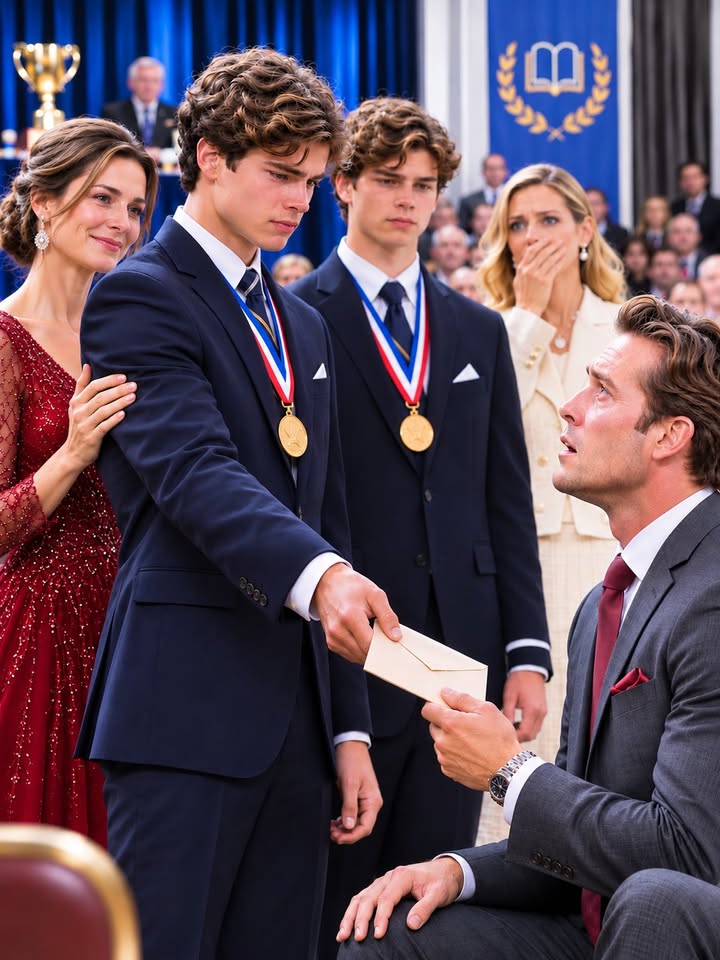
Part 3 – What They Remember
“I don’t remember sending anything,” I said, though my voice sounded less certain than I wanted it to.
Brian was quiet on the other end.
“Could it have been one of the boys’ letters?”
“They never mailed anything without me.”
“I know.”
The gentleness in his reply made my chest tighten.
It was easier to hear accusation than uncertainty.
“I kept the letters in a box,” I said. “I told you that.”
“I believe you.”
A pause stretched between us, filled with the low hum of the house and the faint sound of my sons moving in the kitchen.
“Could the address have been copied from something?” I asked.
“Maybe.”
“You said the letter was returned unopened.”
“It has a postal mark across the front.”
“What does it say?”
“I can’t make it out over the phone.”
I looked toward the hallway, where the boys were waiting.
“We’re meeting you at the café,” I said. “You can show me there.”
“Of course.”
I ended the call and found my sons watching me.
“Something happened,” my older son said.
“Your father found a letter in the envelope that was returned to him unopened.”
Their faces changed.
“Returned from where?” his twin asked.
“His old address, apparently.”
“But we never sent anything,” my older son said.
“I don’t think so.”
The three of us stood in the hallway, each turning the same puzzle over in our minds.
Then my younger son glanced down at his hands.
“We did put a letter in the envelope.”
“Yes,” I said.
“But that one wasn’t mailed.”
“No.”
“Maybe Dad means one of the old letters,” my older son said.
It was possible, but none of us could remember a letter addressed to Brian with a stamp on it.
The envelope we had given him contained copies of the boys’ childhood letters and the note they had prepared together.
They had chosen the copies carefully, though they had not included every page.
The original letters remained in the wooden box.
I had assumed they wanted to keep those private.
Now I wondered whether one had slipped into the envelope by accident.
“Do you want to cancel the meeting?” I asked.
“No,” my older son replied.
His brother nodded.
“We still want to talk to him.”
I studied their faces, looking for a sign that they were agreeing because they thought I wanted it.
They were not.
They were curious, cautious, and perhaps a little afraid of what they might learn, but their decision was their own.
“All right,” I said. “We’ll go together.”
The café sat a short walk from the competition center, tucked between a bookstore and a flower shop.
Its front windows were wide enough to let in the morning light, and the tables were small, round, and close together.
I chose one near the back where I could see the door without making the boys feel watched.
They sat opposite me, leaving the chair beside them empty.
Brian arrived several minutes later.
He paused just inside the entrance when he saw us, as if he had to remind himself that he was welcome only as far as they allowed.
His hands were empty.
For a moment, I thought he had left the letter in his car.
Then he drew a folded page from inside his coat and held it carefully by the edges.
“Thank you for meeting me,” he said.
The boys did not answer immediately.
Brian looked at me, then seemed to remember that he should not turn to me for permission.
“Would it be all right if I sat down?” he asked them.
My older son nodded.
Brian took the empty chair beside them, leaving a respectful space between himself and both boys.
He placed the page on the table but did not push it toward anyone.
“I’m not asking you to explain anything you don’t want to,” he said. “I just thought you should see what I found.”
My younger son leaned forward.
“Is it one of our letters?”
“I think so.”
Brian unfolded the paper.
It was an envelope, not a letter, and the corners had softened with age.
The handwriting on the front was careful and uneven, written in blue ink.
My older son stared at it.
“That looks like mine.”
“It might be,” Brian said.
He turned it so the boys could read the address.
The letters were faded, but the name was clear.
Brian Campbell.
The address beneath it belonged to the apartment where he had lived after leaving our home.
A thick postal mark crossed the upper corner.
RETURN TO SENDER.
Below it, the date was difficult to read, though Brian had circled it in pencil.
It was more than twelve years old.
I looked at the handwriting again.
The shape of the capital B seemed familiar.
Not because I had watched my son write it, but because the older envelopes in the wooden box carried the same careful loops and slanted letters.
“Do you know what was inside?” I asked.
Brian shook his head.
“It was empty.”
The words seemed to settle over the table.
“Empty?” my younger son repeated.
“The envelope was sealed, but there was no letter inside.”
He looked from the page to his father.
“Then how do you know it was mine?”
“I don’t know for certain,” Brian said. “The handwriting looks like the letters I received in the envelope yesterday.”
“You didn’t receive this,” my older son said.
“No.”
“Someone found it and put it with our letters?”
“That’s my guess.”
The boys looked at one another.
I could feel the questions forming between them.
“How did you find it?” I asked.
“It was inside the envelope you gave me,” Brian said. “Under the letter you wrote.”
I stared at him.
“I didn’t put it there.”
“I know.”
“Your sons didn’t put it there either,” my older son said.
Brian nodded.
“I believe you.”
His certainty came without hesitation.
It was the first thing he had said that morning that seemed to make the boys relax, even a little.
My younger son carefully lifted the envelope by one corner.
“Could this have been in the box all along?”
“It’s possible,” I said.
“Maybe it fell between the letters,” his brother suggested.
“I checked the box before,” I replied. “I don’t remember seeing it.”
The sentence came out too quickly.
I heard the doubt in my own voice.
Brian glanced at me but did not challenge it.
“Do you remember writing to me after I left?” he asked.
I looked at the boys.
“I wrote once.”
“You told us about that,” my older son said.
“I did not send it,” I added. “I kept a copy, but I never mailed it.”
Brian’s gaze held mine.
“So you never sent anything to my apartment?”
“No.”
“What about a card, a school notice, a photograph?”
“No.”
He let the answer stand without demanding more.
My younger son set the envelope back down.
“Could someone else have sent it?”
“Who would have known the address?” Brian asked.
The question sounded more troubled than suspicious.
I had no answer.
The café’s espresso machine hissed behind the counter.
Someone laughed softly near the window, and a bell chimed as the door opened and closed.
Inside our small circle, time seemed to move more slowly.
My older son rubbed the edge of the envelope with his thumb.
“Maybe it was one of our letters and the letter fell out,” he said.
“Wouldn’t you have noticed?” I asked.
“We were little,” he replied. “Maybe we thought you put it in the mail.”
“I didn’t.”
“I know.”
His confidence echoed Brian’s words from a moment earlier.
It should have comforted me.
Instead, it left me feeling as though the world had shifted beneath all of us.
Brian folded his hands on the table.
“I want you both to know that I never received any letters from you.”
The boys looked at him.
“Then why did you leave?” my younger son asked.
I felt my shoulders tense.
Brian did too.
He looked down at the table for a moment before answering.
“Because your mother and I were having a terrible time together, and I handled it badly.”
“That’s not the whole answer,” the older twin said.
“No,” Brian agreed. “It isn’t.”
He took a slow breath.
“I thought your mother wanted me out of her life. We were angry with each other, and I believed the things we said in the worst moments more than I believed anything else.”
“You believed she wanted you to leave us?” the younger one asked.
“I didn’t think of it clearly enough. I should have.”
The boys waited.
Brian did not try to make the silence easier for himself.
“I left because I thought I had nothing left to offer this family,” he continued. “Then I made a new life and told myself that staying away was what your mother wanted.”
“Did you ever ask her?” my older son said.
“No.”
“Did you ask anyone else?”
“I asked my lawyer once, early on. He told me your mother had moved and didn’t want contact.”
The words struck me with a force I could not hide.
“I never moved,” I said.
Brian turned toward me.
“I know that now.”
“When did you ask him?”
“I don’t remember the exact date. It was not long after I left.”
“And he told you I had moved?”
“He said he had reason to believe you’d relocated and wanted no communication.”
“I was in the same apartment for another four years.”
His expression tightened.
“I understand.”
“No, Brian, you don’t.” I tried to keep my voice low, but the words came out sharper than I intended. “You could have called. You could have written. You could have asked a second question.”
“You’re right.”
The answer gave my anger nowhere to go.
I had expected him to defend himself, to point at the lawyer, the separation, or the life he had built since.
Instead, he sat with the truth.
That did not make it hurt less.
It only made the hurt harder to place.
My younger son looked at his father.
“If you thought Mom wanted you gone, why didn’t you try to see us?”
Brian’s eyes lowered to the envelope.
“I told myself I was respecting her wishes. I told myself that if she wanted me to know where you were, she would contact me.”
“That sounds like a reason you made up because it was easier,” the older twin said.
Brian nodded slowly.
“It was.”
No one spoke for a while.
I watched him look at the two boys he had once held in his arms.
He did not reach for them.
He did not tell them they should understand.
He simply stayed in the chair they had offered, waiting for them to decide whether there was anything more they wanted to ask.
The younger twin picked up the envelope again.
“Do you remember writing letters to him, Mom?” he asked.
“Yes.”
“Do you remember this one?”
“No.”
He held the envelope closer to the light.
“If it’s mine, it looks like I was trying really hard to write neatly.”
“You always did,” I said.
“I hated when the letters went crooked.”
“You used to turn the paper sideways and start over.”
A faint smile came to his face, gone almost as soon as it appeared.
Brian watched the exchange.
I wondered what it must be like to see his sons remembering a childhood he had not witnessed.
Then I wondered whether I wanted him to understand.
Both thoughts could exist at once.
My older son turned the envelope over.
The flap was sealed, but the paper had been opened along one side.
There was no tear, only a careful cut, as though someone had used a blade.
“Does that mean it was opened?” he asked.
“I don’t know,” Brian said. “I found it like this.”
The boy looked at the cut edge.
“If it was opened, why was there nothing inside?”
No one answered.
The envelope’s empty interior seemed more unsettling than a missing letter.
I had kept every letter I knew about.
Had one been separated from its envelope before the boys ever found the box?
Had I misplaced it, then forgotten?
I tried to picture the wooden box as it had been years ago, before I moved it to the closet shelf.
I remembered the photographs, the cards, the small bundle of letters tied with ribbon.
I could not remember an empty envelope with Brian’s address.
“I’ll look through the box again,” I said.
“Not alone,” my older son replied.
I looked at him.
“If there’s something in it, we should all see it.”
His brother nodded.
Brian did not ask to join us.
That mattered.
He remained still while the boys decided what they wanted.
After a moment, my younger son said, “We’re not ready for more than this today.”
“I understand,” Brian replied.
“You can keep the envelope,” the older twin said. “For now.”
Brian looked surprised.
“Are you sure?”
“We don’t know what it is,” the boy said. “We want to know.”
“All right.”
“But this isn’t a promise that we’re going to see you again soon.”
“I know.”
“And it doesn’t mean we forgive you.”
“I know that too.”
The younger twin studied him.
“Do you?”
Brian’s face tightened with emotion.
“I’m trying to.”
For the first time that morning, his voice faltered.
He looked at both sons, not asking them to make the moment easier for him.
“I’m sorry I left,” he said. “I’m sorry I didn’t make sure I knew what was happening. I should have done more than trust what someone else told me.”
The boys did not answer.
They stood, and I rose with them.
Brian stayed seated until they had turned toward the door.
Then he spoke once more.
“Would it be all right if I asked you a question?”
My older son paused.
“What is it?”
“Would you be willing to talk again sometime? Only if you want to.”
The brothers exchanged a glance.
“Maybe,” the younger one said. “We don’t know yet.”
“That’s all right.”
“Don’t contact us every day asking for an answer,” his brother added.
“I won’t.”
“And don’t tell us what you think Mom said.”
“I won’t,” Brian replied. “If you have questions, I’ll answer as honestly as I can.”
The older boy gave a small nod.
It was not acceptance, but it was something Brian could take away without pretending it meant more.
Outside, the sky had turned brighter, and the sunlight fell across the café windows in pale rectangles.
The boys walked ahead of me along the pavement.
I stayed back long enough to let them speak privately.
Then I heard my younger son say, “He looked older than I expected.”
His brother answered, “So do we.”
I let the words pass without joining them.
When I reached the car, neither boy asked me to drive home.
They wanted to go back to the competition center and collect their display boards.
We did that in quiet, then stopped for lunch.
They talked about the medals and the questions they had not asked.
They did not discuss Brian again until we were almost home.
“Do you really think he didn’t know?” the older twin asked.
“I think he believes he didn’t,” I said.
“That’s not the same thing,” the younger one replied.
“No.”
“Do you believe he wanted to see us?”
“I don’t know.”
They looked at me.
“I can’t tell you what was in his mind all those years,” I said. “I can tell you what I knew. He did not contact us.”
The older boy nodded.
“That’s what we need to remember.”
I understood.
Whatever Brian had believed, his absence was real.
It was not erased by an explanation that arrived thirteen years late.
When we got home, the boys took their medals upstairs to their room.
I went to the closet and brought down the wooden box.
Its brass latch clicked open beneath my thumb.
The contents looked just as I remembered them.
Photographs from the boys’ first years.
Cards from my mother.
A few folded drawings.
The letters, arranged in a stack and tied with a blue ribbon.
I carried the box to the kitchen table and waited until the boys came down.
Together, we untied the ribbon.
The first letters were addressed to Dad in thick marker.
The later ones were more careful, written on school paper and folded into thirds.
We read them in order, not because the boys wanted to revisit every word, but because we were searching for the empty envelope’s companion.
There was one letter with a drawing of a rocket.
Another describing a science fair project.
One written after a school concert that my younger son had been afraid to attend without his father.
Every letter was still there.
No loose page had been tucked inside any envelope.
No stamp or postmark appeared on any of them.
Then my older son stopped at the bottom of the box.
“What’s this?”
He had found a folded sheet of lined paper beneath the ribbon.
The handwriting was mine.
I recognized it at once.
I unfolded the page.
It was the letter I had written to Brian after we separated, the one I had told the boys about.
I had not mailed it.
I had put it away before I finished, unable to decide whether sending it would help or make everything worse.
The page was dated a month after Brian left.
But beneath my handwriting, in the lower margin, was a note in my mother’s careful script.
I had never seen it before.
It read: **Returned to me unopened. He said he didn’t want to hear from us.**
I stared at the words until they blurred.
My mother had died six years earlier.
I could not ask her what she meant.
The boys leaned closer, reading over my shoulder.
“I never sent this,” I whispered.
My older son pointed to the date.
“Then what did Grandma mean by returned?”
I looked again at the small, slanted handwriting.
Suddenly, the empty envelope in Brian’s hands did not seem like an accident.
And the story I had believed about who had first chosen silence no longer fit together.
**–END OF PART 3–CLICK “NEXT” AT THE BOTTOM OF THE PAGE TO CONTINUE READING**
* * *
[PREVIOUS: PART 2](https://puretales.idolsgift.com/blog/part-2-the-letters-he-never-saw-034) | [NEXT: PART 4](https://puretales.idolsgift.com/blog/part-4-the-letters-he-never-saw-034)
✓ Lynn R. Adams
Part 3 – What They Remember “I don’t remember sending anything,” I said, though my voice sounded less certain than I wanted it to. Brian was quiet on the other end. “Could it have been one of the b…