PART 2: The Letters He Never Saw 034
Part 2 – The Letters He Never Saw
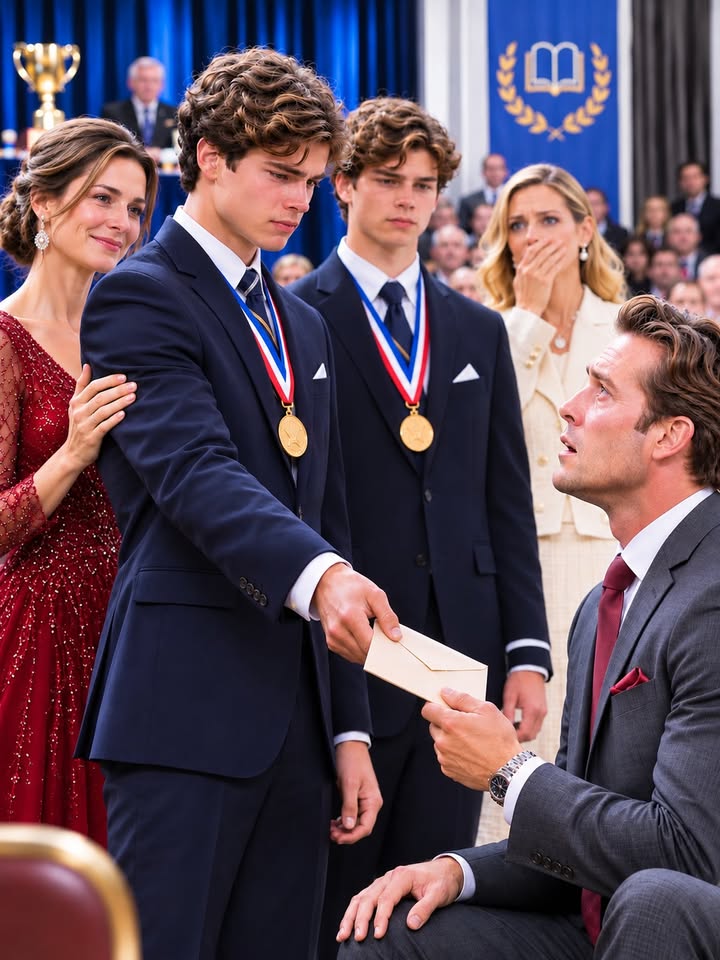
“Dad,” my son said softly, “my brother and I have been waiting thirteen years to give you this.”
Brian stared at the envelope as if it had been placed in his hands by someone from a dream he had forgotten.
The applause still moved around us in waves, but it seemed to fall away from the space between the two of them.
My son’s fingers remained wrapped around the envelope.
He did not push it closer.
Brian looked from him to his twin, who had stopped a few steps behind, then back to the boy standing before him.
“Is this…” Brian began, and lost the rest of the sentence.
“My brother and I prepared it,” my son said.
The words were calm, but his voice held the careful steadiness of someone who had rehearsed what he would say and still had no idea how it would feel to say it.
Brian’s hand rose, then hesitated.
“May I?”
My son glanced over his shoulder at his brother.
His twin nodded once.
Only then did the envelope pass from one hand to the other.
Brian held it by the edges.
His gaze caught on the front, where my sons had written his name in their own handwriting.
For a moment, he seemed unable to touch the seal.
“I don’t know what to say,” he whispered.
“Then read it first,” my younger son replied.
I stayed where I was, several yards away, as the ceremony continued behind us.
The distance was intentional.
My sons had decided what they wanted to do, and I would not make their moment about my hurt, my anger, or the thirteen years in between.
Still, every part of me wanted to cross the room and stand between them and the man who had left.
Not because I believed they needed rescuing.
Because I remembered how small they had been when Brian disappeared from our lives.
The last time he had seen them, one could fit against each of his arms, and the other had fallen asleep on his shoulder.
Now they stood taller than me, wearing matching school blazers and gold medals.
Brian lifted his eyes toward them.
“Could I talk to you both?”
“Not here,” my older son said.
“We don’t want to make a scene,” his brother added.
“You already have the envelope,” the first one said. “You can read it when you’re ready.”
Brian looked down at it again.
“I understand.”
My sons turned toward me.
I did not ask what they wanted to do next.
I simply walked with them toward the exit, leaving Brian beside the rows of chairs and the bright stage lights.
Outside, the afternoon sun had begun to soften, settling over the campus in a warm, pale glow.
My older son loosened his medal ribbon from the back of his neck and held the medal in his palm.
“I thought I’d feel something bigger,” he said.
“Bigger than what?” I asked.
“I don’t know.” He looked toward the auditorium doors. “Like everything would make sense once I saw him.”
His brother ran a thumb over the edge of his own medal.
“Seeing him didn’t make anything make sense.”
I knew better than to tell them that those feelings would come later, or that they had every right to feel exactly what they did.
“I’m sorry you had to meet him like that,” I said.
“You didn’t make him come here,” my older son answered.
“No.”
“And you didn’t make him leave,” his twin added.
His words were not an accusation.
That made them hurt more.
They were still trying to understand how a father could be absent for most of their lives, and they had begun, as children often do, by looking for the part of the story that belonged to me.
I looked at them both.
“I want you to know I never kept you from him.”
The two of them exchanged a glance.
“We know,” my younger son said.
I had spent years wishing those words would come easily.
When they finally did, they carried no comfort.
Only the weight of everything it had taken to arrive at them.
My older son slipped the medal into his pocket.
“Can we go somewhere quiet?”
We found a bench near the far end of the parking area, beneath a broad maple whose new leaves filtered the sunlight into shifting green patches.
The boys sat on either side of me.
For several minutes, none of us spoke.
Across the lot, families packed up display boards and congratulated their students.
A little girl in a bright cardigan ran to her father, who lifted her into his arms as if he had been waiting all day to do it.
My younger son followed them with his eyes.
Then he looked down at the medal in his hand.
“We knew today might happen,” he said.
I turned to him.
“What do you mean?”
“We knew Dad might be at the competition,” his brother said. “The school list was public, and his stepson was competing in the same division.”
I glanced from one to the other.
“You knew he might be here before we arrived?”
“We found out a few weeks ago,” my older son explained. “We didn’t want to tell you and make you worry.”
“I would have wanted to know.”
“We know,” he said. “But we wanted to decide what to do without everyone’s feelings getting mixed together.”
There was no blame in his voice.
They were trying to be fair to me while making room for their own curiosity.
That was what they had done since they were old enough to understand that our household was different from the ones their classmates described.
They asked questions in careful stages, as if the truth were a fragile thing they could damage by reaching for it too quickly.
“What did you decide?” I asked.
“We found the letters,” my younger son said.
My breath caught.
“What letters?”
He looked at his twin, who nodded for him to continue.
“The ones you kept in the wooden box. The blue one with the little brass latch.”
For an instant, I was back in the bedroom we had shared as newlyweds, years before the boys were born, before arguments had narrowed our conversations to accusations and silences.
The box had been mine first.
I had put photographs and small keepsakes in it, things I could not bear to throw away but could not leave in plain sight.
I had not opened it in years.
“You went through the box?”
“We were looking for the baby pictures,” my older son said. “We wanted to see if Dad looked different in the ones you had.”
A small, aching smile touched his face.
“He did not.”
I looked toward the auditorium.
“Did you read the letters?”
“Not all of them,” his twin said. “There were a lot.”
The simple answer landed harder than I expected.
I could picture the envelopes.
Some were decorated in the uneven, bright strokes of little boys who had just learned to form their names.
One had a drawing of a rocket on the back.
Another included a pressed leaf, brittle now, from a school walk they had taken in second grade.
The first letters had been written with my help.
The later ones had been written entirely by them.
They had wanted to send every one.
I had not let them.
“I told you their father had asked for no contact,” I said.
“You told us what you believed,” my younger son replied.
The distinction was gentle, but it opened a door I had kept shut.
“I believed it because he told me,” I said. “His last message was clear.”
“What did it say?” my older son asked.
I looked down at my hands.
“I don’t remember every word. I remember that he said he needed a clean break, and that he did not want us contacting him.”
“You didn’t show us that message,” his brother said.
“No.”
“Why not?”
“Because you were little, and I thought you deserved to be protected from an adult decision you couldn’t change.”
“And the letters?” my older son asked.
“I kept them because I thought someday you might want them. But I didn’t send them because I believed your father didn’t want to hear from you.”
The boys said nothing.
I could feel them considering my explanation without deciding whether it was enough.
“I should have told you they existed sooner,” I continued. “That was my choice, and I’m sorry.”
My younger son looked at me.
“Did you think he might come back?”
“I didn’t know what he would do. I stopped waiting for him to answer, but I never stopped wondering whether he might.”
My voice faltered.
I swallowed, then tried again.
“I was angry for a long time. And tired. I thought if he wanted to be part of your lives, he would find a way to do it.”
“And he didn’t,” my older son said.
“No.”
The truth did not soften when spoken aloud.
My younger son leaned forward, resting his elbows on his knees.
“We didn’t want to give him the letters because we thought they would make him feel bad,” he said. “We wanted him to know we had tried to reach him.”
“Even if he didn’t answer,” his brother added.
A car door shut on the other side of the lot.
A coach called to a group of students near the entrance.
Ordinary sounds continued around us, indifferent to the moment unfolding on the bench.
“Do you want him to read them?” I asked.
“We already gave him the envelope,” my older son said.
“That wasn’t quite what I asked.”
My younger son looked at the envelope in Brian’s hands, visible through the auditorium’s open doors.
“We want him to read what we wrote,” he answered. “We don’t know what we’ll want after that.”
That was fair.
It was more than fair.
We had not raised them to pretend feelings were simple just because adults found them inconvenient.
When we got home that evening, the boys set their medals on the kitchen table.
They placed them beside the invitation to the ceremony and the program marked with their names.
For a while, we ate leftovers without much conversation.
They spoke about the competition, their scores, and the moment one of them had nearly dropped his medal while coming down the stage steps.
The details gave us something small and manageable to hold.
But Brian remained there in the room with us, though he was hundreds of miles from our kitchen.
Before bed, my older son came into the living room where I was sorting laundry.
“Mom?”
I set down the towel in my hands.
“Yeah?”
“Did you ever write him too?”
“I wrote to him once, after we separated.”
“Did he answer?”
“No.”
He seemed to think about that for a moment.
“Do you still have what you sent?”
“I don’t know. I may have a copy somewhere.”
He nodded but didn’t ask anything more.
The question stayed with me after he went upstairs.
When the house was quiet, I returned to the old wooden box.
Its brass latch resisted before opening with a small click.
Inside, beneath photographs and folded cards, lay the letters I had kept safe and hidden from sunlight.
The earliest ones were addressed in thick marker.
Dear Dad, I got a red bike.
Dear Dad, I can read a whole book now.
Dear Dad, I wish you could come to my concert.
I ran my fingertips over the careful lines.
Some letters had two sets of handwriting on the same page, the boys taking turns to add a sentence.
There were jokes, questions, drawings of dogs we had never owned, and descriptions of school trips.
Near the bottom, I found the envelope Brian had once mailed after we separated.
I had preserved it because I had never been able to forget what it said.
His handwriting was as unmistakable as I remembered.
I turned it over but did not open it.
I knew the words already.
A clean break.
No contact.
The phrase had become a wall I had built around my sons, meant to protect them from the pain of waiting for someone who had said he would not return.
In the years that followed, the wall had kept the letters in the box.
The next morning, my sons asked whether I would take them to the café near the competition center.
I understood the reason before either of them said it.
“Do you want me to stay with you?”
My older son answered first.
“Nearby would be good.”
“Not at the table,” his brother added. “We want to talk to him ourselves, but we don’t want to be completely alone.”
“Then that’s what we’ll do.”
They were still discussing the details when my phone rang.
The number was unfamiliar.
I stepped into the hallway to answer.
“Hello?”
“Is this Hannah Campbell?”
“Yes.”
“My name is Brian.”
His voice was older than I remembered, its edges worn by distance and the effort of choosing each word.
For a moment, I could hear the quiet of our old apartment in it.
“I read the envelope,” he said.
I closed my eyes.
“Did you read all of it?”
“I did.”
“What do you want?”
He paused.
“I know I don’t have the right to ask for much. But the boys said they might speak with me if you were nearby.”
“They said that?”
“They did. They also said this isn’t about forgiveness.”
My grip tightened on the phone.
“It isn’t.”
“I understand.”
“Do you?”
“I’m trying to.”
There was no defensiveness in his answer.
That unsettled me more than an argument might have.
The boys appeared at the end of the hallway.
I looked at them and covered the phone’s microphone.
“He wants to talk with you at the café,” I said. “I can stay nearby.”
They considered each other, then nodded.
I returned to the call.
“They’ll meet you for a short conversation,” I said. “I’ll be there, but they decide how long it lasts.”
“Thank you.”
“Don’t thank me. This is their choice.”
“I know.”
The line went quiet.
I could almost hear him searching for another thing to say.
Finally, he asked, “Hannah, the letters… did you ever send any of them?”
“No,” I replied. “I didn’t.”
“Why?”
“Because I believed you had asked for no contact.”
He breathed out slowly.
“I thought you wanted me gone.”
“And I thought you did not want to hear from your sons.”
For several seconds, neither of us spoke.
Then Brian said, “I need to ask you something, but not over the phone.”
I looked at my sons.
“What is it?”
“I found something in the envelope. A letter with an old date on it. The postmark is mine, and it’s addressed to me.”
“From whom?”
“Your older boy, I think. It was returned unopened.”
My stomach tightened.
“That’s impossible,” I whispered.
“I know it sounds impossible.”
“I never mailed it.”
“I know.”
A faint rustle came through the phone, as if he were turning the page again.
“But it has my old address on it, Hannah.”
I looked down at my hands, remembering all the years I had believed silence was the answer he had chosen.
Brian’s voice dropped.
“Do you remember ever sending anything to that address after I left?”
**–END OF PART 2–CLICK “NEXT” AT THE BOTTOM OF THE PAGE TO CONTINUE READING**
* * *
[NEXT: PART 3](https://puretales.idolsgift.com/blog/part-3-the-letters-he-never-saw-034)
✓ Lynn R. Adams
Part 2 – The Letters He Never Saw “Dad,” my son said softly, “my brother and I have been waiting thirteen years to give you this.” Brian stared at the envelope as if it had been placed in his hands …