PART 2: The Letter Claire Left Behind 046
Part 2 – The Letter Claire Left Behind
Ethan stared at the envelope until the blue ink of Claire’s name seemed to blur.
“Who sent you here?” he asked, his voice low enough that the twins stopped laughing.
Lena held the envelope carefully, as if it might break beneath her fingers.
“Claire did,” she said.
Margaret, standing in the hallway, drew a sharp breath.
Ethan did not look away from Lena.
“My wife had been dead for two years when you came to this house.”
“I know.”
“And this letter is dated three months after her funeral.”
“I know that too.”
“Then explain how she sent you.”
Lena glanced at the boys, who had pressed themselves against her sides, sensing the change in the room even if they could not understand it.
“Could we talk somewhere they won’t hear?” she asked.
Ethan’s gaze flicked to his sons.
For one moment, the old instinct rose in him: to keep every difficult truth beyond the reach of his children, to guard them from grief by locking grief away.
Then Nico reached for Lena’s hand, and Santi leaned his cheek against her shoulder.
“Margaret,” Ethan said, “would you take them to the kitchen for a little while?”
Margaret hesitated.
Her eyes moved from the envelope to Lena, then to Ethan.
“Of course,” she said at last.
She crossed the room and held out both hands, but the boys clung to Lena.
“Just for a few minutes,” Lena murmured, gently easing Nico toward Margaret.
“Daddy’s here, and I’ll be close by.”
Nico looked uncertainly at Ethan.
Ethan crouched to meet his son’s eyes.
“I’m not going anywhere,” he promised.
The words felt unfamiliar in his mouth, though he had never stopped loving them.
Santi gave Lena one last squeeze before allowing Margaret to carry him out.
Nico followed, holding Margaret’s hand but turning twice to look back.
When the hallway fell quiet, Ethan closed the living-room door.
He did not sit.
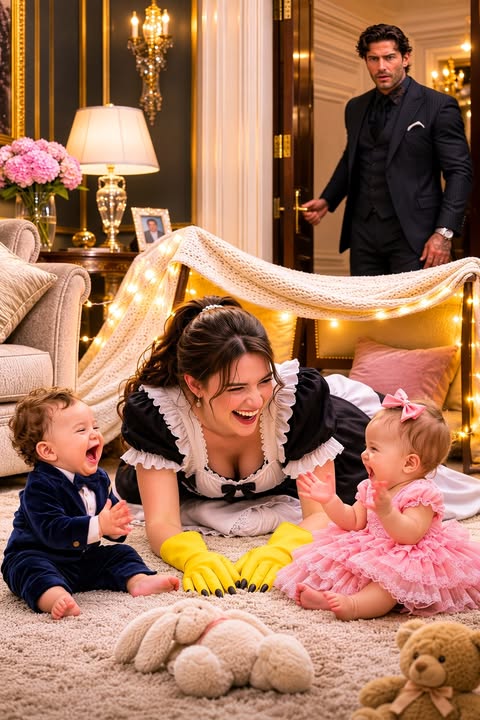
Lena remained on the carpet beside the blanket fortress, still wearing one yellow rubber glove.
For a strange second, Ethan could not stop looking at it.
It was such a small, ordinary thing, ridiculous against the sharp edges of his suspicion.
Then he remembered the laughter.
He remembered the boys calling her Mama.
He remembered Claire’s last weeks, when she had sometimes watched the twins with an expression he could not read.
“Tell me,” he said.
Lena took a breath.
“Months before Claire died, I was volunteering at the children’s hospital where she was receiving care.”
Ethan’s face tightened.
“What hospital?”
“St. Anne’s.”
He recognized the name; Claire had been treated there late in her pregnancy.
“She never told me she met you.”
“I don’t think she wanted to worry you.”
“That’s not an answer.”
“No,” Lena said softly. “It isn’t.”
She took off the rubber glove and laid it on the rug beside her.
“I was helping in the children’s playroom one afternoon when a little boy started crying because he was afraid of a procedure.”
“What did you do?”
“I sat beside him and let him decide whether he wanted me to talk or just stay there.”
Her eyes lowered briefly.
“Claire was in the corridor with a nurse, waiting for an appointment, and she saw us.”
Ethan felt a pulse of anger, quick and bright, then immediately shame.
Claire had been in a hospital, vulnerable and frightened, and he had not known she was meeting people there.
“She spoke to you?”
“She thanked me for being gentle with him.”
“That was all?”
“At first.”
Lena looked up at him.
“After that, I saw her a few more times.”
“How many?”
“Not many.”
“Two? Ten?”
“Five, I think.”
The answer came without defensiveness.
Ethan searched her face for the practiced evasions he knew too well from the men who worked around him.
He found only weariness.
“Why were you there in the first place?” he asked.
“I was studying early childhood education, and the hospital had a volunteer program.”
“You stopped studying?”
“I had to. My mother got sick, and I needed to work.”
The modesty of her explanation left him with nothing to challenge.
He took one step closer.
“What did Claire tell you?”
Lena’s fingers moved to the edge of the envelope.
“She worried about the twins.”
“They were babies.”
“I know.”
“They had me.”
“I know that too.”
“Then what was she worried about?”
Lena met his eyes, and the tenderness in her expression hurt more than accusation would have.
“She told me she was afraid your grief would make the world very small for them.”
Ethan’s jaw tightened.
“My grief?”
“She didn’t say it to judge you.”
“She said it to a stranger.”
“She said it to someone she had watched sit quietly with a frightened child.”
“That makes her a stranger.”
“Yes,” Lena replied. “It does.”
There was no attempt to soften the truth.
That, more than anything, kept him listening.
“She told me how much you loved the boys,” Lena continued. “She said you would give them anything they needed, but that sometimes people who are trying to protect children end up protecting them from ordinary life too.”
Ethan glanced toward the doorway.
The house was quiet again.
He had thought routine was kindness.
He had thought keeping the twins close, keeping the world controlled, keeping their days carefully managed was the safest form of love he could offer.
But he knew how often he had left their care to others because the sight of them reminded him of Claire.
He had never considered that his careful distance might have become another kind of absence.
“What did she ask you to do?” he said.
“Nothing at first.”
“Then what changed?”
“Claire told me she was afraid she might not have much time.”
The air seemed to thin around him.
“Why didn’t she tell me?”
Lena’s eyes filled, though she did not let the tears fall.
“I can’t answer for her.”
“You were there. You must have asked.”
“I did.”
“And?”
“She said she didn’t want every conversation with you to become about what might happen.”
Ethan looked away.
That sounded like Claire.
She had always known how to carry fear quietly, not because she was afraid of him, but because she believed she could spare him the burden.
He had mistaken her silence for confidence.
“What did she ask you to do?” he repeated.
“She asked whether I would consider helping the boys if something happened to her.”
“Helping how?”
“By being there. By helping them keep a sense of ordinary life.”
“That’s why you came here?”
“Not immediately.”
“Lena.”
“I did not come here the day after her funeral with a plan to enter your family,” she said, her voice still gentle but firmer now. “Claire asked me to consider it. I told her I would, if you wanted help and if it was truly good for the boys.”
“And then you waited.”
“Yes.”
“For two years?”
“Not quite. I didn’t know what would happen after she died. I didn’t know if you’d ever want me near them.”
“Then how did you get the position?”
“I applied when the agency posted it.”
Ethan’s eyes narrowed.
“By chance?”
“Not entirely.”
“That sounds like a very careful answer.”
“It is.”
Lena swallowed.
“I saw the listing and recognized your name. I called the agency and asked whether they could send my application through like anyone else’s. I didn’t want Claire’s request to make you feel you had no choice.”
“You could have told me the truth at the interview.”
“I should have.”
“You were asked whether you knew my family.”
“I said I had met your wife.”
“You said you met her once.”
“I was afraid if I explained the rest, you’d think I had come to replace her.”
He had thought that anyway.
The accusation had been waiting beneath his suspicion from the moment Nico said the word.
“Did you teach them to call you Mama?”
“No.”
“Did you encourage it?”
“No.”
“Then why does he say it?”
Lena’s face softened.
“Toddlers use the words they know for the people who make them feel safe.”
“That isn’t the same thing.”
“No,” she said. “It isn’t.”
She did not try to make the word larger than it was.
She did not claim a place in the family.
That should have reassured him, but instead it left him with a question he could not bring himself to ask.
“How long has he been saying it?”
“Only a few days.”
“And you didn’t tell me?”
“I thought you might hear it and decide I had crossed a line before you had a chance to understand what it meant.”
“You let me find out this way.”
“I’m sorry.”
Her apology was quiet, without excuses.
Ethan looked down at the envelope.
The date had been written carefully beneath his name.
Three months after Claire’s funeral.
He had been unable to open most of Claire’s belongings for weeks after she died.
Then months had passed, and the things left in drawers and boxes had become part of the house’s stillness.
No one had mentioned this letter.
“Where did you get it?” he asked.
“Claire gave it to me before she died.”
“Why is it dated after the funeral?”
“She wrote it in advance.”
“Why?”
“She wanted me to deliver it only if the boys began speaking about her.”
Ethan’s gaze lifted.
“What does that mean?”
“She told me that when they were old enough to ask questions, you might need to hear her words.”
“That’s absurd.”
“Maybe,” Lena said. “But she knew you.”
He gave a humorless laugh.
“She knew me better than anyone.”
“That may be why she wrote it.”
The space between them changed.
Ethan felt anger gathering, but beneath it was something more vulnerable: the unsettling possibility that Claire had seen a part of him he had not wanted to see.
“Why now?” he asked. “The boys have been talking about her for months.”
“Not in the way she meant.”
“What way did she mean?”
Lena looked down at the envelope.
“She said I would know when the time came.”
“That’s convenient.”
“I know how it sounds.”
“It sounds like you’re asking me to trust a dead woman’s instructions delivered by someone I barely know.”
“I’m asking you to read her letter.”
“And if it says what you want it to say?”
“Then you can still choose not to listen.”
He studied her.
For a moment, the only sound was the low hum of the house’s heating system and the faint murmur of the boys in the kitchen.
Lena rose from the rug and held the envelope out.
Ethan did not take it.
“Were you ever in my home before the interview?”
“No.”
“Did you speak with Margaret?”
“No.”
“Did Claire tell you anything about me besides the things you’ve already said?”
“She told me you loved the boys.”
“That’s all?”
“She told me you were a good man who had become frightened of losing the people you loved.”
He looked away sharply.
“That’s not her to say.”
“No,” Lena said. “But it is true.”
He almost told her she knew nothing about him.
Then he heard the boys’ laughter from the kitchen, softer now, interrupted by Margaret asking them to wash their hands.
He remembered the little fortress in the living room.
The blankets, the lights, the yellow gloves.
He remembered the last two years of making sure everything in the house was safe except the ache that had settled into it.
“Give me the letter,” he said.
Lena placed it in his hand.
The paper felt almost weightless.
His name, written in Claire’s familiar slant, seemed to pull the whole room out from under him.
He turned the envelope over.
The flap had been sealed with a small round sticker, the kind Claire used to buy in packs for the twins’ drawings.
His thumb rested at its edge.
“Did she write anything else?” he asked.
“She did.”
“What?”
“She said I wasn’t to explain the letter before you read it.”
A wry, pained smile crossed his face.
“That sounds like her too.”
“She wanted you to have the words as they were.”
Ethan eased the sticker free.
He did not tear it, though he had spent years tearing open envelopes without thought.
Inside lay one folded sheet of paper.
The handwriting filled only one side.
He recognized the first line, and his breath caught.
*Ethan, if you are reading this, then the boys have begun finding their words for me, and you have begun asking what those words mean.*
He stopped.
The room seemed to recede around him.
Lena said nothing.
He read on, silently at first.
*I need you to remember that they can love me and still love the people who care for them now.*
Ethan’s hand tightened on the page.
The letter was short.
It did not explain the hospital, or the illness, or why Claire had hidden her worry.
It did not tell him what he should do with Lena.
It did not mention the word Mama at all.
Instead, Claire wrote that the boys should be allowed to speak of her, to miss her, to laugh when they remembered her, and to be comforted when they could not.
She wrote that grief did not need to be guarded like a dangerous secret.
She wrote that no one who loved their sons could take her place.
The final lines trembled slightly, as if her hand had been tired.
*Please don’t mistake their need for comfort as a betrayal of me.*
*And please don’t make them choose between the love they remember and the love that finds them now.*
Ethan lowered the page.
For a long moment he was unable to speak.
He had spent two years believing that the best way to honor Claire was to preserve every part of their life exactly as she had left it.
He had kept her photograph above the mantel.
He had never moved her favorite chair.
He had even refused to let the twins’ room be repainted, though they had outgrown the pale green stars she chose before they were born.
He had thought stillness was loyalty.
Claire’s letter suggested it might have been fear.
“Why didn’t she tell me this herself?” he whispered.
Lena stood a few steps away.
“I don’t know.”
“She could have told me.”
“Yes.”
“She could have trusted me.”
“Maybe she did.”
He looked at her.
“Then why write this for after she was gone?”
“Maybe because she knew you would hear it differently when you could no longer argue with her.”
The answer hurt because it sounded possible.
He folded the letter along its original crease.
“Did she say she wanted you to work for us?”
“She asked me to help, if you were willing.”
“That isn’t the same as wanting you in this house.”
“No,” Lena said. “It isn’t.”
“Did you take the job because you felt bound to her?”
“I took it because I cared about what she asked me to do, and because I saw the boys needed someone patient.”
“And if I tell you to leave?”
“Then I’ll leave.”
The simplicity of that answer unsettled him more than pleading would have.
“You’d walk away from them?”
“I would be heartbroken,” she said. “But they are your children, Mr. Caldwell. I won’t stay by making you feel trapped.”
She turned toward the door.
Ethan held the letter with both hands.
“Wait.”
Lena stopped.
He had no idea what he wanted to say.
Thank you sounded too small.
I’m sorry sounded premature, though the words were already gathering inside him.
He settled on the only question he could manage.
“Did Claire tell you why she chose you?”
Lena’s expression shifted.
“She said she’d watched me with that little boy at the hospital.”
“That’s not a reason to entrust you with her sons.”
“I know.”
“So there was something else.”
Lena hesitated.
“She told me she had never seen anyone offer comfort without trying to make the other person stop being sad.”
Ethan stared at her.
The sentence seemed to belong to Claire completely.
Before he could respond, the door opened.
Margaret stood at the threshold, Nico beside her and Santi balanced on one hip.
“They’ve finished washing,” she said.
Her voice was measured, but the worry in her eyes had not faded.
Nico spotted Lena and immediately reached for her.
“Mama, play?”
Lena’s gaze flicked to Ethan.
He could have corrected the child.
He could have said her name firmly, removed the word from the air before it settled into the house.
Instead, he watched his son reach for the person who had made him laugh.
Lena bent to take Nico’s hand, but she did not lift him.
“Let’s ask your daddy what he thinks,” she said.
Nico looked up at Ethan.
The question in his small face was uncomplicated.
Ethan glanced at Claire’s letter, then at the young woman who had entered his home through a request he had never known existed.
He could not yet say he trusted her.
He could not yet say he understood what Claire had seen.
But he could not pretend the boys’ happiness was a threat.
“You can play for a little while longer,” he said.
Nico’s smile returned.
Santi clapped from Margaret’s arms.
Lena let out a breath she seemed to have been holding since Ethan walked through the door.
Margaret remained where she was, her eyes fixed on the envelope.
As Lena and the boys returned to the blanket fortress, Margaret moved closer to Ethan.
“May I speak with you?” she murmured.
“Not now.”
“It concerns Mrs. Caldwell.”
His attention sharpened.
Margaret glanced toward Lena, who was helping Nico arrange a pillow beneath the fairy lights.
“I have never told you what I saw at the cemetery,” she said. “I thought I was protecting you.”
Ethan looked at the letter in his hands.
“What did you see?”
Margaret’s expression changed with the weight of the answer.
“I saw Lena there before she came to work for you.”
Her voice dropped.
“And she was leaving something at Claire’s grave.”
**–END OF PART 2–CLICK “NEXT” AT THE BOTTOM OF THE PAGE TO CONTINUE READING**
* * *
[NEXT: PART 3](https://echoesofstories.idolsgift.com/blog/part-3-the-letter-claire-left-behind-046)
✓ Lynn R. Adams
Part 2 – The Letter Claire Left Behind Ethan stared at the envelope until the blue ink of Claire’s name seemed to blur. “Who sent you here?” he asked, his voice low enough that the twins stopped lau…