Orphaned at 17, She Inherited Grandma’s Crumbling Homestead—Then a Hidden Cellar Revealed Why Everyone Wanted Her Gone
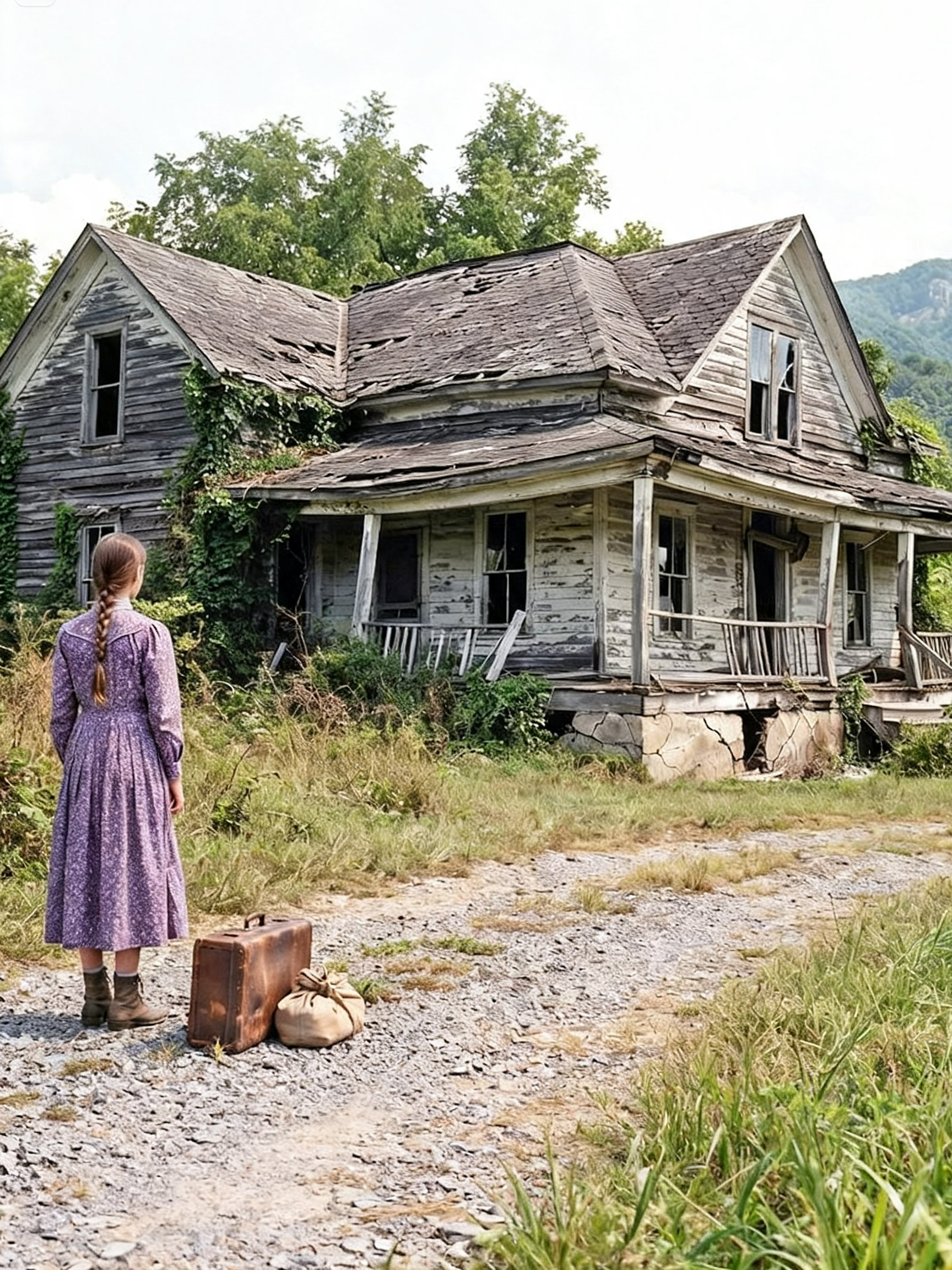
Orphaned at 17, She Inherited Grandma’s Crumbling Homestead—Then a Hidden Cellar Revealed Why Everyone Wanted Her Gone
At seventeen, Emma Whitaker lost her parents, her home, and nearly every person she believed she could trust.
Three weeks later, she inherited a house everyone told her was worthless.
And before she had even spent one night there, a stranger offered her $400,000 to walk away from it.
Emma stood beneath the sagging porch roof of her grandmother’s homestead outside Willow Creek, Montana, staring at a property that looked as though one hard winter might finish what fifty years of neglect had started.
The farmhouse leaned slightly toward the east.
Gray paint peeled from the siding in long curls. Two windows were boarded. Rust had eaten through sections of the barn roof. The old windmill behind the house no longer turned.
Beyond it, however, nearly eighty acres of meadow rolled toward dark pine-covered hills.
Emma tightened her fingers around the brass key in her hand.
Her mother had grown up there.
Yet during Emma’s entire childhood, her parents had visited Grandma June only twice.
Whenever Emma asked why, her father gave the same answer.
“Some family history is better left alone.”
Now both of her parents were dead.
A drunk driver had crossed the center line outside Billings on a rainy Friday night.
Emma had been at a friend’s house studying.
By sunrise, she was an orphan.
Her only living relative, June Whitaker, died twelve days later at eighty-one.
According to the lawyer, Grandma June had changed her will six months before her death.
Everything went to Emma.
The farmhouse.
The eighty acres.
And every debt attached to them.
“Not exactly a fortune,” attorney Michael Harris had warned her.
Emma had almost laughed.
The farmhouse had no reliable heat.
The barn needed structural work.
There were unpaid property taxes.
She had $2,813 in her checking account.
And because she was still technically a minor for another four months, a court-appointed guardian would oversee certain financial decisions until her eighteenth birthday.
But there was nowhere else Emma wanted to go.
Her parents’ rental house had already been emptied.
Her father’s older brother, Uncle Raymond, had made it painfully clear that she could not stay with him for long.
“You need to think practically,” Raymond had told her. “Sell June’s place. Use the money for college.”
Then he had driven her to the homestead himself.
The moment they arrived, Raymond stared across the acreage strangely.
Not with sadness.
Not with nostalgia.
With calculation.
Emma noticed.
She noticed everything now.
Grief had made her quiet.
Silence made people careless.
Raymond walked around the house before joining her on the porch.
“This place is worse than I remember.”
“It’s still standing.”
Emma inserted the key.
Before she could turn it, tires crunched over the gravel driveway.
A black Chevrolet pickup stopped beside Raymond’s truck.
A man in a charcoal jacket climbed out.
He looked about fifty, clean-shaven, expensive boots completely unsuited to the muddy yard.
“Emma Whitaker?”
He smiled and offered a business card.
“Dean Caldwell. Caldwell Land Development.”
Raymond’s expression changed for half a second.
Emma caught it.
Recognition.
Then it disappeared.
Dean gestured toward the property.
“I heard June passed. I’m sorry.”
“Did you know her?”
“Everyone around Willow Creek knew June.”
That did not answer her question.
Dean continued.
“I’ll make things simple for you. Four hundred thousand dollars. Cash purchase. We cover closing expenses, unpaid taxes, everything.”
Emma stared at him.
The lawyer had estimated the property’s value at less than $190,000 because of the condition of the structures.
“You’re offering twice what it’s worth?”
Dean chuckled.
“Developers think long-term.”
Raymond stepped closer.
“That’s a very generous offer, Emma.”
Too quickly.
Emma looked at him.
Then at Dean.
“Why do you want it?”
“Location.”
“There’s nothing here.”
“There will be eventually.”
Emma looked toward the distant hills.
No highway.
No lakefront.
No town expansion.
Just grass, forest, and mountains.
She handed the business card back.
“I’m not selling.”
Dean’s smile remained.
His eyes did not.
“You’re seventeen. Maintaining eighty acres is different from spending summers in the country.”
“I never spent summers here.”
Something flickered across his face.
“Then you know even less about what you’re taking on.”
Emma opened the front door.
Dust rolled through the entryway.
“I guess I’ll learn.”
Dean watched her for another moment.
“Offer stands for forty-eight hours.”
Then he returned to his truck.
Emma waited until he drove away.
She turned to Raymond.
“You knew him.”
Raymond frowned.
“You recognized him.”
“I’ve seen him around.”
“He knew I inherited the property three weeks after Grandma died.”
“Small town.”
“He knew I was coming today.”
Raymond’s face hardened.
“You’re imagining conspiracies because you’re grieving.”
That sentence bothered Emma more than anything else he could have said.
Because Grandma June had once told her something during one of their rare visits.
Emma had been eleven.
They were picking apples behind the barn when June said quietly:
“When somebody tells you not to trust your own eyes, sweetheart, start watching them twice as carefully.”
Emma had forgotten those words for six years.
Standing on the porch, she remembered every syllable.
That afternoon, Raymond left.
Emma stayed.
The electricity worked in three rooms.
The kitchen faucet produced rusty water for almost a minute before running clear.
She found canned soup in a pantry, blankets in a cedar chest, and enough split firewood behind the house to survive several cold nights.
Shortly before sunset, she entered Grandma June’s bedroom.
Everything was untouched.
An old quilt.
Reading glasses.
A Bible beside the lamp.
A photograph of Emma’s mother as a teenager.
Emma sat on the mattress.
For the first time since the accident, she cried without anyone watching.
She cried for her mother.
She cried for her father.
She cried because she had spent most of her childhood assuming there would always be another Thanksgiving, another birthday, another opportunity to ask the questions nobody wanted answered.
When the tears finally stopped, she noticed something beneath the framed photograph.
An envelope.
Her name was written across it.
Her hands trembled.
Inside was one sheet of paper.
Grandma June’s handwriting was weak but unmistakable.
If you are reading this, then I ran out of time.
Do not sell the land.
Do not trust anyone who suddenly becomes interested in helping you sell it.
Your mother knew part of the truth, but not all of it.
Go to the kitchen.
Remove the third drawer beside the stove.
Love, Grandma.
Emma stood instantly.
The third drawer contained old dish towels and tarnished utensils.
She removed everything.
Then she pulled.
The drawer stopped halfway.
Remembering an old trick her father had taught her, Emma lifted the front edge.
The drawer slid free.
Behind it, taped against the wooden cabinet frame, was a small iron key.
And another note.
Only seven words.
The root cellar was never for potatoes.
Emma stared through the kitchen window.
Thirty yards behind the farmhouse stood an overgrown mound of earth with a crooked wooden door.
The cellar.
Outside, darkness had swallowed the fields.
Emma should have waited until morning.
She knew that.
Instead, she grabbed a flashlight.
The root cellar smelled of damp earth and old wood.
Shelves lined both walls.
Empty Mason jars sat beneath decades of dust.
There were potatoes.
Or at least there had been once.
Nothing appeared unusual.
Emma swept her flashlight across the stone floor.
Then she noticed scratches around one shelving unit.
Fresh enough to stand out.
She pulled at it.
Then she saw a small iron lock near the bottom.
The hidden key fit perfectly.
Emma turned it.
A click echoed through the cellar.
The entire shelf swung outward.
Behind it was a narrow staircase descending underground.
Emma froze.
Her own voice sounded too loud.
She descended carefully.
Eight steps.
At the bottom was a concrete room roughly twelve feet wide.
A metal filing cabinet stood against the wall.
Beside it was an antique oak table.
And on the table sat three locked boxes.
Emma’s excitement disappeared when she noticed something else.
Boot prints.
In the dust.
Recent ones.
Someone had been there.
She backed toward the stairs.
Then she heard gravel crunch outside.
Headlights flashed through the root cellar entrance.
Emma switched off her flashlight.
A vehicle door closed.
Then another.
One belonged to Raymond.
Emma’s heart hammered.
She climbed the steps silently and crouched behind the false shelving.
Through a gap, she heard men enter the cellar.
Raymond spoke first.
“She has no idea.”
Dean Caldwell answered.
“She refused four hundred.”
“She’s a kid. Give me time.”
“We don’t have time. Survey work starts next month.”
Emma pressed her palm over her mouth.
Dean lowered his voice.
“If the Whitaker papers are still here, we need them before she finds them.”
Raymond swore.
“June probably burned everything.”
“You said the same thing about Thomas’s copy.”
Emma’s father.
Her chest tightened.
Dean continued.
“And then Thomas started asking questions.”
Raymond replied, “Don’t.”
“Don’t what?”
“Bring my brother into this.”
“You brought him into it when you asked him to convince June to sell.”
“She wouldn’t.”
“And then Thomas found the county records.”
Emma felt suddenly cold.
Her father’s refusal to visit Grandma.
The tension between him and Raymond.
His strange comment about family history.
Maybe it had never been about some ordinary disagreement.
Dean sighed.
“We need that original deed.”
“And if Emma finds it?”
“She won’t.”
Emma leaned closer.
Raymond said, “I’m not hurting my niece.”
Nobody answered for several seconds.
Then Dean laughed quietly.
“I didn’t ask you to.”
Something about the way he said it made Emma grip the wooden frame.
A minute later, both men left.
She waited ten full minutes before moving.
Then she returned underground.
This time she locked the false shelf behind herself.
The first metal box contained family photographs.
The second held letters.
The third did not open with Grandma’s key.
Emma searched the filing cabinet.
Tax receipts.
Cattle records.
Then she found a thick envelope labeled:
THOMAS — IF YOU EVER COME BACK.
Emma sat at the table.
Thomas was her father.
Inside were letters Grandma June had written but apparently never sent.
One dated nine years earlier.
Tom, I know why you’re angry. I should have told you before Raymond became involved with Caldwell. Your grandfather refused their first offer because he discovered why they wanted the western ridge. The geological report was never supposed to reach us.
Raymond says Caldwell only wants the surface rights. I don’t believe him.
Your father hid the original mineral reservation somewhere on this property before he died.
Mineral reservation?
Emma kept reading.
Then she found a copy of a geological report from 1987.
Most of it meant nothing to her.
But one phrase had been underlined twice.
High-grade rare earth mineral deposits.
Emma pulled out her phone.
No service underground.
She photographed every page anyway.
The final letter was dated only eight months earlier.
Raymond came again.
He says the land is useless. He lies badly.
Caldwell’s people have purchased almost every parcel surrounding ours through shell companies.
Your father was right.
Whatever happens, the Whitaker land must not be sold until the original deed is found.
If they control our eighty acres, they control the access corridor to the entire western formation.
Emma stared at the paper.
The house was worthless.
The land was not.
Potentially, it was worth millions.
Maybe far more.
And Raymond knew.
She searched until nearly 3 a.m.
No original deed.
No mineral document.
Nothing that could prove Grandma’s claim.
At dawn, she drove into Willow Creek and parked outside the county courthouse before it opened.
A gray-haired clerk named Ruth Patterson helped her search historical property records.
When Emma mentioned the Whitaker homestead, Ruth stopped typing.
“You’re June’s granddaughter?”
Ruth studied her face.
“You look like your mother.”
“You knew her?”
“This town has twelve hundred people. Everybody knew everybody.”
Emma lowered her voice.
“I need every deed connected to my grandparents’ property.”
Ruth hesitated.
Then she printed several documents.
The newest records looked normal.
The oldest did not.
In 1959, Emma’s great-grandfather, Henry Whitaker, had purchased 1,240 acres.
Emma blinked.
“Our property is eighty acres.”
“What happened to the rest?”
“Sold in parcels.”
Ruth clicked through the records.
“Different buyers.”
Then she leaned closer to the screen.
“Well, that’s strange.”
“Most of them eventually ended up controlled by companies with the same registered agent.”
Emma already knew the answer.
“Caldwell?”
Ruth looked at her.
Over sixty years, the Whitaker family had lost more than a thousand acres.
Piece by piece.
But the final eighty remained.
Emma asked.
Ruth glanced toward the doorway.
Then she lowered her voice.
“Your grandfather used to come in asking the same question.”
“What happened?”
“He died before he found his answer.”
“Heart attack.”
Emma thought of her parents.
A car accident.
She hated herself for immediately becoming suspicious.
Not every tragedy was a conspiracy.
But her father had been investigating.
And Raymond had been meeting secretly with Caldwell.
Emma took the records and went home.
Someone had already broken in.
The front door stood open.
Grandma’s bedroom had been destroyed.
Drawers overturned.
Mattress sliced.
Kitchen cabinets emptied onto the floor.
Someone had searched the house.
Emma ran outside.
The root cellar door hung open.
Inside, the hidden shelf had been discovered.
The boxes were gone.
So were the letters.
The filing cabinet had been emptied.
Emma leaned against the stone wall, sick.
Then she remembered.
She had photographed everything.
Almost everything.
The original deed was still missing.
Emma returned to the farmhouse.
On the broken kitchen floor lay Grandma’s framed photograph.
The glass had shattered.
Emma picked it up.
Behind the photograph was writing she had never seen before.
Not on the picture.
On the cardboard backing.
Four words.
WHERE YOUR MOTHER GREW.
Emma stared at it.
Where your mother grew.
Her mother had grown up in the farmhouse.
Too obvious.
Then she remembered the photograph itself.
It showed her mother, age fourteen, standing beneath an enormous cottonwood tree.
Emma turned toward the window.
Behind the barn stood that same tree.
The cottonwood was nearly six feet wide.
Emma searched around its trunk for an hour.
Then she noticed a rusted horseshoe nailed roughly seven feet above the ground.
She dragged over a ladder.
Behind the horseshoe was a circular wooden plug.
Inside the hollow rested a sealed metal tube.
Emma nearly dropped it.
She opened it on Grandma’s kitchen table.
The first document was an original deed dated March 11, 1959.
The second was a mineral-rights reservation.
The third was stranger.
An easement map.
The Whitaker family had retained permanent access and subsurface rights beneath several parcels that had later been sold.
At the bottom was a handwritten note from her grandfather.
They thought I signed it away.
Emma called Michael Harris immediately.
The attorney arrived two hours later.
He read the documents once.
Then again.
Then he sat silently.
“You need another lawyer.”
Her stomach dropped.
“I thought you were my lawyer.”
“I handle estates and ordinary property matters. This is mineral law, corporate law, potentially fraud.”
“How much is the land worth?”
“I have no idea.”
Michael removed his glasses.
“If the geological report you photographed is authentic?”
“And if these mineral reservations remain enforceable?”
“I would not accept four hundred thousand dollars.”
Emma swallowed.
“How much?”
“Not four million either.”
She stared at him.
Michael immediately made copies and placed the originals in his office safe deposit system.
That decision saved them.
Because that night someone set the barn on fire.
Emma woke at a.m. to orange light flashing across her bedroom walls.
She ran outside barefoot.
Flames had already swallowed half the roof.
She called 911.
Volunteer firefighters arrived within fifteen minutes, but the barn was lost.
Sheriff Daniel Mercer arrived shortly afterward.
He was broad-shouldered, early sixties, and had known Emma’s grandmother for forty years.
He listened while Emma described Dean, Raymond, the break-in, the cellar and the documents.
Unlike Raymond, he never told her she was imagining things.
He simply asked:
“Do you have evidence?”
Emma handed him her phone.
He scrolled through photographs of Grandma’s letters.
His jaw tightened.
Then he reached one image.
It was a photograph of an old invoice she had barely noticed.
Caldwell Exploration Services.
Dated 1991.
Below it appeared a handwritten notation:
Paid R.W. — access information.
Sheriff Mercer looked at her.
“Raymond Whitaker.”
“Could be.”
“You think my uncle sold information about this land?”
“I think initials aren’t proof.”
He returned the phone.
“But I also think you shouldn’t stay here alone.”
Emma refused to leave.
“I’m not letting them scare me off Grandma’s land.”
Mercer studied her for a moment.
“June would’ve said exactly the same thing.”
The fire investigation found traces of an accelerant.
Two days later, Caldwell increased its offer.
This time Dean did not come personally.
A law firm sent a formal proposal.
$2.5 million.
Emma laughed when Michael showed her.
“Two days ago it was four hundred thousand.”
“Apparently your negotiating position improved.”
“Tell them no.”
Michael smiled slightly.
“I already did.”
Within twenty-four hours, it became $5 million.
Then $8 million.
Raymond finally came to the house.
He stepped around the burned barn and found Emma repairing a section of porch railing.
“You need to stop.”
Emma kept working.
“Stop what?”
“Whatever you think you’re doing.”
“Fixing the porch.”
“You know what I mean.”
Emma looked at him.
Raymond appeared exhausted.
“I know about the mineral rights.”
His face went pale.
“And I know Caldwell has been buying the land around us for decades.”
“I know Grandpa suspected them.”
“You don’t understand.”
“Then explain.”
Raymond rubbed both hands over his face.
“Your grandfather was impossible. June was worse. They sat on property that could have changed all our lives.”
“It was theirs.”
“It was our family’s.”
“So you helped Caldwell take it?”
Raymond flinched.
“I helped negotiate sales.”
“You were twenty-one when the first parcels were sold.”
“I needed money.”
“And later?”
“Later I was already involved.”
Emma said nothing.
Raymond looked toward the remains of the barn.
“I didn’t burn that.”
“Did you break into the house?”
“I wanted the papers.”
“Because Caldwell promised me ten percent if I delivered clear title to the last parcel.”
There it was.
Not family loyalty.
“How much?”
Raymond swallowed.
“If their project moves forward? Maybe fifteen million.”
Emma stared at him.
“You were going to steal fifteen million dollars by tricking your seventeen-year-old niece out of her inheritance.”
“I would have made sure you were taken care of.”
“They offered me four hundred thousand.”
“That’s more money than most seventeen-year-olds ever see!”
“It wasn’t yours to decide.”
Raymond’s anger broke through.
“You think June was some saint? She destroyed this family over dirt!”
Emma stepped closer.
“No. You destroyed it over money.”
Raymond pointed toward the hills.
“Do you even understand what’s under there? The development could bring hundreds of jobs. Roads. Industry. Millions in tax revenue.”
“Then why lie?”
He stopped.
Emma continued.
“If this is so good for everyone, why break into houses? Why burn barns? Why hide records? Why convince an old woman her land is worthless?”
Raymond had no answer.
Finally he whispered:
“Sell, Emma.”
His face changed.
Fear replaced anger.
“You don’t understand Caldwell.”
“Then maybe Caldwell should start understanding me.”
Raymond left.
Three hours later, Emma received a call.
Sheriff Mercer had arrested two men in connection with the barn fire.
One worked for a private security company.
The company’s largest client was Caldwell Land Development.
But the biggest shock came the next morning.
Michael Harris called Emma into his office.
Two mineral-rights attorneys from Denver were waiting.
So was a geologist.
They had reviewed Grandma’s documents.
The geologist placed a map on the conference table.
Red markings covered the western region.
“The original surveys underestimated the deposit,” she explained.
Emma looked at the colors.
“What exactly is it?”
“Neodymium, praseodymium, dysprosium. Rare-earth elements used in high-performance magnets, electronics, electric motors and defense applications.”
“And it’s under our land?”
“Some of it. More importantly, your parcel controls the most practical access point to a significantly larger deposit extending beneath surrounding properties.”
Emma remembered Grandma’s letter.
Access corridor.
The attorney leaned forward.
“Caldwell owns or controls most of the surface acreage.”
“But not the mineral rights?”
“Not all of them.”
He tapped her grandfather’s deed.
“Your family retained rights that appear to cover portions of multiple parcels.”
Emma stared.
“So Caldwell bought land they don’t completely control.”
“How much could my rights be worth?”
Nobody answered immediately.
That frightened her more than a number would have.
Finally, the attorney said:
“Depending on permits, environmental review, extraction viability and future commodity prices, you may be controlling an asset worth tens of millions.”
The geologist interrupted gently.
“Potentially more.”
Emma looked down at Grandma’s handwriting.
Crumbling farmhouse.
Broken windmill.
Burned barn.
Eighty acres everyone had called useless.
Grandma had not left Emma poverty.
She had left her leverage.
But Emma soon learned something even more important.
Grandma had left instructions for how to use it.
Michael discovered another document inside Grandma June’s attorney file.
The envelope could only be opened after Emma reached eighteen—or earlier if anyone attempted to challenge the estate.
Caldwell had filed a claim arguing that June had lacked mental capacity when she changed her will.
That triggered the envelope.
Inside was a flash drive.
Emma watched the recording in Michael’s conference room.
Grandma June appeared on-screen.
But completely alert.
She looked directly into the camera.
“My name is June Elizabeth Whitaker. I am eighty years old, and if you’re seeing this, somebody got greedy.”
Emma almost laughed through her tears.
That sounded exactly like Grandma.
June continued.
“The land is Emma’s. Not Raymond’s. Not Caldwell’s. Emma’s.”
Then her expression changed.
“I made mistakes with my children. I let secrets become walls. Thomas believed I chose land over family. I believed I was protecting him from a fight that started before he was born.”
Emma’s throat tightened.
“I was wrong.”
June described how Caldwell’s founder had approached Emma’s grandfather in the late 1980s after private geological surveys identified rare-earth deposits.
When Henry Whitaker refused to sell, the company slowly began purchasing neighboring ranches.
Then they targeted the Whitaker children.
Raymond cooperated.
Thomas refused.
June revealed something Emma had not expected.
Her father had secretly returned to the homestead the year before his death.
He and June had reconciled.
“He told me he wanted Emma to grow up knowing that wealth isn’t what land is worth when somebody wants to buy it. Wealth is what you can build without becoming the kind of person who tried to take it from you.”
Emma covered her mouth.
She had believed her father died still angry with Grandma.
June reached toward the camera.
“If Emma chooses to sell someday, that is her decision. If she chooses to stay, that is her decision. But nobody gets to make it for her.”
Then came the final revelation.
June had established the Whitaker Conservation Trust.
If Emma agreed, a large section of the property could never be strip-mined or environmentally destroyed.
Any mineral development would require strict water protections, limited surface disturbance, independent environmental monitoring, local employment guarantees, and restoration funding.
Emma stared at the screen.
Grandma had given her control.
Not instructions to become rich.
Not instructions to reject development.
Caldwell did not like that choice.
The company sued.
They challenged the mineral reservation.
They challenged the will.
They challenged historical easements.
They alleged documents had been improperly recorded.
They demanded immediate access for exploratory drilling.
For six months, Emma lived between the farmhouse and courtrooms.
She turned eighteen during the fight.
No balloons.
Michael brought her a cupcake and stuck one candle in it outside the county courthouse.
“Happy adulthood,” he said.
Emma laughed.
“Feels expensive.”
“It usually is.”
The case drew statewide attention when Sheriff Mercer’s arson investigation led to communications between a Caldwell regional manager and the security contractor.
Then investigators found emails discussing a plan to “pressure the remaining Whitaker heir into liquidation.”
Dean Caldwell claimed he knew nothing about illegal tactics.
Raymond agreed to cooperate with prosecutors.
In exchange for consideration in his own fraud investigation, he turned over twenty years of emails.
One message changed everything.
It had been sent eight months before Emma’s parents died.
From Dean Caldwell.
To Raymond Whitaker.
Thomas is digging again. Handle the family problem before he creates a title problem.
Emma stared at the email for several seconds when investigators showed it to her.
“Did Caldwell kill my parents?”
The federal investigator across the table answered carefully.
“We have no evidence the crash was anything other than what police originally concluded. The other driver was intoxicated and survived. There’s no known connection to Caldwell.”
Emma closed her eyes.
Part of her felt relieved.
Another part hated that she had reached a point where she needed to ask.
Her parents had died because of one stranger’s terrible choice.
That was tragic enough.
She did not need another monster hiding behind it.
Raymond later asked to see her.
Emma almost refused.
Then she agreed.
They met at the burned barn.
Raymond looked older than he had six months earlier.
“I’m sorry.”
Emma leaned against the rebuilt fence.
“For which part?”
“All of it.”
“That’s convenient now.”
“Did Dad know you were working with Caldwell?”
“That’s why he stopped speaking to you.”
“And Grandma?”
“She knew enough.”
Emma looked toward the farmhouse.
“You spent years telling everyone she was crazy.”
Raymond lowered his head.
“That made it easier.”
“For whom?”
It was the first completely truthful thing Emma had heard him say.
He wiped his eyes.
“I kept telling myself I deserved something. Dad left the ranch to Mom, Mom protected Tom, Tom had a family, and I kept thinking everybody else got something that should have been mine.”
“So you took it.”
Emma waited.
Raymond said quietly:
“When people start believing life owes them something, eventually they stop seeing theft as theft.”
Emma thought about Grandma.
About her father.
About the letters hidden underground.
“Are you asking me to forgive you?”
Raymond looked at her.
“Maybe someday?”
Emma shook her head.
“Forgiveness isn’t something you get to schedule.”
Then walked away.
Fourteen months after Emma first arrived at the crumbling homestead, Caldwell Land Development settled.
The company did not collapse overnight.
Dean Caldwell did not dramatically lose every dollar he possessed.
Real life—even fictionalized through the stories families tell—rarely ends that neatly.
But Caldwell lost what mattered most.
Their claim to the Whitaker mineral rights was withdrawn.
The company paid substantial damages relating to unauthorized property access and agreed to fund restoration measures.
Several executives became targets of separate criminal investigations related to intimidation, destruction of evidence and financial misconduct.
The men convicted of setting the barn fire went to prison.
Raymond pleaded guilty to charges related to fraudulent transactions and conspiracy.
Emma refused Caldwell’s final offer to purchase her rights outright.
It was $38 million.
Instead, she negotiated something nobody expected.
A limited, environmentally controlled lease affecting only a small portion of the larger formation.
Independent engineers would monitor groundwater.
No open-pit mining would be allowed on the original eighty-acre homestead.
Local workers would receive hiring preference.
A percentage of revenue would fund schools and rural emergency services.
And the largest untouched section of the Whitaker land would remain protected permanently.
Emma could have taken a huge check and left Montana forever.
Instead, she kept the farmhouse.
She used her first royalty payments to restore it.
Not replace it.
Restore it.
The peeling gray siding became white again.
The roof was repaired.
Grandma’s kitchen remained mostly unchanged, including the third drawer beside the stove.
The barn was rebuilt using reclaimed timber.
The old windmill turned again.
Emma enrolled at Montana State University and studied environmental engineering.
Four years later, she returned full-time to Willow Creek.
People often assumed she came back because of the money.
They were wrong.
On a cool September afternoon, Emma stood beneath the giant cottonwood tree as workers installed a small bronze plaque.
It did not mention mineral rights.
It did not mention Caldwell.
It did not mention millions of dollars.
It read simply:
JUNE AND HENRY WHITAKER HOMESTEAD EST. 1959 KEEP WHAT MATTERS.
Sheriff Mercer, now retired, stood nearby.
“You think June would approve?”
Emma smiled.
“She’d complain the plaque cost too much.”
Mercer laughed.
“Probably.”
After everyone left, Emma remained beneath the tree alone.
She carried an old cardboard box she had found while restoring Grandma’s bedroom.
Inside were dozens of family photographs.
Her mother riding a horse.
Her father fixing the porch.
Grandma June holding Emma as a baby.
And one photograph Emma had never seen.
Her parents stood beside Grandma only eleven months before the accident.
All three were smiling.
On the back, her father had written:
Starting over.
Emma sat beneath the tree.
For years, adults had convinced themselves that protecting their children meant hiding painful truths.
Grandma hid the fight over the land.
Her father hid his reconciliation with Grandma.
Raymond hid his greed.
Caldwell hid the value beneath the soil.
Every secret had created another.
But one secret had also protected Emma.
Inside the hollow of a tree, her grandfather had hidden a deed.
Inside a kitchen cabinet, Grandma had hidden a key.
Inside a root cellar, she had hidden the truth.
And inside that truth was something worth far more than the $38 million Emma had refused.
Emma finally understood why Grandma never simply sold.
The homestead was never about becoming rich.
It was about refusing to let powerful people decide what something was worth simply because they wanted it.
Emma touched the photograph of her parents.
“I figured it out,” she whispered.
Wind moved softly through the cottonwood leaves.
For a moment, the sound reminded her of Grandma shuffling through the kitchen, complaining about muddy boots and wasting electricity.
Emma smiled.
Then she walked toward the farmhouse.
The porch light glowed against the evening.
The barn stood straight again.
Beyond it stretched eighty acres of golden grass nobody could steal from her anymore.
Years later, reporters would describe Emma Whitaker as the teenage orphan who inherited a collapsing farm and discovered a fortune beneath it.
They always got that part wrong.
The fortune had never been beneath the ground.
It was in an old woman stubborn enough to preserve the truth.
It was in a father who came home before it was too late.
It was in a seventeen-year-old girl who had almost nothing, yet still knew that four hundred thousand dollars offered too quickly was probably hiding a question nobody wanted her to ask.
And it was in seven words written by a dying grandmother:
The root cellar was never for potatoes.
Those seven words changed Emma’s life.
But Grandma June’s final lesson changed the woman she became.
Some inheritances can be counted.
Some can be sold.
Some can be deposited into a bank.
And some are simply the courage to open a hidden door when everyone else is telling you there is nothing behind it.
Emma inherited both.
But she knew which one made her rich.
✓ Lynn R. Adams
Orphaned at 17, She Inherited Grandma’s Crumbling Homestead—Then a Hidden Cellar Revealed Why Everyone Wanted Her Gone At seventeen, Emma Whitaker lost her parents, her home, and nearly every person …