On the morning Ethan Walker and I were supposed to marry,
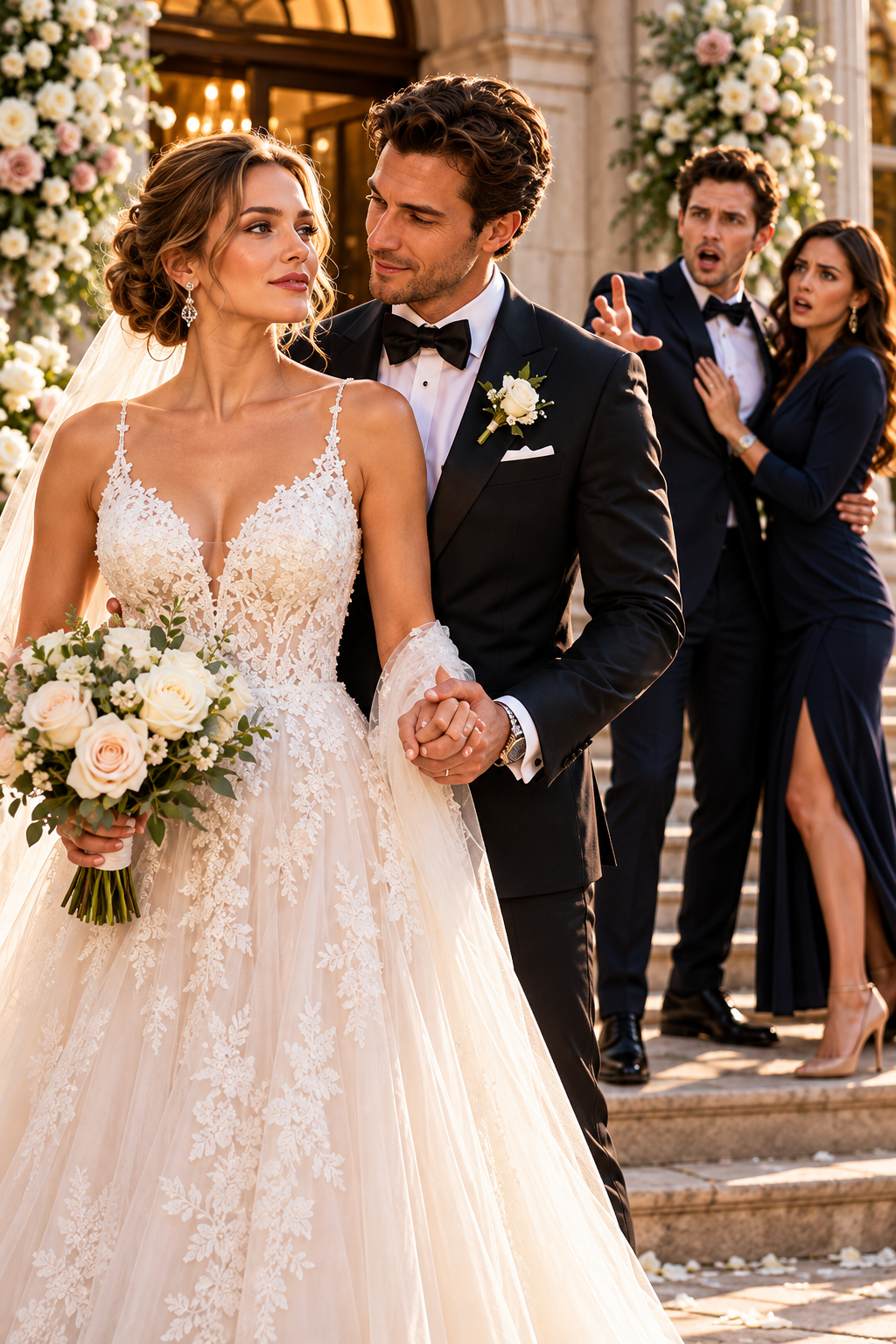
Part 2: One impulsive question became a carefully chosen marriage
Adrien had flown in from New York that morning with the lunch my mother had asked him to deliver. His eyes moved from the empty chair beside me to the Instagram story still glowing on my phone. “He didn’t come,” I said, turning off the screen. “He went to be someone else’s boyfriend.” Adrien didn’t insult Ethan or offer easy sympathy. He placed the lunch in front of me and said, “Eat something first. Then I’ll take you home.”
At a family dinner the month before, Henry Hayes had once again pressured his grandson to date seriously. Adrien had leaned back in his chair and said that if the family refused to stop arranging introductions, he might find someone he trusted, sign a fair prenuptial agreement, and enter a practical marriage that suited them both. That memory returned as I watched him beside the bureau’s empty chair. “Do you still need a wife?” I asked. Adrien’s gaze snapped to my face.
He did not answer immediately. “You’re hurt,” he said. “I can take you out of this building, but I won’t make a permanent decision for you while you’re in pain.” I told him I was thinking clearly. I wasn’t marrying him to make Ethan jealous or prove someone else wanted me. I had simply realized I had already waited seven years and refused to waste an eighth.
I laid out my terms: we would keep our finances and careers separate, and if the marriage didn’t work after a year, we would part without destroying each other. I raised my chin and asked whether he was brave enough to do it. He reminded me this was my last chance to reconsider. “I’m sure,” I said, and pushed Ethan’s ring to the bottom of my bag. Adrien still didn’t take me directly to the counter.
First, he asked his assistant to find a family-law attorney with no business relationship to Hayes Group. The attorney spoke to me alone, explained Nevada marriage law and the consequences of marriage and divorce, and asked repeatedly whether anyone was pressuring me. Only after I confirmed the decision was mine did Adrien and I submit a new application. A canceled ceremony slot had opened that afternoon, and we carried our license into the civil marriage office together.
When the officiant asked us to stand closer for the photograph, Adrien didn’t touch me. He lowered his voice and asked, “May I?” I nodded; his shoulder barely brushed mine when the camera flashed. At p.m., I held a signed copy of our marriage certificate, with both our names beside the same date. “You can reconsider everything you decided today,” he told me quietly, “but while this marriage exists, no one will treat you like an option who can be left waiting forever.”
Ethan finally arrived at a restaurant on the Strip around six. I sat near the window while Adrien stepped outside to take a call. The food had gone cold, and the neon lights were beginning to glow beyond the glass. Ethan rushed in, sweat at his temples, and bent toward me as if to take my hand. “Clare, I’m sorry I’m late.” I pulled away. “You weren’t late. You never came.”
Part 3: Ethan called my marriage betrayal after leaving me behind
Ethan sat across from me and explained that Maya’s grandmother was sick. The old woman had demanded to meet Maya’s boyfriend and refused her medication until Maya brought someone home. Maya had no other family in Nevada, he said. What was he supposed to do—stand by while an old woman made herself worse? He said he intended to text but his phone had died, and he had planned to return after lunch.
He spoke as if we had missed a casual reservation instead of our wedding. “We can apply for another license any day,” he said, reaching toward my face. “You’ve always been compassionate. You can’t blame an elderly woman.” I asked if he knew how many times I had called him. He said he knew I had been worried, and suggested we go tomorrow. I told him there was no need.
I took the signed marriage certificate and ceremony photograph from my bag and placed them on the table. Ethan looked at the license number, the signatures, and the picture. Then he forced a laugh and asked where I had gotten fake documents. I pushed the certified copy toward him; the names Clare Bennett and Adrien Hayes appeared side by side. His face changed as he realized the ceremony had happened that afternoon.
He shot to his feet and accused me of marrying the first man I could find because he was a few hours late. The restaurant door opened behind us. Adrien returned with my wrap and draped it over my shoulders, saying the air conditioning was cold. Ethan stared at him and accused us of planning this together. I put a hand on Adrien’s wrist before he could answer and laid out the timeline: before nine, I intended to marry Ethan; at one, I saw him at Maya’s apartment; only afterward did Adrien and I apply for a license.
“Revenge would require me to care how you reacted,” I said, standing. Ethan stepped in front of me and reminded me of the seven years we had shared. “I didn’t throw them away,” I answered. “You did, when you chose to become another woman’s boyfriend while I waited to become your wife.” I told him my attorneys would review my role at Northbridge Technologies, my shares, and Northbridge’s license to Astra Data’s intellectual property.
On the drive to the Bennett estate in Summerland, I held the marriage certificate until its edge marked my palm. I worried about how my parents would react; before twenty-six, the most rebellious thing I had done was insist on dating a man they thought lacked stability. Now I had married Adrien without warning them. The car passed through the gates as Red Rock Canyon darkened in the setting sun. Adrien didn’t rush me out of the car or ask if I regretted it.
Inside, Richard and Eleanor Bennett and Henry Hayes were waiting in the living room. Henry lifted his cane and pointed at Adrien, accusing him of kidnapping me from the marriage bureau. Adrien stood still and said, “She asked me.” Everyone turned to me. I placed the license and certificate on the coffee table and explained that Ethan hadn’t come, so I had decided I would not wait anymore.
Richard asked how long I had been alone at the bureau. When I told him more than four hours, his teacup hit the table hard enough to make me straighten, bracing for anger. Instead, he closed his eyes and exhaled. He said that although he had disagreed with my plan to marry Ethan, the Bennett family office had completed its review of a possible Northbridge investment. “Thank God nothing was signed,” he added.
Part 4: My parents offered home without conditions or blame
Eleanor came over and touched my cheek. She asked why I hadn’t called them to come get me. I admitted I thought they would be disappointed. Her eyes filled. “We’re disappointed because he failed to value you, not because you trusted the wrong person.” She said I could stay at the estate or try living with Adrien; no one would make that choice for me.
The questions I had carried since childhood remained unanswered. When I was twelve, the aunt who cared for me died and I entered Nevada’s foster system. The Bennett Foundation funded programs for foster children and teenagers aging out of care. Eleanor met me through one of them. I resembled their late biological daughter, Meline, around the eyes, but the Bennetts didn’t take me home on impulse. For six months, they visited me, completed background checks and home studies, accepted social-worker visits, and eventually adopted me through the courts.
They gave me excellent schools and a secure home, but they rarely criticized me or asked much of me. Richard nodded when I brought home perfect grades; Eleanor took me shopping while keeping an almost painful distance. I decided they had taken me in because I resembled the daughter they lost, and that I could never truly become their child. Henry cleared his throat and told Adrien a marriage should not be treated as an angry stunt. “Clare is your wife only while she willingly chooses this life. If she doesn’t, you let her go cleanly.”
Adrien said he understood, without declaring his love in front of everyone. He simply placed a box of tissues within my reach. That night, Eleanor opened the bedroom I had used since I was twelve. The bedside lamp still had the low, warm setting I preferred as a frightened child. She stood in the doorway and said, “Wherever you sleep tonight, this will always be your home.”
The next morning I went to Ethan’s apartment in Henderson to collect my things. When my spare key turned, I saw silver heels in the entryway. Maya stepped out of the guest room rubbing her eyes, wearing an oversized men’s shirt I had bought Ethan for his birthday. The primary bedroom door opened behind her, and Ethan emerged in lounge clothes. Both of them stopped when they saw me.
“Clare, let me explain,” Ethan began. I told him he didn’t need to. Maya insisted nothing had happened and said she had stayed because her grandmother’s health had frightened her. Ethan blamed me for misreading the situation and said I was turning a difficult morning into a reason to destroy seven years. But I had come to collect my clothes, books, and documents, not to argue about what the shirt meant.
As I packed, Ethan followed me from room to room, explaining that he had only helped Maya because she needed someone. He reminded me of every time she had called: when her car broke down, when she had a fever, when a client humiliated her. Each time, he said he was only being a good employer. Each time I had admitted discomfort, he had asked why I couldn’t be more generous. I walked past both of them, zipped my suitcase, and told Ethan I didn’t love him anymore.
Part 5: My company owned the technology Northbridge depended on
At the apartment door, I left my key beside a letter my attorney had prepared. Astra Data owned the copyrights, source code, and derivative rights to its core forecasting model. Northbridge held only a two-year, nontransferable license, and renewal required a negotiation between the companies. The expiration date had been in the contract long before our relationship ended. I was resigning as chief strategy officer, Astra would not renew the license at quarter’s end, and the Bennett family office was ending its discussions about Northbridge’s Series C financing.
Ethan grabbed the letter and accused me of trying to destroy his company. I told him Northbridge hadn’t been built by one person and wouldn’t collapse because I left. He said I was mixing business with personal matters. I replied that I was following the contract. I wasn’t ending the license early, taking clients, or recruiting employees; Northbridge had rented the right to use Astra’s model for a limited period, and no one was entitled to it forever.
Maya stepped forward and said Ethan had sacrificed a lot for Northbridge, too. “You have the Bennett family behind you, so of course you can walk away,” she said. “Northbridge is everything he has.” I looked at her and told her to stay and help him save it. As the elevator doors closed, Ethan stared as if he had finally understood I wasn’t waiting for him to say the right words.
Adrien lived in a modern house on the western edge of Summerland, overlooking Red Rock Canyon. I assumed we would continue living separately, but he pointed out Henry already knew about the marriage and might move into Adrien’s office if we vanished into different homes. He placed a set of keys in my hand. “You can use the guest room or return to the Bennett house. Look at the room first; if you dislike it, we’ll change it.”
The guest room faced the canyon and had a broad desk, shelves of mystery novels, white orchids, and a warm bedside lamp. I stopped in the doorway. It looked like the reading room I had once described to Adrien. He said he had borrowed the idea when the house was renovated two years earlier; it had always been a guest room and nobody had used it. There were no clothes in my size or slippers waiting for me, only signs that he remembered a casual conversation.
After dinner, he placed a postnuptial agreement on the table. Our premarital assets would remain separate, shared expenses would be negotiated, and either of us could request separate living arrangements. Neither the Bennett nor Hayes family could use business relationships to pressure me into staying. “I proposed this marriage,” Adrien said. “You should be able to end it without proving your reasons are good enough.”
He took another bedroom, knocked before entering mine, and asked before moving my luggage. On the bedside table, beneath a glass of water, he left a note: “I don’t know whether you prefer complete darkness or a narrow gap. Your choice.” When I woke from a nightmare after midnight, he was working in the study. He didn’t ask if I had dreamed about Ethan; he warmed milk and waited until I decided whether to talk.
Part 6: Ethan asked me to hide my marriage for his investors
Three days later, Ethan blocked my path outside Astra’s office. He looked as if he hadn’t slept, and the license-expiration notice was crumpled in his hand. He said Maya’s grandmother might return to intensive care at any time, and Maya believed her greatest wish was to see her granddaughter in a wedding dress. Maya had no boyfriend, he said, so he had agreed to a symbolic ceremony that weekend.
The word wedding tightened something in my chest. Ethan and I had toured three venues; each visit had been canceled because of a meeting. We scheduled engagement photos twice, but the first time Maya went to the hospital and the second time a project under her supervision failed. Now one sentence from her grandmother was enough for Ethan to arrange a wedding in three days. He asked me to delay announcing my marriage to Adrien.
Northbridge’s Series C funding was about to begin, and investors had always assumed Ethan would marry into the Bennett family, he explained. If my marriage became public while he appeared at Maya’s ceremony, investors might question his judgment. He suggested that Adrien and I could end our marriage after I calmed down, and then Ethan and I could start again. I told him he wanted me to conceal my marriage while he stood beside Maya in a wedding ceremony, all so he could preserve the Bennett family’s credibility until financing closed.
“It doesn’t count,” Ethan said. “It’s fake.” I replied that every time he sacrificed me for Maya, the pain was real. He grabbed my wrist, asking if I truly didn’t care. Building security separated us immediately. Adrien arrived from a conference room, told Ethan to let go, then watched me decide whether to leave. I later learned he had instructed security not to let Ethan approach me because he saw the bruising on my wrist.
I told Adrien that protecting me didn’t give him the right to decide who could enter my workplace. He went still, then called security and canceled the instruction, asking them to follow my decisions and standard visitor policy. He apologized without excuses. That mattered. Adrien could be wrong and still listen when I told him so; Ethan had often treated my boundaries as evidence that I didn’t love him enough.
Astra Data had fewer than thirty employees, but its supply-chain forecasting model was ours. The copyrights, source code, and improvements had always belonged to Astra. When Ethan started Northbridge with little capital, I granted his company a two-year license at a symbolic price and joined as chief strategy officer. I had helped secure its first clients and quietly used my credibility and relationships, but business magazines called Ethan a self-made visionary. I never corrected them because I thought our success was shared.
I began separating Astra from Northbridge one agreement at a time. I didn’t end the license early, take clients, or recruit employees who wanted to stay. Adrien asked whether I wanted Hayes Group to offer bridge financing. I said not yet, and he left the decision with me. A Northbridge software contract earned by its own team continued through normal channels; only the attached strategic investment was withdrawn. “Taking back what belongs to you doesn’t require innocent employees to pay for his decisions,” Adrien said.
Part 7: Maya’s fake wedding became public evidence of her lies
Over the next two months, Astra moved into a larger office in the innovation district. I invited an early partner to return and began launching an independent product. Richard instructed the Bennett family office to compete in Astra’s financing process under the same standards as any other institution. We chose a San Francisco fund with no connection to either family. Richard sent me a short message: “Well done.” Five minutes later, he invited me home for the apple pie my mother used to make.
Ethan grew more desperate as Northbridge’s investors learned the license would expire. A major project managed by Maya produced inconsistent data, and a client suspended acceptance testing. Northbridge wasn’t collapsing because I had made a phone call; it was finally facing the cost of operating without Astra quietly correcting its weaknesses. Ethan repeatedly asked me to renew the license for another year. I asked him why, but he couldn’t say that he believed I owed him my work because I had loved him.
Maya’s wedding was moved from a small chapel to a luxury resort on the Strip. It now had a designer gown, floral installation, band, photographer, and reception. Maya messaged me, asking me to attend so her grandmother would believe the ceremony and continue treatment. I didn’t answer. On the same day, Adrien and I attended Astra’s product launch at another hotel, announcing independent Series B financing from investors unrelated to the Bennett or Hayes families.
Several business reporters who had expected to cover Maya’s event came to our launch instead. By evening, clips of Maya walking beside Ethan beneath an arch of white roses were spreading online. Her grandmother sat in a wheelchair with tears in her eyes; when the officiant asked if she approved of her new grandson-in-law, the old woman looked startled. Maya took the microphone and said her grandmother was too emotional to speak. Ethan sent me a photograph of the two of them beneath the flowers, with a message: “You can look at this and feel nothing.”
I didn’t reply. Adrien gently took the phone from my hand and turned off the screen. Then he reminded me I had promised him dinner before accepting another interview. He drove me to a casual Mexican restaurant and ordered mild carne asada tacos without cilantro, which I hated. When I asked if my mother had told him that, he looked down at his water and admitted he remembered from the last time we ate together, three years earlier.
At ten that night, a Las Vegas gossip site claimed Northbridge’s founder had abandoned his seven-year fiancée and secretly married his executive assistant. Investors demanded an explanation before midnight. Ethan called Maya repeatedly, ordering her to remove the videos. She cried and insisted relatives had posted them without permission. The next day, a hospital review exposed a worse lie: no physician had told Maya her grandmother was terminal or had only a month to live.
Part 8: The grandmother exposed the story Maya had invented
The doctors had warned that the grandmother’s condition could recur, but had never described her as dying. Once she recovered enough to speak clearly, she told Maya she had never asked to see her married. She had only told her granddaughter to stop sacrificing her personal life for work. Maya had invented the dying wish that justified everything. Ethan learned the truth in the hallway of the hospital.
The grandmother overheard them arguing and pointed at Maya. “When did I ask you to bring your boss here and deceive me? The first day you brought him home, I asked if he had a fiancée. You told me they had already separated.” Maya began to cry and said she had been terrified of losing her grandmother. She said she loved Ethan and never meant to destroy my relationship. “I thought if he kept choosing to help me, maybe he cared about me too.”
For the first time, Ethan didn’t wipe away her tears. He left the hospital and came directly to Astra. A summer storm broke over Las Vegas, and rain soaked through his suit while reception refused to let him upstairs. When the elevator opened, he hurried toward me, saying Maya had deceived him. Her grandmother never wanted a wedding; the old woman’s condition had never been as bad as Maya claimed.
He spoke like a man who had finally found evidence that would save him. He said he had suspended Maya and would repair the damage from the wedding. Then he asked if we could start over. I told him that when Maya lied about needing a boyfriend, he didn’t know the truth—but he did know I was waiting at the marriage bureau. When she claimed her grandmother wanted a wedding, he didn’t know that was false—but he knew we had been planning ours for three years and he had never made time for it.
He said Maya’s lies were her responsibility. I agreed, then reminded him that believing her, protecting her, and sacrificing me were his choices. “Being deceived doesn’t excuse the way you treated me.” He caught my hand and said he had only thought I would never leave. There it was, the truth beneath every excuse. He had always known I would be hurt; he simply believed I would remain where he left me.
I pulled my hand free. He asked if I loved Adrien. “That is between Adrien and me.” Ethan looked relieved and said I was using him to forget. I answered that even if I hadn’t fallen in love yet, Adrien had never demanded I surrender my boundaries to prove I cared. His car waited beyond the glass doors. He stood under the awning in the rain and let me decide when to leave. Ethan called after me, “Clare Bennett, I can wait for you.” I didn’t look back.
Part 9: I chose a real marriage after learning what love required
The longer I lived with Adrien, the harder it became to ignore the small things he remembered. He knew I drank coffee without sugar but added honey after working late. He kept heating patches in the car because an old injury hurt in cold weather. He said my name before approaching from behind because I disliked being startled. Ethan had forgotten many of those things after seven years. Adrien never used them to claim a debt.
On a business trip, my flight back from San Francisco was delayed. Astra’s travel system automatically sent the update to my emergency contact. At one in the morning, I walked out of the airport and found Adrien near the arrivals exit. “You didn’t have to come,” I said. “I know,” he replied. “The system told me about the delay. It didn’t tell me to be here. I came because I wanted to.”
I found the wooden box by accident when a pipe leaked in his study. It fell from a shelf, spilling a high-school track photograph, a faded bookmark, a repaired paper crane, and a note I had written at seventeen: “Thank you for telling me I don’t have to smile when I don’t want to. When I become powerful one day, I’ll protect you, too.” At the bottom lay an interior design plan from two years earlier. Beside the canyon-facing guest room, Adrien had written: “Use the reading-room layout Clare once described. Keep as a long-term guest room.”
When he came home, I placed the plan on the table and asked how long he had loved me. He said he had kept the paper crane since I tucked it into his suitcase at seventeen. He agreed to marry me at the bureau because I had asked, not because he wanted to rescue me. He had never told me his feelings because I loved Ethan, and he didn’t want his affection to become another pressure in my life. His honesty frightened me, but it also showed me the difference between love and possession.
He knew he had crossed a line when he instructed security to keep Ethan away from my office. He apologized and canceled the instruction. When I named his mistake, he changed instead of defending his pride. Still, I feared that even a careful love could become another expectation. Adrien seemed to understand before I could explain. He placed signed divorce papers on the table and reminded me that our one-year agreement was not a sentence I had to complete.
I took the papers and returned to the Bennett house. Eleanor turned on the lamp in my old room and told me Adrien had noticed it was left on whenever I was afraid. Richard brought my adoption records and trust documents, showing that every legal record had named me their daughter, never a replacement for Meline. Eleanor admitted my resemblance had first drawn her attention, but six months of visits had made her love me for myself. Her distance had come from grief and fear, but she saw how it had left me believing I could never fully belong.
Part 10: I returned because I wanted him, not because he waited
Among the papers was an email Adrien had sent my father five years earlier. He had refused family-arranged introductions and written that I had the right to choose my own life. If I ever chose him freely, he would treasure that choice; if I didn’t, the Hayes family must never use the Bennetts’ kindness to influence me. I stayed at the estate for two weeks. Astra launched its product, and the first customer results exceeded our forecasts.
Hayes Group entered the procurement process like any ordinary client, and my team put its representatives through two rounds of price negotiations. One colleague joked that Mr. Hayes was impossible because he insisted a contract won through marriage would damage our brand if the product couldn’t earn it. One rainy evening, I left the office last. Adrien’s car wasn’t outside. He always parked in the same place, never honked, and never called to hurry me; if I looked up, the headlights were simply there.
I realized I didn’t miss having a driver. I missed the man who listened when I said no and took responsibility when he was wrong. I texted him: “Are the divorce papers still valid?” He answered immediately: “Always.” I asked, “What about our marriage?” This time he took longer: “As long as you want it, that is still valid, too.”
I drove to his house with the divorce papers in my bag. When he opened the door, he looked at the suitcase behind me and asked carefully if I had come to collect something. I handed him the papers and tore them in half. “I can’t promise my feelings are as deep as the love you’ve carried for nine years,” I said. “But I want to try honestly—not because you waited, not because you were kind, but because when I’m with you, I don’t have to make myself smaller.”
His eyes reddened. I put my arms around him first. His hands stopped in the air, and only after I nodded did he hold me. “Are you sure this isn’t gratitude?” he whispered. “It isn’t,” I said. “I came back because I started missing you.” The Northbridge crisis continued even after Ethan discovered Maya’s lies; an internal audit found she had transferred testing data to a California competitor while negotiating a job there.
The company terminated Maya and filed a civil action over the unauthorized disclosure. Ethan’s board demanded his resignation after repeated failures in judgment and governance. In his final email to me, he apologized and admitted he had seen my messages the morning of the marriage bureau. When Maya started crying, he decided he could be delayed for an hour or two because I would understand, as I always had. I didn’t reply. An apology could be accepted without reopening the relationship it arrived too late to save.
On the first anniversary of our Las Vegas wedding, Adrien made two bowls of noodles that weren’t especially good. After dinner, he placed our original one-year agreement on the table and said the term had ended; I could choose again. I handed him an envelope. It wasn’t a divorce agreement but a venue confirmation for a small chapel on Mount Charleston, a place we had passed together and both liked. I asked if he would have a wedding that belonged to us.
Part 11: The second wedding belonged to the life we chose together
Adrien stared at the confirmation so long that I raised an eyebrow. “You don’t want to?” I asked. He swept me into his arms and admitted he was trying not to look too eager. A light snow fell on Mount Charleston on our wedding day. Richard walked with me along an aisle lined with pine branches and white flowers. Halfway to the altar, he stopped and told me that when the Bennetts brought me into the family, it wasn’t so I could replace anyone.
“And today, I’m not giving you away to anyone,” he said. His hand trembled around mine. “You can always come home.” Adrien stood at the end of the aisle and didn’t rush me. Before the ceremony began, he leaned close and asked if I was nervous and whether I needed to stop. I took his hand and told him I wasn’t there because I had nowhere else to go. I was there because I chose him.
As we exchanged rings, I remembered the one I had pushed into the bottom of my bag the year before. I had thought I was only ending a failed relationship. I later understood I was also ending the life of a woman who always placed herself last and waited for someone else to grant her the dignity of being chosen. The next morning, I went to Astra for a meeting, and Adrien returned to Hayes Group.
At noon, he messaged me: “Working late on the first day after our wedding. Does Mrs. Hayes accept an internal family investigation?” I replied that Mr. Hayes could make an appointment like everyone else. He sent a photo from outside my office; his car was waiting in the familiar place with its lights on. I closed my computer. This time, I didn’t leave because I feared disappointing anyone. I left because I wanted to see him, too.
Two years later, Astra acquired a Canadian risk-analysis company and became an independent North American industry leader. During an interview, a reporter asked whether marrying Adrien had been the greatest turning point in my life. I thought about it and said no. The greatest turning point happened at the Clark County Marriage License Bureau, when I finally understood that another person’s absence was not evidence of my failure.
I didn’t need to keep waiting to prove seven years hadn’t been wasted. Adrien didn’t win me from another man; he showed me that love could move closer and still apologize, wait without claiming ownership, and hear no without turning it into a punishment. When I walked out of the studio, he took my briefcase and asked what time I was finishing. I told him six and said yes when he asked if I wanted him to pick me up.
He didn’t walk ahead and pull me forward. He didn’t trail behind and urge me to move faster. We left side by side, our steps matching.
✓ Lynn R. Adams
Part 2: One impulsive question became a carefully chosen marriage Adrien had flown in from New York that morning with the lunch my mother had asked him to deliver. His eyes moved from the empty chair…