My In-Laws Took My Husband’s Pregnant
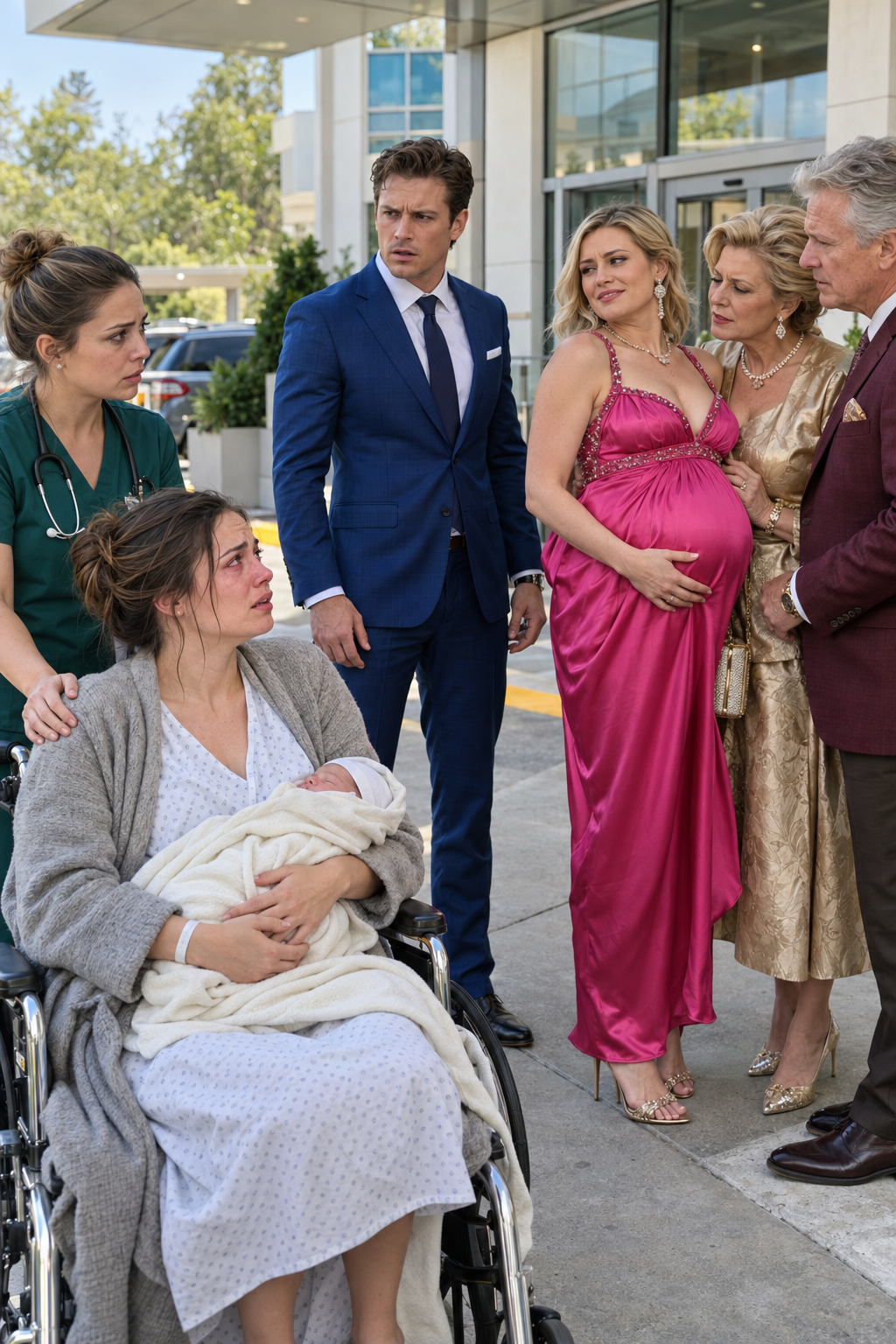
My In-Laws Took My Husband’s Pregnant Mistress to Her Checkup While I Gave Birth Alone—Then They Evicted the Wrong Woman
My husband missed the birth of our daughter because he was holding his pregnant mistress’s hand at her prenatal appointment.
His mother texted me from the specialist’s waiting room while I was six centimeters dilated.
Paige is frightened. You’ve always been strong. Please don’t make today harder than it already is.
At that afternoon, a nurse at St. Catherine Medical Center in Charlotte looked down at my paperwork and quietly asked, “Mrs. Hale, should I leave the father section blank for now?”
Another contraction rolled through me before I could answer.
I gripped the rail of the hospital bed.
Breathed through my nose.
Counted to eight.
Then I said, “No. His name is Andrew Hale.”
The nurse hesitated.
Everyone on the labor floor knew by then.
I had arrived alone in a rideshare carrying a leather overnight bag, a phone charger, and a framed ultrasound picture I had once believed Andrew would hold while our daughter was born.
Instead, Andrew was forty minutes away at a maternal-fetal medicine clinic with Paige Dalton, the twenty-nine-year-old marketing director he had been sleeping with for almost a year.
His mother, Diane, had driven them.
His father, Charles, had gone too.
Apparently Paige had experienced some spotting that morning.
Her doctor had already told them the baby appeared stable.
I knew that because Andrew had called me at a.m.
Not to apologize.
Not to ask how I was feeling.
Not to tell me he was coming home.
He called because he wanted the keys to our second SUV.
“Mom doesn’t like driving downtown in her car,” he said.
I had been standing in the kitchen with one hand pressed to the counter, waiting for another contraction.
“My water broke twenty minutes ago.”
Then Andrew exhaled as though I had created a scheduling problem.
I remember looking through the kitchen windows at the dogwood trees outside.
White blossoms shaking in the March wind.
I remember thinking how strange it was that a life could end without anybody dying.
“Yes, Andrew. Today.”
Another pause.
Then his voice lowered.
“Paige had bleeding this morning.”
I said nothing.
“She’s terrified.”
“My parents are already heading over there.”
Still I said nothing.
Finally he snapped, “Grace, don’t do that.”
“That silence thing. Like you’re judging everyone.”
A contraction tightened beneath my ribs.
I held the edge of the island.
“I’m in labor.”
“And Paige may be having a medical emergency.”
“She’s at a doctor’s office.”
“You’re going to a hospital.”
“You see the difference?”
Just not the one he thought.
Andrew believed one woman needed rescuing and the other woman could survive being abandoned.
He was correct about the second part.
That would become his most expensive mistake.
I did not call him again.
I did not call Diane.
I did not call Charles.
I did not ask my mother to come save me.
I did not beg one person in that family to remember that I existed.
And I did not tell any of them that inside the lining of my hospital bag, beneath a row of tiny pink newborn socks, was a brass key a dead man had given me eleven months earlier.
At p.m., my daughter Lily was born.
Seven pounds, two ounces.
A furious little mouth.
Dark hair plastered against her head.
Ten perfect fingers that closed around my index finger before the nurses had even finished cleaning her.
I did cry then.
Not because Andrew wasn’t there.
Not because his mother had chosen his mistress.
Not because Charles had once called me the daughter he never had and now couldn’t be bothered to answer his phone.
I cried because Lily opened her gray-blue eyes and looked at me as though she had arrived in the world expecting exactly one person.
And I was there.
That was enough.
The nurse placed her against my chest.
“Someone’s been waiting to meet you,” she whispered.
I kissed Lily’s forehead.
“No,” I said softly. “I’ve been waiting for her.”
My phone buzzed on the tray beside the bed.
One message from Andrew.
Everything okay?
No apology.
No Where are you?
No Is she here?
Just three words thrown in my direction as though I were a contractor supervising a delivery.
I took a photograph of Lily’s hand wrapped around my finger.
I stared at the screen for several seconds.
Then I locked my phone without sending it.
Fifteen minutes later, Diane texted.
Paige and baby are fine. Thank God.
I almost laughed.
Instead, I turned my phone facedown.
The first person besides medical staff to meet my daughter was a sixty-one-year-old night nurse named Rosa Martinez, who brought me apple juice at two in the morning and pretended not to notice when I struggled to sit up.
The second was Miriam Cole.
Miriam was not a relative.
She was not a friend.
At least not yet.
She was a trusts-and-estates attorney from Raleigh, with silver-streaked black hair, sensible shoes, and a habit of looking at people as though she had already read the ending of their story.
She entered my hospital room at nine the next morning carrying a bouquet of white tulips and a thin navy folder.
“You look exhausted,” she said.
“I had a baby.”
I looked at the folder.
“Did Walter send you from the grave?”
Miriam almost smiled.
“In a manner of speaking.”
Walter Hale had been Andrew’s grandfather.
Charles’s father.
Founder of Hale Development Group.
Owner of more land in Mecklenburg County than anyone in the family liked to admit.
To the public, Walter had been a hard businessman who turned three construction crews and a borrowed bulldozer into a regional real estate empire.
To his family, he had been an inconvenient old man who refused to die quickly enough.
To me, he had been Walter.
He liked peach cobbler.
Hated cable news.
Cheated shamelessly at gin rummy.
And during the final seventeen months of his life, I was the person who drove him to oncology appointments while everyone else claimed they were busy.
Andrew had been expanding the company.
Diane had been planning charity luncheons.
Charles had been “protecting Walter’s legacy,” which mostly meant pressuring him to sign documents.
I had been cleaning vomit from Walter’s slippers at two in the morning.
Not because he was rich.
Not because I expected anything.
Because no one should be left alone when he was scared.
Walter knew the difference.
Three weeks before he died, he asked me to drive him to an old bank branch in downtown Charlotte.
He moved slowly then.
Cancer had turned his strong hands into pale branches.
Inside the bank, he asked for a private room.
Then he handed me a brass key.
Stamped into it were three numbers.
“What’s this?”
“A door they don’t know exists.”
I had stared at him.
“Listen carefully, Grace.”
His breathing sounded like paper rubbing together.
“If my son ever tells you that everything belongs to him, don’t argue.”
I remember smiling because I thought he was being dramatic.
Walter didn’t smile back.
“If Andrew ever tells you that you have nowhere to go, don’t argue.”
My smile disappeared.
“If Diane starts talking about what this family deserves, don’t argue.”
He closed my fingers around the key.
“And if Victor Sloan ever puts a document in front of you and says signing it will make things easier…”
He leaned toward me.
“…make him put every promise in writing.”
Victor Sloan was the Hale family attorney.
He had represented Charles for twenty-four years.
Walter hated him.
“Why are you telling me this?”
“Because greedy people become careless when they think you’re powerless.”
He nodded toward the key.
“And because sometimes the kindest thing you can do for a thief is let him carry the stolen television all the way into the police station.”
I told him I didn’t understand.
Walter patted my hand.
“You will.”
He died eighteen days later.
The family held a funeral for three hundred people.
Charles delivered a speech about loyalty.
Andrew spoke about legacy.
Diane cried beneath a black lace veil.
I stood near the back because I had spent the previous night sorting Walter’s medication bottles for hospice disposal and didn’t have the energy to perform grief for strangers.
Afterward, Victor Sloan announced that Walter had left Charles operational control of Hale Development and divided most personal property among family members.
Andrew received several investment accounts.
Diane got jewelry.
Two cousins received vacation properties.
I received nothing.
At least publicly.
Nobody seemed surprised.
I wasn’t hurt.
I had never loved Walter for his estate.
But three days after the funeral, Miriam called.
She told me not to use the key.
“Walter created a private structure many years ago,” she said. “You’ll know when it’s time.”
“What structure?”
“I’m not authorized to tell you.”
“That sounds ridiculous.”
“Then why are you involved?”
“Because Walter was very specific.”
“About what?”
Her answer stayed with me.
“He said your greatest weakness was that you kept trying to prove you deserved a place in a family that benefited from making you earn it.”
I said nothing.
Miriam continued.
“He wanted to know whether you would finally walk away when they showed you exactly who they were.”
Now she stood beside my hospital bed while my newborn daughter slept against my chest.
I touched Lily’s back.
“Is it time?”
Miriam looked at me for a long moment.
“Not quite.”
I almost laughed.
“My husband abandoned me in labor to take his mistress to a prenatal appointment.”
“His parents went with her.”
“My mother says I should calm down because divorce would embarrass everybody.”
Miriam’s mouth tightened.
“That part I did not know.”
I looked toward the window.
Charlotte looked silver beneath the morning clouds.
“So what exactly are we waiting for?”
“For them to make a mistake they cannot explain away.”
“Haven’t they?”
She nodded.
She tapped the navy folder.
That was when I understood Walter’s warning.
Do not argue.
Let them believe I was powerless.
Let them believe the house belonged to them.
Let them believe silence meant surrender.
“Does Andrew know you’re here?” I asked.
“Keep it that way.”
Miriam’s expression shifted.
For the first time, she looked pleased.
Andrew arrived at the hospital eighteen hours after Lily was born.
He carried no flowers.
He was still wearing the navy sweater I had seen in Paige’s Instagram story the previous evening.
She had posted a photograph of three hands touching her stomach.
The caption said:
Family is who shows up when you’re scared.
I saved a screenshot.
Not because I wanted revenge.
Because Walter had taught me something during his illness.
People tell the truth accidentally when they believe no consequences are coming.
Andrew stood awkwardly inside my room.
Lily slept in the bassinet.
He rubbed the back of his neck.
“You had her.”
“Yesterday.”
“You could’ve called.”
I looked at him.
That stopped him.
There are moments when a person realizes the version of you he has memorized no longer exists.
Andrew saw it then.
The old Grace would have demanded answers.
The old Grace would have asked whether Paige mattered more.
The old Grace would have wanted him to understand the pain he caused.
Understanding was no longer necessary.
Documentation was.
He stepped closer to the bassinet.
“Can I hold her?”
His eyebrows rose.
“She’s sleeping.”
“I’m her father.”
“That means something.”
“It should.”
He flinched.
Not because I enjoyed hurting him.
Because pain was apparently the only language Andrew still recognized.
He lowered his voice.
“Look, yesterday got out of control.”
“Paige had blood on her clothes.”
“And her doctor said she was stable before you left the house.”
His face changed.
He hadn’t known I knew that.
“Who told you?”
“During your phone call.”
Andrew looked toward the door.
I could almost watch him reconstruct the conversation, trying to calculate what else he had admitted.
“I was under stress.”
“So was I.”
“That’s different.”
“Yes,” I said. “It was.”
He studied me.
“You’re being really cold.”
I looked at Lily.
“She was born at .”
Andrew swallowed.
“No, you know now.”
I reached for the bottle of water beside my bed.
“You didn’t know then.”
He said nothing.
I took a sip.
Finally he dragged the visitor chair toward the bed and sat.
“Mom thinks you should stay somewhere else for a few days when you’re discharged.”
There it was.
The second blade.
I set down the bottle.
“Because things at home are tense.”
“Paige is there?”
He hesitated.
“That’s temporary.”
“In my house?”
“It’s not technically your house.”
I almost heard Walter laughing.
I kept my face still.
Andrew mistook that for shock and rushed forward.
“Don’t make it sound ugly.”
“I haven’t said anything.”
“You’re doing that silence thing again.”
“Tell me what you want, Andrew.”
He leaned forward.
“Paige’s apartment has mold.”
“Convenient.”
“It was confirmed.”
“Last week.”
“You knew last week?”
His jaw tightened.
I smiled slightly.
Not warmly.
“When did you move her into our house?”
“She came last night.”
“Last night.”
“You were in the hospital.”
“Giving birth.”
“I know what you were doing.”
“Apparently.”
“This is exactly why I didn’t want to have this conversation here.”
“Then why did you?”
“Because Mom thinks it would be better if you understood before you came home and caused a scene.”
I stared at him.
He actually said it.
Before you came home and caused a scene.
My husband’s pregnant mistress had slept beneath the roof where I had painted our daughter’s nursery.
And I was being warned not to cause a scene.
I reached for my phone.
Andrew stiffened.
“What are you doing?”
“Checking the time.”
It was 11:16 a.m.
I made a mental note.
“What do you want me to do?” I asked.
His shoulders lowered.
He thought I was negotiating.
“Stay with your mom.”
Because my mother had called me seven hours after Lily’s birth and said, “Try to think long-term, Grace. The Hales can give that baby a life you never could on your own.”
Because when I told her Andrew had missed the birth, she sighed and said, “You’ve always been independent.”
Because my mother had spent fourteen years borrowing money from me while telling relatives I was lucky to marry rich.
Because blood could betray you just as efficiently as strangers.
“I’ll find somewhere.”
Andrew nodded quickly.
“How long?”
“Maybe a week.”
“Just until Paige settles down.”
I looked him directly in the eyes.
“Could you text that to me?”
His face tightened.
“I’m tired. I don’t want to misunderstand.”
“Grace, come on.”
“You said your mother thinks I shouldn’t return to the house because Paige is staying there. You’re asking me and your newborn daughter to live somewhere else for a week. Just text it.”
“So nobody can say later that I misunderstood.”
He stared at me.
For a second, I thought he remembered something Walter might have told him.
Then arrogance won.
Andrew pulled out his phone.
Mine buzzed seconds later.
Mom and I agree it’s best if you and Lily don’t return to the house for at least 7 days while Paige’s health situation stabilizes. I’ll arrange access to anything you need.
I read it twice.
“Thank you.”
He blinked.
“That’s it?”
“That’s it.”
I forwarded it to Miriam.
Her reply came less than a minute later.
Now we’re getting somewhere.
I was discharged the following afternoon.
The hospital volunteer wheeled me toward the entrance while Lily slept in her car seat.
It was raining.
I had stitches.
My abdomen felt hollow and bruised.
My milk had barely come in.
Every movement reminded me that my body had just done something enormous.
No husband waited at the curb.
No in-laws.
My best friend from college, Rachel Kim, drove down from Richmond when she heard what happened.
She arrived in an old Subaru with three coffees, two bags of baby supplies, and murder in her eyes.
“I know you said not to call him,” she said as she loaded my bag, “but just so you know, I’ve imagined six different versions of his funeral.”
“Only six?”
“I’m tired.”
I smiled for the first time in days.
Rachel looked at me.
“You’re not going to your mom’s?”
“Not exactly.”
Miriam had arranged a furnished townhouse owned by one of her clients.
Nothing luxurious.
Two bedrooms.
A clean kitchen.
A small fenced yard.
Thirty-day lease.
Paid by me.
That part mattered.
I didn’t want the Hales later claiming I depended on secret family funds.
Rachel drove me there.
Before we reached the townhouse, I asked her to make one stop.
First Federal Bank.
The downtown branch.
The safe-deposit officer looked at my brass key and disappeared behind a steel door.
A minute later, he returned carrying a long metal box.
My hands trembled only once.
I blamed postpartum hormones.
Rachel waited in the lobby.
I entered a private viewing room alone.
The box contained five items.
A flash drive.
A sealed envelope with my name.
A copy of a trust agreement almost two inches thick.
A red leather ledger.
And an old photograph.
The photograph showed Walter standing beside a young man I recognized immediately.
Henry Bennett.
My father had died when I was nineteen.
A highway accident outside Asheville.
A guardrail.
A funeral with an empty casket because the crash had been so bad my mother refused to let me see him.
I stared at the picture.
Walter had never told me he knew my father.
On the back, in Walter’s handwriting, were four words.
He tried to stop Charles.
My throat went dry.
I reached for the envelope.
If you are reading this, then either Miriam decided the time was right or my family finally did what I feared they would do.
Perhaps both.
First, understand something.
What I left you is not a reward for taking care of me.
Kindness bought with the expectation of inheritance is not kindness.
I left you responsibility because you demonstrated something my son forgot and my grandson never learned.
Property is not power.
The ability to decide what property becomes is power.
The envelope explained the trust.
Twenty-six years earlier, Walter had transferred a majority of Hale Development’s voting shares into the Lillian Hale Stewardship Trust, named after his late wife.
The trust owned sixty-one percent of voting control in Hale Development.
It also owned the Lake Wren estate where Andrew and I had lived.
And one hundred eighty-seven acres of undeveloped land south of Charlotte that had quietly appreciated to an estimated value of more than forty million dollars.
Charles had been serving as administrative trustee.
Not beneficial owner.
Not permanent trustee.
Administrative trustee.
Walter had amended the trust before his death.
Upon Walter’s death, Charles would remain temporary trustee for one year or until one of several removal conditions occurred.
Material fraud.
Unauthorized transfer of trust property.
Use of trust assets for personal benefit.
Or an attempt to dispose of a named protected resident without lawful authority.
My name was listed as a protected resident.
So was any child born to me while I was married to Andrew.
If Charles committed one of those acts, he could be removed through an expedited trustee action.
And the successor trustee named beneath him was:
Grace Bennett Hale.
I read the sentence four times.
Then I turned the page.
Walter had not given me the forty-million-dollar land parcel.
He had given me authority over what happened to it.
The trust’s mission clause required that at least half of its real estate holdings eventually support community housing, maternal care, elder care, or educational projects.
I sat back slowly.
Suddenly the wealth felt less like treasure and more like a loaded weapon someone had trusted me not to misuse.
Then I read the paragraph at the bottom of Walter’s letter.
Charles believes the land belongs to Hale Development outright.
Victor Sloan knows better.
If they ever attempt to mortgage, sell, pledge, transfer, or encumber it without successor approval, do not interrupt them too early.
Let them sign.
Let them represent ownership.
Let them establish intent.
Then call Miriam.
My pulse quickened.
I opened the red ledger.
Page after page listed payments.
Consulting fees.
Development reimbursements.
Private aviation expenses.
Transfers into LLCs I recognized from family conversations.
Some were labeled with Charles’s initials.
Others with Andrew’s.
Amounts ranging from $48,000 to $610,000.
At the end was another handwritten note.
This is incomplete.
Jonas Reed has the rest.
I inserted the flash drive into a secure laptop the bank provided.
Walter’s face appeared.
He was sitting in the library at Lake Wren.
Thinner than I remembered.
But his eyes were clear.
“Grace,” he said.
My hands went cold.
“If you are watching this, then I am dead, which is irritating but unsurprising.”
I laughed through my nose despite myself.
Walter continued.
“You will be tempted to think this is about money.”
He leaned toward the camera.
“It is not.”
For the next fourteen minutes, Walter explained what Charles had been doing.
Using trust-controlled assets to inflate Hale Development’s borrowing capacity.
Charging personal expenses as property management costs.
Moving development opportunities from the trust into companies controlled by Charles and Andrew.
Not enough to destroy the empire.
Enough to drain it slowly.
Walter had confronted Charles.
Charles denied wrongdoing.
Victor minimized it.
Andrew claimed ignorance.
Walter started collecting records.
Then cancer accelerated.
“I chose you because you have no appetite for the game,” Walter said.
“That is exactly why you may be the only person capable of ending it.”
His expression softened.
“You once told me you wanted to work with mothers who had nowhere safe to go after childbirth.”
I remembered.
It had been one of those late-night hospital conversations.
Before I married Andrew, I had worked for a nonprofit helping women leaving abusive households.
I quit after Diane kept making comments about how embarrassing it was that a Hale wife spent her days “dealing with shelters.”
Andrew told me we didn’t need my salary.
Then we started trying for a baby.
Then life became smaller.
Walter remembered.
“There is enough land,” he said, “to build something worthy of Lillian’s name.”
He looked directly into the camera.
“Do not waste this gift humiliating my family.”
“Simply stop them from humiliating anyone else.”
The screen went dark.
I sat there a long time.
Then I called Miriam.
“I opened the box.”
“I assumed you would.”
“There’s a photograph of Walter with my father.”
“You knew?”
“I knew they had met. I don’t know the full story.”
“What does ‘he tried to stop Charles’ mean?”
“That is something Walter instructed me not to discuss until the trust matter is secured.”
Anger flashed hot inside me.
“Everyone keeps deciding what I’m allowed to know.”
“You’re right.”
That answer stopped me.
She continued.
“You have every reason to be angry. But if we open two battles at once, Charles may destroy evidence in the one we can actually prove.”
I closed my eyes.
“Tell me what to do.”
I almost laughed.
“I’ve been banned from home.”
Three days after giving birth, I stood at the gates of Lake Wren with Rachel beside me and Lily asleep in the back seat.
The estate sat on twelve acres outside Charlotte.
White stone.
Black shutters.
A circular drive.
The kind of place that made strangers assume everyone inside had perfect lives.
The gate code no longer worked.
I tried twice.
Then once more while Rachel recorded the screen.
INVALID CODE.
I called Andrew.
He answered after four rings.
“The gate code changed.”
“Mom had security update everything.”
“Because emotions are high.”
“I need my clothes.”
“I said I’d arrange access.”
“Then arrange it.”
He exhaled.
“Not today.”
“Paige is resting.”
Rachel covered her mouth.
I looked at her.
She whispered, “I’m going to prison.”
I shook my head.
“Andrew, our daughter needs the bassinet from the nursery.”
“I can have someone bring it.”
“I also need my breast pump, my medical paperwork, and Lily’s clothes.”
“Text me a list.”
“Can I come inside?”
“Because this house belongs to my family and I’m telling you no.”
There it was.
Rachel’s eyes widened.
I kept my voice quiet.
“Would you mind texting that too?”
The line went silent.
Then Andrew laughed.
Not kindly.
“You’re trying to build some kind of case now?”
“I’m trying to avoid confusion.”
“I told you what’s happening.”
“You always do this.”
“Pretend to be helpless while controlling everything.”
I looked at the locked gates.
“My stitches are bleeding through my jeans, Andrew.”
That was true.
Rachel’s face changed.
Andrew went quiet.
For one second, I thought basic human decency might reach him.
Then he said, “That isn’t my fault.”
Something inside me closed.
Like a bank vault.
“I know,” I said.
Then I hung up.
Ten minutes later, Diane called.
I put her on speaker.
“Grace, this is becoming childish.”
Rachel mouthed, Oh my God.
“Showing up uninvited.”
“To my home?”
“To Hale property.”
“Andrew and I have lived there for six years.”
“And you should be grateful.”
I looked through the iron gates toward the house.
A pale pink Mercedes sat near the garage.
Paige’s car.
Diane continued.
“You need to accept that Andrew’s situation has changed.”
“His situation.”
“He has a wife and newborn daughter.”
“And another child coming.”
“With his mistress.”
“Don’t use ugly words.”
I almost smiled.
Diane had always hated accurate nouns.
She lowered her voice into the patient tone she used with caterers.
“Paige’s pregnancy is delicate. Stress could affect the baby. You are healthy. Lily is healthy. There is no reason you cannot be gracious.”
“You want me to be gracious about being locked out of my house three days after childbirth.”
“You are not homeless.”
“My husband barred me from the property.”
“Temporarily.”
“How long?”
“As long as necessary.”
“Could you put that in writing?”
Diane stopped.
I could almost hear Walter whispering from the grave.
Make them put every promise in writing.
“What game are you playing, Grace?”
“Then stop asking everyone to write things down.”
Rachel turned away so Diane wouldn’t hear her laugh.
I ended the call.
Within an hour, Miriam filed an emergency notice preserving my residency rights.
But she deliberately did not reveal the trust.
Because Charles had called a special Hale Development board meeting for the following Tuesday.
And according to Jonas Reed, Walter’s forensic accountant, Charles intended to do exactly what Walter had predicted.
He planned to pledge the one-hundred-eighty-seven-acre trust property as collateral for a two-hundred-million-dollar development loan.
Charles thought the land belonged to Hale Development.
Victor Sloan knew it didn’t.
If Victor signed the lender certification anyway, we would have more than family cruelty.
We would have intent.
Meanwhile, my own mother delivered the betrayal I should have expected.
Judith Bennett arrived at the townhouse on Sunday afternoon wearing pearls I had paid to have restrung for her birthday.
She did not ask to hold Lily.
She looked around the modest living room and sighed.
“You’re making everything harder.”
I sat on the sofa with Lily against my shoulder.
“For whom?”
“For everyone.”
“That sounds exhausting.”
“What do you want, Mom?”
She folded her hands.
“Diane called me.”
“Of course she did.”
“She thinks a mediated separation would be best.”
“Does she?”
“She said Andrew is prepared to be generous.”
I stared at my mother.
“Generous.”
“Don’t be sarcastic.”
“What did they offer you?”
Her face changed.
There are questions that land because they are accusations.
And questions that land because they are correct.
My mother looked away.
“They helped Mason.”
My brother.
“With what?”
She hesitated.
I stood carefully.
“How much?”
“Mason got behind on the restaurant.”
“How much?”
“Eighty thousand.”
My laugh came out once.
“So Diane gave my brother eighty thousand dollars.”
“It was a loan.”
“In exchange for what?”
“Then why are you here?”
My mother’s lips thinned.
“You always assume the worst.”
“I gave Mason forty-five thousand dollars two years ago.”
“He had setbacks.”
“I paid your mortgage for fourteen months after Dad died.”
“That was years ago.”
“I covered your surgery deductible.”
“Families help each other.”
“Apparently mine helps whichever side has the bigger checkbook.”
She flinched.
“You don’t understand what it was like after your father died,” she whispered.
Something in her voice changed.
I looked at her.
“What does Dad have to do with this?”
“You just said—”
“I said nothing.”
Too quickly.
Walter’s photograph flashed through my mind.
He tried to stop Charles.
My mother picked up her purse.
“Take the settlement, Grace.”
“What settlement?”
Her hand froze.
Neither Andrew nor Diane had told me about one.
My mother realized it immediately.
She moved toward the door.
“What settlement?”
“I don’t know the details.”
“You know enough to tell me to take it.”
She stopped with her back to me.
“Andrew is willing to give you one hundred fifty thousand dollars, six months of housing, and child support if you sign quickly and stop making accusations.”
I felt almost detached.
“One hundred fifty thousand.”
“It’s a lot of money.”
“For abandoning his wife and child?”
“For starting over.”
I looked down at Lily.
She yawned against my shoulder.
My daughter had been alive five days.
Her father’s family had already calculated the price of removing us.
My mother opened the door.
“Don’t become one of those women who destroys herself trying to win.”
I spoke before she stepped outside.
“Did you know Dad knew Walter Hale?”
Her body went completely still.
Not confusion.
Recognition.
My pulse slowed.
My mother turned around carefully.
“Where did you hear that?”
“Answer me.”
“Did Dad know Walter?”
She looked at Lily.
Then at me.
For the first time since she arrived, the superiority vanished from her face.
It was replaced by fear.
“Leave that alone.”
I heard Walter again.
Greedy people become careless when they think you’re powerless.
“What happened between Dad and Charles Hale?”
My mother’s eyes filled.
Not with tears.
With panic.
“You have a baby now.”
“Then act like it.”
She walked out.
I did not chase her.
I locked the door.
Then I called Miriam.
“My mother knows.”
“Knows what?”
“That Dad knew Walter.”
“She told me to leave it alone.”
Another silence.
“I’ll move faster.”
“That isn’t an answer.”
“What aren’t you telling me?”
“I’m telling you that tomorrow morning we secure the trust. After that, we talk about Henry Bennett.”
I looked at Lily sleeping in her portable bassinet.
For once, I agreed.
One battle at a time.
The next morning, Andrew emailed me.
Subject: SIMPLE SOLUTION.
Attached was a twelve-page postnuptial separation agreement prepared by Victor Sloan.
One hundred fifty thousand dollars.
Six months in a furnished apartment.
Standard child support.
A confidentiality clause.
A mutual non-disparagement clause.
And one paragraph requiring me to disclaim “any current or potential interest, possessory right, equitable interest, beneficiary interest, or residency claim relating to Hale-controlled real estate, trusts, companies, or associated entities.”
I called Miriam.
“He knows.”
“How can you tell?”
“The beneficiary language.”
Miriam went quiet.
Then: “Send it to me.”
Twenty minutes later she called back.
“Do not sign.”
“I wasn’t planning to.”
“Respond politely.”
“What should I say?”
“Whatever sounds like the old Grace.”
The old Grace.
The woman they believed could be intimidated with legal language and temporary housing.
I’m overwhelmed and trying to understand what is best for Lily. Before I make any decisions, could Victor confirm in writing that neither I nor Lily currently has any legal or beneficial interest in Lake Wren or any Hale family trust property?
Miriam read it.
Andrew replied twenty-three minutes later.
Victor confirms that neither you nor Lily has ownership or beneficiary rights in Hale family assets. Lake Wren and all related trust property remain under Hale family control. Signing simply avoids future disputes.
Miriam called me immediately.
“Forward the original email with headers.”
“Anything else?”
“Make coffee.”
“That’s legal advice?”
“Today it is.”
Tuesday morning, Charles Hale walked into the boardroom of Hale Development believing he was about to secure the biggest financing package in company history.
I know this because three directors later described his mood as triumphant.
Andrew sat to his right.
Victor Sloan sat to his left.
The lender’s representatives joined by video.
A map of the southern Charlotte property covered one wall.
One hundred eighty-seven acres.
Pine woods.
Two creeks.
Land Walter had refused to sell for decades.
Charles presented it as company collateral.
He described it as “unencumbered Hale-controlled real estate.”
Victor provided a legal certification.
Andrew signed the development authorization as executive vice president.
At 10:18 a.m., Miriam texted me.
I was feeding Lily.
I looked down at my daughter.
“Your great-grandfather was terrifying,” I whispered.
At 10:22, Miriam filed the emergency petition to remove Charles Hale as administrative trustee.
At 10:31, she delivered notice to the lender that the collateral being pledged was not owned by Hale Development.
At 10:44, the lender suspended negotiations.
At 11:03, Jonas Reed delivered a forensic summary to outside board directors showing more than $3.8 million in questionable charges involving trust-controlled assets.
At 11:19, Hale Development’s board counsel—not Victor, independent counsel—called an emergency recess.
At 11:37, Charles called me.
I watched his name flash across the screen.
I let it ring.
He called again.
Then Andrew.
Then Diane.
Then Victor.
I answered Victor.
His voice no longer sounded smooth.
“Mr. Sloan.”
“I understand you’ve retained counsel.”
“There appears to be some confusion regarding Walter’s estate documents.”
“Does there?”
“I think it would be wise for us to meet privately before anyone takes unnecessary action.”
“I thought I had no beneficial interest.”
“That email was a simplified explanation.”
“A complex structure.”
“You said I had no beneficiary rights.”
“You wrote it.”
It was almost beautiful.
“I was operating under information available at the time.”
“Yesterday?”
“Grace, legal structures can be interpreted differently.”
“Is that why you certified the land as company property this morning?”
His breathing changed.
There it was.
Not confession.
Recognition.
“I’m going to suggest,” Victor said carefully, “that all future communications go through counsel.”
“That seems wise.”
At 12:06, the judge granted a temporary restraining order preventing Charles from transferring, pledging, selling, or encumbering Lillian Hale Stewardship Trust assets until a hearing could be held.
At , Lake Wren security called me.
Not Andrew.
“Mrs. Hale?”
“We’ve been advised that your access credentials are being restored immediately.”
I looked at Rachel.
She raised her eyebrows.
“Can I enter the property?”
“Yes, ma’am.”
“Can my daughter?”
A confused pause.
“Of course.”
“Please email that confirmation.”
Rachel laughed so hard she nearly spilled coffee.
I did not move back in.
That surprised everybody.
Diane called it proof I had never cared about the marriage.
Andrew told mutual friends I was “using legal technicalities to punish the family.”
Charles said nothing publicly.
Privately, he sent me a message.
Walter was sick at the end. You have no idea what you’re interfering with.
I forwarded it to Miriam.
Then I returned to Lake Wren once.
With a deputy.
A locksmith.
Paige opened the front door.
She wore a cream maternity sweater.
Her hand rested on a belly that was just beginning to show.
For a second, neither of us spoke.
She looked younger than I remembered.
Not innocent.
Just young.
Behind her, the entry table held the framed wedding photograph Andrew and I had taken in Charleston.
It had been turned facedown.
“Andrew isn’t here,” Paige said.
“I’m not here for Andrew.”
Her expression hardened.
“If you’re going to start something—”
“I’m here for my belongings.”
She looked past me at the deputy.
I walked upstairs.
The nursery stopped me.
The pale green walls were the same.
The oak crib Walter had ordered before he died was still beneath the window.
But my daughter’s name plaque was gone.
White wooden letters Andrew and I had painted together.
On the dresser sat an ultrasound picture of Paige’s baby.
A stack of blue blankets filled the shelves.
My chest hurt.
Not because another baby existed.
That child had done nothing wrong.
Because someone had erased my daughter from her room before she was a week old.
Rachel swore softly behind me.
I walked to the closet.
There, inside a cardboard moving box, were Lily’s things.
Folded badly.
Her blankets.
The stuffed rabbit Walter had bought her.
And the wooden letters spelling her name.
I picked them up.
Paige appeared in the doorway.
“Andrew said you wanted a girl-themed nursery somewhere else.”
I turned around.
“No, he didn’t.”
She shifted.
“He said you agreed.”
For the first time, uncertainty crossed her face.
I could have attacked her.
I could have told her that the house she was standing in was controlled by a trust that had just removed Charles.
I could have enjoyed watching the confidence disappear from her face.
Instead I asked, “Did Andrew tell you I was moving out before I went into labor?”
She folded her arms.
“He said your marriage was basically over.”
“Months ago.”
That hurt more than I expected.
Not because I wanted him.
Because it meant the humiliation had been planned.
“What else did he tell you?”
“I’m not discussing our relationship with you.”
I began packing Lily’s clothes.
Paige watched.
After a minute, she said, “His parents are excited about this baby.”
I looked at her.
She lifted her chin.
It was meant as a wound.
“They’ve been wonderful to me.”
“Diane says she finally gets to enjoy a pregnancy without someone making everything difficult.”
Rachel stepped forward.
I held up one hand.
Paige saw it.
She expected anger.
I gave her none.
“Paige, I’m going to tell you something once.”
“When a family helps a man abandon one pregnant woman, don’t mistake their kindness to the next pregnant woman for character.”
Her face changed.
I picked up Lily’s box.
“They’re showing you what they do when a woman becomes inconvenient.”
I walked past her.
Downstairs, Diane entered through the kitchen.
She stopped when she saw the deputy.
“What is this?”
“Property retrieval,” he said.
Diane looked at me.
“You brought law enforcement into my home?”
I almost corrected her.
Instead I said, “I brought a witness.”
“You’ve humiliated this family enough.”
Rachel muttered, “That sentence should be framed.”
Diane ignored her.
“You think some piece of paper from Walter gives you the right to destroy everything Charles built?”
News traveled fast.
“I haven’t destroyed anything.”
“The loan collapsed.”
“Because Charles pledged property Hale Development doesn’t own.”
“He built that company with Walter.”
“Then he should understand the difference between company property and trust property.”
Her face reddened.
“You were a nobody when Andrew met you.”
The deputy glanced at her.
I kept my voice level.
“That may be true.”
“You lived in a one-bedroom apartment.”
“We introduced you to people you never could have met.”
“We gave you a life.”
I shifted Lily’s box against my hip.
“No, Diane.”
She blinked.
“You gave me access.”
I looked around the foyer.
“Those aren’t the same thing.”
A week later, Charles was temporarily removed as trustee.
Three weeks later, the removal became permanent.
Victor Sloan resigned as Hale Development’s family counsel before the disciplinary complaint reached the state bar.
The board placed Andrew on administrative leave pending an internal review.
Diane stopped posting photographs.
My mother called twelve times.
I answered on the thirteenth.
“Grace,” she said.
Her voice sounded small.
“Can we talk?”
“I mean in person.”
“About Dad?”
“If that’s what you want.”
She came to the townhouse the next morning.
She looked ten years older.
She held an envelope.
“I should have told you years ago.”
My entire body tightened.
For several seconds, she stared at Lily’s bassinet.
“Your father worked for Hale Development.”
“No, he didn’t.”
“He consulted for them.”
“Dad sold industrial equipment.”
“That was part of it.”
“Before you met Andrew.”
I did the math.
Andrew and I met when I was twenty-six.
Dad died when I was nineteen.
“So Walter knew him through the company.”
“What did Dad try to stop?”
My mother’s hands shook.
“A land deal.”
“What land?”
“I don’t know.”
“I truly don’t know.”
She swallowed.
“Henry came home one night and said Charles Hale was moving properties between companies. He said signatures were wrong. Dates were wrong. He found payments to people who weren’t supposed to be receiving them.”
My heart hammered.
“Did he tell Walter?”
“What happened?”
“Walter believed him.”
“And Charles?”
“Charles said your father was trying to extort the family.”
I felt cold.
“That’s a lie.”
“Then why didn’t you tell me?”
“Because your father died eleven days later.”
The room changed.
Not literally.
But suddenly the walls felt too close.
I stared at my mother.
“The accident.”
She nodded.
“It was ruled an accident.”
“What aren’t you saying?”
Her face crumpled.
“I was scared.”
“Of Charles?”
She looked toward the window.
That was answer enough.
“You took money from Diane.”
“Not then.”
“For Mason.”
“You let them buy silence twice.”
“That isn’t fair.”
“I had two children!”
“And I was one of them.”
She started crying.
“You should have told me.”
“I wanted you away from them.”
“You encouraged me to marry Andrew.”
“Because by then I thought maybe I had been wrong.”
I stared at her.
“You thought marrying me into the family Dad was afraid of would fix something?”
“He loved you.”
“No, Mom. He liked how much I tolerated.”
She covered her mouth.
For once, I did not comfort her.
That had been another job assigned to me too early.
My mother finally placed the envelope on the table.
“This came after your father died.”
Inside was a photocopy of a deed.
A parcel number.
A transfer between two LLCs.
One controlled by Walter’s trust.
One controlled by Charles.
At the bottom was my father’s signature as a witness.
The date beside it was three days after his funeral.
I stared at it.
My hands went numb.
“Where did you get this?”
“It was mailed to the house.”
“Two weeks after the funeral.”
“And you kept it?”
“I didn’t know what it meant.”
“Dad’s signature is dated after his death.”
“Why didn’t you go to police?”
That stopped me.
“I took it to a detective.”
“He said it could be a clerical error.”
“I don’t remember.”
My mother closed her eyes.
“Detective Paul Mercer.”
The name meant nothing to me.
I called Miriam after my mother left.
She answered immediately.
“Tell me you found something boring.”
“I found a deed signed by my father three days after he was buried.”
Then Miriam said, “Do not photograph it.”
“Do not email it. Do not upload it. Put it in an envelope, lock your door, and wait for me.”
“You told me you didn’t know the full story.”
“You knew there was a story.”
“Was Dad’s death an accident?”
“I don’t know.”
“That answer isn’t good enough anymore.”
For the first time, fear entered Miriam’s voice.
“Grace, listen to me. The trust fight was civil. This may not be.”
I looked toward Lily.
She was awake.
Watching the ceiling fan spin.
I suddenly understood Walter’s caution.
He had not hidden the trust only because he feared Charles would steal assets.
He had hidden it because he feared what Charles might do when cornered.
The months that followed changed everything.
My divorce from Andrew became public after he filed first, apparently believing that made him look decisive.
It did not.
His attorney tried to frame our separation as mutual.
My attorney introduced the text instructing me not to return home with our newborn.
His attorney suggested Andrew had planned to “reintegrate” us after Paige’s medical crisis.
Then came the locked gate.
The disabled access code.
The nursery photographs.
The one-hundred-fifty-thousand-dollar agreement.
The written statement that Lily and I had no rights in property they knew sat inside Walter’s trust.
Judges are human.
They notice patterns.
Andrew received supervised transitional parenting time at first because he had barely interacted with Lily during her first weeks and because the court wanted a structured schedule.
I did not try to keep him from his daughter.
That surprised him.
“You could make this harder,” he told me after one custody conference.
We stood in the courthouse hallway.
“Why don’t you?”
“Because Lily isn’t a weapon.”
His face tightened.
“You’re treating me like a criminal.”
I adjusted the strap of my diaper bag.
“I’m treating you like a man whose choices have consequences.”
He looked exhausted.
For the first time since I had known him, Andrew seemed to understand that charm could not reverse documented facts.
“Did you ever love me?” he asked.
I studied him.
His eyes lifted.
“That’s the worst part.”
I walked away.
Paige left Lake Wren before her baby was born.
Not because I evicted her.
When the trust officially restored control of the property to my authority, I gave everyone living there ninety days to relocate.
Including Diane.
Including Charles.
Including Andrew.
Including Paige.
Andrew accused me of cruelty.
I reminded him I had been given zero days with stitches and a newborn.
I still gave them ninety.
Paige lasted twelve.
She called me one evening.
I almost didn’t answer.
Her voice shook.
“I’m leaving Andrew.”
I sat at the kitchen table.
“That’s your decision.”
“He lied to me.”
“He said you couldn’t have another child.”
I closed my eyes.
“He said Lily’s birth was complicated and you told him you were done.”
“That conversation never happened.”
“I know that now.”
She started crying.
“I thought…”
She stopped.
“I thought he picked me because I was different.”
I looked toward Lily’s room.
“What does that mean?”
“It means men like Andrew don’t usually choose a woman because she is different.”
“They choose a situation where they can be the same.”
She cried harder.
I did not tell her everything would be okay.
I did not absolve her.
She had knowingly slept with a married man.
She had stood in my nursery and tried to wound me with my in-laws’ excitement.
But I also did not punish her child for her choices.
“What do you need?” I asked.
She went quiet.
“I thought you hated me.”
“I don’t have enough spare energy.”
A broken laugh.
“My apartment really did have mold.”
“I believe you.”
“I don’t have anywhere to go.”
There it was.
The moral test.
Walter had given me control of tens of millions of dollars because he believed property should become something more useful than revenge.
I could hear his voice.
Do not waste this gift humiliating my family.
Simply stop them from humiliating anyone else.
I gave Paige the number for the nonprofit where I had once worked.
Then I called the director myself.
I did not tell them who Paige was.
Only that she was pregnant and needed short-term housing.
Two days later, she moved into a furnished transitional apartment.
Diane called me furious.
“How dare you interfere?”
“I helped a pregnant woman find safe housing.”
“She belongs with Andrew.”
“She belongs wherever she chooses to live.”
Diane went silent.
The irony was too obvious even for her.
Nine months after Lily’s birth, the old Lake Wren estate reopened.
Not as my home.
I never wanted to live there again.
The downstairs offices became counseling rooms.
The west guest wing became six furnished suites.
The pool house became a childcare center.
The ballroom where Diane once hosted fundraising dinners became a communal dining space.
We called it Lillian House.
Short-term housing for postpartum mothers, pregnant women in unstable living situations, and women leaving financially abusive households.
The project did not make me richer.
It made the money mean something.
The one-hundred-eighty-seven-acre property became the planned site for the Lillian Maternal and Family Health Campus.
Prenatal services.
Postpartum mental health care.
Temporary housing.
Job training.
A place designed specifically around the moments when women were most likely to be told they were burdens.
Hale Development survived.
Charles lost control.
Andrew lost his executive position.
Independent directors took over daily operations.
Jonas Reed’s forensic review identified more than six million dollars in questionable benefits and related-party transactions accumulated over years.
Some were repaid.
Some became civil claims.
Some were referred to investigators.
Victor Sloan’s problems became his own.
My mother sold her house and moved closer to my brother.
Our relationship did not magically heal.
Forgiveness without accountability is just permission wearing prettier clothes.
I allowed her to see Lily.
I did not allow her to rewrite what happened.
Andrew eventually became a more consistent father.
Not a better husband.
That chapter was closed.
But he learned to arrive on time.
Learned where the diapers were.
Learned the pediatrician’s name.
Learned that fatherhood happened during ordinary Tuesdays, not staged photographs.
Paige gave birth to a healthy boy.
Andrew’s son.
She and I never became friends.
That would have been false.
But once, three months after her baby was born, she came to Lillian House carrying a box of donated newborn clothes.
She stood in the lobby beneath the brass plaque honoring Walter and his wife.
“I don’t expect you to forgive me,” she said.
“I was cruel to you.”
She nodded.
“I’m sorry.”
I looked at her.
This time, I believed she understood what she was apologizing for.
“Take care of your son,” I said.
She nodded again.
That was enough.
On the first anniversary of Lily’s birth, we held the official groundbreaking ceremony for the maternal health campus.
There were cameras.
County officials.
Former shelter clients.
Rachel stood beside me holding Lily, who was now determined to steal everyone’s sunglasses.
I had just finished speaking when Miriam appeared near the back of the crowd.
One look at her face told me she had not come to celebrate.
She waited until the last reporter left.
Then she approached carrying a flat archival box.
“What is that?”
“Something from Walter’s off-site records.”
My stomach tightened.
“You found more?”
“Jonas found it behind a false panel in an old accounting cabinet.”
Rachel took Lily.
I followed Miriam into the unfinished site office.
She locked the door.
Inside the box were photographs.
Old invoices.
Copies of land records.
A cassette tape.
And a yellow legal envelope sealed with Walter’s initials.
Miriam handed it to me.
My name was written on the front.
Grace Bennett Hale.
Only after Charles loses control.
I opened it.
The first page contained one sentence.
Grace, your father did not discover the fraud by accident.
I looked at Miriam.
She said nothing.
I turned the page.
Walter’s handwriting continued.
Henry came to me because Charles asked him to destroy original survey records connected to the southern land.
My heart began pounding.
That was the land beneath the future maternal health campus.
I kept reading.
Henry refused.
He made copies.
Charles learned about them.
After Henry’s death, the copies disappeared.
I sat down.
Miriam pulled out another photograph.
And a third man.
A police detective.
On the back:
Paul Mercer. Charles introduced him.
The detective my mother had taken the forged deed to.
The detective who called my father’s impossible signature a clerical error.
I felt the room tilt.
“Is he alive?”
Miriam nodded slowly.
“Retired. Lives outside Charleston.”
I looked again at the forged deed.
Then at Walter’s letter.
There was one final paragraph.
If you are reading this, you now control the only institution powerful enough to protect the records Henry died trying to preserve. Before you accuse anyone, locate the original survey packet. It contains a name Grace will recognize.
My hands went cold.
“A name I’ll recognize?”
Miriam reached into the box.
“There’s more.”
She placed a photocopy on the table.
A storage receipt.
Dated nineteen years earlier.
Signed by my father.
The storage unit had been rented under another name.
Judith Bennett.
I stared at it.
Miriam looked genuinely unsettled.
“She told you she didn’t know where the documents were.”
“Then either she lied…”
She stopped.
“Or someone used her name.”
My phone rang.
Neither Miriam nor I moved.
It rang again.
I answered.
Her breathing was ragged.
“Grace, where are you?”
“At the project site.”
“You need to leave.”
My spine stiffened.
“Someone came to my house.”
“I don’t know.”
“Call police.”
She started crying.
“Grace, listen to me. They weren’t looking for money.”
My eyes went to Walter’s box.
“What were they looking for?”
“The papers.”
“What papers?”
“The ones your father gave me before he died.”
Everything inside me stopped.
“You told me you didn’t know anything.”
“I was trying to protect you.”
“Where are they?”
“I moved them.”
Another sound came through the phone.
Then my mother whispered, “Oh God.”
The line went dead.
I stood so quickly the chair scraped backward.
Rachel opened the office door.
“What happened?”
I grabbed Walter’s envelope.
“My mother lied.”
Miriam was already dialing 911.
I looked down at the last item inside Walter’s box.
A certified copy of a land transfer.
Charles Hale’s signature appeared at the bottom.
My father’s forged signature appeared beside it.
And underneath both was a third signature.
Witnessed by:
Judith Bennett.
For a second, I could not breathe.
Then I noticed something handwritten in the margin.
Three words.
Not Walter’s handwriting.
My father’s.
Ask her why.
I stared at my mother’s name.
At the date.
At the document that might connect my family’s betrayal, Walter’s hidden trust, and my father’s death nineteen years earlier.
Outside, people were still taking photographs beside the groundbreaking sign.
Lillian laughed in Rachel’s arms.
Sirens sounded somewhere in the distance.
I picked up the forged deed, called my mother again, and when her voicemail answered, I left the quietest message I had spoken since the day Andrew locked me out of my own house.
“Mom, when you’re safe, could you explain one small thing to me?”
I looked at her signature beneath my dead father’s name.
“Why did you witness a deed three days after Dad’s funeral?”
✓ Lynn R. Adams
My In-Laws Took My Husband’s Pregnant Mistress to Her Checkup While I Gave Birth Alone—Then They Evicted the Wrong Woman My husband missed the birth of our daughter because he was holding his pregnan…