My HOA Clear-Cut Forty Protected Acres—Then My Brother Evicted Me, Certain He Owned the Forest They’d Already Sold
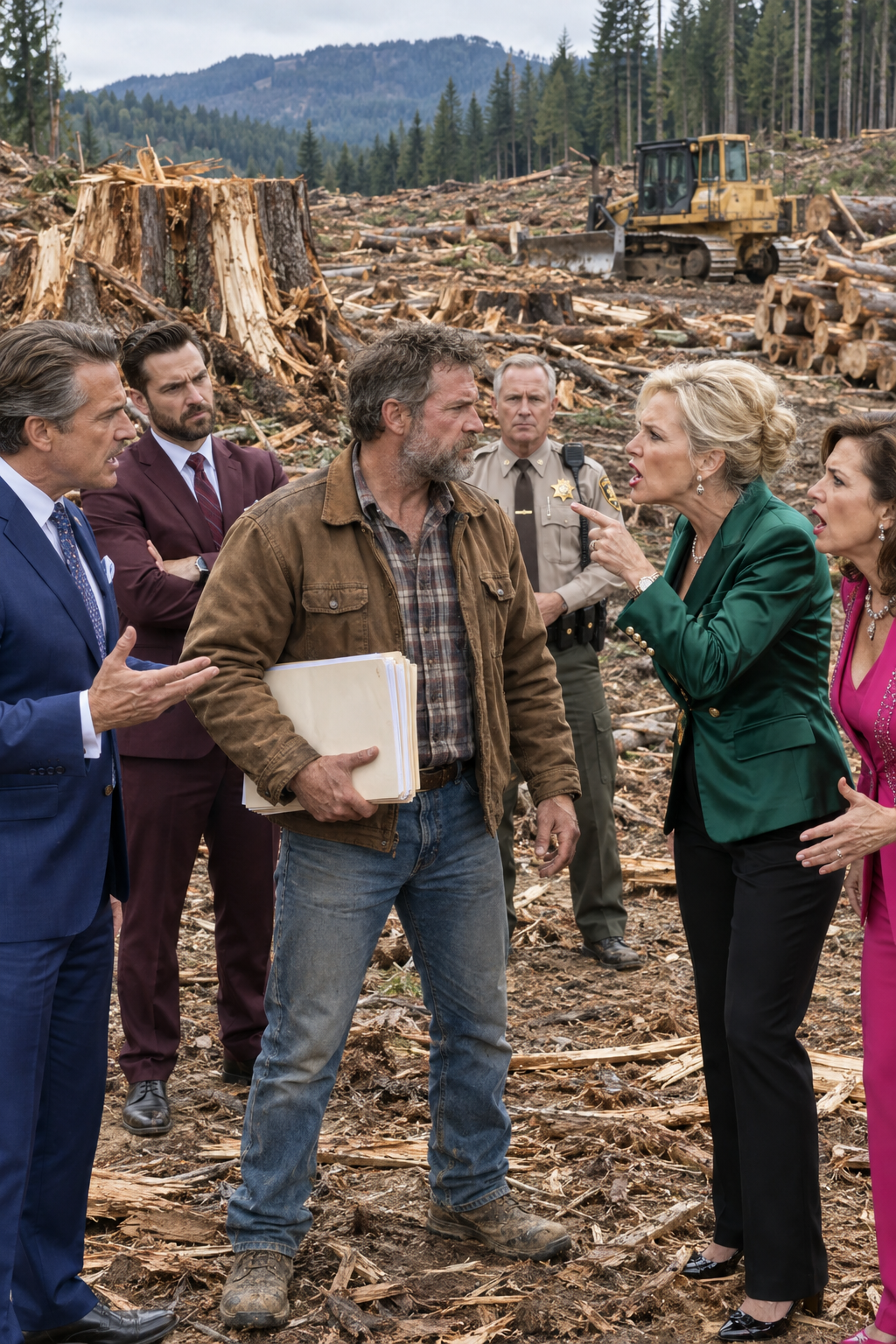
My HOA Clear-Cut Forty Protected Acres—Then My Brother Evicted Me, Certain He Owned the Forest They’d Already Sold
Four days after my father’s funeral, my brother put two of my suitcases on the front porch and told me I had seventy-two hours to disappear from the house where I had cared for our parents for twenty-seven years.
The next morning, forty acres of three-hundred-year-old Douglas fir behind the ridge were on the ground.
And my brother stood beside the HOA president, smiling for a photograph.
I didn’t cry.
That seemed to bother them more than anything.
Grant had expected a scene.
He had dressed for one.
Gray cashmere coat. Polished brown boots. The silver Rolex he bought six months after telling Dad he was “temporarily short on cash.”
His wife, Denise, stood behind him in the doorway with her arms folded over a cream sweater.
She had already changed the curtains in my mother’s kitchen.
That detail hurt more than the suitcases.
Mom had sewn those old blue curtains herself during the winter she was losing strength in her hands.
They were ugly.
They didn’t hang straight.
I loved them.
Now they were stuffed into a black contractor bag near the porch steps.
Grant pointed at my luggage.
“You’ve had long enough, Nora.”
Long enough.
Dad had been buried on Monday.
It was Friday.
I looked at my brother.
Then I looked past him through the open doorway.
Someone had moved Dad’s oak chair away from the window.
My coffee mug was still sitting beside the sink.
“Is that everything?” I asked.
Grant blinked.
He had prepared himself for anger.
“Is that everything you wanted to say?”
His mouth tightened.
“You’re fifty-nine years old. You can’t expect to live here forever.”
“I wasn’t aware I had.”
“You know what I mean.”
For twenty-seven years, Grant had called this place “the old farm” whenever it needed money and “the family estate” whenever it was worth something.
When the barn roof collapsed, it was the old farm.
When Dad needed help with property taxes, it was the old farm.
When Mom’s medical bills arrived, it was the old farm.
When Grant brought investors from Seattle to look at the ridge after Dad died, suddenly it was the Whitaker family estate.
I bent down and picked up the smaller suitcase.
Grant’s expression changed.
For the first time, he looked uncertain.
“You’re really leaving?”
“You told me to.”
Denise gave a small laugh.
I looked at her.
She stopped laughing.
I didn’t beg Grant to reconsider.
I didn’t remind him whose hands had washed our mother after she could no longer stand.
I didn’t remind him who had driven Dad eighty-six miles to the VA hospital twice a month.
I didn’t remind him who had repaired fences, cleared storm damage, paid overdue taxes, and slept beside a hospital bed in the living room for almost three years.
I didn’t tell him what was inside the green steel box already locked in the trunk of my Subaru.
That box was why I could leave quietly.
Dad had given it to me eleven days before he died.
He was almost too weak to lift his water glass by then.
But when he pushed the box toward me, his fingers closed around my wrist with surprising strength.
“Not in the house,” he whispered.
I thought he was confused.
“Take it somewhere Grant can’t get to.”
I stared at him.
Dad’s eyes were still sharp.
“Listen to me, Nora.”
I leaned closer.
He smelled like cedar soap and hospital blankets.
“If they ever come for the trees, don’t argue about the house.”
I felt something cold move through me.
“What trees?”
“The north stand.”
“No one’s coming for the north stand.”
His fingers tightened.
“They will when they think I’m gone.”
Then he said the strangest thing.
“If they cut them, let them finish proving what they are.”
I thought the morphine was talking.
Dad died eleven days later.
The green box went into my car before the funeral.
Grant never saw it.
As I carried my suitcase down the porch steps that Friday afternoon, a white SUV turned into the driveway.
The magnetic sign on its door read CEDAR CREST PROPERTY MANAGEMENT.
Behind it came a black Range Rover.
Valerie Cross stepped out.
Valerie was president of the Cedar Crest Homeowners Association, the gated development bordering our western property line.
She was sixty-two, silver-blonde, always perfectly dressed, and capable of making an insult sound like a meeting agenda.
She smiled as if we were old friends.
We weren’t.
Her eyes moved to my suitcases.
“I heard there was a transition.”
“That’s one word for it.”
Grant came down the steps.
The two of them exchanged a look.
Valerie turned toward me again.
“Grant has been very cooperative about finally resolving the boundary situation.”
“There wasn’t a boundary situation.”
“There was from our perspective.”
“The county survey markers seemed fairly confident.”
Her smile thinned.
“That’s the kind of attitude that made negotiations so difficult with your father.”
“My father never negotiated with you.”
Grant sighed loudly.
“Don’t start.”
I put the suitcase into my Subaru.
Valerie watched me.
“You should know there will be forestry equipment on the north side tomorrow. For safety reasons, you need to stay clear.”
“What forestry equipment?”
Grant moved too quickly.
“Cleanup crews.”
I looked at him.
“Cleanup of what?”
“Fire mitigation.”
That was the first lie.
Not the biggest.
Just the first one they said directly to my face.
The north stand was forty acres of old-growth Douglas fir, western red cedar, hemlock, and maple.
Dad called it the Cathedral.
Some of those trees were already old when Washington became a state.
For thirty years, he had refused every logging offer.
After Mom got sick, one timber company offered enough to pay every medical bill she had.
Dad turned them down.
Grant never forgave him.
I remembered the argument.
Grant had been thirty-eight.
I was thirty-four.
He had spread the timber company’s offer across Dad’s kitchen table.
“This is stupid,” Grant said.
Dad sat quietly.
“We’re talking about trees.”
“No,” Dad answered. “You’re talking about money.”
Grant laughed.
“What do you think trees are?”
Dad looked toward the north window.
“Depends how poor your imagination is.”
That sentence stayed in the room for years.
Now Grant stood beside Valerie Cross and told me the Cathedral needed “fire mitigation.”
I looked at Valerie.
“Who approved it?”
“The appropriate people.”
Her smile returned.
“You don’t live here anymore, Nora.”
There it was.
Not screamed.
Not dramatic.
Just placed exactly where she knew it would hurt.
Behind her, Denise leaned against the porch railing as if watching entertainment.
Grant put both hands into his coat pockets.
“The property decisions aren’t your concern now.”
I looked at him for several seconds.
Then I nodded.
“All right.”
Grant frowned.
Valerie did too.
They had both expected resistance.
I closed the Subaru hatch.
“Anything else?”
Grant stepped toward me.
“For once in your life, don’t make this harder than it needs to be.”
I almost smiled.
“For whom?”
That stopped him.
Only for a second.
But I saw it.
I got into my car and drove away.
I didn’t go far.
Six miles down Highway 9 was the Copper Kettle Motel.
Dad used to joke that the place had survived three recessions, two floods, and every attempt at interior decorating since 1987.
The carpet was brown.
The bedspread was orange.
The ice machine made a noise like farm equipment.
It was perfect.
No one knew me there.
I carried the green steel box into Room 14, locked the door, closed the curtains, and set the box on the bed.
For twenty minutes, I just looked at it.
Then I turned Dad’s brass key.
Inside were five things.
A leather survey notebook.
A thick sealed envelope.
Three recorded deeds.
A flash drive.
And a yellow legal pad with nine words written in Dad’s shaky handwriting.
DON’T STOP THE CUTTING UNTIL YOU KNOW WHO SIGNED.
I read it twice.
Then a third time.
Underneath, in smaller letters, he had written:
Ask Evelyn Mercer about the covenant.
Evelyn Mercer had been Dad’s attorney for thirty-one years.
I called her.
She answered on the second ring.
There was a silence.
“Did he give you the box?”
My skin went cold.
“You knew?”
“I prepared most of what’s inside.”
“What is happening?”
“Where are you?”
“Copper Kettle.”
“Stay there.”
Another silence.
Then she said something I remember word for word.
“Whatever Grant tells you about ownership, do not correct him yet.”
I sat down.
“What did Dad do?”
“He made sure the person who spent her life protecting that land would be the person legally capable of protecting it after he was gone.”
I looked at the deeds.
“I don’t understand.”
“You will.”
“What about the north stand?”
Her voice changed.
“What about it?”
“Valerie said forestry equipment is coming tomorrow.”
There was no answer.
“What exactly did she say?”
I repeated it.
“Fire mitigation?”
Evelyn whispered one word.
“Go nowhere near the equipment. Photograph everything from public access or your own lawful property. Do not threaten anyone. Do not interfere. Do not tell Grant what you have.”
“You’re scaring me.”
“I’m trying to prevent you from saving them from their own mistake.”
That sentence made no sense until the next morning.
I woke to the sound of diesel engines.
Not outside the motel.
In my memory.
It was the kind of sound you know if you grow up around timber country.
Mechanical.
I dressed, drove back toward the Whitaker property, and stopped on the county road overlooking the north ridge.
Three feller bunchers were working among the trees.
Two skidders dragged whole trunks toward a landing.
Chainsaws screamed beneath the engines.
Logging trucks waited in a line.
The morning air smelled like sap.
Fresh-cut Douglas fir has a clean, almost sweet smell.
That morning, it made me sick.
I parked behind an abandoned fruit stand and raised Dad’s old binoculars.
The first tree I recognized was Number 17.
Dad had numbered the largest trees in the Cathedral twenty-three years earlier.
Number 17 was a Douglas fir just over nine feet across at the base.
A lightning scar ran down its eastern side.
Mom used to take a folding chair beneath it during summer.
I watched a machine grab it.
The saw head cut through the trunk in seconds.
Three hundred years standing.
Maybe forty seconds falling.
The ground shook from where I was parked.
I put the binoculars down.
I didn’t scream.
I didn’t call Grant.
I didn’t call Valerie.
I called Evelyn.
“They started.”
“How much?”
“Several acres already.”
“Can you identify the contractor?”
“Evergreen Northwest Logging.”
“Photograph the trucks.”
“And Nora?”
“Open the leather notebook.”
It was sitting on the passenger seat.
I opened it.
Every numbered tree was there.
Approximate age.
GPS coordinates.
Wildlife observations.
Photographs referenced by date.
Thirty-two years of forest inventories.
Dad hadn’t kept sentimental notes.
He had kept evidence.
At the back of the notebook was a photocopy of a recorded document.
WHITAKER OLD-GROWTH CONSERVATION COVENANT.
Executed nineteen years earlier.
Irrevocable.
Running with the land.
Logging prohibited except emergency removal of individually certified hazardous trees.
The covenant covered forty-three point six acres.
Almost exactly where the machines were working.
My hands went cold.
“They can’t cut any of this.”
“Then why aren’t we stopping them?”
“Because the emergency injunction is being prepared right now.”
“That’s not what I mean.”
I watched another cedar fall.
“Dad told me not to stop them until I knew who signed.”
“What does that mean?”
“It means your father believed Valerie could never do this alone.”
She paused.
“And neither do I.”
By noon, Grant called.
I let it ring.
He called again.
Then Denise.
Then Valerie.
I answered Valerie.
“Nora, you need to stop photographing the logging operation.”
I almost laughed.
“How do you know I’m photographing it?”
Then she recovered.
“You were observed.”
“You’re making people uncomfortable.”
“That must be difficult.”
“This is authorized work.”
“Then you shouldn’t mind photographs.”
“The contractor has safety concerns.”
“I’m standing on a county road.”
“You’re creating unnecessary hostility.”
I looked at the hillside.
A stand of cedar that had survived windstorms, wildfire smoke, ice, beetles, and generations of men was being fed into a machine because someone wanted a better view from expensive houses.
“I’m not the person operating chainsaws on someone else’s property, Valerie.”
Her tone hardened.
“Grant owns the property.”
That was the sentence Evelyn had told me to wait for.
I wrote down the time.
Valerie laughed.
“Don’t embarrass yourself.”
“Who told you he owns it?”
“I’ve seen the documents.”
“Which documents?”
“Nora, this conversation is over.”
She paused.
I kept my voice mild.
“I was just asking.”
“Which documents?”
She disconnected.
I called Evelyn.
“Valerie says she saw documents proving Grant owns the land.”
At that afternoon, a courier reached the logging landing.
At , every machine stopped.
A superior court judge had signed a temporary restraining order.
The silence afterward was worse than the noise.
Stumps covered the hillside like open wounds.
Twenty-seven point eight acres were already down.
By the time the survey team completed its first count two days later, the number was thirty-nine point seven acres.
Only a narrow corner of the protected stand remained untouched.
Grant appeared at my motel that evening.
He pounded on the door hard enough to shake the frame.
I opened it but left the chain engaged.
His face was red.
“What the hell did you do?”
“I made a phone call.”
“You shut down a million-dollar contract.”
“That sounds expensive.”
“This isn’t funny.”
“I’m not laughing.”
He lowered his voice.
“You need to call your lawyer and fix this.”
“I didn’t know I had enough authority to cause a problem.”
He stared at me.
“You don’t.”
“Then why are you here?”
That was another small payoff.
A tiny crack.
But sometimes the first crack tells you exactly where a wall will break.
Grant put one hand against the door.
“This property belongs to the family trust.”
“All of it?”
“You know it does.”
“No. I know you say it does.”
His expression shifted.
“You want money?”
I almost admired how quickly he reached the truth.
“That’s what this is about, right? You’re angry Dad made me trustee. Fine. What number makes you stop?”
I looked at my brother.
This was the boy I had once carried home after he broke his wrist falling from an apple tree.
This was the teenager whose college application I typed because Dad was working nights.
This was the man I loaned forty thousand dollars when his first business collapsed.
He had repaid none of it.
I had never asked.
Now he was standing outside a motel room offering to buy my silence about trees he had no right to sell.
“I don’t want your money.”
“Everybody wants money.”
“Dad didn’t.”
His face hardened instantly.
“Dad was an old fool.”
For the first time that night, Grant looked satisfied.
“He left millions of dollars standing in the dirt because you filled his head with sentimental garbage about Mom and that forest.”
“I never asked him not to sell.”
“You didn’t have to.”
Grant leaned closer.
“You were always there.”
The accusation in his voice was almost breathtaking.
As if caring for our parents had been a conspiracy.
As if staying had been manipulation.
As if his absence had somehow become my crime.
He looked around the motel room.
“Look where loyalty got you.”
That one landed.
I won’t pretend it didn’t.
The orange bedspread.
The buzzing fluorescent light.
My belongings packed into two suitcases.
My parents’ house six miles away, already being redecorated by the woman who had complained about visiting Mom because the medical equipment made her uncomfortable.
Grant smiled.
“I have the house.”
I said nothing.
“I control the trust.”
“I have the development agreement.”
“The timber contract.”
“The HOA already paid the access fee.”
I looked at him.
He realized he had said too much.
“What access fee?”
His mouth tightened.
“Forget it.”
“How much?”
“Was that part of the million-dollar contract?”
He stepped back.
“You’re unbelievable.”
Then he walked away.
I closed the door.
And wrote three words on the motel notepad.
HOA ACCESS FEE.
Evelyn arrived the next morning carrying coffee and a cardboard banker’s box.
She was seventy, small, silver-haired, and had the kind of calm voice that made arrogant men underestimate her right until the moment she handed them documents.
She set the box on my table.
“Your father expected Grant to challenge the estate.”
“That’s a polite way to say it.”
“He did not expect him to begin this quickly.”
“Begin what?”
Evelyn opened the first folder.
Inside was a plat map.
The Whitaker property had once been 684 acres.
I knew that.
What I didn’t know was what Dad had done with it.
Seventeen years earlier, after Mom’s diagnosis, my parents divided the land legally.
The farmhouse, barns, orchard, and sixty-two surrounding acres went into the Whitaker Family Living Trust.
Grant was successor trustee.
That was the document he had been waving around since the funeral.
But the remaining 622 acres had been transferred to something called the Mara Whitaker Stewardship Trust.
I stared at Mom’s name.
Evelyn watched me.
“Your father established it after your mother became ill.”
“Who owns the trust?”
“A trust doesn’t work quite that way.”
“You know what I’m asking.”
“You are successor trustee.”
I looked at her.
“I would have known.”
“Not necessarily.”
“I signed Dad’s checks. I handled taxes.”
“For the living trust.”
My mouth went dry.
She slid another document toward me.
It carried my signature.
I recognized the date.
Nine years earlier.
Dad had asked me to sign several estate-planning forms while we were updating Mom’s medical trust.
I had barely read them.
I trusted him.
“You accepted the successor appointment then,” Evelyn said. “It became effective at his death.”
I stared at the map.
The Cathedral was inside the Stewardship Trust.
Every inch.
So was the north ridge.
So was the old logging road Grant had apparently promised to the HOA.
“How much is this land worth?”
Evelyn leaned back.
“Before the current development pressure? Perhaps eight to ten million.”
I said nothing.
“Today, depending on what someone believes can be built around it, possibly twenty.”
That was the secret asset.
But looking at the number, I felt almost nothing.
Because Dad had done something better than leave me money.
He had left me responsibility.
The land Grant believed I had wasted my life protecting was legally under my control.
The old-growth stand Mom had refused to sell for cancer bills was not a forgotten corner of Grant’s inheritance.
It was the centerpiece.
Evelyn turned another page.
“And this is why Valerie Cross has a much larger problem.”
It was the conservation covenant.
The Stewardship Trust owned the land.
But a regional land conservancy held permanent enforcement rights over the Cathedral.
That meant even I could not decide to log it.
Neither could Grant.
Neither could an HOA.
Neither could a future buyer.
Dad had made the promise bigger than any one owner.
My eyes burned.
Not from weakness.
From understanding.
“He knew Grant would try to sell it.”
“I think he knew Grant might.”
“Why didn’t he tell me?”
Evelyn was quiet for a moment.
“Because he knew you would spend the rest of his life trying to repair the family before protecting yourself.”
I looked away.
She wasn’t wrong.
For years, I had been the person who made peace.
When Grant missed Thanksgiving, I told Dad work was probably hectic.
When he forgot Mom’s birthday, I ordered flowers and put his name on the card.
When he borrowed money, I made excuses.
When Denise insulted the farm, I changed the subject.
When Dad wanted to confront him, I said, “He’s still your son.”
Dad had protected me from my own habit.
“What happens now?”
Evelyn’s expression changed.
“Now we determine whether this was negligence or intentional timber trespass.”
“What’s the difference?”
“Potentially millions of dollars.”
The first survey estimate valued the standing timber alone at just under $3.4 million.
I thought that was enormous.
It turned out to be the smallest number anyone would discuss.
The conservancy hired ecological experts.
Some of the trees were more than four centuries old.
The stand contained nesting habitat.
A protected creek crossed its southeastern corner.
Heavy equipment had damaged the buffer.
Soil compaction would require years of restoration.
Removing invasive species after the clearcut would cost more.
Replanting was not enough.
You cannot replace a four-hundred-year-old ecosystem by putting seedlings into neat little rows and calling it restored.
Then came the legal multiplier.
Intentional timber destruction could expose the responsible parties to damages far above the raw lumber value.
Then came restoration damages.
Then habitat damages.
Then the covenant enforcement claim.
Then legal fees.
Then the injunction.
Then the lender.
That was where Cedar Crest began to die.
The HOA had been preparing something called Ridge Phase Four.
Seventy-three luxury homes.
Estimated project value: $38 million.
The selling point was the view.
Snow peaks.
And, according to the glossy marketing booklet Evelyn obtained during discovery, “uninterrupted sunset panoramas created through professionally managed forest clearance.”
I read that sentence three times.
Professionally managed forest clearance.
That was what Valerie called my mother’s trees.
The development lender had advanced Cedar Crest $11.6 million based partly on permits, site access, and construction schedules.
The only practical heavy-equipment route to Phase Four crossed the old Whitaker logging road.
The same road inside the Stewardship Trust.
The access fee Grant had mentioned?
$1.85 million.
Cedar Crest had paid it to the Whitaker Family Living Trust.
Grant had signed an easement agreement.
For land his trust did not own.
He had spent almost half the money already.
That was why he had been desperate.
He had sold something he didn’t own to people who had borrowed millions assuming they controlled it.
And because the court injunction now blocked that road, Ridge Phase Four had no construction access.
Every day cost money.
Valerie responded exactly as people like Valerie usually do when facts become dangerous.
She held a meeting.
Not with me.
Nearly two hundred Cedar Crest homeowners packed the clubhouse.
I did not attend.
Someone sent me the recording.
Valerie stood behind a walnut podium beneath a brass sign reading COMMUNITY. INTEGRITY. LEGACY.
She wore red.
She told residents the Whitaker lawsuit was “a predatory attempt by a disgruntled beneficiary to exploit technical paperwork.”
She called the conservation covenant “an archaic document.”
She said the trees had been removed for wildfire safety.
She said the HOA had acted in good faith.
She said Grant had represented himself as authorized owner.
Then she used my name.
“Ms. Whitaker is currently seeking an unreasonable financial windfall.”
I watched from the motel bed.
Evelyn sat beside me eating pretzels.
“Does that bother you?” she asked.
I looked at her.
“If you weren’t bothered, you’d be dead.”
On the screen, a homeowner asked Valerie how much money I wanted.
Valerie hesitated.
“At this stage, several million dollars.”
People shouted.
One man yelled, “For trees?”
I paused the video.
Evelyn looked at me.
But it wasn’t nothing.
I had heard that before.
From Grant.
From developers.
From timber companies.
From people who had never spent a winter watching eagles return to the same snag.
As if age had no value.
As if memory had no value.
As if keeping a promise was irrational because someone could calculate the board feet.
Dad had been right.
It depended how poor your imagination was.
The next week, Valerie’s attorney offered $600,000.
We declined.
They raised it to $1.2 million.
Grant came personally with an offer of $2 million if I signed a full release and granted Cedar Crest permanent access through the Stewardship Trust.
I declined.
He stared at me across Evelyn’s conference table.
“Do you have any idea what two million dollars is?”
“You’ve spent your whole life counting grocery coupons.”
“That helped.”
He looked humiliated for me.
That was almost funny.
“Nora, you are living in a motel.”
“You drive a twelve-year-old Subaru.”
“It starts.”
“You have no husband.”
“My husband died.”
“You have no children.”
“No career.”
That one was crueler.
I had been a forestry technician before Mom got sick.
I left a state job I loved because someone needed to stay.
At first I thought it would be six months.
Then a year.
Then Mom’s condition worsened.
Then Dad fell from the barn roof.
Then the medical appointments multiplied.
Then life simply closed around the choices I had already made.
I did bookkeeping from home.
Seasonal forestry surveys.
Tax preparation.
Anything flexible.
Grant called it “never doing anything.”
He leaned toward me.
“Two million dollars is more money than you will ever need.”
I folded my hands.
“Then why are you so determined to give it to me?”
He looked at Evelyn.
Then back at me.
“You really think you’re going to beat all of us?”
Another sentence worth remembering.
“Who is all of us?”
His jaw tightened.
“I didn’t mean anything.”
“You said all of us.”
“Figure of speech.”
It was small.
“This ends badly for you.”
Evelyn finally spoke.
“Mr. Whitaker.”
Grant turned.
“You may want to avoid threatening my client during active litigation.”
He left without answering.
Discovery began three days later.
That was when Cedar Crest’s story started collapsing.
The logging contractor produced its files first.
Evergreen Northwest Logging had not entered the property blindly.
They had asked for proof of ownership.
They had asked about protected timber.
They had asked about permits.
Someone had answered.
Valerie Cross.
She sent an email with a map.
The map showed the Whitaker boundary incorrectly.
Not by a few feet.
By almost half a mile.
The Cathedral had been colored green and labeled:
HOA EXPANSION BUFFER / APPROVED VEGETATION MANAGEMENT ZONE.
Attached was a certification letter from Harland Title Services.
Harland’s vice president?
Michael Cross.
Valerie’s brother-in-law.
The title letter did not say Grant owned the property.
It said something more careful.
“Based upon documents presented to our office, the signing party appears to possess sufficient authority to grant temporary vegetation-management access.”
Sufficient.
Three words doing the work of a lie while avoiding the courage of becoming one.
Then we found the wildfire report.
Valerie had repeatedly called the logging “fire mitigation.”
There had indeed been an arborist report.
But it recommended removing eleven hazardous trees.
Someone changed the final work order.
“11 individually marked removals” became “110-acre selective vegetation treatment.”
Then the acreage was later reduced to forty.
The original PDF still existed.
Metadata showed who edited it.
Cedar Crest’s property manager.
At Valerie’s request.
The case stopped being a boundary dispute.
It stopped being a misunderstanding.
It became something much uglier.
Valerie needed views for Phase Four.
Grant wanted money.
Harland Title wanted the development business.
The property manager wanted to keep his contract.
The logging company trusted documents it should have examined more carefully.
The lender trusted the HOA.
The HOA board trusted Valerie because property values had climbed forty percent under her presidency.
Everybody had a reason not to ask the next question.
And the trees could not speak.
Dad had known that.
So he had made paperwork speak for them.
Cedar Crest’s insurance carrier sent a reservation-of-rights letter.
Then another.
Then, six weeks into the case, it denied coverage for intentional environmental damage and knowing violation of recorded property rights.
That morning, Valerie called an emergency meeting.
HOA dues increased immediately.
Then came a special assessment.
$18,500 per household.
People exploded.
Suddenly the woman seeking a “financial windfall” was not an abstract enemy.
I became the reason retirees might have to refinance homes.
I received emails.
Some were angry.
Some were obscene.
Someone taped a note to my Subaru windshield.
YOU KILLED OUR COMMUNITY OVER TREES.
Put it into an evidence envelope.
Then I drove to the north ridge.
By then, the clearcut had turned brown.
The exposed soil baked in afternoon sun.
Foxglove and blackberry were beginning to push through the disturbed ground.
At the edge of what remained, Number 4 was still standing.
Dad had marked it in the notebook as approximately 510 years old.
I put my hand against the bark.
For the first time since the funeral, I cried.
No collapsing.
No screaming.
Just tears.
Not because I was losing.
Because winning would never put the forest back.
That was the part people missed.
Lawsuits are good at pricing damage.
They are terrible at reversing time.
“You’re Nora Whitaker?”
I wiped my face and turned.
A man stood about twenty feet away.
Late seventies.
Baseball cap.
Work jacket.
I recognized him from the Cedar Crest meeting video.
He had been the man who yelled, “For trees?”
He walked closer.
“My name’s Henry Wallace.”
His face reddened.
“I suppose you saw the meeting.”
“I shouldn’t have said that.”
He looked across the clearcut.
“My wife and I moved here twelve years ago.”
I said nothing.
“Valerie told us this was association land.”
“She told us the Whitakers had agreed to the firebreak.”
“She lied.”
“I know that now.”
Henry held out an envelope.
Inside was a printed email.
Sent eighteen months earlier.
From Valerie to the HOA board.
The subject line read:
WHITAKER RIDGE OBSTRUCTION.
The message was short.
Grant believes his father can be bypassed after incapacity. Daughter remains sentimental obstacle. Timing after succession will be critical.
I felt my pulse slow.
Not quicken.
That happens when something you feared becomes something you can prove.
“Where did you get this?”
“I was on the board until last year.”
“Why did you leave?”
“Valerie said I was obstructive.”
“What did you object to?”
“The road deal.”
I looked at him.
“What about it?”
“Too much money for too little paper.”
There it was again.
Henry looked embarrassed.
“I thought it was incompetence. I didn’t understand…”
He looked at the stumps.
“I didn’t understand this was the plan.”
That email became the first real crack in Valerie’s personal defense.
She had known about me.
She had known Dad objected.
She had anticipated succession.
The cutting had not happened because Grant accidentally misrepresented a boundary after Dad’s death.
They had been waiting.
Valerie’s deposition lasted nine hours.
For the first three, she was magnificent.
Offended by every implication.
She said “I don’t recall” thirty-seven times.
She said “to the best of my knowledge” twenty-four.
She blamed staff.
Consultants.
The contractor.
The title company.
At one point, she actually said, “I’m a volunteer homeowner.”
Evelyn slid the marketing booklet across the table.
“Did you approve this?”
Valerie glanced down.
“Page fourteen.”
Valerie turned to it.
Uninterrupted sunset panoramas created through professionally managed forest clearance.
Evelyn let the words sit.
“Which forest?”
“I would need to ask the marketing company.”
“You approved the sentence.”
“I approved the booklet generally.”
“Which forest?”
“I don’t know.”
“Is there another forest between Phase Four and the sunset?”
Valerie’s attorney objected.
Evelyn waited.
Then asked again.
“Mrs. Cross, which forest?”
Valerie finally looked toward me.
I had said almost nothing all day.
Her eyes held mine.
“The Whitaker ridge.”
“Thank you.”
Mini-payoff.
Devastating.
The next one came three weeks later.
Harland Title’s internal emails were subpoenaed.
Michael Cross had ordered a junior examiner not to conduct a full historical parcel search.
The junior examiner objected.
Potential conservation restriction referenced in 2007 transfer. Recommend full chain review before certification.
Michael responded twelve minutes later:
Not necessary. Client needs limited access opinion only. Do not broaden scope.
Two days after that email, Michael attended dinner at Valerie’s house.
Grant was there.
So was the property manager.
Phone location records proved it.
They all claimed they discussed a neighborhood charity auction.
The restaurant receipt said otherwise.
Four dinners.
Three bottles of Cabernet.
One notation handwritten on the merchant copy:
RIDGE CLOSING.
That was twist number one becoming visible to everyone.
They had not simply made the same mistake.
They had coordinated the same risk.
And they had assumed the risk belonged to someone weaker.
A fifty-nine-year-old woman in a cheap motel.
A caregiver with no impressive job title.
A sister who had spent decades fixing things without sending invoices.
Someone who could be pushed out of a house in seventy-two hours.
Someone who would probably take a check.
Someone who would probably be grateful.
Someone who would probably be too tired to fight a board, a title company, a contractor, a lender, and her own brother at once.
Dad had understood people like that.
He had also understood me.
That was why the last page in his notebook mattered.
I found it two months into the case.
It was folded against the inside back cover.
One paragraph.
If you are reading this because they cut the north stand, I am sorry. I tried to make the law stand where I may no longer be able to stand. Do not waste time proving you loved this place more than Grant did. Love is not the legal question. Authority is. Follow the signatures. They will blame the person with the least money first.
I sat alone in the motel room holding that page.
He had known.
Not every detail.
Not the names.
But the shape of it.
People with money create distance between themselves and ugly acts.
A board hires a manager.
A manager hires a contractor.
A title officer writes a careful letter.
A brother signs a document.
And when the trees fall, everyone points sideways.
Dad’s gift was not the land.
Not really.
It was making sure the pointing eventually led backward.
We amended the lawsuit.
Grant was added personally.
So was Valerie.
Michael Cross.
The property manager.
Harland Title.
Evergreen Northwest.
The complaint sought damages for trespass, timber destruction, covenant violations, restoration, misrepresentation, and conspiracy-related conduct.
Cedar Crest’s lender froze the remaining Phase Four funds.
Construction stopped.
Buyers walked away.
Deposits had to be refunded.
Contractors filed liens.
The HOA reserve account drained.
The clubhouse mortgage payment was missed.
Then something unexpected happened.
Homeowners began contacting me.
Not with threats.
With documents.
One sent minutes showing Valerie had discussed the “Whitaker acquisition” two years earlier.
Another sent a private newsletter promising Phase Four residents “permanent western views.”
A former landscape committee member provided maps showing the planned trail system extending into the Cathedral.
A retired accountant found budget entries for “off-site vegetation clearing” made months before Dad died.
Every person Valerie had dismissed became a witness.
Every committee she had bullied had minutes.
Every email she assumed no one would care about became another thread.
Systems protect powerful people until the system realizes the powerful person may drag everyone down with them.
Then systems turn fast.
Grant turned faster.
He asked to meet privately.
He asked again through Evelyn.
We agreed to a conference room.
No lawyers absent.
No side deals.
Grant looked older when he arrived.
His expensive coat was gone.
No polished confidence.
He sat across from me and rubbed both hands together.
“I made a mistake.”
I looked at him.
That was all.
“Nora, I made a mistake.”
“I heard you.”
“I trusted Valerie.”
He looked up.
“You didn’t trust Valerie.”
“What’s that supposed to mean?”
“You trusted money.”
His face changed.
“You think this is easy for me?”
“Denise is leaving.”
I said nothing.
“We may lose the house.”
“The house you removed me from?”
“That was Dad’s decision.”
“No. Dad made you trustee. You made it a weapon.”
He leaned back.
“I was angry.”
“He always respected you more.”
I almost laughed.
“Grant, Dad spent half his life bragging about you.”
“Not at the end.”
“At the end, you stopped visiting.”
His eyes flashed.
“I had a life.”
“So did I.”
“You chose this.”
There it was.
The old argument.
“You chose to stay.”
That surprised him.
For years I had softened that fact.
Explained it.
Defended it.
Not anymore.
“Yes, Grant. I chose it.”
He stared at me.
“I chose Mom when she couldn’t button her clothes.”
“I chose Dad when he couldn’t remember which pills he had taken.”
He looked away.
“I chose the farm when the taxes were late.”
His mouth tightened.
“I chose the forest when selling it would have made my life easier.”
I leaned forward.
“You chose something too.”
He looked at me again.
“You chose not to come.”
His face collapsed a little.
Not enough for forgiveness.
Enough for truth.
“I didn’t think it would go this far,” he said.
“The logging?”
“Any of it.”
“What did you think would happen?”
“Valerie said the covenant could be challenged.”
“Did you know about it?”
That was new.
He rubbed his forehead.
“I knew Dad had signed something.”
My pulse slowed again.
“A few years ago.”
“I saw references in tax papers.”
“Did you tell Valerie?”
I looked at Evelyn.
She looked at him.
Grant corrected himself.
“Not exactly.”
“What does that mean?”
“I told her Dad had some conservation arrangement.”
He swallowed.
“Before the access agreement.”
There it was.
The second twist.
Grant had known.
Maybe not every detail.
Maybe not the exact boundaries.
But he had known enough to ask.
He had simply chosen not to.
He looked at the table.
“Because she said Harland checked it.”
“That’s not why.”
“That’s not why.”
His voice cracked.
“Because I needed the money.”
No speeches.
No villain confession.
Just seven words.
He had debts.
A failed commercial project.
Personal guarantees.
A bridge loan.
Denise’s lifestyle.
He had borrowed against almost everything.
Valerie’s $1.85 million road payment looked like rescue.
Once he accepted it, he had to believe the paperwork.
Once he signed the easement, he had to believe the timber cutting would survive scrutiny.
Once the cutting started, he needed me gone before I asked questions.
So four days after Dad’s funeral, he put my bags on the porch.
Not because I was inconvenient.
Because I was evidence.
“Did Valerie tell you to remove me from the house?”
He said nothing.
His eyes filled.
That did not move me.
Not because I hated him.
Because tears arriving after consequences are not the same as conscience arriving before harm.
“She said it would simplify things.”
Evelyn wrote something down.
Grant looked panicked.
“You said this was settlement discussion.”
“You can’t use—”
“Your attorney explained the rules before we started.”
“This is exactly what Dad did.”
I looked up at him.
“He always made me feel like I was on trial.”
I shook my head.
“Dad kept asking you questions you didn’t like answering.”
Grant left.
That was the last time we spoke for almost five months.
The mediation took place in Seattle.
By then, damages models ranged from $14 million to more than $31 million depending on what claims survived trial.
Cedar Crest could not pay even the low end.
The board offered the reserve fund.
The clubhouse.
Three undeveloped parcels.
Future assessment revenue.
Harland Title offered policy limits.
Evergreen Northwest offered equipment and insurance proceeds.
Grant offered the farmhouse parcel.
That one almost made me laugh.
He had thrown me out of the house.
Now he wanted to give it back as settlement.
Not because I didn’t want it.
Because the case had stopped being about where I slept.
The conservancy demanded restoration funding.
I demanded permanent enforcement safeguards.
Evelyn structured the proposal.
The remaining old-growth acreage would receive expanded protection.
The clearcut would undergo a fifty-year restoration plan.
Cedar Crest would surrender its claimed access rights.
Phase Four would be abandoned permanently.
The HOA would transfer three undeveloped ridge parcels into conservation ownership.
And the responsible defendants would contribute financially according to their roles.
Valerie rejected it.
She called our proposal “vindictive.”
Two days later, Cedar Crest filed for bankruptcy protection.
Homeowners panicked.
Valerie resigned.
Then tried to withdraw her resignation.
The board refused.
They removed her access to association records.
She hired her own attorney.
Michael Cross took indefinite leave from Harland Title.
The property manager was fired.
Grant listed his Seattle home.
The Range Rover disappeared.
The Rolex disappeared.
His marriage filing became public.
People started telling me I had destroyed them.
That word bothered me.
I had not cut the trees.
I had not forged maps.
I had not sold access.
I had not hidden title concerns.
I had not borrowed against development plans built on someone else’s land.
I had asked the people who did those things to pay for them.
Consequences feel like destruction when someone has spent a lifetime treating consequences as something that happens to other people.
Nine months after the first tree fell, Cedar Crest’s bankruptcy judge approved a restructuring and liquidation plan.
The HOA survived in name.
But the development company tied to Phase Four did not.
Its assets were sold.
The clubhouse was transferred.
The project land was divided.
The ridge parcels went to the conservancy.
The remaining association was stripped back to roads, drainage, and basic maintenance.
No luxury expansion.
No Phase Four.
No sunset-view premiums.
No private trail through the Cathedral.
The lawsuit against individual defendants continued outside portions protected by the bankruptcy.
Harland settled.
Evergreen Northwest settled.
The property manager settled.
Grant settled the week before trial.
His payment included every dollar remaining from the $1.85 million access fee.
Plus the farmhouse.
This time, when the deed returned to me, I did not move back immediately.
I stood on the porch alone.
The new cream curtains were still hanging in Mom’s kitchen.
I took them down.
I opened the contractor bag that had been left in the barn.
The blue curtains were inside.
One panel had a tear.
I washed them.
Ironed them.
Hung them back up.
They were still crooked.
I left them that way.
Then I carried Dad’s oak chair back to the window.
That evening, I sat where he used to sit and watched the light fade behind the damaged ridge.
Forty acres were still gone.
Victory did not make the hill green again.
But for the first time in months, I could imagine what might grow there.
Valerie refused every settlement offer.
She wanted trial.
Her attorney argued she had relied on professionals.
Evelyn argued she had selected professionals who told her what she wanted to hear.
The jury saw the emails.
The altered maps.
The marketing booklet.
Henry Wallace’s message.
Michael Cross’s limited title opinion.
The arborist report.
The metadata.
The expense projections.
The access agreement.
Then they saw the photograph taken on the morning Grant threw me out.
The logging contractor’s regional supervisor.
All three standing beside the Cedar Crest sign.
Behind them, through the trees, you could see the top of Number 17.
Still standing.
It fell less than twenty-four hours later.
The jury deliberated two days.
When they returned, Valerie did not look at me.
The award, combined with prior settlements and statutory enhancements, crossed $22 million across the defendants and insurers.
Not all of it would ever be collected.
That was never the point.
The judgment against Valerie personally was enough to ruin her.
Her vacation home was sold.
Her investment accounts were attached.
She filed personal bankruptcy less than three months later.
Michael Cross followed.
Grant avoided bankruptcy only because of his settlement.
Cedar Crest’s Phase Four entity was already gone.
The project that required my family’s forest no longer existed.
People called it revenge.
They were wrong.
Revenge would have been wanting Valerie to feel what I felt when Number 17 fell.
There was no legal mechanism for that.
Justice was smaller.
Signatures.
Restoration orders.
Land transferred beyond developers’ reach.
Promises recorded where no future Grant or Valerie could pretend not to see them.
The first restoration crew arrived in November.
They didn’t begin with trees.
They began with soil.
Compacted ground had to be loosened.
Drainage restored.
Logging debris placed strategically.
Invasive blackberry removed in stages.
Native shrubs returned.
Seedlings came later.
Hundreds of them.
Douglas fir.
A biologist told me I would never live long enough to see the stand become what it had been.
“I know,” I said.
He looked uncomfortable.
“I’m sorry.”
“Don’t be.”
I watched two young workers carry a cedar seedling toward the ridge.
“Someone planted things for me too.”
That spring, the conservancy placed a small bronze marker near the trail entrance.
Not a monument.
Dad would have hated that.
Just a plaque.
THE MARA WHITAKER OLD-GROWTH PRESERVE
Permanent Conservation Land
Beneath that:
What we keep matters too.
I didn’t write the sentence.
Evelyn did.
Grant saw the plaque months later.
I know because he came to the farm.
No warning.
No expensive car.
He drove an old pickup.
For a while, he stood beside the porch without knocking.
I watched him through the kitchen window.
Finally I opened the door.
He looked thinner.
“You look like Dad,” I said.
He gave a broken laugh.
“I think that’s the first nice thing you’ve said to me in a year.”
“It wasn’t necessarily nice.”
He looked toward the ridge.
“I saw Mom’s name.”
“I didn’t know he called the trust that.”
“Not until after you threw me out.”
His eyes closed briefly.
“I’m sorry.”
I believed him.
That did not erase anything.
Some apologies are true.
They are also late.
Both things can exist at once.
“You want coffee?” I asked.
He seemed surprised.
We sat at the kitchen table.
The same table where he had once called Dad stupid for refusing the timber offer.
The old blue curtains moved in the breeze.
Grant noticed them.
“Mom made those.”
“I always hated them.”
“So did she.”
That made us both laugh.
It was the first moment between us that felt like childhood instead of litigation.
Then his face changed.
“There’s something I should tell you.”
“Valerie wasn’t the first person interested in the north stand.”
I didn’t move.
“What does that mean?”
“Dad had another offer.”
“I know about the timber companies.”
“Not timber.”
He looked toward the window.
“A developer.”
“Maybe ten years ago.”
“What developer?”
“I don’t remember the company name.”
“That’s convenient.”
“I’m serious.”
“What did they want?”
“Not the trees.”
I felt something tighten in my stomach.
“Then what?”
“The land beneath them.”
He rubbed one hand across his jaw.
“They offered Dad almost five million for forty acres.”
“That makes no sense.”
“I told him the same thing.”
“What did Dad say?”
“That they weren’t buying forty acres.”
Grant looked at me.
“He said they were buying what was under it.”
For several seconds, the kitchen was silent.
I thought about mineral rights.
Utility corridors.
Then Grant said, “Dad told me never to discuss it again.”
“Why are you discussing it now?”
“Because when Valerie first approached me about the road, she asked a question.”
“What question?”
“She asked whether Dad had ever completed the subsurface transfer.”
I stopped breathing for half a second.
“What subsurface transfer?”
“I don’t know.”
“You expect me to believe that?”
“Why didn’t this come up during discovery?”
“She asked me before any of this started. I forgot about it.”
“You forgot someone asking whether Dad transferred something under forty acres of protected old growth?”
Grant looked ashamed.
“At the time, I thought she meant mineral rights.”
“What did you tell her?”
“That I didn’t know.”
“And what did she say?”
He hesitated.
“She said, ‘Good.’”
That night, I opened the green steel box again.
I had read everything inside it at least twice.
I thought I had.
The covenant.
The flash drive.
The notebook.
Dad’s letter.
I emptied the box onto the kitchen table.
Then I remembered something.
Dad had been a carpenter.
He built things that lasted.
The bottom of the steel box sounded wrong when I set it down.
Not hollow.
I ran my fingers along the inside edge.
Near one corner was a tiny brass screw painted green.
I removed it.
The false bottom lifted.
Underneath was another envelope.
Sealed with tape.
Across the front, Dad had written:
NORA — ONLY IF THEY TAKE THE RIDGE.
My hands started shaking.
Inside was a folded geological survey.
A letter dated fourteen years earlier.
And a deed I had never seen.
The survey covered the Cathedral.
But it wasn’t mapping timber.
It was mapping something beneath the ridge.
A deep basalt formation.
Groundwater.
An underground reservoir.
And a proposed commercial water extraction zone.
The letter came from a corporation called Northstar Resource Partners.
Their offer to Dad had not been five million dollars.
It had been five million up front.
Plus royalties.
For ninety-nine years.
At the bottom, Dad had written one sentence.
They think the forest is expensive because they still don’t understand what it protects.
I called Evelyn at the next morning.
She arrived before eight.
By nine, we had the old county archives pulled electronically.
By ten, we found something worse.
Northstar Resource Partners had dissolved eleven years earlier.
Its assets had been acquired by another company.
That company had merged twice.
The current parent corporation owned water infrastructure across three western states.
And one of its subsidiaries had quietly purchased almost every parcel surrounding Cedar Crest during the previous eighteen months.
Except ours.
My stomach went cold.
“This wasn’t about Phase Four,” I said.
Evelyn didn’t answer.
I looked at the logging maps again.
Forty acres.
Exactly over the old geological survey zone.
Clear the timber.
Create access.
Remove the conservation obstacle.
Then acquire the land after Grant inherited it.
Maybe Cedar Crest had never been the real buyer.
Maybe Valerie had never been the top of the system.
Maybe bankrupting the HOA had only broken the first layer.
Evelyn picked up her phone.
“Don’t call Grant.”
“I wasn’t going to.”
“Don’t call anyone.”
She stared at the survey.
“I want a forensic title search going back fifty years.”
My phone buzzed.
Unknown number.
A photograph appeared.
No message.
Just a photograph.
Taken from a distance outside Evelyn’s office fourteen years earlier.
He was carrying a document envelope.
Someone had circled the envelope in red.
A second message arrived.
YOU SHOULD HAVE TAKEN THE SETTLEMENT.
Evelyn saw it.
Her face went pale.
For some reason, I became completely calm.
The same kind of calm I had felt when Grant put my luggage on the porch.
The same calm I had felt when Valerie told me I no longer lived there.
The same calm I had felt watching Number 17 fall.
Fear is useful when it sharpens you.
I opened Dad’s geological map again.
Near the eastern boundary was a handwritten notation I had missed.
TRANSFER PARCEL B — E.M. HAS ORIGINAL.
Evelyn Mercer.
I slowly raised my eyes.
Evelyn was staring at the same initials.
“Nora,” she said, “I have never seen that notation.”
“I believe you.”
She looked relieved for exactly one second.
Then I asked the question.
A small question.
Almost a weak one.
The kind of question someone might ask because she was confused.
“Evelyn… if you never had the original, why did my father believe you did?”
Neither of us heard the black SUV stop outside the farmhouse.
But we both heard the car door close.
✓ Lynn R. Adams
My HOA Clear-Cut Forty Protected Acres—Then My Brother Evicted Me, Certain He Owned the Forest They’d Already Sold Four days after my father’s funeral, my brother put two of my suitcases on the front…