My Family Banned Me From My Sister’s Wedding for Being Too Successful—Then I Learned Who Was Really Paying for It
My Family Banned Me From My Sister’s Wedding for Being Too Successful—Then I Learned Who Was Really Paying for It
Part 1: They Wanted Me Invisible Until My Name Became Useful
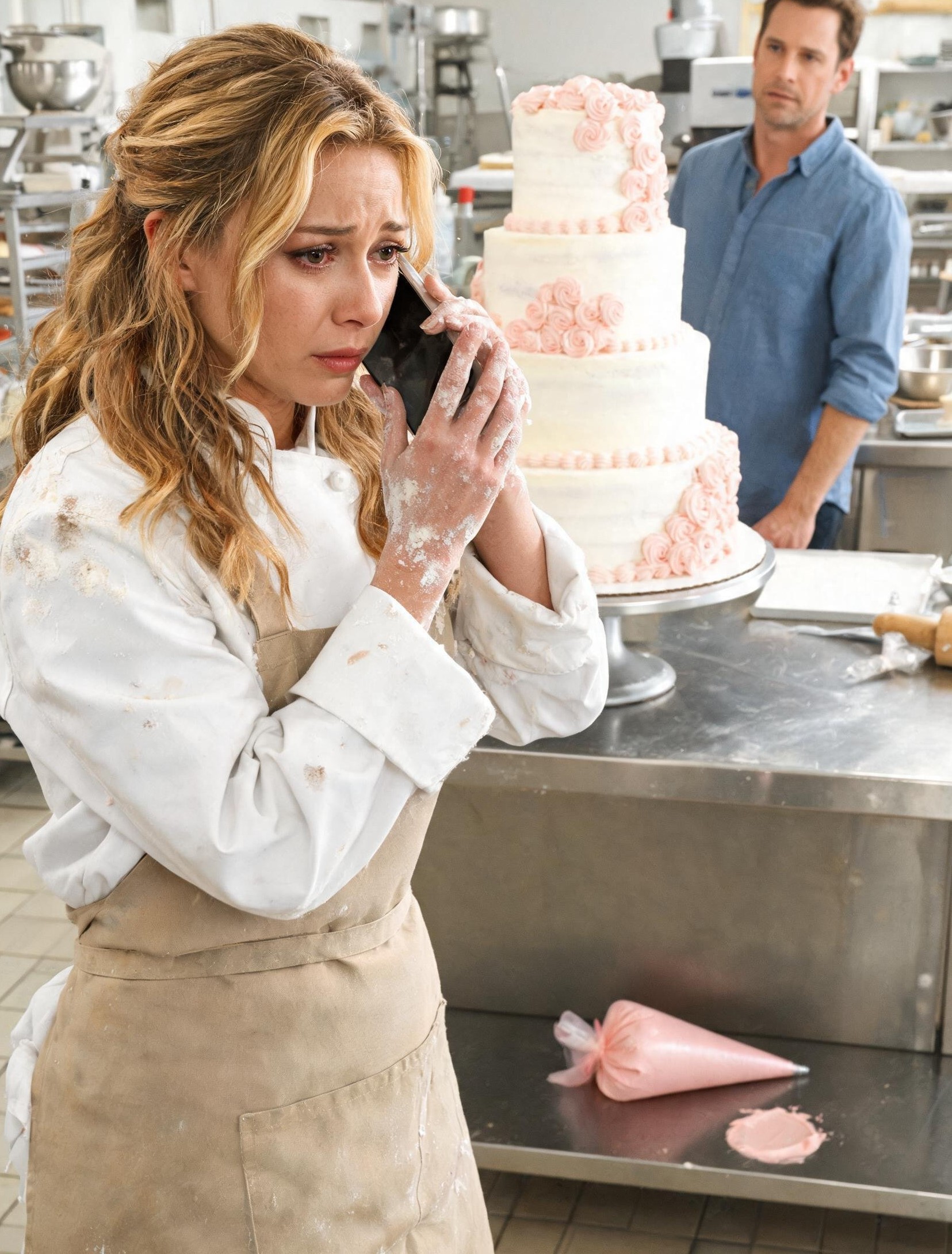
My mother banned me from my only sister’s wedding while I was holding a torch over twelve hundred dollars’ worth of sugar flowers. She did it calmly, almost politely, as if she were canceling a dentist appointment instead of cutting her oldest daughter out of the biggest family event in twenty years. Then, before I could even ask why, she said, “Grace, Lily deserves one day where people aren’t comparing her to you.” The blue flame in my hand kept hissing while a white sugar rose darkened at the edge and collapsed onto my stainless-steel table. I turned off the torch, set it down carefully, and asked, “Does Lily know you’re calling me?”
“She asked me to,” my mother replied, and that hurt more than everything that came after. My sister Lily was twenty-eight, four years younger than me, and she had spent most of her life being protected from any situation in which I might succeed within fifty feet of her. When I won a statewide baking scholarship at seventeen, my parents celebrated by taking Lily shopping because she had failed her driver’s test that morning. When I opened my first bakery in Denver at twenty-six, my mother spent the ribbon-cutting telling customers that Lily had once considered culinary school too. And when my pastry company, Holloway House, landed a national hotel contract three years later, my father asked me not to post about it until after Lily’s engagement party.
I had always swallowed it because swallowing things was easier than fighting a family that treated peace like a job assigned only to me. I had made myself quieter at dinners, smaller in photographs, slower to mention good news, and almost apologetic whenever someone recognized my name. I had learned to say, “It was mostly my team,” even when I had personally spent seventy-hour weeks building the company from one rented kitchen and a secondhand mixer. I had learned to change the subject whenever my parents’ faces tightened at one of my accomplishments. I had learned that in my family, my happiness was acceptable only if Lily’s happiness remained larger.
I had learned to step back when Lily entered the room. I had learned to laugh softly when someone praised me. I had learned to hide good news until hers could come first. I had learned to apologize for things I had earned. I had learned to disappear without technically leaving.
But that Tuesday morning, standing inside my bakery with fourteen employees moving around me and an entire wall covered in photographs of weddings I had helped make beautiful, something inside me finally refused. “So the invitation everybody else received three weeks ago?” I asked. My mother hesitated for half a second, which was enough. “There isn’t one for me, is there?” I said, and she answered, “We thought it would be kinder not to make a production out of it.”
Kinder. I looked through the glass wall of my kitchen and saw my operations manager, Mia, laughing with two decorators while they boxed miniature lemon cakes for a charity event. Nobody out there knew my own family had decided my presence was dangerous because strangers sometimes complimented my work. Nobody knew I had spent thirty-two years managing the emotional weather of a house where Lily was the sun and everyone else was expected to orbit. I felt humiliated, but underneath the humiliation was something colder and more useful. I felt finished.
“I understand,” I said. My mother sounded relieved, which almost made me smile. “I knew you would eventually,” she said, and then added that Lily’s wedding weekend in Charleston was already stressful enough because Trevor Caldwell’s family had invited investors, politicians, executives, and “people whose impressions matter.” I realized then what she was really afraid of: I wasn’t simply the successful sister anymore; I was the sister whose company had recently been profiled in a national food magazine, and she believed attention worked like oxygen, limited and worth fighting over. “You won’t make this difficult, will you?” she asked.
“No,” I said. “I won’t make anything difficult.” I ended the call, finished the ruined sugar rose, and walked into my office, where my fiancé, Noah Bennett, was waiting with two coffees because he had come to take me to lunch. He looked at my face once and put both cups down without asking what I wanted to eat. “What happened?” he said.
I told him everything, including the part where Lily had apparently agreed that her own sister should stay home. Noah listened without interrupting, his hands folded between his knees, and when I finished, he asked one question. “Are you going to spend the next ten years waiting for them to decide you’ve finally become small enough?” I stared at him because he had found the exact wound in one sentence.
Noah and I had been engaged for almost three years. We had postponed setting a wedding date twice, once because Lily was going through a breakup and once because she had gotten engaged and my mother told me two weddings in the same year would be “emotionally confusing for everyone.” I had accepted those explanations because postponing happiness can look very mature when you have been trained to call surrender kindness. Noah had never pressured me, but now I saw what my family’s rules had cost him too. “No,” I said. “I’m done waiting.”
That evening we sat on our back porch under a Colorado sunset and opened the folder where we had kept every wedding idea we had abandoned. There was a vineyard in Virginia, a lakeside lodge in Wisconsin, and an old apple farm overlooking Lake Michigan that Noah had saved two years earlier because I loved the photographs. We called the apple farm first. A cancellation had opened a Saturday in October, six weeks away.
We booked it before I could become afraid of my own decision. Twenty-four guests, dinner under lights between the trees, a small ceremony near the lake, no bridal party, no performance for people we barely knew. I would make our cake, Noah’s sister would play violin, and one of my oldest employees would officiate. For the first time in my adult life, a wedding sounded like something I wanted instead of something I needed permission to survive.
Three days later, my mother found out. “You cannot be serious,” she said when she called me at in the morning. She accused me of deliberately scheduling my wedding five weeks before Lily’s so relatives would compare them, accused Noah of manipulating me, accused me of turning marriage into “one more achievement.” I listened until she ran out of breath.
Then I said, “You told me I wasn’t part of Lily’s wedding, Mom, so Lily’s wedding no longer controls my calendar.” Silence. “That’s cruel,” she whispered. “No, it’s practical,” I replied.
She hung up on me. By noon, three relatives had texted asking whether I was trying to humiliate Lily, and by dinner my father had left a voicemail saying I was tearing the family apart because I “could never let my sister have anything.” I deleted the message after listening once. Noah asked whether I wanted him to block their numbers for me.
“No,” I said. “I want to see what they do next.” That answer turned out to matter, because two mornings later an email arrived from the accounting office of Rosemont Hall, the Charleston estate where Lily was getting married. The subject line read: HOLLOWAY HOUSE SPONSORSHIP CONFIRMATION. I almost deleted it as spam.
Then I opened the attached contract. My bakery’s logo was at the top. My name was at the bottom. And beside a digital signature I had never made was a commitment stating that Holloway House would provide eighty-five thousand dollars in desserts, staffing, transportation, and promotional support for Lily’s wedding.
Part 2: My Family Hadn’t Excluded Me—They Had Replaced Me With My Signature
I read the contract three times before calling anyone. The first time, I thought I had misunderstood it; the second time, I checked every page; the third time, I photographed the metadata, downloaded the original attachment, and forwarded everything to my attorney. I did not call my mother. I did not call Lily.
That was the difference between the woman I had been and the woman sitting behind my desk that morning. Old Grace would have confronted the family immediately and given them time to explain, deny, delete, or manipulate. New Grace had spent six years negotiating hotel contracts with lawyers who smiled while moving commas worth hundreds of thousands of dollars. I knew that when somebody forged your name, emotion was a luxury you could afford after preserving evidence.
My attorney, Hannah Cole, called fourteen minutes later. “Did you sign any agreement connected to your sister’s wedding?” she asked. “No.” “Did you verbally authorize your company to sponsor it?” “Absolutely not.”
She made a quiet sound. “Then don’t contact your family yet.” She explained that the document had apparently been submitted as part of the estate’s event financing package, lowering Lily’s required deposit because my company’s contribution was being treated as an in-kind sponsorship with measurable publicity value. Holloway House was not merely expected to bake a cake. According to the contract, I was providing a nationally branded dessert installation, two pastry chefs, transportation from Denver, custom guest favors, media rights, and an $18,000 cash promotional fee.
My forged signature was dated eleven days before my mother told me not to attend. That detail sat in my stomach like ice. They had apparently decided I was too distracting to stand in the room but useful enough to subsidize it. I asked Hannah what would happen if the contract disappeared before we contacted the venue.
“It won’t,” she said. “Their accountant already sent it to you.” She instructed me to remain quiet while she contacted Rosemont Hall’s counsel and requested every document carrying my name. By the afternoon, we had four more.
My company had supposedly agreed to promote the wedding on social media. I had supposedly approved photographs of my desserts for a lifestyle magazine feature. I had supposedly guaranteed a minimum advertising value of $110,000. And worst of all, one document listed my mother, Margaret Holloway, as an “authorized family representative” permitted to coordinate details on my behalf.
That designation had never existed. But I understood instantly how she had made it sound believable. My mother had spent years telling people that my company was “the family business,” even though neither she nor my father had invested a dollar, worked a shift, guaranteed a loan, or washed a single mixing bowl.
That evening Lily called. I watched her name flash across my phone while Noah cooked pasta, and I let it ring until voicemail. Thirty seconds later she called again. Then came a text: MOM SAYS YOU’RE CAUSING PROBLEMS WITH THE VENUE.
I showed Noah. “So they know.” He turned off the stove. “Apparently.”
I called Hannah before replying. She told me Rosemont Hall had contacted my parents about an hour earlier to verify authorization and had temporarily frozen the sponsorship credit until the discrepancy was resolved. She also told me something else. The estate had received the original agreement from Lily herself.
I sat very still. That was the moment the betrayal changed shape. Until then, I could imagine my mother doing everything while Lily looked away; now Lily’s name was attached to the email that delivered the forged contract. Hannah cautioned me that forwarding a document did not prove Lily created it, but emotionally the distinction offered very little comfort. “What do you want to do?” Noah asked after I hung up.
“I want them to tell me the truth without knowing what I know.” So I called Lily back. She answered before the first ring finished.
“What did you do?” she demanded. I leaned against my kitchen counter and stared through the window at our dark backyard. “That’s an interesting first question.”
“The venue says your sponsorship might not be valid.” Her voice was sharp but nervous, the way it used to sound when we were children and she had broken something before our parents came home. “Was it valid?” I asked. Silence stretched between us.
“Mom handled that,” she said finally. “That isn’t what I asked.” Another pause. “You told Mom you wanted to help with the wedding months ago.”
I remembered the conversation she meant. Lily had just gotten engaged, and I had said, “If you ever want help with desserts, let me know.” In my family, apparently, that sentence had evolved into permission to forge an $85,000 commercial agreement. “Did I sign the contract?” I asked. “Grace, don’t start talking like a lawyer.”
That sentence answered everything. I lowered my voice instead of raising it. “Did I sign the contract, Lily?”
She exhaled. “Mom said it was basically paperwork.” “Did I sign it?” “No.”
Noah looked up from across the room when he heard the word. I closed my eyes for one second. “Thank you,” I said. “That’s all I needed.”
“What does that mean?” Lily snapped. “Grace, you cannot pull out now.” “I never pulled in.”
Then she said something that stayed with me longer than the forgery itself. “Do you have any idea what this will do to me?” Not what our mother had done to me, not what it could do to my company, not whether I could be legally exposed—what it would do to her wedding. I finally understood that Lily had not necessarily hated me.
She had simply been raised inside a world where my boundaries were less real than her emergencies. My achievements were communal resources, my sacrifices were expected, and my pain became selfish the moment it inconvenienced her. She was not innocent. But she had been trained very well.
“I’m going to give you one chance,” I said. “Tell the venue yourself that I never signed anything.” Her breathing changed. “If I do that, they’ll raise the deposit.”
“Yes.” “Trevor’s parents will be furious.” “Maybe.”
“Mom will lose her mind.” “Probably.” Another silence passed. Then Lily whispered, “I can’t.”
I nodded even though she couldn’t see me. “Then my attorney will.” I ended the call.
The next morning Rosemont Hall formally voided every document associated with my company. The missing sponsorship triggered a contractual recalculation, increasing the wedding’s required cash deposit by $96,400 because several discounts had been tied to the publicity package. That was the first mini-payoff, and it happened without me saying a cruel word. I simply removed what had never belonged to them.
My mother called twenty-seven times. My father left messages saying lawyers were “unnecessary between family.” Trevor sent an email explaining that he had been told I had enthusiastically offered the sponsorship and asking whether we could “find a compromise that doesn’t embarrass everyone.”
I forwarded his email to Hannah. Then I went back to frosting a birthday cake for a seven-year-old who wanted purple stars. For once, I refused to abandon my actual life to manage my family’s crisis.
Three days later my mother appeared at the bakery. She walked through the front doors in a cream designer coat, past customers drinking coffee beneath framed photographs of my work, and demanded to see me. I invited her into my office because I would not give her a public scene.
She did not sit. “Fix this,” she said.
I folded my hands. “Fix what?” Her jaw tightened. “You know exactly what.”
“I know someone forged my signature.” “Your sister’s wedding is five weeks away.”
“That sentence has nothing to do with mine.” She stared at me as if calmness were insolence. Maybe to her, it was.
Finally she admitted she had created the sponsorship proposal. Not the signature, she insisted; she said an event consultant had “inserted” it because deadlines were approaching. She claimed she believed I would approve eventually because I had always supported Lily. Her motive was not difficult to see: she wanted a wedding impressive enough to secure her place inside Trevor Caldwell’s wealthy Charleston family, and my brand had become a convenient piece of currency.
“You were never going to let me attend,” I said. “That’s separate.”
I almost laughed. “You wanted my company in every photograph, but not my face.” She looked away, and that tiny movement was more revealing than a confession. “Lily needed one thing that was completely hers.”
“Then she can pay for something that’s completely hers.” My mother’s eyes hardened. “You really are enjoying this.”
“No,” I said. “That’s why you don’t know how to handle me.” She blinked.
“If I were screaming, you could call me jealous. If I were crying, you could call me dramatic. If I threatened Lily, you could call me cruel.” I stood and opened my office door. “But I’m doing none of those things, Mom. I’m simply refusing to finance people who told me not to show up.”
She left without another word. For one brief afternoon, I believed the worst was over. Then Hannah called and asked whether I had ever seen my grandmother Eleanor’s family trust.
I hadn’t. “Why?” I asked.
“Because your mother’s forged wedding contract contains a bank reference,” Hannah said. “And that reference leads to an account with your name on it.”
Part 3: The Wedding Was Expensive, but the Missing Money Was Bigger
My grandmother Eleanor died when I was twenty-three. She had been the only adult in my childhood who never asked me to dim myself for Lily, and she was the person who taught me to make pie crust at a yellow kitchen table while country music played from a radio above her sink. She left my sister and me small inheritances, or at least that was what my parents told us. I received $12,000, which I used as part of the deposit on my first commercial kitchen.
According to Hannah, there had been more. Much more.
She discovered it because one sponsorship document listed “Holloway Family Reserve” as a backup funding source. The name sounded generic, but the routing information matched a trust account created by my grandmother fifteen years earlier. Hannah could not access private bank records without authorization, but she could see enough from archived estate filings to know the trust existed.
I called the attorney who had handled Grandma Eleanor’s estate. His name was Martin Keene, he was seventy-one now, and he remembered me immediately. “The baker,” he said warmly. “Your grandmother kept every newspaper clipping.”
That almost broke me. I had spent years believing my family tolerated my success while my grandmother, apparently, had been saving proof of it. “Mr. Keene, did my grandmother create a trust for me?”
The silence on his end lasted long enough to change my life. “You were never given the documents?” he asked. “No.”
He asked me to come to his office the following Monday. Noah offered to fly with me to Indianapolis, where Martin practiced, but I told him I needed to do this part alone. I spent the flight staring at the clouds and wondering how many versions of my childhood were about to be rewritten.
Martin’s office smelled like old books and lemon furniture polish. He pulled a thick file from a cabinet, set it on the desk between us, and placed his hand on top as if steadying something alive. “Your grandmother created two trusts,” he said.
One was for Lily. One was for me. Each had been funded with $175,000 from the sale of farmland Eleanor inherited from her parents.
I stopped breathing for a moment. “I got twelve thousand dollars.”
Martin frowned. He explained that because I was twenty-three when Eleanor died, my parents had temporarily served as co-trustees until my twenty-fifth birthday, after which control should have passed to me. The trust could be used before then for education, housing, or starting a business. Martin said his records showed a request from my father for $28,000 to help launch my bakery, followed two years later by documents transferring administration of the remaining balance to another financial institution.
“I never got twenty-eight thousand,” I said. “My parents loaned me eight, and I paid them back.”
Martin’s face changed. Not dramatically, but enough. “Do you have records?”
Every repayment was in my accounting software. Eighteen monthly transfers labeled LOAN REPAYMENT—DAD. My parents had apparently withdrawn money from my trust to help fund my bakery, given me only part of it, called that part a loan, and collected repayment from me.
That was twist number one, and it was enough. I did not need ten hidden conspiracies or a secret second family. I needed only the truth sitting in a manila folder under fluorescent office lights.
Martin helped me request a full accounting. Because I was the trust beneficiary, obtaining the records required paperwork, identification, notarized forms, and patience. By the end of the week, I had statements covering nine years. I studied them in my hotel room until two in the morning.
Withdrawals appeared whenever Lily’s life became expensive. Twelve thousand dollars when she transferred colleges. Nine thousand when she moved to New York for an internship. Twenty-one thousand when my parents helped her pay off credit cards. Then larger amounts appeared over the last year.
$34,000. $18,500. $26,000.
The descriptions referenced “family advancement,” “residential planning,” and one phrase that made my entire body go cold: L. HOLLOWAY WEDDING EXPENSE.
They were paying for Lily’s wedding with what remained of my grandmother’s trust. Not all of it—the Caldwell family was financing much of the event—but at least $78,500 had already been transferred toward deposits, travel, design, and accommodations.
I did not call my parents. I called Hannah. Then I called Noah.
He listened while I read him the numbers. When I finished, he said, “Come home.”
“I will tomorrow.” “No, Grace. I mean emotionally. Come home.”
I sat on the edge of the hotel bed and finally cried. Not loudly. Not theatrically. I cried because the eight-thousand-dollar “loan” I had worked nights to repay had been my own money, because every time my father praised me for being responsible he had known, because my mother had once told me they could not afford to attend a pastry conference that later launched my career while quietly using thousands of dollars from my trust for Lily’s apartment.
But tears did not change documents. So the next morning, I scanned everything.
Hannah brought in a trust-litigation attorney named Samuel Ortiz. Together they sent my parents a formal demand for accounting, repayment, preservation of records, and suspension of further distributions. The letter did not accuse them of crimes. It did something more frightening to people who survive through emotional pressure.
It created a paper trail.
My father called within an hour. For the first time in my life, he sounded scared.
“Grace, this has gotten completely out of control,” he said. “Then help me understand it.”
“Your grandmother expected us to use judgment.” “About my money?”
“It was family money.” “The trust has my name on it.”
He started talking about sacrifices. Private school, vacations, braces, college applications, Christmases. I listened until he mentioned that Lily had “needed more help” because I had always been capable of standing on my own.
There it was. The family philosophy in one sentence. Because I could survive being neglected, they treated neglect as reasonable.
“Send everything to my lawyers,” I said. “I’m not discussing numbers on the phone.”
“You’re suing your own parents three weeks before your sister’s wedding?” “I’m asking what happened to my own trust three weeks before my wedding.”
His voice turned hard. “Do you hear yourself?” “For the first time, yes.”
I ended the call.
Our apple-orchard wedding was nine days away by then. I considered canceling, not because my mother wanted me to but because I felt poisoned by everything surrounding marriage. Noah refused to let my family steal the meaning of ours.
“We are not getting married at them,” he said. “We’re getting married to each other.” I laughed despite myself.
So we went to Michigan. Twenty-six people came instead of twenty-four because two cousins quietly asked whether there was still room after hearing what had happened. We said yes.
The orchard looked almost unreal that afternoon. Red apples hung between orange leaves, the lake beyond the meadow was steel blue, and strings of small lights waited above long wooden tables. I wore a simple ivory dress with sleeves because October had turned cold.
Nobody gave me away. I walked alone.
When I reached Noah, he took both my hands. His vows were short. “I will never ask you to become smaller so I can feel bigger.”
That sentence nearly took my knees out.
My own vows were written on a flour-stained recipe card from the bakery. “I spent years believing love meant knowing when to disappear,” I told him. “You taught me love is being seen clearly and still being welcomed closer.”
We kissed beneath an apple tree while our friends cheered. No magazine. No politicians. No investors.
Dinner was roast chicken, potatoes, salad, wine from a local vineyard, and a three-tier brown-butter apple cake I had decorated at sunrise. Mia toasted us by saying, “Grace has spent her career making celebrations for strangers. Tonight we finally get to make one for her.” I cried into Noah’s shoulder.
Then something unexpected happened. A guest posted a thirty-second video of us cutting the cake while Noah wiped frosting from my nose. By the next morning, it had been shared more than half a million times because someone recognized me from the Holloway House magazine profile. By Monday, it had passed four million.
Comments poured into the bakery. People said the wedding looked warm, human, real. Couples asked whether Holloway House would start offering intimate wedding packages.
I had not tried to outshine Lily. I had simply stopped hiding.
Three weeks later, her Charleston wedding arrived. I stayed home.
At that afternoon, Lily called me. I almost ignored it, but something made me answer.
She wasn’t angry. She was crying so hard she could barely speak.
“Grace,” she whispered, “Mom is gone.”
“What do you mean gone?” I asked.
“She left the venue.” Lily sucked in a broken breath. “And Dad says the money is gone too.”
Part 4: On My Sister’s Wedding Day, the Perfect Family Finally Cracked
Lily was sitting in a bridal suite at Rosemont Hall wearing a $14,000 gown while two hundred guests waited downstairs. I could hear women talking behind her, doors opening and closing, somebody asking for a florist, somebody else asking where Margaret Holloway had gone. Lily sounded seven years old. “Her phone is off,” she said.
I asked where Trevor was. He was downstairs dealing with his parents because the venue had demanded an immediate payment after a scheduled transfer failed. My parents had promised to cover the final $42,000 balance that morning.
The transfer had bounced.
“I thought Trevor’s family was paying,” I said. “They paid most of it.”
Most. That word carried an entire childhood.
Lily told me that after my trust attorneys froze further withdrawals, my parents had assured everyone they had other funds. Apparently they did not. For years, their lifestyle had been supported by a mixture of retirement accounts, credit, and money they treated as available simply because they controlled it.
Now the trust was frozen. My father was downstairs calling banks. My mother had disappeared.
“Grace, I know you hate me,” Lily said. “I don’t hate you.”
“You should.” “Maybe.”
She stopped crying for a second. “That’s worse.”
I sat at my kitchen table while Noah silently set a cup of coffee beside me. “What do you want from me, Lily?”
“I don’t know.” That was the first truthful answer she had given me in months.
I asked whether she knew my parents had used my trust for her wedding. Silence. Then: “I knew Grandma left money, but Mom said yours had already been used for the bakery.”
“Twenty-eight thousand was taken for the bakery.” “Okay.”
“I received eight.” Another silence.
I told her the rest. The transfers. The repayments. The wedding expenses.
When I finished, she whispered, “Oh my God.”
I did not rescue her from the feeling. She needed to sit inside it.
Finally she said, “They told me you had already gotten more than I did because you were successful.” That sentence explained how my parents had justified theft without calling it theft. They had convinced Lily fairness meant correcting the imbalance created by my competence.
“Did you know about the forged sponsorship?” I asked. “I knew Mom made the paperwork.”
“That wasn’t my question.” Lily started crying again.
“Yes,” she said. “I knew you hadn’t signed it.”
There was no dramatic music in my kitchen. No shattered glass. Just a refrigerator humming and Noah standing very still across the room.
“Why?” I asked.
“Because everybody kept saying your company would make the wedding important.” She choked on the next words. “And I was so tired of hearing your name.”
There it was: not evil, not insanity, just jealousy left unchallenged until it became entitlement. Lily admitted that every family event had felt like a comparison she was destined to lose, even when I deliberately held myself back. She said Mom had always explained my success as aggression and her insecurity as injury.
“I thought if I could have one perfect thing,” Lily whispered, “maybe I wouldn’t feel second.”
“And did excluding me make you feel first?” I asked.
Downstairs at Rosemont Hall, somebody apparently knocked on the bridal-suite door. Lily covered the phone and spoke to someone, then came back.
“The venue says we have thirty minutes.” “For what?”
“To pay or they’ll cancel the reception service after the ceremony.”
I closed my eyes. Old Grace would have reached for a credit card. Old Grace would have wired the money, told herself she was protecting Lily from humiliation, and quietly absorbed another injury.
New Grace asked, “What is Trevor doing?”
“His father can pay it, but he’s furious.” “Then that’s between the Caldwells and you.”
“You won’t help?” Her voice was small.
For once, I let that single word exist without decorating it with apologies.
Lily did marry Trevor that afternoon. His father paid the outstanding balance after making Lily and Trevor sign an agreement that any additional costs were theirs alone. My father attended the ceremony without my mother.
Margaret Holloway returned six hours later.
She claimed she had suffered a panic attack and driven to a hotel to calm down. Nobody believed that explanation after investigators later confirmed she had gone first to a bank branch, then to a storage unit rented under her maiden name. My attorneys learned about the storage unit because the bank’s internal fraud review triggered a deeper examination of several trust transactions.
That was twist number two. And unlike the first, it was bigger than Lily’s wedding.
Inside the storage unit were tax documents, old trust statements, property records, jewelry that had belonged to Grandma Eleanor, and boxes of correspondence my mother apparently removed from my grandmother’s home after her death. Among the papers was the original trust letter.
I read it sitting beside Hannah in a conference room.
My grandmother’s handwriting slanted sharply to the right. She wrote that she loved both granddaughters equally but had created separate trusts because she worried my parents had developed “a dangerous habit of rewarding Lily’s distress by taking opportunities from Grace.” I had to stop after that line.
Grandma had seen it. Before I had words for it, she had seen it.
Her instructions were painfully specific. Neither granddaughter’s funds were ever to be transferred to the other. Each account was intended to provide independence.
And there was one more document.
Grandma Eleanor had owned a small commercial building outside Denver, property I remembered only vaguely because it once housed a hardware store. In her estate plan, ownership was supposed to pass into my trust when I turned twenty-five.
The property had been sold six years ago for $640,000.
I had never known I owned it.
Hannah turned the deed toward me. “Grace, if this is authentic, the trust accounting we’ve seen is incomplete by hundreds of thousands of dollars.”
I stared at my name printed beneath the property description. Suddenly the missing $78,500 for Lily’s wedding looked small.
“Where did the sale money go?” I asked.
Hannah looked at the next document.
“That,” she said, “is exactly what we need to find out.”
Two days later, my father asked to meet me without my mother. We chose a neutral place, a conference room inside Hannah’s office, because I no longer trusted kitchen tables.
Dad looked older than he had a month earlier. He sat across from me, put his hands flat on the table, and said, “Your mother made decisions I didn’t fully understand.”
I almost smiled. “That sounds rehearsed.”
“It isn’t.” “Then tell me where the property money went.”
He looked at Hannah, then back at me. “We invested it.”
“In what?” His mouth opened.
Then closed.
I knew before he answered that whatever came next would be worse than a wedding. “Richard,” Hannah said, “this is your opportunity to cooperate.”
My father looked at me and whispered, “The house.”
“What house?”
“Our house.”
The suburban home where my parents still lived, the house where Lily got the larger bedroom, the house where my trophies stayed boxed in the basement, the house where my mother told me not to talk about college acceptances because Lily was having a bad week.
They had used my inherited property money to pay off their mortgage.
And according to Hannah’s next question, the house might legally belong partly to me.
Part 5: I Stopped Asking for a Place in Their Family and Started Reading the Documents
The legal battle did not end quickly, and I will not pretend paperwork transformed my life overnight. There were depositions, bank subpoenas, forensic accountants, ugly emails, and relatives who suddenly became experts on forgiveness once the consequences reached my parents. Some told me money was not worth losing family over.
I began answering the same way every time. “Then they should have valued family more than my money.”
My father eventually admitted he knew the trust funds had been used improperly. He insisted my mother handled the details, but documents showed his signature on property-transfer forms and bank requests. Responsibility did not disappear merely because one spouse had been louder.
My mother fought everything. She described every withdrawal as a reasonable parental decision, even though I had been an adult for most of them. She claimed Grandma Eleanor never intended the accounts to create division and accused lawyers of turning “private family choices” into hostility.
But Grandma’s letter destroyed that argument. She had anticipated the exact behavior.
Lily called me six weeks after her wedding. We had not spoken since the day she married Trevor.
“I started therapy,” she said.
I almost made a joke but stopped myself. “Okay.”
“I told Trevor everything.” “Okay.”
“He asked whether I actually wanted our wedding or whether I wanted Mom’s version of winning.” Lily took a breath. “I didn’t know how to answer.”
For the first time, I did not feel responsible for supplying one.
She apologized for sending the forged sponsorship document. Not “I’m sorry you were hurt.” Not “I’m sorry things got complicated.”
She said, “I knew you hadn’t agreed, and I let Mom use your name because it benefited me. That was wrong.”
It did not repair us. But it was the first brick that could theoretically build something.
I told her forgiveness and access were different things. I could someday forgive her and still not trust her with my business, my finances, or the vulnerable parts of my life. She said she understood.
Then she surprised me. “I don’t think I ever hated your success,” she said. “I think Mom taught me that every time you succeeded, something was being taken from me.”
I looked around my bakery office at employee schedules, invoices, thank-you notes, and a photograph from my orchard wedding. “Nothing was being taken from you.”
“I know that now.”
“Do you?” I asked.
She cried quietly. I let the silence stay.
Over the next eight months, the trust case moved toward settlement. My parents agreed to sell their house rather than risk a court ruling that could expose them to greater damages and legal fees. After mortgages, liens, and expenses, a substantial portion of the proceeds went toward restoring my trust.
The forensic accountant traced additional funds through investment accounts. Not all of it could be recovered. But enough could.
My father moved into a condo outside Indianapolis. My mother rented an apartment and stopped speaking to me.
For several months, I wondered whether I felt guilty. The answer kept surprising me.
I felt sad.
Sad was different.
Guilt said I had done something wrong. Sadness said something valuable had been broken.
I had not broken it by refusing to hide the cracks.
Holloway House changed too. The little orchard-wedding video kept circulating, and couples began asking for celebrations that felt personal instead of enormous. I launched a small event program called Full Table Weddings.
We accepted only twelve couples a year. No celebrity packages. No sponsored spectacle.
Just good food, beautiful cakes, and one rule printed inside every contract: Nobody at your celebration should have to become smaller for somebody else to feel important.
Noah laughed when he read that line. “Subtle.”
“I’m evolving.”
A year after our wedding, we returned to the Michigan orchard. The owner remembered us and placed a bottle of cider on our table.
We walked down to the lake after dinner. Noah asked if I missed my family.
“Which version?” I said.
He understood.
I missed the version I thought I had. Sunday dinners. Christmas mornings. My father teaching me to ride a bike.
But memory is complicated. A person can love you and still fail you terribly. A childhood can contain warmth and manipulation in the same photograph.
I did not need to repaint every good memory black to acknowledge what happened.
Lily and I began speaking once every few weeks. Slowly.
She and Trevor downsized their life after the wedding. She left the marketing job my mother bragged about because she admitted she hated it. She started working for a nonprofit theater in Charleston.
One afternoon she mailed me a handwritten card.
I’m learning that being ordinary at something I love feels better than being impressive at something I chose for Mom.
I kept that one.
My father eventually wrote too. His letter was twelve pages.
Some pages were excuses. Some were memories. Some were apologies.
One line mattered.
We thought because you were strong, taking from you would hurt less.
I stared at those words for a long time.
That had been the central lie of my family.
Strong children are not children who need less love. Successful adults are not people whose boundaries matter less. Capable people do not become community property.
Sometimes strength only means nobody noticed how expensive survival became.
On the anniversary of Grandma Eleanor’s death, I made her favorite pie. Sour cherry with too much cinnamon.
I took it to the Open Table program we had started at the bakery for young cooks who lacked family support. Twelve students crowded around the kitchen while I showed them how to keep butter cold and stop overworking dough. One girl named Megan stayed afterward.
“My mom says if I go to culinary school, I’m wasting everything she sacrificed,” she said.
I looked at her flour-covered hands.
“What do you want?”
Nobody had apparently asked her that before.
Her eyes filled immediately. “I want to bake.”
“Then start there.”
That night, after everyone left, I sat alone in the bakery. The mixers were silent. Streetlights reflected against the front windows.
On the wall hung one photograph from my wedding.
I was laughing with my head tilted back, Noah’s arm around my waist, my dress streaked with grass at the hem. I did not look polished.
I looked free.
For thirty-two years, I thought winning meant finally becoming impressive enough that my family could no longer deny my value. I thought if I opened enough bakeries, won enough awards, earned enough money, loved people well enough, eventually they would look at me and say, Grace, we see you.
But that was never the victory.
The victory was realizing I did not need their verdict.
I had people who showed up without being begged. I had employees who challenged me instead of managing me. I had a husband who never confused love with obedience.
And somewhere in South Carolina, I had a sister learning that another woman’s light did not create her darkness.
That would have been a clean place to end the story.
Life rarely gives us clean endings.
Three weeks later, Hannah called again.
“Grace,” she said, “we received a final box from the storage unit.”
I leaned back in my chair. “I thought everything had been cataloged.”
“So did I.”
Her voice had the strange carefulness lawyers use when they are choosing every word.
“There’s a sealed envelope inside. It’s addressed to you.”
“From my mother?”
Hannah said, “The handwriting matches your grandmother’s.”
My entire body went still.
Grandma Eleanor had been dead for nine years.
“What does it say?”
“I haven’t opened it.”
“Because written across the front are the words: FOR GRACE ONLY—OPEN IF MARGARET EVER TRIES TO TAKE THE DENVER PROPERTY.”
I stood so quickly my chair rolled backward into the wall.
The Denver property.
Not the commercial building that had already been sold.
Something else.
“Hannah,” I whispered, “what Denver property?”
There was a pause.
Then she said the sentence that reopened everything.
“That’s what we need to find out.”
✓ Lynn R. Adams
My Family Banned Me From My Sister’s Wedding for Being Too Successful—Then I Learned Who Was Really Paying for It Part 1: They Wanted Me Invisible Until My Name Became Useful My mother banned me fro…