My dad texted, “Skip the reunion—your sister’s boyfriend is a state senator
. Part 2…..
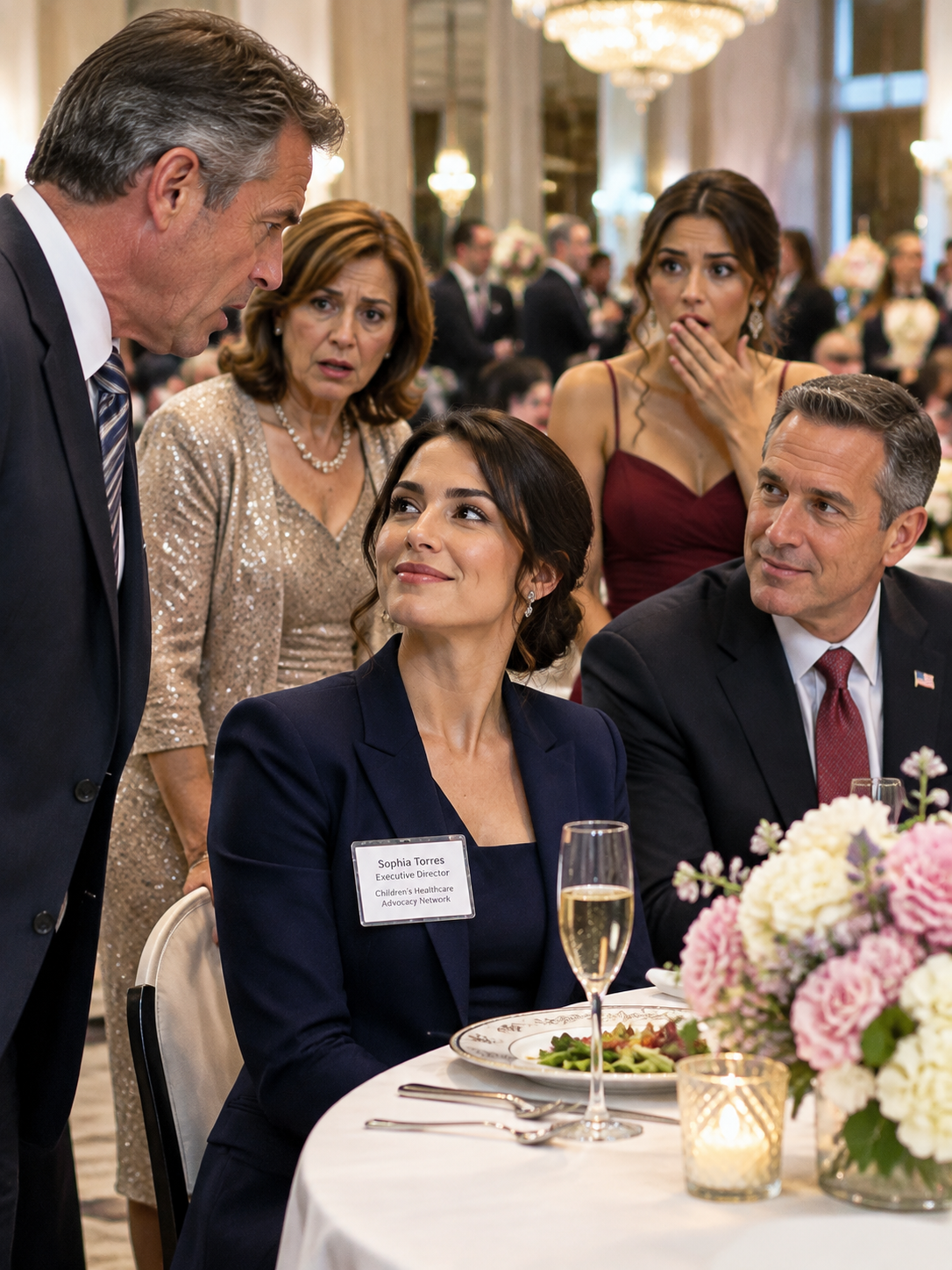
IF FACEBOOK BROUGHT YOU HERE, HERE’S THE CONTINUATION YOU’VE BEEN WAITING FOR. ENJOY! 👇 He stood abruptly and walked away from the table, phone in hand. I could see him typing, and Maria leaned toward me with a desperate look. “Sophia, you have to understand. We didn’t mean—”
I kept my voice quiet. “Dad texted me this afternoon and told me not to come to the family reunion because my nonprofit work would complicate things. He thought I would embarrass you in front of your impressive boyfriend. The same senator I’ve worked with for three years, who is here tonight at my invitation.”
Maria’s face went from red to pale. Richard returned a moment later, his jaw set. He had texted my father to ask why he had never mentioned that his daughter was Sophia Torres. Dad’s answer, Richard told us, was that I worked at “that children’s charity”—nice work, but nothing major.
Richard looked at Maria, then at me. He had told my father that he had worked with me on three major pieces of legislation, that CHON had a $9.4 million operating budget and helped thousands of families, and that I had done more to improve children’s lives in our state than most elected officials managed in an entire career. Maria was crying silently, her carefully applied makeup beginning to run.
I reminded Richard that the program was starting in three minutes. He took a breath and apologized for the scene. I touched his arm briefly and told him we should focus on the children we were there to help. Maria whispered that she was sorry and that she hadn’t known. “I know you didn’t,” I said. “That’s the problem.”
When the lights dimmed, our board chair opened the program, and I gave the welcome. I spoke about the 4,847 families CHON had served that year, the policy victories, and the children whose parents had been able to keep their homes while seeking treatment. We showed a video of a mother explaining how our help had kept her family from bankruptcy while her son fought leukemia. By the end, there wasn’t a dry eye in the room.
Richard’s keynote followed. He told the seven hundred guests that he was honored to support CHON, then gestured toward me. He described how I had founded the organization twelve years earlier with a $50,000 grant and a belief that a child’s access to healthcare should never depend on a family’s bank account. He spoke about the Children’s Medical Debt Relief Act, the research behind it, and the thousands of families who had been able to discharge medical debt because we refused to give up.
Then he spoke about the person who had called my work a “nice little charity job.” He didn’t name my father or my sister, but his point was unmistakable. Too often, he said, people dismissed those whose work didn’t match their own narrow idea of success. I didn’t seek headlines, he told the room; I sought results. I didn’t build a personal brand; I built systems that helped families. He urged everyone not to let brilliant people labor in obscurity simply because they had been too proud to ask what those people were doing.
The ballroom rose in a standing ovation. I stood, nodded my thanks, and tried to keep my expression composed while my heart raced. When Richard returned to the table, he sat beside me rather than beside Maria. He spoke to her quietly and said he couldn’t be with someone who treated her own family that way and dismissed her sister’s accomplishments because they didn’t look like the kind of success she recognized. He told her his assistant would arrange to send her things to her apartment. Maria left the ballroom in tears.
During the silent auction, my phone filled with messages. Dad wanted to talk immediately. Mom asked how I could have kept this from them. Carlos wanted to know what the hell was going on. Aunt Teresa said she was proud of me, and my cousin Miguel told me he had cited my work in his master’s thesis. I turned my phone facedown and returned to my guests.
The lieutenant governor came over during cocktail hour and asked if everything was all right. I told her it was family dynamics, nothing she needed to worry about. She said her own family had thought she was playing politics for years, until she was elected to statewide office. “The people who don’t ask don’t deserve to know your story,” she told me. Then she brought up CHON’s proposal for next year’s state funding and asked to schedule a meeting the following week. By the end of the evening, we had raised $6.8 million—$700,000 more than our goal.
Richard found me as guests were leaving. He apologized for the scene, but I told him he had spoken from the heart about something he believed in. He said his relationship with Maria was over and that he was sorry my family hadn’t seen my worth. “They’re starting to,” I said quietly. I left the country club at eleven, exhausted and exhilarated, with more money secured for the families we served than we had dared to hope.
Part 3 The next message I answered was from James. He told me I was trending online. A clip of Richard’s speech had spread rapidly, and the phrase “Don’t let brilliant people labor in obscurity” was being shared everywhere. By the time I got home, the video had passed 4.2 million views. People were commenting about the daughter whose family had told her to stay away from a reunion because her work might embarrass them, only to discover that she was hosting the senator’s gala.
I sat in my car for a moment before going inside. Then Dad called. “We need to talk about why you didn’t tell us,” he said. I told him he needed to talk about why he had never asked. In twelve years, how many times had he asked what CHON did, what its budget was, how many people worked there, or what policy changes we were pursuing? He had no answer.
I told him we had forty-three employees in five regional offices, had changed six major state policies, and had helped 4,847 families in the previous year alone. I had testified before Congress twice. The Washington Post had profiled me, the New York Times had written about my work, and Forbes had included me on its 30 Under 30 list when I was twenty-six. Dad said they hadn’t seen those things. “You didn’t look,” I replied. “There’s a difference.”
I reminded him that he had texted me that afternoon to say my work would embarrass the family in front of Maria’s boyfriend. He started to say they hadn’t meant it that way, but I told him they had meant exactly what they wrote. He had been embarrassed by the daughter he thought was less glamorous than Maria and less publicly successful than Carlos.
“Tell me three things about my life that you know because you cared enough to ask,” I said. “Not because you heard them from someone else. Three things.” The silence stretched on. I waited, but he couldn’t name one.
I told him I didn’t need him to be proud now because a senator had praised me and millions of people were watching. I had needed him to be interested when it was just me doing work I believed in. His voice cracked as he apologized. “We failed you,” he said. “Yes, you did,” I answered. “But I succeeded anyway. I built something beautiful and changed lives without your support, your interest, or your belief.”
He asked whether we could fix things. I told him I didn’t know yet. Maybe we could, but not because the situation had become embarrassing for him or because Richard had ended things with Maria. If he wanted a relationship with me, he would have to want to know me as a person, not as an unexpectedly successful daughter. I suggested he start by reading CHON’s annual report. If he was genuinely interested afterward, we could have coffee and talk. He said he would read it that night.
The next morning, Maria called. She was crying. Richard had broken up with her, and she wanted to know whether I had orchestrated the whole evening to humiliate her. I told her I had spent eleven months planning my annual gala. Richard’s office had confirmed his keynote six months earlier. I hadn’t even known he was her boyfriend until Dad’s text arrived. Her presence at my event had been a coincidence, not a scheme.
“I didn’t know you’d built something this big,” she said. I reminded her that in twelve years she had never once asked what CHON did, how it was funded, or how many people worked there. She had simply decided it was a cute little charity. When that assumption fell apart in public, she blamed me instead of questioning why she had made it.
She said she had lost Richard because of me. I told her she had lost him because of how she treated her sister. I wasn’t responsible for saving her relationships or hiding my accomplishments so she could feel better about dismissing them. I also told her she had a choice: stay angry that I had succeeded quietly, or examine why she needed to diminish me to feel secure in her own success.
After a long silence, Maria said she was going into therapy. The breakup had made her realize she didn’t like who she had become. I told her I was glad she was doing that for herself, but I wasn’t ready to meet for coffee yet. Maybe in a few months, after she had done some work on herself—not to fix things with me or win Richard back, but because she wanted to change. She agreed, quietly.
Part 4 Three weeks later, Dad called again. He had read CHON’s annual report, the articles about me, my Forbes profile, the Washington Post story, and the transcripts of my congressional testimony. He said he finally understood why I was angry and why I had kept my distance. He also understood that he didn’t know me at all. He asked if we could meet, just the two of us, with no agenda.
I agreed to one hour the following Sunday at a coffee shop on Fifth Street. I arrived early, ordered my usual oat milk coffee, and sat by the window. Dad arrived exactly on time. He looked older and more uncertain than I remembered. After he thanked me for meeting him, I asked him when he realized he didn’t know me.
He told me he had called CHON’s office to verify the annual report. My receptionist had answered professionally, asked what his call was regarding, and said she would be happy to arrange a conversation with me about the organization’s mission. When he said he was my father, she had paused, then continued politely. She didn’t know who he was because I had never mentioned him at work. I had never brought my family to the office or made them part of that side of my life.
Dad said it hurt to realize I had built an entire world and he wasn’t even a footnote in it. I told him to think about how it had felt to sit through years of family dinners where Maria’s promotions and Carlos’s television appearances were celebrated while I was asked whether I needed help paying rent. He said he thought he was being supportive. I told him he had been dismissive, and there was a difference.
I explained that I had bought my townhouse with cash four years earlier, earned $185,000 a year, and had a retirement account worth $420,000. I had been financially stable for seven years, yet he was still asking if I needed rent money. His face crumpled. He admitted he had assumed I was failing because my success didn’t look like Maria’s designer clothes or Carlos’s public profile.
He said Richard had called him the week before and told him that if he didn’t repair his relationship with me, he might regret it for the rest of his life. Richard had told him I was one of the most extraordinary people he had ever worked with. I said Richard hadn’t needed to make that call, but I was glad he had. Dad reached across the table, then stopped short of touching my hand. He said he didn’t know how to repair twelve years of not paying attention, but he wanted to learn.
“That’s not all I am, Dad,” I told him when he began listing my work and accomplishments. “You don’t know what I love, what I read, who my friends are, or what makes me laugh.” He admitted he didn’t. So I told him. I collect vintage political campaign buttons and have more than three hundred, dating from 1896 to the present. I’m obsessed with The West Wing and have watched the whole series eleven times. I foster senior dogs because shelters have trouble placing them, and I’m teaching myself piano even though I’m terrible at it.
His eyes filled. “I didn’t know any of that.” “You never asked,” I said. “But I’m telling you now. This is a chance to know me as a whole person, not as the daughter who disappointed you or the unexpectedly successful surprise.” He said he would take whatever chance I was willing to give him. We talked for two hours about my work and the rest of our lives. It wasn’t forgiveness yet, but it was a beginning.
Final Six months later, CHON celebrated its thirteenth anniversary at our main office. We had just secured a $12 million state contract to expand our services into rural communities. Staff members, board members, volunteers, and families we had helped filled the room. My parents stood near the back, looking a little uncomfortable but genuinely trying to be part of it.
Dad had read every article I sent him, attended two of my speaking engagements, and volunteered to help with our fundraising database. He was surprisingly good at it. Mom had begun volunteering in our family support program, drawing on the social work degree she had let lapse twenty years earlier. Maria was still in therapy, and we had managed two coffees. Carlos had written a sports commentary piece about the sister he said he hadn’t known, and what sports could learn from my quiet leadership.
The moment I remember most happened when a mother approached me during the celebration. She thanked me for helping her family the year before, when her daughter needed emergency surgery. I had personally called her, spent ninety minutes walking through the hardship-fund application, and helped her gather the documentation. She said CHON had saved their home. Dad overheard and watched her hug me.
After she left, he asked, “You do that often?” I told him I did when I could. I had built CHON to help families in the way I wished someone had helped me understand that my worth wasn’t determined by other people’s attention. Dad said he was proud of me. I thanked him, then reminded him that I built this for myself, for the families, and for children who deserved healthcare regardless of their parents’ bank accounts. His pride was welcome, but it wasn’t why I did the work.
He smiled, sad but genuine. “I know. That’s why I’m proud. You didn’t need my approval to become extraordinary. You just became it anyway.”
A year after the gala, Senator Brennan and I met for coffee to discuss new legislation. I mentioned that Maria had posted engagement photos with a technology entrepreneur named Timothy Chin. Richard said Timothy seemed good for her. He made her laugh, didn’t care about her Instagram aesthetic, and had asked him thirty questions about my work before asking a single question about Maria. That, Richard said, was how he knew Timothy was different.
My family relationships had changed, slowly. Dad volunteered at CHON. Mom ran a support group for parents navigating medical crises. Carlos had done a television segment on invisible success, inspired by our story. Maria was still in therapy, still trying, and we now had lunch once a month. At our last lunch, she gave me a vintage William McKinley campaign button she had spent three months tracking down for my collection. That was a small thing, but it meant she had listened.
I told Richard I no longer needed my family’s validation. It was nice when they showed interest, but CHON succeeded whether they noticed or not. Families received help whether my parents were proud or not. I had built something that mattered, and that mattered more than their belated recognition. Richard quoted his own speech: “Don’t let brilliant people labor in obscurity.” He still received messages from people who had been dismissed, underestimated, or told their work didn’t matter.
I hoped they kept telling their stories. Somewhere, someone needed to hear that quiet didn’t mean unsuccessful, and that meaningful work mattered even when nobody was watching. We raised our coffee cups to quiet heroes and to doing the work that matters whether anyone notices or not.
That was the real victory. Not the senator’s viral speech, not my family’s belated recognition, and not Maria’s boyfriend ending their relationship at my gala. The real victory was the 4,847 families we had helped that year, the policies we had changed, the children who received the care they needed, and the parents who didn’t lose their homes to medical debt. I had built something that mattered while everyone thought I was working at a nice little charity. And I would do it all over again.
THE END. I’ve shared the complete story, and I truly hope it touched your heart. If this story moved you, please , like, and share the post. Thank you for reading! ❤️
✓ Lynn R. Adams
. Part 2….. IF FACEBOOK BROUGHT YOU HERE, HERE’S THE CONTINUATION YOU’VE BEEN WAITING FOR. ENJOY! 👇 He stood abruptly and walked away from the table, phone in hand. I could see him typing, and Maria…