I thought the worst thing my wealthy new neighbors could do was threaten to sue me
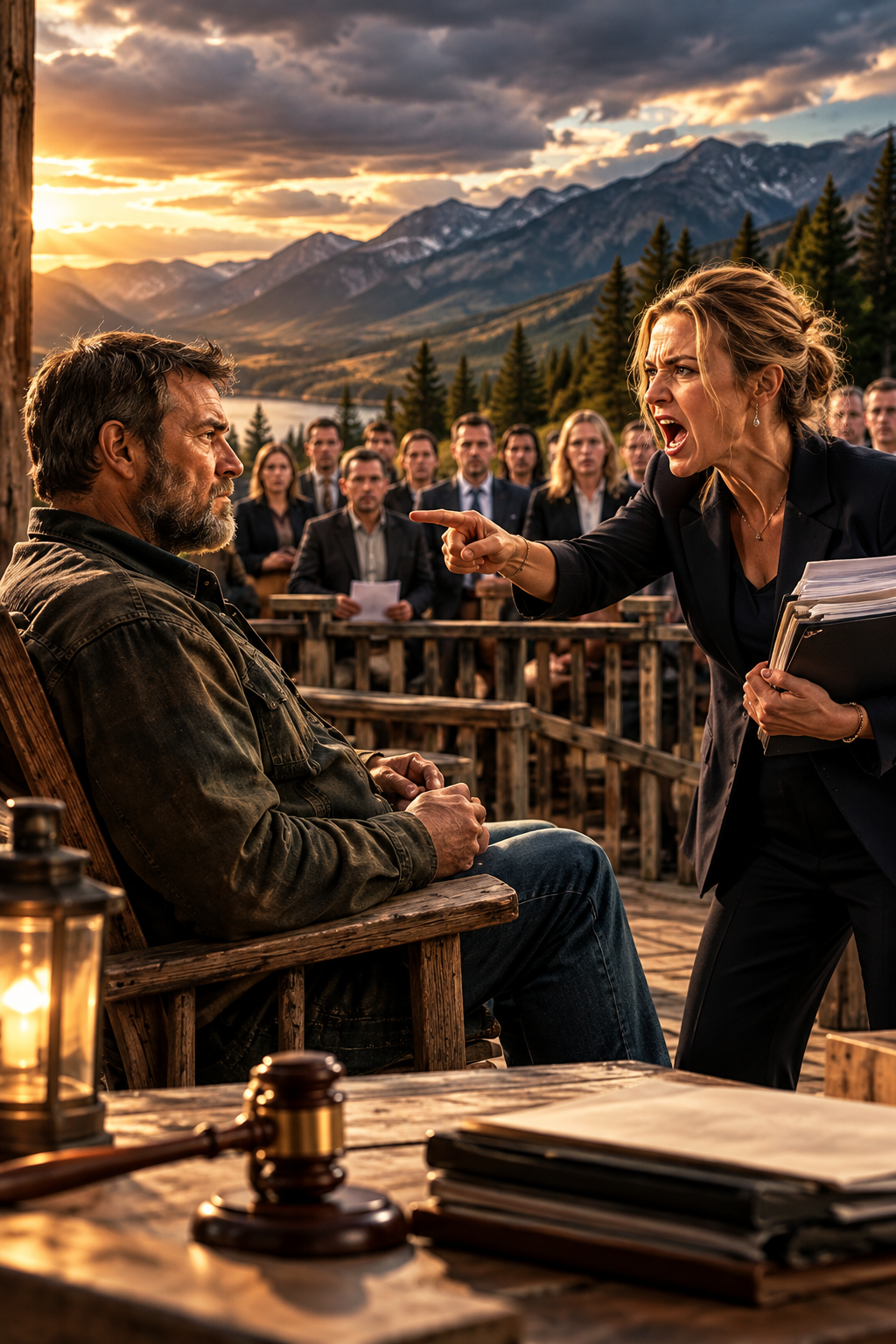
Part 2: My father’s mountain becomes a target for wealthy outsiders
Before Silver Pine Estates arrived, life on Black Ridge followed a rhythm so familiar that I could often predict the day’s work simply by listening to the weather outside my bedroom window. I fed my two aging quarter horses, Dustin and Copper, before sunrise, repaired whatever equipment had failed overnight, checked the water lines, and spent the quieter afternoons clearing brush along the boundaries my father had marked decades earlier. Most evenings I returned to the porch with coffee that had been sitting too long on the stove and watched hawks drift over the valley as the mountains turned gold. I had never married, although that was more a consequence of choosing a remote life than a deliberate rejection of companionship, and the few close friends I maintained understood that showing up unexpectedly usually meant being invited to dinner. I liked people well enough, but I liked them better when they respected the difference between being welcome on my property and having a permanent right to it.
My father taught me that distinction through actions rather than speeches, especially during the years when ranchers regularly borrowed equipment, helped one another during storms, and occasionally disagreed about wandering livestock or damaged fences. Robert was generous with his time, but he kept careful records because he understood how easily an informal kindness could be misremembered as an obligation after enough years passed. He maintained the road himself, paid the property taxes, and kept every survey and county document in a metal cabinet that smelled of old paper and machine oil. When he died, I continued the practice, adding newer maps and correspondence to the original files without realizing that those unremarkable documents would eventually become my strongest protection. The road was never offered to the public, dedicated to the county, or incorporated into any development plan with our family’s consent.
I first noticed Silver Pine Estates when construction trucks began appearing across the lower valley and survey stakes rose from fields where cattle had grazed for generations. Within two years, the development resembled a resort more than a neighborhood, with stone entrance monuments, polished wooden cabins, decorative ponds, and a clubhouse whose enormous windows reflected the peaks above. Victoria Crane became the homeowners association’s founding president, and local newspapers described her as a determined property-management professional with an impressive record of organizing luxury communities. She ran meetings with strict agendas, enforced appearance standards aggressively, and cultivated the reputation of a woman capable of solving problems before most residents knew they existed. The trouble began when she discovered that the developer’s beautiful brochures had said little about the inconvenience of reaching the eastern side of the valley.
Victoria arrived at my house one afternoon wearing expensive shoes entirely unsuitable for loose mountain gravel and carrying a presentation folder filled with maps, projected travel savings, and an offer to purchase permanent access across my land. She spoke about improving property values, reducing emergency response times, and creating a stronger relationship between the development and the surrounding community, all of which sounded reasonable until she began discussing my property as though it were an available resource waiting to be allocated. I listened, asked whether the association had considered improving its existing public route, and explained that I did not intend to grant an easement over the road my family had maintained privately for decades. She offered more money, mentioned possible tax advantages, and assured me that wealthy communities usually compensated cooperative neighbors very generously. I thanked her for visiting and refused again, expecting that an adult accustomed to business negotiations would recognize a completed conversation.
Two weeks later, the first formal letter arrived, followed by another accusing me of obstructing access and implying that I could be held responsible if an emergency vehicle experienced delays reaching Silver Pine Estates. My attorney, Claire Bennett, reviewed the correspondence and found no established right giving the association access to my road, although she cautioned me not to mistake a weak legal claim for a harmless dispute. Victoria could still file proceedings, generate expenses, influence public opinion, and make my life difficult even if the underlying property records favored me. I retrieved the original deed, commissioned an updated survey, and placed copies with Claire while preserving the older records at home. What began as an annoying disagreement about a road had become a conflict over whether someone else’s convenience could override my family’s ownership simply because they possessed money and a willingness to make threats.
Part 3: Midnight intruders discover my private mountain is watching them
The threatening letters became more aggressive as the weeks passed, increasingly portraying me as a selfish recluse whose refusal endangered children, elderly residents, and anyone unfortunate enough to need an ambulance. Victoria’s correspondence contained dramatic descriptions of hypothetical emergencies, but none established that her association had acquired legal rights across the Walker property. I began noticing unfamiliar vehicles near the lower fence line, drivers photographing my gate, and men who claimed to be lost while studying boundary markers clearly visible from the road. Claire recommended that I document the encounters carefully, avoid unnecessary arguments, and inform the sheriff whenever suspicious behavior crossed into threats or attempted trespass. I followed that advice, installing additional motion-activated cameras and sensors along the approach because I would rather collect reliable evidence than discover damage after the responsible people disappeared.
The cameras were not especially glamorous, and setting them up required several frustrating afternoons spent learning equipment instructions written by people who apparently believed everyone already understood wireless networking. My neighbor Frank Ellis helped test the system, laughing whenever the cameras alerted me that one of my horses had walked past a fence post. Eventually the arrangement worked well enough to record the gate, lower road, equipment shed, and several approaches through the trees, with footage copied to secure storage outside the property. I also purchased a small drone for checking remote sections of the ridge, although I used it sparingly because flying over my own mountainside was considerably less entertaining than the s suggested. Victoria knew none of this, and when she called one evening to warn that my continued refusal would bring consequences beyond paperwork, I preserved the conversation according to applicable law and forwarded it to Claire.
The first attempted break-in occurred shortly after two on a cold morning when an alert illuminated the phone beside my bed. I opened the camera feed and saw two men moving near the gate wearing dark clothing, headlamps, and jackets bearing an official-looking patch identifying an organization I had never heard of. One carried heavy cutters while the other positioned a powered tool near the lock, and their movements made it clear they intended to force entry rather than ask permission. My first instinct was to reach for the rifle kept in my bedroom, but I stopped because confronting unidentified people in darkness could turn a property crime into a tragedy. Instead, I remained inside, contacted the sheriff’s department, described the situation precisely, and watched from a safe location while the cameras recorded their actions.
Deputies arrived while the two men were still working on the gate, taking them into custody and documenting the tools, damaged hardware, and invented enforcement insignia. During preliminary questioning, one man reportedly claimed that Victoria had assured them there would be no consequences because the association had authority to open the road. The statement was not enough by itself to prove who hired them, but it gave investigators a reason to examine communications and financial arrangements beyond the immediate trespass. Sheriff Tom Ged, who had known my father and served the county for more than twenty years, visited the following morning to inspect the damage and explain what investigators could realistically establish. He promised to follow the evidence wherever it led, which I appreciated more than any speech about protecting property rights.
I repaired the damaged lock but kept the broken pieces and photographs because Claire warned that physical evidence could become important if the dispute continued. For the first time, I considered that Victoria might be deliberately escalating the situation rather than merely failing to control overenthusiastic supporters. The possibility angered me, not because I feared losing the land immediately, but because somebody had apparently decided that intimidation was a reasonable substitute for negotiation. My father had spent his life treating the mountain as something to maintain, not something to conquer, and I resented watching strangers transform a simple boundary into an excuse for aggression. Still, I refused to respond recklessly, because the people approaching my property expected an angry old rancher, and I intended to give them something far more troublesome: a patient one with records.
Part 4: A fake assault and public smear campaign begin unraveling Victoria
After the attempted break-in, Victoria launched a public campaign depicting me as the villain preventing ordinary families from feeling safe in their expensive mountain community. Flyers appeared throughout Silver Pine Estates accusing me of blocking emergency access, while a professionally designed website urged residents to pressure county officials into opening the road. The materials featured dramatic photographs of the mountain, carefully selected maps, and emotional statements about children whose lives might supposedly depend on a shortcut through my property. None of the promotional language explained that the development already had legal public access or that its developer had known about the surrounding private land before selling the first cabin. By repeating the same accusations often enough, Victoria convinced many homeowners that I was a bitter outsider deliberately punishing them for having more money than I did.
A protest formed near my lower gate one Saturday, attracting several dozen residents holding signs demanding that I open the road immediately. I brought a folding chair, sat behind the fence, and watched the demonstration while drinking coffee because I saw little benefit in shouting back at people who had already decided what they believed. A reporter approached and asked whether I considered the event intimidating, and I answered that I had seen better-organized county fairs. He laughed, printed the comment, and triggered a fresh round of outrage among residents who believed I was mocking their safety concerns. I understood their anger, but I had no obligation to treat every accusation seriously merely because it appeared on colorful poster board.
The situation became more dangerous when a man claiming to be a hiker staggered toward the gate during another gathering and loudly accused me of attacking him. He fell onto the gravel in front of several cameras, shouting that I had shoved him without warning, while nearby protesters rushed forward demanding police intervention. I had not touched him and had remained several feet away throughout the encounter, but I knew that public footage captured from poor angles might create the appearance of a confrontation. Fortunately, my fixed security camera recorded the complete sequence clearly, showing him deliberately throwing himself backward and landing on the ground without physical contact. I provided the original footage to investigators, who later determined that his accusation was false and that he had received money connected to people associated with the campaign against me.
Once the recording became public, the same residents who had demanded my prosecution began questioning how someone supposedly injured by a violent property owner had managed to stage the entire event so badly. Local reporters discovered discrepancies between the man’s account and the video, while investigators traced financial arrangements associated with his involvement. Victoria attempted to dismiss the incident as the irresponsible behavior of an independent supporter, but her explanation became less convincing when compared with the earlier attempted break-in and threatening correspondence. I did not celebrate watching a man face consequences for a false allegation, because manufactured accusations could have damaged my reputation and endangered me long before the truth emerged. What mattered was that the footage allowed facts to replace a story designed to make strangers angry.
Victoria responded by becoming increasingly confrontational, describing the failed accusation as a distraction from what she called the larger public interest. She appeared at HOA meetings insisting that residents remain united, warned against believing my version of events, and promised that legal access would be secured before the next construction season. Several homeowners began asking uncomfortable questions about the cost of the campaign, particularly because association dues had recently increased despite no visible improvements to landscaping or shared facilities. Victoria assured them that legal and administrative expenses were necessary investments in the community’s future. I watched the developments from the ridge, recognizing that the woman who had once approached me with a polite business proposal was now trapped inside a battle she could not afford to lose without exposing everything she had done.
Part 5: Unauthorized bulldozers tear through the land my father protected
I woke one morning to the unmistakable sound of heavy diesel engines operating far below the house, where nothing larger than my own aging equipment should have been moving. Through the kitchen window, I saw a bulldozer pushing brush aside near the lower boundary while an excavator waited behind it, both surrounded by workers wearing bright safety vests. At first I wondered whether a neighboring rancher had begun an approved project near the property line, but the equipment was clearly moving along the proposed route Victoria had marked in her earlier presentations. I drove down in my old pickup, stopped well away from the machinery, and asked the site supervisor who had authorized work on Walker land. He produced a document bearing the Silver Pine Estates association logo and said his company had been hired to create an improved access route for community transportation and emergency vehicles.
The supervisor seemed genuinely surprised when I told him that his crew was operating on private land without my consent, and his confidence weakened when I showed him the boundary markers and explained that the HOA possessed no construction authority over my property. I asked the workers to stop while we clarified the ownership issue and contacted the sheriff, county planning office, and building inspector. Inspector Walter Greer arrived with survey information and confirmed that the work had entered land belonging to me, with no approved authorization permitting the grading activity. The county issued stop-work instructions and began documenting disturbed soil, damaged vegetation, and the absence of required approvals. What had started as an argument about permission had become a costly incident involving construction contracts, potential environmental impacts, and damage to ground my father had spent decades protecting.
I walked the disturbed area after officials left, studying deep tire tracks cutting through old grass and piles of uprooted brush that had once sheltered birds and small animals. The damage was not enormous compared with the total acreage, but seeing machines carve across the landscape without permission affected me more deeply than the threatening letters or embarrassing protests. I remembered helping Robert clear fallen trees after spring storms, watching him stop work to move a nest rather than destroy it simply because doing so would save an hour. He treated the land as something borrowed from generations that came before and owed to generations that might follow, even though our family name appeared on the deed. Victoria saw the same ground as an inconvenient obstacle to a project she had already promised would happen.
The contractor eventually disclosed that the job had been authorized through an agreement signed by Victoria in her capacity as HOA president, and investigators began examining whether she had obtained the board approvals required for such spending. She claimed the project involved emergency access improvements and that the association had acted on legal advice, but the documents available to inspectors did not establish authority to enter my land. Claire prepared demands for restoration, preservation of relevant records, and compensation for documented damage, while advising me not to perform extensive repairs until the condition of the site had been independently assessed. I agreed, although it hurt to leave the torn ground untouched for weeks while the legal process advanced. My father had taught me to repair damage promptly, but experience had taught me that evidence sometimes needed to remain visible long enough for people to understand what happened.
A few evenings later, I sat on the porch watching the valley lights appear and wondered whether the dispute would ever return to the simple question that began it. I had never demanded payment from Silver Pine residents for living below my mountain, never attempted to control their property, and never tried to prevent them from improving roads they actually owned. Yet their association had spent months pretending that my refusal to surrender a private pass gave them permission to threaten, discredit, and eventually damage me. I considered selling the land for one brief exhausted moment, then imagined explaining that decision to the memory of a father who had endured blizzards and droughts without abandoning the place he loved. Before I could decide what to do next, a vehicle climbed the driveway, and the man stepping out carried a folder that would change the entire case.
Part 6: The HOA treasurer reveals $320,000 in secretly diverted funds
Daniel Brooks stood on my porch holding a flash drive, a thick envelope of invoices, and the expression of someone who had spent weeks deciding whether telling the truth would destroy his own life. He introduced himself as the treasurer of Silver Pine Estates, although I recognized him from several public meetings where he had remained silent while Victoria presented increasingly aggressive plans for obtaining my road. I invited him inside, offered coffee, and waited while he arranged the papers on my kitchen table with hands that shook whenever he mentioned the association’s financial records. He explained that he had initially trusted Victoria’s assurances that legal expenses and security measures had been approved through procedures unfamiliar to him. Then he discovered that substantial amounts were moving from reserve accounts without the board authorizations required under the association’s governing documents.
The total he had identified was approximately $320,000, including payments connected to outside legal services, private contractors, the attempted gate entry, the staged assault allegation, and the unauthorized grading project. Some invoices used vague descriptions such as community access consultation or emergency route assessment, while others had been routed through entities whose connection to the actual work was difficult to determine. Daniel admitted that he had signed certain payment documents without examining supporting approvals closely enough, and he feared that his own negligence might leave him facing accusations alongside Victoria. He had a daughter preparing for college, a mortgage, and a career he did not want to lose because he had trusted somebody who treated association money like a private campaign fund. I told him that I could not promise immunity or control what investigators concluded, but I could make sure the documents reached people capable of reviewing them independently.
Claire examined the materials with Daniel’s permission and helped coordinate their proper submission to the relevant authorities, ensuring that potentially sensitive financial information was handled responsibly. Investigators compared invoices against association records, contractor communications, and the evidence already collected from incidents at my gate. The payments did not automatically prove that Victoria personally committed every act involved, but they substantially strengthened the case for examining her authorization decisions and the financial controls she had bypassed. Daniel agreed to cooperate, knowing that transparency might expose mistakes he had made while also establishing that he had not knowingly approved the underlying scheme. I respected him for finally speaking, although I wished he had challenged Victoria before the dispute caused so much damage.
The records also explained why Victoria had resisted compromise with such intensity, because acknowledging that the HOA lacked rights over my road would raise questions about money already spent pursuing those rights. She had apparently promised residents a result, committed funds without sufficient oversight, and then escalated whenever evidence threatened the story she was telling. The mountain road had become more than a practical shortcut; it was the proof she needed that her leadership justified the expense. Each failed attempt increased the pressure to succeed, and each new payment made admitting failure more dangerous. I understood the pattern because my father used to warn that people who refused to admit a small mistake often created much larger ones trying to hide it.
Rather than rush into a public confrontation, I worked with Claire to prepare accurate copies of the records we could lawfully share without interfering with ongoing investigations. We organized property documents, surveys, photographs, documented communications, and financial summaries into a clear timeline explaining how the disagreement evolved. My goal was not to humiliate ordinary homeowners who had believed Victoria’s statements, but to give them information they had been denied while their dues funded an increasingly reckless campaign. I planned a community open house near the lower gate, inviting residents, local journalists, and county representatives willing to attend. For the first time, I was ready to do more than defend my property, because the people who had been shouting outside my fence deserved to know what their association president had been doing in their names.
Part 7: A public evidence display turns angry neighbors against Victoria
On the morning of the open house, I set folding tables beneath a canvas tent near the base of my road and arranged the documents in chronological order, beginning with the original 1954 deed and ending with the most recent evidence of unauthorized construction. Beside the maps were decades of tax records, photographs showing the original road before Silver Pine Estates existed, and copies of surveys documenting the location of my boundaries. Another section displayed material related to the threats, attempted break-in, false assault allegation, and grading work, using only evidence that could appropriately be shared publicly. Claire helped prepare explanations distinguishing established facts from allegations still under investigation, because I refused to replace Victoria’s misleading narrative with exaggerated claims of my own. I brewed several large containers of coffee and waited, uncertain whether anyone from the development would attend voluntarily.
The first visitors were two retired residents who had participated in the earlier protest, followed by a young couple carrying their toddler and a woman named Carol Hutchins who had taught history at the local high school. They moved quietly between the tables, studying the original deed before examining the timeline of letters and photographs. Carol asked whether the road had ever been dedicated to public use, and Claire explained what the available records established and which legal questions remained for the court to resolve. Another resident wanted to know why association dues had increased when no community improvements had been completed, and Daniel carefully explained the financial discrepancies that prompted him to cooperate with investigators. As more people arrived, the conversations became less about my refusal to open the road and more about why Victoria had spent their money pursuing it through questionable methods.
One man who had shouted at me through a megaphone several weeks earlier stood silently before the photograph of the damaged gate, then asked whether the men arrested there had actually carried tools for cutting the lock. I showed him the publicly available incident documentation and explained that investigators were examining who had hired them. He stared at the materials for several moments before admitting that Victoria had described the episode as an exaggerated misunderstanding involving security personnel checking emergency access. Nearby, a woman recognized a contractor’s company name on an invoice and said the firm had recently been paid for work she had never seen completed inside the development. People began asking one another questions, comparing what they remembered from board meetings with dates recorded in the documents.
By early afternoon, local reporters had arrived, and several residents were speaking openly about the difference between the story they had been told and the evidence displayed in front of them. I answered questions about my family’s ownership without insulting the homeowners or suggesting they were foolish for trusting elected association leaders. Many had purchased property in good faith, believing the development’s marketing materials and assuming the HOA understood its own authority. Their mistake was not wanting shorter travel times or reliable emergency services, but accepting the claim that those goals entitled them to somebody else’s private land. I told them I understood why the shortcut seemed attractive, but I could not solve the developer’s planning decisions by surrendering a road my family had maintained for seventy years.
Carol eventually approached me with tears in her eyes and apologized for calling me selfish during the first protest. She said she had spent a lifetime teaching students to examine primary sources, yet had accepted Victoria’s statements without asking to see the underlying documents. I told her that trusting a confident person was understandable, but refusing to reconsider after contradictory evidence appeared would be a choice. She asked whether I would ever forgive the community for the way residents had treated me, and I answered that forgiveness would be easier if they began holding their own leadership accountable. By the time the afternoon ended, several homeowners had organized a petition demanding an independent financial review and new association elections.
Victoria did not attend the open house, but her absence became increasingly conspicuous as coverage spread through local newspapers and television stations. Residents who previously defended her began requesting minutes, bank statements, contract approvals, and explanations for payments that had never appeared clearly in routine reports. The HOA’s attorneys faced questions about whether they represented the association’s interests or decisions Victoria made outside required procedures. Daniel continued cooperating with investigators, and Claire prepared for the court proceedings that would determine whether any claimed access right actually existed. I returned home exhausted but hopeful, because the conflict was finally moving away from shouting and toward documents that could be independently examined.
Part 8: A courtroom ruling destroys the HOA president’s carefully built power
The courtroom was crowded on the morning the dispute reached its decisive hearing, with Silver Pine residents filling the benches beside local ranchers, reporters, and people who had followed the controversy for months. Victoria sat beside her attorneys wearing a dark suit and a carefully neutral expression, although the confident smile she once displayed at my gate was nowhere to be seen. My lawyer presented the original deed, updated surveys, historical maps, tax records, and the absence of any established easement granting Silver Pine Estates the access it demanded. The HOA argued that the road served an important practical purpose and that emergency access could benefit the development, but Claire emphasized that convenience alone did not establish a property right. I listened without interruption, remembering how Victoria originally promised this would be a simple negotiation that any sensible landowner would accept.
The court also considered relevant evidence concerning the association’s conduct, including documented incidents at the gate and the unauthorized grading work. Daniel testified about payments that appeared to bypass required board approvals, explaining the records he had reviewed and the circumstances that led him to report suspected misuse of reserve funds. He acknowledged his own failures to scrutinize certain transactions, which made his testimony more credible than pretending he had noticed nothing until the day he approached my house. Victoria’s attorneys challenged the interpretation of the financial records and argued that various expenditures related to legitimate efforts to improve transportation access. The judge distinguished the property question from possible criminal wrongdoing while considering how the evidence affected the association’s claims and conduct.
When the ruling came, it confirmed that Silver Pine Estates had failed to establish the access rights it claimed over my private road. The court rejected the attempt to compel ordinary use of the pass based on the arguments presented, leaving the association responsible for addressing its transportation needs through lawful alternatives. Related misconduct was referred to the appropriate authorities for further consideration, including financial irregularities and the circumstances surrounding unauthorized work on my property. Victoria remained motionless as the ruling was announced, and I noticed that several residents who had once marched beneath her direction were now watching her with open disappointment. I felt relief rather than triumph, because the court had not given me anything new; it had confirmed the boundaries my father had worked within throughout his life.
Outside the courthouse, journalists surrounded the attorneys and asked whether the outcome represented a victory for private property rights over community safety. I explained that the two interests did not need to be enemies, because communities could improve emergency planning while respecting established ownership and obtaining lawful access where necessary. The actual problem arose when Victoria treated a private road as a resource she could promise without permission and then escalated the dispute through intimidation and unauthorized spending. I said the homeowners deserved reliable infrastructure and honest financial management, not a political campaign financed by their dues against someone who had never joined their association. Then I walked away before anyone could persuade me to deliver the angry speech they seemed to expect.
Further investigations eventually led to serious charges against Victoria involving alleged financial misconduct, unlawful arrangements, and document-related offenses connected with the campaign. She lost her position, and the association underwent a major leadership change as residents worked to restore financial oversight and confidence in the organization. Contractors and other participants faced consequences according to their individual conduct, while the remaining legal disputes took time to resolve. The new board publicly acknowledged that it possessed no right to use my road without a lawful agreement, and it began exploring improvements to existing public routes rather than repeating Victoria’s approach. For the first time in months, the valley began settling into a future where my private property was no longer treated as an obstacle that had to be overcome.
Part 9: The mountain survives while my neighbors learn the cost of arrogance
In the months after the ruling, I repaired damaged ground near the lower boundary, restored sections of fencing, and installed a heavier gate because experience had taught me that written ownership meant little if people felt entitled to ignore it. The work was slow, particularly where heavy machinery had disturbed soil that needed careful stabilization before vegetation could return. Frank helped me transport materials, and occasionally residents from Silver Pine Estates volunteered with restoration projects after asking permission rather than assuming they were welcome. I appreciated the gestures but insisted on managing the work according to plans reviewed with appropriate specialists, because protecting the property meant more than allowing enthusiastic neighbors to create another set of problems. Each repaired section reminded me of my father rebuilding fences after storms, quietly correcting damage without making the repair itself into a performance.
Margaret Wills, an elderly homeowner who had once stood near the front of a protest carrying a sign demanding that the road be opened, visited one afternoon with homemade cookies and a nervous apology. She admitted that Victoria had convinced her the shortcut was legally available and that my refusal represented nothing more than selfishness. When she saw the deed and other records at the open house, she began questioning why she had accepted such an important claim without examining its basis. I told her that I understood why people trust officials who speak confidently, particularly when those officials claim to be protecting a community. The important question was what someone did after discovering the person they trusted had misrepresented the facts.
Other residents stopped by over the following weeks, some apologizing directly and others simply asking whether they could purchase hay, visit the horses, or learn more about the old ranches surrounding the valley. I accepted the genuine apologies without expecting lifelong friendships, because reconciliation was not a requirement for peaceful coexistence. The Silver Pine board eventually invited me to an infrastructure meeting, and I attended as a neighboring landowner rather than a member subject to its rules. We discussed emergency planning, the limitations of their existing access route, and alternatives involving public improvements that would not cross my property without an agreement. I remained unwilling to grant permanent residential traffic through my road, but I was willing to participate in sensible conversations that began by respecting my answer.
Daniel Brooks continued working with investigators and independent reviewers, accepting scrutiny of the payments he had approved while helping reconstruct how Victoria used the association’s accounts. I never described him as a flawless hero because he had overlooked warning signs and allowed his signature to appear on transactions he should have questioned. Still, he eventually chose transparency when remaining silent would have been easier, and that decision helped protect residents from further losses. His daughter later sent me a thank-you card explaining that her father had finally begun sleeping normally again after months of anxiety. I kept the card in the same desk drawer as the original correspondence from Victoria because it reminded me that the conflict had affected people far beyond my own property.
The valley changed gradually as the new HOA leadership repaired financial controls and residents began treating neighboring ranchers less like scenery surrounding their expensive houses. Silver Pine Estates remained a prosperous development, but its brochures stopped implying access to trails and land it did not actually control. The association revised its communications procedures, required greater transparency for major expenditures, and began documenting decisions that previous leadership had handled privately. Those changes were not dramatic enough to attract national attention, but they mattered to the people who would continue living together long after the controversy disappeared from local headlines. I had no interest in becoming the permanent symbol of some battle between rural tradition and wealthy newcomers, because most days I simply wanted to feed the horses and watch the mountains without hearing another lawyer’s voice.
On the first anniversary of the confrontation with Victoria’s twelve representatives, I stood beside the reinforced gate and attached a simple wooden sign made from cedar salvaged from my father’s old workshop. I painted the letters myself, taking care to make them visible without decorating the entrance like a commercial attraction. The message read, “Private Property — Walker Ranch — Access By Permission Only,” followed beneath by the words my father would have recognized immediately. My land, my rules. I stepped back to inspect it, then laughed because the sign was crooked by perhaps half an inch, exactly the kind of imperfection Robert would have noticed before telling me to stop worrying about appearances and finish the actual work.
Part 10: My father’s seventy-year legacy outlives the HOA’s final threat
Several years after Victoria first climbed my driveway carrying her impressive leather folder, Black Ridge looked much as it had when my father was alive, although the new security gate and repaired lower boundary revealed signs of the conflict to anyone who knew where to look. Dustin had grown too old for much riding, Copper spent most afternoons resting in the shade, and I had begun considering whether a younger ranch hand might help maintain the property as I grew older. The idea once frightened me because accepting assistance felt uncomfortably close to admitting that I could not preserve my father’s work alone. But the dispute had taught me that defending independence did not require rejecting every offer of cooperation. What mattered was choosing whom to trust and establishing boundaries before misunderstandings became obligations.
One autumn afternoon, Carol Hutchins arrived with two high school students who were researching the history of private land ownership in the valley for a local heritage project. They asked permission to photograph the original deed, interview me about Robert’s road, and compare historical maps with modern development plans. I agreed, provided that they treated the property records accurately and did not turn the controversy into a simple story about heroes and villains. Victoria had acted irresponsibly, but many residents had supported her because they genuinely believed a shorter access route would improve their community. I wanted the students to understand that complicated disputes often begin with legitimate concerns and become destructive when people decide those concerns justify ignoring another person’s rights.
One student asked why my father had refused to sell the mountain when development elsewhere in the region made similar land increasingly valuable. I explained that Robert had purchased it before anyone considered the area prestigious, built his home there, and never treated the property as an investment waiting for the right buyer. He liked the work, the isolation, the difficult winters, and the satisfaction of knowing every repaired fence or cleared section of road had been accomplished through his own effort. Money would have changed his circumstances, but it would not necessarily have given him anything he wanted more than the life he already possessed. The student wrote the answer in her notebook and then asked whether I felt the same way.
I looked across the ridge toward the places where my father taught me to ride, repair machinery, and wait patiently when bad weather made work impossible. I told her that I did not think property ownership made someone morally superior, and I understood perfectly well why other families sold land when their circumstances changed. But the Walker property represented a particular promise I had made to a man who spent his entire adult life preserving it, and breaking that promise merely to avoid an unpleasant disagreement would have changed how I understood myself. I could negotiate reasonable requests, welcome visitors, and cooperate with neighbors without surrendering ownership to anyone who mistook persistence for authority. The student smiled and said it sounded less like a lesson about real estate than one about knowing what mattered.
That evening, after the visitors departed, I climbed to the highest point on the ridge carrying my father’s old tin cup and watched sunlight retreat from the valley below. Silver Pine Estates glowed in the distance, its orderly streets and expensive cabins no longer seeming threatening because the people living there had finally accepted that their neighborhood ended where another person’s property began. Somewhere among those houses, residents who once marched against me were preparing dinners, helping children with homework, and worrying about ordinary problems rather than my private road. I hoped their new board would continue operating honestly, because the valley was large enough for ranchers and newcomers alike when nobody insisted on controlling everything they could see. The mountain remained quiet around me, indifferent to the arguments that had briefly made its gravel road famous.
I remembered the morning twelve HOA representatives stood outside my gate and laughed when I told them that my land belonged to me. They believed wealth, polished paperwork, official titles, and public pressure could eventually transform an unauthorized demand into an unavoidable obligation. They underestimated the original deed, the cameras, the patience of a man who knew his boundaries, and the willingness of ordinary people to reconsider when confronted with evidence. Victoria lost her authority because she treated opposition as something to eliminate rather than a limit she had to respect, while I nearly lost the peaceful life I loved because I assumed people would recognize an obvious boundary without being forced to see the proof. In the end, the court confirmed my family’s ownership, the community began repairing the damage, and the road remained exactly where Robert Walker had built it.
I finished my coffee, walked back toward the porch, and paused beside the railing my father constructed so long ago that his handprints had worn into the wood. For most of my life, I believed preserving his legacy meant keeping the house standing, the road open for our own use, and the fences repaired before winter. Now I understood it meant protecting the right to decide what happened to the land without allowing someone else’s impatience to become my responsibility. My father never promised that living on Black Ridge would be easy, only that the mountain would reward people willing to care for it without expecting the world to surrender to their wishes. As the last light disappeared behind the peaks, I looked toward the steel gate below and smiled, knowing that everything Victoria tried to take was still here, not because I had been louder or richer or more powerful than she was, but because I had remained patient enough to defend the truth.
The next morning would bring broken equipment, hungry horses, cold coffee, and another ordinary day on the mountain. There would be fences to check, weather to watch, and repairs that seemed determined to outlive me. Perhaps someday the property would pass to someone else willing to respect its history and take responsibility for its future. Until then, I would continue caring for it the way Robert taught me, without confusing stubbornness with pride or generosity with surrender. And whenever somebody asked why I had fought so hard over one narrow mountain road, I would give the answer my father once gave me: some things are worth protecting not because they make you wealthy, but because losing them would mean surrendering a piece of the life you worked to build.
✓ Lynn R. Adams
Part 2: My father’s mountain becomes a target for wealthy outsiders Before Silver Pine Estates arrived, life on Black Ridge followed a rhythm so familiar that I could often predict the day’s work sim…