I Banned the HOA From My Fish Ladder—Then One State Permit Exposed the Land They’d Been Stealing for Years
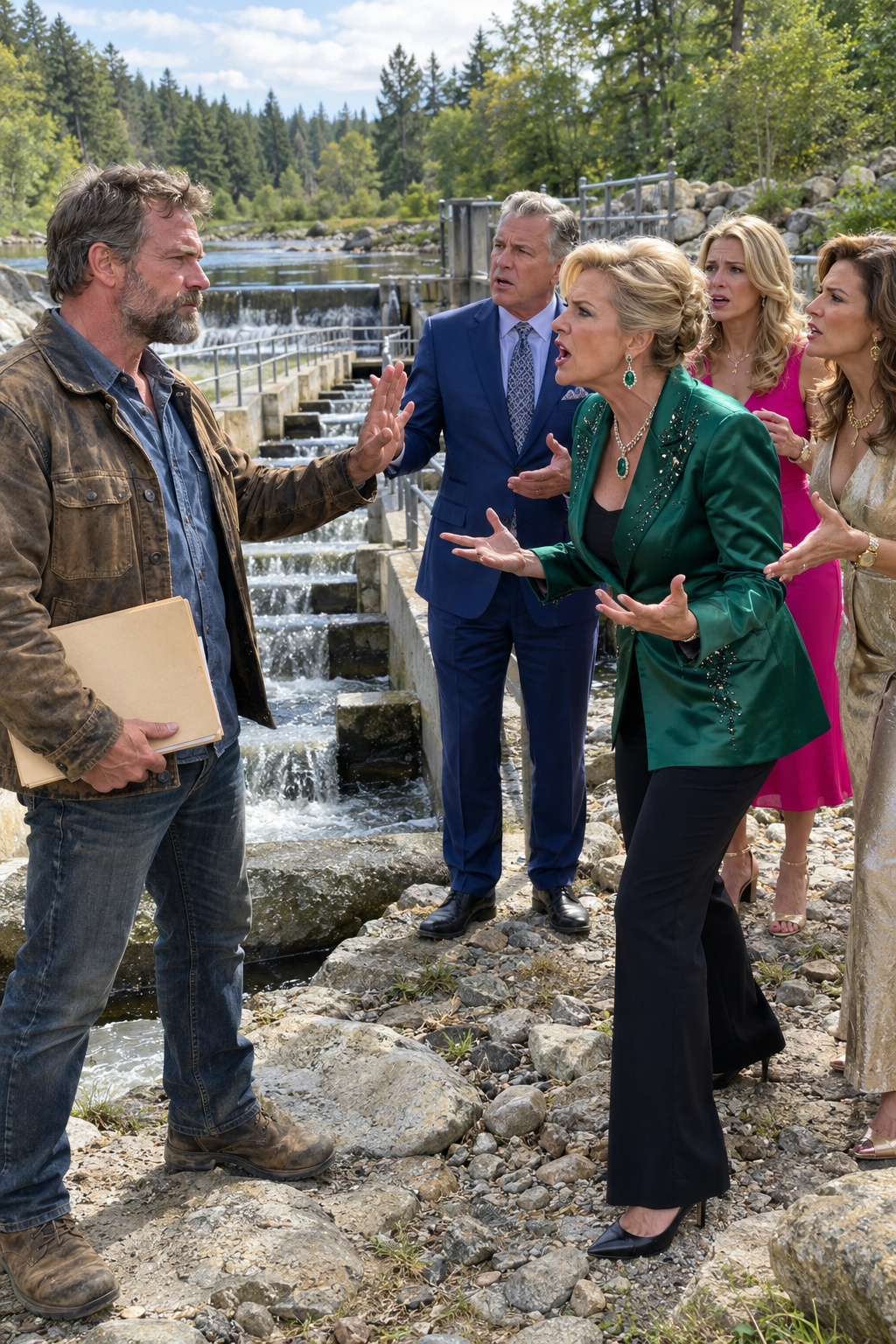
I Banned the HOA From My Fish Ladder—Then One State Permit Exposed the Land They’d Been Stealing for Years
My brother gave me six days to leave the house I had spent eleven years paying to keep alive.
On the seventh morning, the HOA president stood in my father’s kitchen, drinking coffee from his favorite mug, and told me I was no longer allowed to walk down to the river.
That was when I knew they had made a mistake.
Not because the river belonged to me.
Not because the old cedar house belonged to me.
Not even because my brother had lied about our father’s will.
They had made a mistake because the concrete fish ladder below Alder Bend Dam had one legal name attached to it.
I didn’t tell them that.
I folded my father’s canvas jacket over my arm, picked up the small red metal box I had carried down from his bedroom, and looked at my brother, Daniel.
“You want me gone by noon?”
Daniel wouldn’t meet my eyes.
His wife, Melissa, did.
She stood beside the refrigerator wearing cream-colored slacks and the kind of expression people wear when they have already spent money they don’t own.
“We need to move forward, Claire.”
Move forward.
That was what people called betrayal when they wanted it to sound like self-care.
Behind her, through the wide kitchen windows, October sunlight flashed on Alder Creek.
Two hundred yards downhill, the water narrowed against the old diversion dam, foamed silver around the concrete wall, then slipped through the fish ladder my father and I had rebuilt twelve years earlier.
I could hear it even from the house.
Water over stone.
Water through gates.
Water doing exactly what it had done long before Cedar Ridge Estates arrived with its stone entrance monument, decorative lanterns, and six-page rules about mailbox colors.
I set the red box on the kitchen table.
Daniel’s eyes moved toward it.
“What’s that?” Melissa asked.
“What’s in it?”
“I haven’t decided yet.”
Her mouth tightened.
Daniel finally looked at me.
“We’ve already been through his papers.”
“No,” I said. “You went through his desk.”
A little silence followed.
The dangerous kind.
My father, Walter Pierce, had died nine days earlier at seventy-nine.
He had been on the back porch at in the morning, coffee cooling beside him, watching chinook work their way upstream.
I found him twenty minutes later.
For eleven years before that morning, I had organized his medications, driven him to cardiology appointments in Salem, handled the property taxes, replaced the furnace, patched the barn roof, fought insurance companies, maintained three miles of fencing, and climbed down to the fish ladder during spring runoff when younger men refused to go near it.
Daniel visited at Christmas.
Sometimes Thanksgiving.
Once on Father’s Day.
He lived forty minutes away.
Close enough to help.
Far enough to pretend he couldn’t.
And yet three days after Dad’s funeral, Daniel arrived with Melissa, an attorney from Portland, and Patricia Voss, president of the Cedar Ridge Homeowners Association.
That should have told me everything.
Daniel had inherited the house.
At least that was what the will said.
The main house, eight acres around it, the detached garage, and the upper pasture.
I had known Dad might leave it to him.
Daniel had children.
Dad was old-fashioned about sons and names and keeping the Pierce house with a Pierce man, even when that Pierce man didn’t know where the main water shutoff was.
But pain and surprise aren’t the same thing.
The surprise came when Daniel told me I had six days to leave.
The second surprise came when Patricia Voss slid a folder across our kitchen table and announced that Cedar Ridge had “assumed management responsibility” for the river corridor, including the fish ladder.
I had almost laughed.
Instead I asked, “Assumed?”
Patricia smiled.
She was sixty-two, silver-blonde, immaculate, and permanently dressed as though she might have to cut a ribbon at a bank opening.
“Operationally,” she said.
That word interested me.
Not purchased.
Operationally.
I filed it away.
Patricia continued.
“The HOA has maintained community access to Alder Creek for years. With Daniel joining the association boundary agreement, we can finally regularize the entire waterfront.”
Daniel stared at the table.
There it was.
The reason he wouldn’t look at me.
“What boundary agreement?”
Melissa answered too quickly.
“It’s administrative.”
I turned to Daniel.
“What did you sign?”
He exhaled.
“Claire, don’t make everything a fight.”
I didn’t raise my voice.
That disappointed them.
People who betray you prepare for tears.
They prepare for screaming.
They prepare for accusations they can dismiss as emotion.
They rarely prepare for a woman who simply begins asking for document names.
“Did you sign an easement?” I asked.
Daniel rubbed his jaw.
“Patricia’s attorney handled it.”
“What kind?”
“Access easement?”
“Riparian easement?”
Melissa crossed her arms.
“This is exactly why living with you has become impossible.”
Living with me.
In the house where I had paid the electric bill for seven years.
Interesting.
Patricia placed one manicured finger on her folder.
“Regardless, we need a clean transition. The HOA has contractors starting improvements near the river Monday.”
“What improvements?”
“A viewing deck. Interpretive signage. Safety railings. Landscaping.”
“Near the ladder?”
“Adjacent.”
“How adjacent?”
She smiled again.
“Close enough for residents to finally enjoy what they’ve been paying for.”
That was the moment I knew she wasn’t talking about flowers.
Cedar Ridge residents had not been paying for the fish ladder.
They had been using it.
That was different.
For nearly fifteen years, residents from the development upstream had walked a gravel trail along the eastern bank to watch salmon climb the ladder.
Dad had never stopped them.
Neither had I.
School groups came.
Retirees came with binoculars.
Parents brought children in rain boots.
In September, people stood quietly along the railing and watched dark backs push against white water.
My father believed access to something beautiful could make people less selfish.
I’m not sure he was right.
But I tried to honor the belief.
No admission fee.
No private-tour nonsense.
Just one rule painted on a small wooden sign:
RESPECT THE WATER. RESPECT THE FISH. LEAVE IT BETTER THAN YOU FOUND IT.
Patricia hated that sign.
She once told me it looked “rural.”
We were standing in rural Oregon.
I asked what she preferred.
She showed me a rendering with polished steel rails, branded plaques, ornamental lighting, a donor wall, and the words CEDAR RIDGE SALMON WALK.
I told her no.
That was eighteen months before Dad died.
Now she thought she had found another way.
Daniel slid a single sheet toward me.
“It’s done, Claire.”
At the top was a Cedar Ridge letterhead.
NOTICE OF RESTRICTED ACCESS.
Effective immediately, nonresidents and unauthorized individuals were prohibited from entering “HOA-managed riparian facilities.”
At the bottom was Patricia’s signature.
I read it twice.
Then I looked up.
“Unauthorized individuals?”
Patricia didn’t blink.
“You’ll no longer be a resident after today.”
“My father’s ashes are scattered below that dam.”
Daniel flinched.
Patricia didn’t.
“I understand this is emotional.”
That sentence almost earned her the reaction she wanted.
Instead, I folded the notice once.
Then again.
I slid it into my jacket pocket.
“Thank you.”
Melissa stared at me.
“For what?”
“For putting it in writing.”
I picked up the red box.
Daniel’s face changed slightly.
“You’re really just leaving?”
“You told me to.”
“I expected…” He stopped.
He shrugged.
“A discussion.”
“You already signed something.”
His silence confirmed it.
“So what would we discuss?”
I carried the red box toward the mudroom.
Melissa followed me two steps.
“You can’t take estate documents.”
Then I smiled for the first time that morning.
“They aren’t estate documents.”
“How do we know that?”
“You don’t.”
Patricia watched me more carefully now.
Outside, I loaded two suitcases into my ten-year-old Subaru.
Eleven years of my life fit badly into two suitcases, six cardboard boxes, one red metal document case, and a chipped ceramic bowl my mother had made before cancer took her.
Daniel stood on the porch.
Melissa stayed inside.
Patricia was already on her phone.
I put Dad’s jacket on the passenger seat.
Before closing the door, I reached into the pocket.
My fingers found the folded note again.
Dad had written it in blue ink.
His handwriting had become shaky during his last year, but the words were unmistakable.
If Cedar Ridge ever says the ladder belongs to them, do not argue.
Ask for their permit.
Then open the red box.
Underneath, in smaller writing, he had added:
And remember: concrete is not the property. The right underneath it is.
I had read that note twice the night he died.
I hadn’t understood it.
Now I was beginning to.
I drove away at 11:47.
I did not cry where Daniel could see me.
I did not beg for the house.
I did not threaten Patricia.
I did not tell Melissa what was inside the red box.
I did not tell any of them that our father had been warning me about Cedar Ridge for almost twenty years.
I did not tell them that silence was the only inheritance he had taught me to use correctly.
For three nights, I stayed at the Evergreen Motor Lodge twelve miles outside town.
Brown carpet.
A heater that clicked every twenty minutes.
A vending machine outside that ate two dollars and never gave me the pretzels.
I put the red box on the little table beside the window.
Then I began reading.
Inside were no stock certificates.
No secret millions.
No bearer bonds.
Nothing dramatic enough for television.
There were permits.
Inspection reports.
A thirty-two-year-old recorded deed.
Handwritten notes.
Copies of correspondence between my father and the Oregon Department of Fish and Wildlife.
A water-right certificate.
A conservation agreement.
A faded photograph of Dad standing beside the old timber spillway in 1987.
And one document with my full name typed across the first page.
CLAIRE ELIZABETH PIERCE.
I sat very still.
The permit was dated twelve years earlier, when Dad and I rebuilt the failing fish ladder after a winter storm damaged two chambers and washed half the downstream apron away.
I remembered that year.
I was forty-three.
Newly divorced.
Angry at nearly everyone.
Dad called and said, “Come home for a month.”
A month became a year.
A year became eleven.
The state required the ladder reconstruction to meet fish-passage standards.
Dad had suffered a small heart attack three weeks before the final application.
He asked me to handle the paperwork.
I met engineers.
I attended inspections.
I coordinated excavation schedules around migration windows.
I took calls at six in the morning.
I sat through county meetings where men twice asked whether my husband would be joining us.
I answered no both times.
The permit had been issued to me as responsible operator.
That alone was useful.
But it wasn’t the secret.
The secret was attached behind it.
A recorded conveyance from 2014.
My father had transferred ownership of Parcel 17-B to me.
I stared at the legal description.
Read it once.
Read it again.
Then pulled out the map.
Parcel 17-B was not the house.
It was not even attached to the house in the way I had assumed.
It was a long, irregular river parcel beginning above Alder Bend Dam and running nearly a mile downstream.
Forty-six acres.
The fish ladder.
The gravel access road.
Both banks for nearly half the stretch.
The maintenance shed.
And, critically, the point where Cedar Ridge’s walking trail entered the river corridor.
My father had deeded it to me twelve years ago.
The deed had been recorded.
My name was right there.
I remembered signing something in 2014.
Dad had put documents in front of me after surgery.
He said it was “for the ladder.”
I thought it was liability paperwork.
I trusted him.
Apparently he had trusted me more than I knew.
I found another note clipped to the deed.
You gave up more than Daniel knows.
He got the name.
You get the responsibility.
If responsibility ever becomes valuable, don’t apologize for that.
I pressed my thumb against the edge of the paper.
For eleven years, I had wondered whether my father saw what I gave up.
The promotion in Seattle.
The relationship that ended because a man told me he was tired of planning around my father’s cardiology schedule.
Savings drained into roof repairs Dad couldn’t afford.
Four months sleeping downstairs after his hip replacement because he was afraid of falling at night.
I never kept score.
But that doesn’t mean the score didn’t exist.
Dad had seen it.
He just hadn’t known how to say it aloud.
I sat there until the motel parking lot lights came on.
Then I reached the bottom of the box.
That was where I found the dangerous document.
A conservation covenant from 1996.
The language was dense.
But the meaning was simple.
The Alder Bend fish-passage corridor could not be materially altered, commercially branded, obstructed, landscaped in a way that interfered with habitat, or integrated into a residential amenity plan without written approval from the permit holder and relevant state agencies.
There was more.
A lot more.
But one clause made me lean closer to the motel lamp.
Any third-party access granted by the owner was permissive, revocable, and created no prescriptive right.
Cedar Ridge’s fifteen years of walking tours did not give them ownership.
It didn’t even guarantee future access.
My father had let them use the property because he wanted children to see salmon.
He had not surrendered an inch.
At the next morning, I called a land-use attorney named Rebecca Shaw.
Rebecca was fifty-four, sharp-eyed, soft-spoken, and had represented my father during a boundary dispute fifteen years earlier.
She remembered me.
More importantly, she remembered Patricia Voss.
When I told her what happened, she said nothing for a few seconds.
“Do you have the red box?”
I looked at it.
“You know about the box?”
“Your father made me promise I wouldn’t call you unless someone forced the issue.”
My skin went cold.
“Forced what issue?”
“Bring everything.”
An hour later, I sat across from Rebecca in an office overlooking the Willamette River.
She read the permit.
Then the deed.
Then the covenant.
She took off her glasses.
“Your brother had no authority to grant Cedar Ridge access across Parcel 17-B.”
“I figured.”
“No, Claire. I don’t think you understand.”
She tapped the deed.
“Daniel inherited the house parcel. Cedar Ridge negotiated with him as though the river corridor came with it.”
“Maybe they didn’t know.”
Rebecca gave me a look.
“Patricia knew.”
That was the first twist.
Not that I owned the fish ladder.
That part was almost simple.
The twist was that Patricia Voss had known my father separated the river parcel from the house.
Rebecca opened her computer and pulled up old correspondence.
Eighteen months earlier, when Patricia first proposed the Cedar Ridge Salmon Walk, her attorney had written to Dad asking him to grant a permanent recreational easement across Parcel 17-B.
Dad refused.
Patricia sent another letter.
Dad refused again.
Then came a third.
This one offered $180,000.
Dad wrote a single sentence across the top.
Rebecca slid me the copy.
“After that,” she said, “your father called me.”
“What did he say?”
“He said Patricia had stopped trying to buy access.”
“That sounds good.”
Rebecca leaned back.
“He didn’t think so.”
I understood.
“If she stopped trying to buy it…”
“She may have decided to get it another way.”
My phone rang.
I let it ring twice.
Then answered.
His voice was tight.
“Where are you?”
“At an attorney’s office.”
Rebecca raised one eyebrow.
Daniel lowered his voice.
“Legal advice.”
“About Dad’s estate?”
“Among other things.”
“Claire, I need you not to cause problems.”
I nearly laughed.
Instead, I asked, “What’s happening?”
“The HOA contractors found a lock on the lower maintenance gate.”
“You put it there?”
That morning, before driving to Rebecca’s office, I had gone to Parcel 17-B at sunrise.
The maintenance road had a steel gate Dad installed years ago.
We rarely locked it.
I locked it.
Then I fastened a weatherproof envelope to the gate.
Inside was a copy of my deed and a short notice:
PRIVATE PROPERTY.
NO CONSTRUCTION ACCESS.
ALL EXISTING PERMISSIVE RECREATIONAL ACCESS SUSPENDED PENDING LEGAL REVIEW.
CONTACT OWNER.
CLAIRE E. PIERCE.
Daniel spoke again.
“Patricia says you can’t do that.”
“I already did.”
“She says the HOA has contractual access.”
“Ask her to send me the recorded easement.”
“She says you’re disrupting a project.”
“What project?”
He hesitated.
There it was again.
“What project, Daniel?”
“They’re improving the area.”
“Define improving.”
“Define it.”
He exhaled hard.
“There’s going to be a river pavilion.”
I looked at Rebecca.
She was writing something down.
“I don’t know.”
“How much?”
“I don’t know.”
“You signed paperwork for a project you don’t understand?”
“That’s not fair.”
“No. It’s precise.”
His voice sharpened.
“They offered to buy the upper pasture.”
Now we had the motive.
“How much?”
“How much?”
“Two point four.”
He didn’t say the word.
He didn’t need to.
Daniel had spent the last five years complaining about money.
Two kids in college soon.
A business loan.
A mortgage on a house larger than he needed.
Melissa had been posting photos from resort real-estate tours for months.
Two point four million dollars had probably felt like rescue.
Except Cedar Ridge didn’t actually care about eight acres of upper pasture.
I had known that land all my life.
Poor drainage.
No river view.
Worth something, yes.
Not $2.4 million.
I asked the obvious question.
“Why would they pay that much?”
Another silence.
Rebecca mouthed, Keep him talking.
Daniel finally said, “It’s part of the expansion.”
“What expansion?”
“Cedar Ridge is adding twenty-six homes.”
“North tract.”
I pictured the maps.
Then understood.
The north tract had no direct river access.
Unless they crossed our property.
Unless they controlled the trail.
Unless they turned my father’s fish ladder into a marketed amenity.
Riverfront lifestyle.
Private salmon viewing.
Luxury homes.
Suddenly Patricia’s $180,000 easement offer looked very small.
“Daniel,” I said calmly, “did the purchase agreement require access to the river?”
He didn’t answer.
That was an answer.
“Melissa says I shouldn’t discuss contracts with you.”
“Then ask Melissa something for me.”
“Ask her whether title insurance covers selling rights you never owned.”
He hung up.
Rebecca waited.
Then smiled without humor.
“Good question.”
“Was it legally accurate?”
“It was emotionally accurate.”
I liked her immediately.
By noon, we had sent formal notice to Cedar Ridge HOA, its property-management company, its attorney, Daniel, and the contractor.
No construction.
No alteration.
No use of the fish ladder or maintenance road without written permission.
We attached the recorded deed.
We attached the permit.
We did not attach the conservation covenant.
Rebecca wanted to hold something back.
“Never show everyone every card at once,” she said.
Dad would have liked her.
Patricia called at 12:41.
I answered.
“Patricia.”
Her voice had changed.
No more coffee-in-my-father’s-kitchen warmth.
“You’ve created a very serious situation.”
“The HOA has relied on continuous access for more than a decade.”
“Permissive access.”
“Our counsel disagrees.”
“Then your counsel can send Rebecca the recorded instrument.”
“You know perfectly well that your father intended the river corridor to benefit the community.”
“No. My father intended salmon to get upstream.”
“Those are not the same thing,” I added.
“You’re being vindictive because Daniel inherited the house.”
There it was.
The story she needed.
Jealous sister.
Bitter daughter.
Emotional woman.
I let her have it.
“If that’s what you think.”
“You can’t just lock out two hundred families.”
“I can suspend permissive access to private land.”
“You’ll destroy years of community goodwill.”
“Then I suggest you don’t send excavators onto it.”
“They’re already scheduled.”
“Cancel them.”
“You have no idea what’s already been committed.”
“I’m starting to.”
She lowered her voice.
“This project represents more than eighteen million dollars in planned development.”
Now I understood the pressure.
Not a viewing deck.
Not landscaping.
Eighteen million dollars.
Twenty-six homes.
And my fish ladder sitting in the middle of the brochure like a jewel they thought came free.
“Patricia?”
“You should call your lawyer.”
“Call a better one.”
Then I hung up.
That afternoon, Cedar Ridge sent residents an email.
I got a copy from a neighbor named Ellen Price, who had known my father for thirty years.
The subject line read:
URGENT COMMUNITY ACCESS DISRUPTION.
It described me as “a private claimant.”
It said long-established public access had been blocked “without warning.”
It said the HOA was pursuing remedies.
It said planned environmental improvements were temporarily delayed.
Environmental improvements.
At , Ellen called.
“What did they actually plan to build?”
“I’m finding out.”
“They’re telling everyone you locked children away from the salmon run.”
“I locked excavators away from it.”
“That’s not what the email says.”
“Do you want me to correct people?”
“Let them talk.”
She went quiet.
“You sound like your father.”
“That’s not always a compliment.”
“This time it is.”
By evening, I had become the villain of Cedar Ridge.
Someone posted a picture of my locked gate.
Someone else called me “the bitter spinster from the old Pierce place.”
I had been married fourteen years, but facts rarely survive neighborhood social media.
One man wrote that the fish ladder was “obviously public infrastructure.”
A woman named Denise claimed her HOA dues had maintained it.
They hadn’t.
Dad and I had paid maintenance costs ourselves, assisted occasionally by habitat grants.
Cedar Ridge had never paid a dollar toward structural repairs.
I took screenshots.
Not because the comments hurt.
Because among them was one from Patricia.
For years, Cedar Ridge HOA has invested significant resources preserving and enhancing this community asset.
Rebecca called me immediately.
“Screenshot that.”
“Already did.”
“She said asset?”
“Community asset?”
“Because tomorrow she’s going to have to explain what she meant.”
At the next morning, two white contractor trucks stopped at my gate.
I was already there.
So was Rebecca.
So was a state fisheries biologist named Aaron Kim, whom Rebecca had contacted after reviewing the permit.
Aaron wore rain gear, muddy boots, and the expression of a man who didn’t enjoy finding construction equipment beside protected fish passage.
Patricia arrived in a black SUV.
Behind her came the HOA manager, two board members, Daniel, Melissa, and a man I recognized as Martin Kell, Cedar Ridge’s attorney.
Patricia stepped out holding a binder.
I stood beside the locked gate.
Dad’s jacket was zipped against the cold.
The creek roared below us.
Patricia looked at Aaron.
“And you are?”
He introduced himself.
Her expression tightened.
Martin Kell took over.
“Ms. Pierce, Cedar Ridge is prepared to seek emergency injunctive relief if this obstruction continues.”
“What obstruction?”
“Interference with established access.”
I pointed to the gate.
“That gate has been there nineteen years.”
“You’ve newly locked it.”
“After decades of community use.”
“Permissive use.”
“Which we dispute.”
Aaron cleared his throat.
“Before anybody discusses access, I need to know what work is planned within the fish-passage corridor.”
Patricia brightened slightly.
“Environmental enhancement.”
Aaron looked at the contractor.
“What exactly?”
The contractor glanced at Patricia.
She said, “A viewing platform, improved path, safety infrastructure.”
“Excavation?”
“Potentially.”
“Concrete?”
“Lighting?”
“Low-impact.”
“Any work within ordinary high-water boundaries?”
Patricia paused.
Aaron waited.
Her contractor looked increasingly uncomfortable.
Finally, Martin said, “We’re still finalizing details.”
Aaron nodded.
“Then nothing starts.”
Patricia’s face hardened.
“We have county approvals.”
“That may be.”
“We have engineering documents.”
“We’ve spent months on this.”
Aaron pointed downhill.
“That structure is covered by state fish-passage requirements. The permit holder needs to approve modifications affecting operation, access, hydraulics, maintenance, or passage conditions, and additional review may be required.”
Patricia turned toward me.
I watched the understanding arrive.
But enough.
“Permit holder?”
Aaron looked at his paperwork.
“Claire Pierce.”
Daniel stared at me.
Melissa whispered something I didn’t hear.
Patricia recovered first.
“That must be outdated.”
“No,” Aaron said.
“It was originally Walter Pierce’s facility.”
Aaron checked again.
“State records list Ms. Pierce as responsible permit holder after the 2014 reconstruction.”
Patricia looked at me as though I had committed fraud by not volunteering this information sooner.
“You knew?”
“You let us spend months planning.”
I almost smiled.
“You planned construction on my land without asking me.”
“We negotiated access with the property heir.”
“You negotiated with the heir to a different parcel.”
Daniel spoke then.
“She didn’t tell me she owned it.”
I looked at him.
“You didn’t ask.”
“I thought Dad left me everything.”
“No. You thought the house was everything.”
That landed.
Even Melissa went quiet.
Patricia lifted her binder.
“Our survey shows an interconnected recreational corridor.”
Rebecca stepped forward.
“Your survey was commissioned before or after Mr. Pierce’s death?”
“Then your surveyor knew Parcel 17-B existed separately.”
Martin cut in.
“Counselor, we’re not litigating on a roadside.”
Rebecca smiled.
“Good. Then your clients can leave.”
One of the contractor trucks reversed first.
That was my first mini-payoff.
A truck that had arrived to dig into my father’s river backed away without unloading a single machine.
Patricia watched it go.
Then she walked toward me.
“You think this is a victory?”
“You’ve made enemies of your neighbors.”
“They were Dad’s neighbors.”
“You live in a motel.”
“Temporarily.”
“Your brother owns the house.”
“You’re standing beside a concrete channel in the rain pretending that makes you powerful.”
That one almost impressed me.
I stepped closer.
“No, Patricia. I’m standing beside something you need.”
Her eyes changed.
For the first time, she understood the difference.
I didn’t need Cedar Ridge.
Cedar Ridge needed me.
Within forty-eight hours, the $18 million expansion began unraveling.
The twenty-six proposed homes were not technically riverfront.
But Cedar Ridge’s marketing package called them “Salmon Preserve Residences.”
The premium pricing depended on guaranteed access to the Alder Bend corridor.
The pavilion appeared in renderings.
So did my fish ladder.
So did my gravel trail.
One brochure even showed a stylized map labeling the area:
PRIVATE CEDAR RIDGE RIVER PRESERVE.
Rebecca stared at the page.
“They advertised your land.”
“For how long?”
“Looks like six months.”
“Have they taken deposits?”
That question changed everything.
Seven buyers had placed reservation deposits.
Three had signed preliminary contracts.
One family from California had wired $75,000.
Cedar Ridge had sold access it did not own.
Suddenly Martin Kell stopped sending aggressive letters.
He started sending careful ones.
Patricia stopped calling me vindictive.
She started calling the dispute “a misunderstanding regarding historical parcel boundaries.”
Daniel called five times in one day.
I answered the sixth.
“Did you know?” he asked.
“About what?”
“That Dad gave you the river parcel.”
“You expect me to believe that?”
“Why would he hide it?”
“He didn’t hide it. He recorded it.”
“You know what I mean.”
I said nothing.
Daniel’s breathing came through the phone.
Then his voice softened.
“You have to understand my position.”
“I understand it.”
“Patricia told us the river access was already established.”
“And you believed her.”
“She had maps.”
“You had Dad.”
“What does that mean?”
“It means you could have asked him while he was alive.”
Daniel went quiet.
That was cruel.
True, but cruel.
For a second, I regretted saying it.
Then he spoke.
“You always acted like you were the only one who cared about him.”
“I never said that.”
“You didn’t have to.”
“I was here.”
“I had a family.”
“So did I.”
“You didn’t have kids.”
There are sentences that expose more than the speaker intends.
That was one.
My brother had spent eleven years believing my time mattered less because no children depended on it.
My career mattered less.
My marriage mattered less.
My sleep mattered less.
My savings mattered less.
I could care for Dad because, in Daniel’s mind, my life had empty space.
“Do you know why Dad transferred Parcel 17-B to me?” I asked.
“Neither do I.”
That wasn’t entirely true anymore.
“But I’m beginning to understand.”
He changed the subject.
“The sale of the upper pasture is frozen.”
“I assumed.”
“If it collapses, Melissa and I could lose a lot.”
“You spent against it?”
“We made commitments.”
There it was.
They had already counted the money.
The house remodeling.
Maybe the vacation property.
Maybe tuition.
Maybe debt.
It didn’t matter.
“You signed a contract tied to property rights you didn’t verify,” I said.
“I trusted the HOA.”
“That was your choice.”
“You’re my sister.”
“I was your sister six days ago when you put my boxes on the porch.”
He hung up.
Three days later, Cedar Ridge changed strategy.
If they could not defeat me privately, they would isolate me publicly.
A special HOA meeting was called at the Cedar Ridge clubhouse.
Residents were told the “Pierce access controversy” threatened home values.
I wasn’t invited.
I went anyway.
The clubhouse held nearly two hundred people.
Chairs filled the main room.
Residents stood along the walls.
Patricia sat at a long table beside Martin Kell, the property manager, and four board members.
Behind them was a projector screen.
PROTECTING OUR COMMUNITY HERITAGE.
I nearly admired the nerve.
Ellen Price saw me enter and waved.
Conversation rippled across the room.
Patricia stopped speaking.
“Ms. Pierce,” she said into the microphone, “this is a members-only meeting.”
“You’re not a member.”
“Then I’ll ask you to leave.”
I held up a folder.
“Before or after you discuss my property?”
A few people laughed.
Patricia didn’t.
Martin leaned toward her and whispered.
She clearly didn’t like what he said.
Finally she pointed toward an empty chair near the back.
“You may observe.”
“Thank you.”
For forty minutes, they presented their version.
Cedar Ridge had maintained the river corridor.
Cedar Ridge had relied on historical access.
Cedar Ridge had invested in environmental stewardship.
Cedar Ridge was negotiating in good faith.
Then came the lie that mattered.
Patricia told two hundred residents that my father had “verbally committed” the river parcel to the community before his death.
“Excuse me.”
Patricia’s jaw tightened.
“You agreed to observe.”
“Then sit down.”
“I have one question.”
Martin looked uneasy.
Patricia sighed theatrically.
I held up the red box.
Not the whole box.
Just one document from it.
“When exactly did my father make that verbal commitment?”
Patricia answered carefully.
“Over multiple conversations.”
“I don’t have them memorized.”
“Before February?”
She paused.
“What year?”
“This year.”
“Before March?”
“I believe so.”
“Before April?”
“Yes, Claire. Before April.”
Then I looked toward the residents.
“My father stopped speaking after his second stroke on January ninth.”
The room went silent.
Patricia’s face froze.
I continued.
“He communicated with a letter board until his death.”
Someone near the front whispered, “Oh my God.”
I looked back at Patricia.
“So my question is simple. Which conversation are you remembering?”
She opened her mouth.
Nothing came out.
Martin reached for the microphone.
I wasn’t done.
I pulled another page from the folder.
“This is a letter Patricia sent my father on March third asking him to reconsider granting Cedar Ridge permanent access.”
I held up the next.
“This is another letter from March twenty-first.”
And another.
“This one is April second.”
I lowered them.
“If he had already promised Cedar Ridge the property, why were you still asking him for it?”
Now the room changed.
Not dramatically.
People didn’t suddenly cheer for me.
Real life is subtler.
They shifted in their chairs.
They looked at one another.
A board member stopped making eye contact with Patricia.
A man in the front row took out his phone and photographed the screen.
Trust doesn’t always collapse loudly.
Sometimes it develops a crack.
Then another.
Then another.
Patricia finally said, “This has become deeply personal for Ms. Pierce.”
She hadn’t expected that.
I continued.
“My father’s ashes are in that river.”
“I cleaned that ladder after floods. I replaced damaged boards on the viewing rail. I pulled trash out after your Fourth of July picnics. I spent nights monitoring debris when storms pushed whole trees against the dam. Dad and I allowed your families down there because we believed children should see salmon fighting upstream.”
I looked around the room.
“I never charged you.”
A woman lowered her eyes.
“I never asked your HOA for maintenance dues.”
Another person shifted.
“I never put my name on the trail.”
The room was absolutely still now.
“But your board put Cedar Ridge’s name on my property before my father was even buried.”
That was the knife.
Not acreage.
Disrespect.
A man near the aisle stood.
He was in his seventies.
“Patricia, did the board know Claire owned the land?”
Patricia looked toward Martin.
Martin looked at the table.
The man asked again.
“Did you know?”
A board member named Susan Cole spoke quietly.
“I didn’t.”
Another board member nodded.
“Neither did I.”
Patricia turned on them.
“We discussed parcel complications.”
Susan frowned.
“You told us title had been cleared.”
There went another crack.
Then another.
By the end of the meeting, residents weren’t yelling at me.
They were demanding the board release contracts.
Patricia adjourned early.
As people crowded toward the exits, she caught me near the lobby.
“You enjoyed that.”
“Don’t lie.”
“I enjoyed Dad being called a liar less.”
Her face flushed.
“You could have resolved this privately.”
“You tried privately.”
“What does that mean?”
“You went through my brother.”
“He is the heir.”
“To the house.”
Her eyes sharpened.
“That distinction won’t save you forever.”
I studied her.
“From what?”
For half a second, something slipped.
Then it vanished.
“You’ll find out.”
She walked away.
Rebecca, standing ten feet behind me, had seen it too.
“That wasn’t about the fish ladder,” she said.
“Your father knew something else.”
I looked at the red box.
We went through it again that night.
Every page.
Every envelope.
Every handwritten note.
At in the morning, Rebecca found it.
Not in a legal document.
On the back of an old county map.
Dad had drawn a line in pencil from Parcel 17-B north toward Cedar Ridge.
Beside it he had written:
1998 original access agreement expires if ownership transfers to association or developer.
Below that:
DO NOT LET THEM MERGE THE CORRIDOR.
And beneath those words:
Ask who owns the culvert parcel.
I knew the culvert.
Everyone did.
A narrow concrete drainage crossing under Cedar Ridge Parkway.
Nothing special.
Except apparently Dad thought otherwise.
The next morning, Rebecca pulled county records.
The culvert parcel was 1.7 acres.
A useless strip on paper.
Steep bank.
Drainage ditch.
Old utility access.
But it touched three important things.
The Cedar Ridge entrance road.
The north development tract.
And my Parcel 17-B.
Its owner was listed as Alder Bend Habitat Trust.
Trustee: Walter Pierce.
Successor trustee:
Claire Pierce.
I couldn’t help it.
Not because it was funny.
Because Dad had spent twenty years building a legal maze beneath everyone’s feet while pretending he barely knew how email worked.
Rebecca kept digging.
The trust held one more right.
A private access restriction recorded in 1998.
Cedar Ridge’s original developer had been allowed to cross the culvert strip to build the subdivision entrance.
But expansion access beyond the original 122 residential lots required written consent from the trust.
Twenty-six new homes?
No consent.
The new development had another entrance planned on the north side, but emergency access regulations required a second usable route.
Their second route crossed the trust parcel.
Without my signature, the expansion could not satisfy its own access plan.
The fish ladder wasn’t the only thing they needed.
Dad had built redundancy.
Patricia must have known.
Suddenly her urgency made sense.
She needed Daniel’s pasture.
She needed my river corridor.
She needed the culvert parcel.
And she needed all three before anyone realized they were controlled separately.
The house had been bait.
Not intentionally, maybe.
But functionally.
Daniel inherited the visible prize.
The old kitchen.
The place everyone assumed mattered most.
I inherited the rights no one noticed.
Responsibility.
Dad had divided the property the same way people divide a machine.
Daniel got the shell.
I got the gears.
Two weeks after he kicked me out, Daniel came to my motel.
He stood outside Room 18 in the rain.
No Melissa.
No Patricia.
Just my brother.
I opened the door but didn’t invite him in.
“You look terrible,” I said.
“What happened?”
“The pasture deal is dead.”
“Temporarily?”
“Patricia says unless you sign.”
“I’m not signing.”
“I figured.”
Rainwater ran off his jacket.
He looked older.
“Can I come in?”
I stepped aside.
He sat in the motel chair.
I sat on the bed.
For a while neither of us spoke.
Then he saw Dad’s red box.
His face changed.
“He always kept that locked.”
“He told me it was tax garbage.”
“That sounds like Dad.”
Daniel rubbed his hands together.
“Did he hate me?”
The question surprised me.
“Then why did he leave you all this?”
“He left you the house.”
“You know what I mean.”
I looked at him.
“I think he knew which parts of the property each of us valued.”
Daniel flinched.
“I loved that house.”
“You sold part of it nine days after he died.”
“I didn’t sell the house.”
“You sold the pasture.”
“I was trying to protect my family.”
“So was Dad.”
He stared at the carpet.
Then he said something I didn’t expect.
“Patricia approached me before he died.”
Every muscle in my body went still.
“Dad died in October.”
“What did she want?”
“She said the estate would be complicated. She said Dad’s health was declining. She said if I inherited the house, Cedar Ridge could make the transition easier.”
I felt something cold settle in my chest.
“What transition?”
“Buying the pasture. Handling boundary corrections. Consolidating river access.”
“Did Dad know?”
“Did you sign anything before he died?”
Daniel shook his head.
Then stopped.
That stop mattered.
“It wasn’t a contract.”
“What was it?”
“An acknowledgment.”
Rebecca’s voice echoed in my head.
Document names.
Always ask for document names.
“Acknowledgment of what?”
“That I intended to cooperate with a boundary adjustment after probate.”
My mouth went dry.
“I don’t have a copy.”
“They said it was preliminary.”
“Who is they?”
“Patricia and Martin.”
“The HOA lawyer?”
“Where did you sign?”
“Patricia’s office.”
“Anyone else there?”
He closed his eyes.
“September eighteenth.”
Three weeks before Dad died.
“Did the document describe Dad as deceased?”
Daniel looked confused.
“I don’t know.”
“I didn’t read every word.”
Of course he didn’t.
I grabbed my phone and called Rebecca.
Within an hour, she was at the motel.
Within four hours, we had sent a preservation notice demanding every draft, email, survey, boundary plan, and acknowledgment connected to the Pierce property.
Cedar Ridge refused to provide the document.
That lasted one day.
Then one board member panicked.
Susan Cole, the board treasurer, called Rebecca privately.
She had discovered something in the HOA’s shared legal archive.
A draft boundary affidavit.
It stated that Walter Pierce had consented to recognizing Cedar Ridge’s “historic beneficial control” of the river corridor.
The affidavit carried a signature.
Walter Pierce.
Dated September twenty-second.
I stared at the scan.
It looked like Dad’s signature.
But Dad had been hospitalized from September nineteenth through September twenty-sixth.
More importantly, after his January stroke, he could barely sign his name.
His real signatures that year were jagged and compressed.
This signature was smooth.
Like his signature from ten years earlier.
Someone had copied an old one.
Rebecca looked at me.
“Now we have a different kind of case.”
Daniel whispered, “Oh, God.”
I didn’t answer.
Because I had seen something else.
A notary stamp.
Melissa Pierce.
My sister-in-law.
Daniel saw it one second later.
His face went white.
“Is that her commission?”
“She wouldn’t.”
He stood so quickly the chair struck the wall.
“She told me Patricia needed documents witnessed.”
Rebecca’s voice stayed calm.
“Is Melissa a notary?”
“Did she notarize your father’s signature?”
“I don’t know.”
He paced the motel room.
Then a text arrived.
He read it.
And handed me the phone.
Melissa had written:
Please don’t do this over the phone.
Daniel made a sound I had never heard from him before.
Not crying.
Something smaller.
The sound of a person realizing his marriage contained a locked room.
The next morning, Patricia’s attorney offered a settlement.
Cedar Ridge would acknowledge my ownership of Parcel 17-B.
They would pay $600,000 for a permanent recreational easement.
They would cancel all construction within fifty feet of the fish ladder.
They would cover my legal fees.
In exchange, I would release all claims related to prior representations, advertising, and boundary documents.
Rebecca slid the offer across her desk.
“They’re scared.”
“You could counter.”
“How much would make you comfortable?”
She watched me.
“You’re sure?”
Six hundred thousand dollars would have changed my life.
I was fifty-four.
My retirement account had been cannibalized by divorce and eleven years of caring for Dad.
I was living in a motel with a bad heater.
My brother had the family house.
There was no heroic financial cushion waiting for me.
Six hundred thousand dollars was real money.
That was exactly why I had to say no.
Because Dad had not protected the river so I could sell it the first time someone added enough zeros.
He protected it because salmon didn’t know what Cedar Ridge property values were.
They didn’t care whose kitchen had quartz countertops.
They didn’t care which board member wanted a legacy pavilion.
They had one narrow route upstream.
Concrete chambers.
Cold water.
The ladder existed because something weaker than us needed humans to restrain themselves.
That mattered.
Maybe more than the money.
Especially because of the money.
I pushed the offer back.
“No permanent easement.”
Rebecca nodded.
“Then what do you want?”
I thought about it.
“Public access.”
She blinked.
“Not HOA access.”
“They’ve spent fifteen years pretending the river belongs to Cedar Ridge because Dad let people visit.”
“So we fix that.”
I leaned forward.
“I’ll reopen the trail.”
“To residents?”
“To everyone.”
She smiled slowly.
“School groups. Local families. Fishermen where lawful. Birders. Whoever follows the rules.”
“And Cedar Ridge?”
“They can come too.”
“You just banned them.”
“I banned the HOA from controlling it.”
That was the distinction Patricia never understood.
I didn’t want to keep people away.
I wanted to keep ownership honest.
We created a proposal.
The river corridor would be placed under a conservation management agreement.
Public daylight access.
No commercial branding.
No private reservation priority.
No HOA signage.
No exclusive events.
No construction without permit review.
No motorized access except maintenance and emergency vehicles.
A nonprofit watershed group would help monitor habitat.
I would remain owner and permit holder.
Cedar Ridge could contribute maintenance funds if it wanted.
But money would buy maintenance.
Not control.
When Rebecca sent the proposal, Patricia rejected it within twenty minutes.
Of course she did.
Because this had never really been about salmon.
It had been about exclusivity.
Private access increased home values.
Public access did not.
Three days later, the state suspended review of Cedar Ridge’s north expansion pending clarification of access and habitat impacts.
Two reservation buyers withdrew.
Then a third.
The development lender asked questions.
The board called an emergency session.
This time I was invited.
Patricia looked exhausted.
No perfect silver hair.
No ribbon-cutting smile.
She sat at the same long table with six board members.
Martin Kell was absent.
A different attorney sat in his chair.
That told me plenty.
The residents filled every seat.
Daniel sat in the back alone.
Melissa wasn’t there.
Susan Cole opened the meeting.
Not Patricia.
That told me even more.
Susan read a statement.
The board had retained independent counsel.
The board was reviewing prior legal representations regarding the Pierce parcels.
The board had suspended Patricia’s authority to negotiate property matters.
A recall vote would be scheduled.
People murmured.
Patricia stared straight ahead.
Then Susan turned to me.
“Ms. Pierce has offered to restore public access under a conservation framework.”
Applause began near the back.
Not thunderous.
Then stronger.
Then most of the room joined.
I didn’t stand.
I didn’t smile.
I looked at Patricia.
She looked at me.
For a moment, I almost felt sorry for her.
Then she leaned toward her microphone.
“This community is being manipulated.”
Susan said, “Patricia.”
Patricia stood.
“You all think she’s some saint because she waves a permit around and talks about salmon.”
I stayed seated.
Patricia pointed at me.
“She has blocked an eighteen-million-dollar development, damaged homeowners financially, threatened contracts, and humiliated this board.”
Someone shouted, “You lied to us!”
Another voice: “What about the affidavit?”
That hit her.
She turned toward the crowd.
“You don’t understand what was necessary.”
The room fell quiet.
Not because she convinced anyone.
Because people recognize a dangerous sentence when they hear one.
Rebecca had told me guilty people often migrate toward that word.
They stop saying they didn’t do it.
They start explaining why doing it made sense.
Susan asked carefully, “What was necessary?”
Patricia realized too late.
She sat down.
“No further comment.”
The recall passed twelve days later.
Eighty-eight percent.
Patricia lost her presidency.
Two board members resigned.
The management company terminated its contract with Cedar Ridge.
The north expansion was indefinitely postponed.
My public-access agreement was approved.
The first Saturday the gate reopened, eighty-three people came to Alder Creek.
Kids in yellow rain boots.
An elderly couple with folding chairs.
A teacher from Marion Elementary.
Three teenagers who spent ten minutes pretending not to be impressed and then forty minutes filming salmon.
I stood near the old wooden sign.
RESPECT THE WATER.
RESPECT THE FISH.
LEAVE IT BETTER THAN YOU FOUND IT.
Ellen brought coffee.
Aaron from the state came by.
Rebecca wore shoes entirely unsuited to mud and complained about them every six minutes.
Daniel arrived near noon.
He stood at the edge of the crowd.
I walked over.
His hands were in his pockets.
“I haven’t been back since Dad died.”
“To the ladder?”
We walked down together.
For a while, we watched the water.
A chinook entered the lowest chamber.
Its back broke the surface.
It rested in the current.
Then pushed forward.
Daniel said, “Melissa moved out.”
I didn’t know what to say.
So I said, “I’m sorry.”
“I’m not sure I am.”
He stared at the water.
“She says she didn’t forge Dad’s signature.”
“Do you believe her?”
“She admits notarizing it.”
“That’s not what I asked.”
He looked at me.
The salmon pushed into the next chamber.
Daniel rubbed his face.
“I was awful to you.”
He laughed once.
A sad sound.
“I thought you’d say it was okay.”
“It isn’t.”
“But it might be someday.”
He looked down.
“That’s more than I deserve.”
“Probably.”
Another laugh.
Then silence.
I didn’t give him instant forgiveness.
He didn’t ask for it.
That was the first honest thing between us in years.
Before leaving, he handed me an envelope.
“I found this in Dad’s workshop.”
Inside was a key.
A paper tag was tied to it.
“What does it open?”
“I don’t know.”
“Where was it?”
“Behind the pegboard.”
That evening, I drove back to the Pierce house for the first time since Daniel evicted me.
He had not sold it.
The pasture deal was dead.
The porch still sagged slightly on the west side.
Dad’s coffee mug was gone.
Melissa had packed most of the kitchen.
The house felt like a stage after the actors leave.
Daniel let me search the workshop.
The brass key opened nothing there.
Not the tool cabinet.
Not Dad’s desk.
Not the steel drawer under the workbench.
Then I remembered the old maintenance shed near the upper end of Parcel 17-B.
Dad rarely used it after his hip surgery.
I drove down at dusk.
The shed smelled like cedar shavings, oil, cold metal, and river damp.
The key fit a narrow cabinet bolted behind the electrical panel.
Inside was one envelope.
My name was written across it.
No red box this time.
No legal stack.
Just a letter.
I opened it.
Dear Claire,
If you are reading this, then Daniel has either become curious or desperate.
Possibly both.
Do not hate him longer than necessary.
He inherited my worst weakness.
He wants people to approve of him.
You inherited your mother’s.
You can survive so much alone that people begin believing you need nothing.
That line stopped me.
I sat on an overturned bucket.
Dad continued.
Parcel 17-B is yours because you protected it when no one was watching.
The trust is yours because you understand the difference between access and ownership.
The permit is yours because when the ladder failed, you did the work.
None of this is payment.
A father cannot reimburse a daughter for years.
It is simply proof that I noticed.
My eyes blurred.
I wiped them and kept reading.
There is one matter I did not resolve.
Cedar Ridge began with twelve investors in 1997.
One of them later acquired land he did not own.
I discovered the problem too late.
Fixing it publicly would have harmed innocent families.
So I contained it.
Patricia knows part of the story.
If she ever comes after the ladder, it means someone is trying to merge the old parcels again.
Do not focus only on the river.
Look at the original Cedar Ridge plats.
Look at Lot Zero.
I had never heard of it.
Below that Dad had written:
Rebecca has the sealed survey.
Only open it if they forge my name.
My hands went cold.
They had forged his name.
I called Rebecca.
She answered on the second ring.
“I was about to call you.”
“I found Dad’s letter.”
“You found the key.”
“What is Lot Zero?”
Another silence.
“Come to my office.”
“No. Tell me.”
“I can’t explain it properly over the phone.”
Rebecca exhaled.
“The original Cedar Ridge subdivision wasn’t 122 lots.”
“How many?”
“One hundred twenty-three.”
“Where’s the missing lot?”
“That’s the problem.”
“What problem?”
“It’s under the neighborhood.”
I thought I had misheard.
“When the subdivision was replatted, Lot Zero disappeared from the recorded development map.”
“How does a lot disappear?”
“It doesn’t.”
My heart began pounding.
Outside the shed, Alder Creek moved black beneath the last light.
“What was Lot Zero?”
Rebecca answered quietly.
“Thirty-seven acres.”
I gripped the phone.
“Thirty-seven acres where?”
“The central greenbelt, clubhouse site, part of Cedar Ridge Parkway, and portions of eleven residential properties.”
“That’s impossible.”
“I have the original survey.”
“Who owns it?”
“That’s why I was calling you.”
I closed my eyes.
“The last clean deed I can find was held by your grandfather.”
I stopped breathing for a second.
“My grandfather died in 1994.”
“Cedar Ridge wasn’t built until 1998.”
“So what happened?”
“We don’t know yet.”
A truck passed on the county road above me.
Its headlights flashed through the trees.
Rebecca continued.
“But someone recorded a transfer in 1999.”
“From my grandfather?”
“He was dead.”
I looked back at Dad’s letter.
At the final line.
If they forge my name, open the sealed survey.
Suddenly the fake affidavit wasn’t the crime.
It was a habit.
Something older.
Something that had worked before.
The next morning, Cedar Ridge held its first board meeting without Patricia Voss.
She attended as a resident.
So did Daniel.
So did nearly a hundred homeowners.
I arrived with Rebecca carrying a sealed survey tube and three certified deeds.
Patricia saw it.
For the first time since I had known her, she looked afraid before I said a word.
Susan Cole invited me to speak.
I walked to the front of the room.
No performance.
No victory speech.
I placed the sealed survey on the table.
Then I looked at Patricia.
She kept her eyes on me.
I thought about Dad.
About the motel.
About the six-day eviction.
About eleven years of being treated like the daughter with fewer obligations.
About every appointment.
Every roof leak.
Every storm.
Every night beside the river.
About the fish ladder Cedar Ridge tried to brand.
About the permit carrying my name while Patricia called me an unauthorized individual.
And I realized Dad had left me something much larger than forty-six acres.
He had left me standing.
Legal standing.
Moral standing.
A place from which I could finally ask questions people had spent decades avoiding.
So I asked the smallest question I could.
The weakest-sounding question.
The question that made Patricia Voss grip the edge of the table with both hands.
“Before we open my father’s sealed survey,” I said, “would anyone like to explain why my dead grandfather supposedly sold Cedar Ridge thirty-seven acres five years after he was buried?”
✓ Lynn R. Adams
I Banned the HOA From My Fish Ladder—Then One State Permit Exposed the Land They’d Been Stealing for Years My brother gave me six days to leave the house I had spent eleven years paying to keep alive…