HOA Ordered Me to Tear Down My Water Tank—Then 180 Homes Learned Who Really Owned Their Water
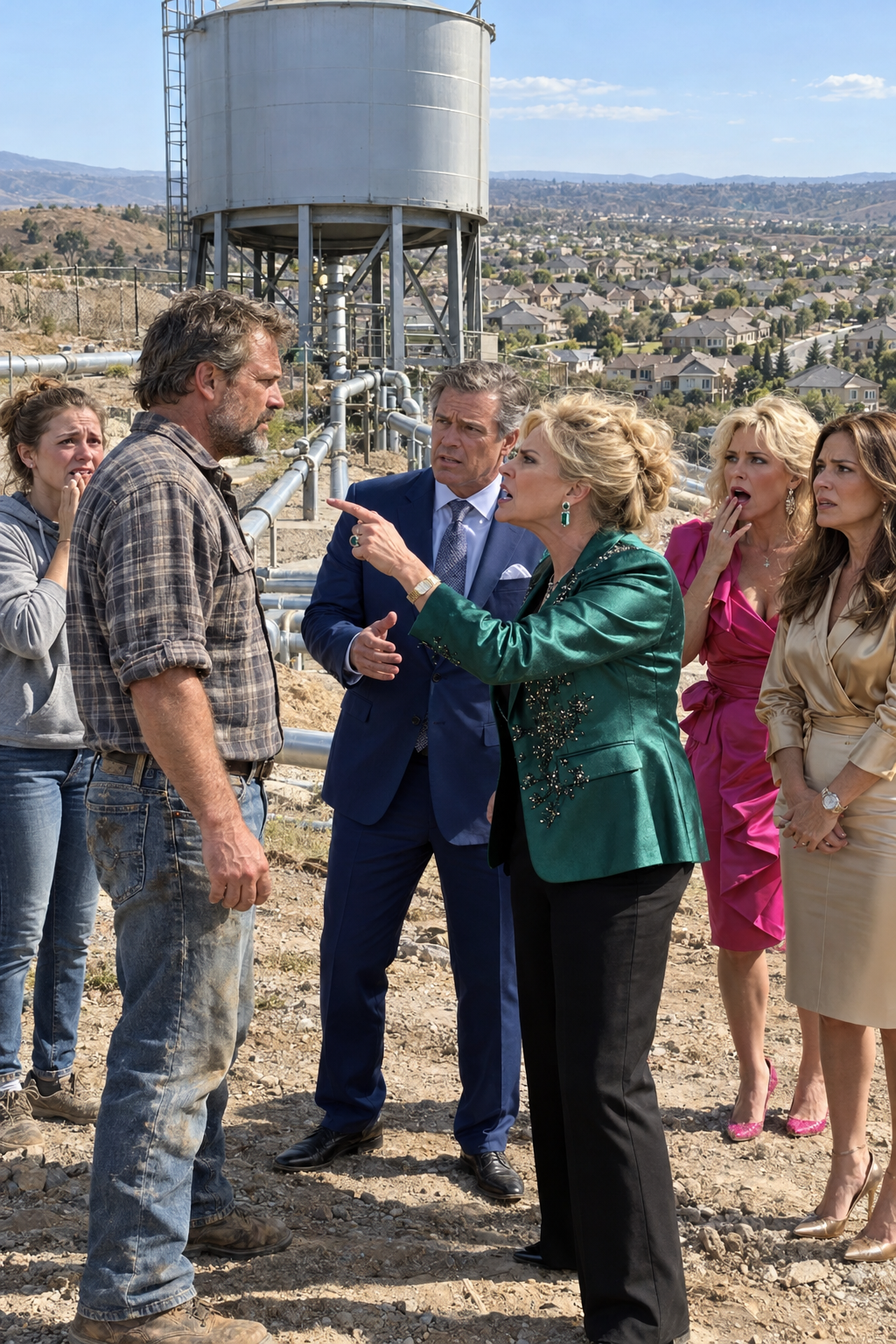
HOA Ordered Me to Tear Down My Water Tank—Then 180 Homes Learned Who Really Owned Their Water
My daughter-in-law gave me seventy-two hours to remove the water tank my dead husband had built with his own hands.
My son stood beside her in my kitchen and said, “Mom, stop embarrassing us. That ugly thing is the reason this neighborhood will never become what Melissa and I deserve.”
Neither of them knew the tank was supplying water to one hundred eighty homes.
And neither of them noticed that while they were talking, I slipped my thumb beneath the edge of an old brass key taped under my kitchen table.
I didn’t cry.
That seemed to bother them more than anything.
Melissa expected tears. She had dressed for them.
She stood beneath the pendant lights in a cream blazer and pearl earrings, holding a glossy folder stamped with the silver logo of Silver Pines Estates HOA. Her blonde hair was swept into the kind of smooth twist that looked effortless only if you had spent an hour making it so.
My son, Eric, stood at the island beside her.
He wouldn’t look directly at me.
That hurt more than the threat.
I had spent thirty-seven years learning the small ways my son avoided guilt. He rubbed the side of his thumb when he lied. He shifted his weight when he was ashamed. He stared at objects instead of faces when he had already chosen somebody else’s side.
That morning, he was staring at the fruit bowl.
“Seventy-two hours?” I asked.
My voice was calm.
Melissa smiled.
Not warmly.
Triumphantly.
“The HOA has been extremely patient, Eleanor.”
I was sixty-three years old.
I had been a widow for four years.
And a woman who had lived on the same piece of Colorado land since before Melissa had learned to spell the word HOA was telling me the neighborhood had been patient with me.
I glanced through the kitchen window.
Beyond the barn, across a sloping pasture still silver with early frost, the old water tank stood on the ridge.
Twenty-eight feet tall.
Forty-two feet across.
Green steel sides faded by wind and sun.
No decorative stone.
No fake cedar panels.
No landscaping lights.
Just half a million gallons of treated mountain water held inside a structure my husband, Thomas, had once called “the ugliest beautiful thing I ever built.”
Melissa tapped the folder.
“The board voted unanimously.”
Eric cleared his throat.
“Mom, you knew this was coming.”
I looked at him then.
He finally met my eyes.
“When did I know it was coming?”
His jaw tightened.
“You’ve had letters.”
“I’ve had threats.”
“Not threats.”
Melissa interrupted him.
“Compliance notices.”
I nodded slowly.
“Of course.”
There had been six of them.
First, the HOA demanded I paint the tank a “community-approved neutral shade.”
Then they demanded landscaping to hide it.
Then they claimed its maintenance ladder violated Silver Pines aesthetic standards.
Then they ordered me to stop service trucks from using the private gravel road on my land.
Then they claimed the tank represented an “industrial installation inconsistent with residential harmony.”
Finally, three days earlier, I had received a certified letter informing me that the structure must be removed.
Not modified.
I had read the letter twice.
Then I had made coffee.
Then I had taken a small brass key from the safe behind my pantry wall.
I had not used that key since Thomas died.
That was the part nobody knew.
Melissa opened the folder and slid a page across my granite countertop.
“Failure to comply may result in daily penalties of twenty-five hundred dollars.”
I looked at the paper.
The signature at the bottom belonged to HOA president Pamela Cross.
Pamela had moved into Silver Pines nine years ago after selling a chain of cosmetic clinics in Denver.
She liked white Range Rovers, imported hydrangeas, and meetings where everyone agreed with her before she finished talking.
She also hated anything she couldn’t control.
Especially me.
“Two thousand five hundred dollars a day,” I said.
“For keeping a water tank on my own land.”
Melissa’s smile thinned.
“You keep saying ‘your land’ like that ends the discussion.”
I looked at Eric.
He stared at the fruit bowl again.
There it was.
The real reason they had come.
Not the tank.
Not the HOA.
Not the view.
My husband and I had owned eighty-six acres on the western edge of Silver Pines before Silver Pines existed.
Before the stone entrance monuments.
Before the clubhouse.
Before the heated pool.
Before the tennis courts, walking trails, decorative ponds, and million-dollar homes with mailboxes selected from an approved catalog.
Back when the valley held cattle, scrub oak, elk trails, and the sound of water running down from Black Elk Mountain every April.
Thomas and I had bought the property in 1984.
We had built our farmhouse ourselves.
We raised Eric there.
We buried two dogs there.
We buried Thomas there too, under a cottonwood near the west fence, because that was where he asked to be.
Twenty-six years after we bought the land, a development company purchased the acreage east of us.
That company became Silver Pines.
And everything changed.
At first, Thomas welcomed them.
That was the kind of man he was.
The developers needed temporary access for construction vehicles.
Thomas gave them an easement.
They needed emergency water while municipal infrastructure was being extended.
Thomas supplied it.
Then the county delayed expansion of the public water district.
One year became two.
Two became five.
Silver Pines expanded.
Homes sold.
Another phase was approved.
A second phase became a third.
And somehow the temporary emergency arrangement became something permanent.
Thomas never complained.
He upgraded the filtration system.
Installed monitoring equipment.
Replaced pumps.
Passed inspections.
Worked nights when pipes froze.
Drove uphill during blizzards when valves failed.
He charged the HOA barely enough to cover operating costs because he believed water was not something you used to make people helpless.
“People can fight about fences and paint colors,” he once told me. “But you never play games with drinking water.”
For years, nobody cared who owned the tank.
They only cared that the faucets worked.
Until land values exploded.
Until Pamela Cross became HOA president.
Until my son married Melissa.
And until someone realized our eighty-six acres were worth somewhere between eleven and fourteen million dollars if combined with the next planned Silver Pines expansion.
Melissa placed another document on the counter.
“This is not personal.”
I almost smiled.
People usually say that immediately before doing something deeply personal.
She continued.
“The development committee believes the tank negatively affects property values.”
“The same tank supplying water to your house?”
Her expression changed for half a second.
Not surprise.
That told me she knew more than she was pretending to know.
Eric stepped forward.
“We’re trying to help you.”
“By giving you an exit before this becomes ugly.”
The room went quiet.
That word stayed between us.
Not solution.
Not compromise.
I folded my hands.
“What kind of exit?”
Melissa looked at Eric.
Eric looked at the countertop.
Then he slid a third document toward me.
A purchase agreement.
Twelve pages.
Offer price: $3.2 million.
For everything.
Water rights.
Road rights.
Eighty-six acres.
I actually laughed.
Melissa’s face hardened.
“You think that’s funny?”
I closed the folder.
“I think it’s educational.”
Eric frowned.
“What does that mean?”
“It means now I know why you’re here.”
He moved around the island.
“Mom, don’t do this.”
“Turn everything into a betrayal.”
I stared at him.
He flinched.
Because betrayal was exactly what it was.
After Thomas died, Eric had started visiting more often.
At first, I thought grief had brought him back.
He repaired fence posts.
Changed smoke detector batteries.
Insisted on handling my online banking because, as he put it, “You shouldn’t have to worry about passwords.”
Melissa brought groceries.
They invited me to Sunday dinners.
They talked about family.
Eventually Eric convinced me to add his name to one household checking account in case of emergency.
Then he began asking questions about the property deed.
The water system.
Tax statements.
He said he wanted to make sure everything was organized if something happened to me.
I wanted to believe him.
A mother can be intelligent in every room except the one where her child asks to be trusted.
That morning, looking at the $3.2 million offer, I finally understood how long they had been circling.
I did not raise my voice.
I did not accuse.
I did not beg my son to remember Christmas mornings, Little League practices, feverish nights, college tuition, the used truck Thomas rebuilt for him, or the nine thousand dollars I quietly paid when his first business failed.
I did not mention the down payment Thomas and I gave him.
I did not mention the fertility treatments we helped Melissa afford.
I did not mention that when Eric lost his marketing job three years earlier, I sent them twenty-two hundred dollars every month for almost a year.
I did not mention any of it.
Because love becomes ugly the moment you present it like an invoice.
Instead, I asked one question.
“Who drafted this agreement?”
Melissa blinked.
“The purchase agreement.”
“Silver Pines Development Partners.”
There it was.
Not the HOA.
The development company.
Pamela had always insisted the two were completely separate.
Melissa watched me carefully.
“You should take it.”
“Should I?”
“You’re alone here.”
“I’ve noticed.”
“The property is too much for you.”
“The tank is failing.”
“The barn roof needs work.”
“Already scheduled.”
“The western field floods.”
“On purpose.”
She frowned.
I saw Eric glance at her.
Neither of them understood that answer.
Thomas had designed the western field as a seasonal overflow basin to recharge shallow groundwater during spring runoff.
Pamela had called it swampy acreage.
The county called it a protected water-management zone.
That distinction would matter later.
I closed the purchase agreement and pushed it back.
Melissa’s cheeks flushed.
“Eleanor, you need to be realistic.”
“The board will fine you.”
“They can place liens.”
“They can try.”
“They can take legal action.”
“I hope they do.”
That finally broke her composure.
“What is that supposed to mean?”
I looked toward the ridge.
Morning sunlight had reached the water tank.
Its faded green sides glowed almost gold.
Thomas used to stand there at sunrise with coffee in one hand, listening for the low hum of the pumps.
I could still picture him.
Gray work jacket.
Flannel shirt.
Hands cracked from cold.
He had built half our life with those hands.
The other half he had protected with paperwork nobody had bothered to read.
I reached under the kitchen table and pulled away a small strip of aging tape.
The brass key dropped into my palm.
Eric stared at it.
“What’s that?”
I closed my fingers around it.
“Nothing you need.”
Melissa laughed.
“You’re being dramatic.”
But drama is sometimes just truth arriving before people are ready for it.
They left twenty minutes later.
At the front door, Eric paused.
He lowered his voice.
“Don’t make this harder than it has to be.”
I looked at the man I had carried inside me.
The boy whose broken arm I sat beside for eleven hours in an emergency room.
The teenager whose father taught him to weld.
The groom Thomas toasted with tears in his eyes.
And I wondered when love had become inconvenience to him.
Maybe slowly.
Maybe all at once.
Maybe the moment he realized my land was worth more than my approval.
“I won’t,” I said.
Relief crossed his face.
He thought I meant I would surrender.
I meant I would make everything very simple.
After they drove away, I locked the front door.
Then I stood alone in my kitchen and listened.
The refrigerator hummed.
The old clock above the pantry ticked.
Somewhere outside, one of the horses kicked a stall door.
Nothing dramatic happened.
But something inside me became very still.
I had spent four years being polite.
I had spent four years giving people time.
I had spent four years explaining boundaries.
I had spent four years forgiving disrespect.
I had spent four years pretending my silence meant weakness.
Not anymore.
That was the anaphora Thomas would have appreciated.
He loved repetition when he wanted a point to stick.
I put on my coat.
I drove the old Ford up the ridge.
And I unlocked the tank house.
The brass key fit perfectly.
Inside, the air smelled of steel, dust, mineral treatment, and machine oil.
Thomas’s workbench still stood against the wall.
I had not touched it since the funeral.
His tools hung from pegboard outlines drawn in black marker.
Pipe wrench.
Voltage tester.
Adjustable spanners.
Grease gun.
Three screwdrivers.
A dented red thermos.
Above the bench was a photograph of us from 1996.
Thomas stood beside me holding Eric, who was twelve and wearing a Denver Broncos jacket three sizes too big.
I took the photograph down.
Behind it was a narrow steel panel.
I inserted the brass key.
The lock clicked.
Inside sat a waterproof document box.
I pulled it out.
Thomas had left instructions in his will.
Not formal instructions.
Personal ones.
A paragraph handwritten on the inside cover.
If anyone ever tells you this tank belongs to Silver Pines, open the lower file.
If anyone ever pressures you to sell the ridge, open the blue envelope.
If Eric is involved, do not protect him from consequences just because he is our son.
I stared at that final sentence.
My throat tightened.
Thomas had known.
Maybe not the details.
Maybe not Melissa.
But he had known our son’s weakness.
He had known Eric loved comfort more than conflict.
He had known that one day somebody smarter and colder might use that weakness.
Beneath the note were county records, easements, engineering plans, water-use permits, maintenance contracts, right-of-way agreements, and a sealed blue envelope.
I did not open the envelope yet.
First I studied the water contract.
The original emergency service agreement was twenty-three pages.
The HOA had a copy.
I knew that.
What the HOA did not appear to have was Amendment Four.
Thomas had stored the certified original.
The amendment had been signed fourteen years earlier after the county rejected Silver Pines’ application to drill three community wells.
It established our tank and underground supply line as the legal primary water source for all occupied lots in Phases One through Five.
One hundred eighty homes.
More importantly, it stated that the system remained entirely privately owned by Thomas and Eleanor Hayes.
Silver Pines had no ownership interest.
No management interest.
No authority to modify, relocate, dismantle, inspect without permission, or restrict access.
And if the HOA interfered with operations?
Section 11.7.
I read it three times.
Any action by the association materially obstructing operation, maintenance, inspection, access, or infrastructure integrity would constitute voluntary termination by the association.
Termination.
In plain English, if the HOA blocked us from operating the system, they were legally choosing to end water service.
And restoring service after such a termination required a new contract.
At current rates.
Subject to engineering capacity.
Subject to my consent.
I sat on Thomas’s stool.
“Good Lord,” I whispered.
But Amendment Four was not the real bomb.
The real bomb was in the county map.
A red line ran from the mountain intake, across my upper pasture, into the storage tank, then underground eastward beneath Silver Pines.
Alongside the line was a shaded corridor thirty feet wide.
Private utility easement.
Owned by Hayes Mountain Water Cooperative.
Cooperative?
Thomas had never mentioned a cooperative.
At least not in those words.
I searched deeper.
Articles of incorporation.
Board minutes.
A state registration certificate.
And then I found the ownership page.
Thomas Hayes, 49%.
Eleanor Hayes, 49%.
Mountain County Emergency Services Trust, 2%.
I leaned back.
The cooperative owned not only the tank.
It owned the pipeline corridor beneath Silver Pines.
All the way to the final distribution junction.
That meant the HOA had built roads, landscaping, retaining walls, one decorative fountain, and part of the clubhouse parking lot above infrastructure it did not own.
But even that was not the secret that made my hands shake.
The blue envelope still waited.
I opened it.
Inside was one sheet of paper.
Thomas’s handwriting.
If you are reading this, somebody wants the land.
They will tell you the tank is ugly.
They will tell you the property is outdated.
They will tell you Silver Pines has outgrown us.
The truth is the opposite.
Silver Pines cannot legally complete its final development phase without our western recharge field, our utility corridor, and our senior mountain-water right.
That right predates the subdivision by twenty-six years.
Do not sell it with the house.
Do not let Eric sign anything.
And before you agree to any transfer, ask the county for File 77-WR-14.
That is where I stopped reading.
File 77-WR-14.
I had no idea what it contained.
But Thomas had underlined it twice.
I drove straight to the county administration building.
By noon, I was sitting across from a water-resources clerk named Denise Porter.
Denise was in her late fifties, with silver glasses and the practical patience of someone who had spent thirty years explaining government forms to angry people.
She typed the file number.
Then stopped.
“Where did you get this?”
“My husband.”
She looked at me.
“Thomas Hayes?”
Her posture changed.
“You’re Eleanor.”
She removed her glasses.
“I met your husband.”
“That doesn’t surprise me.”
“He was persistent.”
“That definitely doesn’t surprise me.”
A small smile appeared.
Then disappeared.
She turned the monitor slightly away from me.
“I need to get our senior administrator.”
“Because this file is restricted.”
“Restricted from me?”
She hesitated.
“Restricted because it is tied to an unresolved land-use condition.”
Twenty minutes later, a man named Randall Voss joined us.
He wore a navy county jacket instead of a suit.
He had a stack of printed maps under one arm.
“Mrs. Hayes.”
“Mr. Voss.”
“I understand you’re asking about 77-WR-14.”
“Has Silver Pines contacted you recently?”
I looked at him.
“That sounds like a question you already know the answer to.”
He nodded once.
“I thought Thomas might have prepared you.”
“He prepared me to distrust easy offers.”
“That sounds like Thomas.”
Randall spread the maps across the table.
Silver Pines filled most of the page.
Phases One through Five were shaded gray.
My acreage sat along the western boundary.
Beyond my land, a much larger tract was marked Proposed Phase Six.
Four hundred twelve additional homes.
A commercial village.
A small medical center.
Two apartment buildings.
And a private school.
I stared at the plan.
“When was this submitted?”
“Three months ago.”
“Silver Pines Development Partners.”
“And the HOA?”
“Officially separate.”
“Unofficially?”
He gave me the bureaucrat’s version of silence.
I understood.
I pointed to Phase Six.
“What does this have to do with my water rights?”
Randall laid another transparency over the map.
Blue lines appeared.
“The proposed expansion has no viable municipal supply at current capacity.”
“What about drilling?”
“Groundwater restrictions.”
“New reservoir?”
“Environmental impact.”
“Trucking water?”
“Not at that scale.”
He looked at me.
“The only economically feasible supply is your senior mountain-water right.”
I stared at the map.
“How valuable?”
He exhaled.
“Phase Six is projected at roughly six hundred eighty million dollars in completed property value.”
For a moment I heard nothing but the fluorescent lights overhead.
Not because I wanted six hundred eighty million dollars.
Because I finally understood the $3.2 million offer.
They weren’t buying my farmhouse.
They weren’t buying my pasture.
They weren’t even buying the tank.
They were trying to buy the one thing standing between them and hundreds of millions of dollars.
And my own son had helped them.
“How long has Silver Pines known?”
Randall’s expression told me everything.
“At least eight months.”
Eight months.
Eric had started visiting me every weekend nine months earlier.
My stomach went cold.
I asked for copies.
Randall slid a form toward me.
Then he pointed to a red stamp on the file.
“There’s another issue.”
“Thomas filed a protective condition before he died.”
“What kind?”
Randall read from the record.
“In the event Hayes land is transferred under coercion, undisclosed development inducement, fraudulent authority, or conflict of interest involving Silver Pines HOA, the county must suspend review of any application dependent upon Hayes water rights until ownership and consent are judicially verified.”
I almost heard Thomas laughing.
Not happily.
That low, stubborn laugh he used when someone tried to corner him.
“He built a tripwire.”
Randall looked at me.
I gathered the documents.
Before I left, he said, “Mrs. Hayes?”
“If they’ve already submitted something with your signature on it, contact counsel immediately.”
“What do you mean?”
He leaned against the table.
“Phase Six’s preliminary water plan states that the developer has a pending acquisition agreement with Hayes property interests.”
“I never signed an agreement.”
“How do you know?”
“Because Thomas’s protective filing requires notarized personal consent from both original owners or the surviving owner.”
“And they don’t have mine.”
Randall gave me a look that made my skin tighten.
“They submitted something.”
I drove home slowly.
Not because I was frightened.
Because anger drives fast, and I could not afford anger.
At that afternoon, three vehicles were parked outside my house.
Pamela Cross’s white Range Rover.
Eric’s black SUV.
And a silver Mercedes belonging to Martin Kline, attorney for the Silver Pines HOA.
They had let themselves onto my property.
That mattered.
I parked behind them.
Pamela was standing on my porch.
She wore an ivory coat and leather gloves.
Eric stood behind her.
Melissa stood beside him.
Martin held a briefcase.
It looked less like a family meeting than an acquisition team.
“Eleanor,” Pamela said.
“We’ve been trying to reach you.”
“My phone works.”
She ignored that.
“We’d like to resolve this amicably.”
“You came onto my property without permission.”
Eric sighed.
I raised one finger.
He stopped.
I had never done that to him before.
He looked startled.
Pamela descended one step.
“We are concerned you may not understand the seriousness of the board’s order.”
“I understand it.”
“The deadline remains.”
“I understand that too.”
Martin opened his briefcase.
“We have obtained authority for emergency enforcement if the tank is not brought into compliance.”
“Emergency?”
“What is the emergency?”
He hesitated.
“Aesthetic and structural concerns.”
I looked at him.
He knew how ridiculous that sounded.
He knew I knew.
And Pamela knew we both knew.
That was the strange thing about organized bullying.
Everyone involved eventually becomes dependent on pretending words mean something other than what they mean.
“Aesthetic emergency,” I said.
Pamela’s nostrils flared.
“The tank is an obsolete eyesore.”
“Then stop drinking from it.”
Melissa stepped forward.
“Eleanor, nobody is saying the water system has to stop.”
“Yes, you are.”
“You’re ordering the tank removed.”
“Service can be transferred.”
“The developer has plans.”
I looked at her.
“What plans?”
Her eyes shifted.
Tiny mistake.
Pamela answered too quickly.
“That isn’t relevant.”
Miniature crack number one.
They had plans for replacement service.
Meaning the tank-removal demand was not about aesthetics.
It was part of a development strategy.
I took out my phone and photographed all four of them standing on my porch.
Pamela’s voice sharpened.
“What are you doing?”
“Documenting trespass.”
Eric stepped toward me.
I took another photo.
He stopped.
I looked at Martin.
“Did you advise them to enter my property?”
Pamela glared at him.
Tiny crack number two.
“Then please leave,” I said.
Pamela didn’t move.
“We are here under HOA authority.”
“No, you’re not.”
“This property falls within Silver Pines architectural jurisdiction.”
“No, it doesn’t.”
Melissa folded her arms.
“We have documentation.”
“I’d love to see it.”
Martin opened his briefcase again.
I shook my head.
“Not today.”
Pamela smiled.
“You’re delaying the inevitable.”
“The fines start Monday.”
“We can pursue a lien.”
“We can authorize contractors.”
That made me look at her.
“Authorize contractors to do what?”
“If you refuse to remove the structure, the HOA may arrange removal and bill you.”
Eric went pale.
He knew immediately that she had said too much.
I looked at Martin.
“Is that your legal position?”
He didn’t answer.
His jaw tightened.
“I would need to review the enforcement procedure.”
Pamela turned.
“You already reviewed it.”
“I reviewed a draft.”
Tiny crack number three.
Pamela hated that smile.
“You think you’re clever,” she said.
“Thomas used to do this too.”
“Pretend being stubborn made him right.”
That was the first real insult of the afternoon.
Not because she insulted me.
Because she used my dead husband as if she had earned the right.
I stepped closer.
Pamela was taller than me in heels.
I still made her move back.
“Do not use my husband’s name while threatening to destroy what he built.”
Her face hardened.
For a moment, the polished HOA president disappeared.
What remained was ambition.
Cold and impatient.
“This community has outgrown your attachment to the past.”
There it was.
Eric was last.
At the bottom of the steps, he turned.
“I’m trying to save you from losing everything.”
I looked at my son.
“No, Eric.”
“You’re trying to make sure I lose it cheaply.”
His face drained.
I closed the door.
That night I called an attorney.
Not the expensive Denver water-rights firm Randall recommended.
I called Helen Shaw.
Helen and I had been friends since our sons played baseball together.
She was sixty-six, semi-retired, and had spent most of her career handling agricultural easements, probate fights, and landowners underestimated by people with polished shoes.
She arrived at seven with Thai food and two legal pads.
By nine, she had read Amendment Four.
By ten, she was swearing.
By eleven, she was smiling.
“Thomas was a dangerous man.”
“He repaired tractors.”
“He also drafted contracts like a suspicious banker.”
“He had help.”
“He had good help.”
She held up the cooperative documents.
“Do you understand what this means?”
“I understand enough.”
“No, Ellie. You own forty-nine percent directly, and Thomas’s forty-nine percent passed to you through his trust.”
“Which means?”
“You control ninety-eight percent of the cooperative.”
“And the county trust has two.”
“Silver Pines owns zero.”
She leaned back.
“Now tell me about Eric.”
Checking account.
Property questions.
Development plan.
When I finished, Helen went silent.
Then she asked, “Did Eric ever have power of attorney?”
“Temporary medical power when Thomas was sick.”
“Financial?”
“Executor?”
“Authorized representative of the cooperative?”
She tapped her pen.
“Then if his signature appears anywhere, somebody has a problem.”
The next morning, the problem arrived by email.
Helen obtained a copy of the developer’s preliminary acquisition packet.
Page forty-three contained something called a “Family Landholder Consent Memorandum.”
Signed by Eric Hayes.
The document identified him as “successor beneficial representative of Hayes family land interests.”
That title was meaningless.
Impressive.
Official-sounding.
And meaningless.
But beneath his signature was a statement that made Helen’s mouth flatten.
Eric represented that “all material family stakeholders had been consulted and expressed intent to cooperate with transfer.”
My name appeared in an attached summary.
Eleanor Hayes — supportive pending final valuation.
I had never said that.
I called Eric.
He answered on the fourth ring.
“Did you sign a consent memorandum for Silver Pines Development Partners?”
Then, “Where did you get that?”
“Answer me.”
“It’s not binding.”
“That wasn’t my question.”
“Melissa said it was preliminary.”
“Did you sign it?”
Another pause.
“Did you tell them I supported selling?”
“I told them you were open to discussing it.”
“That’s how I understood—”
He went quiet.
I stood in Thomas’s tank house holding the phone.
Through the open door, I could see the roofs of Silver Pines below.
One hundred eighty homes.
One hundred eighty families.
Children brushing teeth.
People making coffee.
Dishwashers running.
Showers steaming.
None of them knew their HOA was trying to eliminate the system supplying all of it.
“Why?” I asked.
Eric exhaled hard.
“Because this place is consuming you.”
“Try again.”
“Try again.”
His voice changed.
“Because you don’t need eighty-six acres.”
There it was.
“You don’t need a barn.”
He kept going.
“You don’t need that tank.”
“And you do?”
“No, but you’re sitting on property that could change our family forever.”
“Our family.”
“Which family?”
“Mine? Yours? Melissa’s? Pamela’s?”
“That’s unfair.”
“Did they promise you money?”
That was answer enough.
“How much?”
“How much?”
“It’s not like that.”
“How much?”
He lowered his voice.
“There was a consulting arrangement.”
I closed my eyes.
“How much, Eric?”
“Two hundred fifty thousand.”
I felt something inside me break.
Not my heart.
That had already been wounded too many times.
What broke was the final excuse I had built for him.
Two hundred fifty thousand dollars.
For his cooperation.
For access.
For signatures.
For convincing his widowed mother to sell land worth many times what she was being offered.
“Have they paid you?”
“Only part.”
“How much?”
Fifty thousand dollars.
My son had taken fifty thousand dollars from people trying to pressure me off my land.
“Return it.”
“It went toward debts.”
“What debts?”
“Business debts.”
“Return it.”
“They’ll sue me.”
“Mom, you don’t understand.”
“I understand perfectly.”
His voice cracked with anger.
“No, you don’t. Dad left you everything.”
That stopped me.
There it was.
The wound beneath the greed.
“Everything?” I asked.
“You got the land. The water company. The accounts. The equipment. The house.”
“Your father left you six hundred thousand dollars in trust.”
“Controlled distributions.”
“Because you were in debt.”
“I was thirty-eight years old.”
“And still borrowing.”
“That’s not the point.”
“It seems very close to the point.”
He laughed bitterly.
“You always thought I couldn’t handle anything.”
“No, Eric.”
I looked at Thomas’s old photograph.
“Your father thought you could handle more than you chose to.”
He didn’t speak.
That landed.
Then I asked the question that changed the entire fight.
“Did you give them access to this property?”
“Did you give Silver Pines permission to enter the tank site?”
“I don’t know what you mean.”
My stomach tightened.
“I may have told Pamela she could inspect it.”
“Last month.”
“With whom?”
“A contractor.”
“What contractor?”
“I don’t know.”
Helen and I drove to the tank.
The padlock showed scratches.
Fresh ones.
Inside, nothing looked disturbed.
Then Helen noticed dust on the concrete beneath the control cabinet.
A rectangular outline.
Someone had removed the lower panel.
We called the sheriff.
A deputy named Cole Mercer arrived forty minutes later.
He photographed the cabinet.
Checked the lock.
Then crouched beneath the control box.
“Mrs. Hayes?”
“Does this belong here?”
He held up a small black device attached behind the wiring conduit.
I stared at it.
It was a remote data transmitter.
Not part of my system.
Not part of Thomas’s design.
Not listed in any equipment inventory.
Somebody had installed it.
The question was why.
Helen photographed the serial number.
By evening, we had an answer.
The device was manufactured for industrial telemetry.
It could remotely transmit pump operation, tank levels, pressure readings, and valve status.
Silver Pines had been secretly monitoring my private water system.
Possibly for months.
The next morning, Pamela sent me another certified letter.
This one was almost comical.
It accused me of “creating unnecessary conflict.”
It demanded that I stop “interfering with HOA technical assessments.”
It reminded me that the removal deadline expired at a.m. Monday.
I framed it.
I put it in a cheap black frame and hung it inside the tank house above Thomas’s workbench.
Helen laughed for a full minute.
Sunday night, snow moved over the foothills.
Not a major storm.
Maybe three inches.
Enough to cover roofs and turn the roads white.
At Monday morning, I was sitting at the kitchen table drinking coffee.
At , a convoy came through my gate.
Two contractor pickups.
One flatbed truck.
One excavator.
Pamela’s Range Rover.
Martin Kline’s Mercedes.
And a county sheriff’s SUV.
For one second, I thought they had somehow obtained a court order.
Then the sheriff’s SUV turned sideways across my driveway.
Deputy Mercer got out.
He was there for me.
Helen stepped out of her Subaru behind him.
I had called both at .
Because at , a motion camera near the lower road had alerted me that contractor vehicles were staging outside my property.
Pamela exited her SUV wearing a bright red winter coat.
She looked delighted.
“You were warned.”
“So were you.”
The contractor foreman approached carrying a clipboard.
“Ma’am, we have an authorized removal order for the tank structure.”
“From whom?”
“The Silver Pines Estates HOA.”
“Do you have a court order?”
He looked at Pamela.
Pamela stepped forward.
“We have enforcement authority under the covenants.”
Helen smiled.
Martin climbed out of his car.
His face changed when he saw Helen.
“Who are you?”
“Helen Shaw. Counsel for Eleanor Hayes and Hayes Mountain Water Cooperative.”
He looked at Pamela.
Tiny crack number four.
Helen extended her hand.
“Court order?”
Martin didn’t take it.
“There isn’t one.”
The contractor foreman stepped backward.
Pamela turned on him.
“You have a contract.”
“Lady, I’m not dismantling a five-hundred-thousand-gallon water structure on disputed private property without a court order.”
“It’s empty.”
I looked at her.
That was interesting.
Very interesting.
“How do you know?”
The tank was not visibly metered from outside.
There was no public gauge.
No viewing window.
The only way she could know its current level was through my private monitoring system.
Or the transmitter someone installed illegally.
Pamela realized her mistake.
Helen realized it too.
So did Deputy Mercer.
He stepped closer.
“Ms. Cross, how do you know whether the tank is empty?”
Pamela’s face changed.
“It was in the technical report.”
“What technical report?”
Martin interrupted.
“Pamela, don’t answer that.”
Deputy Mercer looked at him.
“Sir, I’m asking voluntarily right now.”
Martin adjusted his coat.
“My client is represented.”
The contractor foreman closed his clipboard.
“We’re done.”
Pamela’s eyes widened.
“No, you’re not.”
“Yes, ma’am.”
“I paid a mobilization fee.”
“You can talk to our office.”
The crane driver climbed back into his cab.
The excavator operator followed.
Within ten minutes, the entire removal operation was retreating down my road.
Mini-payoff number one.
No shouting.
No dramatic speech.
Just engines reversing while Pamela Cross stood in the snow watching her first plan collapse.
But the real moment came at .
I handed Martin a letter.
He read the first paragraph.
His face went gray.
“What is this?”
“Notice under Section 11.7 of Amendment Four.”
Pamela snatched it.
“What does it say?”
Martin didn’t answer.
So Helen did.
“Your attempted obstruction of the private water facility constitutes material interference under the service agreement.”
Pamela stared.
Helen continued.
“Your board’s formal removal order, contractor mobilization, access restriction notices, and unauthorized technical intrusion collectively trigger the interference provision.”
“What does that mean?”
“It means Silver Pines has breached its water-service agreement.”
Pamela’s face lost color.
I finally spoke.
“The contract gives me the right to terminate service.”
She looked toward the tank.
Then toward the neighborhood below.
“You wouldn’t.”
I held her eyes.
She exhaled.
For one foolish second, she thought mercy had rescued her.
Then I continued.
“I wouldn’t punish one hundred eighty families for what your board did.”
Her mouth tightened.
“So this is theater.”
I handed her a second page.
“I’m not terminating household service.”
Helen smiled.
“We are terminating the HOA as the billing and administrative intermediary.”
Martin closed his eyes.
He understood immediately.
Pamela didn’t.
“What does that mean?”
“It means,” I said, “starting next month, every homeowner receives an individual water-service agreement directly from Hayes Mountain Water Cooperative.”
She stared at me.
“You can’t do that.”
“We already checked.”
“HOA dues include water.”
“Not anymore.”
“You’ll destroy our budget.”
I folded my arms.
“You did that.”
For years, the HOA had charged residents a water infrastructure fee far above what they paid me.
I had never cared.
Thomas hadn’t either.
We assumed the extra amount covered internal distribution maintenance.
Helen had spent the weekend reviewing HOA financial disclosures.
The HOA had been collecting nearly $310,000 per year in water-related assessments.
My cooperative received less than half.
The difference had been routed into a general “capital enhancement reserve.”
The same reserve funding planning expenses for Phase Six.
Pamela’s Phase Six.
Residents had been unknowingly financing the development plan that required taking my land.
That afternoon, Helen mailed one hundred eighty envelopes.
Each contained a plain-language explanation.
No insults.
No accusations.
Just numbers.
This is the annual amount your household pays toward water through HOA assessments.
This is the annual amount the HOA pays the cooperative for your water.
This is the proposed direct household rate.
The direct rate was lower.
Much lower.
By Tuesday evening, my phone rang continuously.
By Wednesday, Silver Pines’ private Facebook group had become a war zone.
By Thursday, residents filled the clubhouse meeting room.
I did not attend.
That drove Pamela crazy.
She wanted an enemy in the room.
I gave her documents instead.
Residents asked why the HOA collected so much more than the cooperative charged.
Pamela called it “administrative overhead.”
Someone asked why administrative overhead funded development consultants.
Martin tried to shut the meeting down.
A homeowner named Rachel Monroe stood up and read the capital reserve report aloud.
Another man demanded to know whether Phase Six was connected to the water-tank dispute.
Pamela denied it.
Then somebody projected the county development map onto the clubhouse wall.
I later saw the video.
Pamela’s face looked like a woman watching a locked door open.
Friday morning, Eric came to my house alone.
He looked terrible.
Jacket half-zipped.
I let him in.
Not because he deserved it.
Because he was my son.
There is a difference.
He stood in the kitchen.
“Melissa left.”
“She’s staying with her sister.”
“She says this is my fault.”
I almost laughed.
Instead, I poured coffee.
He sat at the table.
For a long time, neither of us spoke.
Finally he said, “Pamela told us you were going to sell.”
“Months ago.”
“Why would she know before me?”
He rubbed his forehead.
“She said Dad had discussed it.”
My stomach tightened.
“Before he died.”
“Did she show you anything?”
“A letter.”
“What letter?”
“She said Dad intended the land for future development after you no longer needed it.”
I put down my cup.
“Do you have a copy?”
“Did you read the whole thing?”
“It was a photograph on her phone.”
That was exactly the kind of thing Pamela would use.
Something partial.
Something unverifiable.
Something persuasive enough for a man who wanted to believe it.
“What did it say?”
“I don’t remember exactly.”
He closed his eyes.
“Something like, ‘Eventually the valley will need more homes, and Eleanor shouldn’t be burdened with maintaining all this forever.’”
I went still.
Thomas had said something similar once.
But not about selling.
He had been discussing conservation.
He wanted part of our land placed into a trust so I would not have to maintain all eighty-six acres in old age.
Someone had taken a sentence and removed the rest.
“Who had access to Thomas’s papers after he died?”
Eric looked at me.
“Who else?”
“The lawyer.”
“Which lawyer?”
His silence gave me the answer.
Martin Kline.
Years before becoming HOA counsel, Martin had worked at the firm handling parts of Thomas’s estate.
I called Helen immediately.
By noon, she had requested archived probate records.
By Monday, we found the missing document.
Thomas’s original estate memorandum.
The full sentence read:
Eventually the valley will need more homes, and Eleanor shouldn’t be burdened with maintaining all this forever, but expansion must never be allowed to consume the western recharge field or compromise independent water ownership.
Pamela had shown Eric only the first half.
That was twist number one.
The betrayal had not begun with Eric.
It had begun with people who knew exactly what resentment to feed.
But manipulation did not erase choice.
Eric had still taken the money.
Still signed.
Still lied.
I told him that.
“I thought Dad didn’t trust me.”
“He didn’t trust your judgment around money.”
“That’s the same thing.”
“It feels like it.”
“Feelings are not deeds.”
He stared at the table.
“What happens now?”
“To Pamela?”
There it was.
Not selfish exactly.
But revealing.
I sat across from him.
“You repay the fifty thousand dollars.”
“I don’t have it.”
“Then you make a plan.”
“They’ll come after me.”
“You’ll let them?”
I looked at him.
“My job as your mother was never to make consequences disappear.”
His eyes filled.
For the first time in years, he looked less like a middle-aged consultant and more like the boy who had crashed Thomas’s truck at sixteen and waited on the porch for punishment.
“I’m sorry.”
“I believe you.”
He looked up.
“That doesn’t mean we’re okay.”
His face fell.
That was the beginning.
Not forgiveness.
The beginning before forgiveness.
Two weeks later, the HOA board called an emergency election.
Pamela insisted it was unnecessary.
One hundred twenty-seven homeowners disagreed.
By a vote of 104 to 23, the board recalled her.
Three other directors resigned.
Martin Kline withdrew as HOA counsel.
Silver Pines Development Partners issued a statement claiming it had no involvement in HOA enforcement decisions.
Helen read it and laughed.
“Of course they didn’t.”
Then she subpoenaed their communications.
That was when things became dangerous.
Not physically.
Financially.
Professionally.
The kind of danger rich people take very seriously.
The emails showed Pamela had been in weekly communication with a development executive named Bradley Sloane.
Bradley had promised her something labeled a “community transition advisory package.”
Worth $400,000.
Payable if Phase Six cleared preliminary water approval.
Melissa had also communicated with Bradley.
Her role was subtler.
She had passed along information Eric collected from me.
Tax values.
Insurance renewal dates.
Repair costs.
Estate questions.
Even my travel schedule.
My daughter-in-law had turned family conversations into due diligence.
When Helen showed me the emails, I felt something colder than anger.
Humiliation.
Not because they fooled me.
Because I had welcomed them.
Trusted them.
Melissa once sat at this same kitchen table and told me she loved me.
Maybe she believed it at the time.
Maybe greed does not always replace love.
Maybe sometimes it simply outranks it.
Silver Pines Development offered to settle.
Seven million dollars.
I declined.
Nine million.
Eleven million.
Eric stared at me when he heard.
“Mom, eleven million dollars.”
“You’re turning down eleven million?”
“Because they still want the water rights.”
“You could be done.”
“With what?”
“All of this.”
I looked at him.
That was the difference between us.
To him, money could end the story.
To me, money was no longer the story.
For four decades, Thomas and I had watched land disappear beneath concrete.
Not all development was bad.
Families needed homes.
Communities grew.
But there was a difference between growth and extraction.
Silver Pines had treated water like a line item.
Land like a chip.
People like leverage.
They had taken an emergency kindness Thomas offered and turned it into dependency.
Then, when dependency became inconvenient, they tried to erase the people who made their neighborhood possible.
I would not sell justice for a comfortable number.
Instead, I reopened Hayes Mountain Water Cooperative.
We hired an engineer.
An accountant.
A full-time system operator.
A compliance specialist.
We created a homeowner advisory seat.
The county trust retained its two percent.
And for the first time, every resident received transparent water accounting.
Rates dropped by nearly eighteen percent.
Service improved.
The tank got inspected, reinforced, repainted, and fitted with updated controls.
I chose the color.
The same faded green Thomas had always liked.
Residents suggested hiding it behind decorative panels.
Not out of spite.
Because I wanted people to see it.
Sometimes ugly infrastructure is the thing keeping beautiful neighborhoods alive.
By spring, wildflowers covered the slope below the tank.
Children from Silver Pines Elementary visited on a field trip.
I stood beside the steel wall while an engineer explained gravity-fed storage.
One little girl asked why the tank was so big.
“Because people use more water than they think,” I told her.
Another asked who owned it.
“That’s a complicated question.”
It became more complicated three days later.
Helen called at in the morning.
“Don’t go anywhere.”
“I’m drinking coffee.”
“Keep drinking.”
“What happened?”
“We found something in Thomas’s trust.”
My hand tightened around the mug.
“A schedule of assets that wasn’t digitized.”
“What kind of asset?”
“Not exactly.”
I heard papers turning.
“Ellie, remember the western recharge field?”
“Thomas placed a restrictive covenant over it.”
“No, you know about the environmental covenant.”
“There’s another?”
“What does it do?”
“It dedicates forty-two acres into a future community water trust if Silver Pines ever exceeds two hundred homes.”
I stared through the kitchen window.
“Because he knew expansion would eventually pressure supply.”
I almost smiled.
Of course he did.
“What happens at two hundred homes?”
“The trust activates.”
“The water rights attached to that acreage become nontransferable for private development purposes.”
I slowly sat back down.
“So Phase Six—”
“Cannot use them.”
“Even if I wanted to sell?”
“Not without court modification, county approval, and consent of the trust beneficiary.”
“Who is the beneficiary?”
Helen was silent.
“That’s the strange part.”
My heartbeat changed.
“Then who?”
“The beneficiary is listed as Black Elk Community Foundation.”
“I’ve never heard of it.”
“Neither have I.”
“Thomas created it?”
“Apparently.”
“For what?”
“We’re checking.”
Then her voice lowered.
“There’s more.”
I closed my eyes.
Of course there was.
“The foundation’s successor trustee isn’t you.”
“Who is it?”
I said nothing.
Thomas had distrusted Eric with cash.
Yet somehow trusted him with the future of the water land.
That made no sense.
Unless it wasn’t about trust.
Unless it was about forcing him to choose.
I drove to Helen’s office.
Eric met us there.
He looked as confused as I felt.
Helen placed the trust document on the conference table.
“Your father named you successor trustee upon activation.”
Eric stared at his signature line.
“He never told me.”
“He wasn’t required to.”
“What does the foundation do?”
Helen turned several pages.
“That’s where things get interesting.”
Its purpose clause was short.
To preserve water security, emergency supply, open land, and affordable access for residents of the Black Elk Valley, with priority protection for households placed at risk by private development activity.
Eric read it twice.
Then leaned back.
“He wanted this to protect Silver Pines?”
“Not Silver Pines,” I said.
“The people living there.”
Thomas had separated the institution from the residents.
He distrusted the HOA.
But he protected the homeowners.
Even after death.
That was my husband.
Stubborn enough to fight a board.
Soft enough to protect the families behind it.
Eric’s eyes filled.
“He still named me.”
I looked at my son.
“Maybe because he wanted you to become the man he thought you could be.”
Eric lowered his head.
For a while, nobody spoke.
The Phase Six project collapsed six weeks later.
Not dramatically.
No television cameras.
No handcuffs.
No public confession.
Development projects die in quieter ways.
Financing pauses.
Permit clocks expire.
Partners withdraw.
Investors ask uncomfortable questions.
Insurance costs rise.
Lawyers become less optimistic.
Bradley Sloane resigned from Silver Pines Development Partners.
Pamela sold her house.
Melissa filed for divorce from Eric.
Martin Kline faced a state bar inquiry regarding his use of confidential probate material.
Eric entered a repayment agreement over the consulting payment.
He sold his expensive SUV.
Moved into a small apartment.
Got a job managing operations for a construction supplier.
For the first time in years, he lived within his income.
We had dinner every second Sunday.
Not every Sunday.
Every second.
Trust should return slower than guilt.
One evening he helped me replace fencing near Thomas’s grave.
Afterward, we sat beneath the cottonwood.
Eric looked toward the tank.
“You know Dad planned all this, right?”
“He planned enough.”
“He knew people would come for the land.”
“He knew I might screw up.”
I looked at him.
“He knew you.”
“That’s worse.”
“Sometimes.”
He laughed.
A real laugh.
The first I’d heard from him in months.
Then he asked, “Are you ever going to sell?”
His eyebrows rose.
“Seriously?”
“I don’t know.”
“What about the tank?”
“That’s not mine to destroy.”
“It literally is.”
I looked toward Silver Pines.
Children were riding bicycles along the lower road.
Sprinklers flashed in late-afternoon sun.
A woman walked a golden retriever near the pond.
A man washed his truck.
Ordinary life.
Water moving invisibly beneath all of it.
“Ownership and responsibility are not always the same thing,” I said.
Eric nodded.
That summer, the cooperative held its first annual open meeting.
One hundred thirty-six households attended.
Pamela’s old boardroom had been converted into something less polished and more useful.
Folding chairs.
Coffee urns.
Printed financial statements.
A large map on the wall.
Nobody sat at an elevated table.
Nobody called anyone “noncompliant.”
We discussed maintenance reserves.
Emergency shutoff zones.
Fire-flow capacity.
Drought preparation.
Boring things.
Important things.
At the end, Rachel Monroe stood.
She had been one of the first residents to challenge Pamela.
“Do you regret not taking the eleven million?”
The room went quiet.
I looked around.
At retirees.
Young couples.
People who had once received water from my husband without knowing his name.
Rachel smiled.
“Not even a little?”
“Ask me when the pump fails at two in the morning.”
They laughed.
Then I added, “Money would have paid me for the property.”
The room settled.
“But it wouldn’t have paid Thomas back for thirty years of being treated like the man who owned the ugly tank instead of the man keeping the neighborhood alive.”
Nobody laughed then.
I looked toward Eric.
He was standing near the back wall.
His eyes were wet.
I continued.
“And it wouldn’t have fixed what happened to my family.”
I folded my notes.
“Some things are expensive because they cost money. Other things are expensive because they cost dignity. I decided not to sell the second kind.”
The meeting ended at eight.
By nine, everyone was gone.
Eric helped stack chairs.
Helen collected leftover documents.
I drove home alone beneath a warm Colorado moon.
For the first time in almost a year, I felt finished.
Not victorious.
There is a difference.
Victory wants applause.
Finished simply wants sleep.
I parked by the farmhouse.
Walked inside.
Fed the dog.
Turned off the porch light.
Then noticed something on the kitchen table.
Brown paper.
No return address.
My doors had been locked.
I stood completely still.
The dog growled.
I had not placed the package there.
Nobody had permission to enter.
I called Deputy Mercer.
He arrived twelve minutes later.
We photographed everything before touching it.
No obvious threat.
Inside was a smaller box.
And inside that box was a folder.
Water-stained.
Stamped with a symbol I had never seen before.
BLACK ELK VALLEY LAND & WATER ASSOCIATION.
Underneath it was a date.
Six years before Thomas and I bought our property.
My hands went cold.
The first page was a map.
Not of Silver Pines.
Not of my eighty-six acres.
The map covered nearly four thousand acres across the valley.
My property sat near the center.
Several modern subdivisions were drawn over old boundary lines.
Silver Pines.
Aspen Ridge.
North Hollow.
Cedar Brook.
And underneath all of them ran a network of blue lines.
Water lines.
Much older than Thomas’s tank.
Deputy Mercer leaned over my shoulder.
“What is that?”
“I don’t know.”
Then I saw the note clipped to the second page.
No signature.
Mrs. Hayes,
Your husband discovered that the mountain-water system did not begin with him.
That is why he created the foundation.
He was not protecting one tank.
He was protecting the original valley allocation.
Ask the county why File 77-WR-14 begins on page 38.
I stopped breathing.
I had never noticed.
The county file Randall showed me began on page thirty-eight.
Where were pages one through thirty-seven?
I turned to the next document.
It was a deed.
Dated March 4, 1978.
The owner was Black Elk Valley Land & Water Association.
The grantee line had been left blank.
But attached to it was an inventory.
Reservoir easements.
Spring rights.
Pipeline corridors.
Overflow basins.
Three mountain intakes.
And one item circled in red ink.
Senior Water Allocation—2.8 million gallons per day.
I gripped the table.
Our tank supplied a fraction of that.
A tiny fraction.
If the deed was valid, someone had once controlled enough water to supply not one hundred eighty homes.
But thousands.
Deputy Mercer said my name.
I barely heard him.
At the bottom of the inventory was Thomas’s handwriting.
I recognized it instantly.
Three words.
They know, Ellie.
Present tense.
I flipped the page.
A photocopy of a certified letter dated eleven days before Thomas died.
Addressed to him.
Sender concealed beneath black marker.
The visible paragraph read:
Your continued inquiry into the 1978 allocation is creating unnecessary risk. The modern ownership structure has remained undisturbed for decades. We strongly recommend you discontinue your investigation.
My knees weakened.
Thomas’s death had been ruled cardiac arrest.
He had heart disease.
There had never been any reason to question it.
I still had no reason to question it.
But now I had a letter telling him to stop investigating something eleven days before he died.
Deputy Mercer read it.
His face changed.
“I’m taking this seriously.”
I looked at the package.
“Someone was inside my house.”
“They wanted me to find this.”
“Or they wanted me scared.”
I turned back to the old map.
One hundred eighty homes had almost lost water because an HOA thought an old widow would surrender an ugly tank.
That fight had seemed enormous.
Now it looked small.
Thomas had not built a tripwire merely to protect our land.
He had built one around a secret.
A secret involving water rights created before Silver Pines existed.
Before we owned the farm.
Before our son was born.
Before half the roads in the valley had names.
My phone rang.
Unknown number.
Deputy Mercer looked at me.
I answered.
Nobody spoke.
Then a man’s voice came through.
“Mrs. Hayes?”
“You found Thomas’s map.”
Every hair on my arms lifted.
Deputy Mercer started writing.
“Who is this?”
The man ignored the question.
“Do not take it to the county.”
“Because someone there already knows what happened to pages one through thirty-seven.”
The line went silent.
I looked at Mercer.
He motioned for me to keep talking.
“What happened to them?”
Then the man said, “Ask your son where his father took him on August 14, 2007.”
My heart stopped.
Eric had been twenty-three.
I remembered that summer vaguely.
Thomas and Eric had taken a trip together.
Fishing, I thought.
Three days.
Thomas came home quiet.
Eric never mentioned it again.
The caller breathed slowly.
“Because Eric has seen the original reservoir.”
The line went dead.
I called my son immediately.
He answered, sleepy.
“Where did your father take you August fourteenth, 2007?”
Not confusion.
His breathing changed.
“How do you know that date?”
My fingers tightened around the phone.
“Answer me.”
Another pause.
Then he whispered something I had never heard my son say before.
“Mom, Dad made me promise I would never tell you.”
Deputy Mercer looked at me.
I felt the whole house grow cold.
“Tell me what?”
Eric’s voice shook.
“There’s another tank.”
I stared toward the dark ridge outside my window.
“Not like ours.”
“What do you mean?”
“It’s underground.”
My mouth went dry.
“I don’t know.”
“You saw it?”
He hesitated.
Then said, “Under Silver Pines.”
I stopped breathing.
The neighborhood.
The clubhouse.
The expensive homes.
All of it sitting above something Thomas had hidden from me for nearly twenty years.
“Eric,” I whispered, “what exactly did your father show you?”
My son started crying.
And when he answered, I understood why Thomas had warned me never to sell the ridge.
“He showed me a steel door in the mountain,” Eric said. “And behind it was water. More water than I could see.”
I gripped the edge of the table.
Deputy Mercer went completely still.
Then Eric added the sentence that made everything before it feel like the easy part.
“And Mom… Dad said if anyone ever tried to take your tank, I was supposed to ask you one question.”
I swallowed.
“What question?”
His answer came barely above a whisper.
“Did they ever tell you what the one hundred eighty homes were built on?”
✓ Lynn R. Adams
HOA Ordered Me to Tear Down My Water Tank—Then 180 Homes Learned Who Really Owned Their Water My daughter-in-law gave me seventy-two hours to remove the water tank my dead husband had built with his …