HOA Karen Stole Power From My Solar Grid to Charge Her Tesla—So One Legal Voltage Test Destroyed More Than Her Car
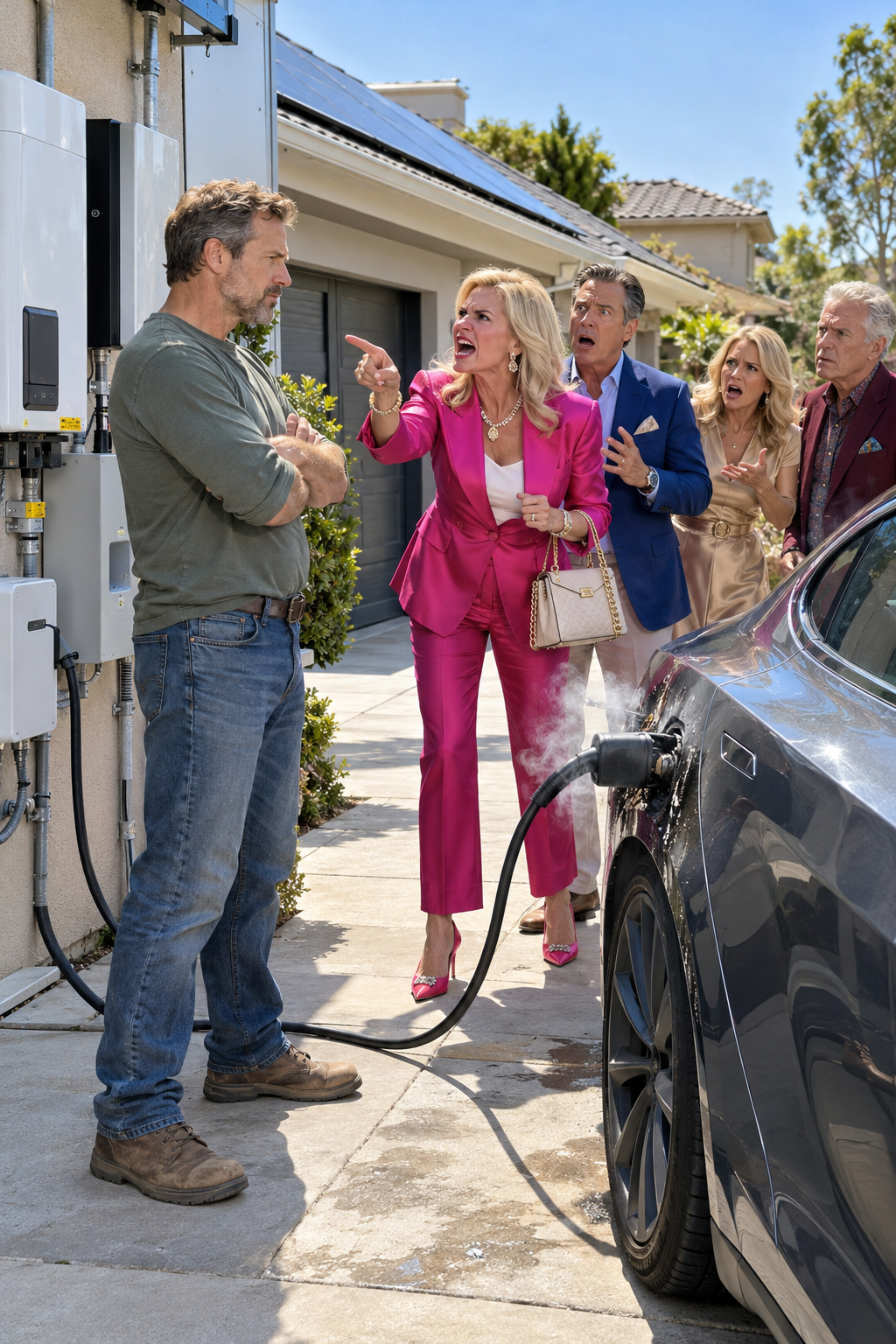
HOA Karen Stole Power From My Solar Grid to Charge Her Tesla—So One Legal Voltage Test Destroyed More Than Her Car
The first time I caught Karen Hartley stealing electricity from my solar system, her white Tesla was parked behind my barn at in the morning.
The second time, she sent me a $750 HOA fine for “unauthorized interference with community energy infrastructure.”
I wasn’t even a member of her HOA.
And the third time?
The third time was when I realized her Tesla wasn’t the real reason she’d been stealing from me.
My name is Jack Mercer.
I’m fifty-two years old, I live outside Prescott, Arizona, and for twenty-seven years I designed and inspected electrical systems for industrial facilities across the Southwest.
Power plants.
Water treatment facilities.
Remote mining operations.
Places where a bad decision around electricity doesn’t inconvenience somebody.
It kills somebody.
So when I retired early and bought fourteen acres of scrub oak, granite, and stubborn Arizona dirt, I built my home the way I wanted it.
Independent.
My house sat on the western ridge above a newer development called Silver Canyon Estates.
Their brochures showed stone entrance pillars, desert landscaping, smiling families, and luxury homes lined up beneath blue skies.
My property had none of that.
I had a thirty-year-old ranch house, a steel workshop, a barn, two horses, a battered Ford F-250, and enough solar panels on the south slope to make my electric meter practically ornamental.
More important, I had battery storage.
A lot of it.
I had designed the system myself and paid licensed contractors to install and certify everything.
It could run my house, well pump, workshop, refrigeration, security system, and barn equipment during outages without touching the utility grid for days.
That mattered out there.
Summer thunderstorms could knock service down.
Winter ice occasionally took lines with it.
And wildfire shutoffs were becoming more common.
My wife, Laura, used to call the battery room my “nerd bunker.”
She died three years before this happened.
Forty-eight years old.
After she was gone, I kept the house exactly the same for almost a year because changing anything felt like admitting she wasn’t coming back.
Her coffee mug stayed beside the sink.
Her gardening gloves hung in the mudroom.
Her yellow rain jacket stayed on the hook by the back door even though Arizona rarely gave us enough rain to justify it.
Eventually I started living again.
The solar project helped.
So did the horses.
So did silence.
Then Silver Canyon Estates finished its third expansion.
And Karen Hartley arrived.
I first met Karen on a Tuesday morning when she drove her Tesla Model X through my open ranch gate without permission.
She was maybe forty-seven.
Blonde hair cut perfectly around her jaw.
Oversized sunglasses.
White linen pants.
Blue silk blouse.
The kind of person who managed to look overdressed beside a livestock trailer.
I was replacing a hinge on the barn door when she stopped ten feet from me and lowered the window.
“You’re Jack?”
No introduction.
I wiped my hands on my jeans.
“Depends who’s asking.”
She smiled like I’d made a cute joke.
“Karen Hartley. President of the Silver Canyon Homeowners Association.”
I nodded toward the ridge.
“Congratulations.”
Her smile tightened.
“I’m here about your western access road.”
“The dirt road running along your property boundary.”
“I know which road is mine.”
She removed her sunglasses.
“I’m glad. Then this should be simple.”
Whenever somebody says that sentence, nothing that follows is simple.
She explained that several homeowners in Silver Canyon wanted a “secondary recreational access route.”
The developer had apparently shown them an old map suggesting my dirt road might once have been part of a county trail.
I had the title survey.
The road sat entirely inside my property.
Karen said the HOA believed residents should be allowed to use it for bicycles, golf carts, dog walking, and “occasional electric vehicle access during community events.”
I stared at her.
“Electric vehicle access?”
“Occasional.”
That seemed to surprise her.
She blinked twice.
“We haven’t discussed the benefits.”
“You’re asking whether strangers can drive across my property.”
“I’m asking you to participate constructively in the neighborhood.”
“I don’t live in the neighborhood.”
That was the moment she decided she didn’t like me.
I saw it happen.
Her mouth stayed polite.
Her eyes changed.
“Silver Canyon surrounds most of your eastern boundary now.”
“That doesn’t make me a member.”
“We all affect one another.”
“Still doesn’t make me a member.”
She looked past me toward the solar array.
“That’s quite a power system.”
“How much do you generate?”
“Battery backup?”
I stopped smiling.
People who understand electrical systems sometimes ask that question.
Karen didn’t sound like she understood electrical systems.
She sounded like she was cataloging assets.
“No reason. Sustainability is a major initiative for our community.”
Then she put the sunglasses back on.
“We’ll revisit the road.”
“No, we won’t.”
Her Tesla rolled backward, turned around, and disappeared through my gate.
I closed the gate behind her.
Then I locked it.
Three weeks later, my overnight battery usage changed.
Not dramatically.
That’s why I almost missed it.
Normally, from midnight to sunrise, the property used very little power.
Refrigerators.
Security system.
Network equipment.
Well controls.
A few standby loads.
The graph was boring.
I liked boring.
Then one Wednesday morning, I noticed a new draw beginning around a.m.
It lasted almost four hours.
The next night, nothing.
Friday night, there it was again.
Then Sunday.
Then Tuesday.
The load was too large for a forgotten light.
Too steady for the well.
Too consistent for workshop equipment.
Something was pulling serious power.
I checked the house.
Battery room.
I walked the property looking for damaged cables, failed equipment, or signs of an animal getting somewhere it shouldn’t.
Then I checked the security cameras.
At 12:47 a.m. Tuesday, headlights appeared near my southern fence.
Not through the gate.
Along the HOA side.
The vehicle stopped behind a stand of juniper trees.
The camera angle was bad.
All I could see was white paint and the rear quarter of an SUV.
At a.m., it drove away.
I moved one camera.
Then I waited.
Thursday night, no activity.
Friday, nothing.
Saturday at a.m., my phone notified me.
Motion detected.
I was already awake.
I opened the camera feed.
White Tesla.
Karen Hartley.
She drove along the edge of Silver Canyon, stopped near my old equipment shed, got out, opened her rear hatch, and walked toward my fence carrying something dark.
She disappeared below the camera line for maybe two minutes.
Then she returned without it.
She climbed into the Tesla.
And stayed there.
My battery monitor showed the draw beginning less than thirty seconds later.
I stared at the screen.
Then back at the camera.
Then the monitor.
The load climbed.
Held steady.
Karen had somehow connected her car to my system from the opposite side of my fence.
I didn’t go outside.
That surprises people when I tell the story.
They always imagine the satisfying version.
Jack storms down there with a flashlight.
Jack catches Karen red-handed.
Jack yanks the cable.
Jack calls the sheriff.
Jack makes her panic.
That would have felt good for maybe thirty seconds.
It also would have destroyed the most useful thing she’d given me.
So I sat in my kitchen.
Made coffee.
Saved the footage in three places.
Captured the power logs.
Photographed the monitoring screen with a separate device.
And waited.
I didn’t raise my voice.
I didn’t touch her car.
I didn’t cut her cable.
I didn’t threaten her.
I didn’t let her know I had seen a thing.
At a.m., Karen disconnected.
The power draw stopped.
Her Tesla disappeared toward Silver Canyon.
At that morning, I called Daniel Price, the electrician who had overseen the original installation.
He arrived Monday.
Daniel was sixty-one, broad-shouldered, gray mustache, forty years in the trade.
He watched the video twice.
Then he said one word.
We walked to the southern fence.
For twenty minutes, we found nothing.
That bothered him.
“If she’s pulling what your logs show, there has to be hardware somewhere.”
We followed the fence east.
About seventy yards past the equipment shed, Daniel stopped beside a cluster of decorative rocks on the HOA side.
“Those new?”
He crouched.
One rock wasn’t a rock.
It was molded composite.
The kind utility companies sometimes use to conceal equipment.
Daniel lifted it.
Underneath was a weatherproof enclosure.
He didn’t touch anything.
Neither did I.
A heavy cable disappeared underground toward Silver Canyon.
Another disappeared beneath my fence.
Daniel stood.
His face had changed.
“That’s not some portable extension cord.”
“What is it?”
“I’m not opening it until we have the right people here.”
“Because whoever installed this put effort into it.”
He pointed toward my property.
“Your buried feeder to the workshop runs through this corridor.”
I felt something cold settle behind my ribs.
“You think they tapped into it?”
“I think we call the county inspector.”
By Tuesday afternoon, a county electrical inspector named Maria Santos was standing beside the fake rock with Daniel and me.
Maria took photographs.
Checked property records.
Checked permit records.
Then frowned.
“There’s no permit for this enclosure.”
Karen appeared sixteen minutes later.
I still don’t know who called her.
She arrived in the same Tesla, wearing a red blazer and the expression of somebody showing up to correct incompetent employees.
“What are you doing?”
Maria stood.
“County inspection.”
“On HOA property?”
“We’re determining that.”
Karen looked at me.
“You called them?”
“I noticed unauthorized equipment near my electrical system.”
“Unauthorized according to whom?”
“The owner.”
“You don’t own this side of the fence.”
“I own what’s on the other side.”
She laughed once.
“Jack, this is becoming ridiculous.”
Maria cut in.
“Ma’am, are you responsible for this enclosure?”
Karen barely glanced at her.
“I’m the HOA president.”
“That wasn’t my question.”
Karen’s smile disappeared.
“The association has several infrastructure projects.”
“Was this one permitted?”
“You’d need to speak to our facilities contractor.”
“I don’t carry contractor files in my head.”
Daniel coughed.
It was suspiciously close to a laugh.
Karen turned on him.
“And who are you?”
“The electrician who built Jack’s system.”
“Well, then maybe you should explain to him that modern communities share infrastructure.”
Daniel stared at her.
“Not like this.”
Karen crossed her arms.
“Our attorney has reviewed the easements.”
That was the first time she mentioned an easement.
Maria heard it too.
“What easement?”
Karen answered too quickly.
“The utility easement.”
“Which utility?”
Karen paused.
Half a second.
But half a second is enough when someone realizes they said something they weren’t prepared to explain.
“The appropriate utility.”
Maria wrote something down.
“Do you have documentation?”
“Our management office does.”
“Good. I’ll need it.”
Karen turned toward me.
“This is exactly what I warned the board about.”
“You warned them about me?”
“About living beside someone who thinks independence means ignoring community obligations.”
I almost smiled.
“You connected something to my power system.”
“That’s your interpretation.”
“My monitoring logs show energy leaving my property when your vehicle is parked beside this box.”
“Coincidence.”
“I have video.”
That landed.
Her shoulders stiffened.
“Video of what?”
For the first time since she had driven onto my property, Karen had nothing ready to say.
Maria looked between us.
Then at the Tesla.
“Mrs. Hartley, were you charging that vehicle here?”
Karen’s jaw tightened.
“I’m not discussing my private transportation habits with a county employee.”
Maria nodded.
“That’s fine.”
She pulled out her phone.
“I’m documenting refusal to answer.”
Karen looked at me one last time.
“You’re making a serious mistake.”
Then she drove away.
Daniel watched her taillights disappear.
“She’s scared.”
I looked at the fake rock.
“She’s angry.”
There’s a difference.
Scared people run.
Angry people retaliate.
Karen retaliated before breakfast the next morning.
At a.m., I received an email from Silver Canyon Estates HOA.
NOTICE OF VIOLATION.
The letter said my property was operating an “unapproved private electrical generation facility adjacent to community land.”
It demanded documentation proving compliance with HOA renewable energy standards.
It ordered me to allow an HOA inspection within ten days.
And it imposed a $750 fine for “interference with shared infrastructure.”
I read it twice.
Then called the number.
A woman named Denise answered.
“Silver Canyon management.”
“This is Jack Mercer.”
But noticeable.
“Yes, Mr. Mercer.”
“I received a violation notice.”
“I don’t belong to your HOA.”
“You border HOA property.”
“That doesn’t give your HOA authority over mine.”
“I’d have to direct legal questions to counsel.”
“Please do.”
“I can provide his email.”
“Send him the deed while you’re at it.”
She exhaled.
“Mr. Mercer, hostility won’t help.”
“I’m not hostile.”
My voice was flat.
“I’m documenting.”
Another silence.
People behave differently when they hear that word.
Documenting.
Not arguing.
Not threatening.
Documenting.
I forwarded the notice to my attorney, Rebecca Sloan.
Rebecca had handled Laura’s estate for me.
She was forty-four, brutally organized, and had a gift for making aggressive people regret putting things in writing.
Her response came nine minutes later.
Do not reply to them again.
I called her.
She answered with, “This might be my favorite thing that’s happened all week.”
“Glad somebody’s enjoying it.”
“They fined a nonmember for interfering with equipment connected to his property?”
“And they put that in writing?”
“Karen may be the first HOA president I’ve ever wanted to send flowers.”
Rebecca drafted a letter.
Not emotional.
Not dramatic.
Three pages.
My property was not within Silver Canyon Estates.
No restrictive covenant bound my parcel.
No recorded agreement granted Silver Canyon access to my electrical infrastructure.
The HOA was ordered to stop claiming authority over my property.
The HOA was also instructed not to alter, access, disconnect, modify, inspect, or otherwise interfere with my power system.
Finally, Rebecca requested every document related to the “shared infrastructure” referenced in their notice.
Karen’s attorney responded two days later.
His name was Leonard Briggs.
His letter was much less confident.
He claimed there appeared to be a “boundary misunderstanding.”
He suggested the enclosure might belong to a prior developer project.
He said nobody had admitted connecting to my system.
Then came the interesting sentence.
The association reserves all rights regarding an existing utility and sustainability easement believed to cross the Mercer parcel.
Rebecca called me.
“Do you have any easement?”
“Standard utility access along the northern edge. Nothing near the southern fence.”
“Anything with Silver Canyon?”
“Developer?”
“Then they’re either confused or preparing paperwork.”
That sentence stayed with me.
Preparing paperwork.
County inspector Maria returned Friday with an investigator from the state licensing board.
Karen did not appear.
This time, with proper authorization and documentation, the enclosure was opened.
Inside was equipment I won’t pretend was amateur.
It was professionally mounted.
Weatherproofed.
The underground line from my side had been attached to a circuit serving my workshop.
The other side ran beneath Silver Canyon property.
Maria followed the markings.
“So where does it terminate?”
Nobody knew.
The line clearly supported Karen’s charging setup.
But its capacity made Daniel suspicious.
“This is oversized for one car.”
Maria looked at him.
“How oversized?”
“Enough that I don’t believe the Tesla was the purpose.”
I remembered Karen asking about my batteries the first day we met.
How much do you generate?
Battery backup?
Sustainability is a major initiative for our community.
The Tesla suddenly felt less like the crime.
And more like a symptom.
Maria issued a stop-work notice.
The unauthorized connection was disconnected and secured.
Every step was photographed.
Nobody damaged anything.
Nobody played cowboy electrician.
Nobody gave Karen the argument she wanted.
At that evening, I was grilling a steak when headlights appeared at my gate.
She got out and hit the call button.
I answered through the intercom.
“We need to talk.”
“We’ve talked.”
“You had our equipment disconnected.”
“The county disconnected unauthorized equipment attached to my system.”
“You know what you’re doing.”
Her eyes flashed toward the camera.
“Open the gate.”
“You’re hiding behind a fence now?”
“No. I’m standing beside a grill.”
That almost made me laugh.
It definitely did not make her laugh.
“Silver Canyon experienced electrical disruptions this afternoon.”
“Call your utility.”
“You caused them.”
“Then your utility should be able to verify that.”
She gripped the bars of my gate.
“You think you’re clever because you keep forcing everything through lawyers and inspectors.”
“I think lawyers and inspectors are useful when somebody is stealing electricity.”
“You have no idea what you’re interfering with.”
There it was.
Not a confession.
Something better.
“What am I interfering with, Karen?”
She realized it immediately.
Her lips pressed together.
Then her face softened.
That was almost more disturbing.
“Jack, this doesn’t need to become ugly.”
“You sent me a fine.”
“I can withdraw it.”
“I don’t owe it.”
“We can reset.”
“There’s nothing to reset.”
“You generate far more electricity than one person needs.”
There are sentences that reveal a person completely.
That was Karen’s.
Not I didn’t steal it.
Not it was an accident.
Not the contractor made a mistake.
You have more than you need.
Therefore, in her mind, taking it was negotiable.
I leaned toward the intercom.
“You don’t get to decide what part of my property I deserve to keep.”
Her stare hardened.
“You’ll regret making this adversarial.”
“You drove here.”
I ended the call.
She stood at the gate another thirty seconds.
That night, my batteries stayed full.
Saturday night too.
For the first time in weeks, the power graph looked normal.
Then Tuesday morning I heard an engine behind the barn.
I stepped outside.
Karen’s Tesla.
She had entered through an HOA maintenance opening beyond the eastern wash and driven along the fence.
She wasn’t on my land.
She parked beside the fake rock.
Opened the enclosure.
I watched from roughly fifty yards away.
“Morning, Karen.”
She spun around.
For once, she looked embarrassed.
Then furious.
“What did you do?”
“My charger.”
“I don’t own your charger.”
“You changed something.”
“The county disconnected an unauthorized line.”
“My car won’t charge.”
“Sounds like a Tesla problem.”
“It charged here before.”
There it was.
I didn’t react.
Her face changed as soon as she heard herself say it.
I held up my phone.
“Would you repeat that?”
“You’re recording me?”
“I’m recording my property boundary.”
She slammed the enclosure shut.
“You think this is funny?”
“My vehicle is at twelve percent.”
“There’s a charging station eight miles away.”
“I shouldn’t have to drive eight miles when power is available here.”
“You sell excess back to the grid.”
“Sometimes.”
“For pennies.”
“Still mine.”
Her voice rose.
“What kind of selfish person watches a neighbor struggle when he has more energy sitting in batteries than he can possibly use?”
I stared at her.
“You’re not struggling.”
“You know what I mean.”
“No. I don’t.”
“I’m trying to manage a community of nearly three hundred people.”
“With my electricity?”
She stepped closer.
“Silver Canyon has become the most desirable development in this part of the county because people like me solve problems instead of hiding behind technicalities.”
“Property ownership is a technicality?”
“Community comes with responsibility.”
“I’m not part of your community.”
She pointed toward my house.
“You are geographically inside our expansion plan.”
Expansion plan.
That phrase mattered too.
“You planning to buy me out?”
She laughed.
“You couldn’t afford what we’d offer.”
“That sentence doesn’t make sense.”
“You know what I mean.”
Actually, I didn’t.
But Rebecca later did.
When I told her, she went quiet.
“Jack, I want the development filings.”
“What filings?”
“Everything Silver Canyon submitted for the next phase.”
The county planning office had public records.
Rebecca found them by Wednesday afternoon.
Silver Canyon Phase Four.
Forty-seven additional homes.
Clubhouse expansion.
A fitness center.
EV charging pavilion.
Landscape pumps.
Emergency backup facilities.
And something labeled Community Resilience Microgrid.
Rebecca emailed me one page.
My property sat beside the proposed development.
A thick blue line ran from Silver Canyon’s planned energy facility.
Across the southern boundary.
Toward my solar installation.
I called her immediately.
“What the hell is that?”
“That’s what I’m asking.”
“They drew their project through my land.”
“Looks like it.”
“They can’t.”
“Does the county know?”
“This version is conceptual. But look at the date.”
The filing had been submitted five months earlier.
Two months before Karen first visited me.
She hadn’t driven through my gate to introduce herself.
She had come to inspect an obstacle.
My batteries.
My solar system.
The whole conversation replayed differently.
How much do you generate?
Battery backup?
Sustainability is a major initiative for our community.
Rebecca said, “I’m requesting the full application.”
“Because projects like this sometimes involve funding.”
She was right.
The proposed microgrid was tied to a public-private resilience program.
Silver Canyon’s developer, Horizon Crest Communities, was applying for incentives, infrastructure credits, and state sustainability funds.
Potential value?
Over five million dollars.
Suddenly Karen’s behavior made sense.
Not morally.
Economically.
My solar system wasn’t worth five million dollars.
But control of the corridor through my property might be.
The next week became very quiet.
No angry emails.
No Karen at the gate.
No HOA letters.
Rebecca told me that worried her more than the threats.
Then, on Thursday, I received a certified envelope.
Inside was a copy of something titled:
UTILITY AND RENEWABLE ENERGY ACCESS AGREEMENT.
My name was printed at the bottom.
Jack Mercer.
My property description was correct.
The document granted Silver Canyon Estates and Horizon Crest Communities broad access rights across part of my southern acreage.
Buried utilities.
Maintenance.
Energy transmission.
Temporary vehicle access.
And an easement extending toward my workshop service corridor.
The date was eleven months earlier.
My signature appeared above my printed name.
It looked convincing.
It was not mine.
I called Rebecca.
She read the first page while we were on the phone.
Then the second.
Then the signature page.
She stopped speaking.
“I’m here.”
“It’s fake.”
“What do we do?”
“This just stopped being primarily an HOA dispute.”
The sheriff’s office got involved the next morning.
So did the county recorder.
The document had never been properly recorded against my title, which was the good news.
The bad news was that copies appeared in multiple project files.
Somebody had been using it.
The deputy assigned to take my statement was named Aaron Mitchell.
He was younger than me, maybe thirty-seven.
He studied the signature.
“Could anybody argue this is yours?”
“Any prior negotiations?”
“Did you ever discuss selling an easement?”
“Did you sign anything electronically?”
“Does anyone have access to scans of your signature?”
That question made me think.
Laura’s estate.
Tax documents.
Old engineering contracts.
Loan paperwork.
Plenty of places.
Aaron photographed the document.
“We’ll figure out where it came from.”
I asked, “What about the power theft?”
“Separate issue.”
“Connected?”
He looked at me.
“Probably.”
Karen stopped driving the Tesla three days later.
I noticed because she started arriving at HOA meetings in a black Lexus.
Silver Canyon residents noticed too.
And residents talk.
One of them knocked on my gate Sunday afternoon.
His name was Tom Avery.
Early sixties.
Retired dentist.
He lived four houses into Silver Canyon.
“I’m probably not supposed to be here,” he said.
“According to who?”
He looked back toward the development.
“You know who.”
I opened the pedestrian gate.
Tom carried a folder.
We sat beneath the covered porch.
He didn’t touch the iced tea I offered him.
“Karen told us your electrical system malfunctioned.”
“Interesting.”
“She said it damaged community infrastructure.”
“Also interesting.”
“She said you were being investigated.”
“That part is new.”
Tom rubbed his thumb along the edge of the folder.
“She also told us our HOA fees had to increase because the utility company changed the rate structure.”
“How much?”
“Special assessment. Eleven hundred dollars per household.”
“For electricity?”
“Energy infrastructure.”
“Six months ago.”
Before Karen had approached me.
“What was the money for?”
“Charging stations. Backup power. Clubhouse upgrades.”
“And did those get built?”
He opened the folder.
HOA statements.
Meeting minutes.
Assessment letters.
One invoice caught my attention.
DESERT INTEGRATED ENERGY SOLUTIONS.
Electrical modernization.
Microgrid preparation and conduit placement.
Emergency energy interconnect.
“Tom, have you shown these to Rebecca?”
“My attorney.”
He swallowed.
“I don’t want Karen knowing I came here.”
“She doesn’t need to.”
Tom finally drank the tea.
Then he said something that pushed the whole thing sideways.
“Jack, people think Karen charges her Tesla for free.”
He leaned forward.
“I mean they think free charging was part of her HOA compensation.”
“She told the board she wasn’t taking a salary this year. Instead she received transportation and energy benefits.”
“Who approved that?”
“Karen controls the agenda.”
“Not the same question.”
Tom looked uncomfortable.
“Most homeowners don’t attend meetings.”
“That’s how people like Karen survive.”
Then he pointed toward one invoice.
“There’s more.”
“The clubhouse power bill fell almost forty percent after this work was installed.”
My attention sharpened.
“About five months ago.”
Exactly when the underground equipment near my fence had likely been installed.
I called Daniel.
He came the next morning.
I showed him the invoice copies and clubhouse usage figures.
He read them slowly.
Then leaned back.
“Jack, if they were pulling enough energy from you to reduce a clubhouse bill by forty percent, you would’ve noticed.”
“I did notice a draw.”
“Not that much.”
“So where did the rest come from?”
He looked at me.
“Or where did it go?”
That question bothered me all day.
The unauthorized line had been larger than necessary for Karen’s Tesla.
We already knew that.
But my recorded losses weren’t large enough to explain the HOA’s apparent savings.
Unless the system had been used differently at different times.
Or unless what we found was only one connection.
That afternoon, Maria Santos returned with two county employees.
This time they had utility maps.
Daniel joined them.
They traced the underground conduit farther toward Silver Canyon.
I stayed back.
Around , Maria walked toward me carrying rolled plans.
“You need to see this.”
We stood beside my barn.
She spread the plan over the hood of my truck.
The line near my property didn’t run directly to Karen’s charging location.
It branched.
One path went toward the clubhouse.
One toward the private charging area.
And one disappeared toward a utility cabinet near Silver Canyon’s future Phase Four.
“How old is this drawing?” I asked.
“Submitted revision says three months.”
“Who submitted it?”
“Horizon Crest.”
“Was it approved?”
“Not in this form.”
“Then why does the equipment exist?”
“That’s what we’re determining.”
Daniel tapped a notation.
“Look here.”
I leaned closer.
The line was marked as an interconnection to a private renewable energy source.
Source ID: MERCER ARRAY.
My name was literally printed on their construction document.
Not as a neighboring property.
As infrastructure.
I looked at Maria.
“How can somebody build from plans that aren’t approved?”
“They’re not supposed to.”
“But they did.”
“Who inspected it?”
She didn’t answer immediately.
That answer scared me more than I expected.
Finally she said, “There’s a signature on the contractor closeout paperwork.”
“A former county inspector.”
“He retired four months ago.”
“Did he actually inspect this?”
“We don’t know.”
Karen arrived twenty minutes later.
Not in the Lexus.
In a silver Mercedes sedan driven by a man I’d never seen.
He stayed inside.
Karen walked toward us.
Her confidence had changed.
It wasn’t gone.
It was sharper.
Controlled.
She looked at Maria.
“I’ve been informed you’re accessing association infrastructure without notifying counsel.”
Maria barely glanced up.
“County inspection.”
“Then communicate through the association attorney.”
“I’m not required to ask your lawyer before inspecting unpermitted electrical work.”
Karen looked at me.
“You enjoy this, don’t you?”
I folded my arms.
“Not especially.”
“You humiliate people because you’re lonely.”
Maria looked up at that.
Karen kept going.
“You sit up here in your little fortress pretending every neighbor is an enemy because you lost your wife and decided the world should stop with you.”
There are insults that make you angry.
Then there are insults that become evidence.
Karen expected me to break.
To step toward her.
To give her something she could describe later as threatening.
Instead, I looked at the phone clipped to Maria’s vest.
Then I looked at Karen.
“Are you finished?”
Her face twitched.
“You think being calm makes you powerful.”
I glanced at the plans.
“Documents do.”
Daniel turned away because he was smiling.
Karen saw it.
“Everyone here thinks this is funny?”
Maria rolled up the map.
“Nobody thinks this is funny.”
Karen pointed at me.
“This man deliberately damaged my vehicle.”
That was new.
I said nothing.
Maria asked, “How?”
“He manipulated his electrical system knowing my vehicle was connected.”
Daniel looked at her.
“You just said your vehicle was connected to his system.”
Karen froze.
It might have been the cleanest mini-payoff of my entire life.
She recovered fast.
“To association infrastructure adjacent to his system.”
Daniel shrugged.
“That’s not what you said.”
Karen’s face flushed.
“You know exactly what he did.”
“What did he do?”
“He caused a voltage event.”
I finally spoke.
“What voltage event?”
“My onboard charging system failed.”
“The morning after you had the line disconnected.”
Daniel scratched his jaw.
“So after the county isolated an unauthorized installation, your car failed while attached to what?”
Karen glared at him.
“You people are twisting words.”
Maria said, “Mrs. Hartley, did you reconnect your vehicle after the county issued a stop-work notice?”
Karen didn’t answer.
Maria repeated it.
“Did you reconnect your vehicle to equipment marked out of service?”
“You’re missing the point.”
“I don’t think I am.”
Karen stepped toward me.
“Tell them.”
“Tell them what?”
“You ran a high-voltage diagnostic.”
Daniel’s eyes moved toward me.
Karen spread her hands.
Maria looked at me.
“On my own isolated system after your office verified disconnection.”
Daniel understood immediately.
He said, “That test was scheduled weeks ago.”
It had been.
My battery equipment manufacturer had issued a maintenance bulletin.
Daniel and I had planned a supervised diagnostic procedure to verify portions of the system after the unauthorized tap was removed.
Everything had been isolated from public utilities and unauthorized connections first.
That was exactly why Maria’s office had documented disconnection.
Karen apparently ignored the stop-work notice and reattached something on her side afterward.
I had not known.
Daniel had not known.
Maria had not known.
But Karen knew enough about the scheduled test to accuse me.
That meant she had access to information she should not have had.
I looked at her.
“How did you know when my diagnostic was scheduled?”
Maria turned.
Karen’s face went pale.
Just slightly.
“I was told.”
“The association has people.”
“What people?”
“This is harassment.”
She turned and walked toward the Mercedes.
Maria called after her.
“Mrs. Hartley.”
Karen didn’t stop.
“You may want to preserve all HOA communications related to this project.”
Karen opened the rear door.
Then looked back.
“My attorneys preserve everything.”
The Mercedes left.
Daniel waited until it disappeared.
Then said, “She shouldn’t have known.”
Maria’s expression was serious.
“She really shouldn’t have known.”
Rebecca filed for emergency preservation of records the next day.
HOA emails.
Contractor emails.
Developer communications.
Permit submissions.
Access logs.
Board minutes.
Vendor contracts.
Energy system records.
Security footage.
Nobody was accusing anyone of destroying evidence.
The order simply made it dangerous to try.
That’s when Silver Canyon started turning on Karen.
Tom wasn’t the only homeowner asking questions anymore.
A woman named Melissa Grant discovered her HOA account had been charged $380 for a “renewable integration fee” nobody remembered approving.
Another resident found board minutes showing a vote that several homeowners insisted never happened.
A retired accountant named Gary Mills started comparing special assessments with contractor invoices.
The numbers didn’t match.
At the next HOA meeting, nearly ninety residents showed up.
Tom invited me.
Rebecca told me not to speak unless necessary.
So I sat in the back.
Karen sat behind a long folding table in the clubhouse beside two board members and Leonard Briggs, the HOA attorney.
Her broken Tesla wasn’t outside.
People noticed.
For twenty minutes, Karen tried to run the normal agenda.
Landscaping.
Pool maintenance.
Holiday decorations.
Nobody cared.
Finally Gary stood.
“Where did the energy assessment go?”
Karen sighed.
“We’ve addressed this.”
Gary held up papers.
“You gave us categories. I’m asking where the money went.”
“Renewable infrastructure.”
“Which infrastructure?”
“Multiple projects.”
“Jack Mercer’s?”
The room changed.
Dozens of people turned toward me.
Karen’s eyes found mine.
“No HOA money was spent on Mr. Mercer’s private equipment.”
Gary held up an invoice.
“This contractor billed us for a Mercer Array Interconnect.”
Leonard leaned toward Karen.
Whispered something.
Karen said, “That description may be internal shorthand.”
Gary laughed.
Not happily.
“Internal shorthand for what?”
“And why were we told the community owned an easement across Jack’s land?”
Karen’s voice sharpened.
“Please sit down.”
The room got very quiet.
Tom was not a rebellious-looking man.
He wore loafers, khakis, and reading glasses on a cord.
But when a polite person finally refuses to sit down, everyone pays attention.
Karen tapped her microphone.
“This meeting will remain orderly.”
Tom said, “Then answer the question.”
A woman near the front raised her hand.
“My husband is on the architectural committee. We were told Phase Four had guaranteed energy access.”
Someone else said, “Guaranteed by who?”
Another voice.
“Why did our fees increase?”
“Why are inspectors digging up the south corridor?”
“What happened to your Tesla?”
That one got murmurs.
Karen’s face hardened.
“The situation involving my vehicle is subject to litigation.”
Rebecca leaned toward me.
“She’s trying to shut them up.”
Gary asked, “Did Jack damage it?”
Karen stared directly at me.
“The vehicle suffered catastrophic charging damage following deliberate changes to his electrical system.”
Rebecca stood before I could move.
“Be careful.”
She didn’t raise her voice.
Didn’t identify herself.
She didn’t need to.
Karen’s attorney whispered urgently.
Karen ignored him.
“He knew I had access.”
Rebecca smiled slightly.
“Thank you.”
Karen realized it too late.
Residents started talking at once.
“He knew she had access?”
“Why did she have access?”
“She said the HOA connection was legitimate.”
“Was she charging there?”
“Who paid for it?”
Leonard grabbed the microphone.
“This meeting is adjourned.”
Gary shouted, “No, it isn’t.”
Under the HOA bylaws, members could continue certain proceedings if a quorum remained.
Gary had apparently read the bylaws.
That night, residents voted to demand an independent financial audit.
Karen called the vote invalid.
Seventy-six homeowners signed the request before leaving.
When I reached my truck, Karen was waiting beside it.
Rebecca stayed ten feet away.
“I hope you’re happy,” Karen said.
“You’ve turned neighbors against each other.”
“They asked questions.”
“You fed them documents.”
“I didn’t give Gary that invoice.”
“You gave Tom information.”
“Tom gave me information.”
Her expression shifted.
For a second, the anger fell away.
Underneath was exhaustion.
Real exhaustion.
I almost felt sorry for her.
Then she said, “Do you understand what happens if Phase Four collapses?”
“People lose money.”
“Maybe talk to the developer.”
“You think Horizon Crest is going to absorb this?”
“Not my concern.”
“It will become your concern.”
She looked toward the dark ridge.
Silver Canyon lights stretched across the hillside.
Big houses.
Stone walls.
Debt dressed like prosperity.
Karen spoke quietly.
“This development is carrying obligations you don’t understand.”
“What obligations?”
She shook her head.
“You think this is about a car.”
“I stopped thinking that weeks ago.”
Her eyes came back to me.
“Then stop digging.”
“You could sell.”
“They would pay you well.”
“You don’t even use most of the land.”
There it was again.
You have more than you need.
Different words.
Same philosophy.
“You already tried taking access without buying it.”
“That wasn’t me.”
“Whose signature is on my fake agreement?”
“I don’t know.”
“You expect me to believe that?”
“I expect you to understand that there are people involved who don’t care whether Silver Canyon residents like them.”
That sounded less like a threat.
More like fear.
Rebecca stepped closer.
“Karen, you should stop talking.”
Karen looked at her.
Then at me.
“Ask your attorney what happens when a project lender accelerates a development loan.”
Rebecca’s expression changed.
Karen saw it.
She smiled for the first time all night.
Then walked away.
In the truck, I asked Rebecca, “What does that mean?”
“It means we need financing records.”
“Can we get them?”
“What are you thinking?”
“If Phase Four financing depends on certain infrastructure milestones, losing access through your property might trigger contractual problems.”
She looked at the clubhouse.
“Possibly bigger than the HOA.”
The independent audit began the following week.
Karen tried to stop it.
She failed.
County investigators inspected more of the buried work.
Two additional unpermitted conduits were found.
Neither connected directly to my system.
One did, however, run toward the proposed Phase Four energy site.
Horizon Crest Communities issued a statement blaming a subcontractor.
The subcontractor denied installing anything outside approved plans.
Desert Integrated Energy Solutions stopped returning HOA calls.
Then their office was suddenly closed.
That was Twist Number One.
The contractor Karen had paid nearly $400,000 in HOA funds appeared to have vacated its leased office over a weekend.
Phones disconnected.
Website down.
Mail accumulating.
But somebody had still been using their credentials.
Rebecca found the company’s registered owner.
A man named Colin Reeves.
He had dissolved another contracting company in Nevada three years earlier.
Same type of work.
Same pattern of unpaid vendors.
Then Maria called me Wednesday morning.
“Jack, are you home?”
“Stay there.”
That’s never a comforting sentence.
Forty minutes later, two sheriff’s vehicles, Maria’s county truck, and an unmarked state vehicle came through my gate.
Aaron Mitchell got out.
So did a woman who introduced herself as investigator Paula Nguyen from the state attorney general’s fraud section.
We went into my kitchen.
Laura’s coffee mug was still on the shelf above the sink.
I noticed Paula looking at the photographs on the refrigerator.
Laura and me in Sedona.
Laura feeding our old horse, Charlie.
Laura standing beside the first row of solar panels after installation, arms raised like she’d personally conquered the sun.
“We’ve examined the access agreement.”
“We’ve also examined several related project submissions.”
“There are different versions.”
“How many?”
“Four so far.”
I looked at Rebecca, who had joined by video call.
“Different how?”
Paula opened a folder.
“One version grants a narrow utility easement.”
Another page.
“One grants energy interconnection rights.”
“One includes road access.”
“And this version grants an option to purchase a portion of your parcel under specific conditions.”
My chair suddenly felt too hard.
“I’ve never seen that.”
“Signature?”
“Purportedly yours.”
“Also fake.”
“We believe so.”
“Who filed these?”
“Different entities.”
“What entities?”
She glanced at Aaron.
Then back to me.
“Silver Canyon HOA. Horizon Crest Communities. A project consultant. And a financing entity.”
“What financing entity?”
“Canyon Ridge Capital Partners.”
Rebecca spoke through the laptop.
“I know that name.”
Everyone looked at her.
She continued.
“They finance master-planned developments.”
Paula nodded.
“They also hold significant debt associated with Silver Canyon.”
“How significant?”
She didn’t give me a number.
Which told me the number mattered.
“What does this have to do with my solar system?”
Paula slid a document toward me.
At the top:
PROJECT RESILIENCY CERTIFICATION.
Below it, my property was listed as a participating renewable generation site.
My solar installation’s approximate capacity appeared beside it.
My batteries too.
Close enough to be disturbing.
“They used my equipment in their financing documents?”
Paula said, “It appears your site may have been represented as available future infrastructure.”
I laughed once.
I couldn’t help it.
Not because it was funny.
Because the alternative was putting my fist through the kitchen wall.
“I spent years building that system.”
“I understand.”
My voice stayed quiet.
“You don’t. My wife and I planned this place together. Every conduit. Every panel. Every battery cabinet. She chose where the damn equipment shed went because she didn’t want it blocking the sunset.”
Nobody spoke.
I took a breath.
“So somebody looked at our home and decided it belonged in their spreadsheet.”
Paula said, “That’s what we’re investigating.”
Walked to the window.
Silver Canyon glittered below the ridge.
Three hundred people sleeping, eating breakfast, driving to work.
Most of them probably had no idea.
Neither had I.
For months, I had thought Karen was arrogant.
Then greedy.
Then desperate.
Now I wondered whether she had been trying to keep a much larger lie from collapsing.
Paula said, “We need access to your solar monitoring records.”
“You can have copies.”
“And security footage.”
“And we’d like your permission to conduct a full inspection of your southern property corridor.”
Rebecca interrupted.
“Subject to a written scope.”
Paula smiled slightly.
“Of course.”
That afternoon, crews surveyed my land.
Ground scanners.
Utility locators.
Survey stakes.
Around p.m., one technician stopped near the dry wash roughly two hundred yards from the first illegal enclosure.
He called Maria over.
Then Daniel.
Then Paula.
I walked down.
The technician pointed at the ground.
“There’s another run.”
Daniel frowned.
“Where does it go?”
“Toward what?”
The technician looked at me.
“My battery building.”
Nobody spoke for a second.
I said, “There shouldn’t be anything here.”
Daniel stepped closer to the markings.
“This wasn’t on our installation drawings.”
The crew traced it.
The buried run approached the rear of my battery building but stopped short.
Or appeared to.
They would need authority before excavation near the structure.
Paula asked, “Who knew the layout of this property?”
“Lots of people.”
“Who knew the battery capacity?”
“Daniel. Manufacturer. Installer. Me.”
“What about Karen?”
“She asked.”
“Did you tell her?”
Paula wrote that down.
The search continued until sunset.
Then everyone left.
Rebecca told me to lock everything.
I already had.
At 11:36 that night, my security alarm triggered.
Not the house.
Battery building.
I was awake instantly.
Camera feed.
A figure in dark clothing moved along the wall.
Another waited near the fence.
I did not go outside.
I called 911.
Then watched.
The first person knelt beside something near the foundation.
The camera couldn’t see their hands.
Thirty seconds.
Then headlights appeared on the county road.
The figure stood.
One crossed toward Silver Canyon.
The other headed south into the wash.
Sheriff’s deputies arrived six minutes later.
They didn’t catch anyone.
But they found fresh soil.
Aaron arrived just after midnight.
Under portable lights, the deputies secured the area.
Paula came too.
Daniel answered his phone at 12:22 a.m. and drove over wearing jeans, boots, and a sweatshirt.
By , investigators had uncovered part of the buried conduit.
It ran beneath my battery building.
Daniel stared at it.
“That was installed before the slab.”
I looked at him.
“The conduit.”
He pointed.
“You can’t place it like that after the building exists without major excavation. Jack, that was there before we installed your batteries.”
“But we built this building eight years ago.”
Laura had been alive.
Silver Canyon barely existed then.
Karen didn’t live here.
Phase Four wasn’t even proposed.
Paula crouched beside the exposed section.
“You said you hired a general contractor for this building?”
I told her.
She typed it into her phone.
Then looked up.
“Company still active?”
“I think so.”
She searched.
Her face changed.
She turned the screen toward me.
The company had closed six years earlier.
The owner had died.
But one listed project manager was still active in construction consulting.
His name was Colin Reeves.
The registered owner of Desert Integrated Energy Solutions.
The disappearing contractor.
I felt the pieces shift.
This hadn’t started when Karen discovered my solar system.
Somebody connected to the project had known about my property years before Karen showed up.
Paula stood.
“Everybody out of this area.”
Aaron said, “Why?”
“Because we no longer assume this is simply unauthorized utility access.”
That night I slept in the guest room because it faced the battery building.
Or tried to sleep.
At a.m., Karen texted me.
First message she had ever sent directly.
You should have sold when you had the chance.
I screenshot it.
Forwarded it to Rebecca.
Then to Aaron.
I didn’t answer.
At , Karen sent another.
Don’t make this worse.
Again, I saved it.
At , a third message arrived.
I tried to protect the residents.
That one was different.
I called Rebecca.
“She’s unraveling,” Rebecca said.
“Or building a defense.”
“Could be both.”
At noon, Silver Canyon’s board placed Karen on temporary administrative leave pending the audit.
By , she had emailed the entire neighborhood claiming she was the victim of a coordinated campaign by “outside interests.”
By , seventy-three homeowners had signed a petition demanding her resignation.
By , Horizon Crest issued another statement denying knowledge of any forged property documents.
At , Karen’s attorney Leonard Briggs withdrew as HOA counsel.
That got everyone’s attention.
At , I sat on my porch watching the sunset turn the granite hills orange.
For the first time in weeks, there were no inspectors.
No lawyers.
No HOA residents.
No contractors.
Just wind in the junipers.
I thought about Laura.
She had always hated conflict.
Not because she was weak.
Because she could see through it.
She used to tell me, “The loudest person in the room is usually trying to stop everyone from hearing something else.”
Karen had been very loud.
Accusations about her Tesla.
Maybe Laura would have spotted it sooner.
The car was noise.
The theft was noise.
Even the HOA fight might have been noise.
At , a truck stopped at my gate.
Older Chevy.
The driver was a man around seventy.
Western shirt.
He held both hands where the gate camera could see them.
I answered the intercom.
“Can I help you?”
“Jack Mercer?”
“My name is Samuel Tate.”
The name meant nothing.
“I need five minutes.”
“Your wife.”
Everything inside me went still.
“What about Laura?”
He looked directly into the camera.
“She hired me nine years ago.”
I opened the gate.
Samuel drove to the house.
I met him outside.
He carried an old leather document case.
“Who are you?”
“Surveyor.”
“Used to contract with several developers.”
“Including Silver Canyon?”
“Before it was called Silver Canyon.”
My heartbeat changed.
“What did Laura hire you for?”
Samuel looked toward the southern ridge.
“Property verification.”
“She never told me.”
“She asked me not to.”
“Because she wasn’t sure there was anything to tell.”
He opened the case.
Inside were old survey maps.
Photographs.
Copies of deeds.
Handwritten notes.
One handwriting style stopped me immediately.
I knew the slant of her L.
The way she crossed her t’s.
The little loop she put on capital M.
My hand actually trembled when I touched the page.
“What is this?”
Samuel’s voice softened.
“Your wife believed someone had altered a boundary exhibit before you bought this property.”
I looked up.
“She found a discrepancy.”
“During the battery building project.”
The conduit.
Eight years ago.
My mouth went dry.
“Why didn’t she tell me?”
“She planned to.”
“She wanted evidence first.”
“What evidence?”
Samuel removed a large folded map.
He opened it on my porch table.
My property.
But not exactly my property.
The southern border extended farther than my current survey showed.
Much farther.
Across part of what was now Silver Canyon Phase Three.
I stared at him.
“This can’t be right.”
“Maybe not.”
“Those houses are on HOA land.”
“Today’s map says they are.”
“What did the old map say?”
Samuel pointed.
“That this entire drainage corridor belonged to the parcel you purchased.”
I felt dizzy.
“How much land?”
“Approximately thirty-two additional acres.”
I laughed nervously.
“That’s impossible.”
Samuel didn’t laugh.
“Laura thought so too.”
“Where did the land go?”
“That’s the question she hired me to answer.”
Samuel hesitated.
“I found a chain of revised exhibits.”
“Revised by who?”
“Different people.”
He folded his hands.
“One was Colin Reeves.”
There it was again.
The same man.
Battery building contractor.
Desert Integrated Energy Solutions.
Connection to the buried line.
Now an old land survey.
I sat down.
Samuel continued.
“Laura became concerned when she realized the discrepancy wasn’t just acreage.”
“What else?”
“What access?”
“The original parcel had an old recorded utility corridor running through it.”
I looked toward the battery building.
Samuel followed my eyes.
“You knew about the conduit?”
“I knew about the corridor.”
“Was it active?”
“Not when you bought the property.”
“Then why bury anything?”
“Because somebody expected it to become valuable.”
I stared at the map.
Silver Canyon.
Phase Four.
The forged easement.
The microgrid.
The five-million-dollar incentives.
Thirty-two acres.
This was no longer about somebody stealing electricity.
It might not even be primarily about energy.
“What was Laura going to do?”
Samuel looked uncomfortable.
“She scheduled a meeting.”
“With who?”
“The original developer.”
He swallowed.
“Three days before she was diagnosed.”
That silenced me.
Cancer consumed the next eighteen months of our lives.
Appointments.
Maps disappeared.
Land didn’t matter.
Nothing mattered except trying to keep her alive.
After she died, I boxed her office and never went through half of it.
Samuel reached into the case.
“There’s one more thing.”
He handed me a sealed envelope.
My name was written on it.
Laura’s handwriting.
For a few seconds, I couldn’t breathe.
“When did she give you this?”
“Nine years ago.”
“Why the hell didn’t you give it to me?”
“She told me only if someone ever tried to claim an energy or utility right across the southern parcel.”
My anger flared.
“That happened months ago.”
“I didn’t know.”
“Silver Canyon is everywhere.”
“I moved to New Mexico. I’m back because an old colleague called and said investigators were asking about Colin Reeves.”
I stared at the envelope.
“Did you read it?”
The seal was intact.
My fingers struggled with it.
Inside was one sheet of paper.
Laura never wasted words.
If you’re reading this, someone came back for the corridor.
Do not sign anything.
Do not sell the south acreage until you find the original Prescott Land & Water map from 1987.
The map everyone uses now is not the first map.
The first map shows what is actually under the ridge.
I read it twice.
Then a third time.
Samuel was watching me.
“What does she mean, under the ridge?”
“I don’t know.”
“Prescott Land & Water?”
He shook his head.
“Company dissolved decades ago.”
“Where’s the map?”
“I never found it.”
My phone rang.
Paula Nguyen.
I answered.
“Jack, we have a problem.”
“The financing company just produced another document.”
I looked at Laura’s letter.
“What kind of document?”
“A purchase option.”
“We already saw one.”
Paula paused.
“This one is different.”
“It predates Karen Hartley.”
The evening air suddenly felt cold.
“Eight years.”
The same time Laura hired Samuel.
“What does it say?”
“It gives a development entity the right to acquire the southern corridor if a specific infrastructure project is activated.”
“What infrastructure project?”
“That’s what I’m calling about.”
I stood slowly.
“The document doesn’t describe a solar interconnect.”
Samuel was staring at me.
Paula continued.
“It describes an underground energy storage site.”
I looked toward the ridge.
Laura’s words seemed to burn through the paper in my hand.
The first map shows what is actually under the ridge.
“What kind of storage site?” I asked.
“We don’t know yet.”
Then headlights exploded across my front gate.
Not one vehicle.
Black SUVs.
They stopped bumper to bumper outside.
Samuel stood.
“Were you expecting someone?”
My security monitor chimed.
Motion detected near the southern boundary.
Then another alert.
Battery building.
Then another.
Three separate zones.
At the gate, doors opened.
Men stepped out.
No uniforms.
At least one carried a hard equipment case.
My phone buzzed with a text from Aaron Mitchell.
LOCK YOUR DOORS. UNITS ARE COMING.
Then Paula spoke sharply through the phone.
“Jack, get inside now.”
I didn’t argue.
Samuel and I moved into the house.
I locked the door.
Security lights came on across the property.
The men outside the gate didn’t try to enter.
They just stood there.
Then my phone received one final message.
Unknown number.
No greeting.
Just a photograph.
Nine years younger.
Standing beside Colin Reeves near my southern ridge.
Behind them was a drilling rig I had never seen before.
Beneath the photograph were seven words.
Your wife knew what the solar panels covered.
✓ Lynn R. Adams
HOA Karen Stole Power From My Solar Grid to Charge Her Tesla—So One Legal Voltage Test Destroyed More Than Her Car The first time I caught Karen Hartley stealing electricity from my solar system, her…