HOA Karen Kept Driving Her Jaguar Across My Hayfield—So I Dug a 12-Foot Trench and Found What My Father Hid
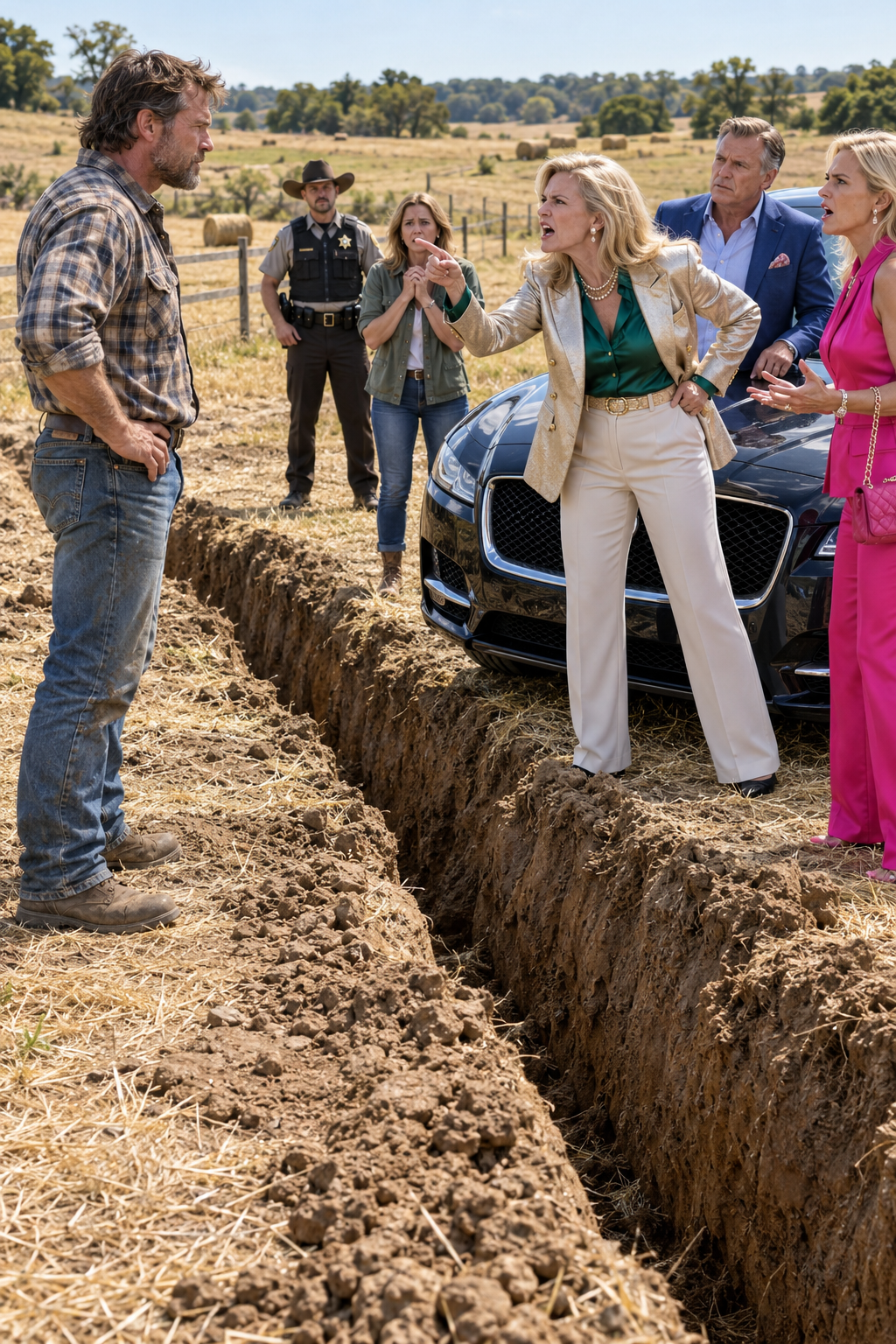
HOA Karen Kept Driving Her Jaguar Across My Hayfield—So I Dug a 12-Foot Trench and Found What My Father Hid
Three days after my father’s funeral, my brother threw my suitcase onto the front porch of the farmhouse I had spent eleven years keeping out of foreclosure.
An hour later, the president of Cedar Ridge Estates drove her white Jaguar straight through Dad’s hayfield, flattened two fresh windrows, rolled down her window, and smiled at me.
“You don’t live here anymore, Caroline.”
Then she drove over the place where we had scattered my father’s ashes.
I didn’t scream.
I didn’t chase her.
I didn’t throw a rock at that ridiculous car, although for one hot second I imagined the sound the windshield would make.
I simply looked down at the brass key inside my fist.
My father had slipped it into my hand six hours before he died.
And my brother had no idea what it opened.
Neither did Victoria Vance.
My name is Caroline Mercer.
I was forty-two years old when my father died, and until that week, I had spent most of my adult life being described by my family with words that sounded harmless.
Dependable.
The unmarried daughter.
The one who could handle things.
Those words cost me eleven years.
Eleven years earlier, my mother had died of pancreatic cancer after seven brutal months that turned our farmhouse outside Ashford, Missouri, into a place of pill bottles, oxygen tubing, casseroles from church ladies, and whispered conversations behind closed doors.
My brother Grant lived in St. Louis then.
He visited twice.
Both times, he brought his wife, Melissa, their two children, and enough luggage to make it feel less like a visit and more like a holiday.
He cried at Mom’s funeral.
Then he went home.
Dad was sixty-eight when Mom died. Strong enough to haul feed bags but old enough that grief seemed to change his shape. His shoulders curled. His hands shook when he thought nobody was looking. He stopped opening bank statements.
So I came back.
At first, I told myself it would be six months.
I had been a project manager for a construction company in Kansas City. Good salary. Benefits. A little condo near Westport.
I gave up the condo.
Then the job.
Then six months became a year.
The farm had 412 acres of hay, soybeans, timber, and pasture. It looked rich from the county road.
Dad had borrowed against it twice.
Then a machinery loan went bad.
Then a drought hit.
Then the old north barn needed a new roof.
I learned to negotiate diesel contracts.
I learned which tractor could run another season with a bad hydraulic seal.
I learned how to argue with an insurance adjuster without raising my voice.
I learned that sacrifice rarely announces itself as sacrifice.
Usually it looks like a Tuesday.
A doctor appointment.
A broken fence.
A check written before breakfast.
A life postponed one ordinary decision at a time.
Grant knew the farm was struggling.
He also knew I was covering part of the mortgage from my savings.
He never offered money.
But every Christmas, he would stand in Dad’s kitchen, look through the window toward the western pasture, and say things like, “Land around here is getting valuable.”
That should have told me everything.
What finally changed the value of our farm wasn’t anything Dad or I did.
It was Cedar Ridge.
Five years before Dad died, a developer named Hollis Development bought 900 acres directly east of us and built a luxury residential community around an artificial lake.
The entrance had limestone pillars.
The clubhouse had a heated pool.
The houses started around $900,000.
The marketing brochures called it “country living without the inconvenience of country life.”
Dad laughed the first time he heard that.
“Means they want the view without the smell,” he said.
He was right.
Within a year, Cedar Ridge homeowners were complaining about tractors before 8 a.m., cattle trailers, dust, manure, hunting season, hay balers, and the fact that rural Missouri apparently contained rural Missouri.
Then Victoria Vance became HOA president.
Victoria was fifty-six, blond in the expensive way that required regular appointments, and married to a regional orthopedic surgeon who seemed to have mastered the medical art of never being home.
She drove a pearl-white Jaguar F-Pace.
Always spotless.
Always too fast.
The first time she crossed our land, I thought she was lost.
She came through a gap beside the eastern tree line, drove diagonally across fourteen acres of second-cut hay, and exited onto County Road 18.
I flagged her down.
She lowered her window three inches.
“This is private property,” I said.
She smiled.
“We’ve always used this.”
“No, you haven’t.”
“The previous owners allowed access.”
“There are no previous owners. My family has owned this farm since 1948.”
The window slid upward.
That was Victoria’s preferred argument.
The second time, she brought two SUVs behind her.
The third time, a landscaping contractor.
Then delivery vans.
Then golf carts.
Cedar Ridge had one official entrance on State Route 6.
But using our field saved almost twelve minutes when traveling between the clubhouse side of the development and County Road 18.
Twelve minutes.
That was apparently worth destroying my hay.
Dad told me to install steel posts.
Someone removed them.
I installed a chain.
Someone cut it.
I installed a camera.
Victoria sent me a certified letter accusing me of “surveilling Cedar Ridge residents engaged in customary access.”
Customary access.
That phrase eventually became very important.
At the time, it just made Dad laugh.
He sat at the kitchen table with the letter in one hand and a cup of black coffee in the other.
“Save everything she sends,” he told me.
“No. I mean everything.”
He looked toward the eastern window.
For a second his expression changed.
Not worried.
Something sharper.
He folded the letter carefully.
“If they ever start using words like customary access or prescriptive rights, don’t argue with them.”
“Because people talk too much when they think you’re scared.”
Then he put the letter into a brown accordion folder.
That folder disappeared after his death.
I didn’t know where.
By then, Dad had already begun losing weight.
Six months later, we learned why.
Stage four colon cancer.
He lasted fourteen months.
Grant started visiting more often after the diagnosis.
Much more often.
At first, I was grateful.
Then I noticed he spent more time walking the property than sitting with Dad.
He brought an appraiser once.
Said the man was “an old friend.”
Another Saturday, he arrived with Melissa and a real estate broker.
They stood near the south porch talking quietly while Dad slept upstairs.
I stepped outside.
“What are you doing?”
Grant smiled.
“Thinking ahead.”
“The inevitable.”
I remember the exact way the word felt.
The inevitable.
Our father was alive upstairs.
Grant was pricing the dirt under his bed.
I told the broker to leave.
Grant followed me into the kitchen.
“You need to be realistic, Carrie.”
Only Grant called me Carrie.
I hated it.
“Dad isn’t dead.”
“I didn’t say he was.”
“You brought a real estate agent.”
“Because somebody needs to think clearly.”
“I’m thinking clearly.”
“No. You’re emotional because you’ve built your entire identity around taking care of him.”
That sentence stayed with me.
Not because it was clever.
Because it was almost true.
I had built a life around taking care of people who assumed I required nothing in return.
Dad heard some of the argument.
Later that night, when I brought his medication upstairs, he said, “Don’t hate your brother.”
“He’s afraid.”
“Being ordinary.”
Dad didn’t.
“Men like Grant spend their whole lives thinking money can make them look taller.”
He reached for the glass of water beside his bed.
His hand trembled.
I steadied it.
Then he whispered, “There are worse things than losing a farm.”
I looked at him.
He looked back.
“There are worse things than losing family too.”
I thought that was grief talking.
Two weeks before Dad died, Cedar Ridge announced Phase Three.
Thirty-eight new luxury homes.
A second clubhouse.
Tennis courts.
A private event pavilion.
The press release said Phase Three would include “improved secondary transportation connectivity.”
That phrase made me sit up.
I printed the development map.
The proposed secondary route ran straight across our eastern hayfield.
Not beside it.
Right over the path Victoria had been carving with her Jaguar for years.
I took the map upstairs.
Dad was weaker by then.
Morphine on the bedside table.
Oxygen machine humming against the wall.
His eyes moved slowly across the page.
Then he smiled.
It was the first real smile I had seen in days.
He pointed to his dresser.
“Bottom drawer.”
Inside was an old pair of leather work gloves.
Under them sat a small white envelope.
My name was written on the front.
Inside was the brass key.
No explanation.
“What does it open?”
“You’ll know.”
“When everybody starts telling you what belongs to them.”
I stared at him.
He closed his eyes.
“Dad, that is annoyingly dramatic.”
“I’m dying. I’m allowed one dramatic line.”
I laughed despite myself.
His eyes opened again.
Then his voice changed.
“Caroline.”
“If Grant tells you to leave the house after I’m gone, leave.”
I thought I had misheard him.
“Don’t fight over the house.”
“Why would Grant tell me to leave?”
“Because he’ll think he won.”
My stomach tightened.
“What did you do?”
Dad breathed slowly through his nose.
“Promise me.”
I looked at the brass key.
Then at him.
“I promise.”
“And if Victoria comes across that field again?”
That made even less sense.
“Document it.”
“Every tire track.”
He looked toward the window.
“Because arrogance is expensive when properly recorded.”
Those were almost the last clear words he ever said to me.
Eleven days later, he died at in the morning.
I was holding his left hand.
Grant arrived at .
Melissa came at .
By noon, they were asking where Dad kept his property records.
The funeral was Wednesday.
Grant evicted me Saturday.
He called it “taking possession.”
Dad’s will had named Grant executor of the estate.
The farmhouse and what the will described as “residual real property” appeared to pass equally to both of us.
Grant claimed that because he was executor, he had authority to secure the property until probate was completed.
His lawyer backed him.
Melissa stood near the refrigerator with her arms crossed while Grant delivered the speech.
“You can stay at a hotel for a while.”
“I’ve lived here eleven years.”
“I paid the mortgage for nineteen months when Dad couldn’t.”
“That can be addressed in probate.”
“I put one hundred and sixty-eight thousand dollars of my own money into this place.”
“Keep receipts.”
I looked at him.
He looked away first.
Then Melissa spoke.
“We’re trying to keep this civilized.”
I almost laughed.
Instead, I walked upstairs and packed one suitcase.
Grant seemed unsettled.
“You’re not going to argue?”
“Caroline, this isn’t personal.”
I zipped the suitcase.
“No. We have buyers interested, and an occupied property complicates things.”
There it was.
Dad had been dead three days.
“What buyers?”
Grant hesitated.
Melissa didn’t.
“Cedar Ridge.”
I looked at her.
Her face changed immediately.
A tiny realization.
She had said too much.
Grant sighed.
“Nothing is final.”
“How much?”
“How much?”
He scratched the back of his neck.
“Preliminary number is four point eight.”
Four point eight million dollars.
For a farm Grant had contributed nothing to.
For fields he hadn’t cut.
For taxes he hadn’t paid.
For a father he visited when convenient.
I felt something inside me go completely still.
Melissa mistook silence for defeat.
She smiled.
Not cruelly.
“We can all move forward now.”
That was when I understood what Dad meant.
Grant thought the farmhouse was the farm.
Cedar Ridge thought Grant was the owner.
Victoria thought the tire tracks had created a right.
Everybody thought the obvious thing was the true thing.
I carried my suitcase downstairs.
Before I left, I stopped beside Dad’s empty chair.
Grant watched me.
“Need something?”
I looked at the shallow scratch on the table where Dad used to sharpen pencils with his pocketknife.
Then I drove away.
I didn’t tell Grant that Dad had given me a key.
I didn’t tell Grant that Victoria’s certified letters were missing.
I didn’t tell Grant that the Cedar Ridge expansion map was folded inside my coat.
I didn’t tell Grant that Dad had spent forty-two years refusing to throw away a single deed.
I didn’t tell Grant that the night before he died, my father had squeezed my hand and whispered, “When they think you have nothing left, ask them what they actually bought.”
I rented a room at the Ashford Motor Lodge.
The carpet smelled like detergent and old cigarettes.
The ice machine rattled every twelve minutes.
I sat on the edge of the bed with the brass key in my palm until nearly midnight.
Then I remembered something.
Dad’s bank.
Not the current branch downtown.
The old Farmers & Merchants building beside the courthouse.
Dad had kept a safe-deposit box there when Mom was alive.
I hadn’t heard him mention it in twenty years.
The next morning, I walked into the bank.
The manager was a woman named Denise Carter who had gone to high school with Grant.
She recognized me immediately.
“I’m sorry about Harold.”
“Thank you.”
“What can I do?”
I placed the brass key on her desk.
Her expression changed.
Not dramatically.
Just enough.
“That’s an old box key.”
“I thought so.”
She typed Dad’s name into her computer.
Then she stopped.
“Interesting.”
“The box isn’t under Harold Mercer.”
My heart began beating harder.
“Who is it under?”
She turned the monitor slightly.
“Mercer Agricultural Holdings Trust.”
I stared at her.
“I’ve never heard of that.”
“You’re listed as authorized trustee.”
The room seemed to narrow.
“When was it created?”
“Twenty-six years ago.”
Before Mom died.
Before Cedar Ridge existed.
Before Grant moved to St. Louis.
Denise took me downstairs.
The safe-deposit room smelled like cold metal.
Box 314 was long and narrow.
The brass key turned perfectly.
Inside were three items.
A sealed brown folder.
A flash drive.
And a handwritten letter.
For Caroline.
I opened the letter first.
Dad’s handwriting had grown uneven during his final months.
If you are reading this, your brother probably did exactly what I feared he would do.
Do not blame him too quickly.
Then, written underneath:
But do not trust him either.
I sat down.
The letter continued.
Your grandfather divided the property legally in 1987 after your Uncle Raymond’s bankruptcy nearly cost us the farm. The farmhouse tract and the agricultural tract have never been the same parcel, though we operated them as one.
In 2001, your mother and I placed the agricultural tract into the Mercer Agricultural Holdings Trust.
You became successor trustee when you turned thirty.
Grant is not a beneficiary of that trust.
My hands started shaking.
I stopped reading.
Not because I wanted to.
Because I suddenly knew what was inside the brown folder.
The deed described 286 acres.
The hayfields.
The south pasture.
The eastern tree line.
The equipment barn.
And a narrow, oddly shaped strip of land extending all the way from County Road 18 to the Cedar Ridge boundary.
The same strip Victoria crossed every time she took her shortcut.
Grant had inherited half of the farmhouse parcel.
He had not inherited the working land around it.
Cedar Ridge’s proposed access route?
The hayfield?
The old farm lane?
Even the equipment barn where Grant had already parked Dad’s tractor for the estate auction?
I kept reading.
There was more.
A conservation clause prohibited permanent residential construction on most of the agricultural tract.
A private access covenant allowed neighboring landowners limited agricultural passage with written permission.
No permission had ever been given to Cedar Ridge.
Then I found a smaller document.
It was signed nine months before Dad died.
A notice drafted by a land-use attorney named Evelyn Shaw.
The header read:
NOTICE OF UNAUTHORIZED USE AND NON-ACQUIESCENCE.
Dad had formally objected to every Cedar Ridge crossing.
Every year.
For four years.
The notices had been sent certified mail.
Victoria had signed for two herself.
Customary access?
Prescriptive rights?
Almost impossible to claim when the owner had repeatedly objected in writing.
Dad had let Victoria keep driving because every crossing strengthened a damage record without strengthening her legal position.
Arrogance is expensive when properly recorded.
I sat inside that vault for almost twenty minutes.
Then I laughed.
Not because I was rich.
That was the strange part.
I didn’t feel rich.
I felt seen.
For eleven years, people had treated my work like background noise.
Grant called it helping Dad.
Melissa called it staying home.
Victoria called the land unused.
The developer called it connectivity.
But Dad had called it mine.
Not as a reward for being the good daughter.
The trust had been created years earlier.
He had updated it after Mom died.
And beneath the legal documents was a note from her.
One sentence.
Property should belong to the hands that protect it, not the mouths that price it.
I cried then.
For maybe thirty seconds.
Then I folded the note.
Put everything back except copies Denise made for me.
And called Evelyn Shaw.
She answered on the second ring.
“Caroline.”
“You knew.”
“Did Dad tell you not to contact me?”
“He told me to wait until you found the box.”
I stared at the bank wall.
“That sounds like him.”
“He was very specific.”
“Grant is selling the farm.”
“He says he has a buyer.”
“He can sell what he owns.”
“What does he own?”
“Approximately twelve point six acres containing the farmhouse, north lawn, old garage, and garden.”
I closed my eyes.
“And Cedar Ridge thinks they’re buying all four hundred?”
“Apparently.”
“How do you know?”
“Because their attorney emailed me a draft closing packet yesterday.”
I almost smiled.
“Does their attorney know you represent the trust?”
“Your father wanted them to commit.”
“Their own story.”
That phrase landed hard.
I drove back toward the farm.
I did not enter the driveway.
Grant had changed the gate lock.
Instead, I parked on County Road 18 beside my hayfield.
My hayfield.
It felt strange even thinking the words.
Two hours later, Victoria’s Jaguar appeared.
Same white paint.
Same dark glasses.
She slowed when she saw me.
Then she turned directly into the field.
I pulled out my phone.
Recorded everything.
She stopped twenty feet away and lowered the window.
“You need to stop lurking around estate property.”
I said nothing.
Her smile widened.
“Grant told me about the sale.”
Still nothing.
“It’ll be good for the community.”
I looked at the tire tracks behind her.
Deep tracks.
The ground was soft from rain.
She followed my eyes.
“You can send your brother an invoice.”
“This isn’t his field.”
She gave a little laugh.
“Oh, Caroline.”
That laugh did more damage to her than any confession could have.
“You’ve had a difficult week. I understand.”
“Your father passed. You lost the house. Your brother is moving forward. That can feel destabilizing.”
“Victoria.”
“Who told you this road belongs to Cedar Ridge?”
Her expression flickered.
“It’s an established access.”
“That wasn’t my question.”
“It’s been used openly for years.”
“Residents. Contractors. Service providers.”
“How many?”
She frowned.
“How many vehicles use it?”
“I couldn’t possibly know.”
“More than twenty a week?”
She hesitated.
I watched the calculation happen.
She thought I was building a damage claim.
She also thought the land would belong to Cedar Ridge within weeks.
So she smiled again.
“Probably more than fifty.”
There it was.
“Thank you.”
“For what?”
I stopped recording.
She stared at me.
Then she drove away.
Across the hay.
The following Monday, Grant scheduled Dad’s equipment auction.
I called him.
“Cancel it.”
He sounded genuinely surprised.
“You don’t get a vote.”
“The equipment barn isn’t estate property.”
“What are you talking about?”
“The barn.”
“The barn is on the farm.”
“Which is part of the estate.”
Another silence.
Then a laugh.
Grant laughed almost exactly like Victoria.
“Carrie, whatever theory you’ve invented—”
“Don’t sell anything from the equipment barn.”
“Dad’s lawyer reviewed the will.”
“Dad had more than one lawyer.”
That stopped him.
“What does that mean?”
“It means cancel the auction.”
He lowered his voice.
“Are you threatening me?”
“Because if you interfere with estate assets—”
“I’m trying to keep you from selling property you don’t own.”
“Then send me proof.”
That was the moment I could have ended it.
I could have emailed the trust.
Sent the deed.
Shown him everything.
Dad had warned me.
People talk too much when they think you’re scared.
So I said, “Okay.”
Grant waited.
“That’s it?”
“That’s it.”
“You’re not sending anything?”
“You asked me to send proof. I said okay.”
“Eventually.”
He cursed and hung up.
The auction happened.
Seven tractors and implements were listed.
Three belonged personally to Dad.
Four were purchased through the agricultural trust.
I attended.
Grant walked over before bidding began.
“You’re creating a scene just by being here.”
“I’m standing next to a fence.”
“You know what I mean.”
Melissa joined him.
She wore cream-colored slacks and boots that had never touched mud.
“You need to stop making Grant feel guilty for handling this responsibly.”
“I haven’t mentioned guilt.”
“You don’t have to.”
Grant glared at her.
She stopped.
I looked at the row of equipment.
“Last chance.”
Grant’s jaw tightened.
I nearly smiled.
“I don’t have one, remember?”
The auctioneer sold the trust-owned equipment for $184,000.
I recorded every lot number.
Every buyer.
Every hammer price.
Then I left.
That afternoon, Evelyn filed an emergency petition with the probate court.
By Tuesday morning, the proceeds from the auction were frozen.
By Wednesday, Grant’s lawyer had withdrawn from representing him personally.
By Thursday, Grant called me seventeen times.
I answered the eighteenth.
“What did you do?”
“I warned you.”
“What trust?”
“There it is.”
“What trust, Caroline?”
“The one that owns the field.”
“You’re lying.”
“Dad wouldn’t do that.”
That word told me more than anything else.
Not to the family.
As though Dad had taken Grant’s birthright and hidden it in a box.
“You inherited exactly what Dad wanted you to inherit.”
“Half a house?”
“Half of the house tract.”
“I’m his son.”
He inhaled sharply.
“You manipulated him.”
“You lived there. You controlled his medication. You controlled who saw him.”
My hand tightened around the phone.
He knew it would.
I looked through the motel window at rain sliding down the glass.
Then I said, “Say it again.”
“That I controlled Dad’s medication.”
He hesitated.
“Say it clearly.”
“Because Evelyn is sitting beside me.”
He hung up.
She wasn’t.
But that was the last time Grant accused me of manipulating a dying man.
Victoria found out about the trust two days later.
She came to the motel.
No warning.
Black blazer.
Jaguar idling beneath the awning.
She knocked three times.
I opened the door but didn’t invite her inside.
“We should talk.”
“The property.”
“My property?”
Her lips tightened.
“Apparently.”
“Apparently?”
“I’m trying to be civil.”
She looked past me into the cheap motel room.
The expression was brief.
Pity mixed with satisfaction.
She still believed cheap surroundings meant weak position.
People like Victoria understand labels before they understand leverage.
She probably thought my motel room was evidence.
I thought it was camouflage.
“Cedar Ridge has invested substantially based on long-established access.”
“That sounds expensive.”
“We have thirty-eight Phase Three homes under preliminary contract.”
“Congratulations.”
“We also have construction financing tied to access completion.”
She hated that.
“We’d like to purchase the eastern corridor from you.”
“You haven’t heard the offer.”
“One point two million.”
“For eleven acres.”
Her nostrils flared.
“Caroline, this is pasture.”
“Hayfield.”
“Fine. Hayfield.”
“You drove over the second cutting.”
“I’m offering you more money than that field could produce in fifty lifetimes.”
“Then you should have no trouble finding another route.”
“There is no economically practical alternate route.”
Just a little.
For the first time, Victoria understood that I knew exactly what she needed.
Her voice changed.
“You’re doing this because you dislike me.”
“You resent Cedar Ridge.”
“You’re angry about your brother.”
“That one has some truth in it.”
“Then what do you want?”
I looked past her at the Jaguar.
There was dried mud along the lower door panels.
“I want you to stop driving across my field.”
She laughed.
“You cannot be serious.”
“We have established use.”
“My father objected in writing.”
The laugh disappeared.
“How many times?”
That was the beautiful part.
She knew exactly how many certified letters she had received.
I didn’t answer.
She studied my face.
Then she said, “Our attorneys will handle this.”
“I assumed they would.”
She turned.
“Victoria.”
She stopped.
“Until they do, stay off my land.”
She looked over her shoulder.
I thought of Dad.
Then I said, “Or eventually you’ll reach a part of it your Jaguar can’t cross.”
She drove through the hayfield again that afternoon.
Then again the next morning.
The second time, three Cedar Ridge contractors followed her.
The day after that, a dump truck crossed.
Then a concrete mixer.
I photographed every vehicle.
I sent formal trespass notices.
Victoria ignored them.
Cedar Ridge’s attorney responded with a letter asserting a “prescriptive access claim.”
Evelyn called me.
“She’s betting you won’t litigate before their closing.”
“When is closing?”
“Phase Three financing closes in nine days.”
I stared at Dad’s development map.
“What happens if access isn’t established?”
“According to the financing documents we subpoenaed, the lender can suspend the second construction draw.”
“How much?”
“Eighteen million.”
There it was.
The real number.
Not the value of my field.
The value of their dependence.
That evening, I met a county agricultural drainage contractor named Wade Holloway at the southern end of the property.
Dad had planned drainage repairs there for years.
Spring runoff washed across the eastern field and pooled near the tree line.
We already had a county-approved agricultural drainage plan on file.
Wade looked at the marked route.
“You sure about the timing?”
“This is going to upset somebody.”
He looked toward Cedar Ridge.
Then toward the tire tracks cutting diagonally across my hay.
“Same somebody?”
“I’ll bring two machines.”
I did not ask him to create a trap.
I did not hide what we were doing.
That mattered.
We installed reflective barricades.
Warning lights.
Orange fencing.
Temporary agricultural drainage signs.
Everything visible.
Everything legal.
And then, starting at Friday evening, Wade’s excavators opened the earth.
By midnight, there was a trench running north to south across the unauthorized shortcut.
At its deepest section, it measured just under twelve feet.
Wide enough to carry seasonal runoff.
Sloped properly.
Barricaded on both sides.
Impossible to miss.
Impossible to cross.
I stood under the floodlights at in the morning while Wade climbed down from the excavator.
“There’s your drainage channel.”
I looked into the dark cut.
The exposed soil showed years in layers.
Time itself stacked beneath my boots.
Dad had worked this field before I was born.
Mom had driven a hay wagon here when she was pregnant with me.
I had learned to steer on this land at twelve years old while Dad walked beside the tractor.
And Victoria Vance thought it was empty because nobody had built a swimming pool on it.
Wade handed me the final inspection sheet.
“You think she’ll try it?”
“The trench?”
I shook my head.
“No sane person would.”
I should have known better than to measure Victoria with that standard.
At the next morning, my phone rang.
It was Grant.
“What the hell did you do?”
I sat up in the motel bed.
“What happened?”
“Victoria’s calling everybody.”
“You dug a canyon across the access road.”
“My drainage project?”
“Don’t play games.”
I smiled into the darkness.
“It’s not an access road.”
“She can’t get through.”
“That was always true legally. Now it’s true physically.”
“You’re going to destroy the sale.”
“Your sale doesn’t include my land.”
“Cedar Ridge won’t buy the house parcel without the surrounding acreage.”
“Then your buyer misunderstood what you were selling.”
“You knew.”
“Of course I knew.”
“You let me negotiate for weeks.”
“I warned you before Dad died that the parcels were complicated.”
“No, you didn’t.”
“You’re right.”
Grant’s breathing changed.
“You don’t remember?”
“Remember what?”
“Thanksgiving. Two years ago. You were talking about putting condos near the east field after Dad died.”
“I never said—”
“You said, ‘Once this is ours, we should sell before property taxes eat it alive.’”
“Dad looked at you and said, ‘Be careful using the word ours.’”
Grant said nothing for several seconds.
Then very quietly:
“You planned this.”
“You’ve been waiting.”
“No, Grant.”
I got out of bed.
“I’ve been working.”
I drove to the farm.
The scene near the eastern field looked like a crime scene staged by wealthy people.
Two Cedar Ridge golf carts.
Three SUVs.
Victoria’s Jaguar.
A contractor pickup.
Grant’s truck.
A sheriff’s cruiser.
And fifteen people standing near my barricades.
The Jaguar had not fallen into the trench.
Victoria had stopped inches from the first orange barrier.
She had, however, driven around two signs before reaching it.
Deputy Mark Ellison stood with his thumbs hooked into his duty belt.
I knew Mark.
His parents had bought hay from Dad.
Victoria was pointing at me before I was even out of my truck.
“There she is.”
Mark looked tired.
“Morning, Caroline.”
Victoria marched toward me.
“You endangered lives.”
I looked at the reflective barriers.
Then at the flashing warning lights.
“You excavated an active road overnight.”
“People use it.”
“Illegally.”
Grant stepped forward.
“Carrie, stop.”
I looked at him.
He had slept badly.
“We can fix this,” he said.
“Fix what?”
“Fill it back in.”
“The HOA will cover the cost.”
Victoria’s voice hardened.
“You do understand that obstructing an easement can expose you to substantial liability.”
“What easement?”
“The established Cedar Ridge access.”
“Show it to Deputy Ellison.”
Mark looked at Victoria.
She looked at Grant.
Grant looked at me.
Nobody produced anything.
I opened my folder.
“Here’s the deed.”
Mark read it.
“Here’s the agricultural drainage approval.”
He read that too.
“Here are the notices of unauthorized entry.”
I handed him four copies.
Victoria’s face lost color.
“And these are delivery confirmations.”
Mark looked at the signatures.
One was Victoria’s.
Another belonged to the Cedar Ridge property manager.
He looked at her.
“Ma’am, you signed one of these.”
Victoria straightened.
“Receipt does not constitute agreement.”
“No,” I said. “It constitutes receipt.”
Grant rubbed his forehead.
Mark handed the papers back.
“As far as I can tell, this is a civil property dispute. But those no-trespassing notices look pretty clear.”
Victoria pointed toward the trench.
“So she can just dig a twelve-foot excavation across a roadway?”
Mark glanced at the hay.
“What roadway?”
For one second, nobody spoke.
I loved that second.
Not because Victoria was embarrassed.
Because somebody had finally described the land correctly.
Private property.
Not connectivity.
Not amenity.
Not future development.
Not somebody else’s shortcut.
Victoria turned toward me.
“You think this is funny?”
“You’re jeopardizing dozens of families.”
That bothered me.
Not because it was true.
Because she knew exactly which moral button to press.
Homeowners.
Ordinary people who had signed contracts without knowing their HOA had promised access across land it didn’t own.
That was not their fault.
I had spent eleven years being the person who absorbed damage so other people wouldn’t feel inconvenience.
Victoria was counting on that instinct.
For a moment, Dad’s voice came back.
There are worse things than losing family.
I looked at the Cedar Ridge homeowners gathered behind her.
A younger couple stood beside a golf cart.
The woman was pregnant.
A gray-haired man wore slippers.
These weren’t villains.
They had bought houses.
Believed brochures.
The system around Victoria was the problem.
Hollis Development.
The HOA board.
Their real estate lawyer.
The broker who marketed the expansion.
A whole chain of people who assumed one quiet woman would surrender because confrontation was more expensive than theft.
I addressed the homeowners instead of Victoria.
“None of you are losing access to your current homes.”
Victoria spun around.
“Caroline—”
I continued.
“Cedar Ridge’s legal entrance remains open. This field was being used as a shortcut and proposed as access for a new development phase. Those are different things.”
A man near the back said, “They told us this was already an HOA road.”
There it was.
Victoria turned sharply.
“Who told you that?”
“Our annual meeting packet.”
Someone else spoke.
“It’s on the map.”
Another homeowner held up his phone.
“I have it.”
The mood changed.
But enough.
Victoria had brought witnesses.
Now they were becoming mine.
Grant stepped close to me.
That word almost made me sad.
“Let them put a temporary bridge across it.”
“For two weeks.”
“Name your price.”
I looked at him.
The man who threw my suitcase onto the porch four days after burying our father.
The man who auctioned equipment after I warned him it wasn’t his.
The man who accused me of manipulating Dad when the inheritance disappointed him.
Now he wanted a price.
So I gave him one.
“Mom’s note.”
His face changed.
“The handwritten note that was in Dad’s desk.”
“I don’t know what you’re talking about.”
“Yes, you do.”
Melissa looked at him.
That was interesting.
I hadn’t known for certain that Grant had taken the brown accordion folder.
But I knew Mom’s notes were inside it.
His reaction told me enough.
“What note?” Melissa asked.
Grant ignored her.
I said, “The folder too.”
He stared at me.
“Return both.”
Victoria snapped, “This is absurd.”
I looked at her.
“Then use State Route 6.”
Not gracefully.
Her Jaguar reversed through flattened hay, backed into a Cedar Ridge sign, and scraped the rear bumper against a steel fence post.
Nobody laughed.
At least not while she could hear.
By Monday, Cedar Ridge filed for an emergency injunction ordering me to reopen the route.
By Tuesday morning, we were in county court.
Victoria sat behind the developer’s attorney.
Grant sat three seats away from her.
That hurt more than I expected.
Not because I wanted him beside me.
Because blood has muscle memory.
Some part of me still remembered him at fourteen teaching me to ride a bicycle.
At nineteen, punching a boy who called me ugly.
At twenty-six, carrying Mom’s casket.
People rarely become strangers all at once.
They do it one decision at a time.
Judge Marianne Holt entered at .
The developer’s attorney argued first.
He described decades of open use.
Economic reliance.
Community necessity.
Substantial investment.
Then Evelyn stood.
She placed four certified notices on the evidence table.
Then aerial photographs.
Then vehicle logs.
Then Cedar Ridge planning documents showing that the so-called road did not appear on a single approved plat.
The judge removed her glasses.
“Counsel, where is the easement?”
The developer’s attorney shifted.
“We contend an easement arose through established continuous use.”
“After written objections?”
“We dispute the legal effect—”
“Where is the easement?”
Judge Holt turned a page.
“And why does your Phase Three financing package describe this corridor as ‘access to be acquired’?”
Victoria moved behind him.
Just slightly.
The attorney looked down.
That phrase had come from their own paperwork.
Access to be acquired.
Not established.
To be acquired.
Cedar Ridge had been telling homeowners one thing, its lender another, and me a third.
Miniature lies that only worked while nobody compared documents.
The judge denied the injunction.
Just like that.
No dramatic speech.
No gavel smashing.
“Petition denied.”
Victoria stood too quickly.
Her chair scraped.
Judge Holt looked up.
“Mrs. Vance?”
Victoria sat.
The judge continued.
“The court is not making a final determination regarding any claimed easement today. However, the petitioners have not demonstrated sufficient likelihood of success to justify forcing a landowner to restore vehicular passage across an agricultural parcel that, based on the evidence currently before me, petitioners do not own.”
Then she looked directly at Victoria.
“And I would strongly advise all parties to obey posted property restrictions until this dispute is resolved.”
Outside the courthouse, three reporters waited.
I didn’t know who called them.
Probably Victoria.
Before the hearing.
She had expected photographs of herself winning.
Instead, one reporter asked:
“Mrs. Vance, why did HOA documents describe private farmland as an HOA road?”
Victoria kept walking.
Another reporter asked Grant:
“Were you aware the land you were negotiating to sell was held in a separate trust?”
Grant stopped.
I thought he might answer.
He looked at me instead.
Like someone who had spent his life reading a map upside down and had only just noticed.
That afternoon, Cedar Ridge suspended Phase Three construction.
The next morning, Hollis Development removed Victoria’s name from the project website.
Thursday, the lender froze the second construction draw.
Eighteen million dollars.
Pending clear legal access.
Victoria called me at that evening.
I answered.
She didn’t say hello.
“You’ve made your point.”
“What more could you possibly want?”
“The crossings stopped.”
“They’ve stopped.”
“Then that part is finished.”
“You’re enjoying this.”
“Don’t insult me.”
I stood on the motel balcony.
Traffic moved along Highway 6.
“I spent eleven years watching people call my work worthless because it didn’t come with a title.”
She said nothing.
“I watched my father get weaker while my brother measured his fields.”
“I watched Cedar Ridge treat productive farmland like an empty parking lot.”
“Caroline—”
“And the strangest part is everybody keeps assuming this is about punishing you.”
“Isn’t it?”
“Then take the money.”
“What money?”
“Two million.”
“Four million dollars for the corridor.”
I almost laughed.
Days earlier, she had offered 1.2.
The trench had appreciated nicely.
Her breath came sharply.
“What do you want?”
I looked toward the dark horizon.
“Something you can’t sell me.”
“An admission.”
She went quiet.
“That Cedar Ridge never had permission.”
“That every homeowner was told you did.”
“That Phase Three contracts were marketed using access your board did not own.”
“You’re trying to destroy us.”
“No, Victoria.”
My voice stayed calm.
“You already built the fire. I just stopped standing where you wanted to hide the smoke.”
She hung up.
Friday morning, Grant came to the motel alone.
He held the brown accordion folder.
For a second, seeing it under his arm made me furious.
Dad’s handwriting.
Mom’s papers.
Years of records.
My brother had simply taken it.
But I opened the door.
He handed it to me.
“I’m sorry.”
I said nothing.
“I found it after the funeral.”
“I thought it was estate paperwork.”
“You read it.”
“How much?”
“Before you threw me out?”
His eyes dropped.
That was my answer.
Something inside me broke cleanly.
Not loudly.
Not dramatically.
Just cleanly.
“You knew the trust existed.”
“I knew there was some kind of separate deed.”
“You knew.”
“I didn’t understand it.”
“You understood enough to hide the folder.”
He rubbed both hands over his face.
“Hollis told me it could be challenged.”
There it was.
The system.
Not just greed.
Reassurance.
A developer telling a desperate heir what he wanted to hear.
A lawyer saying maybe.
A broker saying probably.
An HOA president saying established.
A brother deciding uncertainty was permission.
“How much did they promise you?” I asked.
Grant looked at me.
“The sale?”
“Personally.”
His silence answered.
“How much?”
“Two hundred and fifty thousand.”
My stomach turned.
“For what?”
“Consulting.”
I laughed once.
It sounded awful.
“What were you consulting on?”
He looked away.
“Family cooperation.”
I had to sit down.
Not because I was weak.
Because if I stayed standing, I might have forgotten the kind of woman Dad raised.
Grant remained near the door.
“Hollis wanted a fast closing. They said if I could make sure there weren’t inheritance disputes—”
“So you evicted me.”
“I thought once the money came through, you’d understand.”
“Understand what?”
“That this was best for everyone.”
“Everyone.”
“You’d get millions too.”
“From land I already owned?”
He flinched.
“I didn’t know that yet.”
“You knew enough.”
One honest word.
I opened the folder.
Mom’s note was inside.
Property should belong to the hands that protect it, not the mouths that price it.
Grant had read that too.
I held it between two fingers.
“She wrote this when?”
His eyes filled.
“I don’t know.”
“Yes, you do.”
He swallowed.
“The year Grandpa died.”
I looked at him.
“Dad told me.”
“Told you what?”
“That Mom wanted the trust.”
My throat tightened.
Grant sat in the chair across from me.
“About six years ago.”
Before Dad got sick.
Before Phase Three.
Before any of this.
Grant had known something existed for six years.
Not the exact terms, perhaps.
But enough.
“He told me you’d earned the farm.”
I stared at him.
“What did you say?”
Grant’s face folded in a way I had not seen since Mom died.
“I told him earning didn’t matter. I was his son.”
There it was.
Not villainy.
Entitlement so old it felt like law.
“He asked me if I thought being born male was farm labor.”
Despite everything, I almost smiled.
That sounded exactly like Dad.
Grant rubbed his eyes.
“I was angry.”
“You stayed angry six years?”
“I stayed afraid.”
I remembered Dad’s words.
Don’t hate your brother.
He’s afraid.
Of being ordinary.
Grant looked around the motel room.
“I have debt.”
“How much?”
He told me.
More than I expected.
A failed restaurant investment.
A second mortgage.
Private school tuition.
A boat he couldn’t afford.
A life built one upgrade ahead of collapse.
Melissa didn’t know all of it.
Hollis did.
That was how they got him.
Not with a suitcase of cash.
With rescue.
All he had to do was help turn his father’s land into a development corridor.
“You should have asked me for help.”
“I couldn’t.”
He looked at me for a long time.
“Because you were the one person in the family who would know I wasn’t who I said I was.”
That hurt differently.
I closed the folder.
“I’m not giving you the farm.”
“I’m not paying your debt.”
“I may testify if there’s fraud litigation.”
His jaw tightened.
Then he nodded.
“So why are you here?”
He reached into his jacket.
For one second, I thought he had another document.
Instead, he placed a small digital recorder on the table.
“What is that?”
“Insurance.”
My skin went cold.
“Against who?”
I stared at him.
“He started getting nervous after you found the trust. Told me we needed to ‘align recollections.’”
“What does that mean?”
“He wanted me to say Dad gave Cedar Ridge verbal permission years ago.”
“Did you agree?”
“I let Hollis think I might.”
My brother looked at the recorder.
“So he talked.”
That was the first twist I had not seen coming.
I pressed play.
Hollis’s voice filled the motel room.
He talked about fixing timelines.
Finding witnesses.
Using homeowner testimony to establish old access.
He mentioned Victoria.
He mentioned the HOA attorney.
Then he said something that made Evelyn, when I played it for her later, stop the recording and rewind three times.
“If Mercer’s daughter pushes the survey issue, we have a bigger problem than the road.”
The survey issue.
Evelyn looked at me.
“What survey?”
“I don’t know.”
“Did your father ever have the property resurveyed?”
“Constantly.”
“When was the last one?”
“Maybe two years ago.”
“Where is it?”
I thought of the safe-deposit box.
The brown folder.
Dad’s filing cabinets.
Then I remembered the flash drive.
The one item from Box 314 I had not opened.
We plugged it into Evelyn’s laptop.
There were seven folders.
Cedar Ridge.
Correspondence.
And one labeled:
DO NOT RECORD UNTIL NECESSARY.
Inside was a survey.
Dated eighteen months earlier.
Signed by a licensed surveyor named Paul Renner.
The map showed my 286 acres.
The farmhouse parcel.
County Road 18.
Cedar Ridge.
Then Evelyn zoomed in.
A thin line ran east of our recognized boundary.
Hundreds of feet.
She stopped moving the cursor.
“Caroline.”
“I think Cedar Ridge’s original plat is wrong.”
“How wrong?”
She didn’t answer.
She kept zooming.
Lot numbers appeared.
Then houses.
Existing houses.
Not Phase Three.
Built houses.
Swimming pools.
Back patios.
A retention pond.
The western edge of the Cedar Ridge clubhouse.
All of them sitting partly inside an irregular strip marked:
MERCER FAMILY ORIGINAL RESERVATION — TITLE NOT CONVEYED.
My mouth went dry.
“What does that mean?”
“It means your grandfather may never have transferred this strip when he sold the neighboring property in 1987.”
Evelyn checked the scale.
“Roughly forty-one acres.”
I stopped breathing for a second.
“How many houses?”
She counted.
Then counted again.
“Twenty-three appear to cross the line. Eleven more might have driveways or improvements on it.”
I thought of Hollis on the recording.
If Mercer’s daughter pushes the survey issue, we have a bigger problem than the road.
Maybe not Victoria.
Maybe not Grant.
But Hollis knew.
Evelyn opened another file.
A scanned letter from Dad to Paul Renner.
Do not file the corrected survey yet.
I need to know whether this is merely an old drafting mistake or whether somebody knowingly built across the reservation.
If it is the latter, Caroline should not inherit my war unless they force it on her.
Evelyn leaned back.
For the first time since I met her, she looked stunned.
I kept reading.
Dad’s last paragraph was underlined.
If they leave the farm alone, let sleeping dogs sleep.
If they try to take the eastern field, wake everything.
I closed my eyes.
The trench.
The letters.
None of it had been Dad trying to make me rich.
He had been trying to spare innocent homeowners from a title disaster while keeping enough evidence to stop the developer if they ever came for us.
That was the moral weight of the inheritance.
The asset wasn’t forty-one acres.
It wasn’t four million dollars.
It wasn’t even control of Phase Three.
It was a choice.
I could use the defect like a weapon and terrify families who had done nothing wrong.
Or I could direct it where Dad intended.
At the people who knew.
Evelyn looked at me.
“What do you want to do?”
I thought of the pregnant woman by the trench.
The old man in slippers.
The homeowners at the hearing realizing their road map might be fiction.
“Protect the residents.”
“And Hollis?”
I looked at the frozen screen.
“Wake everything.”
Within ten days, Hollis Development’s insurance carrier received notice of a potential title claim.
The Phase Three lender expanded its review.
The county planning department reopened Cedar Ridge’s original plat file.
Victoria resigned as HOA president.
She called it a temporary leave for family reasons.
Nobody believed her.
Grant withdrew as executor after Evelyn filed a petition detailing his conflict of interest.
The probate judge appointed an independent administrator.
The auction proceeds were returned.
The trust equipment buyers were compensated through the auction company.
The farmhouse went into proper probate.
I still didn’t move back.
Something about sleeping in that house while fighting over Dad’s estate felt wrong.
Instead, I moved into the little apartment above the equipment barn.
It had one bedroom, a rusted shower, and windows facing east.
Toward Cedar Ridge.
The twelve-foot drainage trench remained.
We installed a culvert for farm machinery on my side.
No public road.
No HOA shortcut.
The hay grew back around the tire scars.
For the first time in years, the field became quiet.
Then, one morning in late September, I saw a white vehicle stopped near the barricade.
Not the Jaguar.
A rented Chevrolet.
Victoria stood beside it.
A gray sweater.
She looked smaller without the costume.
I walked over.
“You’re trespassing.”
“That’s an interesting opening.”
She looked toward Cedar Ridge.
“I came to apologize.”
“I told people the access was established because Hollis told me it was.”
“You also received Dad’s letters.”
“You cut my chain.”
Her head turned.
“The chain at the east gap. Three years ago.”
“I didn’t cut it.”
I watched her.
She looked genuinely confused.
“I assumed one of our maintenance contractors did.”
“Who ordered them to?”
“No one on the board.”
“Victoria.”
“I’m telling you the truth.”
I almost dismissed her.
Then she said something I wasn’t expecting.
“Hollis wanted that crossing used.”
“Obviously.”
She stepped closer.
“You don’t understand. He wanted constant traffic there.”
A cold sensation crawled up my arms.
“He told us that if Cedar Ridge used it openly for enough years, the route would become ours.”
I knew that part.
“Dad’s notices prevented that.”
“I know now.”
“Then why keep doing it?”
She looked embarrassed.
“Hollis said Harold Mercer was old. He said eventually the family would sell.”
The words were ugly.
But not surprising.
Then she added:
“He said the son was cooperative.”
“How long had they been talking?”
“Before your father got sick.”
That hit harder.
“How long?”
“Seven years, maybe eight.”
Before the cancer.
Before Phase Three.
Before Dad warned Grant.
The system had been circling our land much longer than I knew.
Victoria looked at the hayfield.
“Hollis used to joke that your father was sitting on land he didn’t understand.”
I almost smiled.
“He understood it.”
She looked back toward the development.
“I think that’s what scared them.”
“Who is them?”
Victoria hesitated.
Then her old instincts returned.
She became guarded.
“I’ve said too much.”
“You came here.”
She opened her purse.
Pulled out a manila envelope.
“I found these while clearing out the HOA office.”
She handed it to me.
Inside were copies of survey maps.
Older than Dad’s.
One dated eleven years ago.
Another dated nine.
Both showed the forty-one-acre reservation.
Hollis had known before Cedar Ridge built its westernmost homes.
My chest tightened.
“They built anyway.”
Victoria said nothing.
“They knew.”
“Not when the homes were built.”
“When did you find out?”
“Last year.”
I stared at her.
“And you still tried to take my field.”
Her eyes hardened.
“I told myself the boundaries would be corrected during Phase Three.”
“For whom?”
She looked away.
There was the answer.
For Cedar Ridge.
For the developer.
For the system.
Quiet landowners could be corrected.
I held the envelope against my side.
“Why give me this?”
Her voice dropped.
“Because Hollis is blaming me.”
“Maybe he should.”
“He should blame me for plenty.”
That was the first honest thing I had ever heard her say.
“But not for this.”
She reached into the car.
Pulled out another folder.
Much thicker.
“This is what you actually need.”
I didn’t take it immediately.
“What is it?”
“Board executive-session minutes.”
“About the road?”
“What else?”
Victoria looked toward Cedar Ridge.
Then toward me.
“Your father.”
Every instinct in me sharpened.
“What about him?”
“The board discussed him for years.”
“He kept finding things.”
“What things?”
She swallowed.
“The survey. Drainage violations. A buried utility line. The lake discharge permit.”
I stared at her.
“What buried utility line?”
Victoria’s face went pale.
“You really don’t know.”
I took the folder.
The first page was dated eight years earlier.
The subject line read:
MERCER CONTAINMENT STRATEGY.
My stomach turned.
Containment.
Dad had not simply been an obstacle.
He had been a problem they were managing.
I flipped pages.
Legal fees.
Access discussions.
Property acquisition.
Grant’s name appeared twice.
Then three times.
Not as owner.
Not as heir.
As “family contact.”
I kept turning pages.
Then I found a photograph.
Standing beside the eastern tree line.
The date printed beneath it was two years before his cancer diagnosis.
Another photograph showed his truck.
Another showed the farmhouse.
Someone had been documenting us.
My hands went cold.
“Who took these?”
“I don’t know.”
“Victoria.”
She pointed to a notation in the margin.
Three initials.
I had never seen them before.
“What does that stand for?”
She shook her head.
“Hollis always used initials in the minutes when outside partners were involved.”
“Partners in what?”
“I don’t know.”
I flipped to the final page.
A handwritten note was clipped to it.
Not Dad’s writing.
Not Victoria’s.
Four lines.
H.M. continues refusing corridor proposal.
Family contact believes daughter can be displaced after death.
Do not initiate title correction until acquisition complete.
R.B.C. confirms Mercer tract required for western utility alignment.
I read the third line again.
Family contact believes daughter can be displaced after death.
My own brother.
Seven years before Dad died.
Victoria watched my face.
“I’m sorry.”
I folded the page.
She blinked.
“Don’t give me sympathy because you need a different villain.”
She absorbed that.
Then nodded once.
I stepped away from the car.
“Caroline.”
“There’s something else.”
Of course there was.
“After the injunction hearing, Hollis told the board the trust wasn’t the real threat.”
“What was?”
“He said if you ever found the old reservation survey, the project could survive it.”
“That doesn’t make sense.”
“What did he say exactly?”
She thought.
Then repeated it.
“He said, ‘The houses aren’t the problem. The ground underneath the houses is.’”
I stared at her.
“That means the same thing.”
“That’s what I said.”
Victoria’s voice dropped almost to a whisper.
“He said, ‘Not if Mercer finds out what’s under the ground.’”
The wind moved through the hay.
For a second, all I heard was dry grass brushing dry grass.
“What’s under it?”
“I don’t know.”
Victoria got back into the Chevrolet.
I stood beside the drainage trench holding the blue folder while she drove away.
That afternoon, I called Evelyn.
By six, we were at the county recorder’s office.
By eight, we had old utility filings spread across a conference table.
By ten, we found an easement application from twelve years earlier.
Western regional utility corridor.
Applicant: Red Basin Consolidated.
The proposed route crossed the forty-one-acre reservation.
Then disappeared beneath what later became Cedar Ridge.
Evelyn read the old application twice.
Her face changed.
“Caroline.”
“This wasn’t for ordinary utilities.”
She turned the page toward me.
The original project description listed a sealed transfer pipeline connected to an industrial cleanup site five miles north.
The permit had been denied after environmental review.
But a later Cedar Ridge drainage map showed an unidentified buried line in almost the exact same location.
My throat went dry.
“Are you telling me Hollis built houses over an illegal pipeline?”
“I’m telling you we don’t know what it is.”
I thought of Dad standing beside the tree line in those photographs.
The lake discharge permit.
The surveys.
His warning.
If they leave the farm alone, let sleeping dogs sleep.
If they try to take the eastern field, wake everything.
Maybe I had misunderstood him.
Maybe he hadn’t been talking about legal documents.
Maybe he had been talking about whatever was buried beneath forty-one acres of Cedar Ridge.
The next morning, before sunrise, Grant called.
I almost didn’t answer.
Then I did.
His voice was shaking.
Not emotional.
“Caroline, are you at the farm?”
I stood inside the equipment barn.
“What happened?”
“Just leave.”
“They know Victoria gave you the files.”
My body went still.
“Who knows?”
Grant said nothing.
“And who, Grant?”
“I don’t know all their names.”
“Try again.”
He whispered something.
I couldn’t hear.
“Red Basin.”
My grip tightened around the phone.
“What is Red Basin?”
“I thought it was an investment group.”
“You thought?”
“That’s what Hollis told me.”
“Why were you meeting an investment group?”
“Because the farm wasn’t just for Cedar Ridge.”
Cold moved through me.
“What does that mean?”
“The four-point-eight-million-dollar offer was only the surface purchase.”
Grant started crying.
Not loudly.
I had never heard my brother cry like that.
“They needed the eastern field because whatever they buried doesn’t stay entirely inside Cedar Ridge.”
The barn seemed to tilt.
“What did they bury?”
“I don’t know.”
“I swear to God, Caroline.”
“You were going to sell them Dad’s land without knowing why they needed it?”
“I thought it was utilities.”
“Then why are you telling me to leave?”
His voice came back almost inaudible.
“Because Dad knew.”
“How do you know?”
“He confronted Hollis two years ago.”
My heart slammed once against my ribs.
“About what?”
“I don’t know. Afterward Dad called me.”
“What did he say?”
Grant breathed.
“He asked me one question.”
“He asked, ‘If somebody offered you millions for dirt they could buy cheaper somewhere else, wouldn’t you want to know what they were really buying?’”
The line went quiet.
Then I heard a sound outside the barn.
I walked toward the window.
Headlights appeared beyond the eastern tree line.
Not one vehicle.
Moving along the edge of Cedar Ridge before dawn.
Grant was still talking.
“Caroline?”
I said nothing.
The first truck stopped near the far end of my hayfield.
Two men climbed out.
Reflective jackets.
No company markings.
One carried survey equipment.
The other carried something shaped like a soil probe.
The second truck backed toward the old tree line.
The exact place Dad had been photographed standing.
“Caroline?”
“I’m here.”
“Please leave.”
I watched the men.
Then a third vehicle arrived.
A man stepped out.
Even from two hundred yards away, I recognized Hollis.
He looked toward my barn.
Directly toward it.
As though he knew exactly where I was standing.
I turned off the light.
“Seven years ago, when you told Hollis you could get me off the farm after Dad died…”
He stopped breathing.
“How much did you already know?”
“Caroline—”
My voice stayed quiet.
Almost gentle.
That was how Dad taught me to ask dangerous questions.
Never sound like you need the answer.
“Did you think they wanted our hayfield?”
No response.
Outside, one of the men drove a metal probe into the ground.
Then he stepped back.
The instrument in his hand began flashing.
Even from the barn window, I could see his body change.
He called Hollis over.
Hollis looked at the reading.
Then looked toward the farmhouse.
Then toward my barn.
Grant whispered, “You need to run.”
I stared at the dark line of my father’s field.
At the trench they couldn’t cross.
At the land everybody had called empty.
At the soil my mother believed should belong to the hands that protected it.
And suddenly I understood why Dad had never recorded the corrected survey.
Why he had stored evidence outside the house.
Why he had told me to leave quietly when Grant threw me out.
Why he had made me promise not to fight too early.
He had never been preparing me to inherit a farm.
He had been preparing me to survive what the farm could prove.
I picked up the blue folder.
Grabbed Dad’s brass key.
And called Evelyn.
Then I asked my brother one last question.
The kind of question that sounded almost weak.
Almost frightened.
The kind of question Dad would have loved.
“Grant… before you promised them our land, did you ever ask why they needed my father dead before they could dig it up?”
✓ Lynn R. Adams
HOA Karen Kept Driving Her Jaguar Across My Hayfield—So I Dug a 12-Foot Trench and Found What My Father Hid Three days after my father’s funeral, my brother threw my suitcase onto the front porch of …